
Key takeaways
- Holding ETH is free; disposing of it is taxable. Selling, trading, or spending Ethereum triggers capital gains. Buying and holding does not.
- Staking rewards are income, then capital gains. Rewards are ordinary income at value when you control them, and the same ETH is taxed again as a gain or loss when sold.
- Gas fees are small disposals. Paying gas in ETH is technically selling that ETH, and the fee often adjusts the basis or proceeds of the related transaction.
- Staking timing is a gray area. When rewards become taxable, at accrual, withdrawal access, or unstaking, can be genuinely unsettled depending on your setup.
Ethereum is where crypto taxes get more interesting than Bitcoin. Beyond simple buys and sells, ETH holders stake, pay gas on every on-chain action, swap into ERC-20 tokens, and wrap ETH for DeFi. Each of those has a tax consequence, and the staking rules carry a real timing question the IRS has only partly answered. This guide walks through when ETH is taxed, how staking and gas work, the gray areas, and how to report it cleanly.
Is Ethereum taxable?
Yes, in specific situations. The IRS classifies ETH as property under Notice 2014-21, so the same rules that apply to stocks or real estate apply to Ethereum.
- Capital gains apply when you dispose of ETH: selling for dollars, trading it for another token, or spending it. Gain or loss equals what you received minus your cost basis.
- Ordinary income applies when you earn ETH: staking rewards and other yield are taxed at fair market value when you receive them.
Buying and holding Ethereum is never taxable. No gain, no income, until something happens to it.
Taxable events for Ethereum
Here is how the common Ethereum actions are treated.
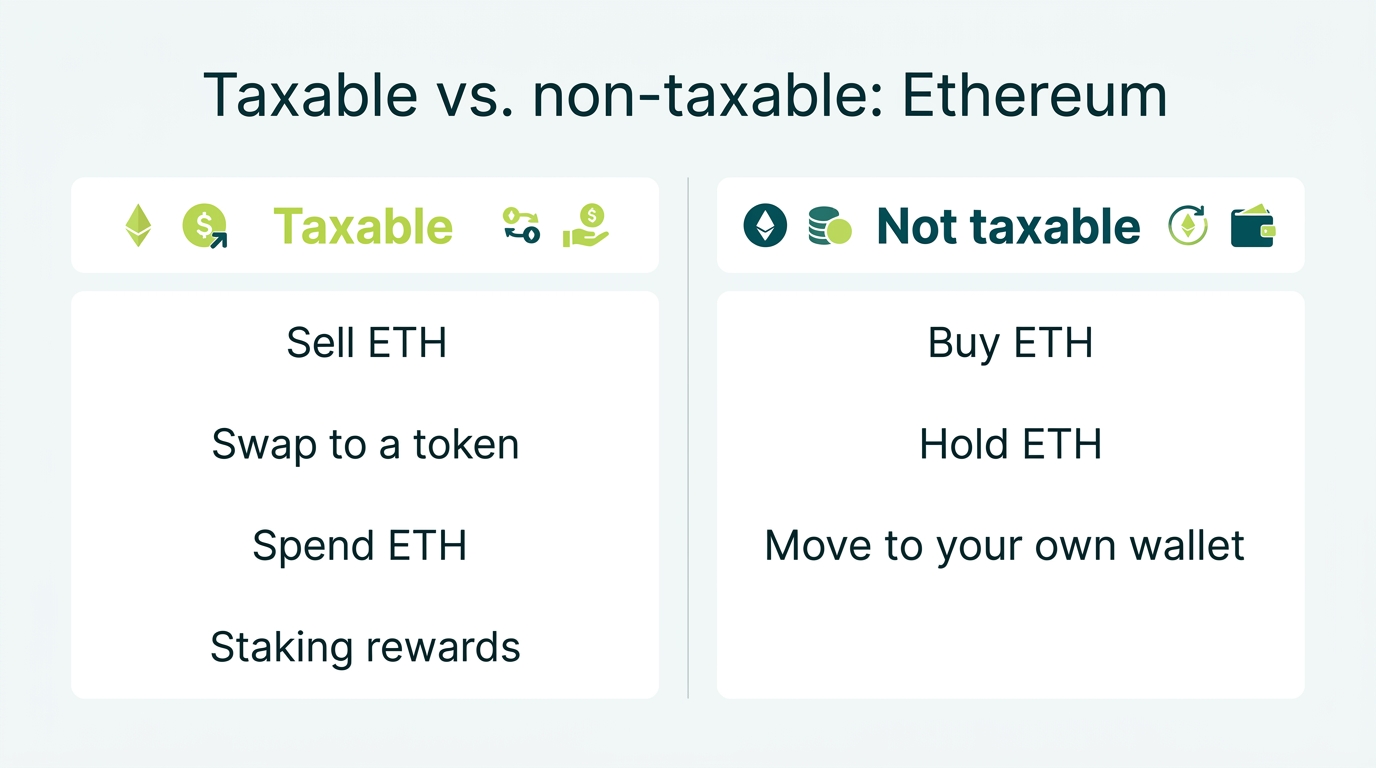
| Action | Taxable? | Treatment |
|---|---|---|
| Buy ETH with USD | No | Not taxable. Sets your cost basis. |
| Hold ETH | No | No tax while holding, even if it appreciates. |
| Sell ETH for USD | Yes | Capital gain or loss (proceeds − basis). |
| Swap ETH for an ERC-20 token | Yes | Disposal of ETH; capital gain or loss. |
| Spend ETH on goods/services | Yes | Treated as selling ETH; capital gain or loss. |
| Pay gas in ETH | Yes | Small disposal of ETH; often adjusts basis/proceeds. |
| Staking rewards received | Yes | Ordinary income at FMV when you control them. |
| Move ETH to your own wallet | No | Not taxable; basis and holding period carry. |
Ethereum staking taxes
Staking is the defining Ethereum tax topic, and it is taxed in two layers.
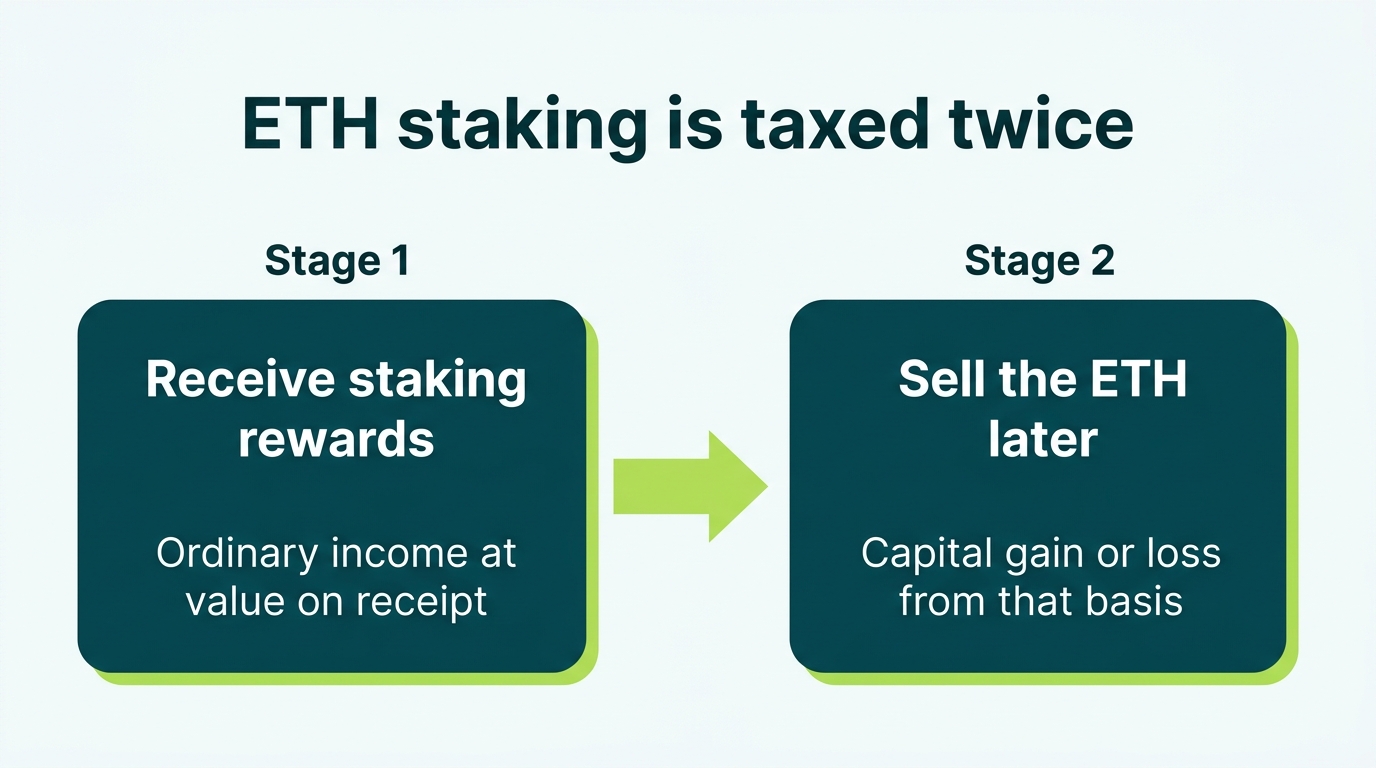
First, each reward is ordinary income at its fair market value when you gain dominion and control, the standard set in Revenue Ruling 2023-14. Second, that value becomes the reward's cost basis, so a later sale produces a separate capital gain or loss. The income applies whether you stake solo, through an exchange, or via a liquid-staking provider.
The staking-timing gray area
"Dominion and control" sounds simple but gets murky on Ethereum. The conservative reading taxes rewards when you can actually access or withdraw them. Where reward mechanics auto-compound into your stake, or where withdrawal depends on exit queues and unstaking periods, the precise moment income is recognized can be genuinely unsettled. The cautious, defensible approach is to recognize income as rewards become controllable and to document your method and apply it consistently, rather than switching year to year. If staking is a large part of your activity, this is worth a professional read.
Liquid staking (stETH, rETH) and wrapped ETH
Liquid staking tokens like stETH or rETH, and wrapping ETH into wETH, raise the same kind of question Solana's liquid staking does: is the mint or wrap a taxable swap of one asset for another, or a non-taxable change of form? Practitioners differ. A conservative position may treat a swap into a distinct token as a disposal; others treat a pure wrap (wETH) as a non-taxable change of form. Whatever you choose, be consistent on both the entry and exit, and do not ignore the accrued staking income inside a liquid-staking position.
Are Ethereum gas fees taxable or deductible?
Every on-chain Ethereum action costs gas, paid in ETH, and paying that gas is technically a small disposal of ETH (a tiny gain or loss versus your basis in the ETH spent). The more useful question is how the fee is treated:
- Gas to acquire an asset can often be added to that asset's cost basis, reducing a future gain.
- Gas to sell or dispose of an asset can often reduce your proceeds, also lowering the gain.
- Gas on a personal transfer between your own wallets is generally not deductible, though it is still a small disposal of the ETH used.
How much tax will you owe on Ethereum?
There is no single "Ethereum tax rate." It depends on holding period and income.
- Short-term gains (held one year or less) are taxed at your ordinary federal rate, 10% to 37%.
- Long-term gains (held more than a year) are taxed at 0%, 15%, or 20%. Most filers land at 15%.
- Staking income is ordinary income at receipt regardless of holding period.
- High earners may owe an extra 3.8% Net Investment Income Tax above $200,000 single or $250,000 married filing jointly.
- State tax may apply on top; most states tax crypto gains as ordinary income.
Staking, swapping, and paying gas all year?
ETH staking income plus hundreds of gas-fee micro-disposals is exactly where returns go wrong. We reconcile all of it into clean, CPA-ready figures.
See how it worksCost basis and the per-wallet rule
Your cost basis is what you paid for the ETH, including acquisition fees. Two things make ETH basis tricky:
- Per-wallet tracking. Since January 1, 2025 (Rev. Proc. 2024-28), basis must be tracked per wallet or account, not pooled. The default is FIFO per wallet, with specific identification allowed if documented.
- Staking rewards create many small lots. Each reward has its own date, value, basis, and holding-period clock, which is hard to track by hand for frequent rewards.
How to report Ethereum on your tax return
Ethereum activity lands on a few IRS forms:
- Form 8949 lists every disposal (each sale, swap, spend, and gas event) with dates, proceeds, cost basis, and gain or loss.
- Schedule D totals those gains and losses, split into short-term and long-term.
- Schedule 1 carries staking and other earned ETH as "Other income."
- The Form 1040 digital-asset question must be answered "Yes" if you sold, exchanged, or received ETH.
The $1,100 of rewards is ordinary income on Schedule 1, and the $4,000 gain on the sold ETH is long-term capital gain on Schedule D. Two buckets, one return.

The 2025/26 Crypto Tax Guide. Built by former Big 4 accountants.
A printable, step-by-step guide and checklist to reconcile every coin and wallet, recover missing cost basis, and file accurately before the deadline.
- Form 8949, Schedule D, and Schedule 1 walkthroughs
- How to handle staking, DeFi, NFTs, and lost coins
- The $0-basis 1099-DA trap (and how to avoid it)
- FBAR, Form 8938, and foreign exchange reporting