
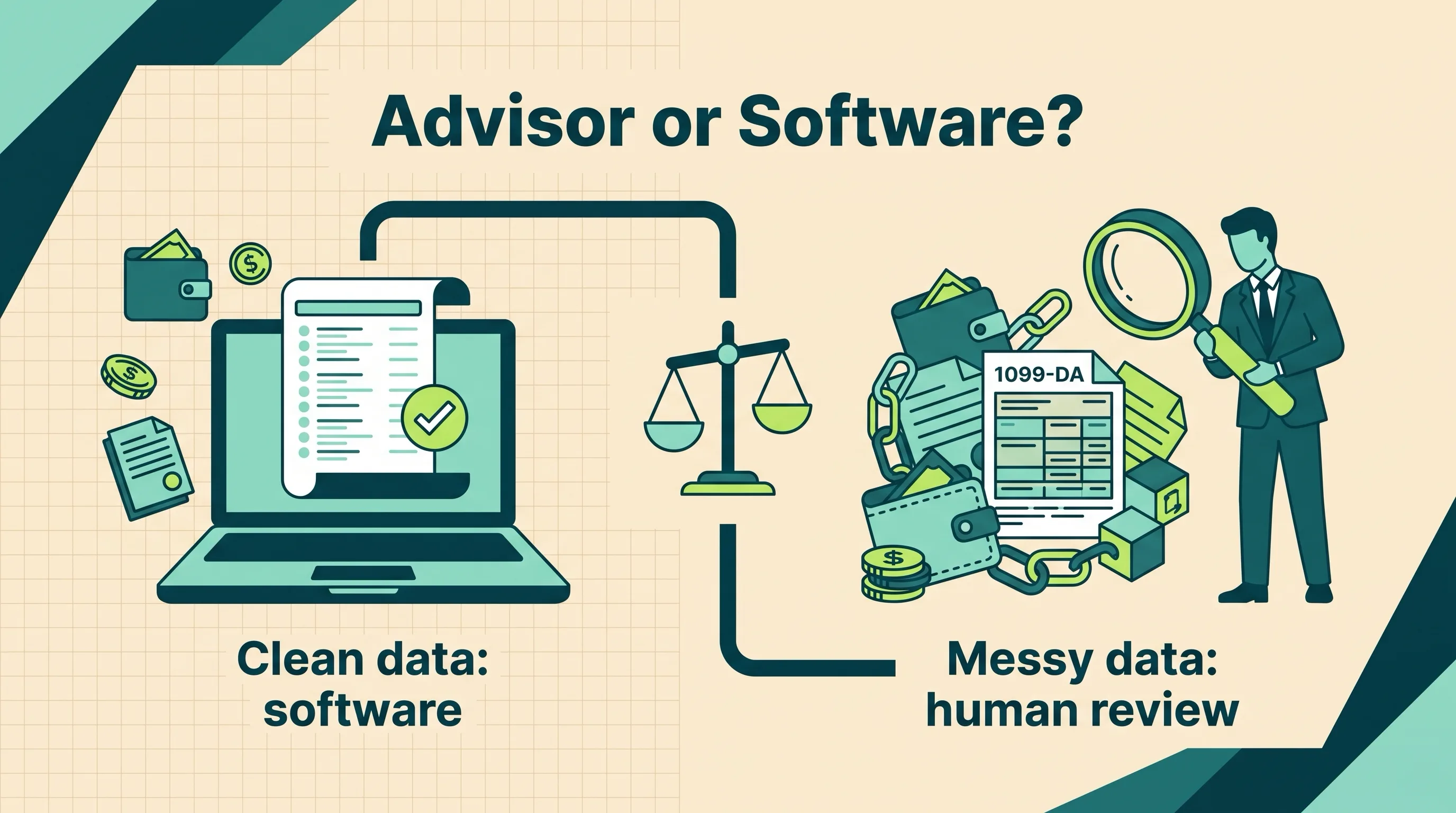
If you’ve spent any time preparing crypto tax records, you already know the two options: run your transactions through a tax software platform, or hand them to a specialist. The marketing on both sides makes it sound like an either/or choice. It usually isn’t. The right answer depends less on your budget and more on what your on-chain activity actually looks like.
This guide breaks down where software genuinely does the job, where it quietly produces wrong numbers, and how to tell which side of that line your portfolio falls on. We’ll keep it balanced: for a lot of people, a $49 software plan is the correct answer, and paying for reconciliation would be a waste. For others, that same plan is the reason they under-report gains and face an IRS mismatch or notice two years later.
The short version of what each option does
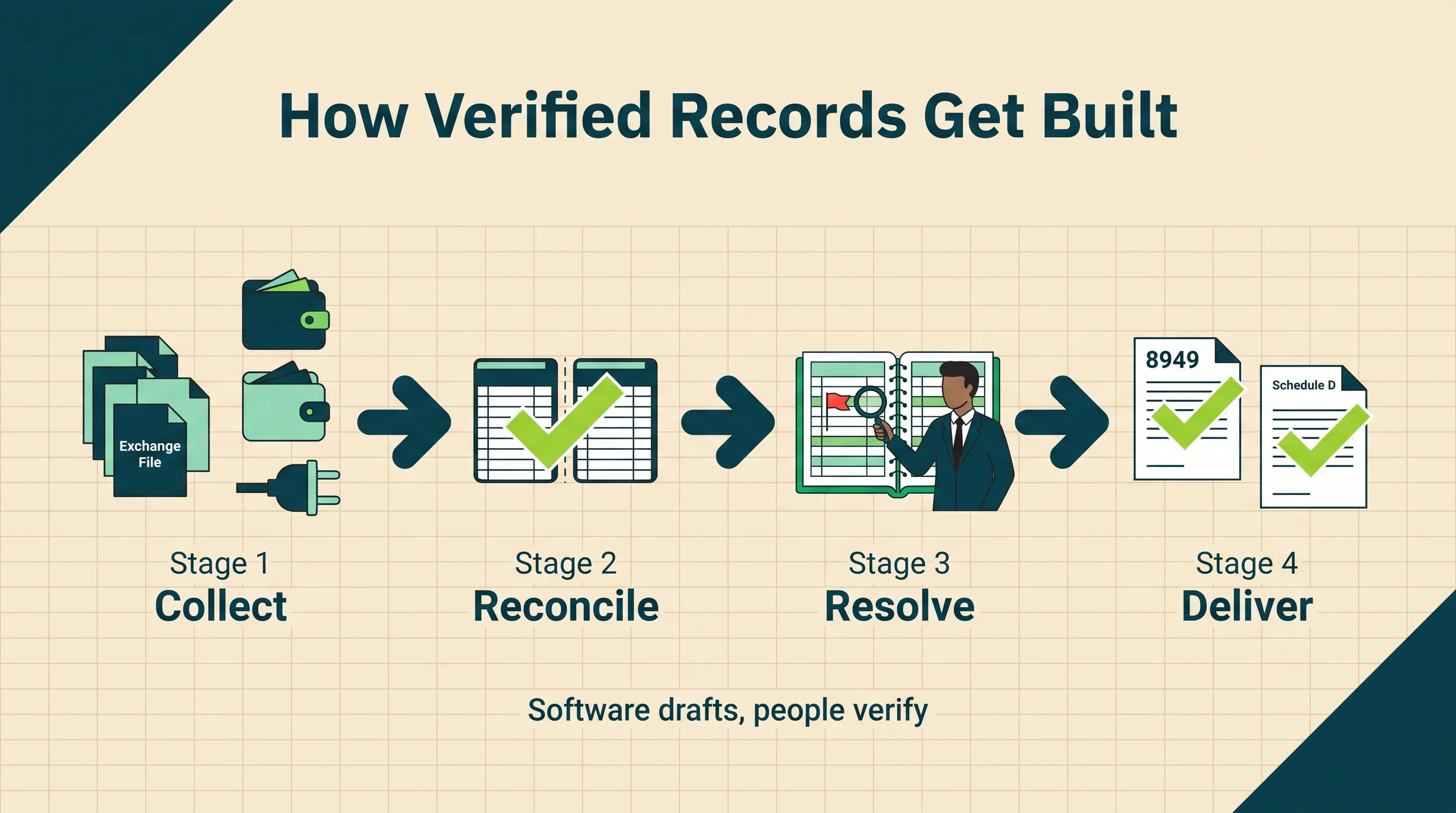
Crypto tax software connects to your exchanges and wallets through APIs and CSV uploads, then matches buys to sells, applies a cost basis method, and generates Form 8949 and Schedule D. It’s fast, cheap, and genuinely good at high-volume, well-labeled data from major exchanges.
A crypto tax advisor, or specialist firm, does something the software can’t: they verify. When a transfer between your own wallets shows up as a taxable sale, when a DeFi swap imports as two unrelated events, or when cost basis is simply missing, a human has to reconstruct what really happened. Software flags the gap. A specialist closes it.
The distinction that matters here is automation versus verification. Software automates the math on the data you give it. It has no way to know whether that data is complete or correctly classified. That’s the whole ballgame.
Side-by-side comparison
| Factor | Crypto Tax Software | Crypto Tax Advisor |
|---|---|---|
| Typical cost | Free to ~$300/year depending on transaction count | Flat fees or transaction-based pricing; hourly rates commonly $150-$500+ |
| Speed | Minutes once data is imported | Days to weeks for a full reconciliation |
| Handles high-volume CEX trades | Excellent | Excellent (usually with software as a starting tool) |
| DeFi, LP tokens, yield farming | Partial and often mislabeled | Manually classified and verified |
| Missing or broken cost basis | Guesses or flags an error | Reconstructed from on-chain history |
| Multi-wallet self-transfers | Frequently counted as taxable sales | Traced and correctly excluded |
| Bankruptcy exchange claims (FTX, Celsius) | No meaningful support | Adjusted and documented |
| 1099-DA reconciliation | Limited | Matched against your own records |
| Audit-ready documentation | Report output only | Full working papers and support |
| Best for | Simple, single-platform activity | Complex, multi-source, or high-stakes portfolios |
When software alone is enough
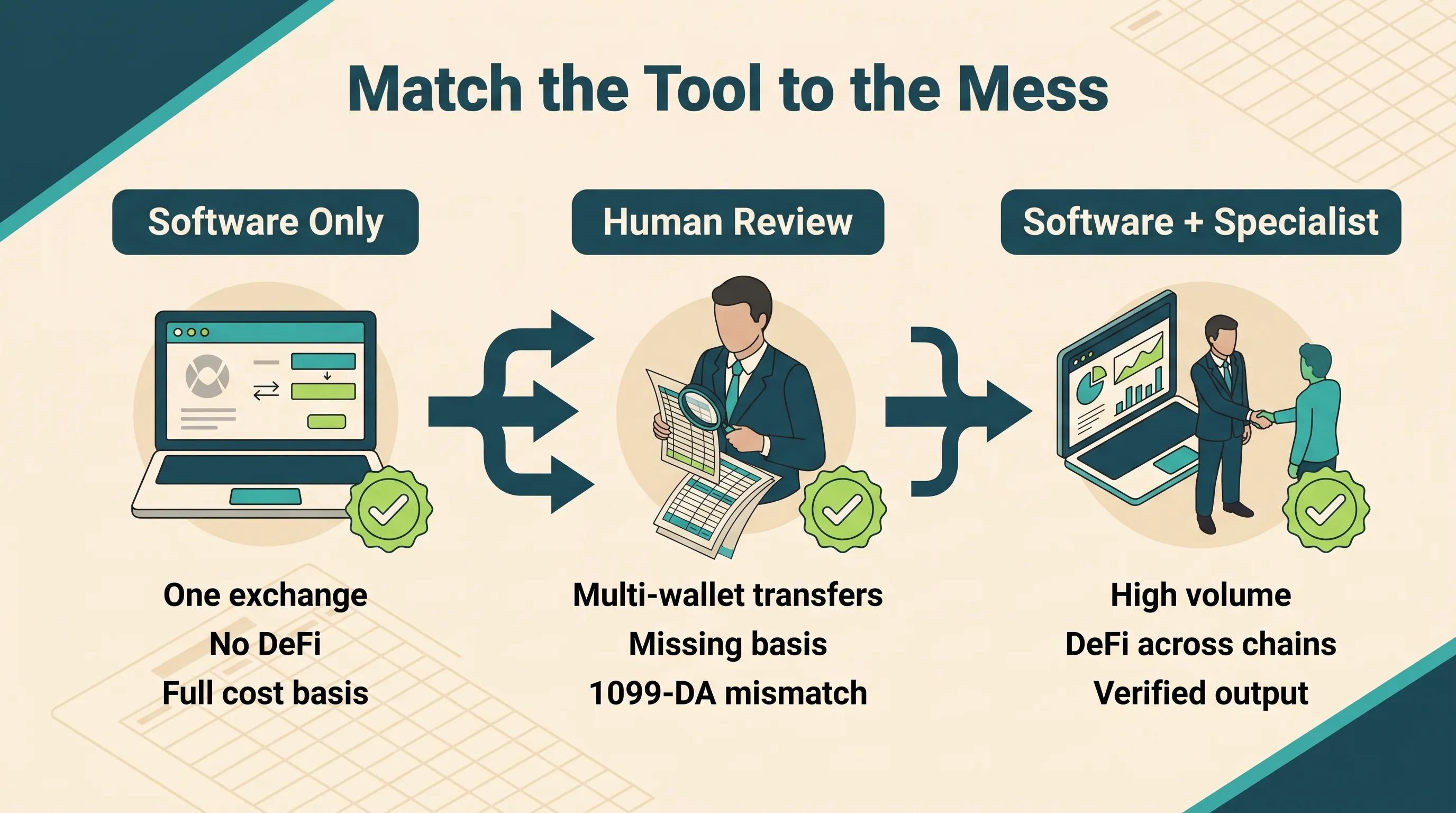
Plenty of crypto users don’t need to pay a specialist, and it would be dishonest to pretend otherwise. Software handles your situation well if most of the following are true:
- You trade on one or two major exchanges (Coinbase, Kraken, Binance.US) that support clean API imports.
- You buy and sell whole tokens; you’re not deep into DeFi, LP positions, or NFTs.
- Your total transaction count is manageable and your history is intact from day one.
- You haven’t moved assets between wallets in ways that confuse the import.
If that’s you, connect your accounts, review the flagged items, and export your Form 8949. A good platform will get you a correct return.
Where software quietly fails
The problem isn’t that software crashes. It’s that it produces confident, wrong numbers, and nothing on screen tells you they’re wrong. Here are the three failure modes we see most often.
DeFi transactions get misclassified
Say you deposit ETH into a liquidity pool and receive an LP token, then later withdraw. Many platforms read the deposit as a disposal (a taxable sale of your ETH), the LP token as a new asset with no cost basis, and the withdrawal as another taxable event. Depending on the protocol, some of those may be taxable and some may not. The software applies one blanket rule and hopes. A specialist reads the actual contract interactions and classifies each leg.
Multi-wallet transfers look like sales
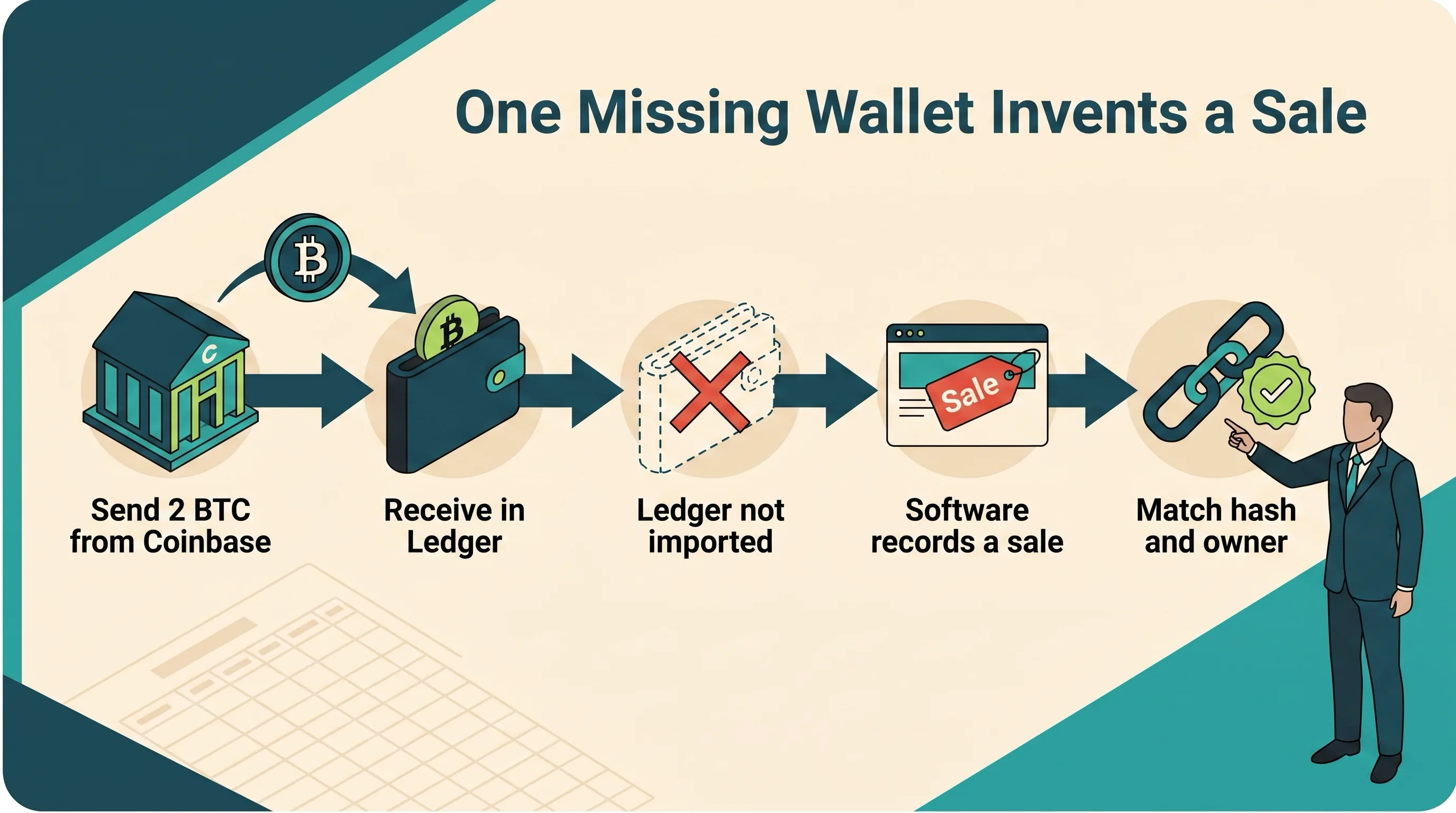
You move 2 BTC from Coinbase to your Ledger, then later to a DeFi wallet. If the software imports the Coinbase side but not the receiving side (or imports them at different times), it can record a 2 BTC disposal with a matching phantom gain. We’ve seen this single error add tens of thousands of dollars in fictional taxable income. Reconciling transfers across sources is exactly the kind of tracing that requires following the assets on-chain, not trusting each platform’s isolated export.
Cost basis goes missing
This is the big one. An exchange shuts down, you switch platforms, you used a wallet that doesn’t export clean history, or you bought during a period the API doesn’t reach. The software hits an unknown acquisition price and either assigns a cost basis of zero (inflating your gain) or throws a “missing cost basis” warning and leaves it to you. Reconstructing that number means finding the original acquisition on-chain and pricing it at the time. That’s reconstruction work, not data entry.
When you need a professional
Bring in a specialist when the stakes or the complexity outrun what a spreadsheet-with-a-UI can safely handle:
- You hold assets across many wallets and chains, with frequent transfers between them.
- You have real DeFi activity: staking, lending, yield farming, or liquidity positions.
- You have gaps in your history, missing cost basis, or years you never filed.
- You had funds on FTX, Celsius, BlockFi, or another bankrupt platform.
- You received a 1099-DA that doesn’t match your own records, or an IRS notice.
- Your portfolio is large enough that a reporting error carries a serious tax cost.
In these cases the value isn’t speed, it’s accuracy you can stand behind if the IRS asks questions. This is where working with experienced digital asset reconciliation specialists pays for itself, because the human-verified reconciliation is the deliverable, not an add-on.
When you need both
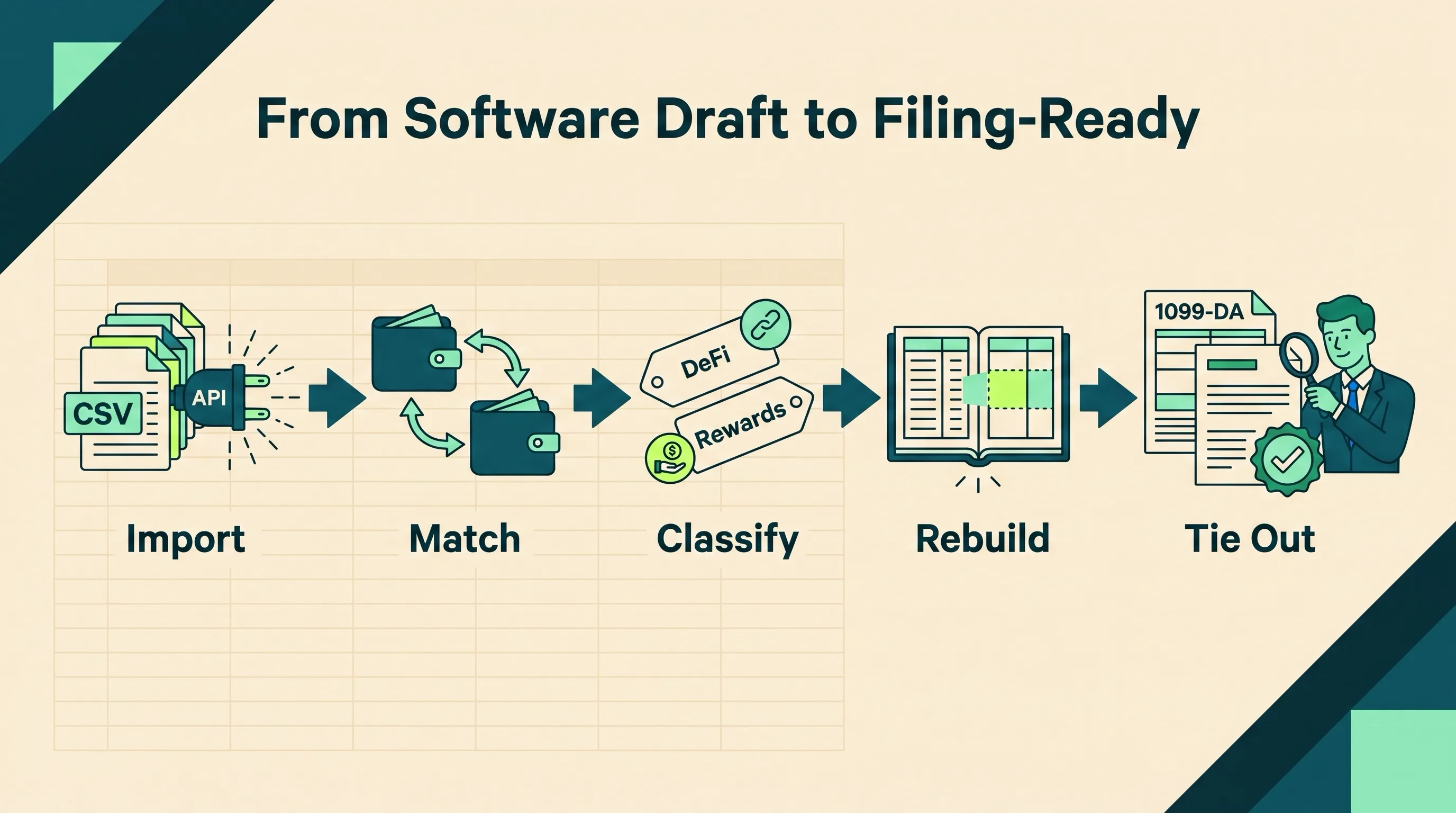
For most active crypto users, the honest answer is both, used in sequence. Software is the intake layer. A specialist is the verification layer.
The workflow looks like this: software pulls thousands of transactions into one place quickly, which is genuinely useful and would take a human forever by hand. Then a specialist reviews the output, fixes the misclassified DeFi events, reconciles the transfers, reconstructs missing cost basis, and produces documentation that ties out. You get the speed of automation and the accuracy of a human review, which is how professional firms actually work internally.
That combined approach is the core of our Digital Asset Reconciliation service. It turns a rough software export into CPA-ready crypto tax reports you can hand to your CPA or retain with your filing records.
How to decide in five minutes
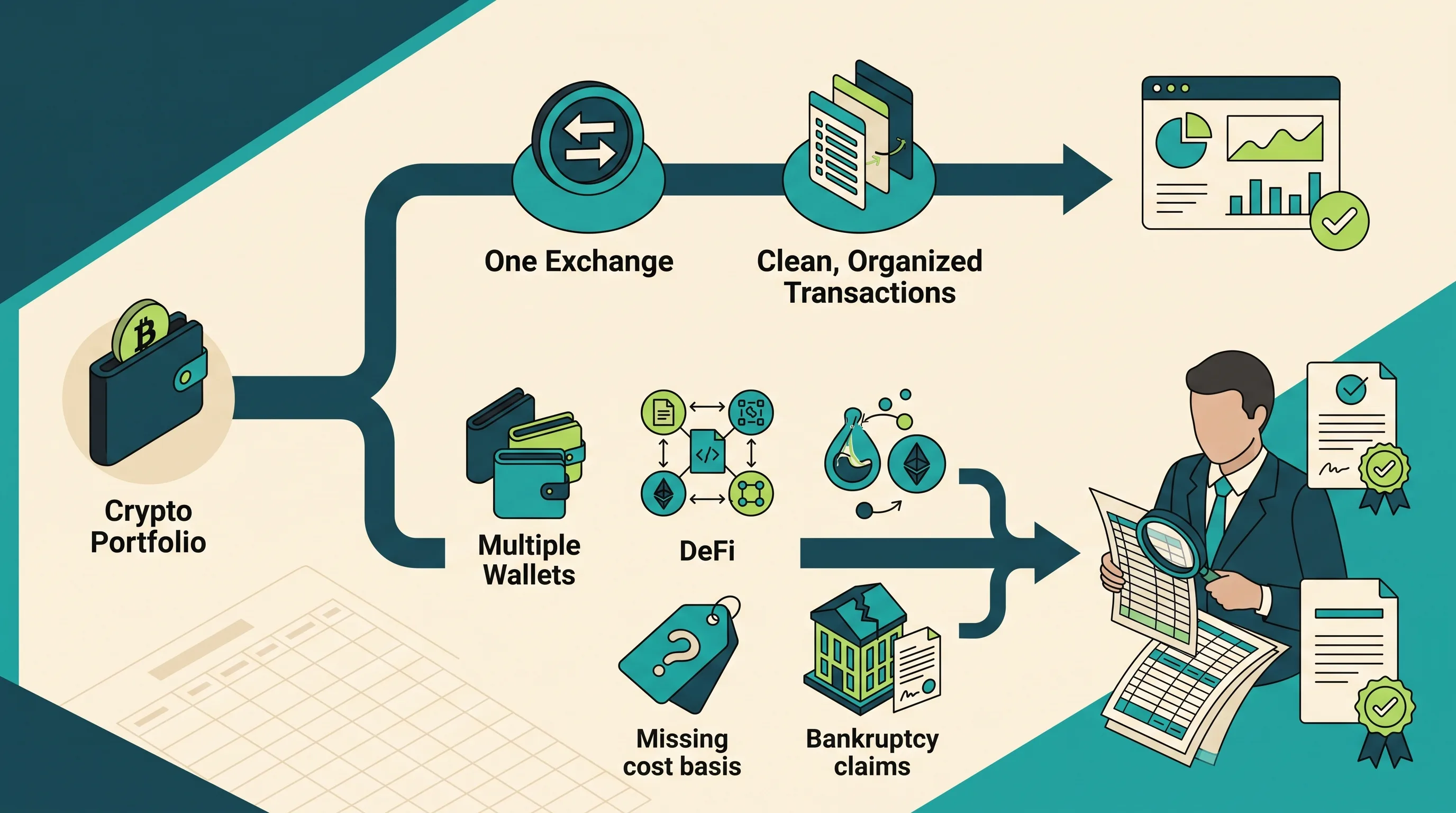
Run through these questions honestly:
- Do you use more than two platforms or wallets? If no, software is probably fine.
- Do you have any DeFi, LP, staking, or NFT activity? If yes, lean toward a professional review.
- Is any part of your history missing or broken? If yes, you need reconstruction, not automation.
- Were you affected by a bankrupt exchange or an IRS notice? If yes, get a specialist.
- Would a five-figure reporting error hurt? If yes, verification is cheap insurance.
If you answered “no” to most of these, save your money and use software. If you answered “yes” to two or more, the cost of getting it wrong almost always exceeds the cost of getting it verified.
Frequently asked questions
Do I need a crypto tax advisor if I already use software?
Only if your activity includes the things software handles poorly: DeFi, multi-wallet transfers, missing cost basis, bankruptcy claims, or a large enough portfolio that errors are expensive. Simple single-exchange trading rarely needs more than software.
Is crypto tax software accurate?
It’s accurate on clean, complete data from supported platforms. It’s unreliable when data is incomplete or when transactions need interpretation, because it has no way to verify what it imported. Accuracy comes from the quality of the input, not the tool.
Why is DeFi so hard for software to handle?
DeFi transactions are smart contract interactions, not simple buys and sells. Whether a given event is taxable often depends on the specific protocol mechanics, and most platforms apply one generic rule rather than reading what actually happened on-chain.
What does a crypto tax advisor cost compared to software?
Software runs from free to a few hundred dollars a year. Advisor pricing varies with portfolio complexity, often structured as flat or transaction-based fees, with hourly rates commonly in the $150-$500+ range. The comparison that matters is that fee against the tax cost of an unverified error.
Can I keep using my software and just get it reviewed?
Yes, and that’s usually the smartest path for active users. Software does the heavy lifting of aggregating transactions; a specialist verifies and corrects the output, then produces documentation you can actually defend.
Get filing-ready records
Count On Sheep provides Digital Asset Reconciliation, not tax-return preparation or accounting. We clean wallet, exchange, DeFi, and NFT activity into Form 8949, Schedule D, and Schedule 1 inputs. You can file with tax software or hand the finished package to your CPA.
Learn more about our crypto tax reports and Digital Asset Reconciliation service, or contact the team to discuss a complex history.
This article is for general information only and is not tax or legal advice. Ask a qualified tax professional how the rules apply to you.
Frequently Asked Questions
Do I need a crypto tax advisor if I already use software?
Only if your activity includes the things software handles poorly: DeFi, multi-wallet transfers, missing cost basis, bankruptcy claims, or a large enough portfolio that errors are expensive. Simple single-exchange trading rarely needs more than software.
Is crypto tax software accurate?
It's accurate on clean, complete data from supported platforms. It's unreliable when data is incomplete or when transactions need interpretation, because it has no way to verify what it imported. Accuracy comes from the quality of the input, not the tool.
Why is DeFi so hard for software to handle?
DeFi transactions are smart contract interactions, not simple buys and sells. Whether a given event is taxable often depends on the specific protocol mechanics, and most platforms apply one generic rule rather than reading what actually happened on-chain.
What does a crypto tax advisor cost compared to software?
Software runs from free to a few hundred dollars a year. Advisor pricing varies with portfolio complexity, often structured as flat or transaction-based fees, with hourly rates commonly in the $150-$500+ range. The comparison that matters is that fee against the tax cost of an unverified error.
Can I keep using my software and just get it reviewed?
Yes, and that's usually the smartest path for active users. Software does the heavy lifting of aggregating transactions; a specialist verifies and corrects the output, then produces documentation you can actually defend.