

Blank or $0 cost basis
Transferred-in coins often arrive without their purchase history. Proceeds minus nothing looks like pure profit, even when you paid for the asset years ago.
 USA Based TeamFormer Big 4 LeadershipOptimized Crypto Tax ReportsKeep your CPA
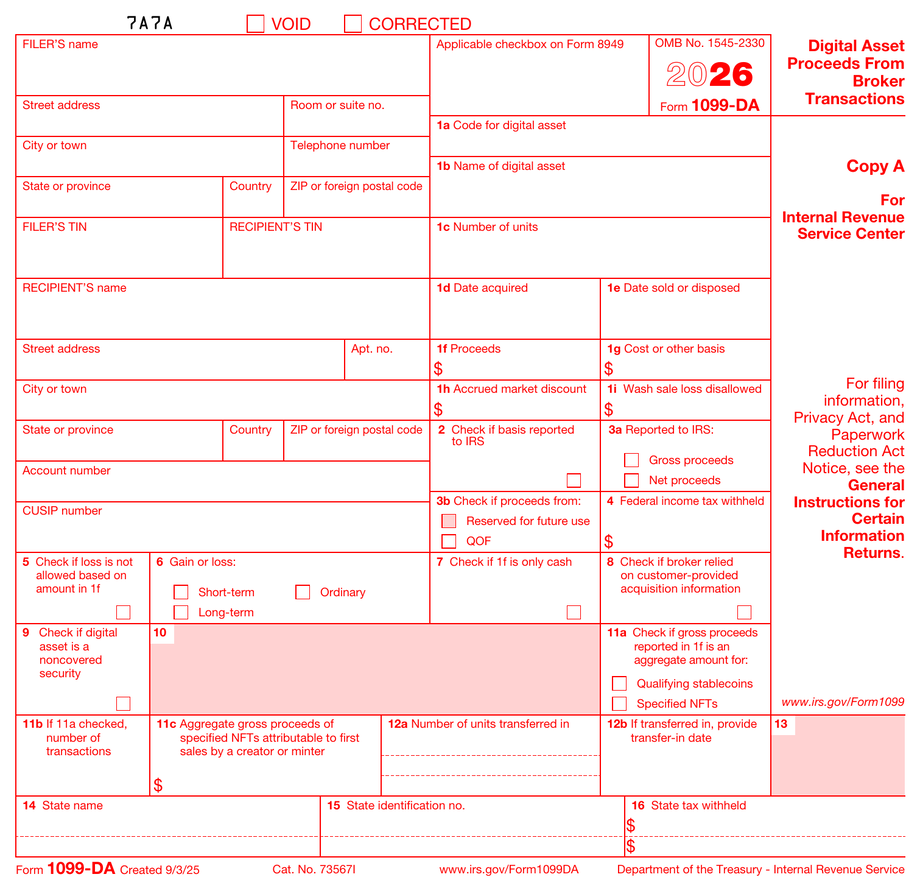
For tax year 2025, brokers report gross proceeds, while cost basis reporting for covered assets begins with tax year 2026. A form can be correct about the sale and still be incomplete about the gain.
Transferred-in coins often arrive without their purchase history. Proceeds minus nothing looks like pure profit, even when you paid for the asset years ago.
Several exchanges can issue several 1099-DAs. Each form covers only its own platform, so transfers and sales may not line up until the records are combined.
Current 1099-DA reporting does not capture your full DeFi or self-custody activity. Those transactions still belong in the tax record.
Your broker totals and crypto tax software may use different transaction sets, classifications, or timing. Filing before they agree creates an avoidable mismatch.
If basis is the problem, read how to fix wrong or missing 1099-DA cost basis.
Start with a free call. We will discuss the brokers, wallets, notices, and deadlines involved, then outline the right reconciliation scope for your situation.

Review your forms and next steps
Our 1099-DA help does not simply import the form and accept its totals. We reconcile from both directions: broker forms against your complete crypto history, and your complete crypto history back against every broker form.
The result is documented, filing-ready output your CPA or tax software can use.
We gather the forms from every broker and identify missing files before work begins.
Broker proceeds are checked against the unified wallet and exchange ledger, then the ledger is checked back to the forms.
We trace acquisition history across wallets and exchanges to support basis for lots the selling broker could not see.
You receive Form 8949 and Schedule D-ready reports for your CPA or preferred tax software.
We preserve the records and explanations behind corrections when broker data and the tax record differ.
When the current mismatch starts in an earlier year, we can identify and rebuild the missing history.
You know what we need, what we are checking, and what your CPA receives.
Upload every 1099-DA, exchange export, and wallet address through our secure process.
We consolidate broker, wallet, and on-chain activity into a unified ledger.
Our team matches proceeds, traces transfers, and reconstructs supported basis for missing lots.
We check the reconciled results against each form and document any adjustment that remains.
You receive corrected cost basis for every 1099-DA, plus clean Form 8949 and Schedule D reports for your CPA or tax software.
Want to understand the handoff first? See how a 1099-DA is reported on a tax return.
Our complete guide covers what the form reports, what it leaves out, why the totals can disagree with your real gains, and how a defensible reconciliation works, step by step.
You received several broker forms and the totals do not reconcile cleanly.
You bought in one place, moved the coins, and sold somewhere else without basis following the transfer.
Your taxable activity extends beyond the centralized brokers that issued forms.
Manual line-by-line cleanup is too large or too risky to handle alone.
You already received an IRS notice and need the underlying records reconciled before you respond with your tax professional.
Do not assume zero is correct. For tax year 2025, the form generally reports gross proceeds without basis. Starting with 2026 transactions, brokers report basis only for covered assets. If the asset was transferred in, we trace the earlier purchase records and reconstruct supported cost basis for the filing-ready report.
You must report your taxable digital asset sales and exchanges whether or not you receive a form. The broker sends the 1099-DA to the IRS, so the proceeds on your return should be reconciled to it rather than ignored.
We combine every form with the full wallet and exchange history. That unified ledger lets us identify transfers between platforms, preserve basis, and confirm that each broker's proceeds are represented once.
Your return should reflect the correct transaction record. We document the discrepancy and prepare the supported Form 8949 output. If gross proceeds are wrong, you should also request a corrected form from the broker.
No. Count On Sheep is a crypto tax and blockchain accounting service, not a CPA firm, and we do not file tax returns. We deliver reconciled records plus CPA-ready or TurboTax-ready Form 8949 and Schedule D reports. Your CPA or tax software finalizes the return.
Not on current forms from self-custody wallets or decentralized protocols. Proposed rules could extend reporting to certain DeFi front-end operators for 2027 transactions, but current DeFi activity still has to be reconstructed and reported from your own records.
Book a free call so we can discuss your accounts, transaction history, forms, and deadlines. After that review, you receive a written scope and quote before work begins.
Timing depends on the number of accounts, transaction volume, missing records, and whether earlier years need cleanup. On the free call, we review your deadline and give you a realistic schedule with the written scope.