
To report Form 1099-DA, move each sale or disposition to Form 8949, total the matching categories on Schedule D, and answer the digital asset question on Form 1040. The number in Form 1099-DA box 1f is proceeds, not automatically taxable income.
That distinction matters. If your broker reports $80,000 of proceeds but your basis is $65,000, your starting gain is $15,000, not $80,000.
This guide focuses on that exact handoff. For what the form covers and when brokers issue it, start with our Form 1099-DA reference. If your numbers do not line up yet, work through how to reconcile Form 1099-DA with your crypto records first. For a broader crypto return walkthrough, see our guide to filing crypto taxes with Form 8949 and Schedule D.
The reporting timeline has two phases:
-
Brokers began mandatory gross proceeds reporting for reportable digital asset dispositions made in 2025, with statements furnished in 2026. The IRS says most 2025 statements will not include basis.
-
For sales after 2025, basis reporting is required for covered digital assets. Under the 2026 Instructions for Form 1099-DA, that generally means assets acquired after 2025 in an account where the broker provided custodial services and held through the disposition. Older or transferred-in units may remain noncovered.
Where does a 1099-DA get reported?
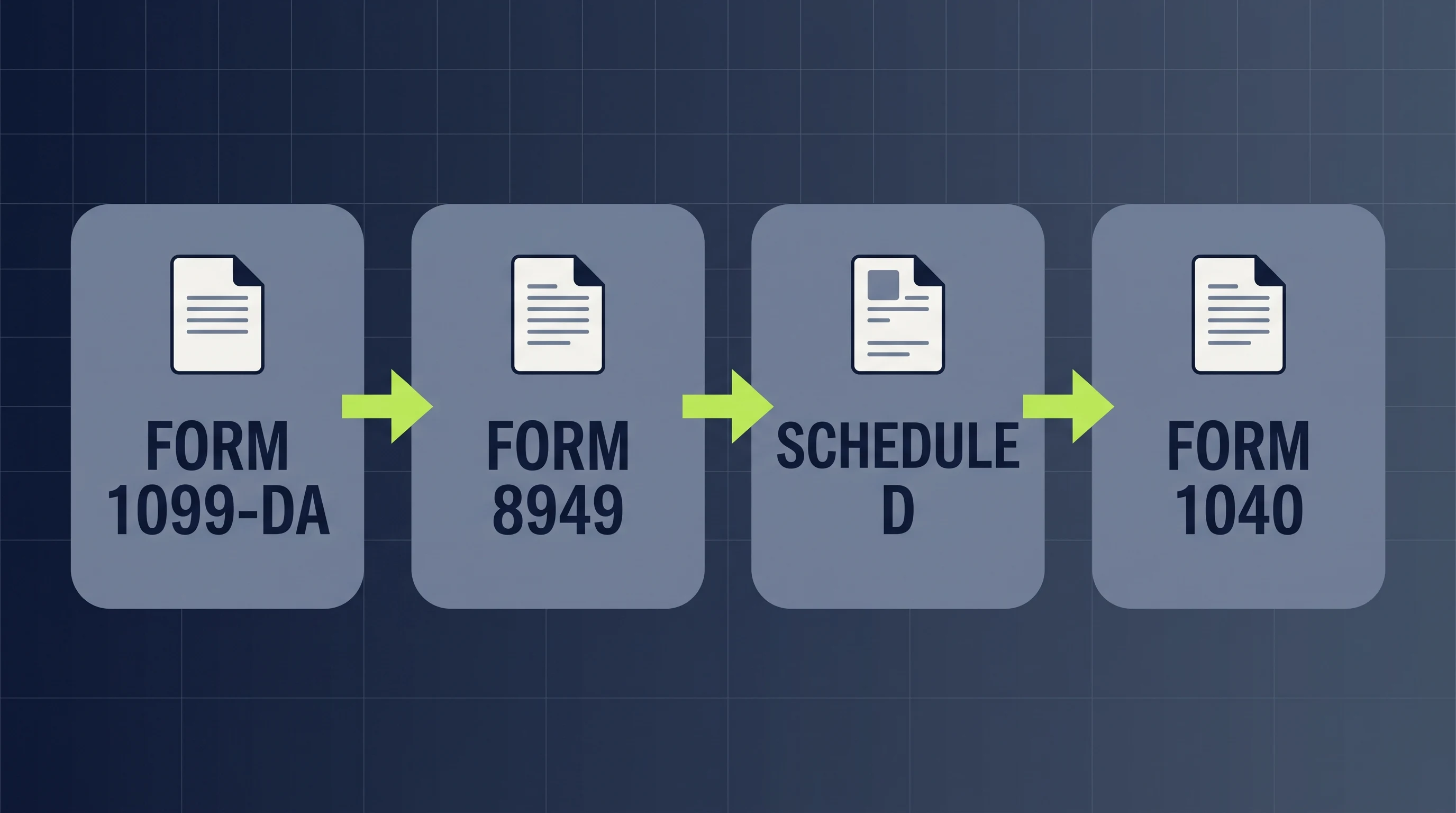
Most sales of digital assets held for investment go from Form 1099-DA to Form 8949, then to Schedule D, and finally to Form 1040. You do not enter one big Form 1099-DA total directly as ordinary income.
Here is the flow:
-
Form 1099-DA tells you what the broker reported to the IRS.
-
Form 8949 for crypto reconciles each reportable sale with your dates, proceeds, basis, and any adjustments.
-
Schedule D combines the Form 8949 category totals with your other capital gains and losses.
-
Schedule D calculates the net capital result that flows to Form 1040.
If the asset was inventory, part of a trade or business, or subject to a special rule, another form may apply. The steps below cover the common case of crypto held as a capital asset for investment.
How do Form 1099-DA boxes map to Form 8949?
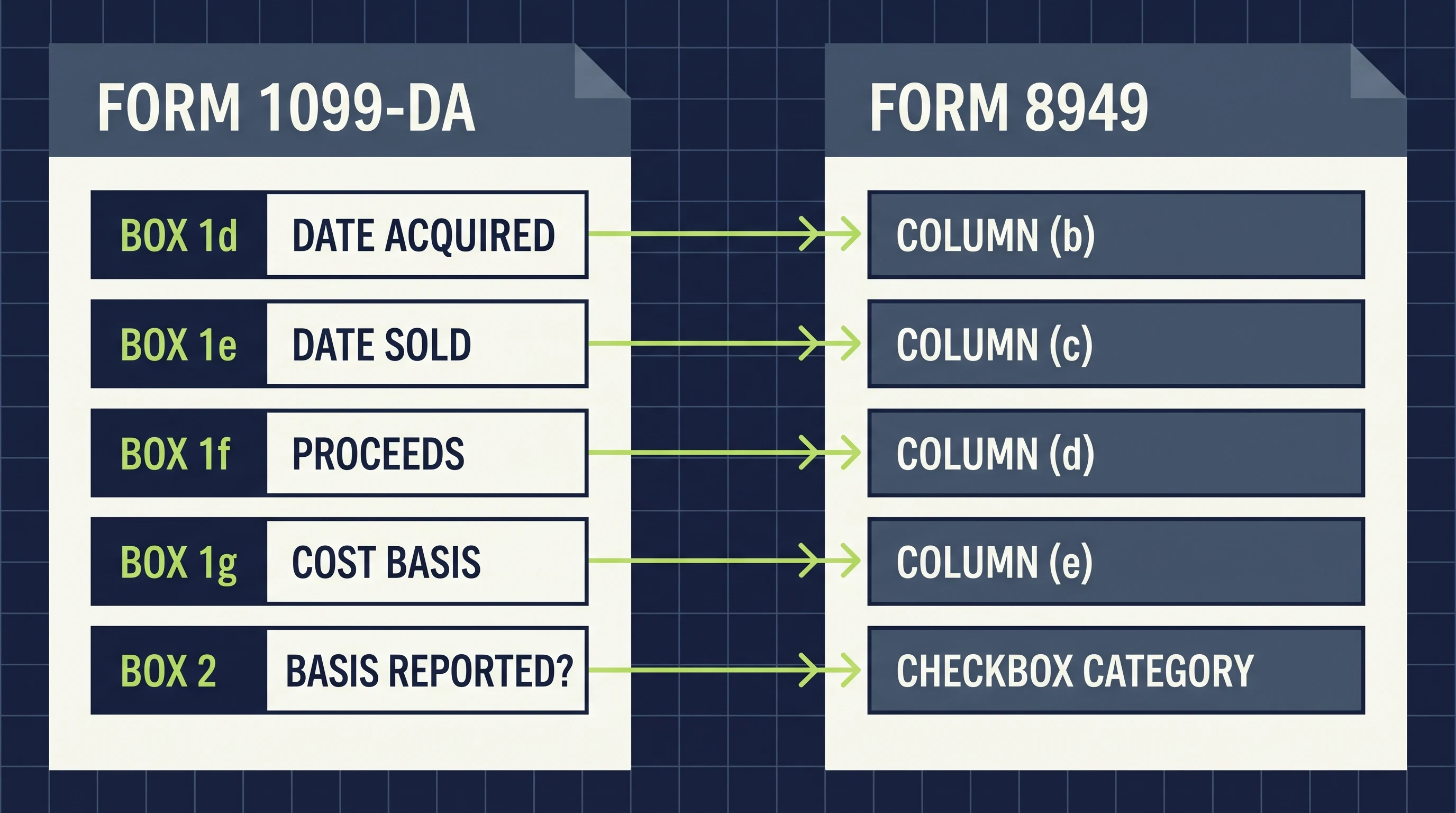
The core mapping is direct: Form 1099-DA boxes 1d through 1g supply the acquisition date, disposition date, proceeds, and basis for Form 8949 columns (b) through (e). Boxes 2, 6, and 9 help determine which Form 8949 category applies.
| Form 1099-DA item | What it reports | Form 8949 destination |
|---|---|---|
| Box 1b and box 1c | Digital asset name and number of units | Column (a), description of property |
| Box 1d | Date acquired | Column (b), date acquired |
| Box 1e | Date sold or disposed | Column (c), date sold or disposed |
| Box 1f | Total proceeds | Column (d), proceeds |
| Box 1g | Cost or other basis, if reported | Column (e), cost or other basis |
| Box 2 | Whether basis in box 1g was reported to the IRS | Helps choose G or H for short term, or J or K for long term |
| Box 6 | Short-term, long-term, or ordinary classification | Part I for short term, Part II for long term, or further review if ordinary |
| Box 9 | The asset was a noncovered security | Basis may be blank and may need to come from your records |
| Applicable checkbox on Form 8949 | Broker’s suggested reporting category | Confirm against your records before using that category |
Form 8949 column (h) is your gain or loss for the row. The calculation is:
Proceeds in column (d) minus basis in column (e), plus or minus any adjustment in column (g).
Do not force every 1099-DA field onto Form 8949. For example, box 4 is federal income tax withheld, and it belongs with tax payments or withholding on the return rather than in the capital gain calculation.
Which Form 8949 checkbox should you use for a 1099-DA?
Digital asset transactions use boxes G through L on the 2025 Form 8949. The correct box depends on holding period, whether you received a Form 1099-DA, and whether basis was reported to the IRS.
| Your transaction | Form 8949 part and box | Schedule D line |
|---|---|---|
| Short term, basis reported to IRS | Part I, box G | Line 1b |
| Short term, basis not reported to IRS | Part I, box H | Line 2 |
| Short term, no Form 1099-DA received | Part I, box I | Line 3 |
| Long term, basis reported to IRS | Part II, box J | Line 8b |
| Long term, basis not reported to IRS | Part II, box K | Line 9 |
| Long term, no Form 1099-DA received | Part II, box L | Line 10 |
Do not use boxes C or F for digital assets. The IRS Form 8949 instructions specifically direct digital asset transactions to G, H, or I for short term and J, K, or L for long term.
Your broker may print an “Applicable checkbox on Form 8949” near the top of the 1099-DA. Treat it as a useful starting point, not a substitute for checking the holding period and basis status yourself.
How do you report a 1099-DA step by step?
Report the form in six passes: collect, verify, classify, map, reconcile, and total. This order catches basis problems before they inflate your gain.
1. Collect every Form 1099-DA and transaction export
Download the form and full transaction history from each broker. You will also need purchase confirmations, fee records, wallet history, and records from any platform that originally held transferred-in assets.
Platform-specific details can vary. See our reporting guides for Kraken Form 1099-DA and Coinbase Form 1099-DA if either exchange is in your file.
2. Match box 1f proceeds to the broker’s sale records
The IRS tells Form 8949 filers who received a 1099-DA to enter the proceeds shown on the statement in column (d). Match each reported amount to a sale, swap, purchase paid with crypto, or other disposition.
If proceeds are wrong, ask the broker for a corrected form and keep the correspondence. Do not change a number simply because it looks surprising.
3. Decide whether each transaction is short term or long term
Assets held for one year or less are generally short term. Assets held for more than one year are generally long term. Use Part I of Form 8949 for short-term dispositions and Part II for long-term dispositions.
If Form 1099-DA box 1d is blank because the broker did not know the acquisition date, use your own records to determine the date and holding period.
4. Choose the correct G through L category
Check box 2 to see whether the broker reported basis to the IRS. Then combine that answer with the holding period and the table above.
Keep each category on a separate Form 8949 page. A short-term transaction with basis reported does not belong on the same Form 8949 page as a short-term transaction without basis reported.
5. Enter the transaction and correct the basis treatment
Map boxes 1b through 1g to columns (a) through (e). Then use columns (f) and (g) only when an adjustment is required.
This is the step where transferred assets usually need work. A receiving exchange may know the sale proceeds but not what you paid on the original exchange.
6. Carry each category total to Schedule D
Total columns (d), (e), (g), and (h) for each Form 8949 category and move them to the corresponding Schedule D line. Schedule D then combines your short-term and long-term results.
Under the 2025 Schedule D instructions, net short-term gain or loss reaches line 7, net long-term gain or loss reaches line 15, and the combined result reaches line 16. A net gain on line 16 then flows to Form 1040 line 7a.
What if your 1099-DA has no cost basis?
If box 1g is blank and basis was not reported to the IRS, enter your correct basis directly in Form 8949 column (e). Do not use a zero basis just because the broker did not have your purchase history.
The IRS says taxpayers must calculate basis before filing. Basis usually starts with what you paid for the asset, including qualifying acquisition costs such as transaction fees and commissions.
A blank basis and an incorrect reported basis are not the same problem:
-
Box 1g is blank: Use your records to enter the correct basis in column (e). Code B is not automatically required because the broker did not show an incorrect basis amount.
-
Box 1g shows an incorrect amount, but box 2 is not checked: Use box H for short term or K for long term, enter the correct basis in column (e), enter code B in column (f), and enter zero in column (g).
-
Box 1g shows an incorrect amount and box 2 is checked: Use box G for short term or J for long term. Enter the basis reported on the 1099-DA in column (e), enter code B in column (f), and put the correcting adjustment in column (g).
Those code B instructions come directly from the IRS adjustment table for Form 8949. For a deeper correction workflow, use our guide to fixing missing or wrong Form 1099-DA cost basis.
Worked example: 1099-DA proceeds with no basis
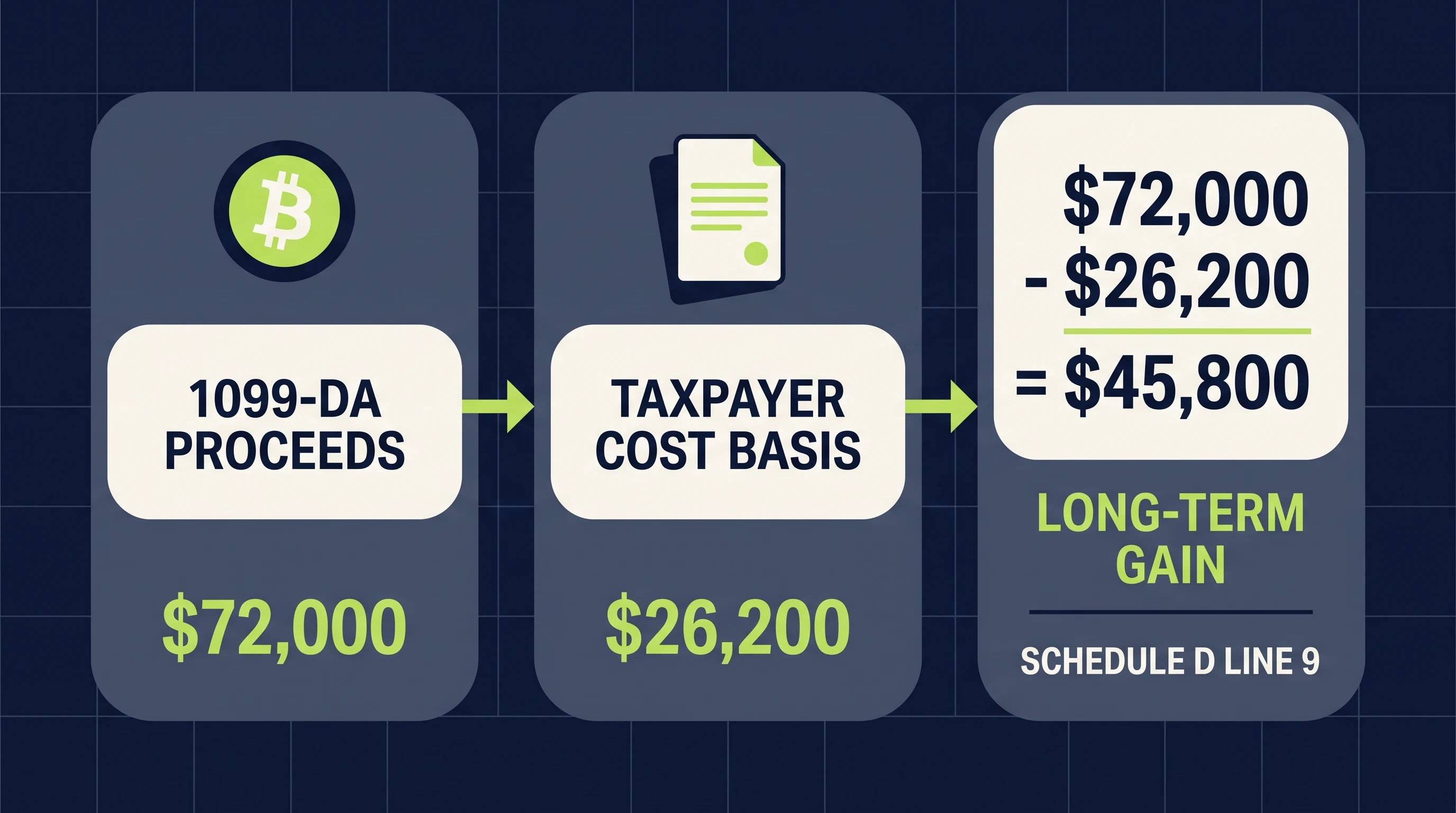
When basis is missing, the taxpayer supplies it on Form 8949 and carries the resulting gain to Schedule D. Here is the full path with one sale.
The transaction
Maya bought 0.8 BTC on June 10, 2023, for $26,000 and paid a $200 acquisition fee. Her total basis was $26,200.
She later transferred the 0.8 BTC to another exchange. On November 15, 2025, she sold it for $72,000.
The selling exchange issued Form 1099-DA showing:
-
Box 1b: Bitcoin
-
Box 1c: 0.8 units
-
Box 1e: November 15, 2025
-
Box 1f: $72,000 proceeds
-
Box 1g: blank
-
Box 2: not checked
The exchange did not report basis because it did not know what Maya paid before the transfer.
Form 8949
Maya held the BTC for more than one year, received Form 1099-DA, and had no basis reported to the IRS. She uses Form 8949 Part II, box K.
Her row is:
| Form 8949 column | Entry |
|---|---|
| (a) Description | 0.8 BTC |
| (b) Date acquired | 06/10/2023 |
| (c) Date sold | 11/15/2025 |
| (d) Proceeds | $72,000 |
| (e) Cost basis | $26,200 |
| (f) Code | Blank |
| (g) Adjustment | Blank |
| (h) Gain | $45,800 |
The math is $72,000 minus $26,200, which equals a $45,800 long-term capital gain.
Schedule D and Form 1040
Assume this is Maya’s only capital transaction. She carries the Form 8949 box K totals to Schedule D line 9:
-
Column (d), proceeds: $72,000
-
Column (e), basis: $26,200
-
Column (g), adjustments: $0
-
Column (h), gain: $45,800
That $45,800 is included in Schedule D line 15, then line 16. Because it is a gain, it flows to Form 1040 line 7a. Maya also answers Yes to the Form 1040 digital asset question because she disposed of a digital asset during the year.
Notice what did not happen: Maya did not treat the full $72,000 of proceeds as taxable gain, and she did not invent a zero basis.
What if you received multiple 1099-DAs?
Report every disposal once, then combine transactions by Form 8949 category rather than by exchange. You might have a box H page containing short-term transactions from three brokers and a separate box K page containing long-term transactions from those same brokers.
Use this reconciliation check:
-
List every broker and every Form 1099-DA.
-
Tie each reported proceeds amount to a transaction in your master ledger.
-
Flag transfers so they are not mistaken for taxable sales.
-
Add missing acquisition records from the sending exchange or wallet.
-
Group the finished rows into G, H, I, J, K, and L.
-
Compare each Form 8949 category total with the matching Schedule D line.
Do not simply add all proceeds and subtract one portfolio-wide basis number. Short-term and long-term transactions must remain separate, and basis-reporting categories also stay separate.
What if the platform did not send a 1099-DA?
You still report the transaction. The IRS states that digital asset income, gains, and losses must be reported whether or not you receive Form 1099-DA.
For a capital asset sale with no Form 1099-DA or substitute statement, use box I on Form 8949 Part I if the transaction was short term or box L on Part II if it was long term. Enter the description, dates, net proceeds, basis, and any applicable adjustment from your own records.
This commonly affects transactions made through some foreign platforms, self-custody activity, and dispositions that a broker did not report. No form does not mean no tax return entry.
Do you have to pay taxes on a 1099-DA?
You pay tax on taxable gain, not on the mere receipt of Form 1099-DA and not automatically on the full proceeds in box 1f. A loss may offset capital gains and may affect your return under the capital loss rules.
Form 1099-DA is an information return. It tells the IRS that a disposition occurred and what the broker reported. Your basis and adjustments determine the actual gain or loss.
This is why basis reconciliation matters so much. If your forms show missing or questionable basis, pause before filing and rebuild the transaction history.
Do you file Form 1099-DA itself with your return?
You generally keep your copy of Form 1099-DA with your tax records rather than attaching it to an individual federal return. The broker sends the reported information to the IRS, while you use the form to prepare Form 8949, Schedule D, and the rest of your return.
Also check box 4 for federal income tax withheld. If it contains an amount, report that withholding in the proper place on your return instead of treating it as a capital gain adjustment.
Finally, answer the Form 1040 digital asset question. Every filer must answer Yes or No. If you received Form 1099-DA because you sold, exchanged, or otherwise disposed of a digital asset, the answer will generally be Yes.
Get the 1099-DA reconciliation right before you file
The form-to-return path is simple when the data is clean: box 1f proceeds and verified basis go to Form 8949, category totals go to Schedule D, and the net result reaches Form 1040.
The hard part is proving basis across exchanges, wallets, transfers, and years of activity. Count On Sheep’s 1099-DA help service rebuilds the transaction history, resolves missing basis, and produces filing-ready reports. If your 1099-DAs do not match your records, we can take the reconciliation off your plate.
Frequently Asked Questions
How do I report a 1099-DA on my tax return?
Use the transaction details from Form 1099-DA to complete Form 8949, including the digital asset, acquisition date, sale date, proceeds, and cost basis. Then carry the Form 8949 totals to the matching lines on Schedule D and include the resulting net capital gain or loss on Form 1040.
Where does a 1099-DA get reported?
Most investment sales reported on Form 1099-DA go on Form 8949 first and then Schedule D. Digital asset transactions use boxes G, H, or I for short-term transactions and boxes J, K, or L for long-term transactions, depending on whether basis was reported to the IRS and whether you received a form.
Do I have to pay taxes on a 1099-DA?
Form 1099-DA does not make the full proceeds amount taxable. You generally pay tax on your gain, which is proceeds minus your adjusted cost basis and any applicable adjustments. A transaction that produced a loss may reduce other capital gains, subject to the tax rules that apply to your return.
Do I need to file the 1099-DA itself?
You generally do not attach your copy of Form 1099-DA to an individual federal income tax return. Use it to prepare Form 8949 and Schedule D, keep it with your records, and report any backup withholding shown on the form in the proper place on your return.
What if my 1099-DA has no cost basis?
Reconstruct the basis from your purchase records, fees, and transfer history, then enter the correct basis in column (e) of Form 8949. A blank basis is different from an incorrect basis reported to the IRS, so do not automatically use adjustment code B.
What if I got multiple 1099-DAs?
Reconcile every form and report every disposal once. Sort the transactions into the correct Form 8949 categories, total each category separately, and carry those totals to the corresponding Schedule D lines.