
Direct answer
Need help tracking missing cost basis for my crypto
Count On Sheep reconstructs missing crypto cost basis by tracing transfers across exchanges, wallets, and chains and matching each deposit to its original acquisition. Every assumption is documented in an audit-ready workpaper, and you receive corrected Form 8949 inputs. The work is delivered by our former Big 4 (EY) crypto tax team.
Reviewed by Garrett Taylor, CPA, former Big 4 Tax Accountant (EY).
If your 1099-DA shows proceeds but the cost basis is blank, zero, or obviously wrong, you do not automatically owe tax on the full sale amount. You owe tax based on the transaction’s actual tax result, which usually means proceeds minus your adjusted cost basis.
The catch is that you have to prove the basis. Your exchange cannot see purchases made elsewhere, and the IRS receives the same proceeds report you received. That leaves you with one job before filing: connect the reported sale to the original acquisition and report the defensible result on Form 8949.
Start with our full Form 1099-DA guide if you need a box-by-box overview. For the end-to-end matching process, see how to reconcile Form 1099-DA with your crypto records. This article focuses on the expensive part: fixing bad basis before a blank field turns into phantom gain.
Disclaimer: This guide is for informational purposes only. Tax treatment depends on your facts. Consult a qualified tax professional about your return.
Why your 1099-DA cost basis is blank
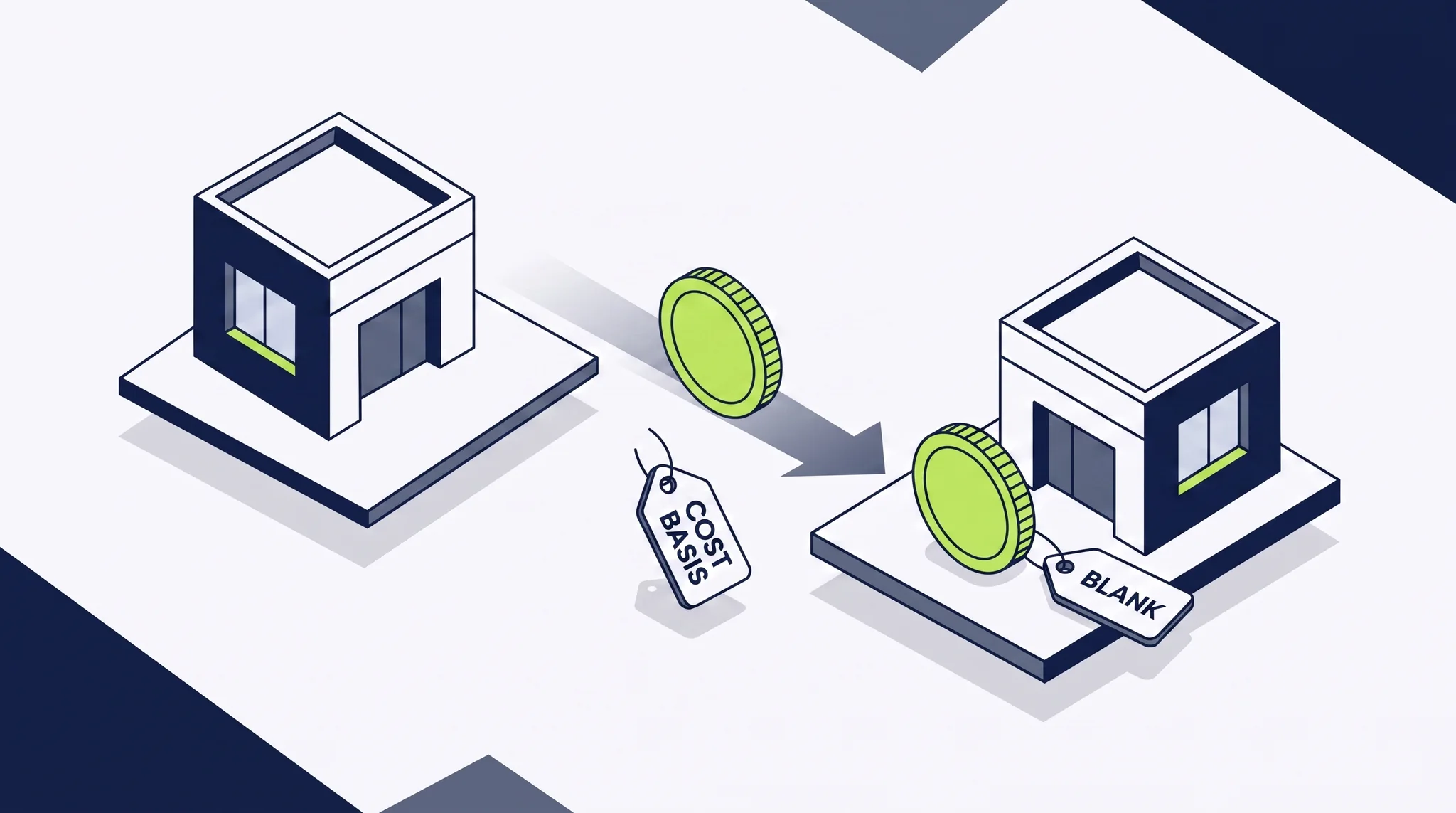
A blank basis is often a reporting limitation, not proof that you paid nothing for the asset. The 2026 IRS Instructions for Form 1099-DA divide digital assets into covered and noncovered securities for broker basis reporting.
For sales after 2025, a broker generally must report basis for a covered digital asset. To be covered, the asset generally must have been acquired after 2025 in an account for which that broker provided custody, then held in that account until the broker handled the disposition.
That definition leaves many common holdings outside mandatory basis reporting.
| Situation | Why basis may be blank |
|---|---|
| You acquired the crypto before January 1, 2026 | A digital asset acquired before 2026 is noncovered |
| You transferred it from Exchange A to Exchange B | A digital asset transferred into the selling broker is noncovered |
| You bought it in self-custody or through another service | The selling broker did not provide custody when you acquired it |
| The broker uses an optional method for certain stablecoins or NFTs | The 2026 instructions permit basis and acquisition details to be omitted under those methods |
| You sold in 2025 and received the form in 2026 | The first reporting year focused on gross proceeds, and the IRS warned that most 2025 statements would not include basis |
The transfer rule is the one that catches most people. Buying 1 BTC on Exchange A, moving it to Exchange B, and selling it there does not give Exchange B your original trade history. The blockchain shows that BTC arrived. It does not tell the receiving exchange what you paid, whether the incoming unit was a gift, or which tax lot you transferred.
The 2026 instructions also say customer-provided acquisition information can be used for lot-selection purposes, but not for broker reporting of basis or acquisition dates under current law. Telling the platform what you bought may help identify a lot without turning a transferred-in asset into a covered asset.
Blank basis and zero basis are not the same thing
A blank field means the broker did not report basis. Zero means the asset actually had no basis. Those are different facts and should not be collapsed into the same number.
The IRS instructions are unusually direct here: a broker should enter zero in the cost basis field only if the digital asset actually had a basis of zero. If your form literally reports zero and you have records showing that you paid for the asset, ask the issuer for a corrected form. The IRS tells recipients with incorrect information to contact the issuer, keep the original form and correspondence, and not delay filing.
The more common zero-basis trap happens downstream. A blank basis enters tax software or a preparation worksheet as zero, so the program calculates the full proceeds as gain. The arithmetic works. The input does not.
The $60,000 phantom-gain example
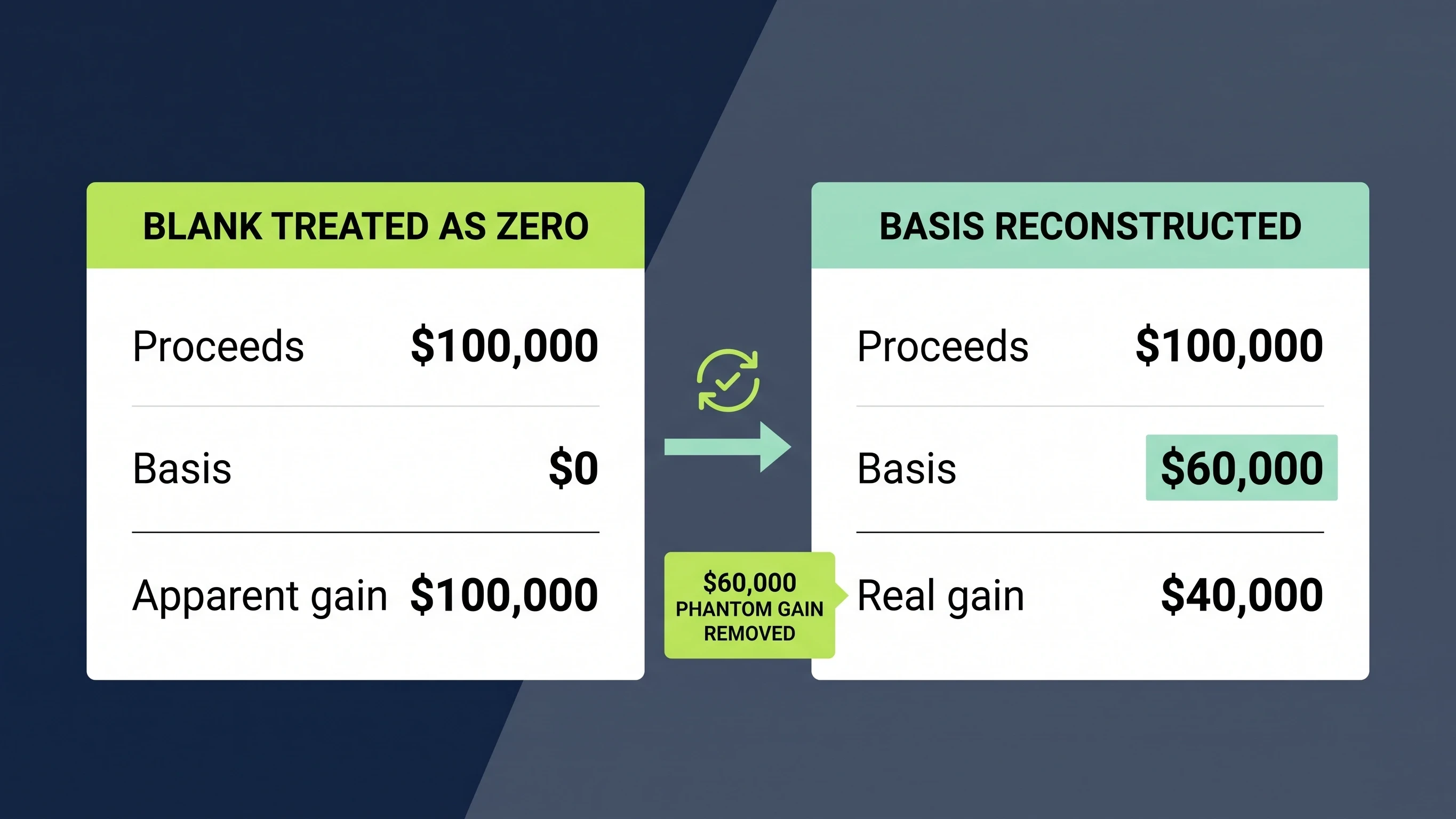
Suppose you bought 1 BTC on Exchange A for $60,000. You later moved it to Exchange B and sold it for $100,000.
Your sale proceeds are $100,000. Your adjusted basis, ignoring fees for simplicity, is $60,000. Your real capital gain is:
$100,000 proceeds minus $60,000 basis equals $40,000 gain.
But Exchange B received the BTC from outside its custody. The asset is noncovered for its basis-reporting purposes, so the 1099-DA can show $100,000 of proceeds with basis left blank.
If blank becomes zero in your tax file, the result changes to:
$100,000 proceeds minus $0 basis equals $100,000 apparent gain.
That is $60,000 of phantom gain. It is not a special deduction or a loophole when you restore the $60,000 basis. It is simply the correct calculation, supported by the original purchase and transfer records.
Fees can change the final numbers. The 2026 instructions generally require brokers to reduce reported proceeds by digital asset transaction costs related to the sale, while other acquisition or transaction costs can affect basis depending on the facts. Reconcile the actual fee treatment instead of adding every fee to basis by habit.
Why a reported basis can be wrong
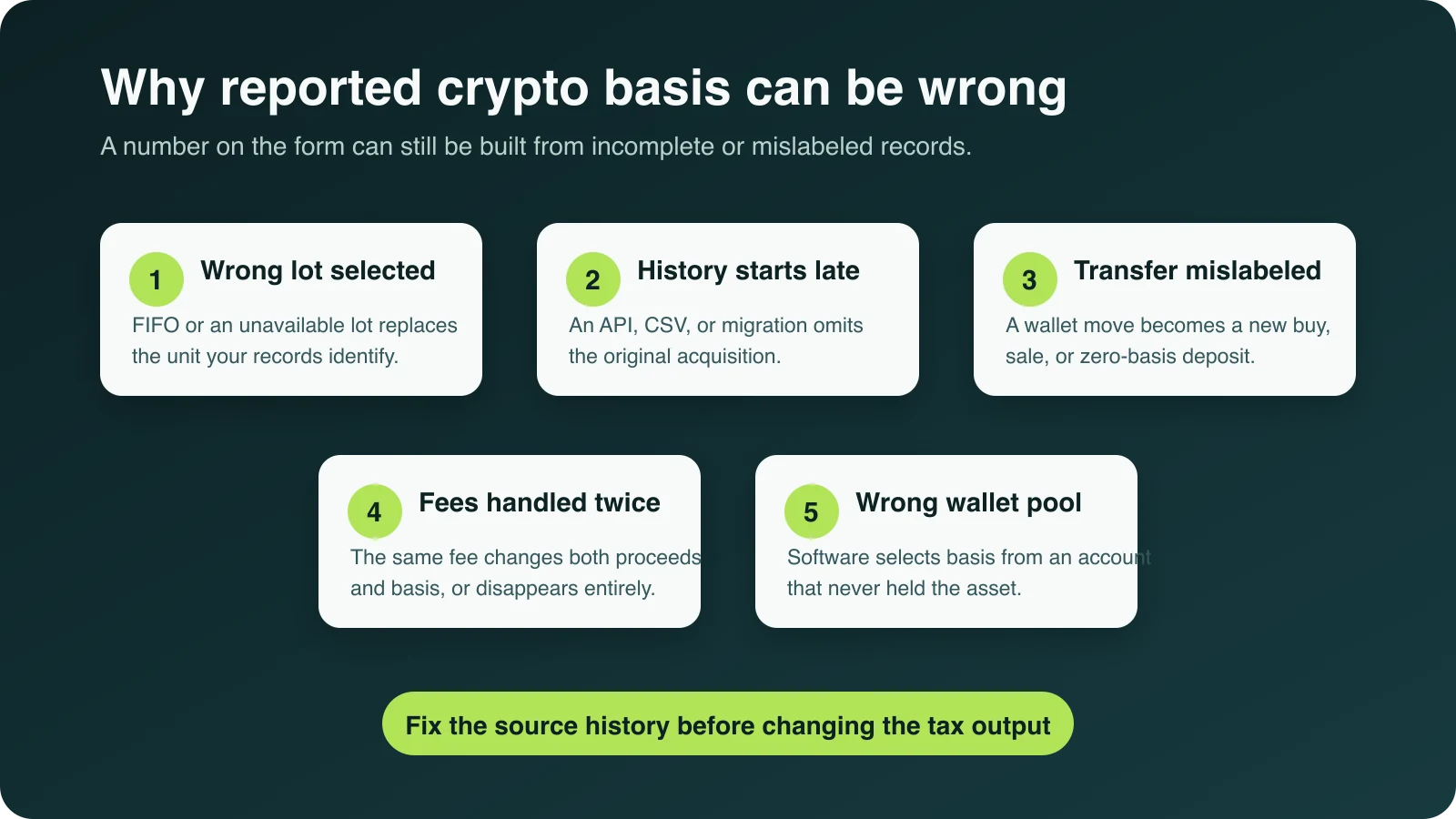
Wrong basis has a different cause from missing basis. The broker supplied a number, but that number does not match the basis supported by your records.
Common causes include:
- An incorrect lot was identified. Your records support one unit, while the broker applied another or defaulted to its available ordering rule.
- The history starts too late. An API, CSV, or migrated account may omit older acquisitions, making later sales attach to the wrong lots.
- A transfer was treated as an acquisition or disposal. A move between wallets you own generally is not a sale, but a broken import can create a new zero-basis deposit or remove the original lot.
- A gift, reward, fork, or income transaction was labeled as a purchase. Each has its own basis facts. A broker may know when the units arrived but not the tax history behind them.
- Fees were omitted or counted twice. A fee can change proceeds, basis, or create a separate disposition when paid with crypto, depending on the transaction.
- Your software used universal pooling after the rules changed. A global lot selected from the wrong wallet can produce a result that is impossible to support under the current wallet-by-wallet framework.
Do not assume your preferred basis method overrides the location of the asset. FIFO, HIFO through specific identification, and other lot decisions operate within the applicable wallet or account. Our FIFO vs. HIFO vs. specific identification guide explains what each method changes and what documentation it needs.
How to reconstruct missing crypto cost basis
For a complete start-to-finish process, use our guide to reconstructing missing crypto cost basis. It covers dead exchanges, wallet-to-wallet transfer matching, historical fair market value, and the documentation behind each assumption.
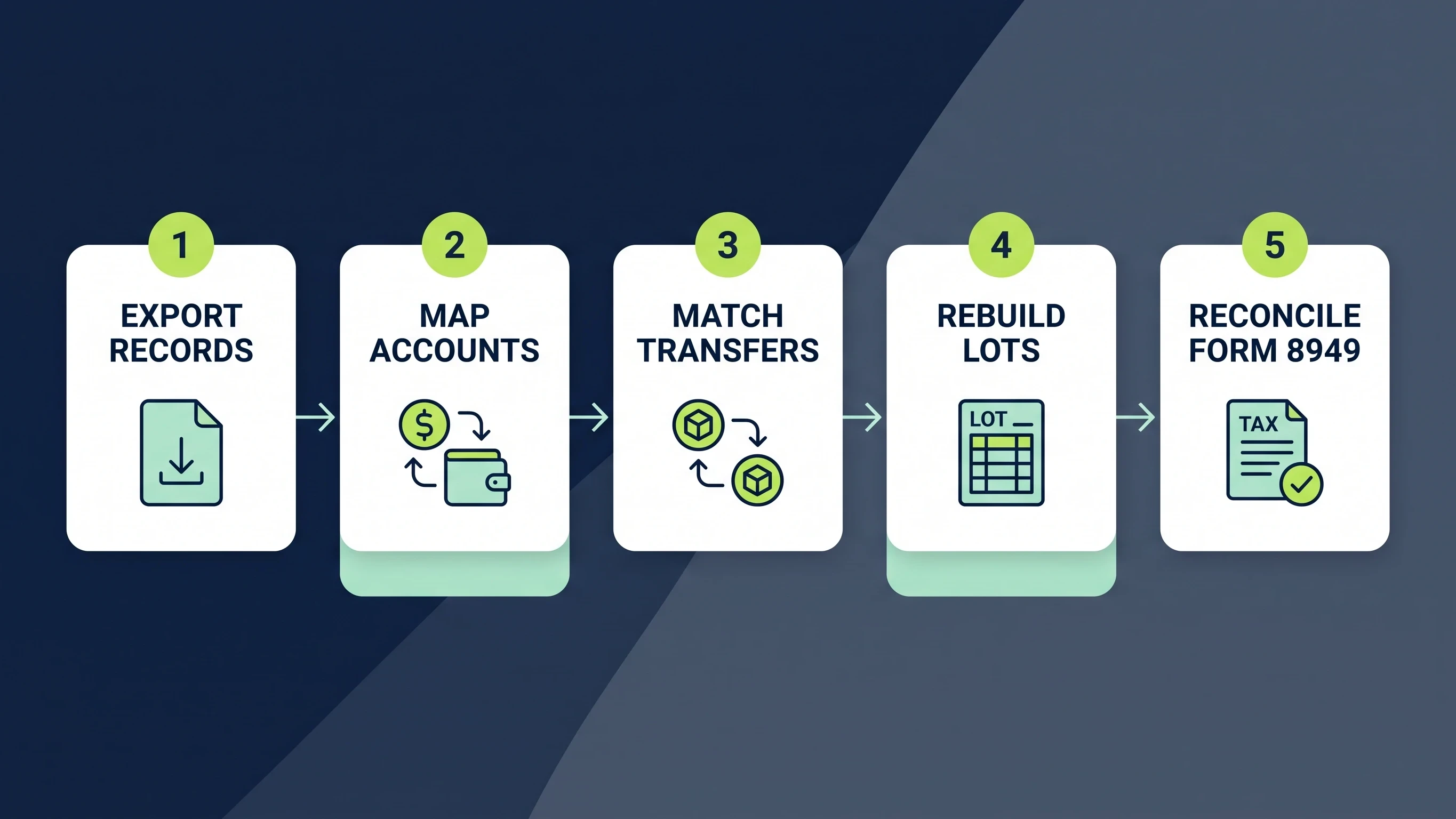
Reconstruction means building one continuous chain from acquisition to disposition. Work in this order.
1. Freeze the source records
Download the 1099-DA, complete trade history, deposits, withdrawals, transfers, rewards, and fee exports from every exchange you used. Do this even for platforms you no longer use. Save native CSV files before editing them.
For self-custody, export wallet activity where possible and preserve public addresses and transaction hashes. A blockchain explorer can confirm a transfer, but it usually cannot supply the off-chain purchase price from an exchange.
2. Make a complete account map
List every exchange account, hosted wallet, self-custody wallet, staking account, and closed platform involved in the asset’s history. Then record the date range available from each source.
This catches the quiet failure that ruins many tax files: the connected accounts look fine, but one old exchange or wallet is missing entirely.
If your sale was on a major exchange, compare the platform-specific reporting notes in our Kraken 1099-DA guide or Coinbase 1099-DA guide.
3. Match every transfer
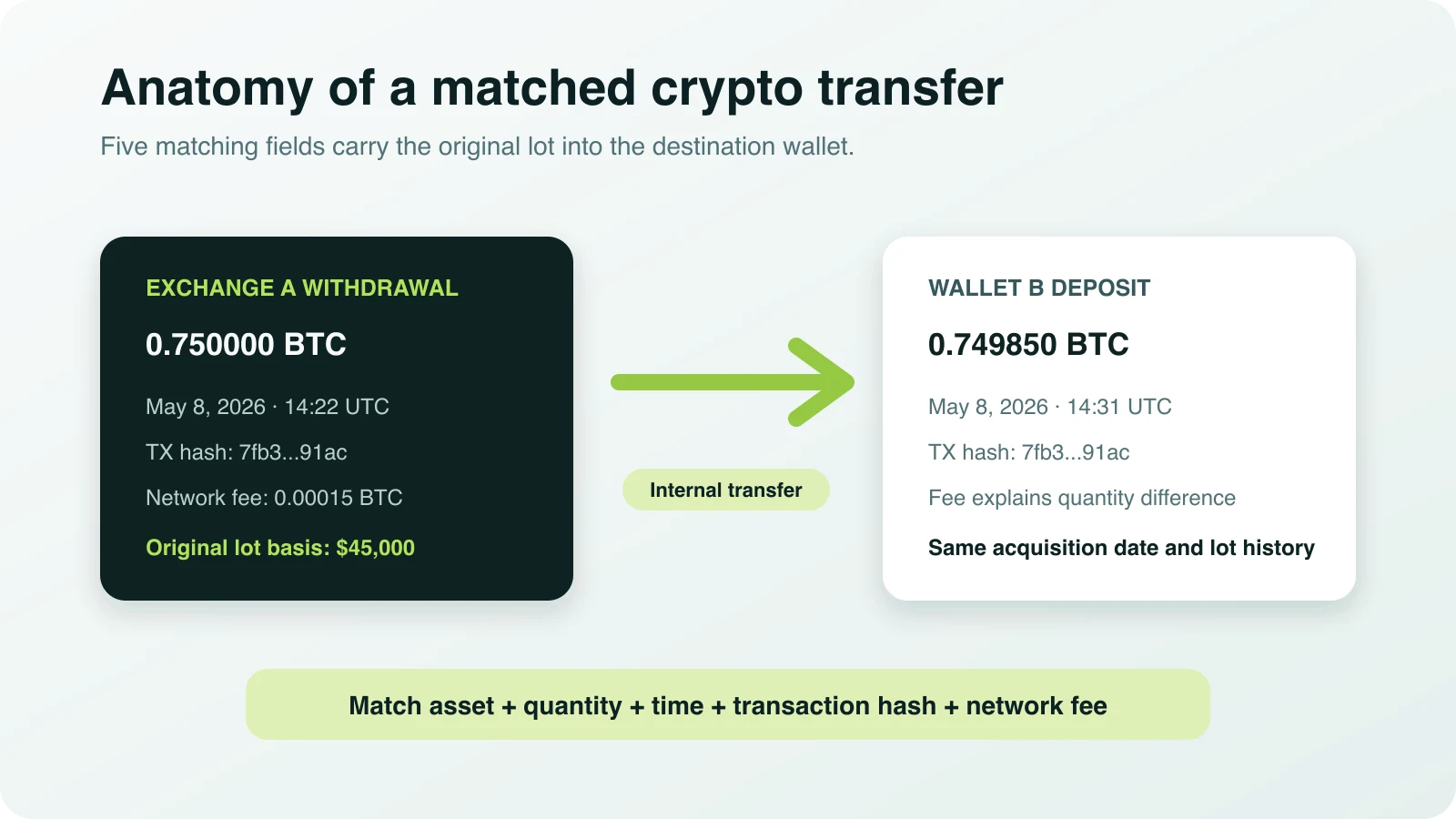
Pair each withdrawal with the corresponding deposit using asset, quantity, date and time, transaction hash, and network fee. Label transfers between accounts you own as internal transfers, then carry the same acquisition date and basis lot into the destination wallet.
Do not create new basis at the destination. The lot did not become newly purchased just because it moved.
Partial transfers need extra care. If you bought 2 BTC in one lot and transferred 0.75 BTC, the destination needs the basis attached to the 0.75 BTC actually moved. That choice also affects which basis remains behind.
4. Rebuild lots wallet by wallet
Revenue Procedure 2024-28 provided a safe harbor for taxpayers transitioning from universal tracking to wallet-by-wallet or account-by-account tracking as of January 1, 2025. The revenue procedure requires records showing the remaining units in each wallet or account, the unused basis, original basis, and acquisition dates. It also says an allocation made under the safe harbor is irrevocable.
The safe harbor does not invent basis and does not excuse missing support. It allocates substantiated unused basis to the matching number and type of units held at the transition.
For activity after the transition, keep the lots inside the wallet or account that actually holds them. If you transfer a lot, move its basis record with it. Our guide to per-wallet crypto cost basis under Rev. Proc. 2024-28 covers the transition and allocation mechanics in detail.
5. Reconcile to the 1099-DA before preparing Form 8949
For each reported disposition, compare:
- asset and quantity sold
- date acquired, if known
- date disposed
- proceeds
- whether basis was reported to the IRS
- covered or noncovered status
- your reconstructed adjusted basis
- short-term or long-term treatment
- any transaction-cost adjustment
Your final file should tie the gross proceeds reported on the 1099-DA to the proceeds on the tax return. Then it should show exactly how your acquisition records support the basis and gain or loss.
How the fix reaches Form 8949
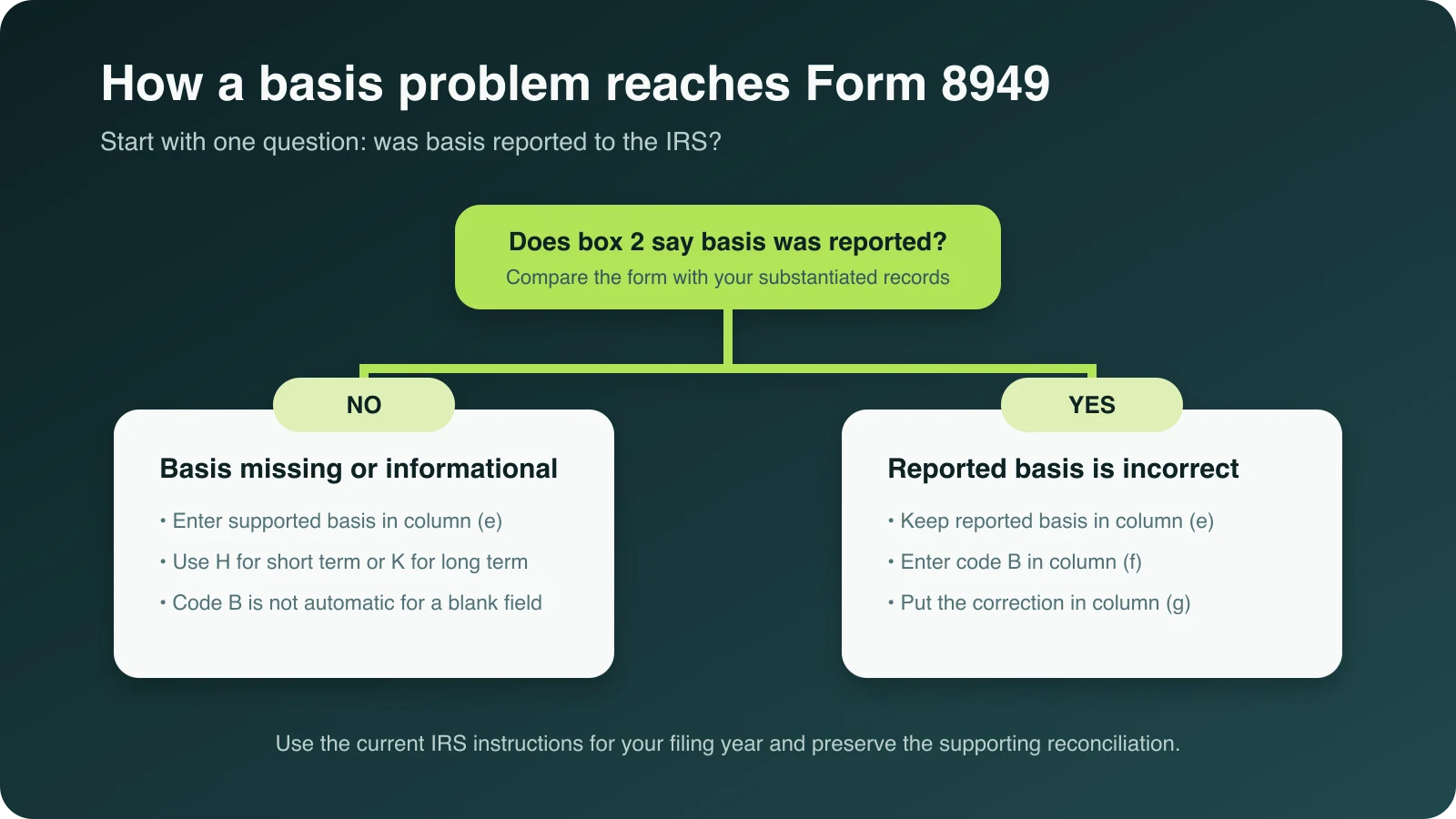
Form 8949 is where you reconcile the broker-reported transaction with the numbers on your return. The details depend on whether basis was missing, shown but not reported to the IRS, or reported to the IRS incorrectly.
The 2025 Instructions for Form 8949 separate digital asset transactions into their own reporting categories:
| What the 1099-DA says | General Form 8949 treatment |
|---|---|
| Short-term, basis not reported to the IRS | Part I, box H |
| Long-term, basis not reported to the IRS | Part II, box K |
| Short-term, basis reported to the IRS | Part I, box G |
| Long-term, basis reported to the IRS | Part II, box J |
If the form has no basis or says the basis was not reported to the IRS, enter your correct substantiated basis in column (e). If a basis amount is shown but was not reported to the IRS and that amount is wrong, the instructions call for code B in column (f), the correct basis in column (e), and zero in the adjustment column.
If the incorrect basis was reported to the IRS, keep the broker-reported basis in column (e), enter code B, and correct the result through the adjustment in column (g). This preserves the amount the IRS computer expects while showing the correction transparently.
Do not copy a generic adjustment from an online example. The sign and amount in column (g) depend on whether the reported basis is higher or lower than the correct basis. Use the basis-adjustment worksheet in the instructions or have your preparer apply it.
For the full filing sequence from 1099-DA to Form 8949 and Schedule D, read how to report Form 1099-DA on your tax return and our Form 8949 for crypto guide.
What not to do with a wrong 1099-DA
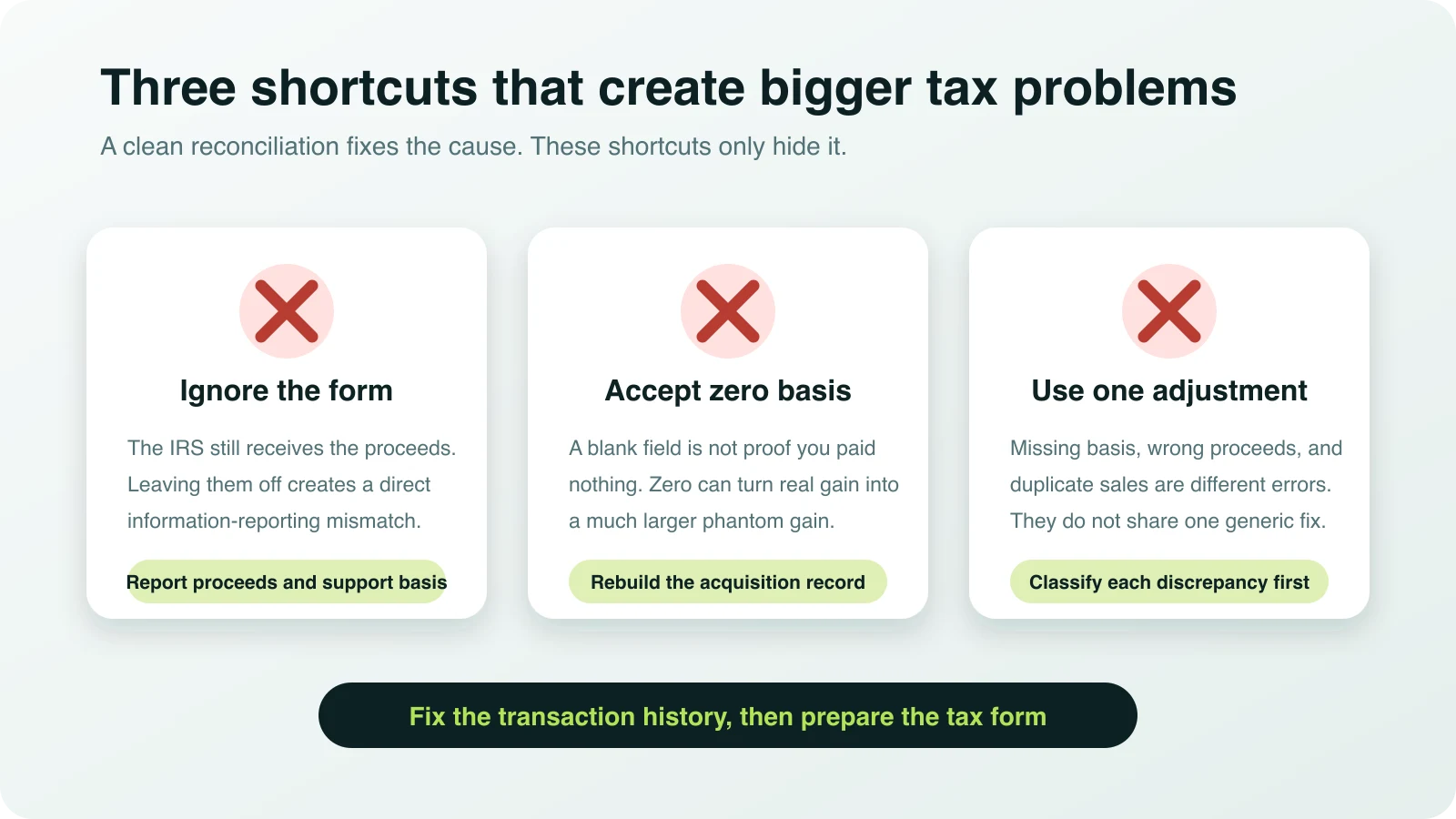
Most bad filings start with one of these shortcuts.
Do not ignore the form
The broker sends the form to you and the IRS. Leaving the proceeds off your return creates an obvious information-reporting mismatch. Even when basis is missing, the IRS still sees the sale proceeds.
Do not accept zero basis to make the software balance
Zero basis can make an unresolved transaction warning disappear. It can also turn $40,000 of real gain into $100,000 of apparent gain. Fix the source history, not the warning icon.
Do not force every discrepancy through one adjustment
Missing basis, wrong proceeds, duplicate sales, incorrect holding period, and a sale that never happened are not the same problem. Ask the broker for a corrected form when the issuer’s information is wrong. The IRS says not to wait to file, so document the request and report the transaction under the applicable instructions if the corrected form does not arrive in time.
When professional reconciliation is worth it
You can usually repair one transferred lot if you still have the purchase confirmation and transaction hash. Professional reconciliation becomes worthwhile when the answer depends on the rest of the portfolio.
Our crypto reconciliation service handles the source collection, transfer matching, basis reconstruction, and review when those dependencies span the full portfolio.
Bring in help when:
- several exchanges or wallets are missing history
- you used DeFi, bridges, liquidity pools, staking, or wrapped assets
- a closed exchange or lost account holds the original purchase record
- the same asset moved through several wallets before sale
- your software balances do not match the actual holdings
- your safe harbor allocation or post-2024 wallet records are unclear
- the 1099-DA proceeds do not tie to the tax report
- the adjustment is large enough that you would want to defend it in an examination
A finished reconciliation produces four things that agree: the transaction history, lot ledger, transfer map, and Form 8949 output.
Fix the basis before the filing becomes the problem
A 1099-DA with blank basis is incomplete, not final. A 1099-DA with incorrect basis is a reconciliation issue, not a command to pay tax on the wrong gain. In both cases, the answer is to rebuild the record before filing and preserve the evidence behind every correction.
Count On Sheep handles Digital Asset Reconciliation end to end. Our 1099-DA help service traces the history across exchanges, wallets, and chains, resolves missing or duplicated activity, rebuilds defensible cost basis, and delivers reports your tax professional can use. You can also find the crypto tax service for your state or city when local filing rules or an appointment location matter. If the sale is large or the records are tangled, fixing it now is usually far cleaner than explaining a zero-basis return later.
Frequently Asked Questions
Need help tracking missing cost basis for my crypto
Count On Sheep reconstructs missing crypto cost basis by tracing transfers across exchanges, wallets, and chains and matching each deposit to its original acquisition. Every assumption is documented in an audit-ready workpaper, and you receive corrected Form 8949 inputs. The work is delivered by our former Big 4 (EY) crypto tax team.
Why is the cost basis on my 1099-DA blank or wrong?
A broker may leave basis blank when the asset is noncovered, including crypto acquired before 2026 or transferred into the broker from another exchange or wallet. The basis can also be wrong when the broker's records are incomplete, a transfer was misclassified, or a reported lot does not match your supported tax records.
Do I owe tax on the full proceeds if basis is missing?
No. Tax is generally calculated on the gain, which is proceeds minus your adjusted cost basis, not on gross proceeds alone. You must reconstruct and substantiate the missing basis, then report the transaction correctly on Form 8949.
How do I prove my cost basis to the IRS?
Keep exchange trade exports, wallet histories, bank records, transaction hashes, receipts, fee records, and a lot-level reconciliation that connects the original acquisition to the eventual sale. Your records should establish the asset, quantity, acquisition date, acquisition value, transfers, disposition date, proceeds, and the basis method used.
What is the zero-basis trap?
The zero-basis trap happens when a blank or incorrect basis is treated as zero, making the full sale proceeds appear to be taxable gain. A $100,000 sale of Bitcoin with a valid $60,000 basis should produce a $40,000 gain, not a $100,000 gain.
Can I just ignore a wrong 1099-DA?
No. The broker also sends Form 1099-DA to the IRS, so omitting the reported proceeds can create a mismatch. Request a corrected form when appropriate, but do not wait to file. Report the proceeds and basis using the applicable Form 8949 instructions and keep your supporting reconciliation.
Who can fix my crypto cost basis?
A crypto tax reconciliation specialist can rebuild the transaction history across exchanges and wallets, match transfers, apply a defensible lot method, and produce records for Form 8949. Count On Sheep provides done-for-you Digital Asset Reconciliation for portfolios that are too complex to fix safely with a few manual edits.