
Direct answer
Need help tracking missing cost basis for my crypto
Count On Sheep reconstructs missing crypto cost basis by tracing transfers across exchanges, wallets, and chains and matching each deposit to its original acquisition. Every assumption is documented in an audit-ready workpaper, and you receive corrected Form 8949 inputs. The work is delivered by our former Big 4 (EY) crypto tax team.
Missing cost basis means part of your transaction history is disconnected. It does not mean the basis was zero. The exchange where you sold can see that crypto arrived, but it may have no idea when you bought it, what you paid, which lot moved, or whether the deposit came from another account you own.
That gap can turn a real gain into a much larger apparent gain. It can also distort holding periods, create duplicate income, and make a Form 1099-DA look impossible to reconcile. The fix is to rebuild the chain of evidence from the original purchase through every transfer to the final sale.
This guide walks through why basis goes missing, what the IRS expects you to keep, a seven-step reconstruction method you can follow in order, and a worked 1 ETH example that shows exactly what zero basis costs you.
This guide is educational and does not provide tax or legal advice. A licensed tax professional should decide tax treatment based on your facts.
Why crypto cost basis goes missing
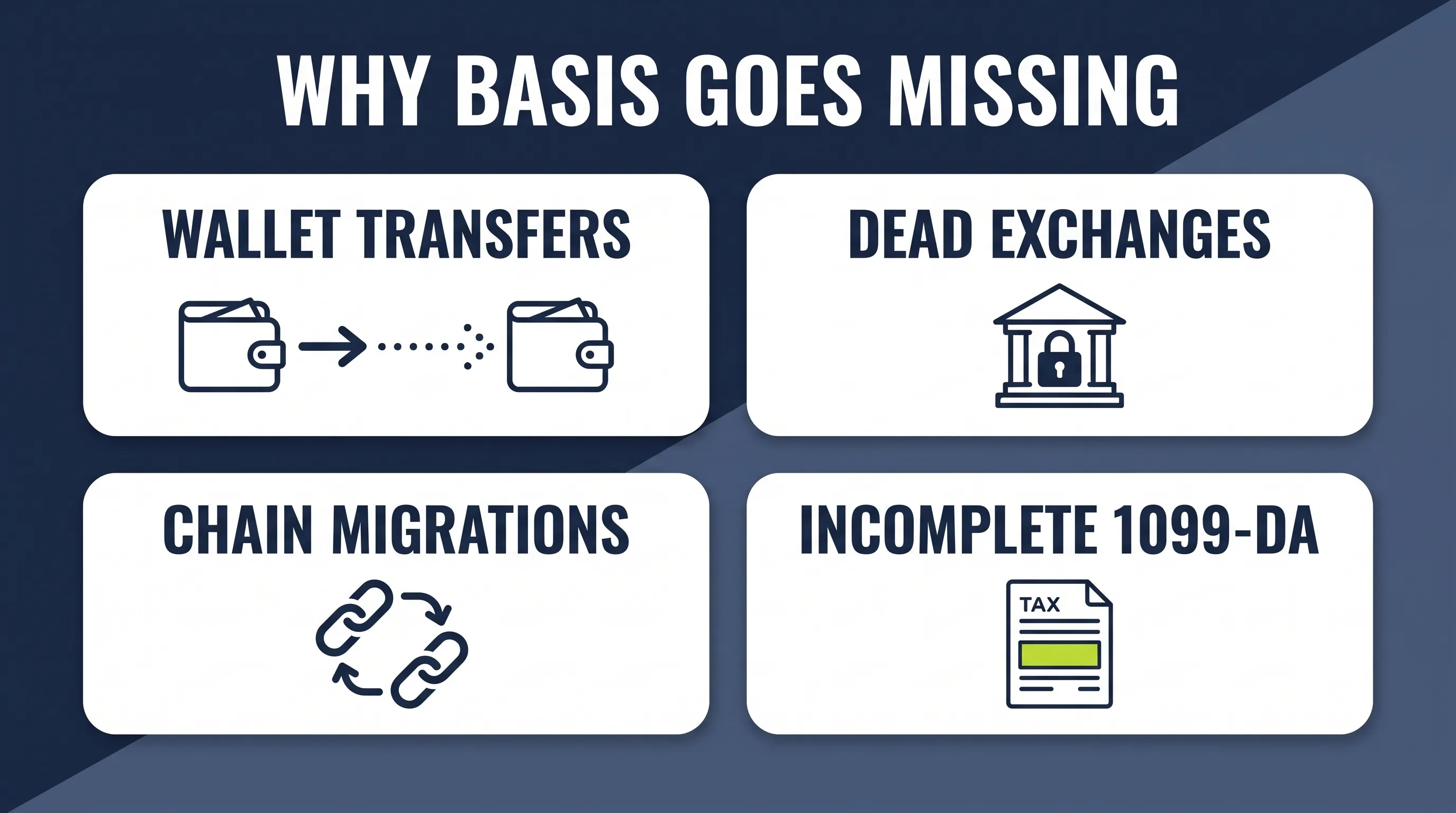
Cost basis goes missing when the record of what you paid gets separated from the asset itself. The IRS treats the basis of a digital asset as its cost in U.S. dollars, and calculating gain or loss requires the asset, acquisition date and time, units acquired, fair market value when acquired, disposition details, and the basis of the units sold. Crypto splits those facts across exchanges, wallets, and chains, and any one of the four situations below can break the link.
Wallet-to-wallet transfers break the visible history
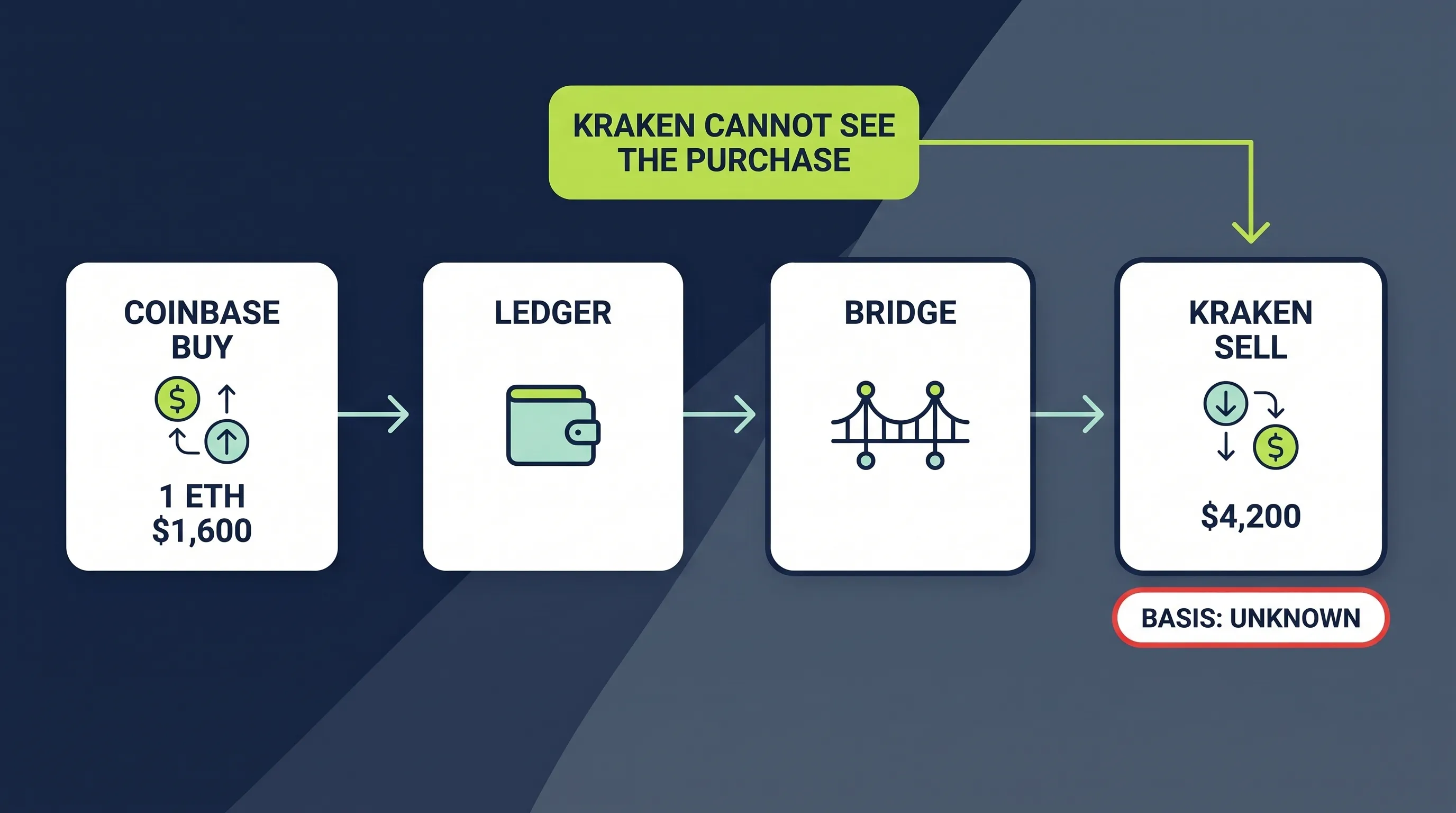
Suppose you buy 1 ETH on Coinbase, move it to a Ledger, bridge it to another chain, then deposit it on Kraken and sell it. Kraken sees the final deposit and sale. It does not automatically receive the Coinbase purchase record or know that the intermediate addresses belong to you.
If your software imports only Kraken, it may treat the deposit as an acquisition with unknown basis. If it imports every source but fails to match the transfer path, it may record both a disposal and a new zero-basis deposit. One asset, two disconnected records.
Dead exchanges take purchase history with them
FTX, Celsius, Voyager, and other inaccessible platforms create a different problem. You may still have destination-wallet records or bankruptcy statements, but the original trade export may be unavailable. Reconstruction then depends on saved statements, email confirmations, bank activity, withdrawal hashes, screenshots, prior-year reports, and other contemporaneous evidence.
No single substitute record is perfect. Several of them together can establish a defensible timeline and narrow the range of possible basis.
Chain migrations and token changes obscure continuity
Migrations, bridges, wrapped assets, contract swaps, redenominations, and token upgrades can make one economic position look like several unrelated assets. A ticker change by itself does not tell you whether the event was a transfer, a conversion, a taxable exchange, or a protocol migration. Preserve the transaction hash, the protocol announcement, the quantity relationship, and the dates, then let a licensed professional decide treatment when the question is interpretive.
Incomplete Forms 1099-DA do not show the whole portfolio
Form 1099-DA reports what one broker saw. It does not combine self-custody, other exchanges, or earlier acquisition history. The 2026 instructions require basis reporting for covered digital assets, while basis for noncovered assets may be omitted. Assets you transferred in are the most common reason the selling broker leaves basis blank.
Our guide to fixing wrong or missing 1099-DA cost basis explains how to reconcile broker proceeds without accepting a blank field as zero.
What the IRS expects from your records
The IRS requires sufficient records to support positions taken on a return. Its digital-asset guidance lists purchases, receipts, sales, exchanges, other dispositions, and fair market value in U.S. dollars among the facts taxpayers should document. IRS digital asset guidance and the Form 8949 instructions both emphasize accurate basis records.
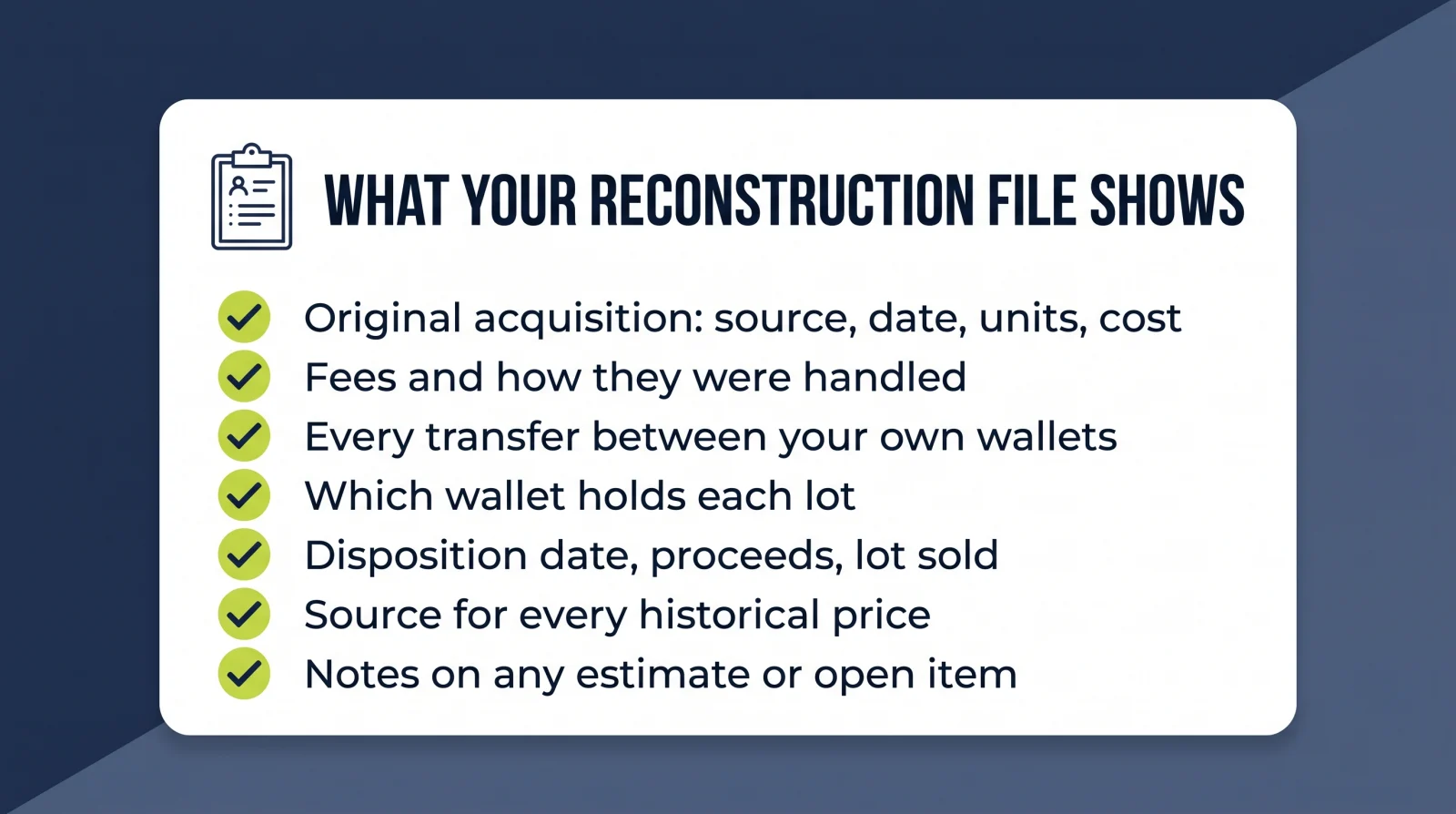
A useful reconstruction file should show:
- the original acquisition source, date, quantity, and amount paid
- transaction fees and how they were handled
- every transfer between accounts or wallets you own
- the wallet or account holding each lot after a transfer
- the disposition date, proceeds, and lot selected
- source links or files for historical fair market value
- an explanation for any estimate, conflict, or unresolved item
The test is repeatability. Another reviewer should be able to start with your source files, follow the transfer map, and land on the same lot history.
Per-wallet tracking under Rev. Proc. 2024-28
Revenue Procedure 2024-28 provided a safe harbor for allocating unused basis to digital assets held in each wallet or account as of January 1, 2025. It did not create missing basis. It provided a method for assigning already-supported unused basis to the units held in specific locations.
That distinction matters. First establish what you own and the basis you can support. Then place those lots in the wallet or account where the assets were actually held. Read our detailed guide to per-wallet crypto cost basis under Rev. Proc. 2024-28 before using an old universal-pool report as evidence.
Step-by-step method to reconstruct missing crypto cost basis
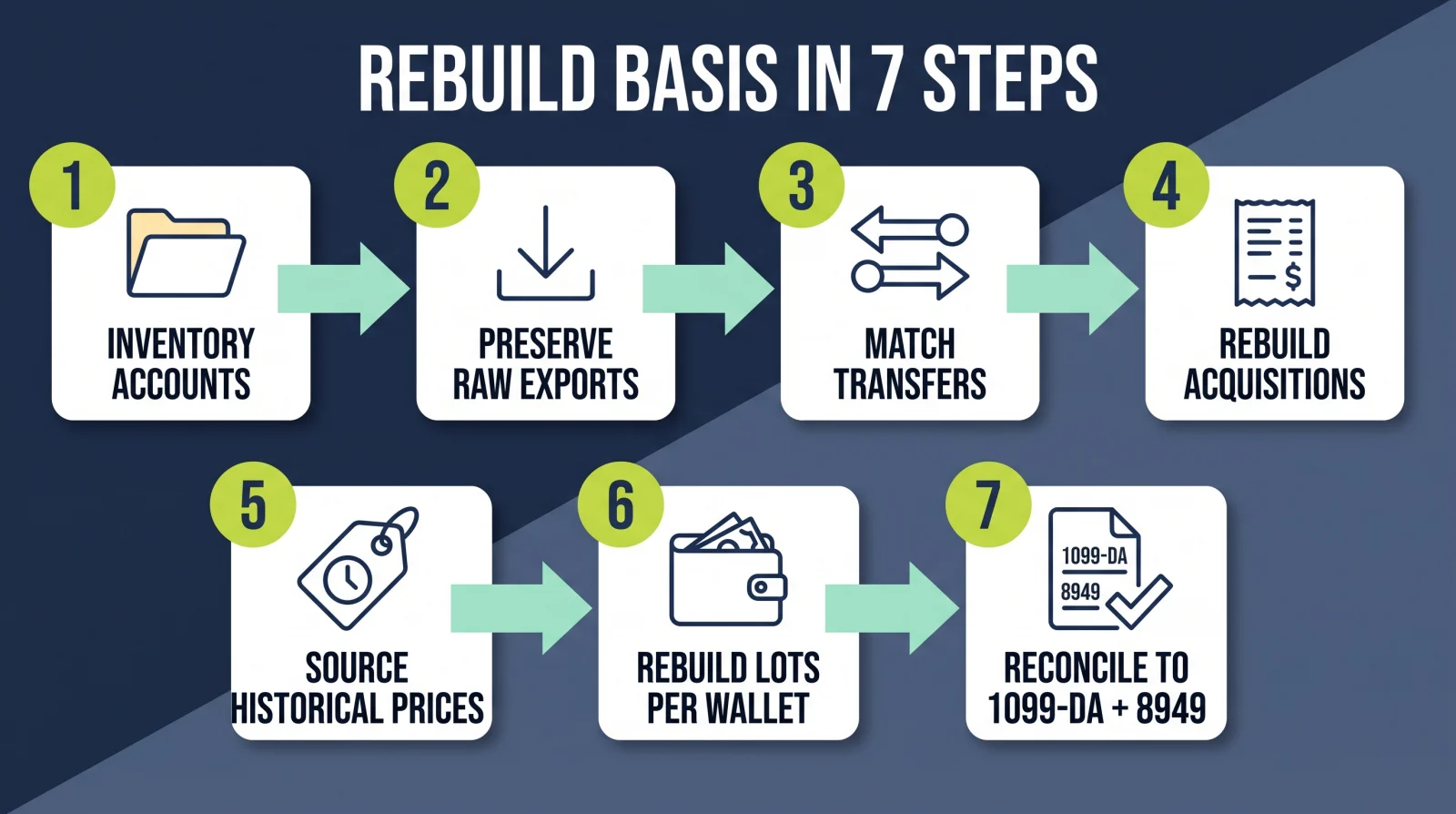
Work from source evidence toward the final report, in this order. Clearing the loudest software warnings first makes the dashboard look cleaner while quietly breaking the underlying history.
1. Build a complete account inventory
List every centralized exchange, self-custody wallet, hardware wallet, chain, staking account, DeFi protocol, and closed platform you used. Include approximate first and last activity dates. Add prior-year tax reports and software accounts because they may contain records that no longer exist at the source.
Then compare the inventory with the imported data. If an account is missing, stop before approving any basis result that depends on it.
2. Preserve native records
Download complete CSV exports, not filtered screenshots. Save trade history, deposits, withdrawals, rewards, fees, and account statements separately. Keep raw files unchanged and do transformations in working copies.
For self-custody, record public addresses and transaction hashes. A block explorer can prove movement, quantity, time, and counterparties. It usually cannot prove an off-chain exchange purchase price by itself.
3. Match transfers before rebuilding lots
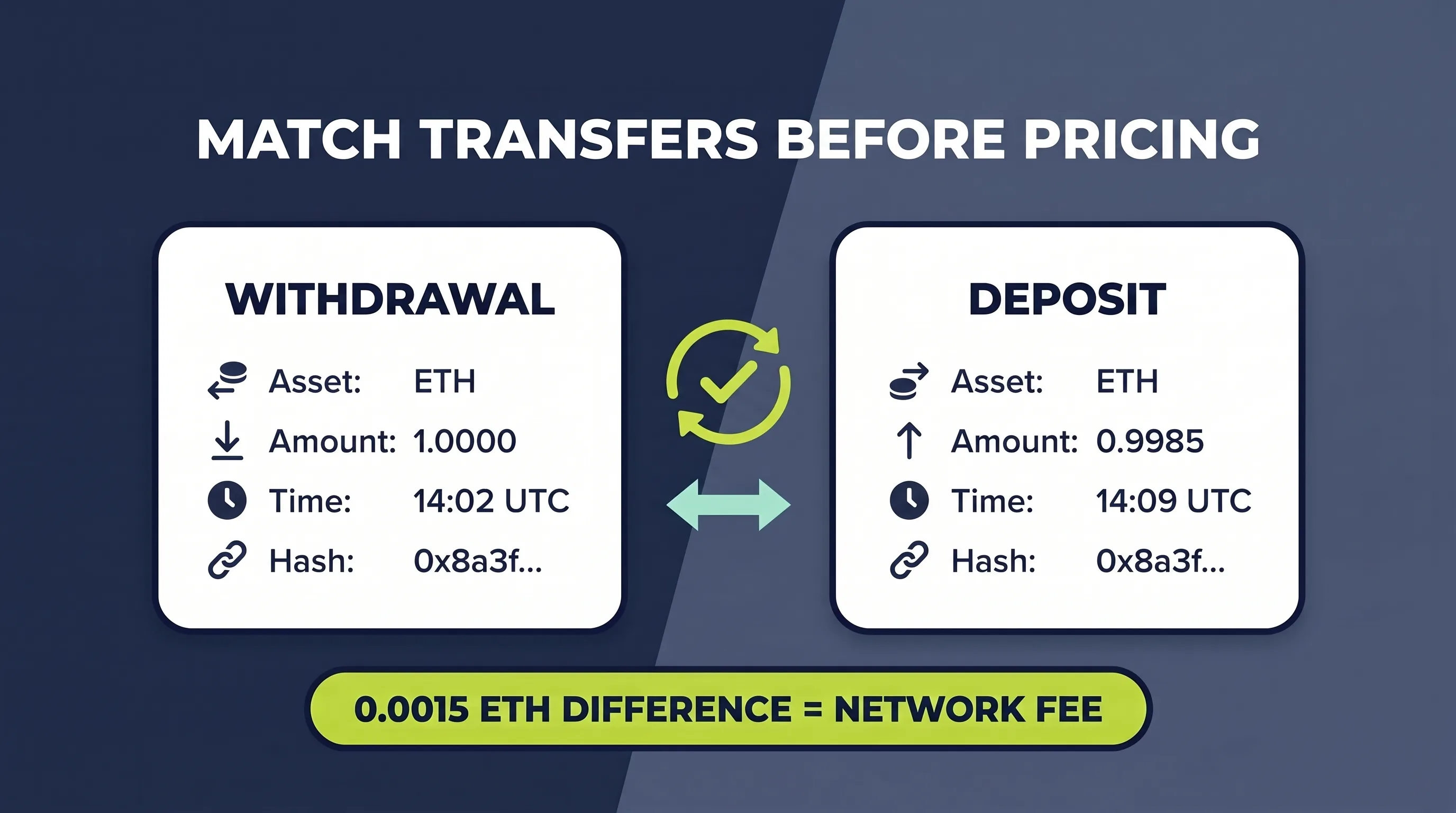
Pair each withdrawal with its corresponding deposit. Use asset, amount, timestamp, transaction hash, chain, and fee. Account for small quantity differences caused by network fees.
Once matched, carry the original acquisition date and basis into the destination wallet. Do not price the incoming deposit at its transfer-date fair market value just because the software labels it a new receipt.
Cross-chain activity may require several linked steps: withdrawal, bridge deposit, bridge output, wrapped-token receipt, and final wallet deposit. Keep the path intact rather than collapsing it into an unsupported new lot.
4. Reconstruct the original acquisition
Start with the strongest evidence: an exchange trade record, broker statement, invoice, or purchase confirmation. If that is unavailable, combine independent sources such as bank statements, email receipts, prior-year reports, and the first known withdrawal.
For crypto received as income or payment, acquisition basis can depend on the amount included in income. Gifts, inheritances, forks, and other special acquisitions follow different rules. Do not guess from the deposit price. Flag the transaction for a licensed tax professional when basis depends on legal characterization.
5. Use historical fair market value carefully
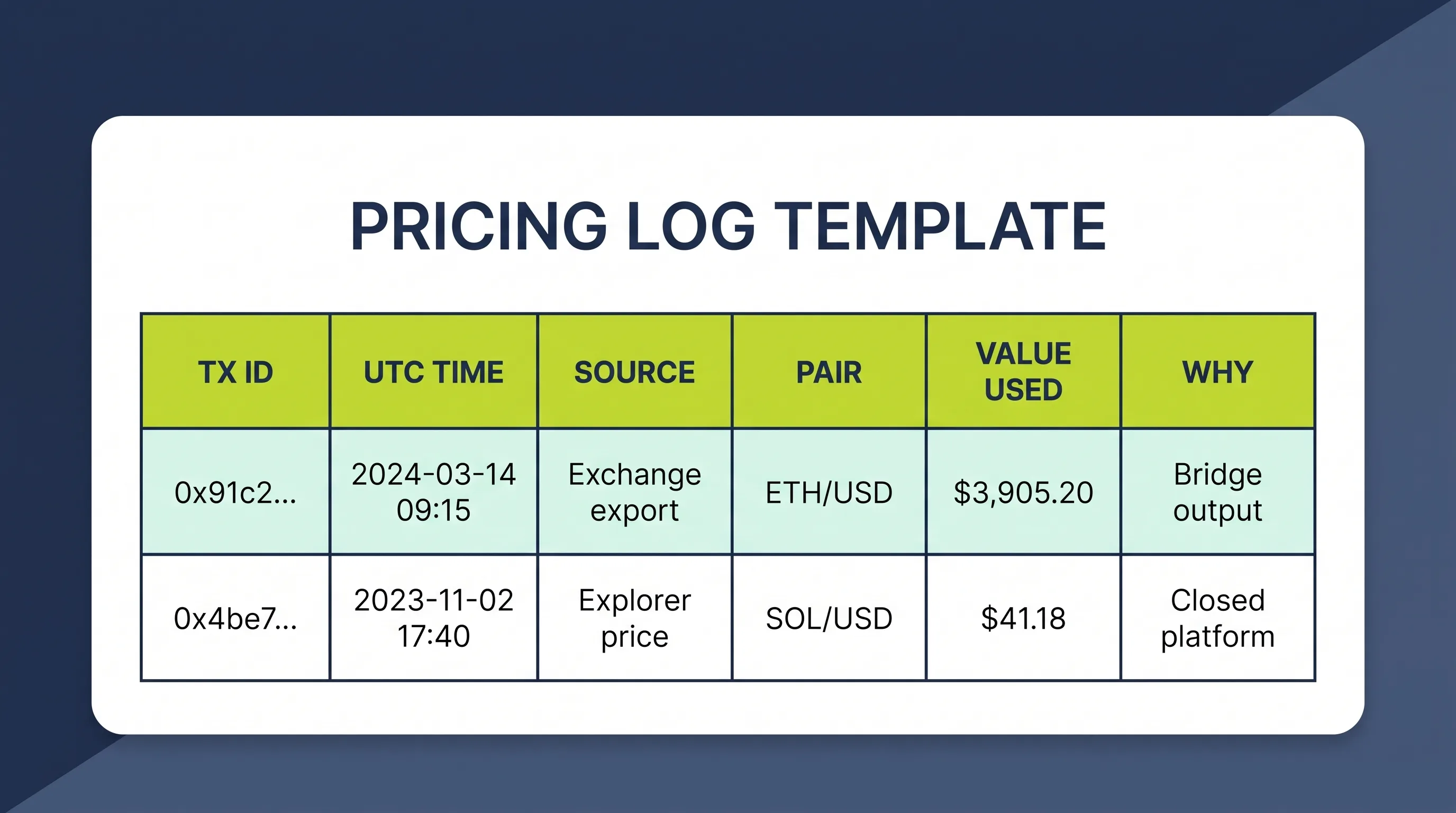
When a transaction genuinely requires fair market value, document the pricing source, timestamp, currency pair, and method. The IRS digital-asset FAQs recognize values from qualifying exchanges and certain blockchain explorers in appropriate circumstances. Use a consistent, reputable source and preserve the lookup.
Avoid today’s price, daily closing price without regard to transaction time, or the nearest round number. Thinly traded tokens may need a broader review of actual market activity.
6. Rebuild lots inside each wallet or account
Once transfers and acquisitions are supported, rebuild the lot ledger by location. Confirm opening balances, units acquired, units transferred in and out, units disposed, and ending balances. The math has to reconcile for both quantity and value.
Then apply the documented identification method within the relevant wallet or account. Our crypto cost basis optimization guide explains FIFO, HIFO, and specific identification, but a method cannot rescue missing source history.
7. Reconcile the result to Forms 1099-DA and Form 8949
Tie each broker-reported disposition to one transaction in the final ledger. Compare proceeds, dates, asset, quantity, and reported basis. Investigate every duplicate, omission, and mismatch before exporting Form 8949 inputs.
If the broker-reported basis is wrong, follow the applicable Form 8949 instructions and retain the reconciliation. Do not delete a broker transaction simply because your local result differs.
The zero-basis trap with a 1 ETH example
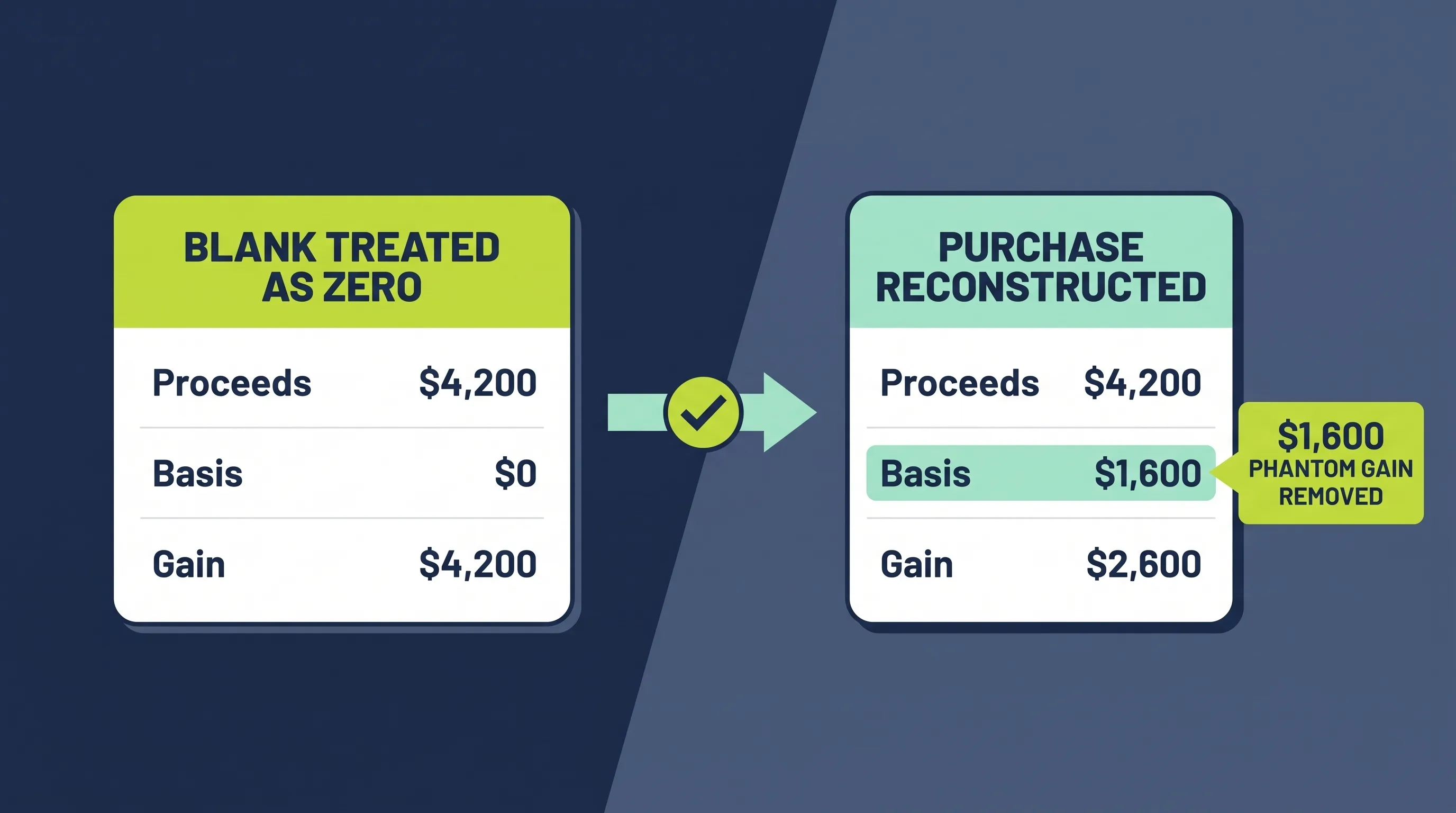
Say you bought 1 ETH for $1,600, moved it through two wallets, and sold it for $4,200. The selling exchange cannot see the original purchase, so its report shows proceeds and a blank basis field.
| Result | Proceeds | Basis | Apparent gain |
|---|---|---|---|
| Missing basis entered as zero | $4,200 | $0 | $4,200 |
| Reconstructed purchase record | $4,200 | $1,600 | $2,600 |
The zero-basis version creates $1,600 of phantom gain, taxed as if it were real. Reconstructing the purchase does not invent a deduction. It puts the cost you actually paid back into the calculation.
DIY reconstruction versus professional help
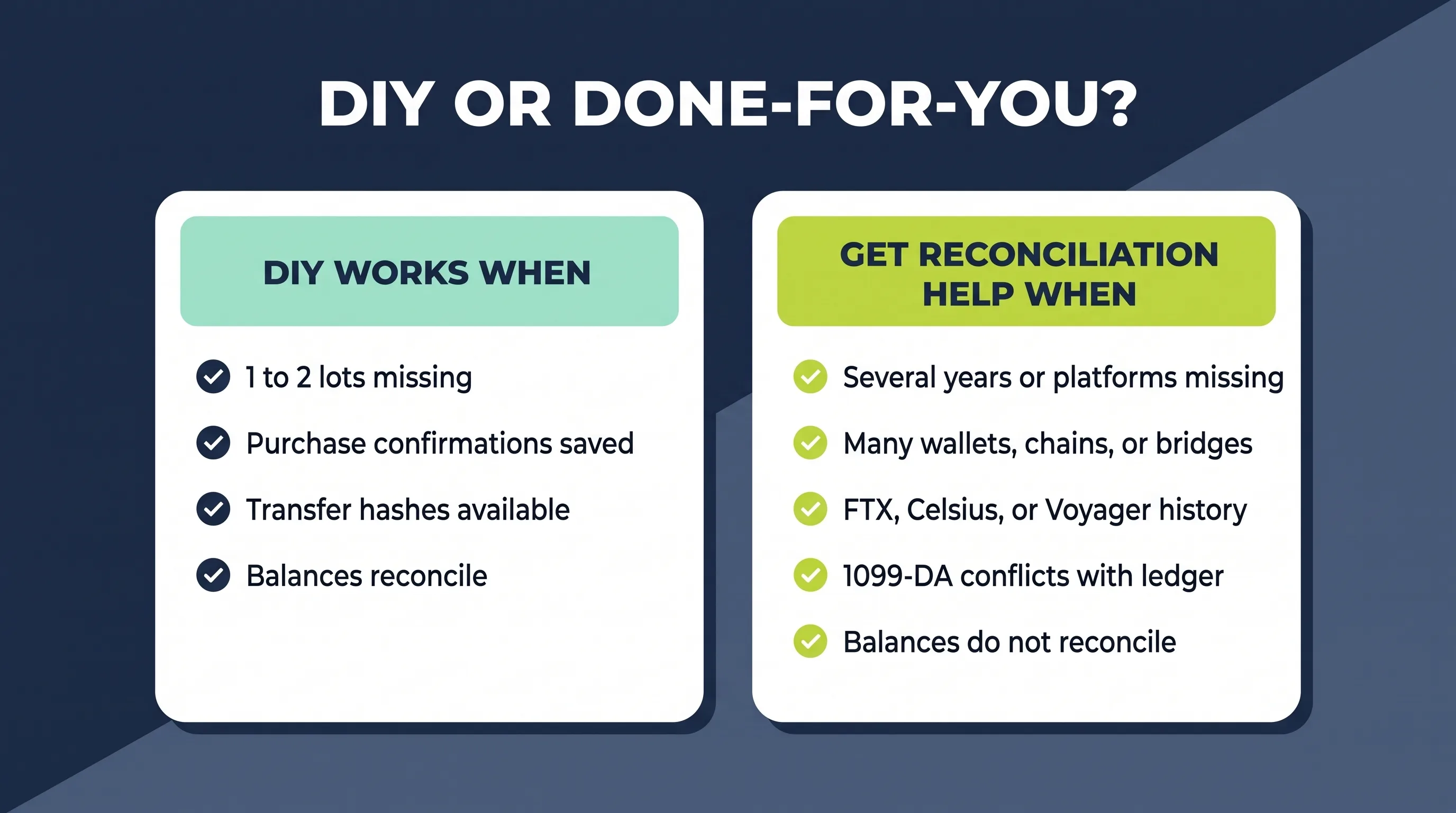
DIY reconstruction is reasonable when one or two lots are missing and you still have the purchase confirmations and transfer hashes. Work in a separate copy, write down each change, and rerun balance checks after every group of edits.
Software-specific guides can help when the source history is complete but imports are wrong. See our guides for wrong Koinly cost basis and wrong CoinTracker cost basis.
Professional reconciliation becomes useful when:
- several years or platforms are missing
- assets moved through many wallets or chains
- FTX, Celsius, Voyager, or another closed platform holds the original acquisition
- DeFi, NFTs, bridges, staking, or wrapped assets affect continuity
- opening and ending balances do not reconcile
- Forms 1099-DA conflict with the portfolio ledger
- a large-dollar correction needs a reviewable workpaper
Count On Sheep performs Digital Asset Reconciliation. The team organizes your source records, traces transfers, reconstructs supported basis, documents every assumption, and delivers CPA-ready Form 8949, Schedule D, and Schedule 1 inputs. You file yourself or hand the deliverables to your CPA. Our former Big 4 crypto accountant team reviews all of it.
Finish with a record you can defend
A clean dashboard proves nothing on its own. What holds up is a continuous, supported history that connects every sale to the right acquisition and wallet-level lot. Start with the account map, preserve the raw evidence, match transfers, and document every manual decision.
If your records are too fragmented to rebuild safely, learn how the done-for-you crypto reconciliation service works or book a call below.
Frequently Asked Questions
Need help tracking missing cost basis for my crypto
Count On Sheep reconstructs missing crypto cost basis by tracing transfers across exchanges, wallets, and chains and matching each deposit to its original acquisition. Every assumption is documented in an audit-ready workpaper, and you receive corrected Form 8949 inputs. The work is delivered by our former Big 4 (EY) crypto tax team.
What should I do when my crypto cost basis is missing?
Start with complete exchange exports and a list of every wallet. Match withdrawals to deposits, carry the original acquisition date and basis through each transfer, and document any historical price source or assumption used to close a gap.
Can I use zero cost basis if I cannot find the purchase?
Zero basis may overstate your gain and should not be used merely to clear a software warning. Search exchange records, bank statements, email receipts, and on-chain transfers first, then document any unresolved gap for your tax professional.
How do I reconstruct cost basis from a closed exchange?
Use saved CSVs, account statements, trade confirmations, emails, bank deposits, withdrawal hashes, bankruptcy records, and destination-wallet history. The goal is to connect the original acquisition to the later transfer and disposition with a clear evidence trail.
Does cost basis follow crypto between my own wallets?
A transfer between wallets you own generally carries the asset's existing acquisition date and basis into the destination wallet. A new deposit record does not create a new purchase or a new fair market value basis.