
You got a Coinbase 1099-DA, saw a giant number, and immediately wondered if the IRS thinks you made that much money.
Take a breath. The number that usually causes the panic is gross proceeds, not profit and not tax owed.
Coinbase sent the form because it reported qualifying sales and exchanges from your Coinbase.com account to the IRS. Your job is to match those proceeds with the correct cost basis, including basis from any coins that came from another exchange or a self-custody wallet. Our main Form 1099-DA guide explains the form itself. This guide focuses on the Coinbase version and what to do before you file.
What does a Coinbase 1099-DA actually mean?
A Coinbase 1099-DA means Coinbase reported proceeds from qualifying digital asset dispositions in your Coinbase.com account to both you and the IRS. It does not mean Coinbase calculated your final taxable gain correctly.
The IRS describes Form 1099-DA as a broker information return for proceeds from digital asset sales or dispositions and, in some cases, basis. Coinbase says a reportable sale can include:
-
Selling crypto for US dollars or another currency
-
Exchanging one crypto asset for another
-
Using crypto to pay a broker transaction cost
Simply moving the rest of your crypto from Coinbase.com to an address you control is not reported as a sale on the form. Coinbase says only the crypto disposed of to pay a network fee is reported in that situation.
The form gives the IRS one side of the math: what you received. Your records supply the other side: what the disposed coins cost you.
Why does the proceeds number look so high?
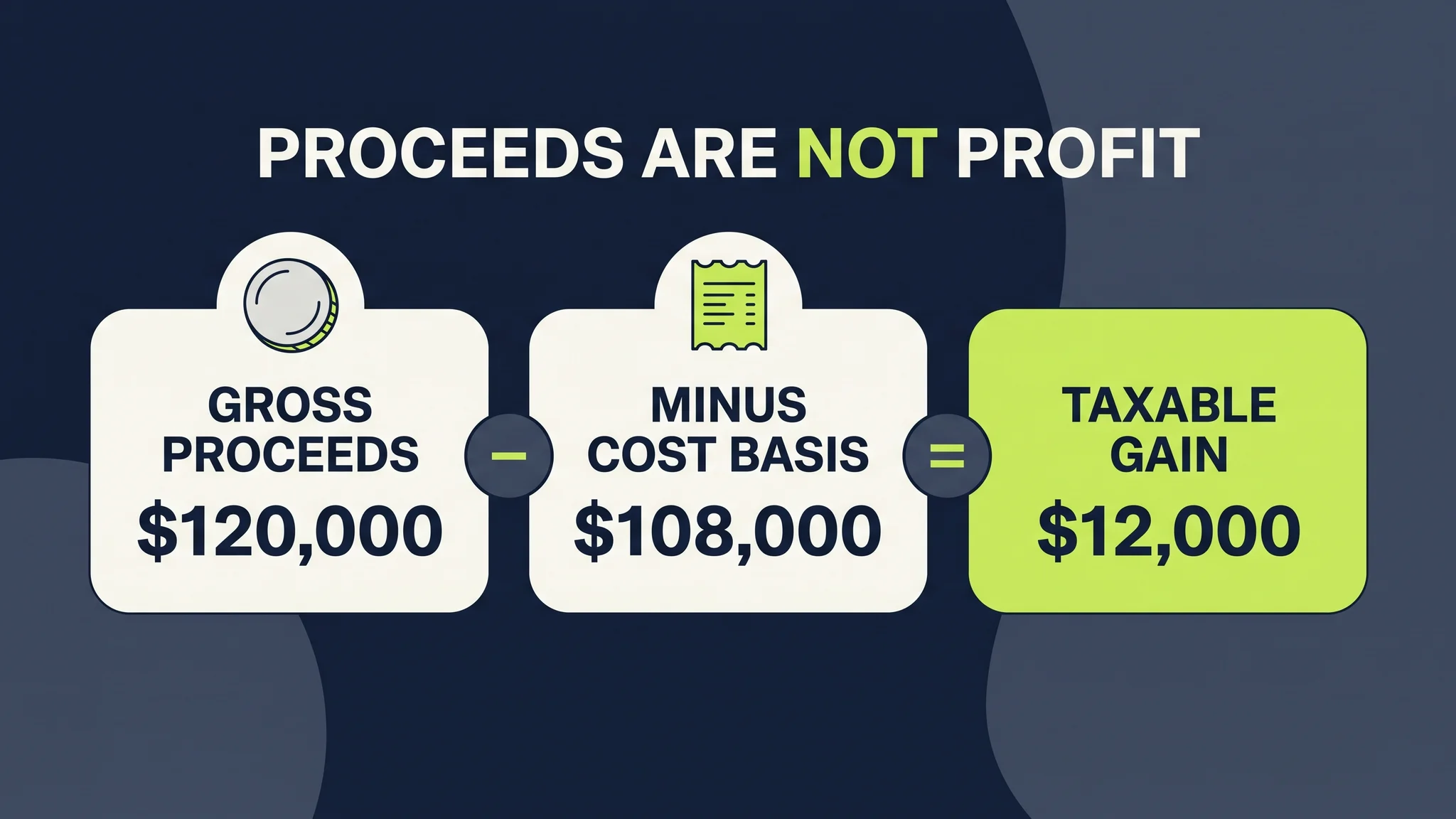
Gross proceeds add up the value received from every reported sale and exchange, even if you repeatedly bought back in. That total can be far larger than your account balance or your actual gain.
Say you make 12 trades during the year. Each time, you sell $10,000 of crypto and later buy another asset.
-
Total gross proceeds: $120,000
-
Adjusted basis in the assets sold: $108,000
-
Net capital gain before any other adjustments: $12,000
Your Coinbase 1099-DA can show $120,000 even though your gain is only $12,000. The form tracks the top line of each disposition, not the bottom-line profit.
The math is:
Proceeds minus adjusted cost basis equals gain or loss.
The 1099-DA amount is not added to your income as if you earned the whole number. You use the form with your basis records to calculate the actual result.
When does Coinbase issue Form 1099-DA?
Coinbase issues Form 1099-DA to US customers who sold or exchanged a digital asset in a qualifying Coinbase.com transaction, starting with the 2025 tax year. Coinbase says the 2025 form was provided no later than March 17, 2026, with an email sent when the document was ready.
There are two reporting phases to understand:
| Transaction year | What Coinbase reports |
|---|---|
| 2025 | Gross proceeds from qualifying sales and exchanges. Coinbase says it does not report cost basis on the 2025 form. |
| 2026 and later | Gross proceeds, plus basis for certain covered assets. Basis for noncovered assets is not required. |
The 2026 IRS instructions for Form 1099-DA define a covered asset narrowly. In general, it must have been acquired after 2025 in an account where the broker provided custody, then remain in that account until the broker handled the disposition.
This is why “basis reporting starts in 2026” does not mean every 2026 Coinbase sale will arrive with basis.
Why is cost basis missing on my Coinbase 1099-DA?
Basis is missing because Coinbase either was not required to report it or does not have the acquisition history needed to establish it. For 2025 dispositions, Coinbase says the form reports proceeds only.
Starting with 2026 dispositions, the IRS treats these common assets as noncovered:
-
Crypto acquired before January 1, 2026
-
Crypto transferred into Coinbase from another exchange
-
Crypto transferred into Coinbase from a self-custody wallet
-
Crypto Coinbase did not custody when you acquired it
Example: Coins moved in from Coinbase Wallet
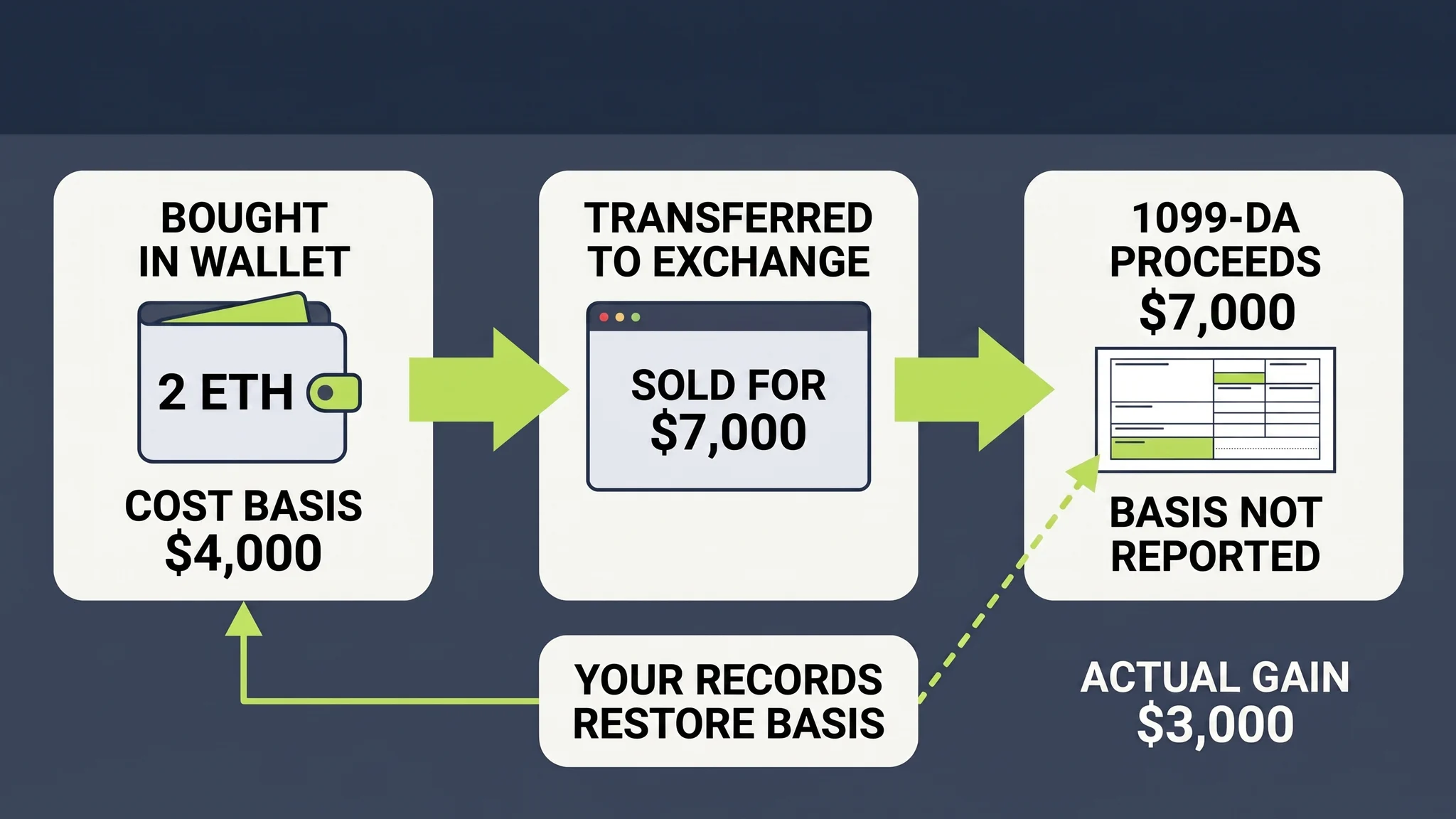
You bought 2 ETH in Coinbase Wallet for $4,000 total, then transferred them to Coinbase.com and sold them for $7,000. Coinbase knows the sale proceeds. It does not have the wallet purchase record, so the asset is noncovered and the form may not include basis. Your actual gain is $3,000 before any other basis adjustments, not $7,000.
Missing basis is not the same as zero basis. It means the broker did not report the number. You still need to calculate and support the correct amount.
For a detailed fix workflow, use our guide to repairing wrong or missing 1099-DA cost basis. The wallet-by-wallet cost basis rules also matter when you are identifying which units were sold. If several brokers sent forms, use the multiple 1099-DAs guide before combining their records.
Does Coinbase Wallet get a 1099-DA?
No, Coinbase does not issue a 1099-DA for activity that occurred only in the self-custody Coinbase Wallet. Coinbase’s tax-report instructions say Coinbase Taxes reflects Coinbase.com activity and does not include Coinbase Wallet transactions.
That difference comes down to custody. Coinbase.com holds the private keys for assets in its hosted accounts. With Coinbase Wallet, you control the keys. The IRS instructions also say a provider that only supplies software letting users control their own private keys is not a broker for that activity.
That changes when the coins return to Coinbase.com.
If you move crypto from Coinbase Wallet to Coinbase.com and sell it, the Coinbase.com sale can appear on Form 1099-DA. The wallet purchase history still will not. That is exactly how a real cost basis turns into a blank field on the broker form.
Your wallet activity does not become tax free just because no form arrives. Swaps, sales, and spending from the wallet can still be reportable. Our Coinbase Wallet tax guide covers the wallet side, while the Coinbase tax guide covers the hosted exchange account.
How do I download my Coinbase 1099-DA and full history?
Download the tax form from Coinbase Taxes, then export account statements covering your full account history. The form alone is not enough to rebuild transferred basis or verify every disposal.
To get the tax form:
-
Sign in and open Coinbase Taxes.
-
Select Documents.
-
Download Form 1099-DA and any other tax documents you need.
To get the transaction history:
-
Open the Statements page.
-
Download existing monthly statements in HTML, PDF, or CSV format, or generate a custom statement.
-
Set the asset, transaction type, and date filters. Pull the full period from account opening through year-end.
Coinbase says account statements are available from the time the account was created. Also save records from Coinbase Pro if you used it in prior years. Coinbase says old Coinbase Pro activity remains available in account statements until 2027.
What should I do before filing my Coinbase 1099-DA?
Reconcile the reported proceeds against every disposal, rebuild missing basis from outside records, and file the correct gains and losses. Do not file straight from the PDF.
The IRS says taxpayers must calculate basis before filing. For 2025 Coinbase dispositions, that usually means using Form 8949 to report the proceeds, your reconstructed basis, and the resulting gain or loss, then summarizing the totals on Schedule D.
For a line-by-line filing workflow, see how to report Form 1099-DA on your tax return. Do not force your tax return to copy an incomplete basis field. Report the correct result and keep the records that explain how you got there.
What if my Coinbase 1099-DA is wrong?
Contact Coinbase for a corrected form if the reported identity details or proceeds are wrong, but do not wait indefinitely to file an accurate return. The IRS says the issuer, not the IRS, corrects Form 1099-DA.
Use this order:
-
Compare the form to the raw Coinbase history.
-
Document the mismatch with dates, transaction IDs, and amounts.
-
Contact Coinbase Support and request a correction.
-
Keep the original form, corrected form, and all correspondence.
-
File using accurate information by the applicable deadline.
Basis needs a different response. A blank basis on a noncovered asset is not necessarily an error Coinbase can correct. If the coins came from Coinbase Wallet, Kraken, or another outside account, your reconciliation is what restores the missing history.
That is also why a Coinbase-only tax report can be misleading. Crypto follows you across platforms, but each broker sees only its own piece. If you also sold on Kraken, reconcile that separate Kraken 1099-DA with the same master ledger so one transfer does not become two unrelated records.
The bottom line
Your Coinbase 1099-DA is a reporting document, not a bill. The scary number is usually the total value of reported dispositions. Your taxable gain can be much smaller once the correct basis is attached.
The safe filing order is simple: download the form, export the full history, add outside wallet and exchange records, match every transfer, rebuild basis, then report the reconciled result.
If that trail runs across years, exchanges, and self-custody wallets, Count On Sheep can handle the cleanup. Our 1099-DA help service rebuilds the transaction history, traces cost basis across transfers, and produces a clean Form 8949 package for your tax preparer. Book a call and we will map out what is missing before you file.
Frequently Asked Questions
What is the 1099-DA Coinbase sent me?
Coinbase Form 1099-DA is an information return that reports proceeds from qualifying digital asset sales and exchanges in your Coinbase.com account to you and the IRS. The 2025 form reports proceeds but does not report cost basis, so it does not show your taxable gain.
Does Coinbase report to the IRS?
Yes. Coinbase reports qualifying digital asset sales and exchanges to the IRS on Form 1099-DA starting with 2025 transactions. Coinbase also sends you a copy through Coinbase Taxes so you can reconcile the reported proceeds with your records.
Is the amount on my Coinbase 1099-DA what I owe?
No. The amount is gross proceeds from reported dispositions, not your tax bill and not necessarily your profit. Your taxable gain or loss generally equals proceeds minus your adjusted cost basis and eligible transaction costs.
Why is cost basis missing on my Coinbase 1099-DA?
Coinbase does not report basis on its 2025 Form 1099-DA. For 2026 and later transactions, basis reporting applies to certain covered assets, while coins acquired before 2026 or transferred into Coinbase from another exchange or wallet remain noncovered and may show no basis.
Does Coinbase Wallet get a 1099-DA?
Coinbase Taxes does not include activity from the self-custody Coinbase Wallet, so Coinbase does not issue a 1099-DA for sales made only inside that wallet. If you transfer coins from Coinbase Wallet to Coinbase.com and sell them there, Coinbase can report the sale proceeds but may not have the original cost basis.
How do I report my Coinbase 1099-DA?
Match the form's proceeds to your Coinbase transaction history, add records from every wallet and exchange, calculate the correct basis for each disposal, and report the resulting capital transactions on Form 8949 and Schedule D when required. Keep the 1099-DA and your reconciliation records with your tax files.