
If you received multiple 1099-DA forms, do not add the proceeds together and assume that total is your taxable profit. Each broker reports the digital asset dispositions it handled. It may know the selling price while knowing nothing about what you paid on another exchange.
The right approach is to build one transaction history across every exchange and wallet, match transfers between accounts you own, restore the original cost basis, and then organize the taxable dispositions for Form 8949.
Start with our Form 1099-DA guide if you need a quick explanation of the form itself. For the full matching workflow across every form, see how to reconcile Form 1099-DA with your crypto records. If you are comparing it with the older brokerage form, see Form 1099-DA vs. Form 1099-B.
Why did I get 1099-DAs from multiple exchanges?
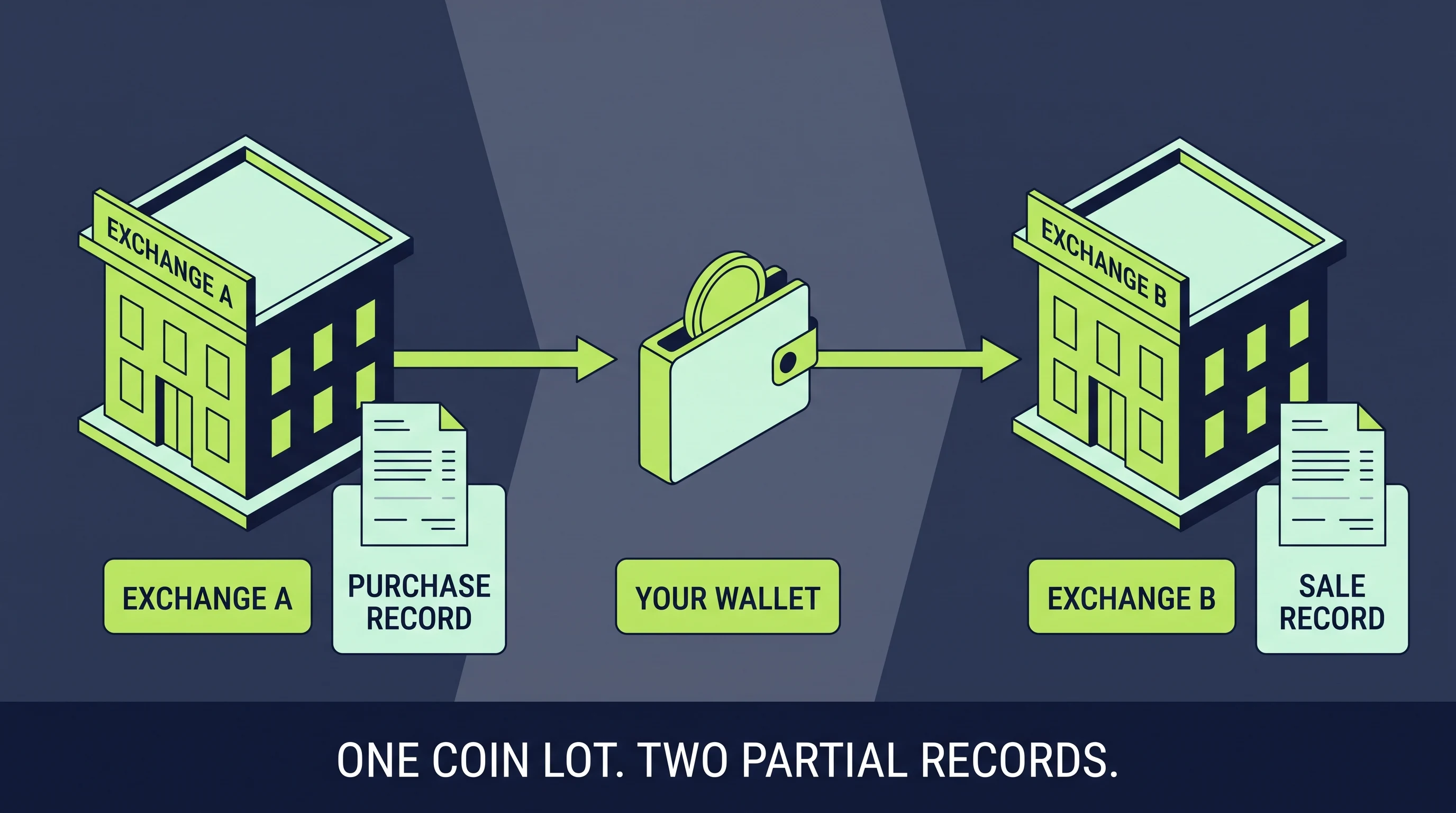
You received multiple forms because each broker reports the digital asset sales or dispositions it effected. The IRS instructions for Form 1099-DA tell brokers to report the sales they effect for customers. They do not turn one exchange into the historian for your other accounts.
Think of each exchange as a camera pointed at one room:
-
Exchange A can see the purchase made there and the withdrawal that left its account.
-
Your personal wallet can see the on-chain arrival and departure, but it does not issue a broker form.
-
Exchange B can see the deposit and eventual sale, but it may not know the original purchase price.
This is why a 1099-DA from two exchanges may not tell one coherent story. One form can contain proceeds from sales on Exchange A. Another can contain proceeds from sales on Exchange B. If crypto moved between them, the receiving broker may also identify units as transferred in without carrying over the tax lot details you expected.
For 2025 sales, brokers were generally required to report gross proceeds, while basis reporting was voluntary. For sales after 2025, mandatory basis reporting applies to covered digital assets, but noncovered assets can still have no reported basis. A digital asset generally must be acquired in the broker’s custodial account after 2025 and remain there until that broker effects the disposition to be covered under the 1099-DA rules.
Transferred-in crypto often falls outside that path. The receiving broker did not acquire the asset for you in its account, so the later form can show proceeds without basis.
If your forms came from specific platforms, use our Coinbase 1099-DA guide and Kraken 1099-DA guide to check each platform’s records before combining them.
What happens when you buy on one exchange and sell on another?
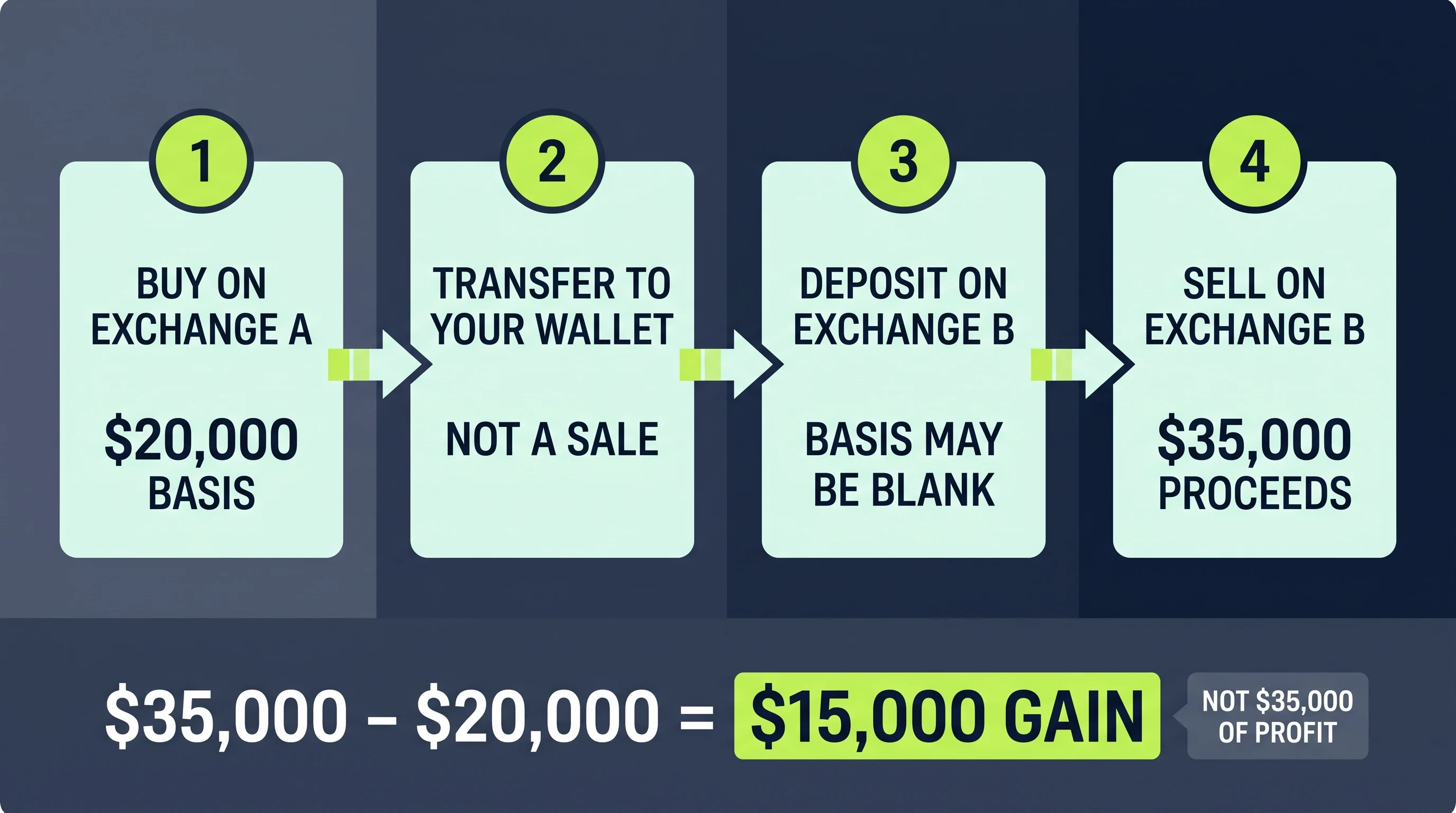
The original basis follows the crypto even when the broker’s data does not. A transfer changes where you hold the asset. It does not reset the purchase price to zero or to the value on the transfer date.
Here is the full path:
| Step | Activity | Tax result | What the broker can see |
|---|---|---|---|
| 1 | Buy 1 BTC on Exchange A for $20,000 total | No gain or loss | Exchange A knows the $20,000 basis |
| 2 | Move 1 BTC to a personal wallet | Generally not taxable | Exchange A sees a withdrawal |
| 3 | Move 1 BTC from the wallet to Exchange B | Generally not taxable | Exchange B sees an inbound transfer |
| 4 | Sell 1 BTC on Exchange B for $35,000 | $15,000 gain | Exchange B knows $35,000 of proceeds but may show no basis |
The number that belongs on the return
Assume the $20,000 purchase amount already includes the costs allocated to acquiring the Bitcoin, and ignore transfer fees for this simplified example.
The sale produces a $15,000 gain: $35,000 of proceeds minus $20,000 of adjusted basis.
If tax software treats the blank basis on Exchange B’s form as zero, it may calculate a $35,000 gain. That overstates the gain by $20,000.
Exchange A should not report your withdrawal to your own wallet as if it were a $20,000 sale. Exchange B reports the disposition it handled, which is the $35,000 sale. The repair is not to delete Exchange B’s proceeds. It is to connect the sale back to the original $20,000 lot.
The same logic applies if you receive other 1099-DA forms for unrelated sales. Keep all valid proceeds, remove duplicate or mislabeled events only when the records support that treatment, and attach the right basis to each actual disposition.
For a field-by-field orientation before you start, use our 1099-DA instructions guide.
How do you combine multiple 1099-DAs on one return?
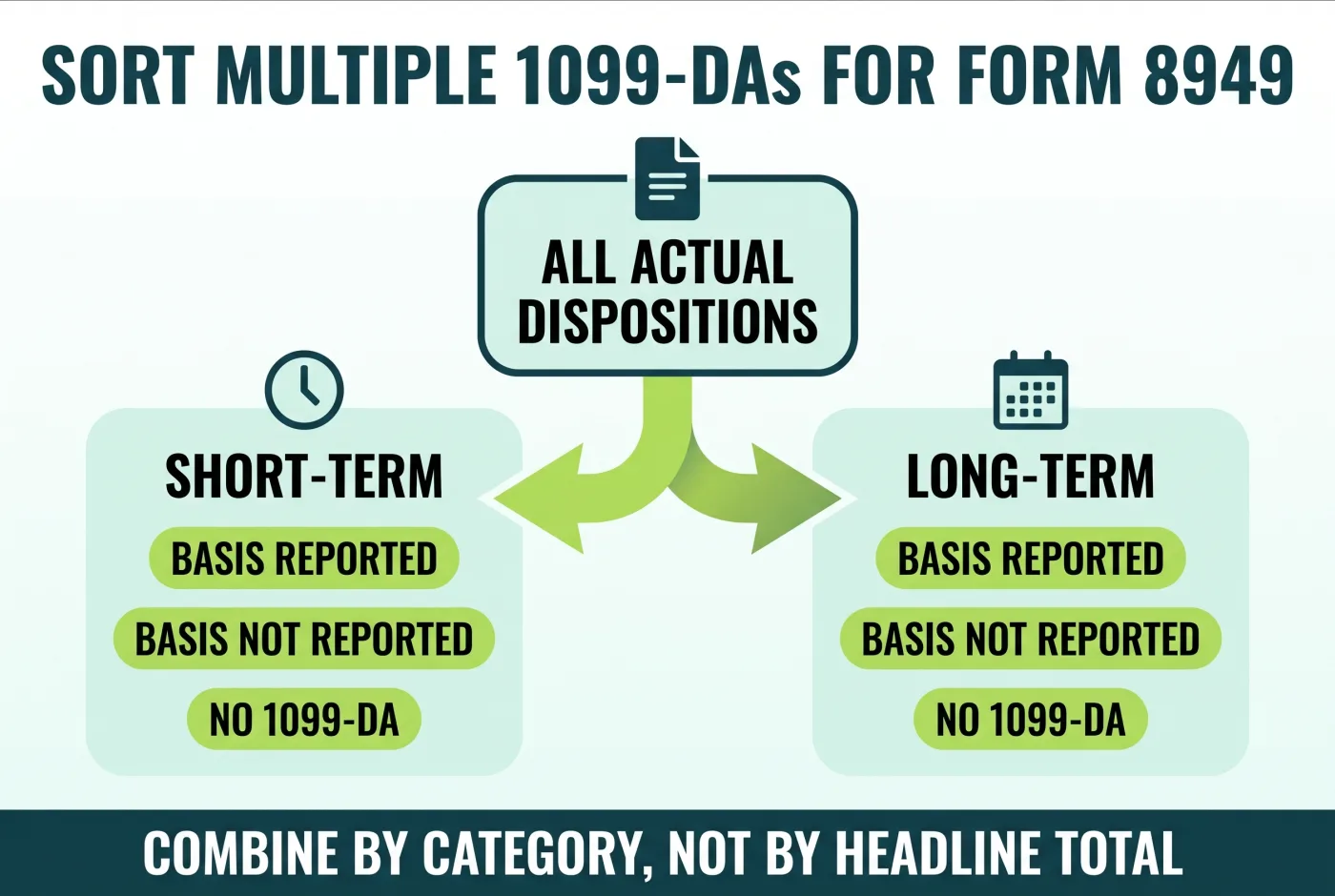
Combine the transactions, not the headline totals. Form 8949 is organized by holding period and reporting status, so one return can include transactions from Coinbase, Kraken, and other brokers without pretending they came from one form.
Use this order:
-
List every actual sale, trade, spend, and other taxable disposition from all accounts.
-
Preserve the proceeds shown on each valid 1099-DA for the transaction it reports.
-
Add the correct acquisition date and adjusted basis from your full records.
-
Separate short-term transactions from long-term transactions.
-
Within each holding-period group, separate transactions whose basis was reported to the IRS from those whose basis was not reported.
-
Keep taxable digital asset dispositions that had no 1099-DA in their applicable no-form category.
-
Carry the totals from all required Form 8949 parts to Schedule D.
The IRS Form 8949 instructions require separate reporting for the different categories. They also allow detailed attached statements in the same format as Form 8949. If you use the attached-statement summary procedure and have statements from more than one broker, report each broker’s total on a separate Form 8949 row.
That last detail matters. “Combine” does not mean squeezing six exchange files into one mystery total. It means putting every disposition into the correct category and reconciling the category totals on one tax return.
Our Form 8949 for crypto guide explains the form’s structure, and our walkthrough on how to report 1099-DA on your tax return follows the information into Schedule D.
How do you match withdrawals to deposits so basis follows the coins?
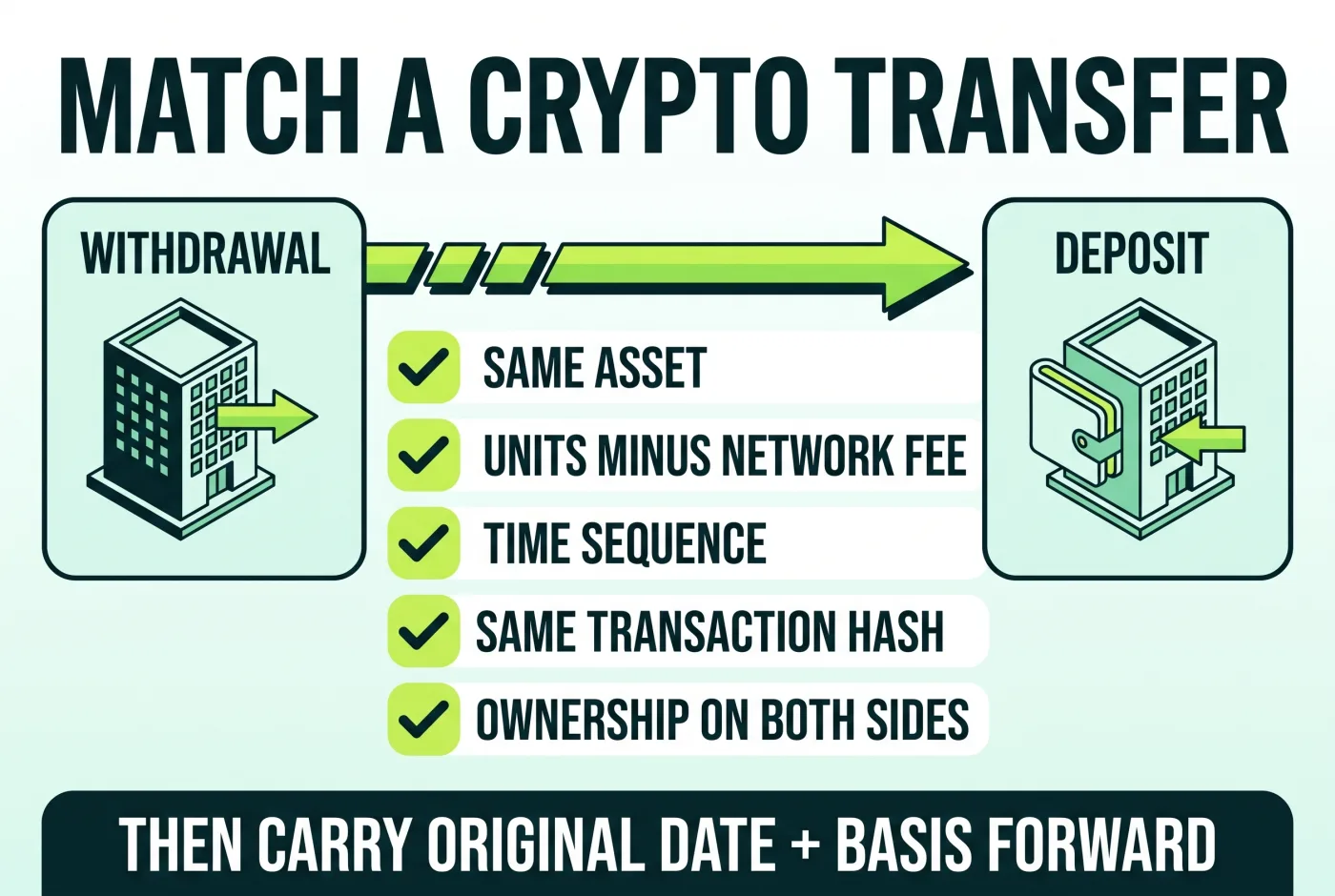
Match each outbound transfer to its inbound side before calculating gains. A clean match proves the asset stayed under your ownership and gives the receiving account the acquisition history needed for a later sale.
For every transfer, compare:
| Field | What to match |
|---|---|
| Asset | The same digital asset on both sides |
| Units | Withdrawal units, deposit units, and any network fee difference |
| Time | A reasonable sequence from withdrawal to deposit |
| Transaction ID | The same on-chain hash when both platforms provide it |
| Addresses | Source and destination addresses, when available |
| Ownership | Evidence that both accounts or wallets belonged to you |
| Original lot | Acquisition date, cost, and eligible acquisition costs |
Do not delete the withdrawal and deposit simply because neither is a sale. Keep them as a linked pair. That pair is the bridge between the $20,000 purchase on Exchange A and the $35,000 sale on Exchange B.
CSV exports sometimes round timestamps, label transfers differently, or show the network fee as a separate amount. On-chain data can help settle the match, but it does not prove your original basis by itself. You still need the source exchange’s trade history, account statement, or other reliable purchase record.
For a deeper transfer-to-basis repair workflow, see how to fix wrong or missing 1099-DA cost basis.
How does per-wallet cost basis change the reconciliation?
Basis is tracked by wallet or account under the current digital asset rules, so you cannot treat all units of the same coin across every platform as one unrestricted pool. Your records need to show which lots were held in each account and which lots moved.
Rev. Proc. 2024-28 provided a safe harbor for allocating unused basis to digital assets held in each wallet or account as of January 1, 2025. Its transition rules reflect the move away from universal, multi-wallet basis accounting.
For the Exchange A to Exchange B example, this means the transfer trail does more than explain why a broker left basis blank. It identifies the lot that left Exchange A, passed through the wallet, and arrived at Exchange B. Without that trail, software may pull basis from a different Bitcoin lot held somewhere else.
That mistake can change both the gain and the holding period. A high-basis long-term lot and a low-basis short-term lot can produce very different tax results even if both are 1 BTC.
Read our full guide to per-wallet crypto cost basis and Rev. Proc. 2024-28 before using a universal accounting export for a return after the transition.
Can multiple 1099-DAs double-count a sale?
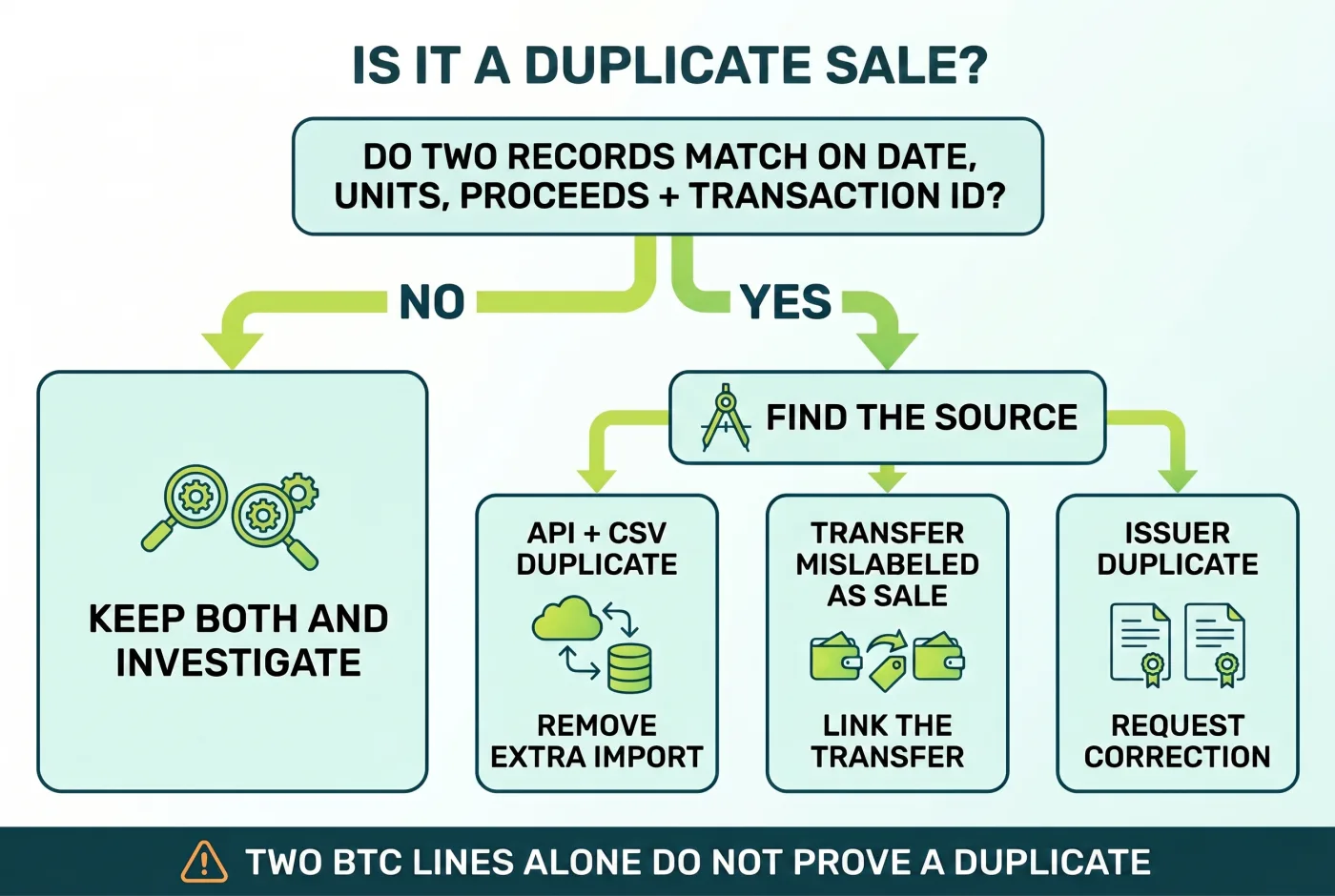
Multiple forms can appear to double-count activity, but the duplicate must be proved at the transaction level. Two lines for “BTC” are not enough. You may have sold different Bitcoin lots on different dates or through different brokers.
Look for these common traps:
-
A transfer imported as a sale. A withdrawal from Exchange A and deposit to Exchange B may be mislabeled by software as two unrelated events.
-
The same exchange imported twice. An API connection and a CSV upload can create duplicate sales, proceeds, and fees.
-
Internal exchange movements treated as disposals. Moving assets between subaccounts or products can create pairs that need to be linked, not taxed.
-
A transfer fee ignored. The owned-to-owned transfer is generally not taxable, but digital assets used or withheld to pay transaction services can create a separate disposition.
-
Gross proceeds mistaken for income. Two forms showing $60,000 of combined proceeds do not prove $60,000 of profit.
IRS digital asset FAQ 81 says a transfer between wallets, addresses, or accounts you own is a non-taxable event, except to the extent digital assets are used or withheld to pay for the transaction service. Our taxable vs. non-taxable crypto events guide covers the distinction with more examples.
When two valid forms report two genuine sales, keep both. When two records point to the same sale, determine whether the duplication came from the broker, your import process, or tax software before removing anything.
What if one of the 1099-DAs is wrong?
Ask the issuer to correct identity data, gross proceeds, duplicate dispositions, or transactions that did not happen. Do not manufacture extra basis to force a wrong proceeds number into the gain you expected.
The IRS guidance for recipients of Form 1099-DA says to contact the issuer, keep the original form and your correspondence, and request a corrected form when information is wrong.
Missing basis is different. If basis was not reported to the IRS for a transferred-in, noncovered asset, you generally use your supported basis when preparing Form 8949. A blank field is not necessarily a broker error, and it never means you should assume the asset cost zero.
Keep a short reconciliation note for each issue:
| Issue | Record to keep | Next action |
|---|---|---|
| Proceeds do not match the sale | Trade export and account statement | Request issuer review |
| The same sale appears twice | Transaction ID and duplicate source records | Remove the duplicate import or request correction |
| Basis is blank after a transfer | Source purchase and matched transfer trail | Enter supported basis in the proper category |
| Acquisition date is missing | Original trade confirmation and wallet trail | Restore the supported date and holding period |
What should you gather before filing multiple 1099-DAs?
Gather records from every account that touched the assets, including accounts that did not issue a form. The sale-year 1099-DAs are only the starting point.
Your file should include:
-
Every original and corrected Form 1099-DA.
-
Full transaction exports from each exchange, not just gain and loss summaries.
-
Deposit and withdrawal exports with timestamps and transaction IDs.
-
Wallet addresses and on-chain records for self-custody transfers.
-
Purchase records from earlier years when those lots were later sold.
-
Notes supporting ownership of the source and destination accounts.
-
A final ledger showing proceeds, adjusted basis, acquisition date, disposition date, holding period, and gain or loss.
Reconcile totals back to each broker form before filing. Your ledger should explain why the valid 1099-DA proceeds remain on the return and where the basis for each sale came from.
When does the puzzle need professional reconciliation?
Professional reconciliation makes sense when the missing basis spans several exchanges, wallets, and years, or when your software cannot explain its own totals. A $20,000 basis gap is too large to settle with a guess.
Get help when you have:
-
Transfers that do not pair cleanly because units changed, assets were wrapped, or bridges were involved.
-
Multiple API and CSV imports with duplicate proceeds.
-
Missing exchange history or closed accounts.
-
Mixed covered and noncovered lots in the same asset.
-
Material differences between broker forms and tax software.
-
Prior returns that used a universal basis method and current records that need wallet-by-wallet treatment.
The goal is a return-ready ledger with a documented transfer trail, not a prettier software dashboard.
Turn disconnected forms into one defensible tax record
Multiple 1099-DAs are manageable once every form is tied to the transactions it actually reports. The hard part is carrying basis across the gaps between exchanges without turning transfers into sales or letting blank fields become zeroes.
Count On Sheep’s 1099-DA help service connects exchange files, wallets, transfers, tax lots, and broker forms into one defensible record. You get the numbers and documentation needed for filing without guessing at basis or paying tax on gross proceeds as if they were profit.
Frequently Asked Questions
Do I report every 1099-DA I receive?
Use every valid 1099-DA when preparing your return, but do not treat each form's gross proceeds as taxable income. Reconcile each reported disposition with your complete records, calculate the correct basis, and report the resulting gain or loss. If a form reports a transaction that did not happen, request a correction from the issuer and keep the correspondence.
Why did I get 1099-DAs from multiple exchanges?
Each broker reports the digital asset sales or dispositions it effected. If you sold or exchanged crypto through two brokers, you may receive forms from both, and one broker can issue more than one Form 1099-DA. The forms are separate pieces of your tax history, not a combined gain and loss report.
Is transferring crypto between exchanges taxable?
A transfer between wallets or exchange accounts you own is generally not taxable. Digital assets used or withheld to pay a transfer fee can create a separate disposition, so preserve the fee record along with the matched withdrawal and deposit.
Why does my 1099-DA show no cost basis after a transfer?
The receiving broker usually did not see what you paid before the asset arrived. Transferred-in assets can be noncovered, which means the broker may report the later proceeds without reporting basis. A blank basis does not mean zero basis.
Can multiple 1099-DAs double-count my sales?
Valid forms should report the sales each broker effected, but duplicates, software imports, and transfers mislabeled as sales can make proceeds appear twice. Compare transaction dates, units, proceeds, and transaction IDs rather than matching on the asset name alone. Ask the issuer to correct a genuine duplicate.
How do I combine multiple 1099-DAs on Form 8949?
Combine the underlying transactions by holding period and reporting category, including whether basis was reported to the IRS. Use separate Form 8949 parts or attached statements as required, then carry the totals to Schedule D. If you summarize attached statements from more than one broker, the Form 8949 instructions say to report each broker's total on a separate row.