
Form 1099-DA is easier to read once you stop treating it as one big tax calculation. Most of the form does four jobs: identify the asset, show what left your account, report the proceeds, and tell you what the broker did or did not report about basis.
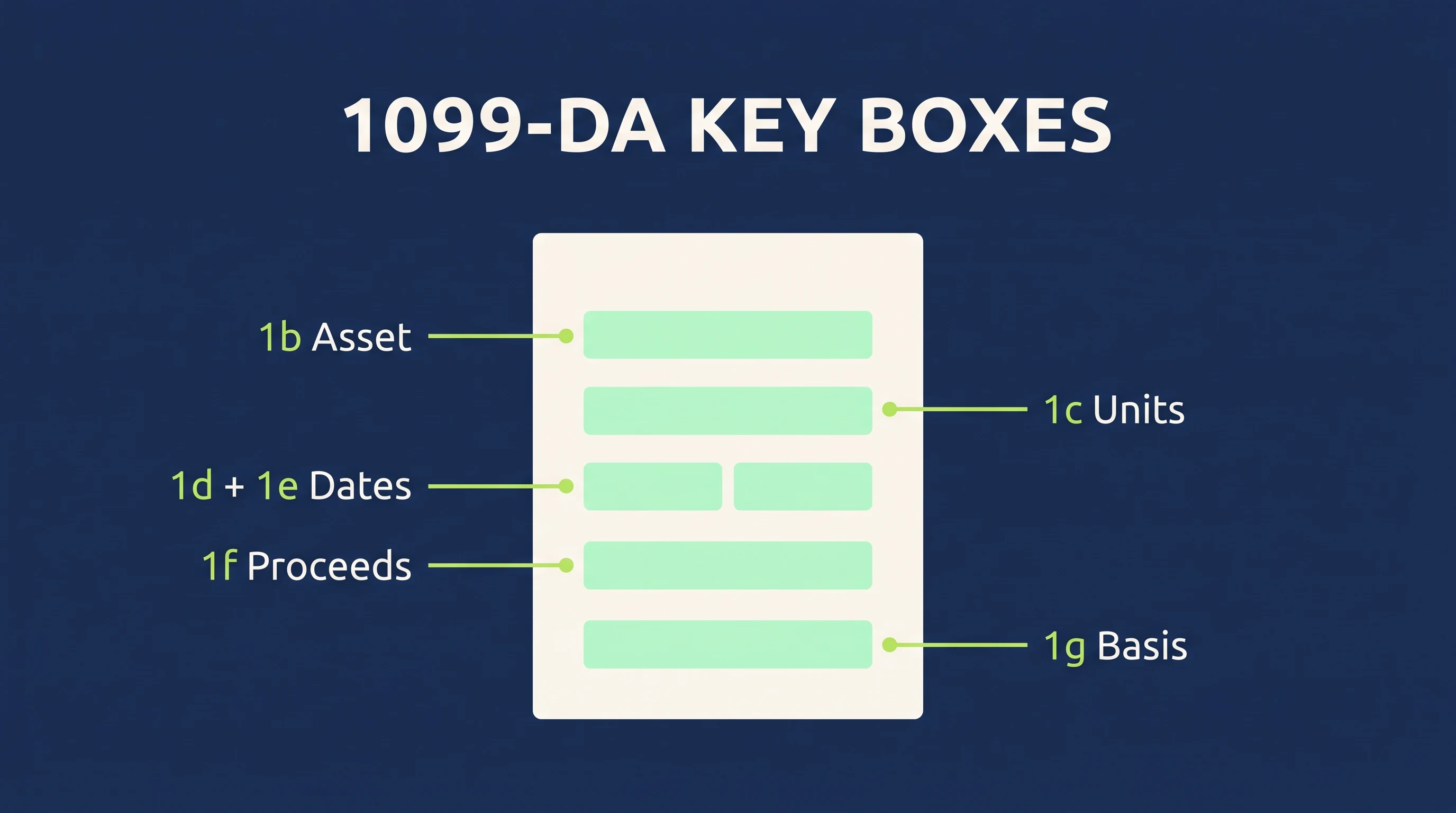
The boxes that usually matter most for your return are 1b through 1g, plus box 2, box 6, box 9, and the “Applicable checkbox on Form 8949” code near the top. Those fields tell you what was sold, when it was acquired and disposed of, the proceeds, the reported basis, and whether the IRS received that basis.
For the broader rule set, start with our Form 1099-DA guide. This article focuses on the 2026 revision of the form and the IRS Instructions for Form 1099-DA, then shows how the information moves to Form 8949.
Proceeds reporting began for broker transactions during 2025. Mandatory basis reporting phases in for covered digital assets acquired on or after January 1, 2026, then sold while still held with the same custodial broker. Assets acquired before 2026 and assets transferred into the broker are generally noncovered, so their basis may be blank.
Which fields should you read before the numbered boxes?
Start with the filer, recipient, account, and Form 8949 code. These unnumbered fields tell you who issued the form, whose tax ID the IRS matched, which account produced it, and where the transaction belongs on Form 8949.
-
Filer information and TIN: The broker’s name, address, phone number, and taxpayer identification number.
-
Recipient information and TIN: Your name, address, and taxpayer identification number. Your copy may show only the final four digits, but the filer reports the complete TIN to the IRS.
-
Account number: The broker’s account identifier, not a wallet address. The IRS requires it when a broker files more than one Form 1099-DA for a recipient with multiple accounts and encourages it on all forms.
-
CUSIP number: A CUSIP or other applicable identifying number for a digital asset that is also a tokenized security. Most ordinary cryptocurrency transactions will not use this field.
-
Applicable checkbox on Form 8949: A one-letter routing code. G means short-term with basis reported, H means short-term without basis reported, J means long-term with basis reported, K means long-term without basis reported, and Y means the broker could not determine whether H or K applies because the holding period is unknown.
That top code is a routing aid, not the gain or loss itself. G and H point to short-term reporting in Form 8949 Part I. J and K point to long-term reporting in Part II.
Boxes 1a through 1c identify the digital asset and units
Boxes 1a, 1b, and 1c tell you exactly which digital asset was disposed of and how much of it left the account.
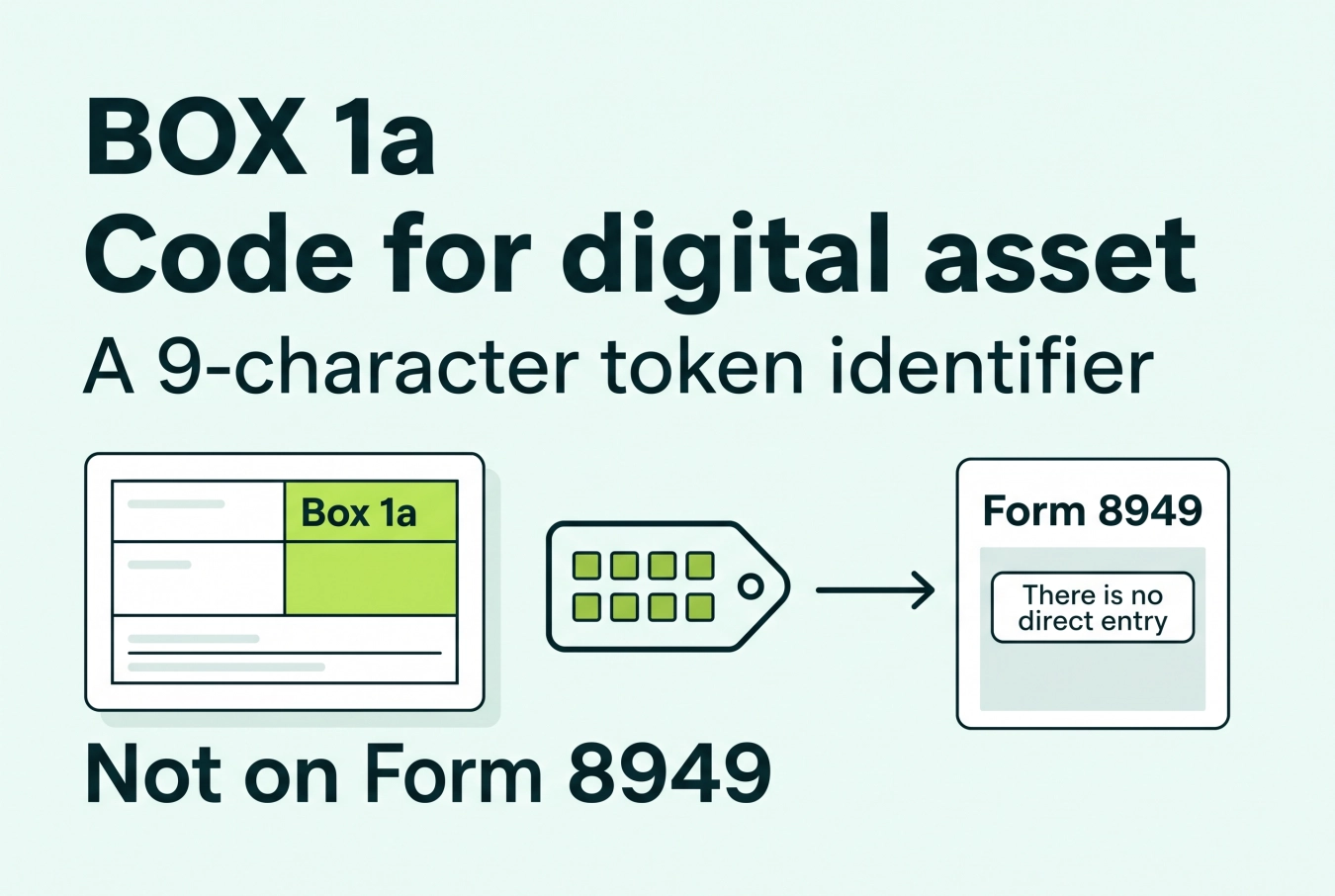
Box 1a, Code for digital asset: The broker enters the nine-character Digital Token Identifier issued by the Digital Token Identifier Foundation. If the asset is not registered, the instructions tell the broker to use 999999999. The same fallback code is used for specified NFTs reported under the optional method.
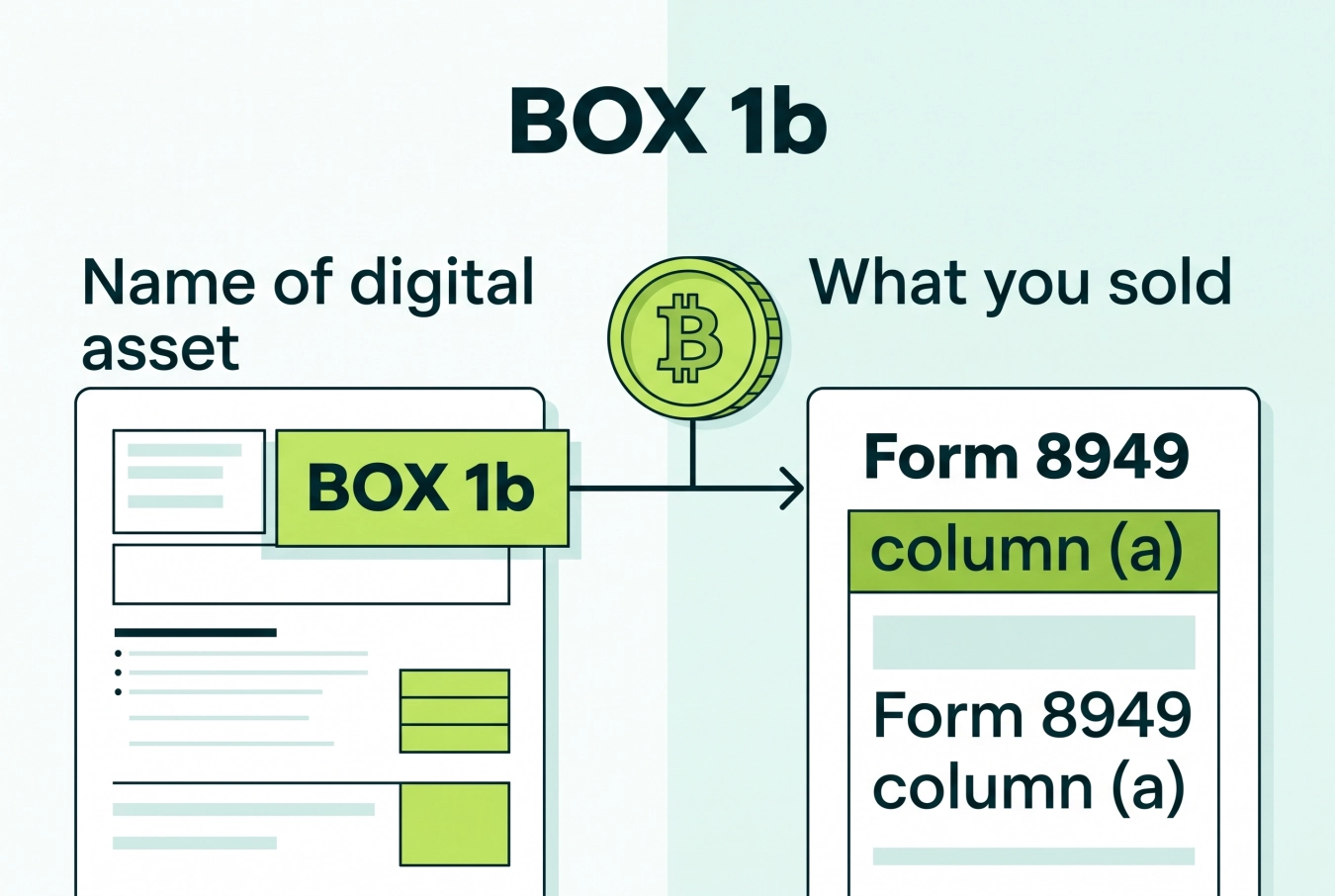
Box 1b, Name of digital asset: This is the full asset name. When box 1a contains a registered token identifier, the name must match that registration. Under the optional NFT method, this field reads “Specified NFTs.”
Box 1c, Number of units: This is the number of units sold, exchanged, or otherwise disposed of, reported to 18 decimal places. Under an optional aggregate method, it can show the total qualifying stablecoin or specified NFT units covered by the form.
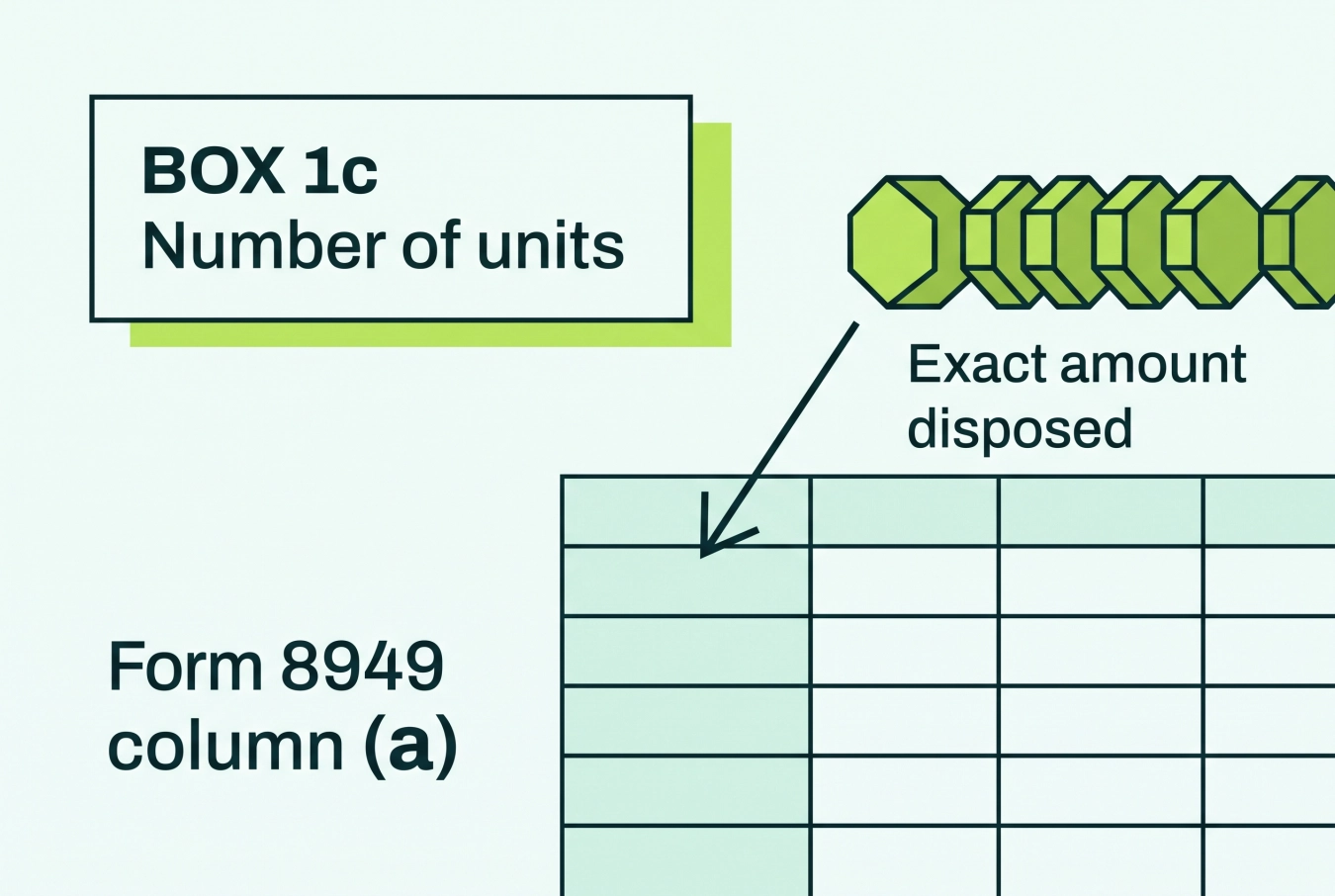
For Form 8949 column (a), use the full name or symbol and the exact units disposed of. The IRS instructions also ask for the sale transaction ID when it is available.
Boxes 1d and 1e show when you acquired and disposed of the asset
Box 1d is the acquisition date and box 1e is the sale or disposition date. These dates determine which Form 8949 part you use and whether the result is generally short-term or long-term.
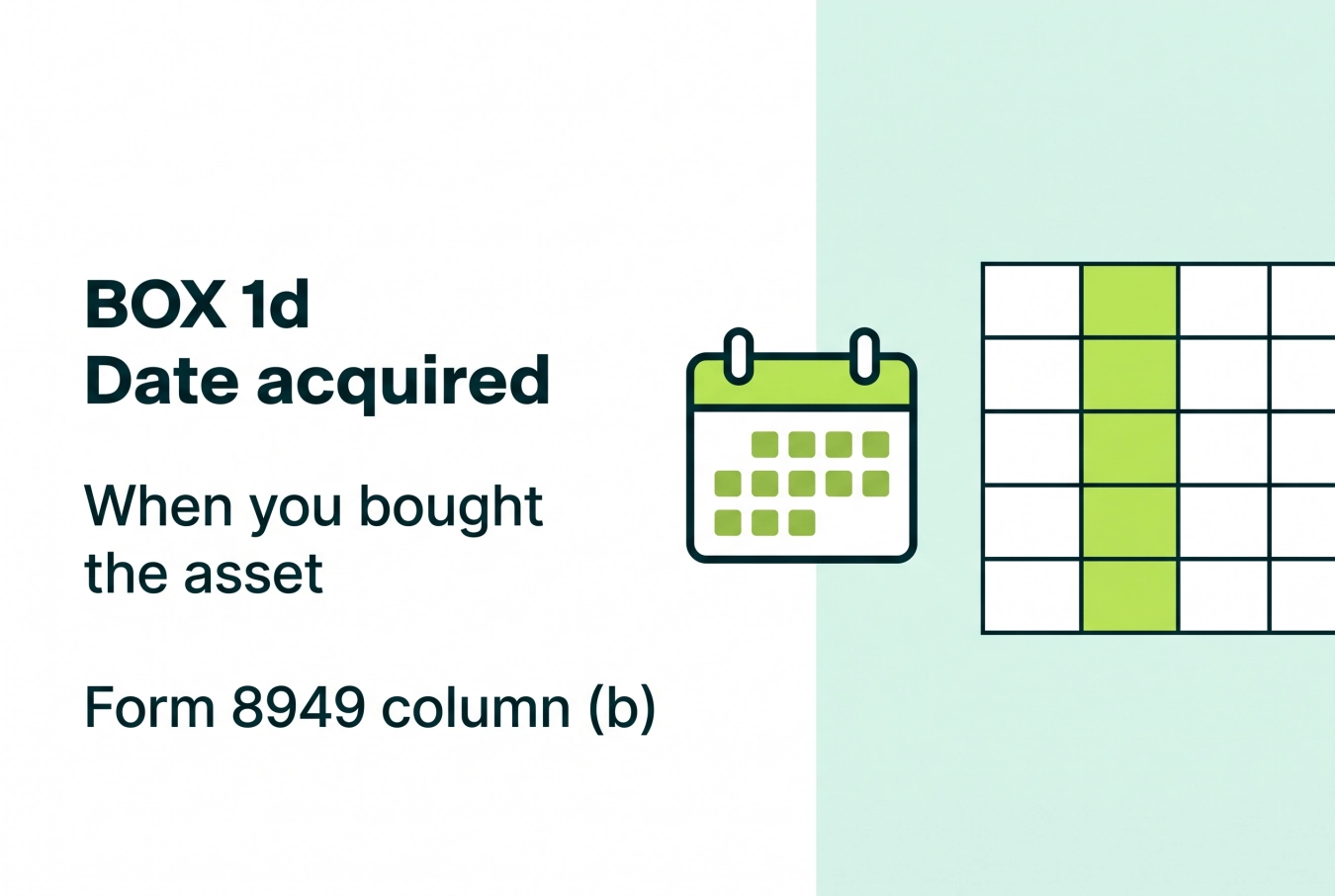
Box 1d, Date acquired: The broker enters the original acquisition date in MM/DD/YYYY format. It may be blank if the units were acquired on various dates, box 9 is checked and the broker does not know or does not report the date, or an optional stablecoin or NFT method applies.
Box 1e, Date sold or disposed: The broker enters the sale or disposition date in MM/DD/YYYY format. It may be blank under the optional reporting methods for qualifying stablecoins and specified NFTs.
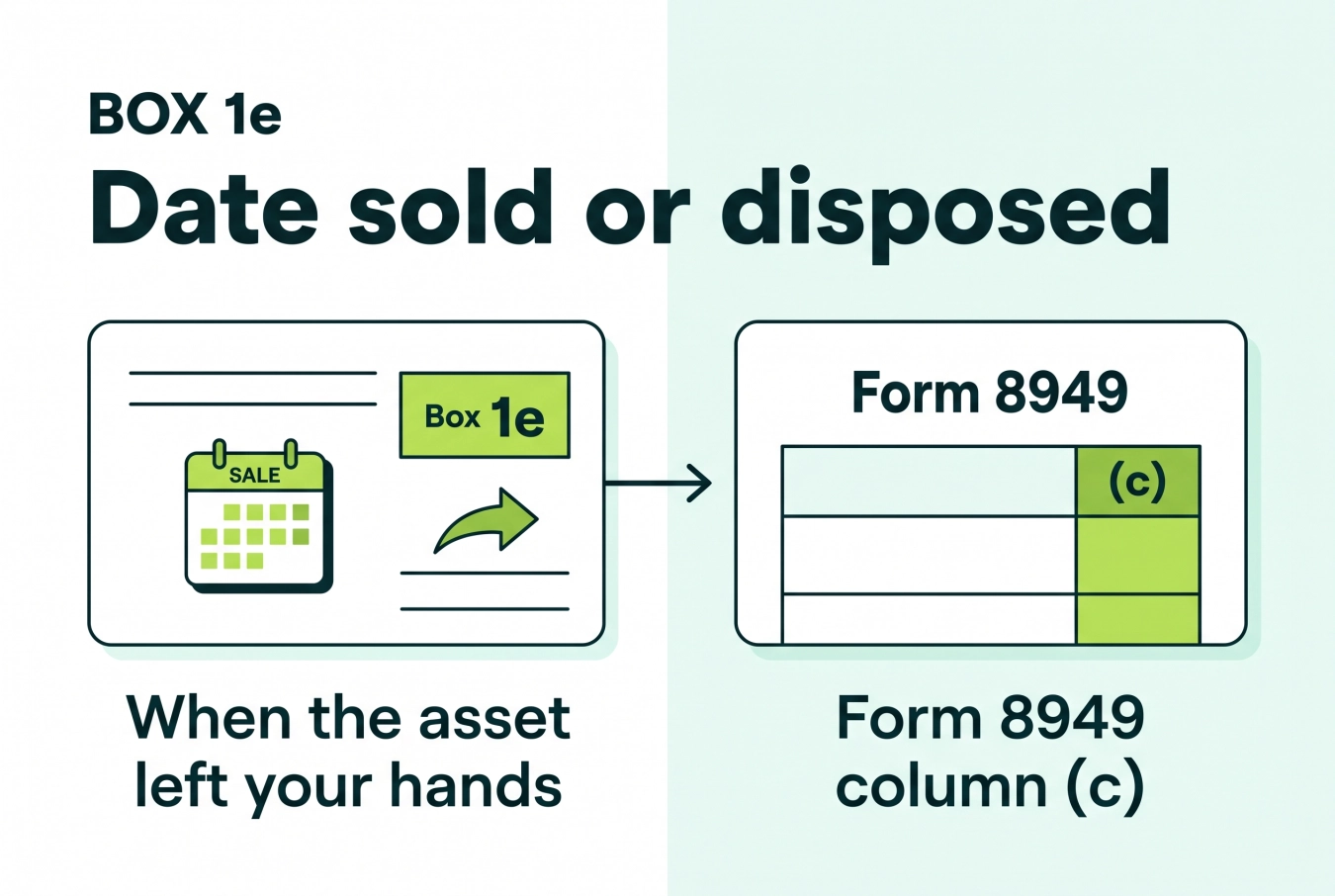
On Form 8949, box 1d generally supplies column (b), and box 1e supplies column (c). If multiple acquisition dates are combined on one permitted row, Form 8949 instructions allow “VARIOUS” in column (b), but short-term and long-term transactions still belong in separate parts.
Box 1f is proceeds, not taxable income
Box 1f shows the total proceeds from the digital asset transaction. That amount can include cash, services, digital assets, or other property received for the asset you disposed of.
The 2026 instructions require brokers to reduce the reported proceeds by digital asset transaction costs related to the sale, including transaction fees, commissions, and transfer taxes. For certain option transactions, box 3a tells you whether option premiums were reflected in the number.
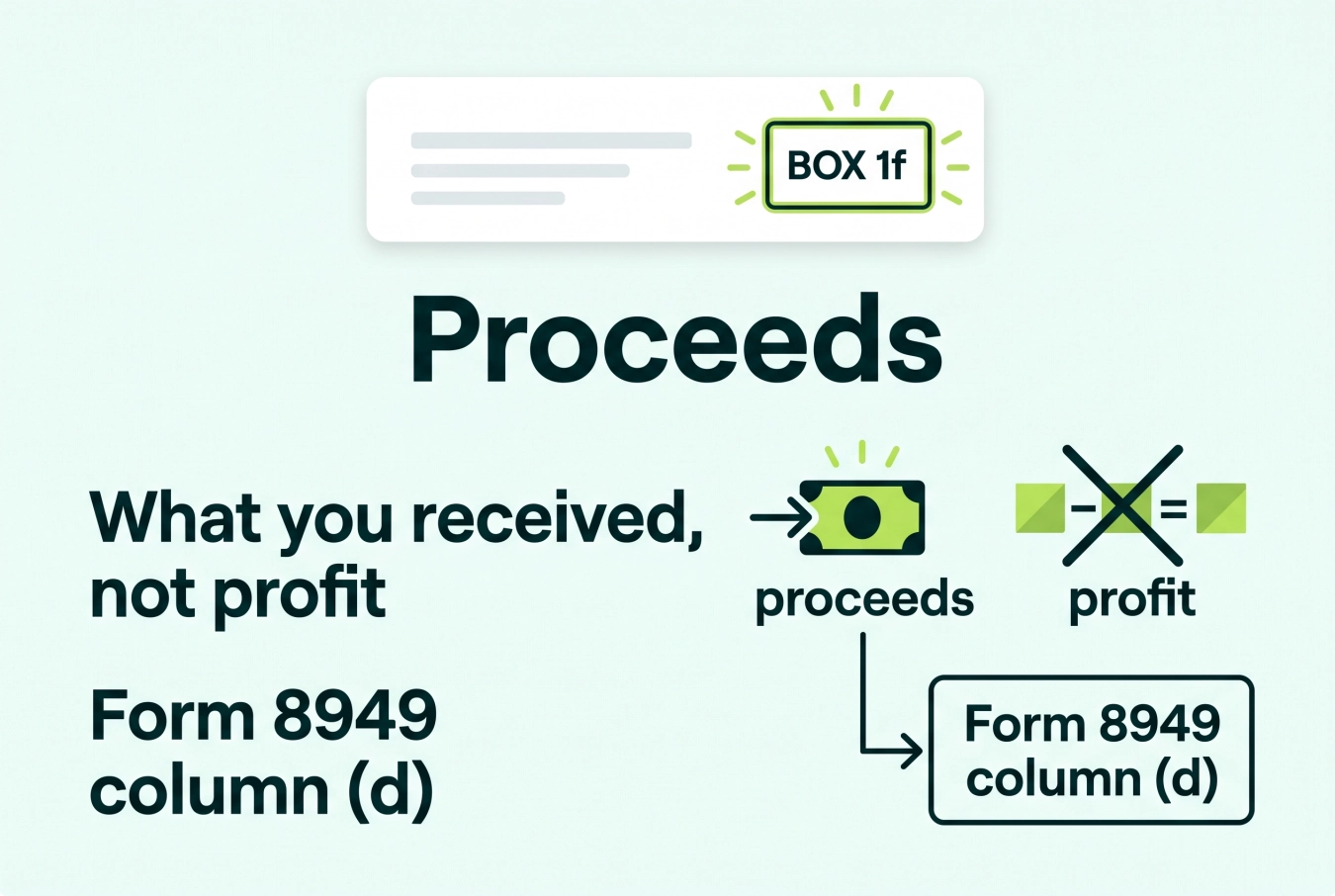
Copy the proceeds shown on Form 1099-DA to Form 8949 column (d). Do not replace the figure with your net bank deposit or subtract the basis from it. Basis has its own column.
Box 1g is cost or other basis
Box 1g shows the aggregate adjusted basis of the units disposed of when the broker reports basis. This is the starting amount that generally maps to Form 8949 column (e).
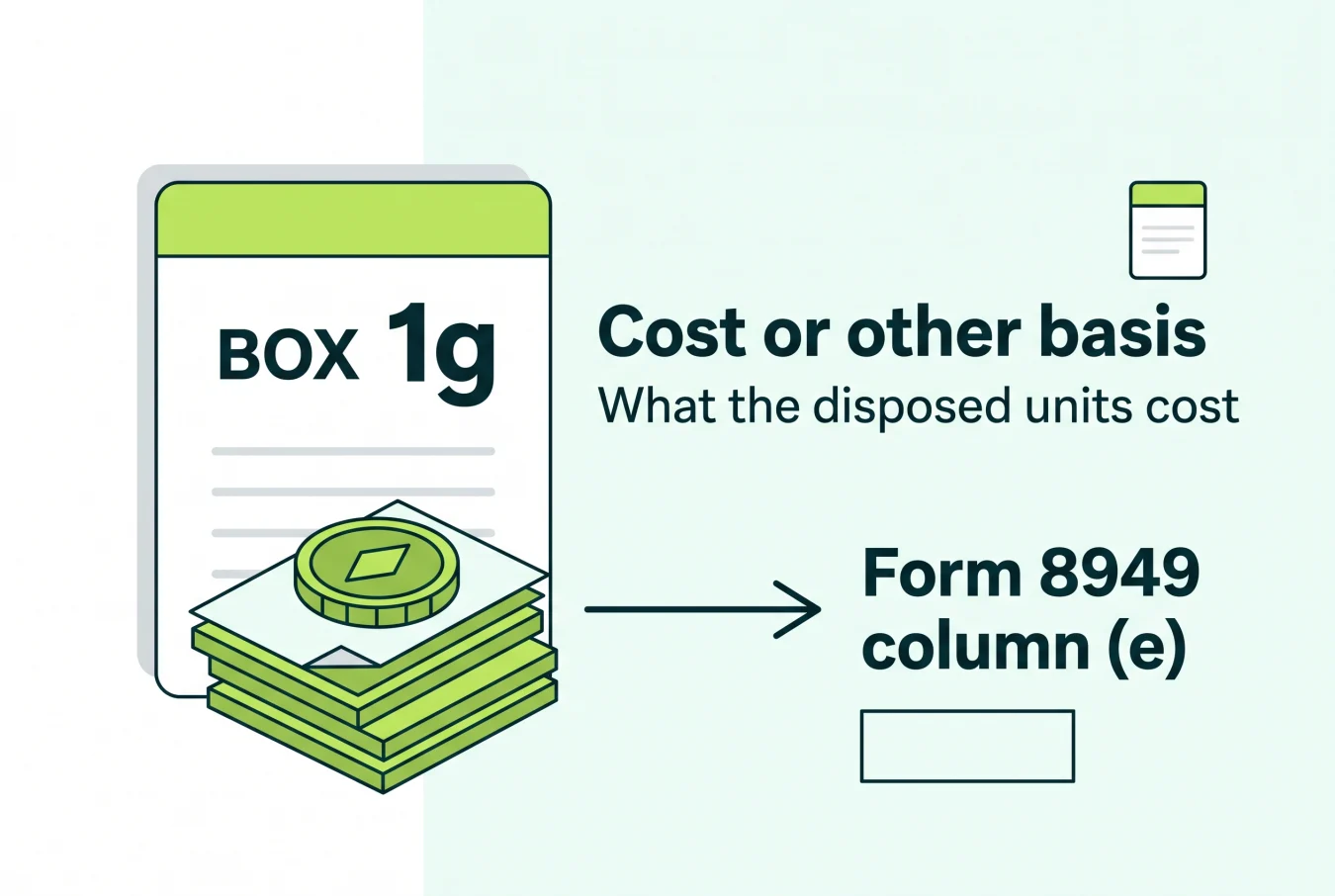
The distinction between a blank and zero matters:
-
A blank box 1g means the broker did not report a basis amount on that form.
-
A
0in box 1g means the broker reported that the basis was actually zero. -
Any entry in box 1g, including zero, is treated on the recipient instructions as basis reported to the IRS.
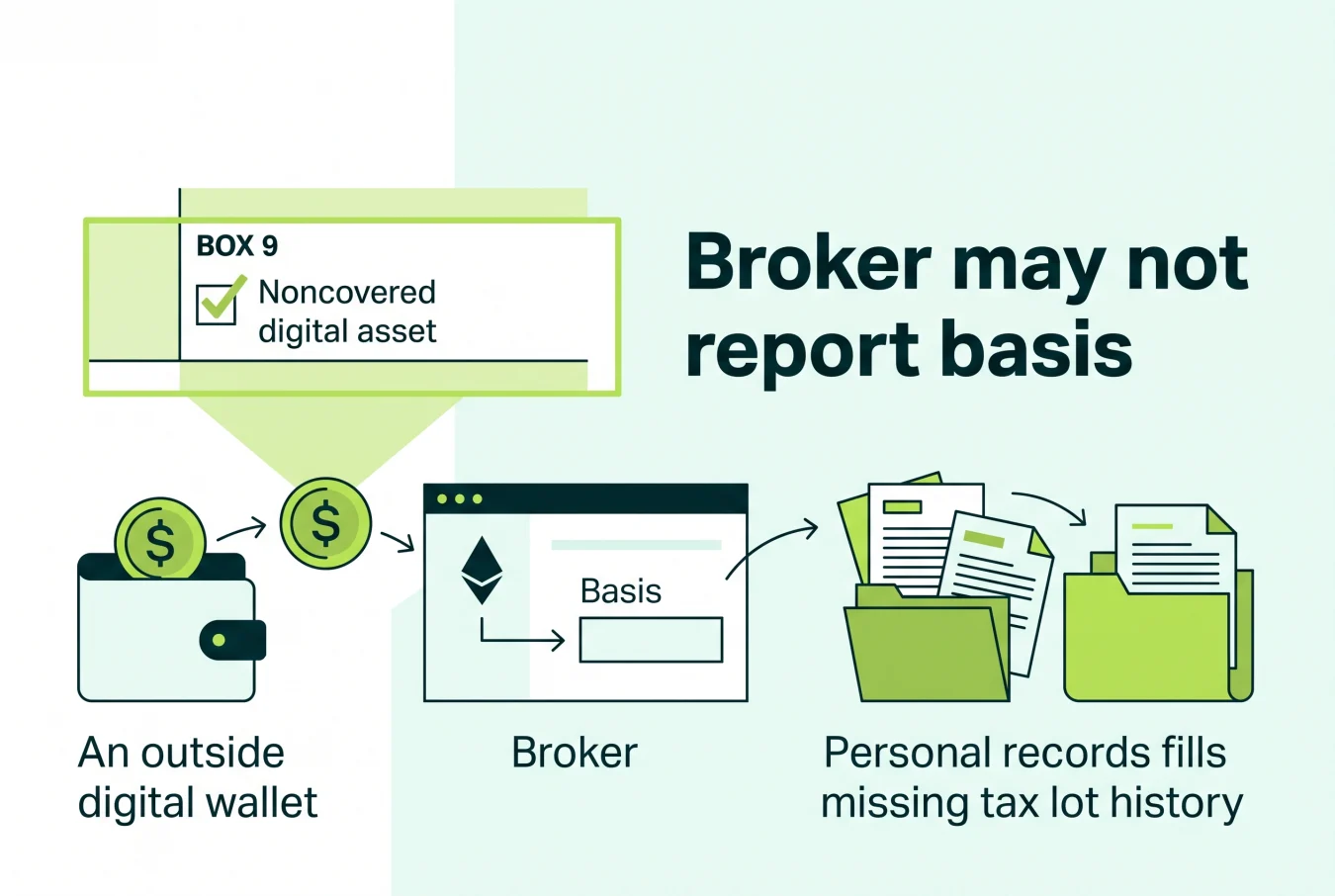
If box 9 is checked, the asset is noncovered and box 1g may be blank. That often happens when the asset was acquired before 2026 or moved into the broker from another wallet or exchange. Reconstruct the basis from your own records. Our guide to fixing wrong or missing 1099-DA cost basis walks through that process.
Boxes 1h and 1i cover special adjustments
Boxes 1h and 1i apply to narrow cases involving tokenized debt or tokenized stock and securities. They are not general cryptocurrency fields.
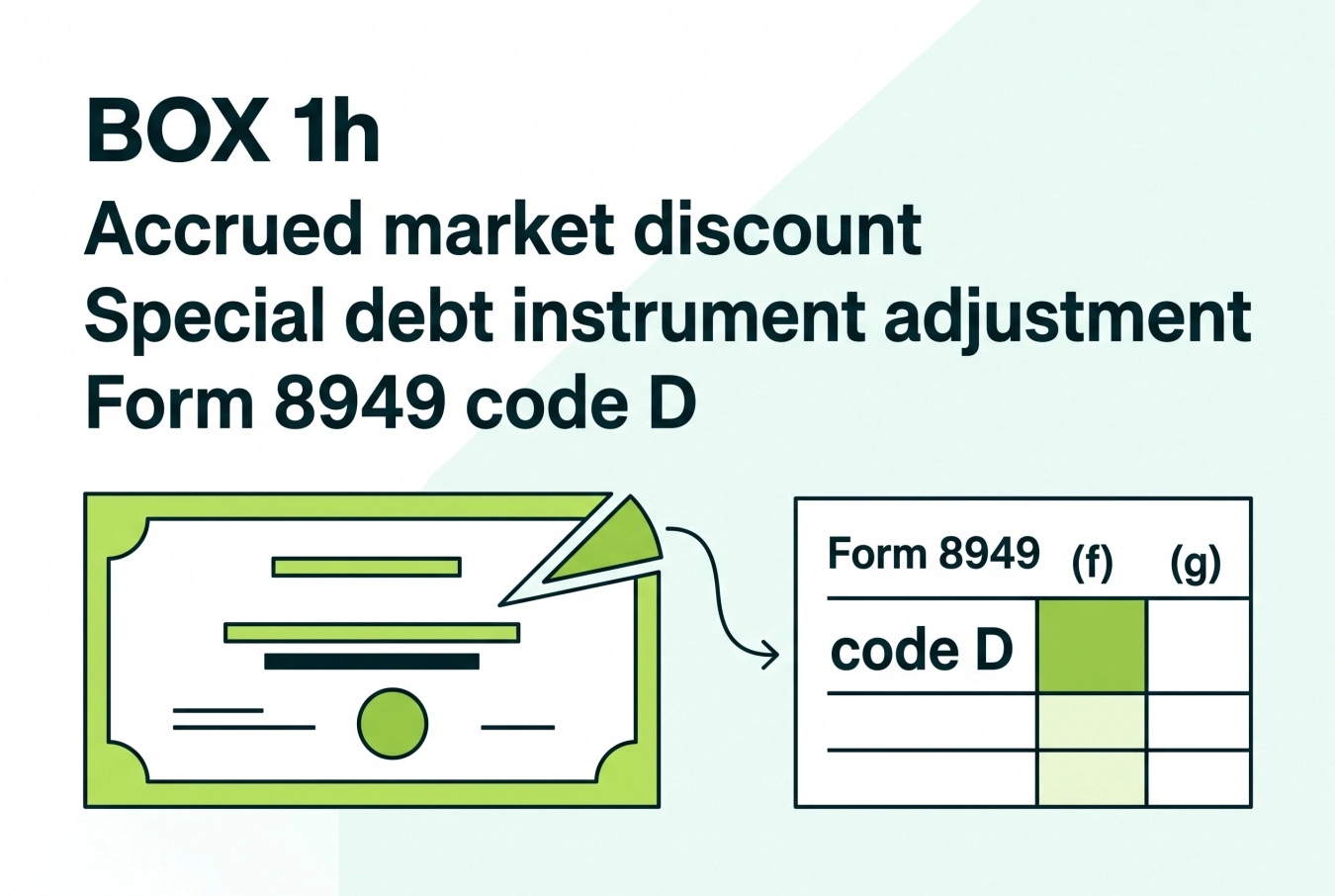
Box 1h, Accrued market discount: This reports accrued market discount when the covered digital asset is also a debt instrument for federal tax purposes. Form 8949 generally uses code D in column (f), with the adjustment calculated in column (g) under the Form 8949 worksheet. Do not simply copy box 1h into column (g) without applying that worksheet.
Box 1i, Wash sale loss disallowed: This reports a nondeductible wash sale loss for a digital asset that is also stock or a security under the wash sale rules. Form 8949 uses code W in column (f), and the nondeductible loss is generally entered as a positive adjustment in column (g).
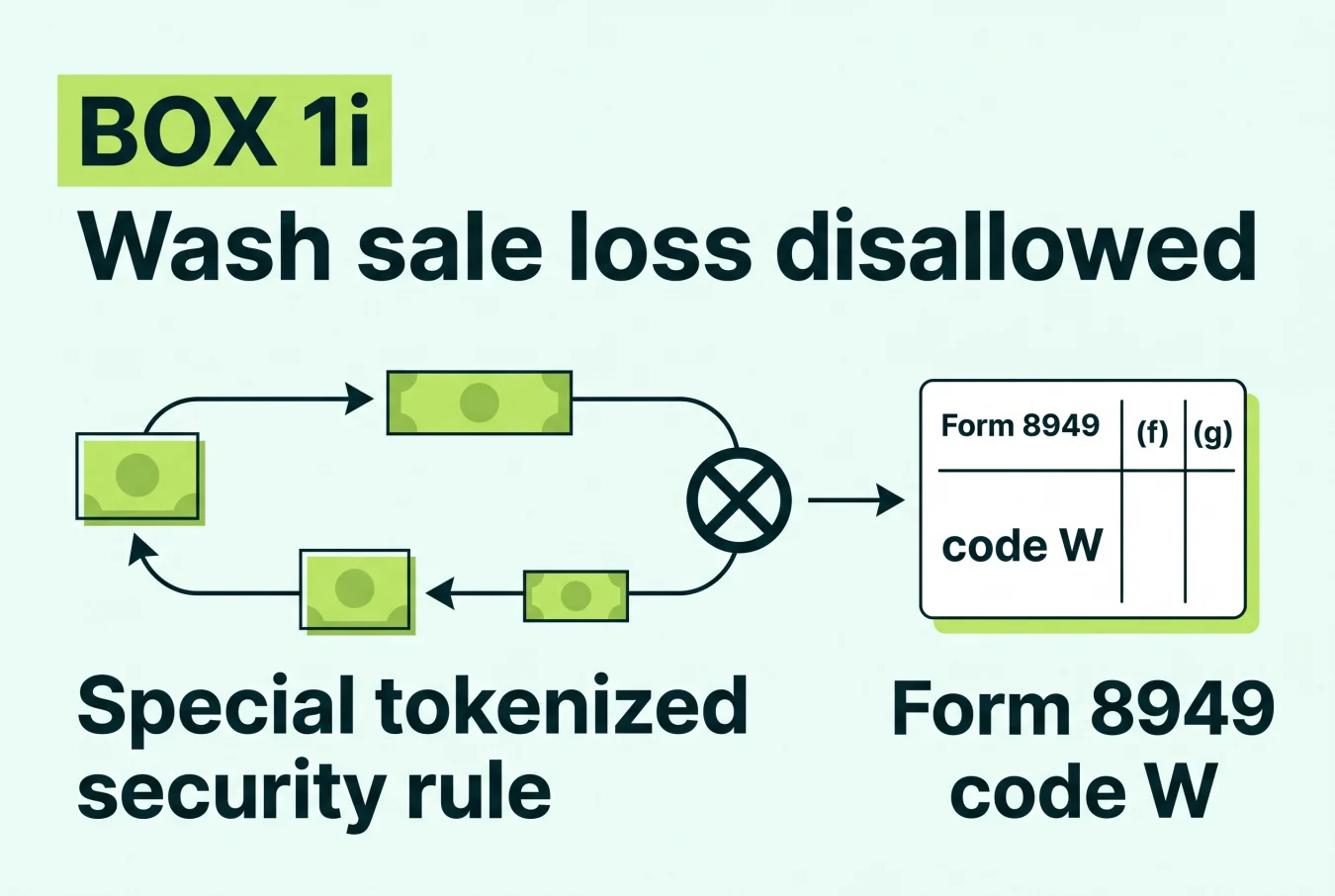
The broker rules for box 1i focus on tokenized securities. A wash sale amount does not automatically appear for ordinary crypto simply because you sold and repurchased it.
Boxes 2, 6, and 9 tell you how basis and holding period were classified
Boxes 2, 6, and 9 explain whether basis went to the IRS, whether the broker classified the transaction as short-term or long-term, and whether the asset was noncovered.
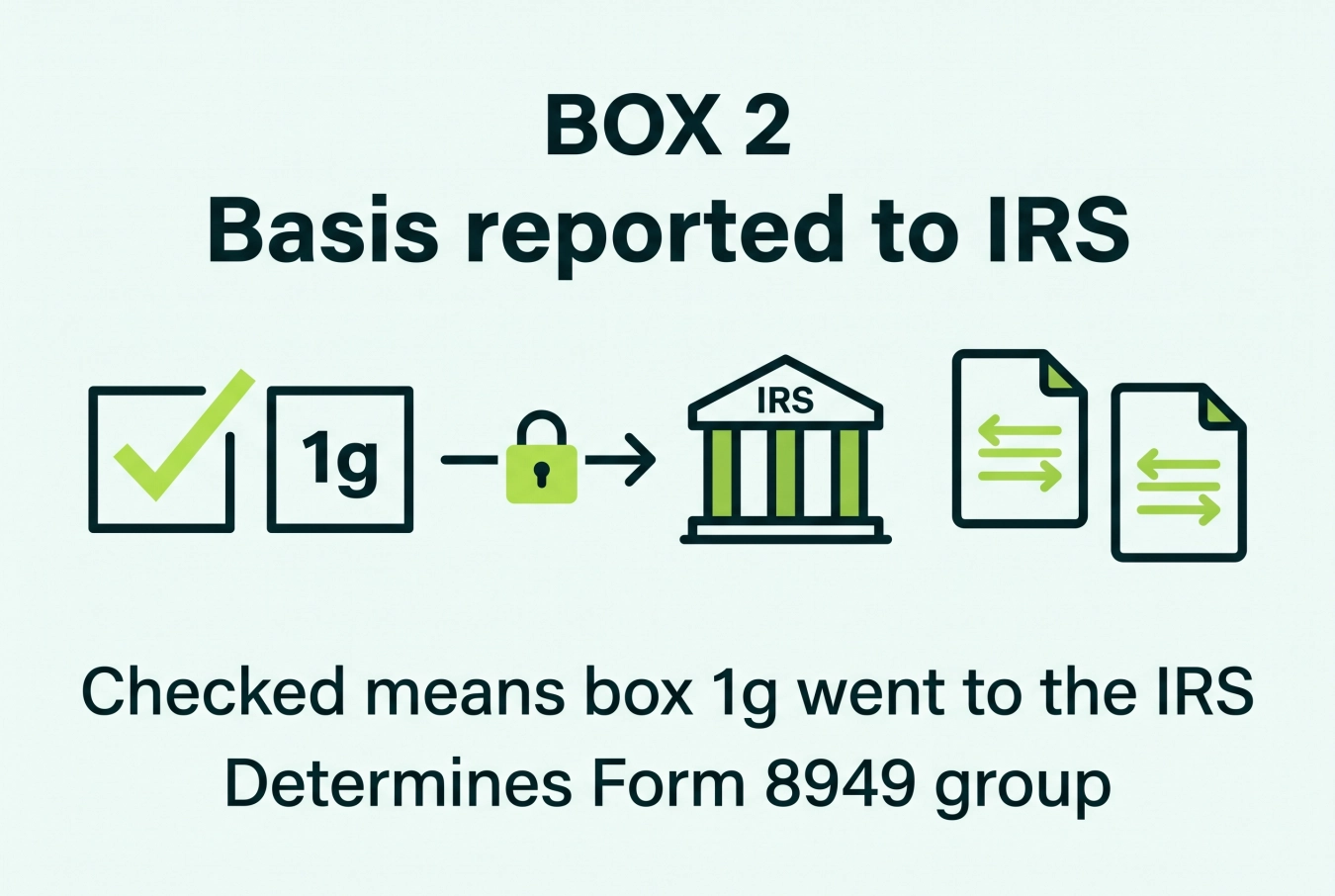
Box 2, Check if basis reported to IRS: When checked, the broker reported the box 1g basis to the IRS. The broker generally checks it for covered assets and may also check it when voluntarily reporting basis for a noncovered asset.
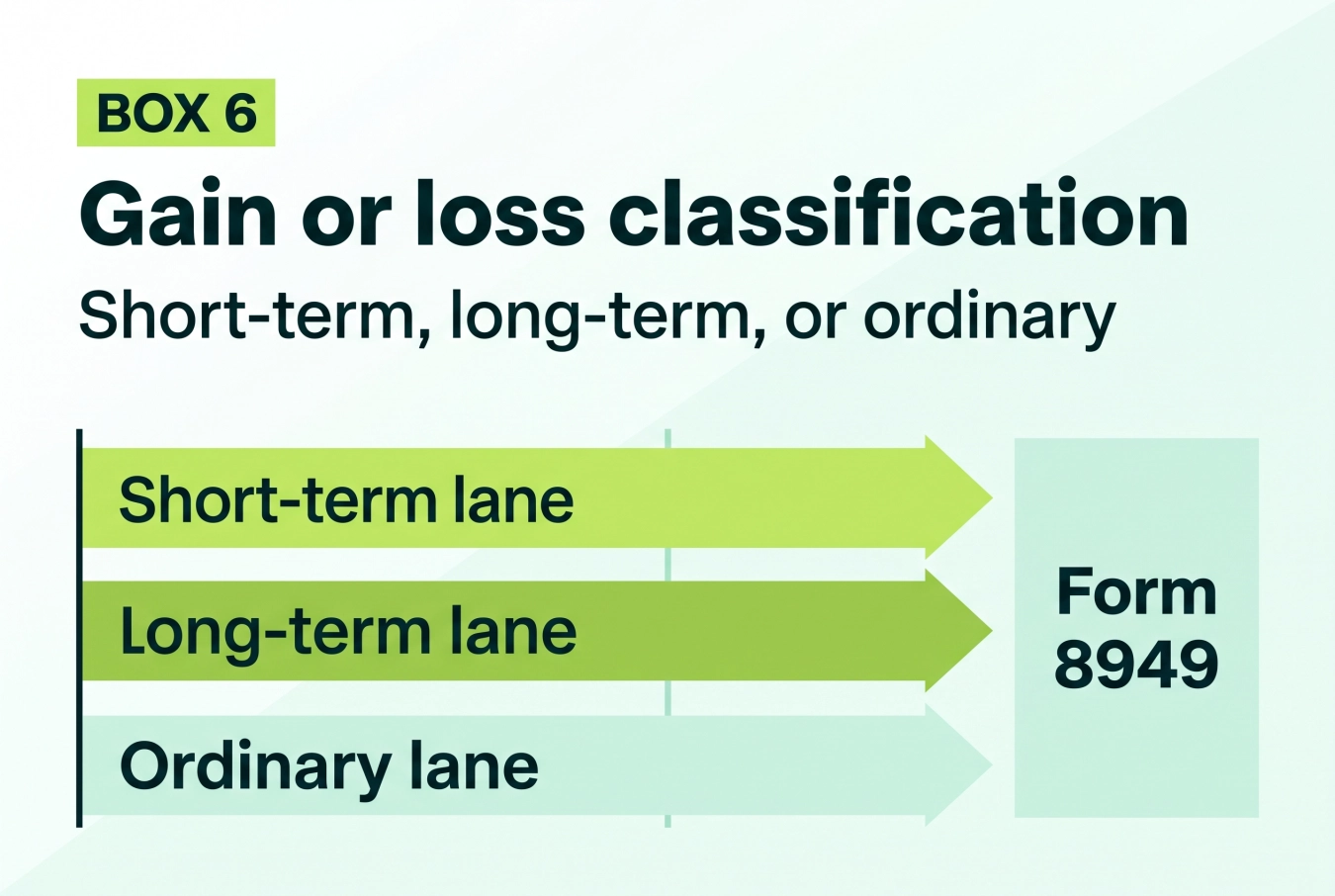
Box 6, Gain or loss: The broker checks short-term or long-term and may also check ordinary when special rules could apply. One Form 1099-DA cannot report both short-term and long-term treatment. This box classifies the holding period, but it does not display a dollar gain or loss.
Box 9, Check if digital asset is a noncovered security: When checked, the asset is noncovered. Boxes 1d, 1g, 1h, 1i, 2, and 6 may be blank. A digital asset acquired before 2026 or transferred into the custodial broker is generally noncovered under the 2026 instructions.
These boxes drive the Form 8949 routing code at the top. Short-term with reported basis is G. Short-term without reported basis is H. Long-term with reported basis is J. Long-term without reported basis is K. Unknown holding period is Y. Code Y is an alert, not a checkbox printed on Form 8949. Use your records to determine the holding period and choose the correct reporting group.
Boxes 3a through 8 cover special reporting flags and withholding
Boxes 3a through 8 explain how proceeds were measured, whether tax was withheld, and whether unusual transaction rules apply.
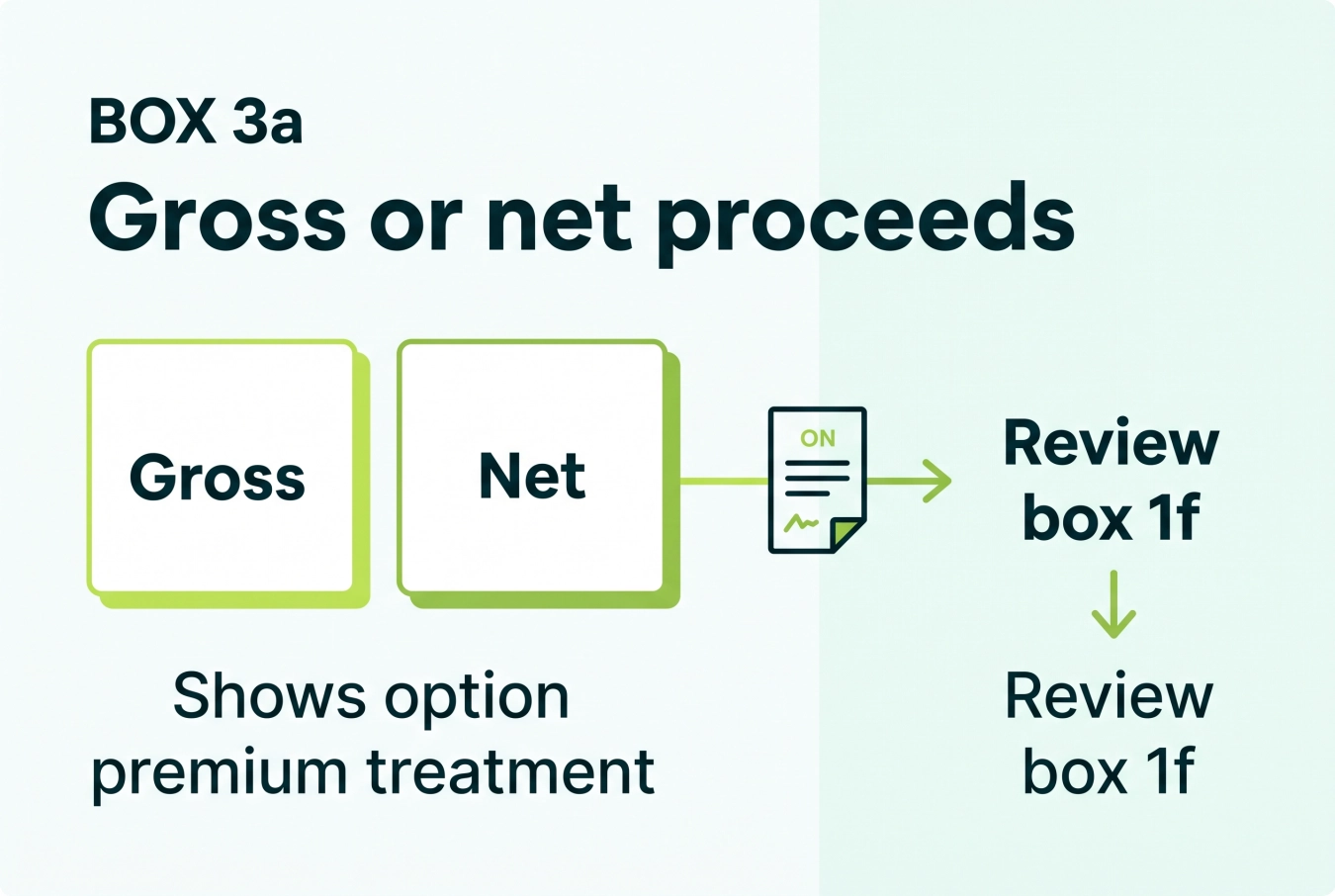
Box 3a, Reported to IRS: The broker checks either “Gross proceeds” or “Net proceeds.” For a digital asset sold through exercise of an option, “Net proceeds” means box 1f was adjusted for option premium. “Gross proceeds” means it was not.
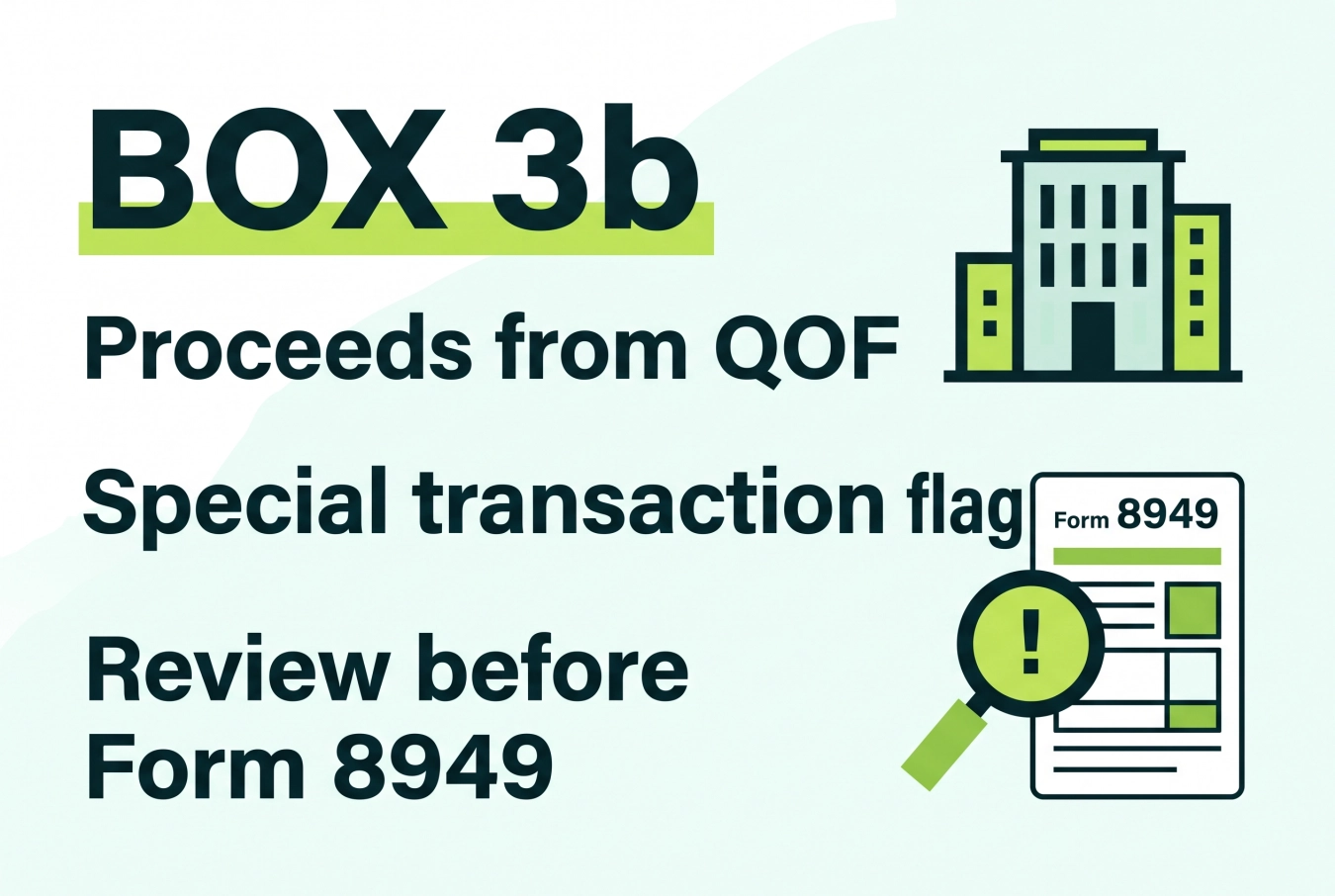
Box 3b, Check if proceeds from: The QOF option is checked for a disposition of an interest in a Qualified Opportunity Fund. The other printed option is reserved for future use.
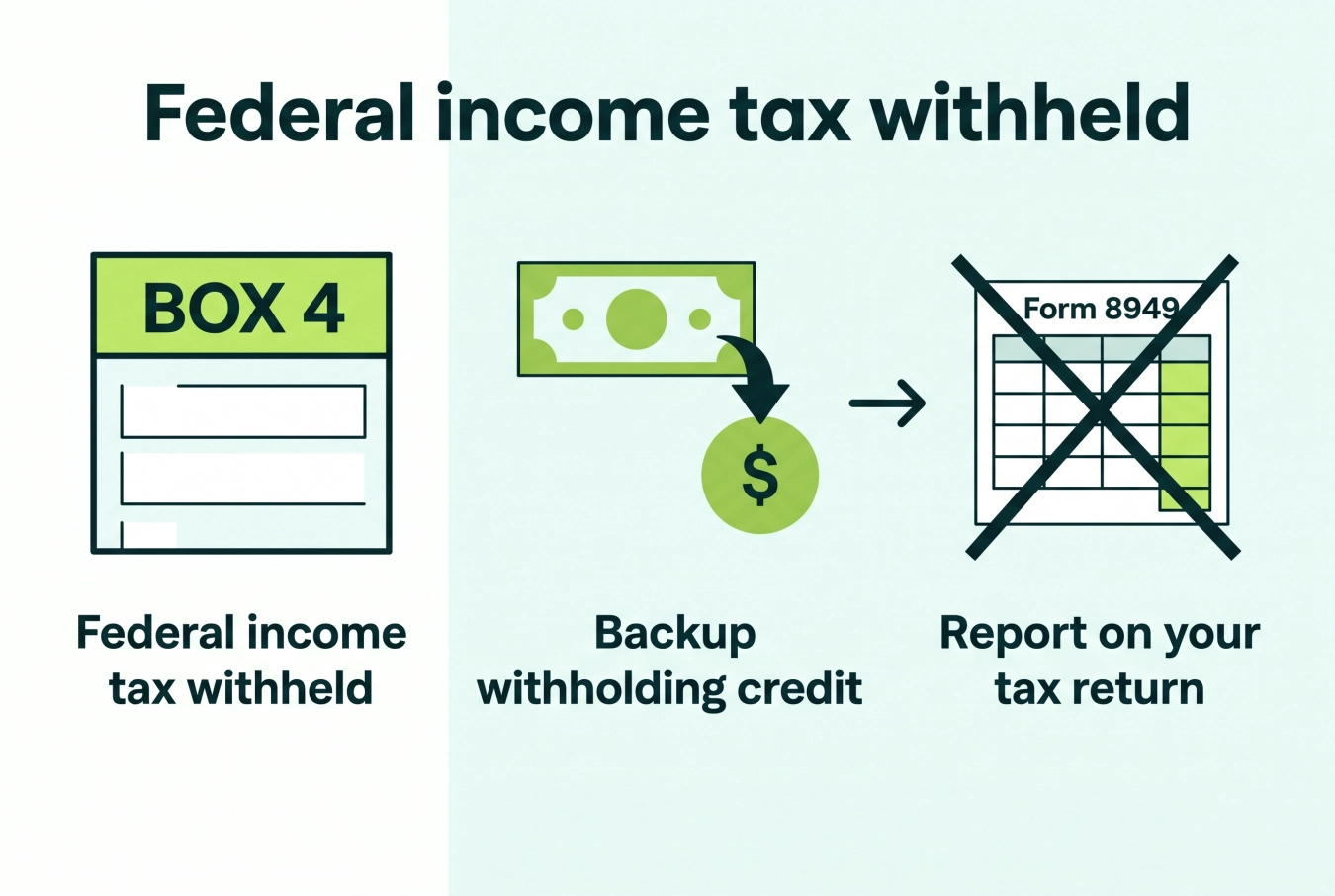
Box 4, Federal income tax withheld: This is backup withholding, often triggered when a recipient did not furnish a taxpayer identification number in the required manner. Include the amount as federal tax withheld on the appropriate line of your return. It does not go in a Form 8949 sales-price or basis column.
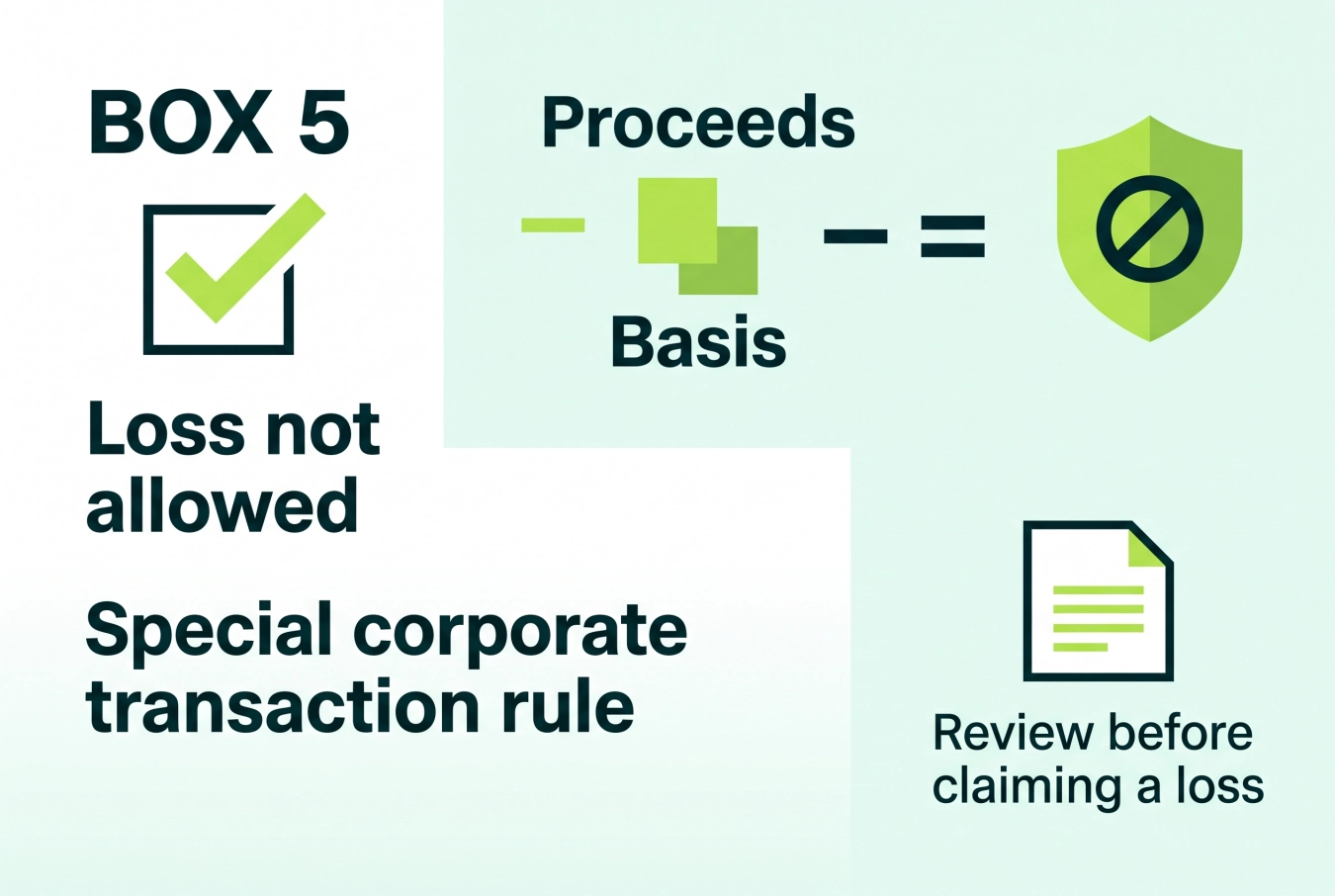
Box 5, Check if loss is not allowed based on amount in 1f: This applies to a reportable acquisition of control or substantial change in capital structure. If checked, you cannot claim a loss based only on the proceeds in box 1f. The broker should provide separate information about the disallowed loss.
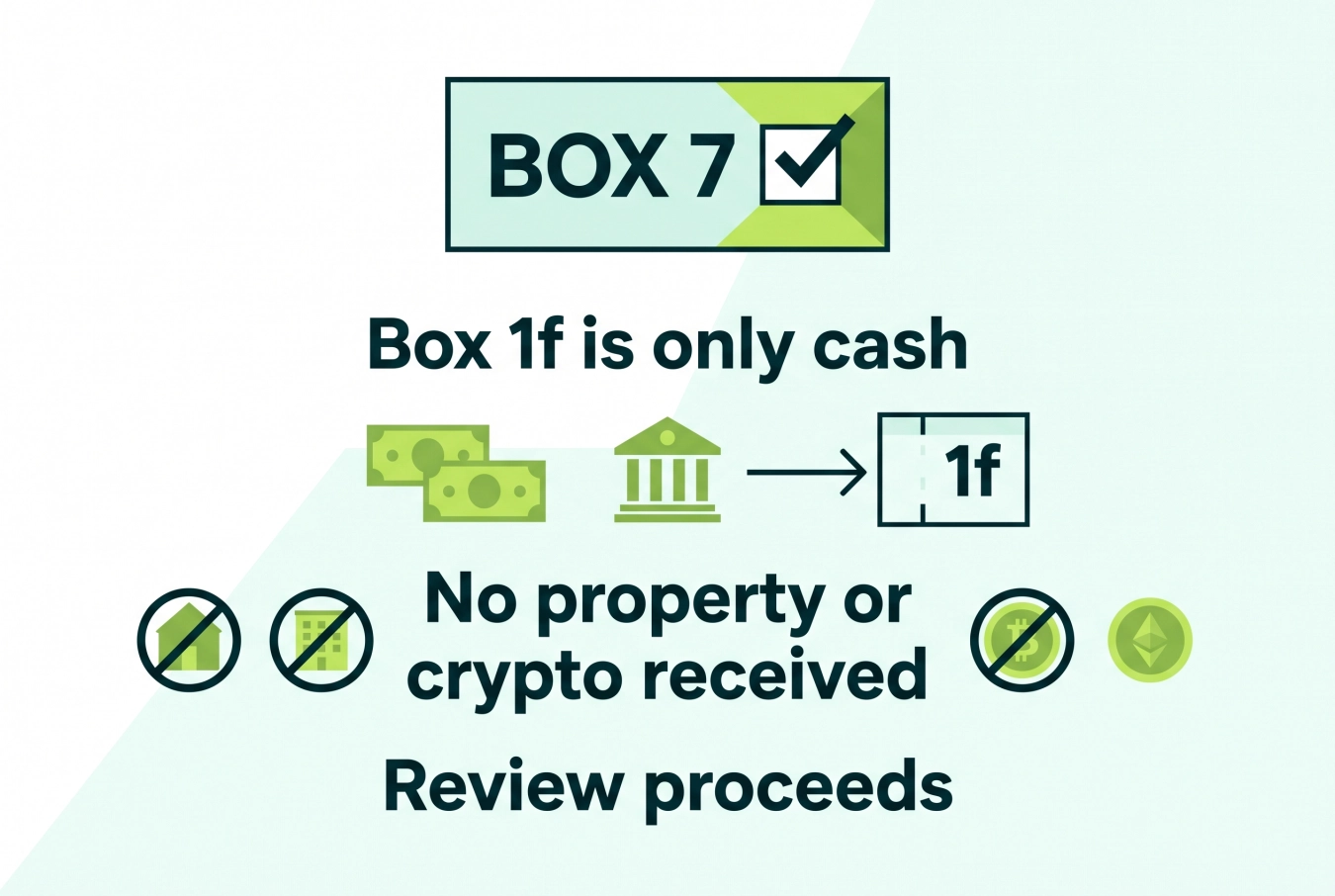
Box 7, Check if 1f is only cash: This means the transaction paid only cash proceeds, including U.S. dollars or convertible foreign currency issued by a government or central bank.
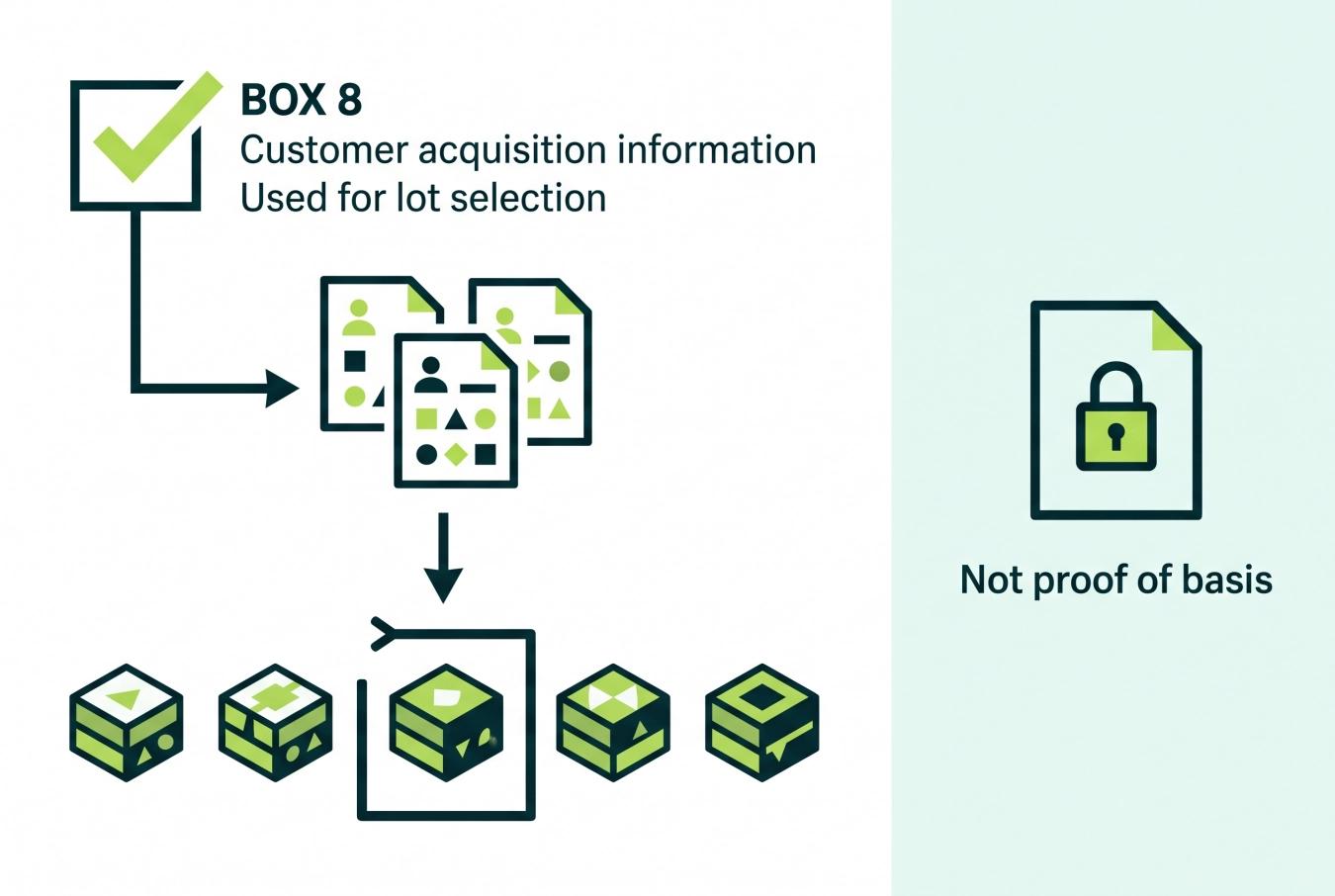
Box 8, Check if broker relied on customer-provided acquisition information: This means the broker received customer information to identify which units were sold. Under the 2026 instructions, customer-provided acquisition information can be used for lot selection, but not as broker-reported proof of basis or acquisition date.
Most readers will see box 7 far more often than boxes 3b or 5. Still, a checked special-purpose box is a reason to slow down before importing the form.
Boxes 10 through 13 cover optional aggregation and transfers
Boxes 10 and 13 are reserved. Boxes 11a through 11c support optional aggregate reporting for certain stablecoins and NFTs, while boxes 12a and 12b identify assets transferred into the broker.
Box 10, Reserved: The IRS has reserved this box for future use.
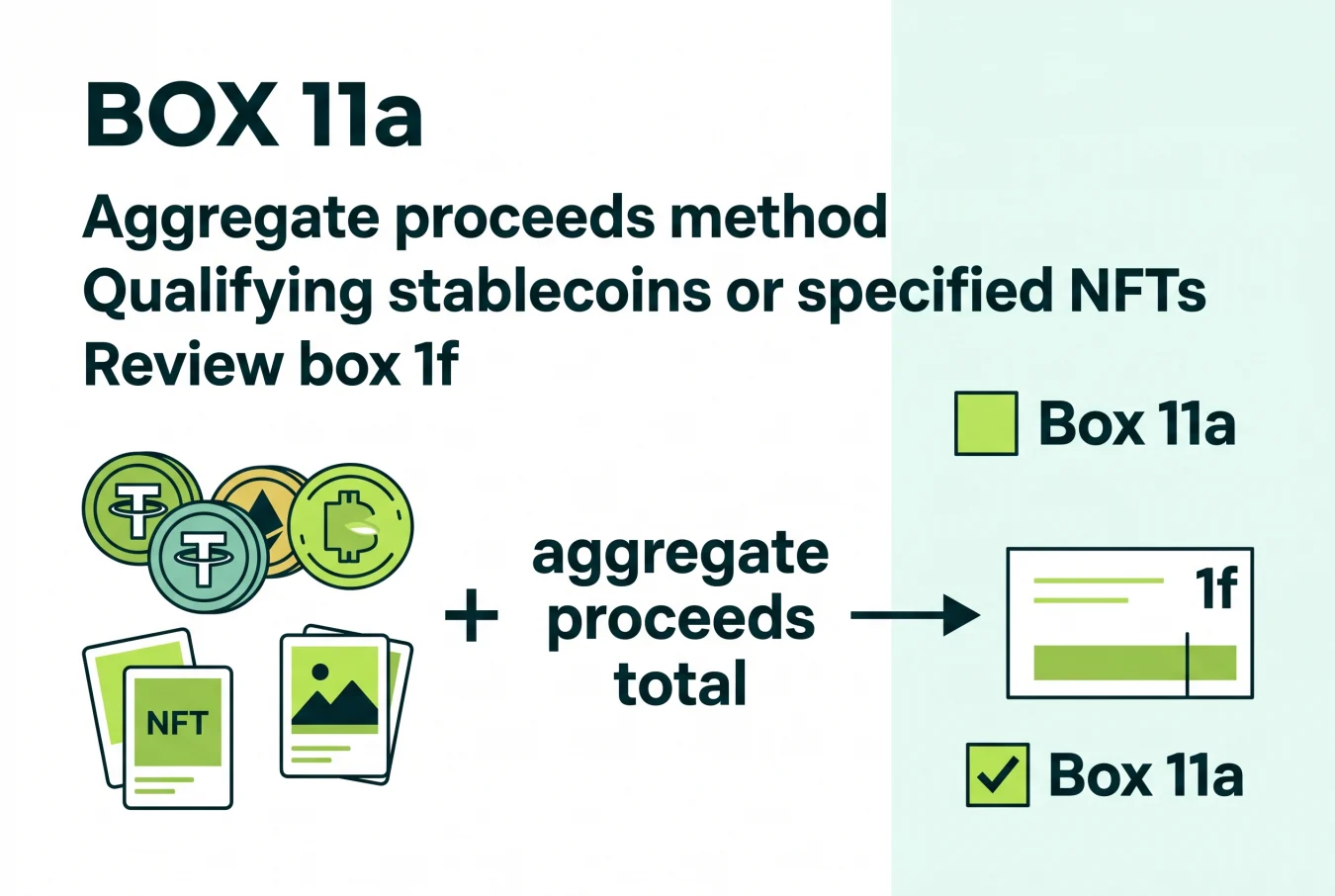
Box 11a, Check if gross proceeds reported in 1f is an aggregate amount for: The broker checks “Qualifying stablecoins” or “Specified NFTs” when using the related optional aggregate reporting method.
Box 11b, If 11a checked, number of transactions: This shows the number of transactions included when box 11a is used.
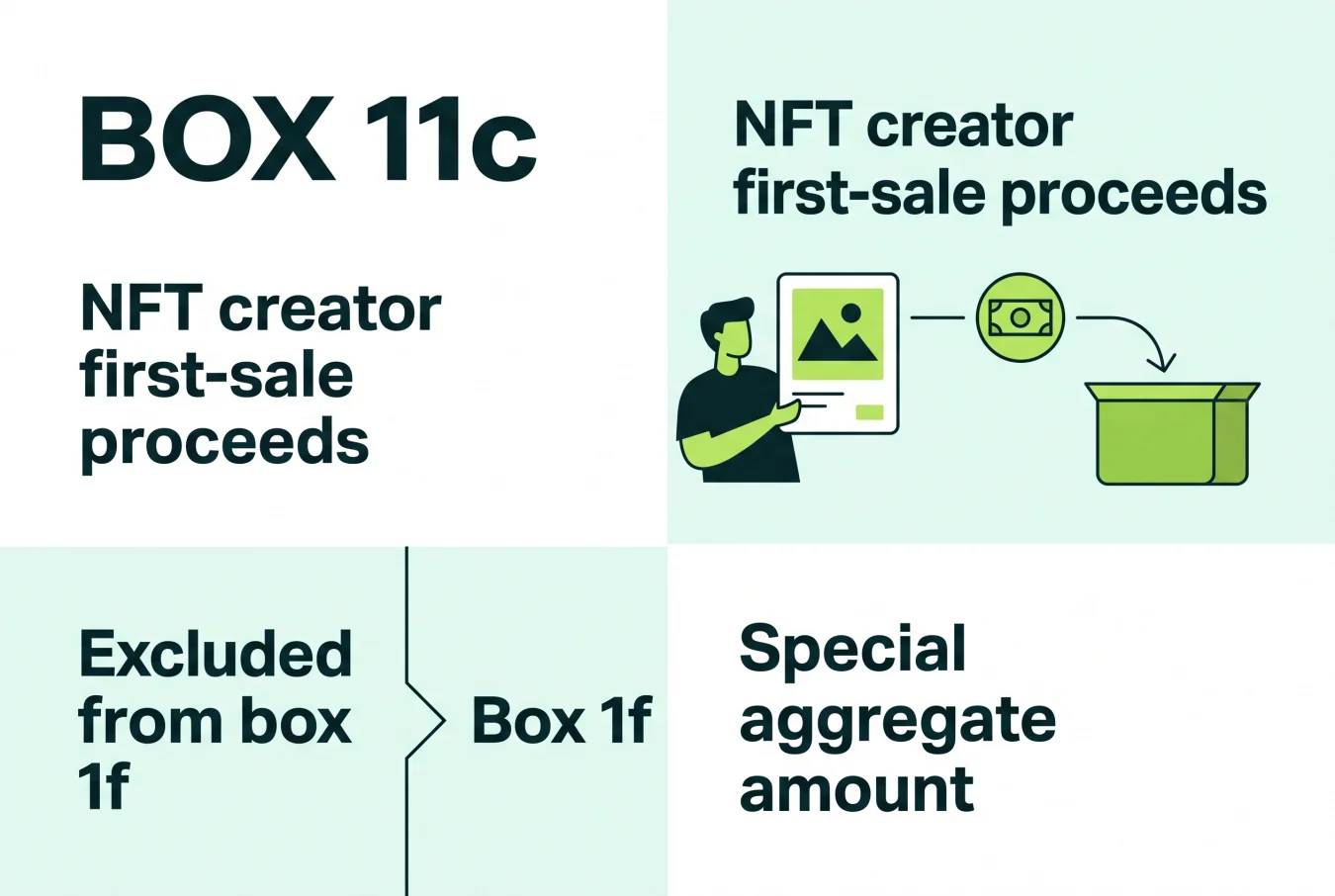
Box 11c, Aggregate gross proceeds of specified NFTs attributable to first sales by a creator or minter: This shows aggregate gross proceeds from first sales by the creator or minter. Those primary-sale proceeds are not included in box 1f.
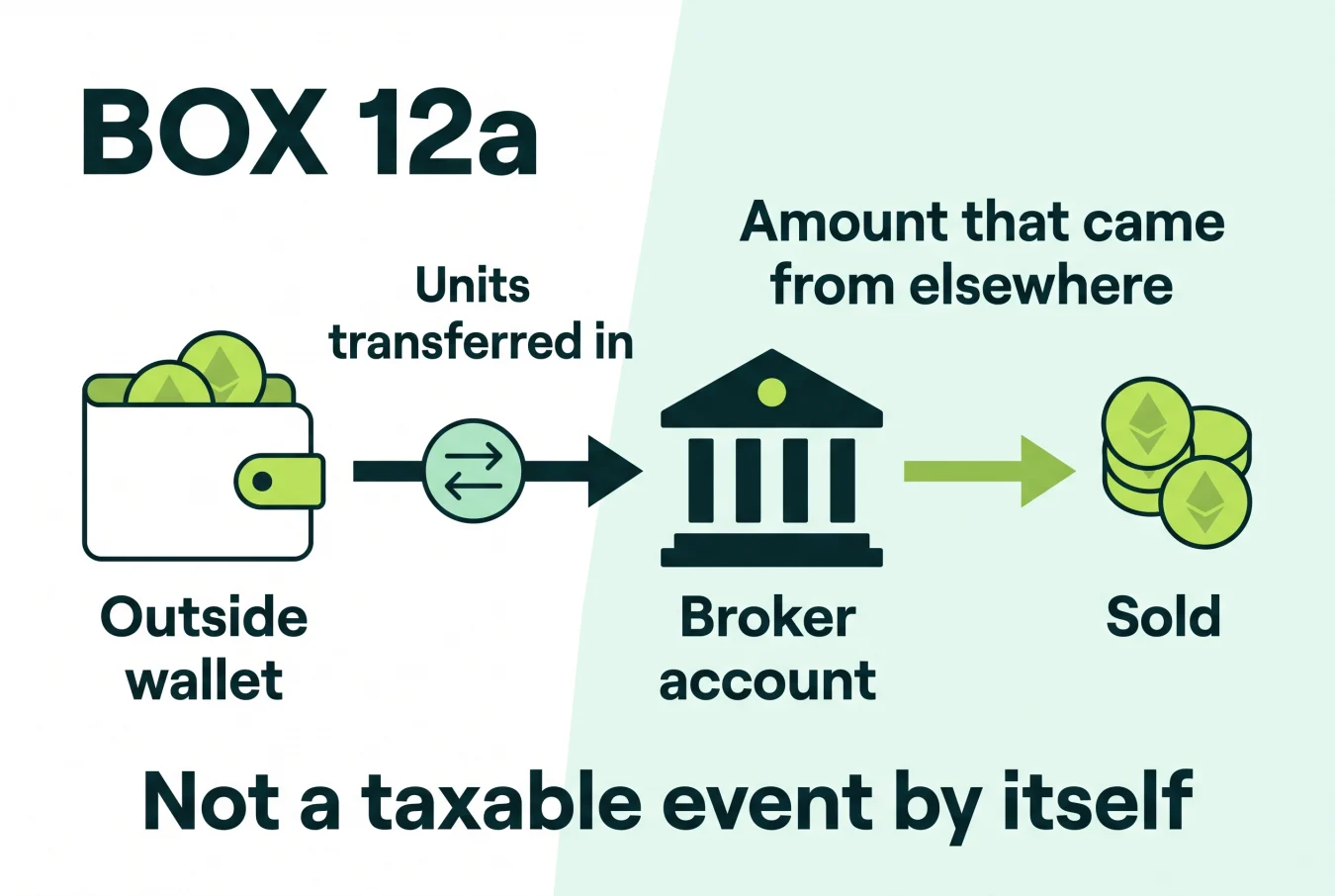
Box 12a, Number of units transferred in: This shows how many of the disposed units had previously been transferred into the broker’s custodial account, reported to 18 decimal places.
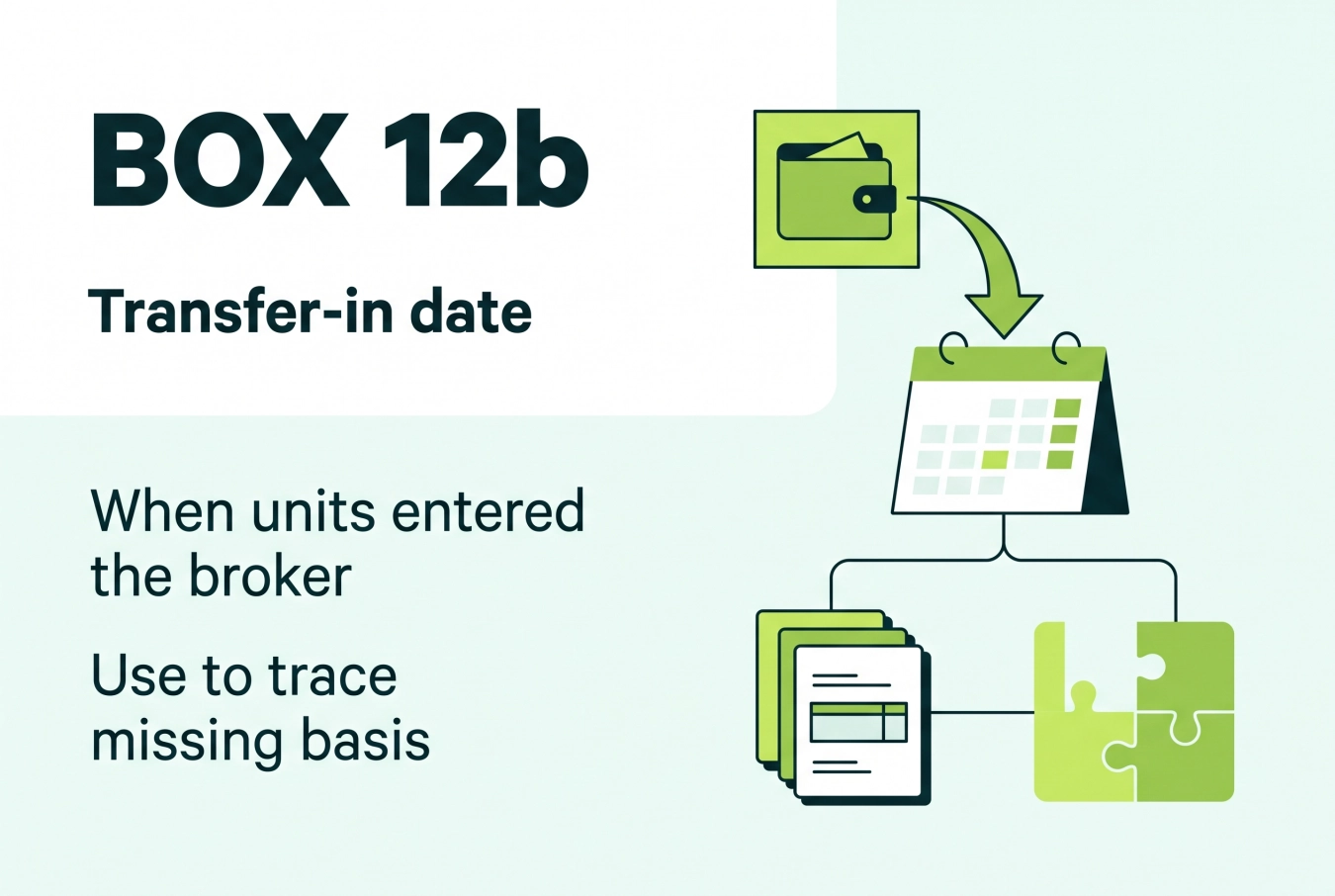
Box 12b, If transferred in, provide transfer-in date: This shows the date those units entered the custodial account. It may be blank when the units came in on various dates.
Box 13, Reserved: The IRS has reserved this box for future use.
Boxes 12a and 12b do not say the transfer itself was taxable. They flag that the sold units arrived from elsewhere. That is one reason a single tax year can produce multiple 1099-DAs across exchanges and transfers.
Boxes 14 through 16 contain state information
Boxes 14 through 16 report state-level information, not federal capital gain calculations.
Box 14, State name: The abbreviated state name.
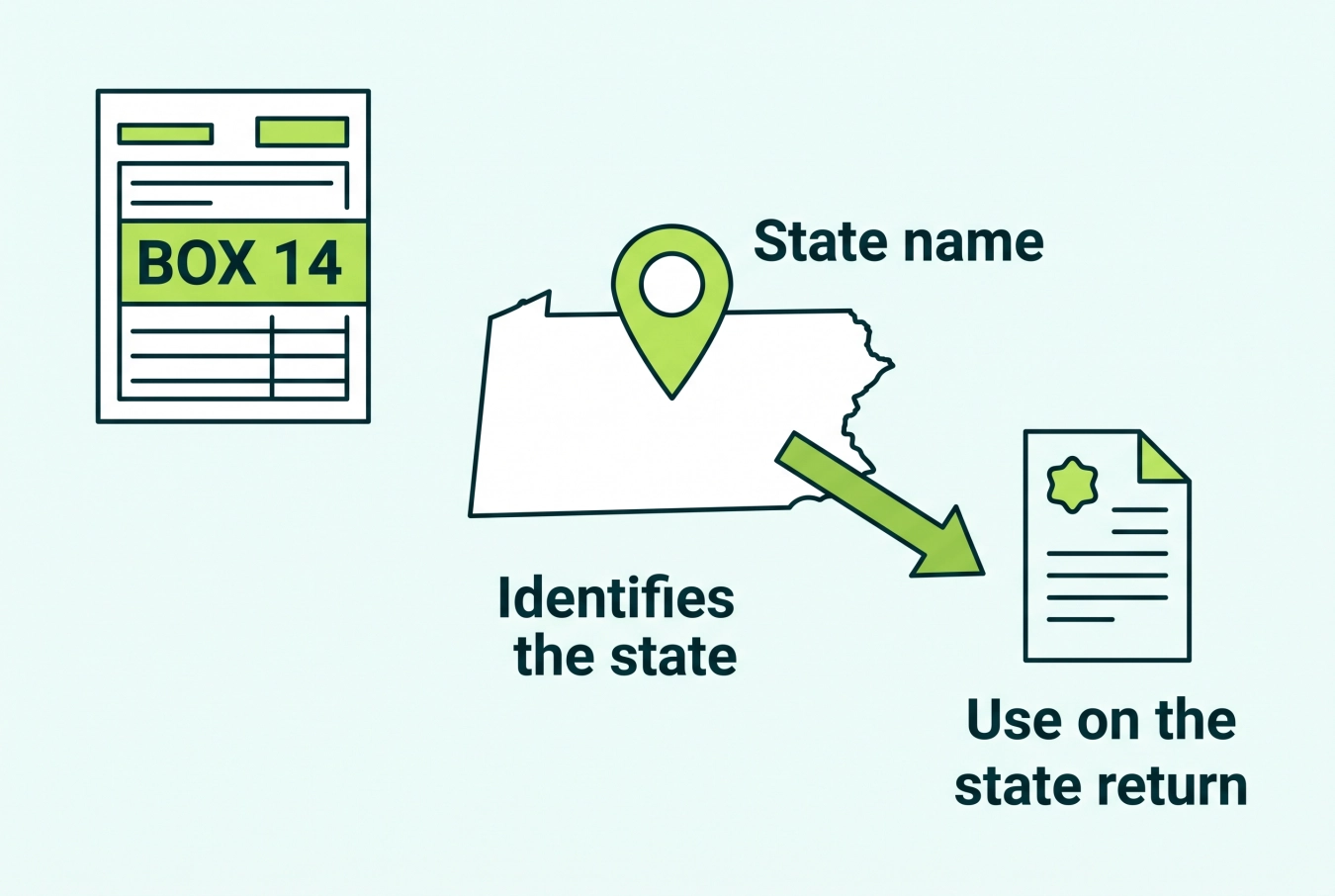
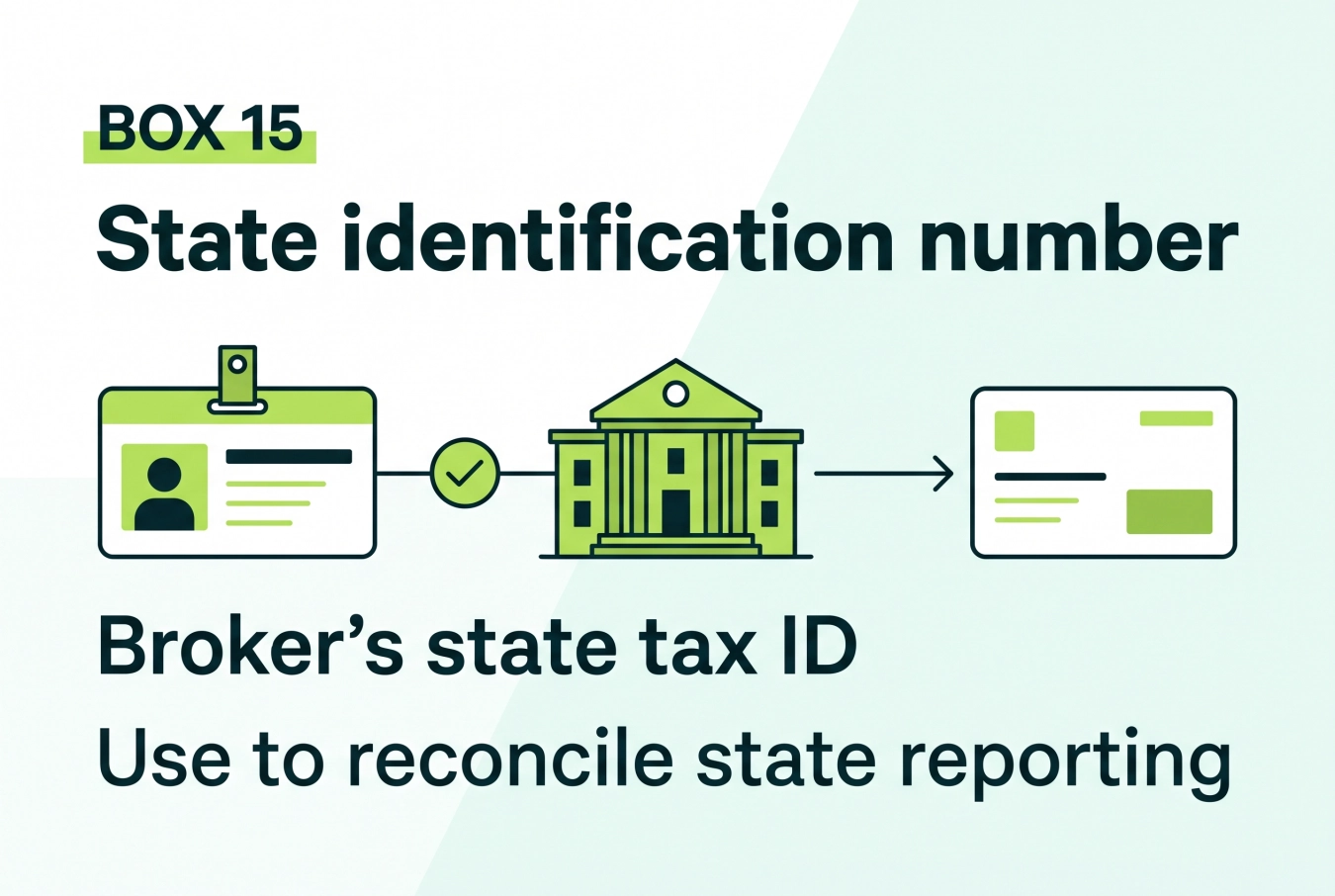
Box 15, State identification no.: This is the filer’s identification number assigned by that state.
Box 16, State tax withheld: State income tax withheld on the payment.
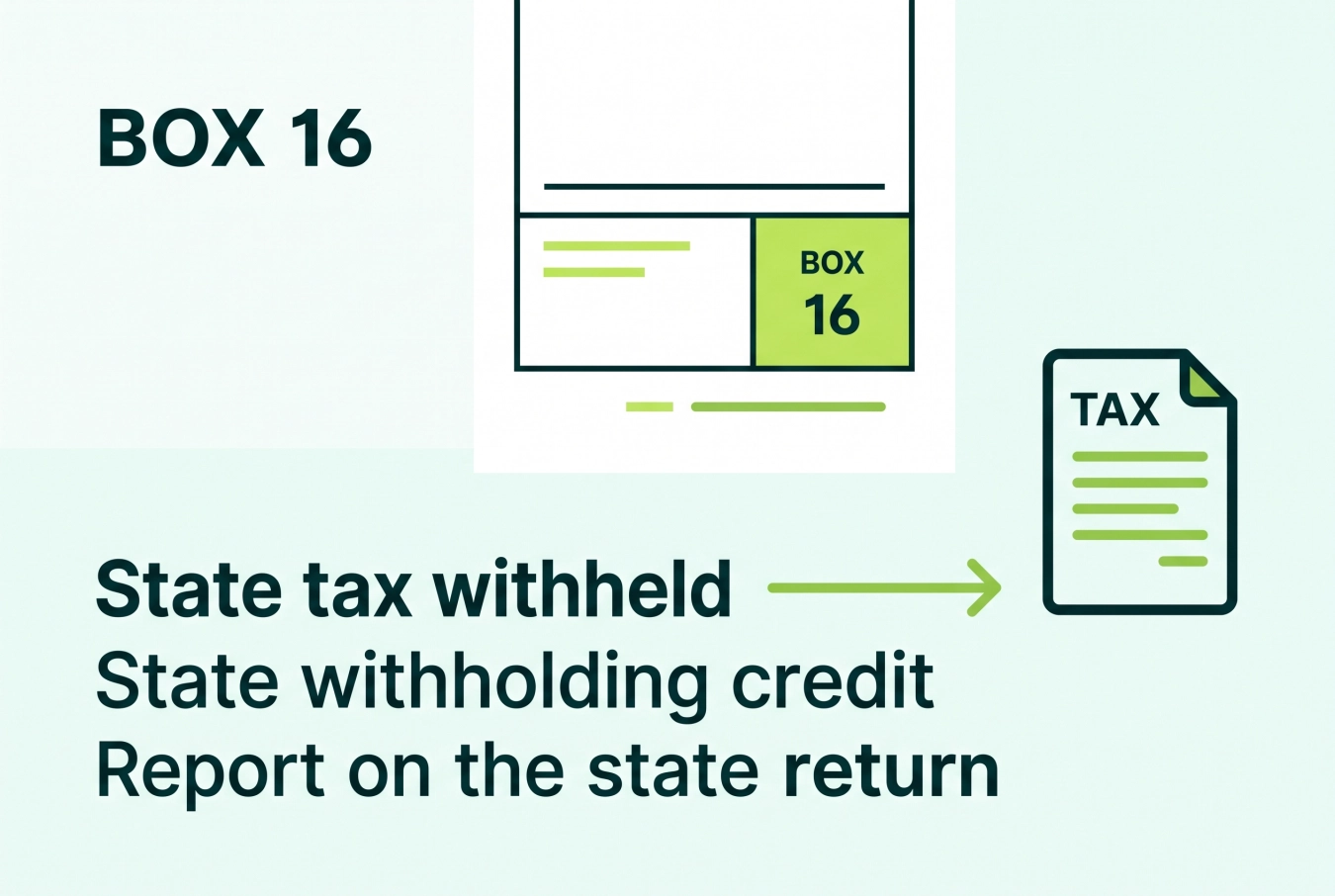
The form can report up to two states in the state section. These figures do not transfer to Form 8949 columns (a) through (h). Use them when preparing the applicable state return and reconciling state withholding.
Where does each 1099-DA box go on Form 8949?
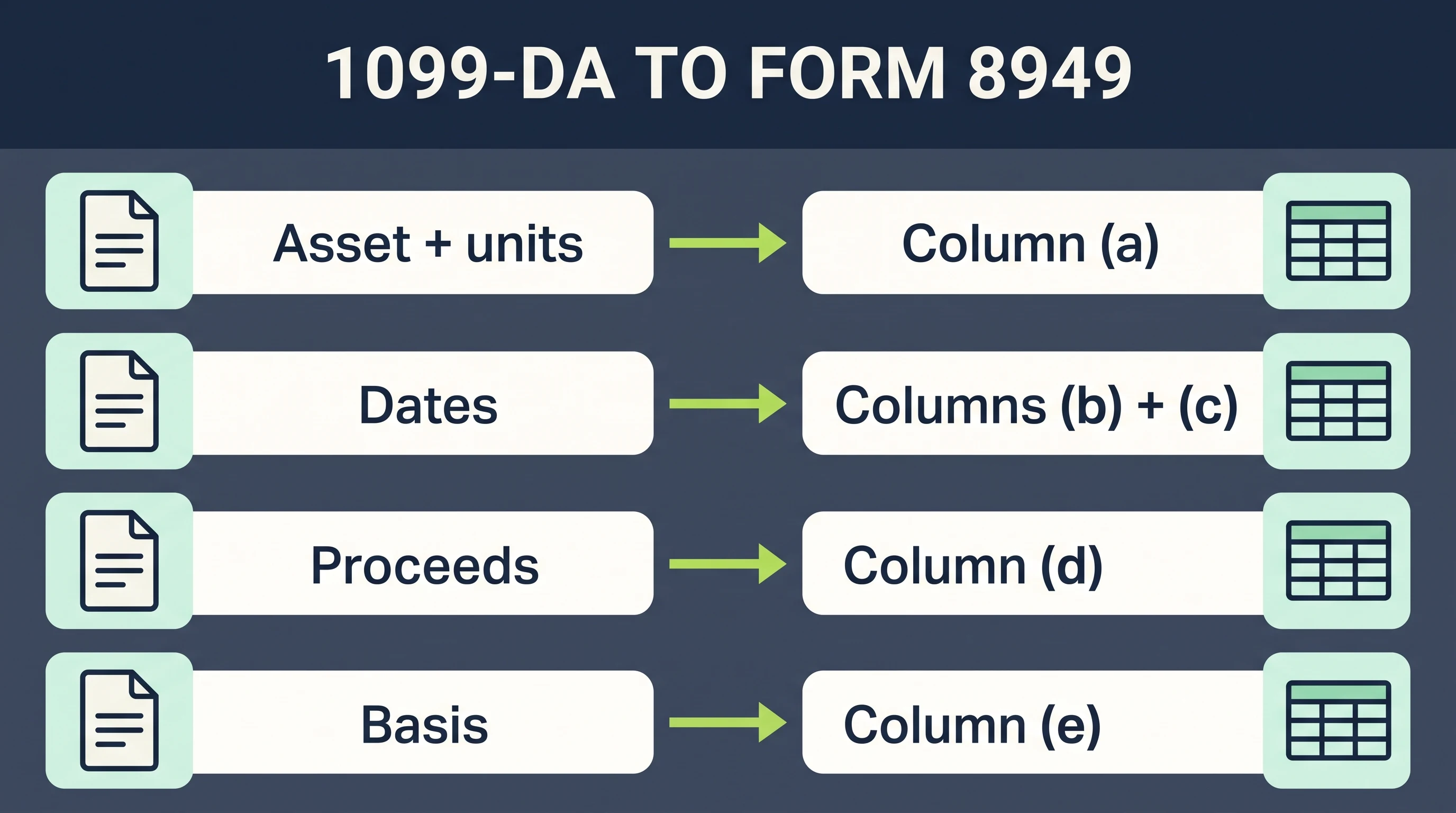
The asset, units, dates, proceeds, and basis map to Form 8949 columns (a) through (e). Reporting codes and special adjustments determine the correct part and whether columns (f) and (g) need entries.
| Form 1099-DA field | Form 8949 destination | What to enter |
|---|---|---|
| Boxes 1b and 1c | Column (a) | Asset name or symbol and exact units disposed, plus transaction ID if available |
| Box 1d | Column (b) | Date acquired, or “VARIOUS” when permitted |
| Box 1e | Column (c) | Date sold or disposed |
| Box 1f | Column (d) | Proceeds shown on the form |
| Box 1g | Column (e) | Reported basis, or your correctly determined basis for a noncovered asset |
| Box 1h | Columns (f) and (g) | Code D and the calculated market discount adjustment |
| Box 1i | Columns (f) and (g) | Code W and the nondeductible wash sale adjustment |
| Applicable checkbox code | Form 8949 part and top checkbox | G or H for short-term, J or K for long-term. Y means the broker could not determine whether H or K applies |
| Box 6 | Part I or Part II | Broker’s short-term or long-term classification |
| Box 9 | Basis-reporting category | Confirms the asset is noncovered and helps route it to H or K when the term is known |
The crypto Form 8949 guide covers the full filing workflow. If the basis reported to the IRS is wrong, do not silently overwrite it. The IRS Instructions for Form 8949 generally require the reported basis in column (e), code B in column (f), and a correcting amount in column (g). If basis was not reported to the IRS, enter the correct basis in column (e).
How do you read a filled-in 1099-DA?
Read it in this order: identity, dates, proceeds, basis, reporting status, then Form 8949 code. That sequence turns a crowded form into one tax row.
Worked example: a covered Bitcoin sale
Your 2026 Form 1099-DA shows Bitcoin in box 1b, 0.25000000 units in box 1c, an acquisition date of 02/10/2026 in box 1d, and a sale date of 11/20/2026 in box 1e. Box 1f shows $24,500 of proceeds. Box 1g shows $17,900 of basis. Box 2 is checked, box 6 marks the transaction short-term, box 7 is checked because you received only cash, and the applicable Form 8949 code is G.
On Form 8949 Part I with box G checked, column (a) identifies 0.25 Bitcoin and the transaction ID if available. Column (b) is 02/10/2026. Column (c) is 11/20/2026. Column (d) is $24,500. Column (e) is $17,900. With no other adjustment, columns (f) and (g) stay blank and column (h) shows a $6,600 short-term gain.
Now change one fact. Suppose the Bitcoin was transferred into the broker and box 9 is checked, box 1g is blank, and boxes 12a and 12b show the inbound units and date. You still report the box 1f proceeds, but you must reconstruct the correct basis and acquisition date from the source exchange or wallet records.
For a transaction-by-transaction walkthrough, use our guide to reporting Form 1099-DA on your tax return. If you are comparing this new form with an older brokerage statement, see Form 1099-DA vs. Form 1099-B.
Where can you get the official Form 1099-DA instructions PDF?
Download the official Form 1099-DA PDF from the IRS and use the instructions linked on IRS.gov/Form1099DA. Check the year printed at the top before matching a box to this guide.
The recipient copy is for your records. You generally do not attach Form 1099-DA itself to your federal return. Use it with your transaction records to prepare Form 8949 and Schedule D, unless the Form 8949 or Schedule D instructions allow a direct summary method for transactions with basis reported and no adjustments.
What should you do if a box is wrong?
Contact the filer shown at the top of Form 1099-DA and request a corrected form. Keep the original form, the corrected copy, and every email or support message about the error.
The IRS tells recipients not to contact the IRS for a 1099-DA correction and not to wait to file. If a correction is still pending near the deadline, use the records you can support and follow the current filing instructions.
The practical response depends on the field:
-
Wrong name, TIN, asset, units, sale date, or proceeds: ask the filer to correct the form.
-
Blank basis for a noncovered or transferred-in asset: reconstruct basis from your records.
-
Wrong basis that was reported to the IRS: use the Form 8949 adjustment procedure.
-
Wrong short-term or long-term classification: report the transaction on the correct Form 8949 part and use the required adjustment code.
Need help reconciling Form 1099-DA?
A 1099-DA is only one slice of your transaction history. Transfers, missing basis, multiple exchanges, wallet activity, and duplicate forms can change the result long before the numbers reach Form 8949.
Count On Sheep’s 1099-DA help service organizes the records, matches transfers, rebuilds missing tax lots, and prepares a clean gain and loss package for filing.
Frequently Asked Questions
What do the boxes on Form 1099-DA mean?
The boxes identify the digital asset, units sold, acquisition and sale dates, proceeds, basis, holding period, reporting status, transfer details, and any special adjustments or withholding. Boxes 1a through 1g contain the information most taxpayers use to prepare Form 8949.
What does a blank cost basis box mean on a 1099-DA?
A blank box 1g means the broker did not report basis on that form. It does not mean your basis is zero. Use your own exchange, wallet, and purchase records to determine the correct basis, especially when box 9 is checked or the asset was transferred in.
Which 1099-DA boxes go on Form 8949?
Boxes 1b and 1c help complete Form 8949 column (a), box 1d maps to column (b), box 1e maps to column (c), box 1f maps to column (d), and box 1g maps to column (e). The applicable Form 8949 code tells you which part and checkbox to use, while boxes 1h and 1i may require adjustment codes in columns (f) and (g).
Where do I get the official 1099-DA instructions PDF?
Download the current Form 1099-DA and its instructions from IRS.gov/Form1099DA. Confirm the tax year printed on the form before using the box instructions because the IRS can revise forms and reporting rules.
Do I file the 1099-DA itself with my return?
Generally, no. Form 1099-DA is an information statement that you use with your records to prepare the appropriate return, usually Form 8949 and Schedule D for capital transactions. Keep the recipient copy with your tax records.
What if a box on my 1099-DA is wrong?
Contact the filer shown at the top of the form and request a corrected Form 1099-DA. Keep the original, the correction, and your correspondence. The IRS says not to contact it for the correction and not to delay filing while the issue is being addressed.