
Form 1099-B is the long-running broker form for stocks, ETFs, bonds, options, and other traditional investments. Form 1099-DA is the newer form for broker-handled crypto and other digital asset dispositions.
That is the headline. The part that affects your tax return is cost basis.
For 2025 crypto sales, brokers had to report gross proceeds on Form 1099-DA, but basis reporting was voluntary. For 2026 sales, basis reporting becomes mandatory only for covered digital assets, which generally means assets acquired after 2025 in an account where the reporting broker provided custody.
If you transferred crypto into the platform, do not assume the basis shown on the form is complete. Start with our main Form 1099-DA guide, then use this comparison to sort out which numbers belong on your return.
What is the difference between 1099-DA and 1099-B?
Form 1099-B reports broker and barter-exchange transactions involving traditional securities and certain contracts. Form 1099-DA reports sales, exchanges, and other broker-handled dispositions of digital assets.
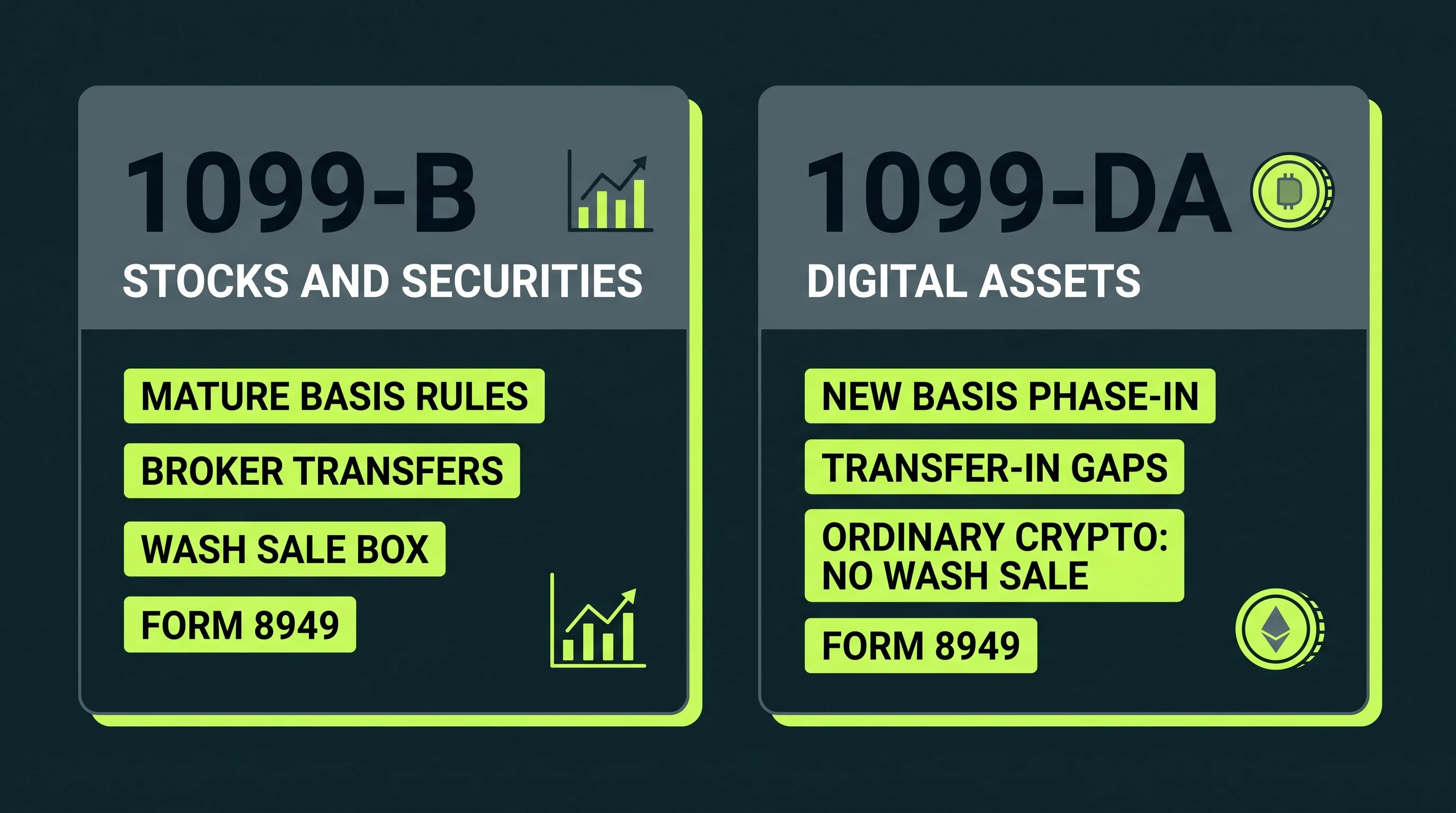
Here is the clean comparison:
| Feature | Form 1099-B | Form 1099-DA |
|---|---|---|
| Primary purpose | Reports proceeds from broker and barter-exchange transactions | Reports proceeds from digital asset broker transactions |
| Common assets | Stocks, ETFs, bonds, options, securities futures, commodities, and certain contracts | Cryptocurrency, stablecoins, NFTs, and other reportable digital assets |
| First mandatory reporting era | Long-established form, with basis reporting phased in starting with stock acquired after 2010 | Gross proceeds required for 2025 digital asset sales; mandatory covered-asset basis reporting begins with 2026 sales |
| Cost basis maturity | Mature covered-security system with years of broker reporting | New phase-in; 2025 basis was voluntary, and many 2026 lots can still be noncovered |
| Transferred assets | Covered-security transfer statements can carry basis and acquisition data between brokers | No broadly required digital asset transfer statement yet; transfer-in boxes do not supply full basis history |
| Wash sale field | Box 1g reports certain disallowed wash sale losses | Ordinary crypto is generally outside the current federal wash sale rule; 2026 box 1i is for applicable tokenized securities |
| Tax return path | Generally reconciled on Form 8949 and Schedule D | Generally reconciled on Form 8949 and Schedule D |
The forms look similar because both can show dates, proceeds, basis, and holding-period information. But they do not promise the same data quality.
The IRS instructions for Form 1099-B describe reporting for stocks, debt instruments, options, regulated futures contracts, securities futures contracts, commodities, and other broker transactions. The IRS instructions for Form 1099-DA cover broker-effected digital asset sales.
Why did crypto move from 1099-B to 1099-DA?
Crypto moved to Form 1099-DA because Congress and the IRS created a dedicated reporting system for digital assets. The separate form gives the IRS fields and definitions built for crypto transactions instead of forcing digital assets into a securities form.
Before Form 1099-DA, platform reporting was inconsistent. Robinhood says its new 1099-DA replaces the 1099-B previously used for crypto dispositions. Other platforms used different approaches. Coinbase, for example, used Form 1099-MISC for qualifying rewards or staking income, while customers still had to track sales and exchanges for capital gain reporting.
That difference matters. Form 1099-MISC reports income. It does not give you a disposal-by-disposal capital gain report.
The transition happened in two steps:
-
Brokers began using Form 1099-DA for reportable digital asset sales and exchanges occurring in 2025. Those forms were delivered during the 2026 filing season.
-
For digital asset sales occurring in 2026 and later, brokers must also report basis when the asset is a covered security. The first forms reflecting that rule arrive during the 2027 filing season.
The form changed. Your obligation to report taxable crypto activity did not. You still need to report taxable sales, swaps, and spending transactions even when a platform sends no form.
Which form applies to each investment in 2026?
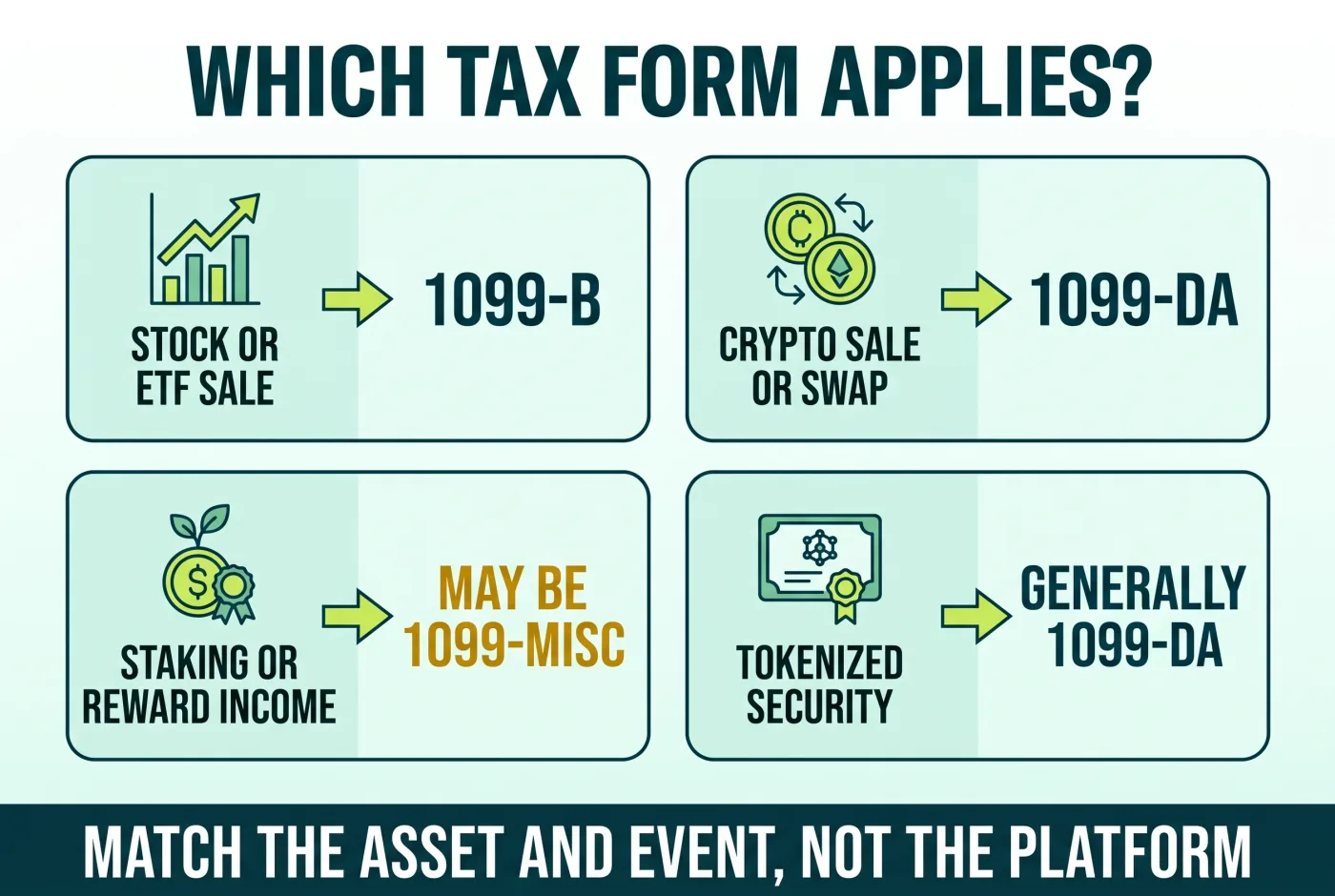
Form 1099-B generally applies to stocks, ETFs, bonds, options, and other traditional broker transactions. Form 1099-DA generally applies to cryptocurrency and other digital assets sold or exchanged through a reporting digital asset broker.
Use this practical split:
- A stock or ETF sale belongs on Form 1099-B.
- A Bitcoin or Ether sale through a custodial crypto platform belongs on Form 1099-DA.
- A crypto-to-crypto exchange handled by a reporting broker can belong on Form 1099-DA even though no dollars entered your bank account.
- Staking rewards and similar income do not belong on Form 1099-DA. A platform may report qualifying payments on another form, such as Form 1099-MISC.
There is a narrow edge case for tokenized securities. The 2026 Form 1099-DA instructions say a tokenized security that is also a digital asset is generally reported on Form 1099-DA, not Form 1099-B. Form 1099-B can still apply to certain section 1256 contracts and assets that are digital only because trades clear or settle on a limited-access regulated network.
Most investors will never need that exception. If the asset is an ordinary stock in a brokerage account, expect 1099-B. If it is ordinary crypto in a custodial crypto account, expect 1099-DA.
How does cost basis reporting differ?
Form 1099-B has a mature basis-reporting framework, while Form 1099-DA is still in its first basis-reporting phase. A 1099-DA can be accurate and still have a blank basis because the sold asset was noncovered.
The 1099-B rollout happened over several years. Corporate stock generally became covered if acquired after 2010. Mutual fund and dividend reinvestment plan shares followed for acquisitions after 2011. Options, securities futures, and many debt instruments phased in later, with timing that depends on the instrument.
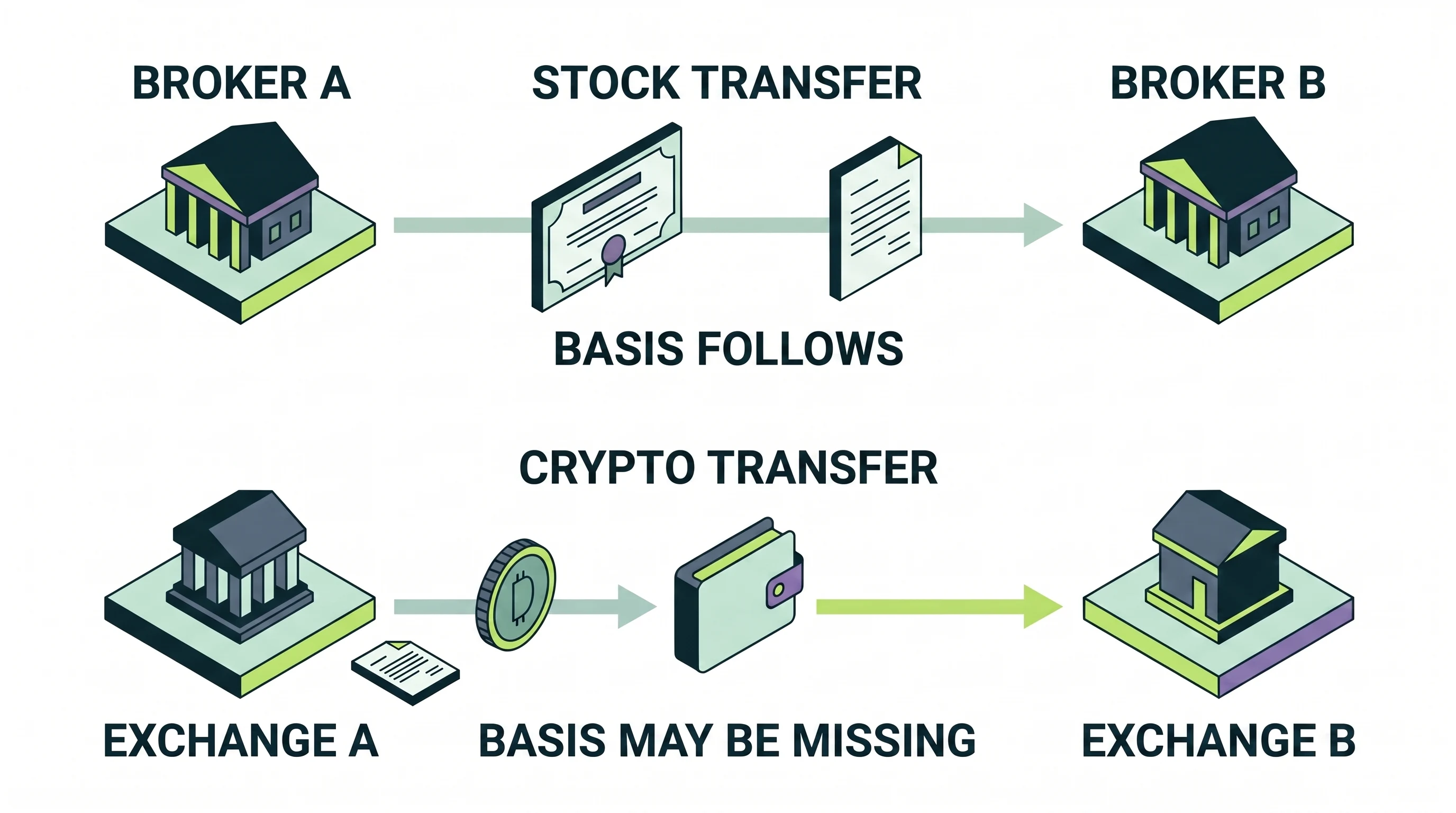
That history gave securities brokers years to build basis systems. It also came with transfer statements. When a covered security moves from one broker to another, the transferring broker generally must provide acquisition and basis data to the receiving broker within 15 days after settlement.
Crypto does not yet have the same transfer pipeline.
The final digital asset broker regulations generally exempt digital assets from mandatory broker-to-broker transfer statements until the IRS issues further rules. Form 1099-DA can show the number of units transferred in and the transfer date in boxes 12a and 12b, but those fields do not tell the receiving broker what you originally paid.
That leads to the biggest practical difference:
- Crypto acquired before 2026 is generally noncovered for Form 1099-DA basis reporting.
- Crypto transferred into a broker is generally noncovered because the broker did not acquire it for you in that custodial account.
- Crypto acquired after 2025 inside the broker’s custodial account can be covered if the other requirements are met.
Say you bought 1 BTC for $30,000 on Exchange A in 2024, moved it to a wallet, then deposited it at Exchange B and sold it for $70,000 in 2026. Exchange B can report the $70,000 of proceeds on Form 1099-DA, but it may not be required to report your $30,000 basis.
Your gain is not $70,000. Before other adjustments, it is $40,000.
If the basis is blank or wrong, use the records from Exchange A and the wallet transfer to reconstruct it. Our guide to fixing wrong or missing 1099-DA cost basis covers that process. If several brokers or wallets are involved, use the multiple 1099-DAs and exchange transfers guide before combining anything.
Does the wash sale rule apply to Form 1099-DA?
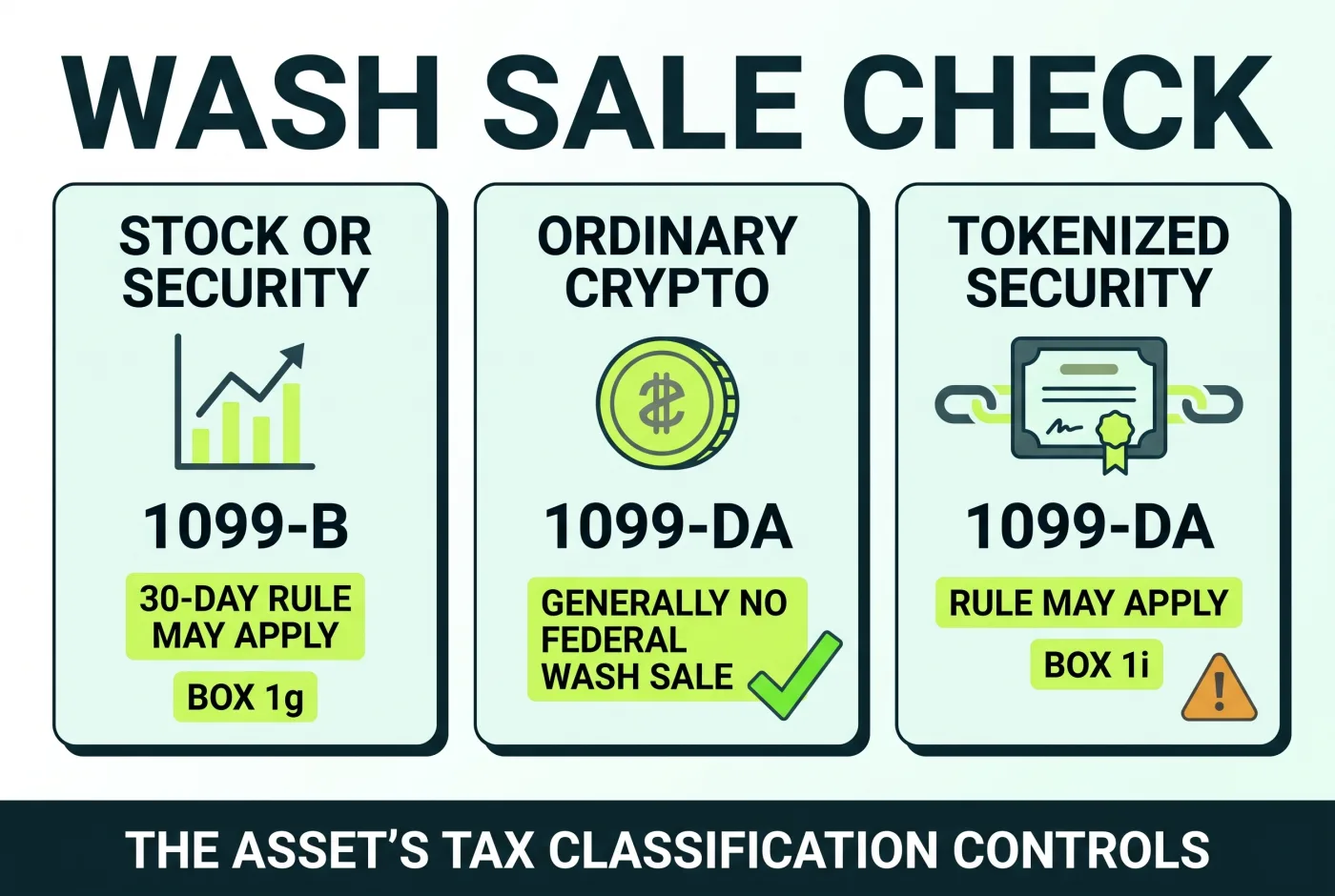
The federal wash sale rule generally does not apply to ordinary cryptocurrency under current law. Section 1091 applies to losses on stock or securities, and the IRS Schedule D instructions limit the digital asset wash sale discussion to assets that are also stock or securities for tax purposes.
Form 1099-B has a dedicated wash sale field. Box 1g reports a loss disallowed under section 1091 when the broker sees both the loss sale and the replacement purchase in the same account for covered securities with the same CUSIP. Your actual wash sale calculation can still be broader because the broker may not see activity in another account.
For ordinary Bitcoin, Ether, or similar crypto, selling at a loss and buying back within 30 days does not currently trigger the federal wash sale rule. That can make crypto tax-loss harvesting more flexible, but it does not excuse sham transactions or change the need for complete records.
Tokenized securities are the catch. The 2026 Form 1099-DA includes box 1i for wash sale losses on tokenized securities that are treated as stock or securities under section 1091. The form name alone does not decide the wash sale result. The asset’s federal tax classification does.
See our 2026 crypto wash sale rule guide for the current rule, the tokenized-security exception, and the records to keep.
Do both forms get reported on Form 8949?
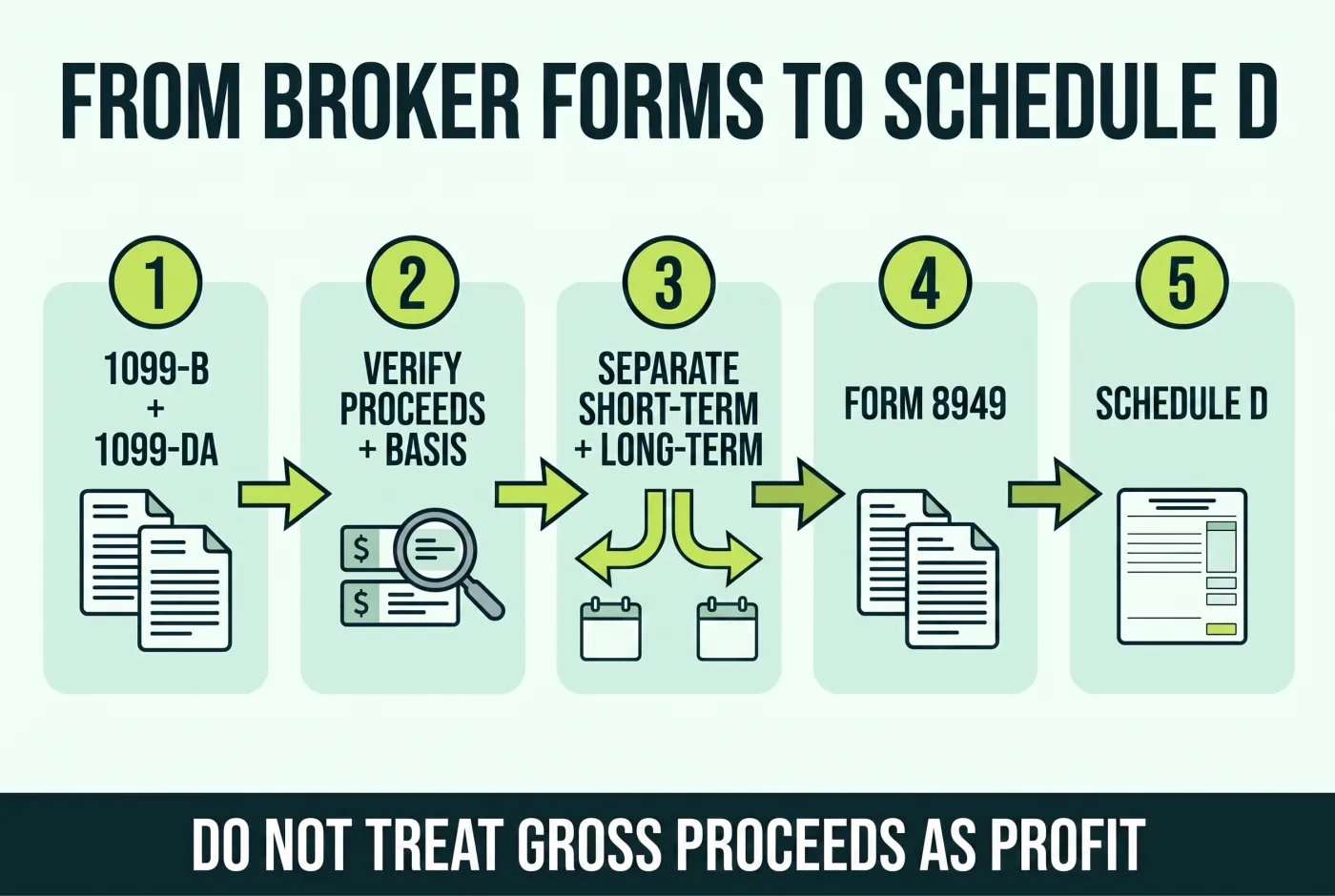
Yes, transactions from Form 1099-B and Form 1099-DA generally flow through Form 8949 and then to Schedule D. The forms use different source data, but the return still has to reconcile proceeds, basis, adjustments, and holding period.
The IRS explains that Form 1099-DA is used with Form 8949 and Schedule D. Form 1099-B follows the same basic capital gain reporting path.
For each form:
-
Match the asset description, sale date, and proceeds to your records.
-
Confirm whether basis was reported to the IRS.
-
Enter the correct basis and any required adjustment using the applicable Form 8949 category.
-
Separate short-term and long-term transactions.
-
Carry the totals to Schedule D.
Do not combine gross proceeds from the two forms and call that taxable income. Taxable gain or loss generally starts with proceeds minus adjusted basis, followed by any applicable adjustments.
For the exact reporting mechanics, use our Form 8949 guide and the walkthrough on how to report 1099-DA on your tax return.
What if the same platform sent both forms?
If the same platform sent both forms, the 1099-B usually covers your securities activity and the 1099-DA covers your crypto activity. Receiving both is normal for a broker where you traded stocks and digital assets.
Robinhood is a straightforward example. Its current tax guidance says a consolidated PDF can include both Form 1099-B and Form 1099-DA. The packaging is combined, but the reported transactions are not duplicates just because they came from one company.
Use this check before filing:
-
Separate the 1099-B pages from the 1099-DA pages.
-
Match the 1099-B section to stock, ETF, option, and other traditional broker trades.
-
Match the 1099-DA section to crypto sales, swaps, and other reportable digital asset dispositions.
-
Look for the same transaction in both sections. If an ordinary crypto sale appears twice, contact the issuer rather than reporting it twice.
-
Reconcile cost basis separately for each section before preparing Form 8949.
If you need help reading a specific 1099-DA box, use our 1099-DA instructions guide. It explains what the form reports, what a blank field means, and which records fill the gaps.
What should you do before filing either form?
Compare both forms with your complete transaction history before you file. A form is an information return, not proof that every basis number or transfer was captured correctly.
Work in this order:
-
Download the original 1099-B, 1099-DA, and any corrected versions.
-
Export the full transaction history from every broker, exchange, and wallet involved.
-
Match every transfer between accounts you own so it is not mistaken for a sale.
-
Rebuild basis for noncovered and transferred-in assets.
-
Confirm which basis amounts the issuer actually reported to the IRS.
-
Reconcile the final sales on Form 8949, then review the totals on Schedule D.
This is especially important if you received several forms. A broker sees only its own account. It does not see the purchase that happened on another exchange, the years an asset spent in self-custody, or the replacement purchase that could affect a securities wash sale in another brokerage account.
What matters is whether you can trace every reported sale back to the correct acquisition lot.
Get both forms reconciled before you file
Form 1099-B is built around a mature securities-reporting system. Form 1099-DA brings crypto into a dedicated broker-reporting system, but older and transferred-in digital assets can still arrive with missing basis.
Count On Sheep’s 1099-DA help service supports investors with multiple exchanges, wallets, and tax forms. We match transfers, rebuild missing basis, reconcile 1099-DA proceeds, and prepare clean gain and loss reports for your tax preparer.
Frequently Asked Questions
What is the difference between 1099-DA and 1099-B?
Form 1099-DA reports broker-handled sales and exchanges of digital assets. Form 1099-B reports broker transactions involving stocks, bonds, ETFs, options, commodities, and certain other traditional assets. Both can report proceeds and basis, but their covered-security and transfer rules are at different stages.
Why did I get a 1099-DA instead of a 1099-B for crypto?
The IRS introduced Form 1099-DA as the dedicated information return for digital asset dispositions beginning with 2025 transactions. Some brokers previously included crypto sales on Form 1099-B, but ordinary crypto sales now belong on Form 1099-DA.
Can I get both a 1099-B and a 1099-DA?
Yes. A brokerage where you traded both securities and crypto can send Form 1099-B for stock, ETF, option, or other traditional broker transactions and Form 1099-DA for digital asset dispositions. The forms may arrive in one consolidated PDF, but each section reports different transactions.
Does the wash sale rule apply to my 1099-DA?
The federal wash sale rule generally does not apply to ordinary crypto because section 1091 covers stock or securities. It can apply to a digital asset that is also a tokenized stock or security, and the 2026 Form 1099-DA includes box 1i for that narrow case.
Do 1099-B and 1099-DA both go on Form 8949?
Sales reported on Form 1099-B and Form 1099-DA generally feed Form 8949 and then Schedule D, although IRS aggregation exceptions may let some transactions go directly to Schedule D. Use the applicable Form 8949 category and reconcile the proceeds and basis from each form with your records.
Which form reports cost basis more reliably?
Form 1099-B has the more mature basis-reporting system because covered-securities reporting and broker transfer statements have existed for years. Form 1099-DA basis reporting becomes mandatory for covered digital assets acquired after 2025, but older and transferred-in crypto can remain noncovered with blank basis.