

A taxable crypto event is any transaction that triggers a tax obligation under IRS rules. As of 2026, selling, trading, spending, or earning cryptocurrency all qualify as taxable events subject to capital gains or income tax. A non-taxable event, on the other hand, is a crypto transaction that does not create an immediate tax liability. Knowing the difference between the two is the single most important step you can take to stay compliant and avoid surprise bills from the IRS.
If you are holding, staking, swapping, or gifting crypto in 2026, this cheat sheet will show you exactly which transactions trigger taxes and which ones do not.
This article is part of our complete crypto tax guide for 2026. Bookmark that pillar page for the full picture of how the IRS treats digital assets this year.
Every Taxable Crypto Event in 2026

The IRS treats cryptocurrency as property under Notice 2014-21. That means virtually any disposal of crypto triggers a reportable event. Here is the complete list of taxable crypto transactions for 2026.
Selling crypto for fiat currency. When you sell Bitcoin, Ethereum, or any other cryptocurrency for US dollars (or any fiat currency), you realize a capital gain or loss. The gain is calculated as the difference between your sale proceeds and your cost basis.
Trading one crypto for another. Swapping BTC for ETH, SOL for AVAX, or any token-to-token trade is a taxable disposition. Each side of the trade must be valued at fair market value on the date of the transaction.
Spending crypto on goods or services. Using crypto to buy a cup of coffee, a car, or a subscription counts as a sale. You must calculate gain or loss based on the fair market value of the crypto at the moment you spend it.
Receiving crypto as payment for work. Wages, freelance income, or contractor payments received in crypto are taxed as ordinary income. Your employer or client should report this, but ultimately you are responsible for including it on your return. Learn more about how crypto is taxed in the US.
Mining rewards. Crypto earned through mining is taxable as ordinary income at the fair market value on the date you receive it. This applies to both proof-of-work mining and cloud mining arrangements.
Staking rewards. Staking income is taxed as ordinary income when you gain dominion and control over the tokens. For a deeper breakdown, see our guide on crypto income tax for staking, mining, and airdrops.
Airdrops. Tokens received through an airdrop are taxable as ordinary income per IRS Revenue Ruling 2019-24. The taxable amount equals the fair market value at the time you gain the ability to transfer, sell, or exchange the tokens.
Earning interest or yield from DeFi protocols. Interest, rewards, or yield earned through lending platforms, staking platforms, or certain DeFi protocols may be treated as ordinary income when received or when you gain dominion and control. Liquidity pool activity can also create separate capital gain or loss issues depending on the protocol mechanics.
Complete List of Non-Taxable Crypto Events
Not every crypto transaction results in a tax bill. The following events are generally not taxable under current IRS guidance.
Buying crypto with fiat. Purchasing Bitcoin with US dollars is not a taxable event. Your tax obligation only begins when you later sell, trade, or spend that crypto.
Transferring crypto between your own wallets. Moving ETH from Coinbase to your Ledger hardware wallet is not a taxable event, because you maintain ownership throughout. However, you must carry your cost basis with you across wallets. This is where many taxpayers make costly record-keeping mistakes.
Gifting crypto (under the annual exclusion). In 2026, you can gift up to $19,000 per recipient under the annual gift tax exclusion. Gifts above this threshold may require a gift tax return and generally reduce your lifetime gift and estate tax exemption, but they do not automatically create tax owed. The recipient inherits your cost basis.
Donating crypto to a qualified charity. Donating appreciated crypto to a 501(c)(3) organization is not a taxable event. In fact, you may be eligible for a fair-market-value deduction if you have held the asset for more than one year.
HODLing. Simply holding cryptocurrency, regardless of how much it increases or decreases in value, does not trigger any tax obligation. Taxes are only owed when you dispose of the asset.
Certain soft forks (no new tokens received). If a blockchain undergoes a soft fork and you do not receive any new tokens, there is no taxable event.
Gray Areas: Where It Gets Complicated
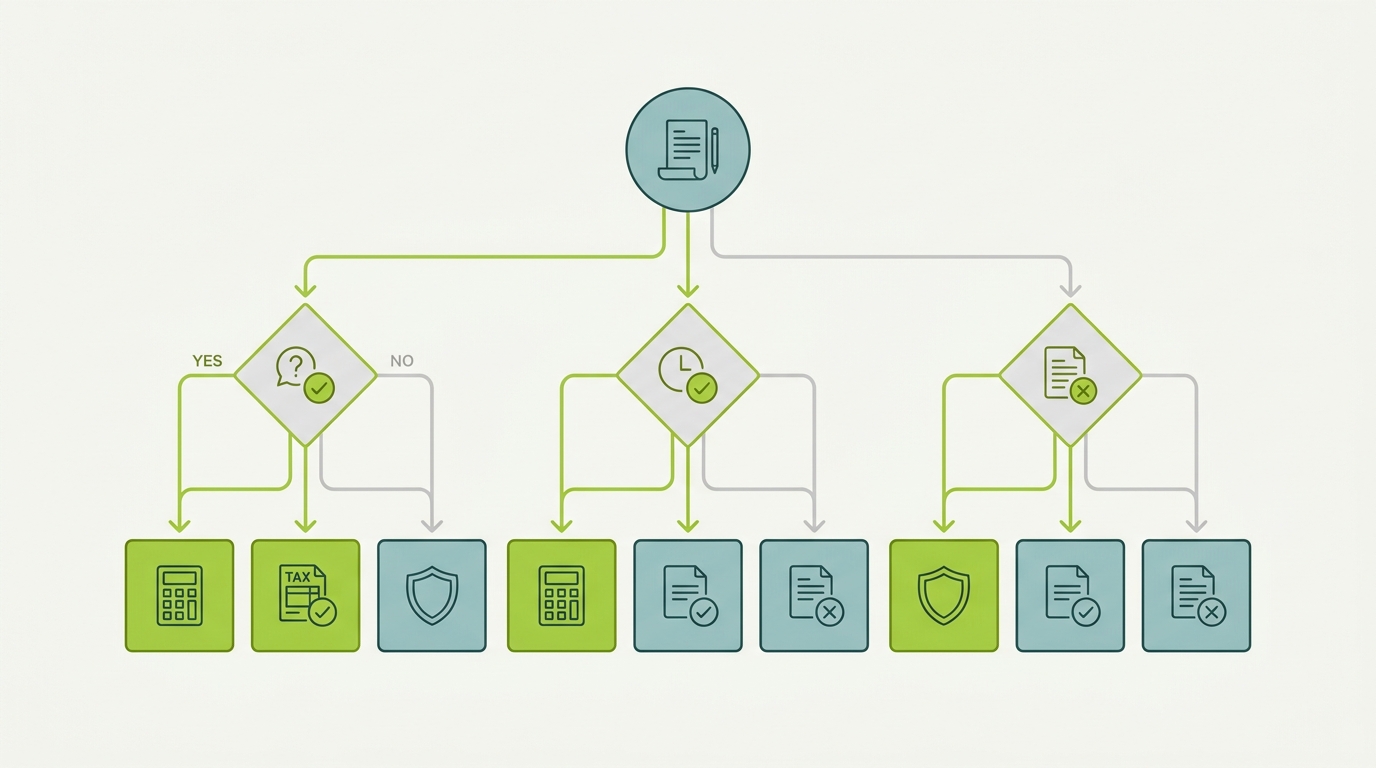
Some crypto transactions fall into uncertain territory. The IRS has not issued definitive guidance on every scenario, so taxpayers and tax professionals must apply existing rules as best they can.
Wrapping and unwrapping tokens. Converting ETH to WETH (wrapped Ether) is a gray area. Some tax professionals treat this as a non-taxable event because the economic substance does not change. Others treat it as a taxable swap. The IRS has not provided explicit guidance, so the safest approach depends on your specific situation and risk tolerance.
Hard forks with new tokens. When a hard fork results in new tokens appearing in your wallet, the IRS generally treats this as taxable income at the fair market value of the new tokens when you gain dominion and control. But what if you never claim the tokens? That is where things get murky. If you lack the ability to access or transfer the forked tokens, a strong argument exists that no taxable event has occurred.
DeFi liquidity pool deposits and withdrawals. Adding tokens to a liquidity pool may or may not constitute a taxable exchange, depending on the protocol’s mechanics. Some pools issue LP tokens in return, which could be treated as a swap. This is one of the most contested areas in crypto tax law right now.
Bridging tokens across chains. Moving tokens from Ethereum to Arbitrum via a bridge raises questions. Is this a non-taxable transfer (like moving between wallets), or is it a taxable exchange? The answer often depends on whether the bridged token is technically a new asset.
Real Dollar Examples: Taxable vs Non-Taxable
Let’s put numbers to these rules so you can see how they work in practice.
Selling Bitcoin (Taxable)
You bought 0.5 BTC for $15,000 in January 2025. In March 2026, you sell it for $22,000. Held for more than one year, this qualifies as a long-term capital gain, taxed at 0%, 15%, or 20% depending on your total income.
Swapping ETH for SOL (Taxable)
You bought 5 ETH for $10,000. Later, you swap all 5 ETH for SOL when your ETH is worth $14,000. You owe tax on the $4,000 gain even though you never touched fiat currency.
Example 3: Receiving staking rewards (Taxable). You earn 0.1 ETH per month from staking. Each monthly reward is worth $350 at the time you receive it. Over a full year, you report $4,200 as ordinary income on your tax return.
Example 4: Transferring to a hardware wallet (Non-Taxable). You move 2 BTC from Kraken to your Trezor wallet. No tax is owed. Your cost basis carries over to the Trezor wallet.
Example 5: Gifting crypto to a family member (Non-Taxable). You gift $15,000 worth of ETH to your sibling. Because the gift is under the $19,000 annual exclusion, no gift tax applies. Your sibling inherits your original cost basis.
Common Mistakes That Trigger IRS Problems
Misclassifying a taxable event as non-taxable is one of the fastest ways to end up with an IRS notice. Here are the mistakes we see most often.
Forgetting that crypto-to-crypto trades are taxable. Many traders assume that swapping tokens is not taxable because no fiat currency is involved. This is incorrect. Every crypto-to-crypto trade is a taxable disposition.
Ignoring small transactions. Buying a $5 coffee with Bitcoin still triggers a taxable event. The IRS does not have a de minimis exception for crypto transactions.
Losing track of cost basis across wallets. When you transfer crypto between multiple wallets and exchanges, your cost basis must follow. If you cannot prove your basis, the IRS may assign a cost basis of zero, maximizing your tax bill.
Double-counting transfers as sales. Some taxpayers mistakenly report wallet-to-wallet transfers as sales, creating phantom gains. This inflates your reported income and leads to overpayment.
Failing to report airdrops and forks. Just because you did not ask for airdropped tokens does not mean they are tax-free. If you had the ability to access and sell them, you owe income tax on their fair market value.
The difference between a taxable and non-taxable crypto event often comes down to one question: did you dispose of the asset, or did you simply move it?
How to Track and Report Every Event
Proper reporting starts with clean records. Here is a simple framework you can follow.
Step 1: Use a single source of truth. Connect all of your exchange accounts and wallet addresses to a crypto tax software tool. This gives you a unified view of every transaction.
Step 2: Tag each transaction. Label every transaction as a buy, sell, trade, transfer, income event, or gift. This is where most errors happen, so take the time to verify each one.
Step 3: Verify cost basis. Make sure your cost basis is accurate for every asset. Pay special attention to tokens that were transferred between wallets, received as airdrops, or earned through staking.
Step 4: Generate your tax forms. Your software should produce IRS Form 8949 for capital gains and losses. Ordinary income from mining, staking, and airdrops goes on Schedule 1 or Schedule C, depending on whether the activity is a business or hobby.
Step 5: Get a professional review. If you have complex transactions (DeFi, NFTs, cross-chain bridges), a professional review can catch errors that software misses. Our crypto tax service reconciles the underlying transaction data for clients every year.
2026 Updates: What Changed This Year
The 2026 tax year includes several updates that affect how crypto events are classified and reported.
Broker reporting under the Infrastructure Investment and Jobs Act. Centralized exchanges are now required to issue 1099-DA forms to users and the IRS. This means the IRS has a clearer picture of your trading activity than ever before. Discrepancies between your reported gains and what exchanges report will trigger automated notices.
Cost basis reporting requirements. For 2026 transactions, Form 1099-DA reporting may include cost basis information for covered digital assets, but basis reporting may be unavailable for noncovered assets, transferred-in assets, assets acquired before 2026, or assets where the broker lacks sufficient information. Taxpayers are still responsible for maintaining complete records across all wallets, exchanges, and DeFi protocols.
Continued lack of guidance on DeFi. Despite growing DeFi adoption, the IRS has not released comprehensive guidance on liquidity pools, yield farming, or cross-chain operations. Taxpayers must continue to apply general tax principles to these transactions.
Bottom Line: What to Do Next
Every crypto transaction falls into one of two categories: taxable or non-taxable. Selling, trading, spending, and earning crypto are taxable. Buying, holding, transferring between your own wallets, and gifting under the annual exclusion are not.
The gray areas (wrapping, bridging, DeFi) require careful analysis and documentation. When in doubt, treat the transaction as taxable and keep records that support your position.
For the complete picture of crypto taxation in 2026, read our full crypto tax guide. If you want help classifying your transactions and filing accurately, schedule a consultation with our team. We work with crypto investors, traders, and businesses to make sure every event is reported correctly.
Frequently Asked Questions
Is buying crypto taxable?
No. Purchasing cryptocurrency with US dollars or other fiat currency is not a taxable event. You only owe taxes when you sell, trade, spend, or earn crypto.
Is transferring crypto between my own wallets taxable?
No. Moving crypto between wallets you own (e.g., Coinbase to Ledger) is not taxable, as long as you maintain ownership. However, you must track cost basis across wallets.
Is swapping one crypto for another taxable?
Yes. Trading one cryptocurrency for another (e.g., BTC to ETH) is a taxable event. You must calculate the gain or loss based on the fair market value at the time of the swap.
Are crypto gifts taxable?
Giving crypto as a gift is generally not taxable for the giver, as long as the gift is under the $19,000 annual exclusion for 2026. Gifts above this amount count against your lifetime exemption.
Is receiving a crypto airdrop taxable?
Yes. Airdrops are taxed as ordinary income at the fair market value when you gain dominion and control over the tokens, per IRS Revenue Ruling 2019-24.