

 Crypto Tax Forms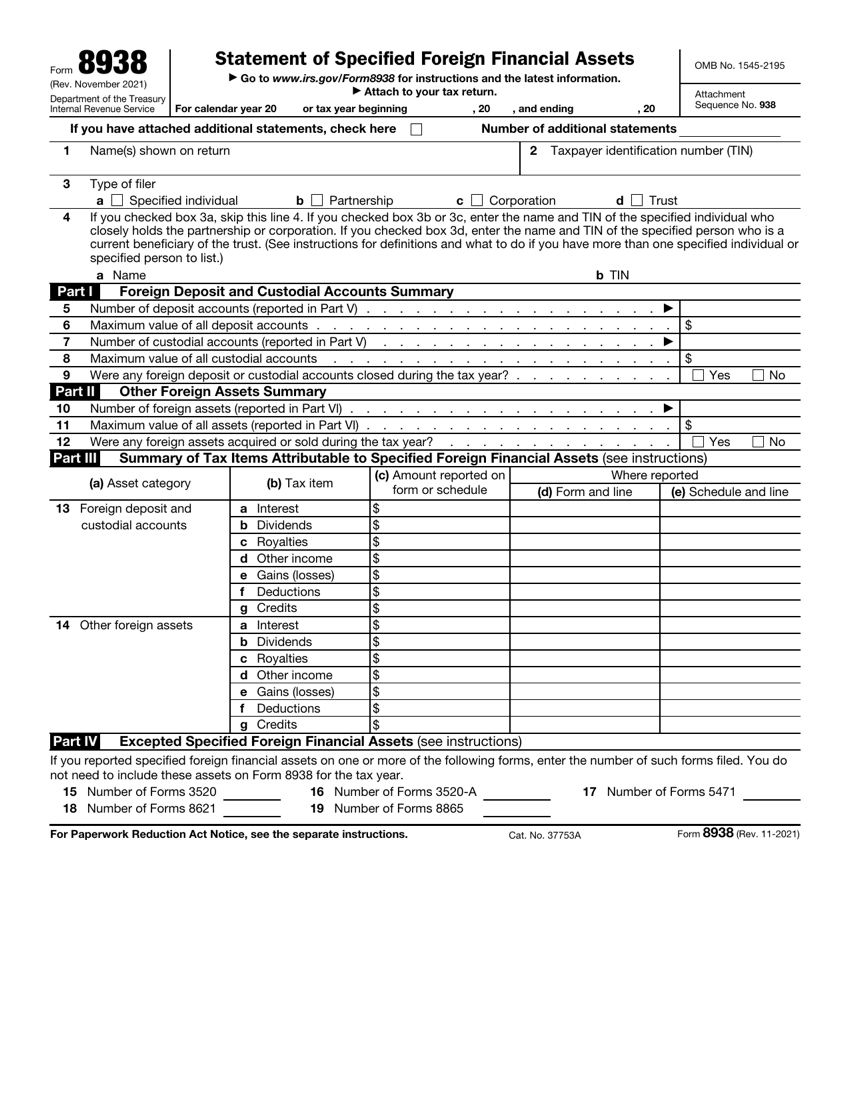
Key takeaways
- Two different forms, two agencies. The FBAR goes to FinCEN, Form 8938 goes to the IRS with your return. You can owe both.
- Foreign crypto is unsettled. FinCEN proposed reporting crypto-only foreign accounts, but it is not final for the 2026 tax year.
- Thresholds differ. FBAR triggers at $10,000 aggregate. Form 8938 thresholds are higher and depend on filing status and residence.
- Penalties are harsh. Non-willful and especially willful failures carry large penalties, so this is a place to be careful.
Most crypto tax pages focus on what you owe. These two forms are different: they are about disclosure, not tax. If you hold assets through foreign institutions, the US wants to know, and the penalties for staying quiet are among the steepest in the tax code. Crypto sits in an uncomfortable spot here, because the rules were written for bank and brokerage accounts, and the question of whether a foreign crypto exchange counts has not been fully settled. This guide explains both forms, the thresholds, the unsettled crypto question, and how to think about the conservative and aggressive positions.
What the FBAR is
The FBAR is FinCEN Form 114, the "Report of Foreign Bank and Financial Accounts." It is filed electronically with the Financial Crimes Enforcement Network (FinCEN), separate from your tax return. A US person must file it if the aggregate value of their foreign financial accounts exceeds $10,000 at any point during the year, even for a single day. It is a disclosure, not a tax: filing it does not create tax, but failing to file it can create enormous penalties.
What Form 8938 is
Form 8938 is the "Statement of Specified Foreign Financial Assets," filed with your tax return under the Foreign Account Tax Compliance Act (FATCA). It overlaps with the FBAR but is not identical: it goes to the IRS, it covers a somewhat broader set of assets, and it kicks in at higher thresholds that depend on your filing status and whether you live in the US or abroad.
| Feature | FBAR (FinCEN 114) | Form 8938 |
|---|---|---|
| Filed with | FinCEN, electronically | IRS, with your tax return |
| Threshold | $10,000 aggregate, any time in year | Higher, varies by status and residence |
| Single filer in US | $10,000 | Over $50,000 year-end or $75,000 any time |
| Covers | Foreign financial accounts | Specified foreign financial assets, broader |
| Purpose | Anti-money-laundering disclosure | FATCA tax compliance |
The thresholds above are common examples for the 2026 tax year. Joint filers and US persons living abroad have higher Form 8938 thresholds, so confirm the figure for your exact situation before deciding you are below the line.
The unsettled question: foreign crypto exchanges
Here is the genuinely gray area. The FBAR rules were written for bank and securities accounts. For years, FinCEN guidance indicated that an account holding only virtual currency was not, by itself, reportable on the FBAR. FinCEN then announced its intent to propose amending the rules to include foreign accounts holding virtual currency, but as of the 2026 tax year that proposed change has not been finalized into a binding requirement for crypto-only accounts.
That leaves a real choice, and it is worth being honest about it.
| Position | What it means | Trade-off |
|---|---|---|
| Conservative | Report foreign crypto holdings on the FBAR and 8938 as if they count. | Maximum protection from penalties. Some extra disclosure. |
| Aggressive | Do not report crypto-only foreign accounts until rules are final. | Defensible under current rules, but risk if rules are deemed to apply. |
| Clear-cut | Account holds fiat or other assets too. | Reportable now under existing rules, regardless of the crypto debate. |
Thresholds in practice
Two numbers anchor the analysis. The FBAR is an aggregate $10,000 test: add up the highest value of all your foreign financial accounts, and if the combined peak crosses $10,000 at any moment in the year, the FBAR is triggered for all of them. Form 8938 uses higher, status-based thresholds and looks at both a year-end value and a peak value.
Neither account alone crosses $10,000, but together they peak at $10,700, so the aggregate test is met and both must be reported. This catches a lot of people who assume each account is judged on its own.
Holding crypto on a foreign exchange?
Foreign account reporting is high-stakes and unsettled for crypto. We help you inventory accounts, weigh the conservative and aggressive positions, and document the choice.
See how it worksDeadlines and how each form is filed
The two forms are filed in completely different ways, and missing the mechanics is its own kind of failure. The FBAR is filed electronically through FinCEN's BSA E-Filing system, not with your tax return and not with the IRS. Its due date is aligned with the tax filing deadline, and an automatic extension is generally available, but it is a separate submission that many people forget precisely because it does not ride along with the 1040.
Form 8938, by contrast, is attached to and filed with your federal income tax return. If you extend your return, you extend the 8938 with it, because they move together. The result is that a taxpayer with a single large foreign crypto account may have to remember two distinct filings on two distinct systems, one to FinCEN and one to the IRS, even though the underlying account is the same. Building both into a filing checklist is the simplest guard against an accidental miss.
The penalties are severe
This is why the forms matter so much. FBAR penalties are among the harshest in the code. A non-willful failure can carry a substantial penalty per violation, and a willful failure can reach the greater of a large fixed amount or half the account balance, with potential criminal exposure in extreme cases. Form 8938 carries its own steep penalties, starting in the thousands and increasing for continued failure after notice, along with extended statutes of limitations.
The asymmetry is the point: filing an FBAR costs you nothing in tax, while failing to file can cost a fraction of the entire account. That lopsided risk is exactly why many practitioners lean conservative when a foreign crypto account is in play.
Who counts as a US person
These rules reach further than many crypto holders assume, because the trigger is being a US person, not living in the US. A US person includes US citizens, green card holders, and residents who meet the substantial presence test, along with certain US entities. That means a US citizen living abroad and holding crypto on a local foreign exchange is squarely within the FBAR and Form 8938 universe, even though everything about their day-to-day life is overseas. Living outside the country raises the Form 8938 thresholds, but it does not remove the obligation.
The reach also extends to accounts you do not own outright but have authority over. Signature authority over a foreign account, or a financial interest held through an entity, can pull an account into FBAR reporting even when the balance is not technically yours. For crypto, this can surface with business accounts, accounts held jointly, or arrangements where you control a wallet on a foreign platform on behalf of an entity. The practical lesson is to map not just what you own, but what you control.
Why you can owe both forms
The FBAR and Form 8938 overlap heavily, which leads people to assume filing one covers the other. It does not. They are administered by different agencies under different laws, with different definitions, thresholds, and deadlines, and a single foreign account can require both. The FBAR is a FinCEN filing under anti-money-laundering law. Form 8938 is an IRS filing under FATCA that travels with your tax return. An account that crosses both thresholds appears on both forms, and meeting one obligation does nothing for the other.
How to approach it
- Inventory every foreign-held account, including foreign crypto exchanges and any fiat balances inside them.
- Flag mixed accounts that hold fiat or other assets, which are reportable now regardless of the crypto debate.
- Compare to the thresholds, the $10,000 aggregate FBAR test and the higher Form 8938 figures for your status.
- Choose and document your position on crypto-only foreign accounts, ideally with professional advice.
- File on time, the FBAR with FinCEN and Form 8938 with your return.

The 2025/26 Crypto Tax Guide. Built by former Big 4 accountants.
A printable, step-by-step guide and checklist to reconcile every coin and wallet, recover missing cost basis, and file accurately before the deadline.
- Form 8949, Schedule D, and Schedule 1 walkthroughs
- How to handle staking, DeFi, NFTs, and lost coins
- The $0-basis 1099-DA trap (and how to avoid it)
- FBAR, Form 8938, and foreign exchange reporting