
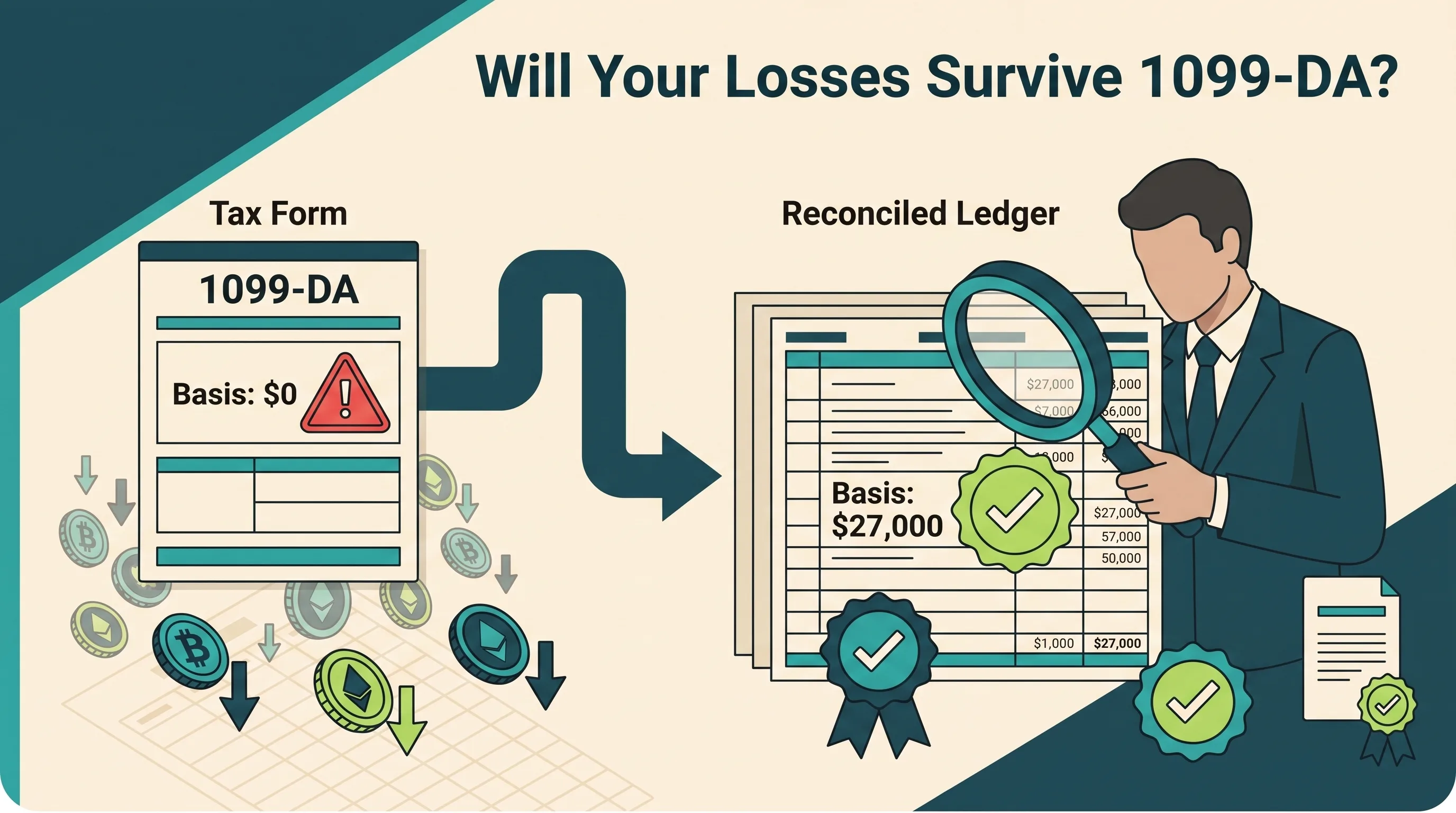
A harvested crypto loss can be economically real and still fail on the tax report. The usual problem is not the sale. It is the missing path between the lot you acquired, the wallets it crossed, the proceeds a broker reported on Form 1099-DA, and the basis entered on Form 8949.
For harvesting strategy, timing, and current wash-sale rules, start with our crypto tax-loss harvesting pillar. This guide begins after the trade. It shows how to make the claimed loss agree with broker reporting, transferred-lot history, and the evidence in your wallets.
For 2025 transactions reported in 2026, covered brokers generally report gross proceeds on Form 1099-DA. Basis reporting begins for certain covered-asset transactions in 2026, but transferred assets remain a problem because the receiving broker may not have the earlier acquisition history. A clean loss therefore depends on lot-level reconciliation, not the number produced by a single exchange export.
Why harvested losses become a 1099-DA basis problem
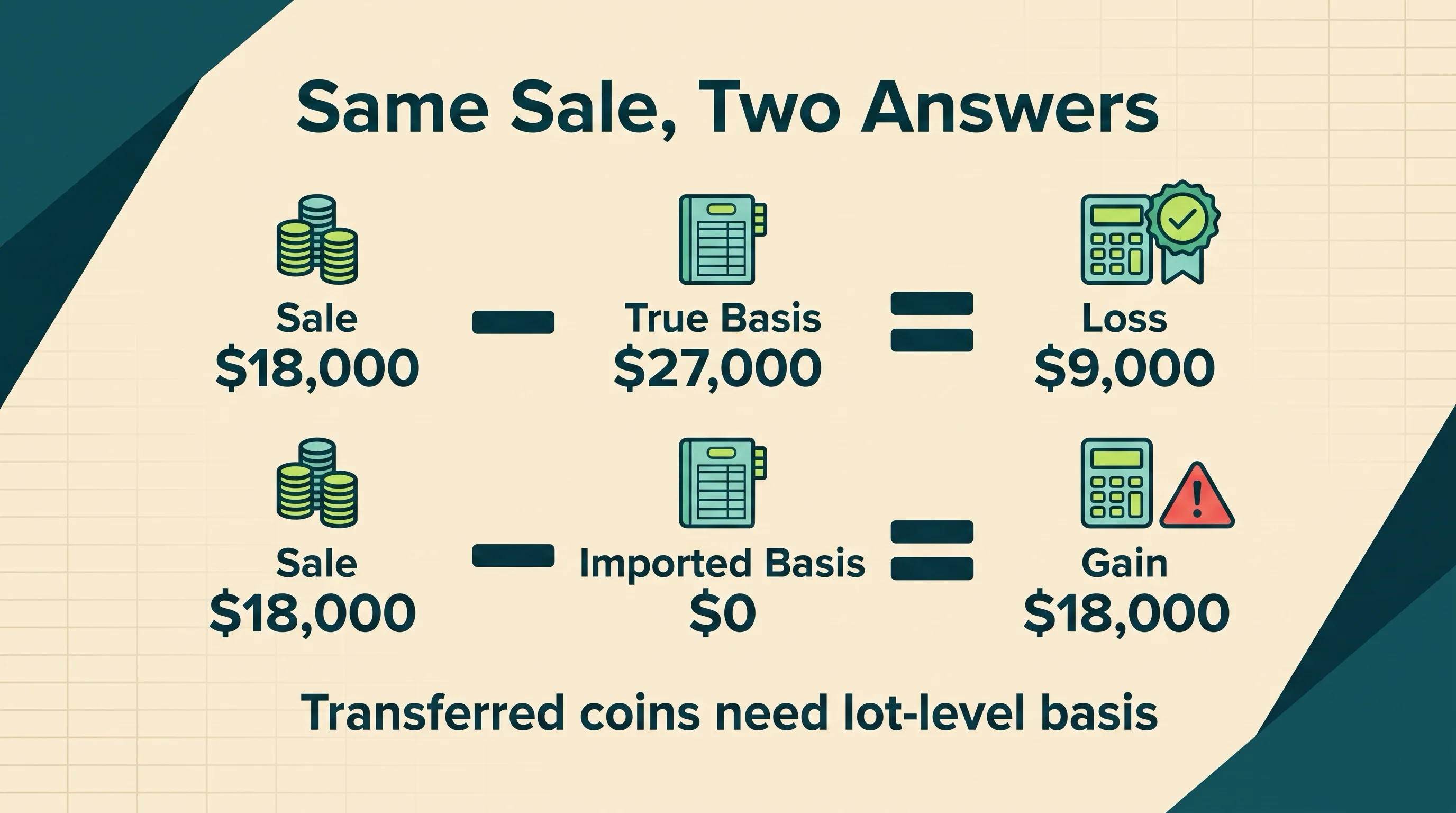
Form 1099-DA can establish the proceeds from a broker sale without establishing the basis of the sold lot. If that lot arrived from self-custody, another exchange, a bridge, or a DeFi protocol, the receiving broker sees the asset enter but may not know when or how you acquired it.
Consider a simple example. You bought a transferred lot for $27,000, then sold it through a broker for $18,000. The real result is a $9,000 capital loss. If the import assigns zero basis, the same sale appears to create an $18,000 gain. The proceeds match either way. Only the lot history proves which result belongs on Form 8949.
That mismatch is why downloading a broker form is not the finish line. You need to connect four records:
- The original acquisition, including date, price, and fees
- Every owner-controlled transfer that moved the lot between accounts
- The broker disposal reported on Form 1099-DA
- The Form 8949 line showing proceeds, adjusted basis, and the resulting loss
The account-by-account basis framework makes location matter. A loss sold on one exchange must be tied to a lot that actually reached that account. You cannot repair missing basis by grabbing an unrelated purchase from another wallet because it produces a more favorable result.
Run the basis test before and after every harvest
The safest workflow checks the lot twice. Before the trade, confirm that the intended lot has a traceable acquisition and sits in the account where the disposal will occur. After the trade, confirm that the broker proceeds and your disposal record refer to the same quantity, timestamp, and asset.
Before the disposal
Choose the lot under the cost basis method you consistently use. Confirm its acquisition date, original dollar basis, and holding period. If the asset crossed wallets, link the sending and receiving transactions so the basis travels with it. If the transaction came from a reward, mint, pool withdrawal, or wrapped asset, verify how that event established or carried basis.
This review catches the most expensive mistake early: selling a transferred asset whose acquisition cannot be found. The trade may still be valid, but the reconstruction becomes slower once several more wallet movements pile on top.
After the disposal
Match the sale confirmation to the on-chain transaction or exchange trade ID. Record gross proceeds, fees, and the exact quantity disposed. Then compare those figures with Form 1099-DA when it arrives. A small difference may come from fee treatment, timestamp pricing, or how the broker grouped transactions. A large difference often points to a missing lot or duplicated disposal.
Do not edit a software result merely to make totals agree. Find the source event, document the reason for any adjustment, and keep that support with the final workpapers.
Use a year-round reconciliation calendar
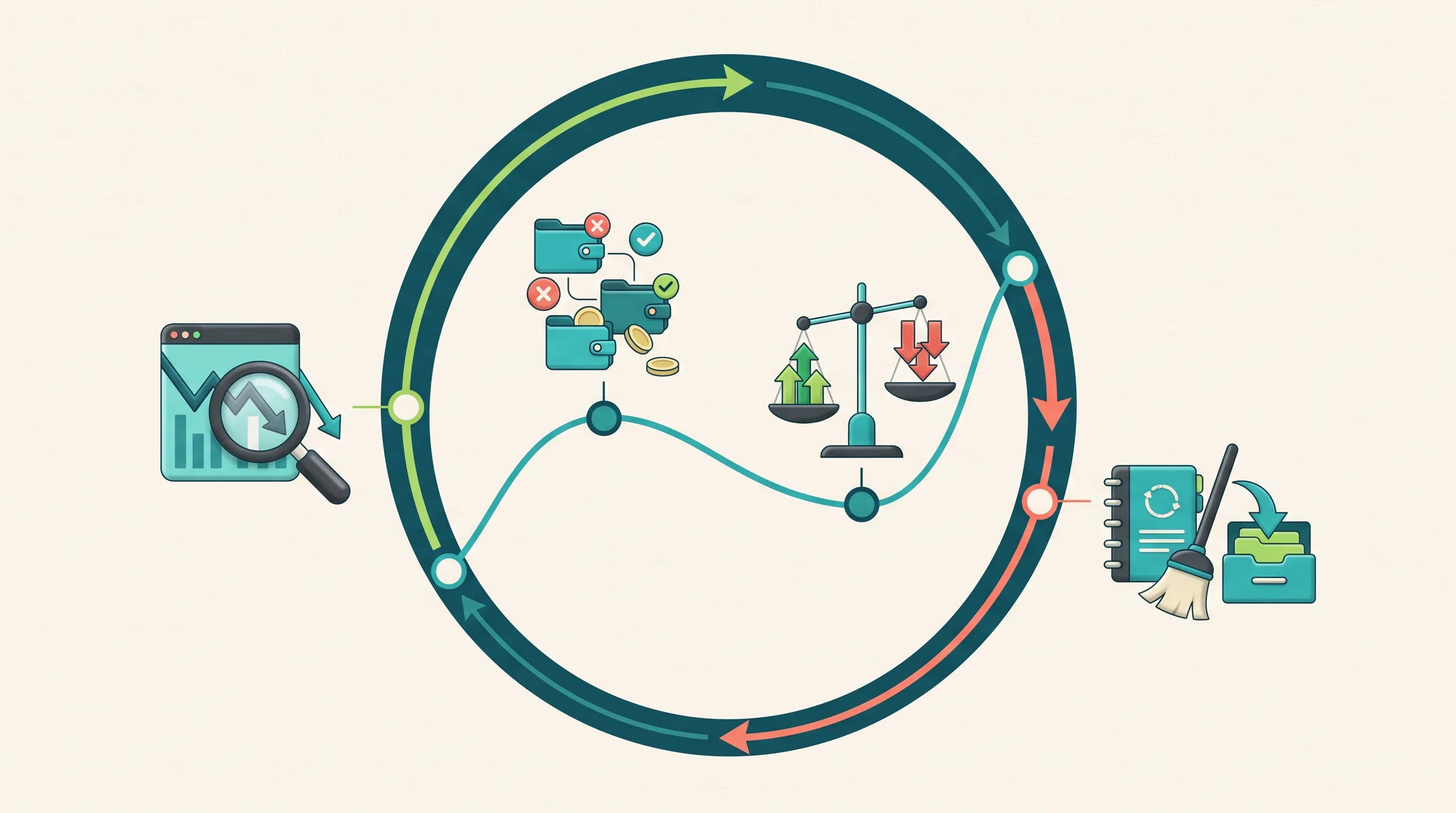
The best time to document a harvested loss is when the transaction is still familiar. Rebuilding everything in tax season forces you to remember why a token appeared, whether two addresses belonged to you, and what a protocol receipt token represented months earlier.
Q1 through Q3: close the record while it is fresh
When you dispose of a losing position during a market drawdown, save the acquisition lot, disposal ID, wallet path, and fair market value support that week. Add a note for any bridge, wrap, or protocol interaction that software may misread. If you repurchase the asset, keep the new lot separate from the disposed lot so its new basis and acquisition date do not overwrite the old history.
October through November: model the whole ledger
By late fall, reconcile realized gains and losses across every account. This is when missing wallets, zero-basis lots, duplicated transactions, and unclassified rewards should surface. Review the draft loss total against the lots you can actually prove rather than relying on the dashboard total.
December: close gaps instead of rebuilding history
Use the final weeks to resolve remaining basis issues and save year-end exports. If you complete the record throughout the year, December becomes a controlled close. If you wait, a missing bridge or abandoned exchange account can hold up the entire report.
Reconcile spot, DeFi, NFT, and frozen positions differently
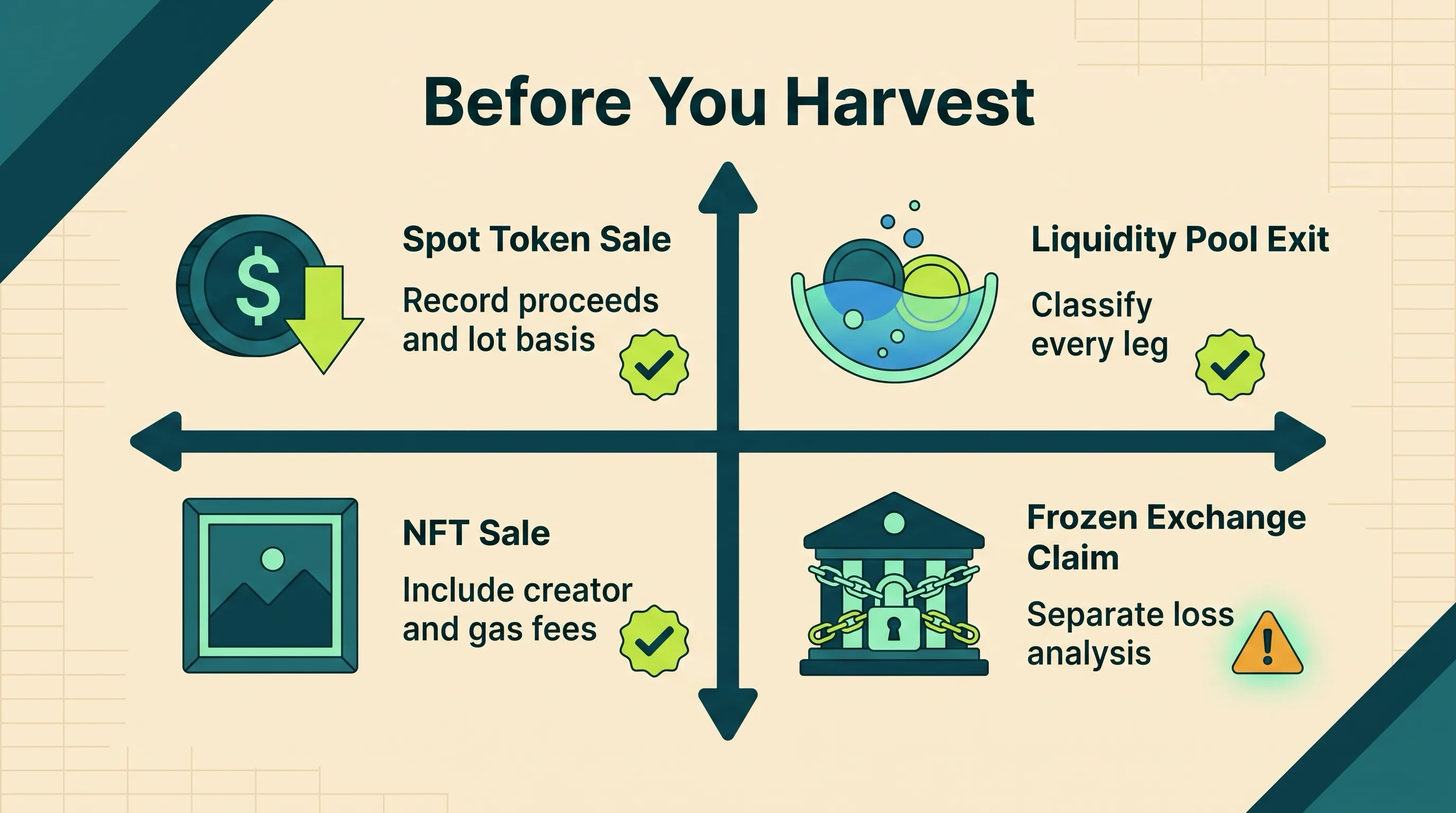
The same proceeds-minus-basis formula applies to many capital asset disposals, but the evidence trail changes with the position. A broker sale can appear on Form 1099-DA while the events that created its basis remain entirely on-chain.
Spot tokens transferred to a broker
Start with the original purchase and carry that lot through each self-transfer. Match quantities carefully when network fees reduce the amount received. The broker disposal should connect to the specific transferred lot rather than a generic portfolio-wide basis pool.
DeFi and liquidity pool positions
A liquidity pool can contain several tax moments. Depositing tokens and receiving an LP token may be treated as an exchange under a conservative approach. Withdrawing can dispose of the LP token and return different assets. Fees and incentives may create income lots with their own basis.
Impermanent loss by itself is not a tax deduction. The report needs a realized disposal and a supported comparison between proceeds and the basis of the property disposed. When a pool exit eventually feeds assets to a broker sale, preserve the pool entry, receipt token, rewards, exit, transfer, and sale as one connected chain.
Staking rewards
Staking rewards are generally ordinary income at fair market value when you gain dominion and control. That same value becomes the basis of the reward lot. If the price later falls and you sell the reward, the later capital loss is separate from the earlier income.
This two-step treatment prevents both zero basis and double counting. Record income once at receipt. On sale, measure only the change from that established basis.
NFTs
An NFT bought for 3 ETH and later sold for 0.2 ETH may create a capital loss, but the basis is not simply “3 ETH.” It is the dollar value of the ETH disposed at purchase, adjusted for relevant acquisition costs. The ETH spend may also create its own gain or loss.
Keep the mint or purchase hash, gas, marketplace sale, royalty charges, and dollar values. If no market buyer exists and you use a burn transaction to close a position, document the transaction and the facts supporting the treatment. A collapsed floor price without a disposition does not establish a realized loss.
Failed exchanges and frozen assets
Coins locked on a failed exchange do not automatically create an ordinary harvested loss. You may still own the asset or hold a bankruptcy claim, and those facts differ from a normal market sale. Separate these positions from routine Form 1099-DA reconciliation and have the specific loss treatment reviewed before reporting it.
Build the evidence packet that supports the Form 8949 loss
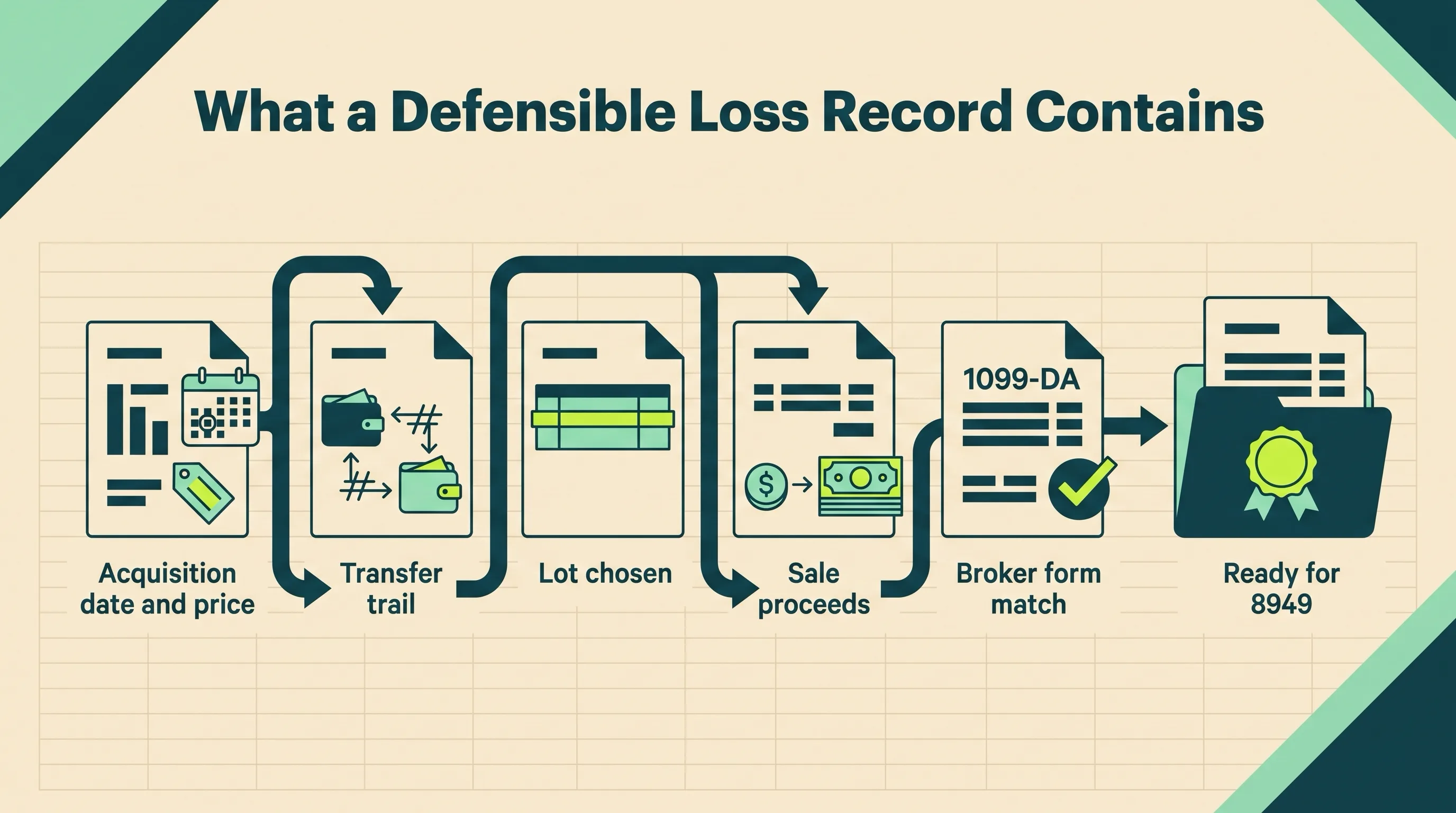
A defensible loss record lets another reviewer follow the numbers without guessing. For each disposed lot, keep:
- Acquisition date, quantity, dollar basis, and fees
- The wallet or account where the lot originated
- Transaction hashes for every owner-controlled transfer
- Disposal date, quantity, proceeds, fees, and trade ID or hash
- The corresponding Form 1099-DA line, if one exists
- The basis amount used on Form 8949 and the source that supports it
- The cost basis method and any specific-identification record
- A short note explaining adjustments, bridge treatment, or software overrides
The note matters. If a broker reports proceeds but no basis for transferred ETH, write down which acquisition transaction supplied the basis and how the lot reached the selling account. If software duplicated a swap, identify the duplicate hash rather than deleting a row with no explanation.
Consistency matters too. FIFO, HIFO, and specific identification can produce different gains and losses. Use a method that fits the applicable rules and maintain the records it requires. Changing methods inside a report only to enlarge a loss can break the lot trail and make the output harder to defend.
Work a transferred-lot example from purchase to Form 8949
Suppose you bought 10 ETH for $27,000, including acquisition fees. You moved the 10 ETH from an exchange to self-custody, then transferred it to a second broker during a market decline. The second broker sold the lot for $18,000 and later reported the $18,000 of proceeds on Form 1099-DA.
Your reconciliation should show:
| Record | Amount or evidence |
|---|---|
| Original acquisition | 10 ETH, $27,000 basis including fees |
| First transfer | Exchange withdrawal hash and self-custody receipt |
| Second transfer | Self-custody send and broker deposit record |
| Broker disposal | 10 ETH sold for $18,000 gross proceeds |
| Form 1099-DA | $18,000 proceeds matched to the sale |
| Form 8949 result | $18,000 proceeds minus $27,000 basis equals a $9,000 loss |
If the second broker shows unknown or zero basis, the two transfer links and original acquisition support the $27,000 adjustment. Without them, tax software may turn the same transaction into an $18,000 gain.
Now add one complication. Suppose 0.1 ETH was spent on network fees across the transfer path, so only 9.9 ETH reached the broker. The reconciliation must determine how those fees are treated and which quantity was actually disposed. It should not force the original 10 ETH purchase into a 9.9 ETH sale merely because the totals look close.
Review the capital loss waterfall only after basis is clean
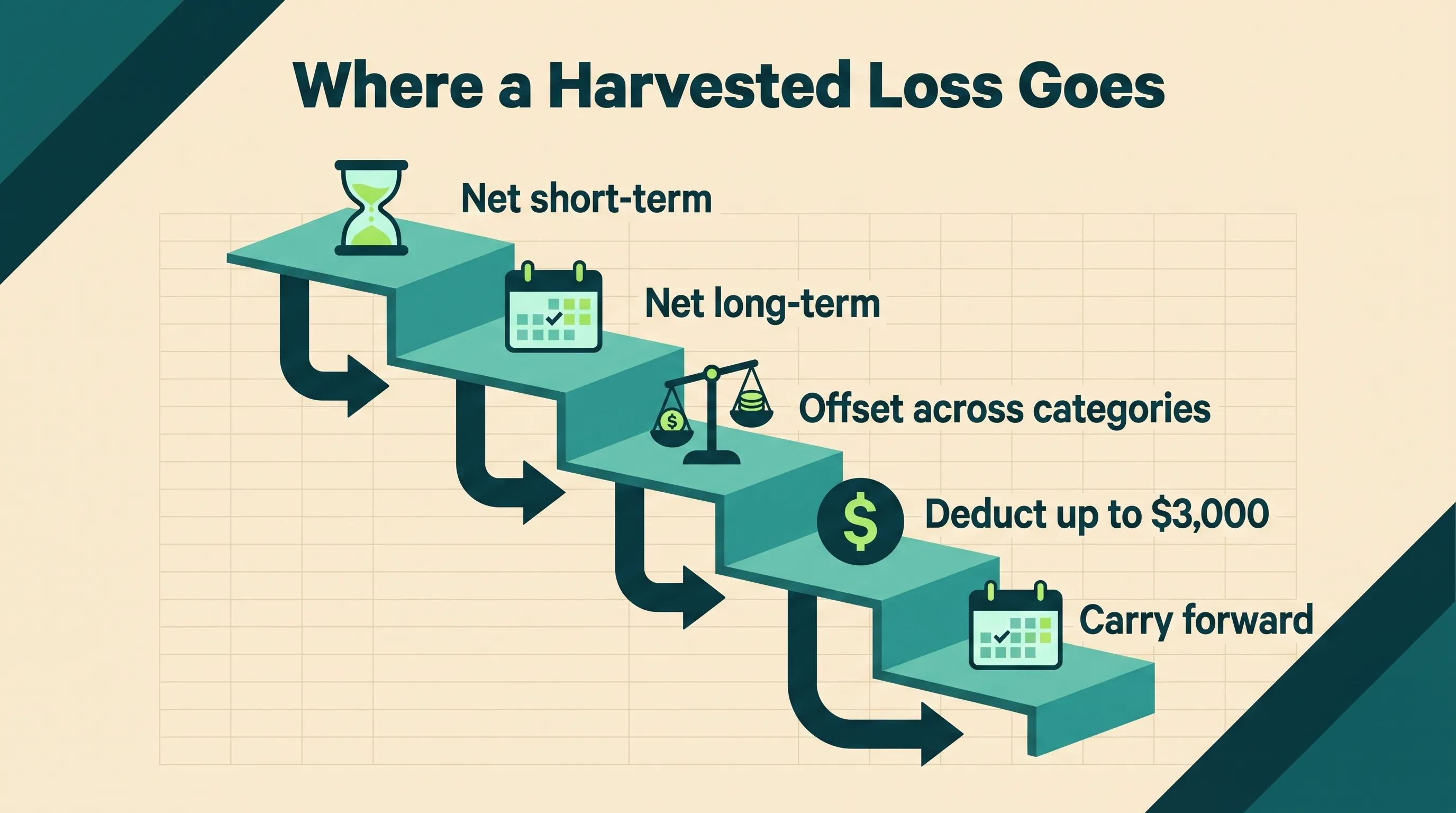
Once every harvested disposal has supported proceeds and basis, the losses can flow through the normal netting process. Short-term items net with short-term items, long-term items net with long-term items, and the categories then offset each other. If a net capital loss remains, up to $3,000 may offset ordinary income for the year ($1,500 if married filing separately), with the rest carried forward.
The waterfall does not fix weak inputs. A large carryforward built on missing or zero basis will remain wrong in later years. Reconcile the lot first, then calculate how the verified loss is used.
Get filing-ready records
Count On Sheep provides Digital Asset Reconciliation, not tax-return preparation or accounting. We clean wallet, exchange, DeFi, and NFT activity into Form 8949, Schedule D, and Schedule 1 inputs. You can file with tax software or hand the finished package to your CPA.
Learn more about our crypto tax reports and Digital Asset Reconciliation service, or contact the team to discuss a complex history.
This article is for general information only and is not tax or legal advice. Ask a qualified tax professional how the rules apply to you.
Primary-source references
- IRS digital asset reporting overview
- IRS guidance on understanding Form 1099-DA
- IRS Revenue Procedure 2024-28
- IRS Publication 550
Frequently Asked Questions
Why can a 1099-DA show proceeds without the basis needed to prove my loss?
A broker may know what you received from a sale without knowing what you paid for transferred-in coins. Your wallet and exchange history must supply the missing acquisition lot, date, fees, and basis before the loss is reported on Form 8949.
How do I reconcile a transferred crypto lot with Form 1099-DA?
Match the reported disposal to the exact wallet lot, trace that lot back to its acquisition, and compare the broker proceeds with your supported basis. Keep the exchange trade ID, transaction hashes, timestamps, and any basis adjustment in one evidence packet.
What if my crypto tax software assigns zero cost basis to a harvested loss?
Do not file the zero-basis result without review. Trace the asset to its original purchase, reward receipt, mint, or prior swap, then carry the supported basis through each owner-controlled transfer before recalculating the disposal.
Can DeFi and NFT losses be reconciled to a 1099-DA?
Yes, but a broker form may cover only part of the activity. DeFi pool entries, reward receipts, NFT purchases, gas, and self-custody transfers usually require on-chain reconstruction alongside the broker-reported disposal.
What records prove a harvested crypto loss?
Keep the acquisition record, wallet path, disposal record, fair market value support, fees, lot-selection method, and the relevant 1099-DA line. The goal is a continuous trail from the original basis to the Form 8949 result.