
Crypto tax-loss harvesting is a strategy where you sell digital assets at a loss to offset capital gains and lower your tax bill. As of 2026, crypto remains exempt from the wash sale rule under IRC Section 1091, allowing you to immediately repurchase the same token after selling at a loss. That makes this one of the most powerful tax reduction tools available to crypto investors right now.
This article is part of our Complete Crypto Tax Guide for 2026, which covers everything from capital gains to cost basis methods and reporting requirements.
How Crypto Tax-Loss Harvesting Works
Tax-loss harvesting follows a simple three-step process. You sell a crypto asset that has dropped below your cost basis, realize the loss on paper, and then use that loss to reduce your taxable income.
Here is the core mechanism. When you sell crypto for less than you paid, the difference is a capital loss. The IRS lets you use capital losses to offset capital gains from other trades. If your losses exceed your gains, you can deduct up to $3,000 of the remaining losses against ordinary income (such as your salary or freelance earnings). Any leftover losses roll forward to the next year.
Unlike stocks, crypto is not currently classified as a “security” under IRC Section 1091. That means the wash sale rule does not apply. You can sell Bitcoin at a loss on Monday and buy it back on Tuesday. With stocks, you would need to wait 31 days or the loss would be disallowed.
This distinction is what makes crypto tax-loss harvesting especially valuable in 2026.
The $3,000 Ordinary Income Deduction
Many investors focus only on using losses to offset gains. But the $3,000 ordinary income deduction is equally important, especially in years where you have no gains to offset.
Here is how the ordering works:
- Short-term losses first offset short-term capital gains.
- Long-term losses first offset long-term capital gains.
- Any remaining net losses offset the other category of gains.
- If you still have excess losses, up to $3,000 offsets ordinary income ($1,500 if married filing separately).
- Everything beyond that carries forward to the next tax year.
For someone in the 32% federal tax bracket, that $3,000 deduction saves $960 in federal taxes alone. Over five years of carrying forward a $15,000 loss, that adds up to $4,800 in tax savings from the ordinary income deduction by itself.
Wash Sale Rule Status for Crypto in 2026
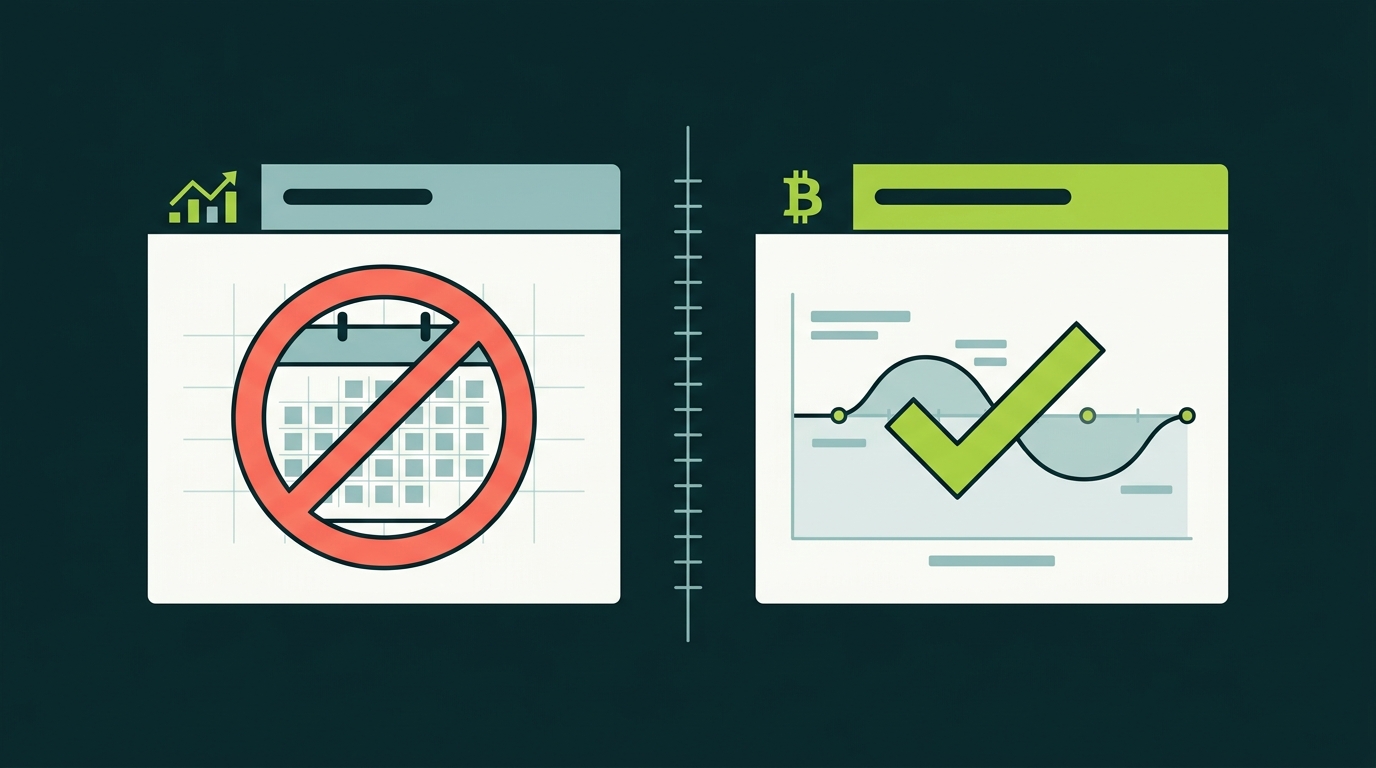
The wash sale rule prevents investors from claiming a tax loss on a security if they buy the same (or a “substantially identical”) security within 30 days before or after the sale. This 61-day window exists to stop people from selling just to book a tax loss and then immediately buying back in.
Crypto is currently exempt. The IRS defines the wash sale rule as applying to “stock or securities,” and the agency has not classified cryptocurrency as a security for purposes of Section 1091. This means you can:
- Sell ETH at a loss and buy ETH back the same day
- Harvest losses as many times as you want throughout the year
For the full breakdown of why crypto is exempt, the crypto ETF exception, and the economic substance caveat, see our dedicated guide to the crypto wash sale rule in 2026.
If you want to understand how cost basis methods affect your harvesting strategy, read our guide on FIFO vs. HIFO vs. Specific Identification for crypto taxes.
Step-by-Step Harvesting Strategy
Follow these steps to execute a tax-loss harvest on your crypto portfolio.
Step 1: Identify positions trading below your cost basis. Review each asset in your portfolio and compare the current market price to what you paid (your cost basis). Any asset below your purchase price represents a harvestable loss.
Step 2: Calculate the potential loss. Subtract the current fair market value from your cost basis. If you bought 2 ETH at $3,500 each ($7,000 total) and they are now worth $2,200 each ($4,400 total), your potential loss is $2,600.
Step 3: Sell the asset. Execute the sale on your exchange. Make sure the transaction is completed before December 31 if you want to claim the loss for the current tax year.
Step 4: Record the transaction. Document the date of sale, the amount received, your original cost basis, and the resulting loss. You will need this for Form 8949 and Schedule D.
Step 5: Repurchase if desired. Because the wash sale rule does not apply to crypto, you can buy back the same asset as long as you can defend that there is a non-tax-related investment purpose for buying and selling. This lets you maintain your portfolio allocation while still booking the tax loss.
Step 6: Report on your tax return. Each disposal goes on Form 8949. Net results flow to Schedule D, where the $3,000 ordinary income deduction is calculated.
Real Dollar Example
Let’s walk through a concrete scenario for the 2026 tax year.
Sarah’s situation:
- Salary: $120,000
- Bought 1 BTC at $68,000 in January 2025
- Sold 1 BTC at $85,000 in March 2026 (short-term gain: $17,000)
- Bought 10 SOL at $180 each ($1,800) in February 2025
- SOL dropped to $90 each. She sells all 10 in June 2026 (short-term loss: $900)
- Bought 5 ETH at $3,800 each ($19,000) in April 2024
- ETH dropped to $2,400 each. She sells all 5 in August 2026 (long-term loss: $7,000)
Tax calculation:
| Item | Amount |
|---|---|
| Short-term gain (BTC) | +$17,000 |
| Short-term loss (SOL) | -$900 |
| Net short-term gain | +$16,100 |
| Long-term loss (ETH) | -$7,000 |
| Long-term gain | $0 |
| Net long-term loss | -$7,000 |
The $7,000 long-term loss offsets $7,000 of the $16,100 net short-term gain. That leaves $9,100 in taxable short-term capital gains (taxed at her ordinary income rate).
No Loss Harvesting
Sarah only reports the BTC sale. The full $17,000 short-term gain is taxable at her ordinary income rate. At 24%, that is $4,080 in federal tax.
Losses Offset Gains
The $900 SOL loss and $7,000 ETH loss offset the BTC gain. Only $9,100 remains taxable. At 24%, that is $2,184 in federal tax.
If Sarah had no gains at all, the $7,900 total loss ($900 + $7,000) would work differently. She could deduct $3,000 against ordinary income in 2026 and carry the remaining $4,900 forward to 2027.
Short-Term vs. Long-Term Loss Differences
Not all losses are created equal. The holding period matters.
Short-term losses (assets held one year or less) first offset short-term gains, which are taxed at your ordinary income rate (up to 37%). Long-term losses (assets held more than one year) first offset long-term gains, which are taxed at preferential rates (0%, 15%, or 20%).
From a pure tax savings perspective, short-term losses offsetting short-term gains produce the largest dollar savings because short-term gains face the highest tax rates.
However, there is a planning consideration. If you have both short-term and long-term losses available, think about which gains you expect to realize this year. Your cost basis method also plays a role in determining whether a specific lot produces a short-term or long-term loss.
For a deeper look at how capital gains rates apply to crypto, see our Crypto Capital Gains Tax Guide for 2026.
Carryforward Rules
Unused capital losses do not expire. They carry forward to future tax years indefinitely until fully used.
Each year, your carryforward losses follow the same ordering rules: offset gains first, then deduct up to $3,000 against ordinary income. A $30,000 loss with no offsetting gains would take 10 years to fully deduct through the $3,000 annual limit alone. But if you realize a $25,000 gain in a future year, you can use $25,000 of the carryforward to offset it in a single year.
Keep thorough records. You will need to track your carryforward balance from year to year, and the IRS expects you to report it correctly on Schedule D each year.
If you have lost access to crypto or had assets stolen, there may be additional deduction rules. Read our guide on lost and stolen crypto tax deductions for 2026.
When Congress Might Close the Loophole
The crypto wash sale exemption has been on Congress’s radar since 2021. Several proposals have attempted to bring digital assets under the same wash sale rules that apply to stocks:
- 2022: The Build Back Better Act included crypto wash sale provisions. It did not pass.
- 2024: The Biden administration’s budget proposal again targeted the loophole.
- 2025-2026: Bipartisan discussions continue, with growing support for “parity” between digital assets and traditional securities.
No legislation has passed as of May 2026. But the trend is clear. If you have been putting off harvesting losses, the time to act is now. Once the rule changes, you will need to wait 31 days before repurchasing the same asset, which introduces market risk.
Common Mistakes to Avoid
Forgetting to track cost basis. Every purchase creates a tax lot with its own cost basis and acquisition date. If you cannot prove your cost basis, the IRS may treat it as zero, making your entire sale proceeds taxable.
Ignoring staking rewards. Staking rewards are taxed as ordinary income when received. If the token price drops after you receive rewards, selling those specific tokens creates a capital loss. Many investors overlook this opportunity.
Assuming all exchanges share data. If you trade across multiple exchanges and wallets, you need to consolidate your records. The IRS receives 1099 forms from exchanges, but those forms may not reflect your actual cost basis if you transferred assets between platforms.
Harvesting losses without a plan. Selling at a loss just to book the deduction is not always the right move. Consider whether you still believe in the asset, whether you want to maintain exposure, and how the loss fits into your overall tax picture for the year.
Not consulting a specialist. Tax-loss harvesting interacts with other parts of your tax return, including estimated tax payments, AMT calculations, and state tax rules. A crypto-focused CPA can help you build a strategy that maximizes savings without surprises.
Our crypto tax accountants works with crypto investors year-round on tax-loss harvesting strategies. If you want a personalized plan, schedule a consultation.
Bottom Line: What to Do Next
Crypto tax-loss harvesting is one of the most straightforward ways to reduce your tax bill in 2026. The wash sale exemption gives crypto investors an advantage that stock investors do not have, but that window may be closing.
Review your portfolio for unrealized losses. Sell strategically to offset gains or claim the $3,000 ordinary income deduction. Repurchase immediately if you want to maintain your positions. And keep detailed records for your tax return.
If your portfolio is complex or you are unsure how harvesting fits into your broader tax situation, working with a crypto tax specialist is worth it. Reach out to our team for a review of your 2026 tax position.
For the full picture on crypto taxes this year, start with our Complete Crypto Tax Guide for 2026.
Frequently Asked Questions
What is crypto tax-loss harvesting?
Tax-loss harvesting is a strategy where you sell crypto at a loss to offset capital gains and reduce your tax bill. Losses can offset gains dollar-for-dollar, plus up to $3,000 of ordinary income per year.
Does the wash sale rule apply to crypto in 2026?
Currently, the wash sale rule under IRC Section 1091 applies only to stocks and securities, not cryptocurrency. You can sell crypto at a loss and immediately repurchase it. However, Congress has proposed closing this loophole.
How much can I deduct in crypto losses?
Crypto losses first offset capital gains dollar-for-dollar. Any excess losses can offset up to $3,000 of ordinary income per year ($1,500 if married filing separately). Remaining losses carry forward indefinitely.
When is the best time to harvest crypto losses?
Most investors harvest losses before December 31 to claim them on the current tax year. However, you can harvest losses at any point during the year when positions are down.
Can I harvest losses on staking rewards?
Yes. If you received staking rewards and their value dropped below the fair market value at receipt, you can sell them to realize a capital loss.