

Koinly and CoinTracker can produce different totals from the same activity. The useful way to compare them is to load the same anonymized transaction set into both tools, hold the tax settings constant, and trace every difference back to an import, match, label, or basis decision.
This staging draft does not publish invented tool output. The source package did not include the anonymized dataset, Koinly export, CoinTracker export, or reconciled control file needed to support numerical test claims. The test structure below is ready for those verified figures before merge. For product selection, use the full Koinly vs CoinTracker comparison.
Disclaimer: This guide is for informational purposes only. Always consult a qualified tax professional about your specific situation.
How We Tested Koinly and CoinTracker
The controlled method uses fresh imports of one anonymized transaction set in Koinly and CoinTracker. Both accounts must use the same tax year, base currency, time zone, cost-basis method, and per-wallet setting. No manual corrections should be made until the uncorrected totals and exception lists are saved.
The evidence package needed to complete the run is not present in this repository. Before merge, attach or record the source transaction file, both raw tool exports, screenshots of the tax settings, and the reconciled control calculation. Without those records, a numerical winner would be guesswork.
The Test Dataset and Expected Results
The final disclosure must state all eight dataset counts and the control total. These fields are intentionally marked pending until the source exports are available.
| Dataset field | Verified value |
|---|---|
| Exchanges | Pending source export |
| Wallets | Pending source export |
| Chains | Pending source export |
| Spot trades | Pending source export |
| Transfers | Pending source export |
| Staking entries | Pending source export |
| DeFi entries | Pending source export |
| Deliberately missing-basis records | Pending source export |
| Reconciled control gain or loss | Pending control calculation |
The expected result is not that both tools match immediately. A useful test includes transfers, staking, DeFi, and missing basis because those are the places where classification and exception handling can diverge.
Accuracy Results by Transaction Type
| Test area | Koinly score | CoinTracker score | Evidence required |
|---|---|---|---|
| Import completeness | Pending | Pending | Imported count compared with source rows |
| Transfer matching | Pending | Pending | Matched transfer pairs and exceptions |
| DeFi labeling | Pending | Pending | Correct labels compared with the control ledger |
| Missing-basis flags | Pending | Pending | Deliberately incomplete records surfaced |
| Uncorrected gain or loss | Pending | Pending | Saved tax summary before corrections |
| Final total after correction | Pending | Pending | Corrected export compared with control |
Where the Totals Diverged
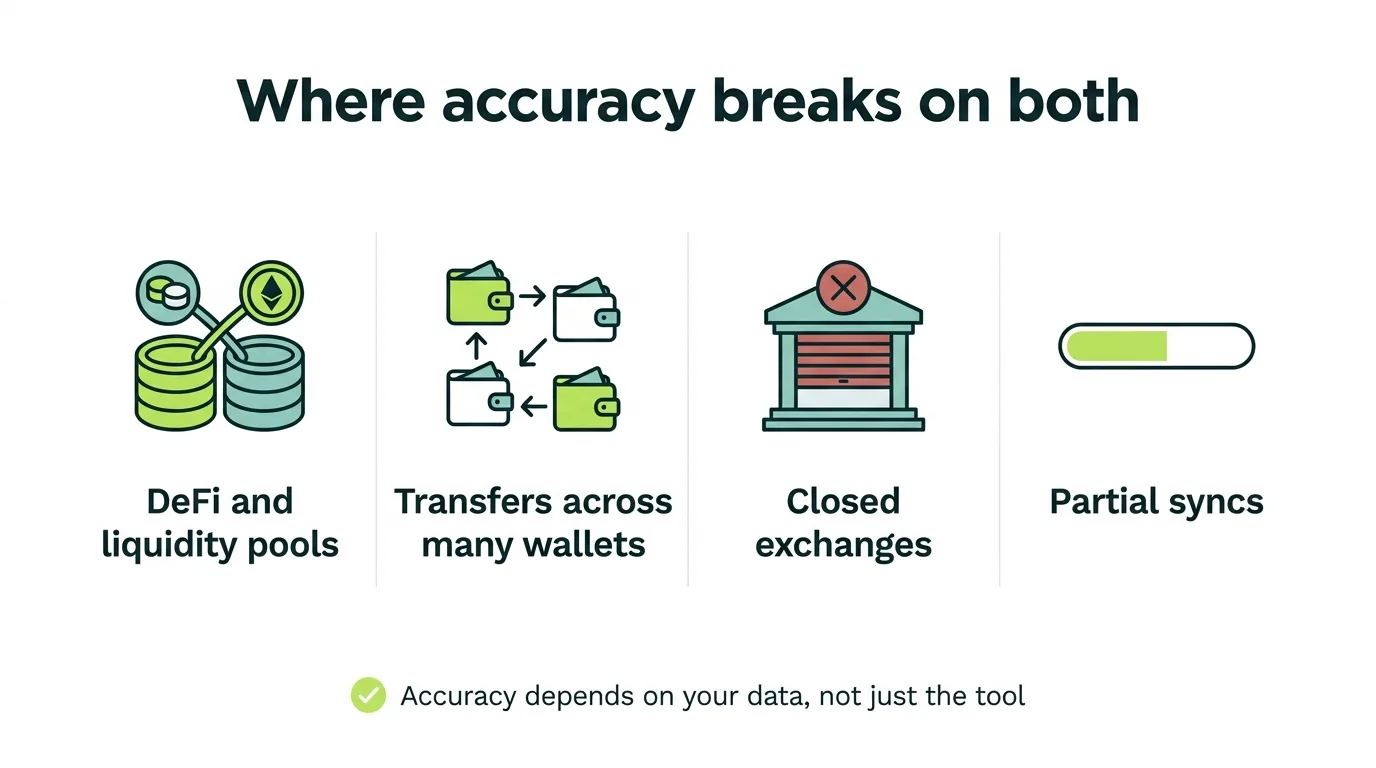
The difference log should identify each transaction that changes the uncorrected totals. Common causes include a wallet that did not import its full history, a transfer treated as a disposal, a staking receipt labeled as a transfer, a DeFi exit split into the wrong legs, or a missing-basis record that one tool flagged more clearly.
The uncorrected Koinly total, uncorrected CoinTracker total, and reconciled control total remain pending because the source exports are not part of the prepared implementation package.
What We Corrected Manually
Apply the same corrections in both tools, in the same order:
- Add any source rows that failed to import.
- Match transfers between owned accounts.
- Restore basis for the deliberately incomplete records.
- Relabel staking and DeFi events against the control ledger.
- Confirm the per-wallet setting for the tested tax year.
- Export the corrected totals and compare both with the control.
Each correction should be logged with the original label, corrected label, reason, and dollar effect. That log is what turns a software comparison into an auditable test.
Accuracy Test Verdict
No numerical verdict is supportable in this staging draft because the required same-data exports and control calculation were not supplied. Once those files are available, the verdict should name which tool imported more completely, which surfaced the missing-basis records more clearly, how much manual work each required, and whether both matched the reconciled control after correction.
The broader buying decision belongs on the full Koinly vs CoinTracker comparison. This page should stay focused on measured accuracy.
When a Human Reconciliation Still Wins
The controlled test is separate from a real client case we have already seen.
A client ran the same portfolio through both Koinly and CoinTracker and got gains that differed by roughly $28,000. Neither was right. Koinly had mislabeled a batch of liquidity-pool exits, while CoinTracker had assigned $0 cost basis to coins from an exchange that had closed. We connected the missing source, imported the closed exchange CSV, and relabeled the DeFi events consistently. Both tools then landed within a few hundred dollars of each other and of the reconciled result.
High volume, meaningful DeFi, many wallets, years of unreconciled history, or a 1099-DA that conflicts with your records can push either tool past what automation can settle on its own. If your report is already tangled, see our guide to human cleanup for Koinly or CoinTracker.
Key Takeaways
- A fair accuracy test uses the same anonymized data and tax settings in both tools
- Import completeness, transfer matching, DeFi labels, and missing-basis flags matter more than the headline total
- The raw totals, corrected totals, and reconciled control must be saved before a verdict is published
- The existing $28,000 divergence is a separate client case, not the controlled test
- Complex records still need human reconciliation even when the software import looks complete
Frequently Asked Questions
Is Koinly or CoinTracker more accurate?
Neither tool is automatically more accurate. The result depends on complete imports, matched transfers, correct DeFi labels, and restored cost basis. A controlled test needs the same transaction set and the same tax settings in both tools.
Why do Koinly and CoinTracker give different numbers?
The tools can classify ambiguous transactions differently, pull different date ranges from an exchange API, or recognize different protocols. Compare the exception lists and transaction labels instead of choosing whichever total is lower.
Does either tool handle DeFi accurately on its own?
No crypto tax tool can classify every DeFi event correctly without review. Liquidity pools, staking, lending, wrapped tokens, and bridges can require manual corrections in either platform.
What should an accuracy test measure?
Use the same anonymized dataset in both tools and record import completeness, transfer matching, DeFi labeling, missing-basis flags, the uncorrected total, and the final total after the same corrections.
When does a human reconciliation beat the software?
A human reconciliation matters when activity includes high volume, several wallets, meaningful DeFi, missing history, or a 1099-DA that conflicts with the records. The software calculates from the data it can see, while a person can investigate and repair what is missing.