
Direct answer
Need help organizing my cryptocurrency transactions for tax season
Count On Sheep organizes your crypto history before tax season. The team imports every exchange, wallet, and chain, fixes missing data and duplicates, and reconciles cost basis. You get clean, CPA-ready 8949 and Schedule D inputs whether you file yourself or use a CPA. The work is delivered by our former Big 4 (EY) crypto tax team.
Crypto tax season gets difficult when your records tell seven different versions of the same portfolio. One exchange has the purchase. A wallet has the transfer. A DeFi protocol has the swap. Your tax software may show all three as unrelated events.
Organizing the history means building one complete record before you trust any gain, loss, or income total. This guide gives you the files to collect, a schedule that works backward from your filing date, the three problems that wreck most crypto records, and a ten-step cleanup order you can hand to a reviewer.
This guide is educational and does not provide tax or legal advice. A licensed tax professional should decide tax treatment based on your facts.
What to gather before you organize anything
Start with a complete account inventory, then collect the source files for every item on it. Include accounts you closed, wallets you stopped using, and chains that hold only a few transactions. A forgotten account is often the only place that shows the original purchase behind a later sale.
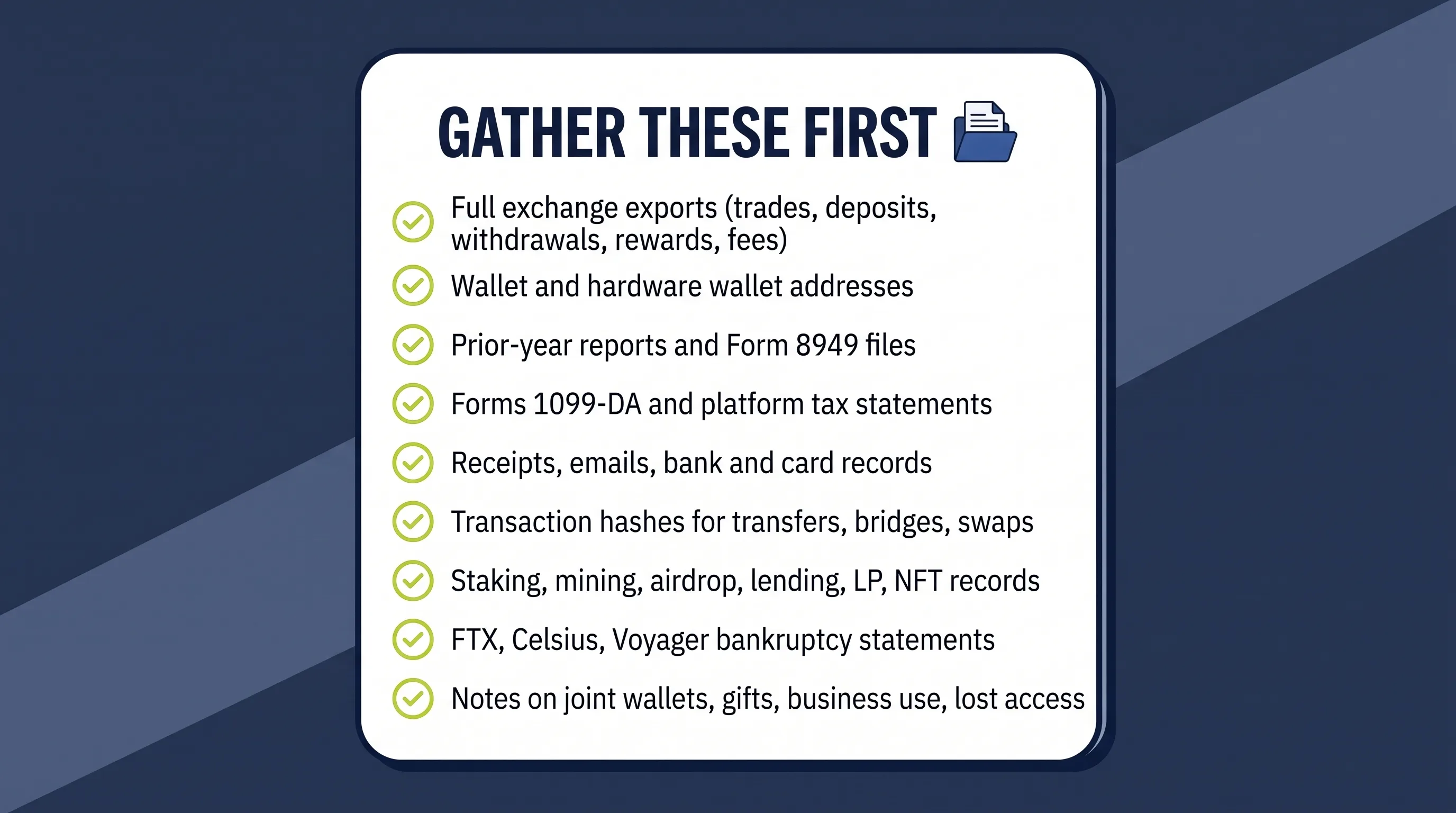
Gather this checklist:
- complete trade, deposit, withdrawal, reward, and fee exports from every exchange
- public addresses for self-custody wallets and hardware wallets
- prior-year transaction reports and Form 8949 files
- Forms 1099-DA and other tax statements received from platforms
- purchase receipts, email confirmations, and bank or card records
- transaction hashes for transfers, bridges, swaps, and wallet migrations
- records for staking, mining, airdrops, lending, liquidity pools, and NFTs
- bankruptcy statements and saved files from FTX, Celsius, Voyager, or other inaccessible platforms
- notes about wallets you own jointly, business activity, gifts, inheritances, or lost access
Save raw exports in a read-only folder. Make renamed copies for working use, and never edit the only source file. When you later need to explain a correction, the original export is your baseline.
Key tax-season deadlines to put on your calendar
Your filing deadline depends on the return, extension status, and any state obligations. Use our current cryptocurrency tax deadlines for 2026 page to confirm the dates that apply to you.
The filing deadline is not your reconciliation deadline. A complex portfolio can need several rounds of missing-data requests, transfer matching, and review, so work backward from the date your CPA or filing software needs final inputs.
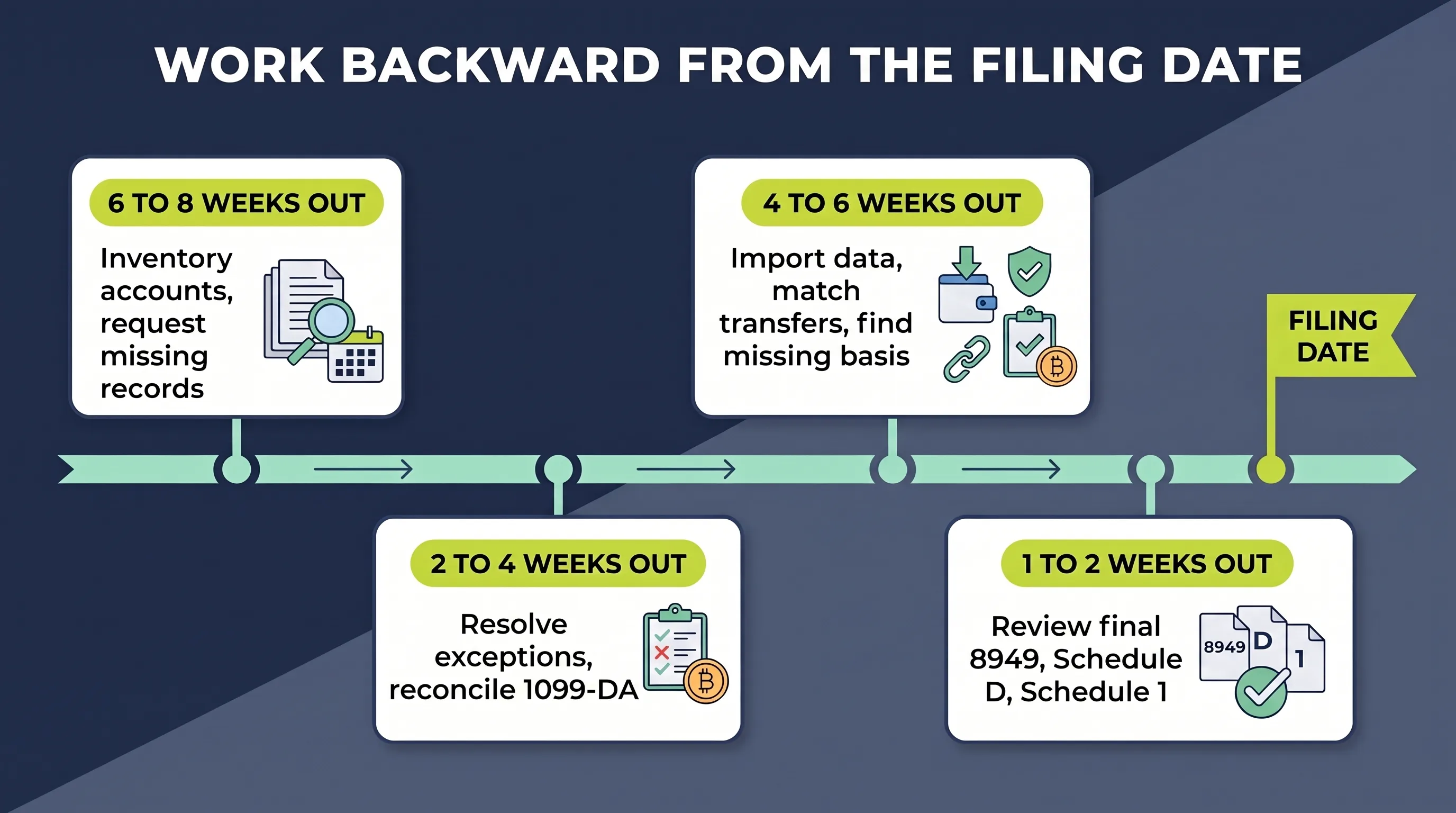
A practical schedule looks like this:
- Six to eight weeks before filing: inventory accounts and request inaccessible records.
- Four to six weeks before filing: import data, match transfers, and identify missing basis.
- Two to four weeks before filing: resolve exceptions and reconcile Forms 1099-DA.
- One to two weeks before filing: review final Form 8949, Schedule D, and Schedule 1 inputs.
If you are already inside that window, prioritize completeness over a tidy dashboard. Hiding unresolved transactions to get an error counter to zero only moves the problem into your return.
The three messes that derail crypto records
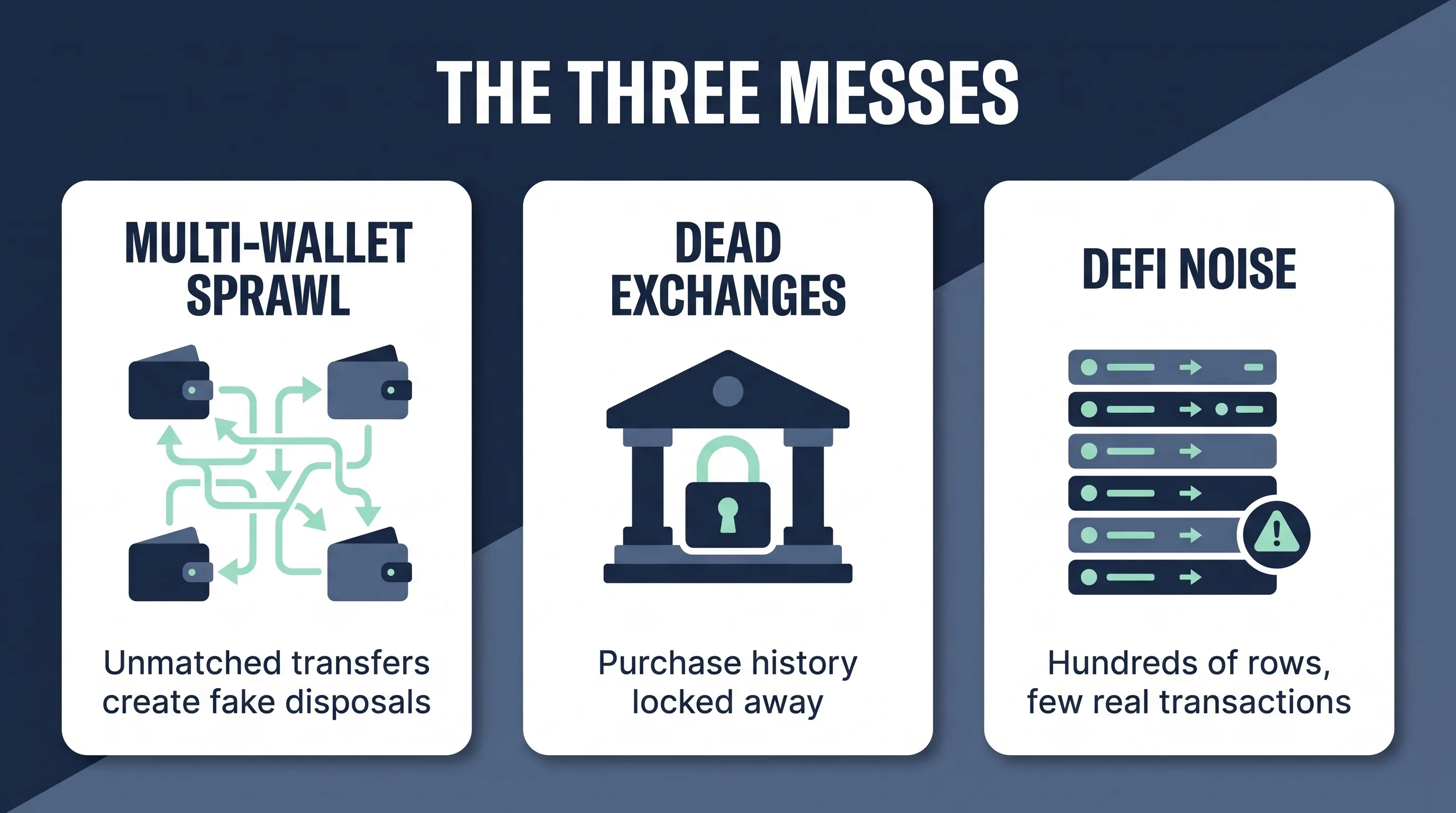
Most broken crypto tax files trace back to one of three problems: transfers between your own wallets that never got matched, purchase history stuck on a platform you can no longer access, and DeFi imports full of rows that are not real transactions. Here is how to spot and handle each one.
Multi-wallet sprawl
Moving assets between exchanges and self-custody wallets does not move the supporting basis record with them. When software fails to match a withdrawal to its deposit, it may create a taxable disposal, a zero-basis receipt, or both.
Build a wallet map first. Then match transfers using asset, quantity, timestamp, transaction hash, chain, and fee. Carry the original lot into the destination rather than pricing the deposit as a new purchase.
Dead exchanges and inaccessible history
Closed or frozen platforms can remove the original trade export from your normal workflow. Search saved devices, email confirmations, bank statements, old software files, prior reports, and destination-wallet history. Bankruptcy claims and distribution records may also help explain later receipts.
When basis is still missing, document the gap and the evidence reviewed. Our step-by-step guide explains how to reconstruct missing crypto cost basis without automatically using zero.
DeFi noise
DeFi imports are full of approvals, internal protocol movements, wrapped-token steps, liquidity-pool deposits, rewards, spam tokens, and duplicate events. A wallet can show hundreds of rows that represent a handful of actual economic transactions.
Group related transaction hashes and follow what entered and left your control. Remove obvious spam from reporting views, but preserve the raw chain history. Tax characterization can depend on the protocol and facts, so flag uncertain treatment for a licensed professional rather than forcing a label.
A DIY checklist that keeps the work reviewable
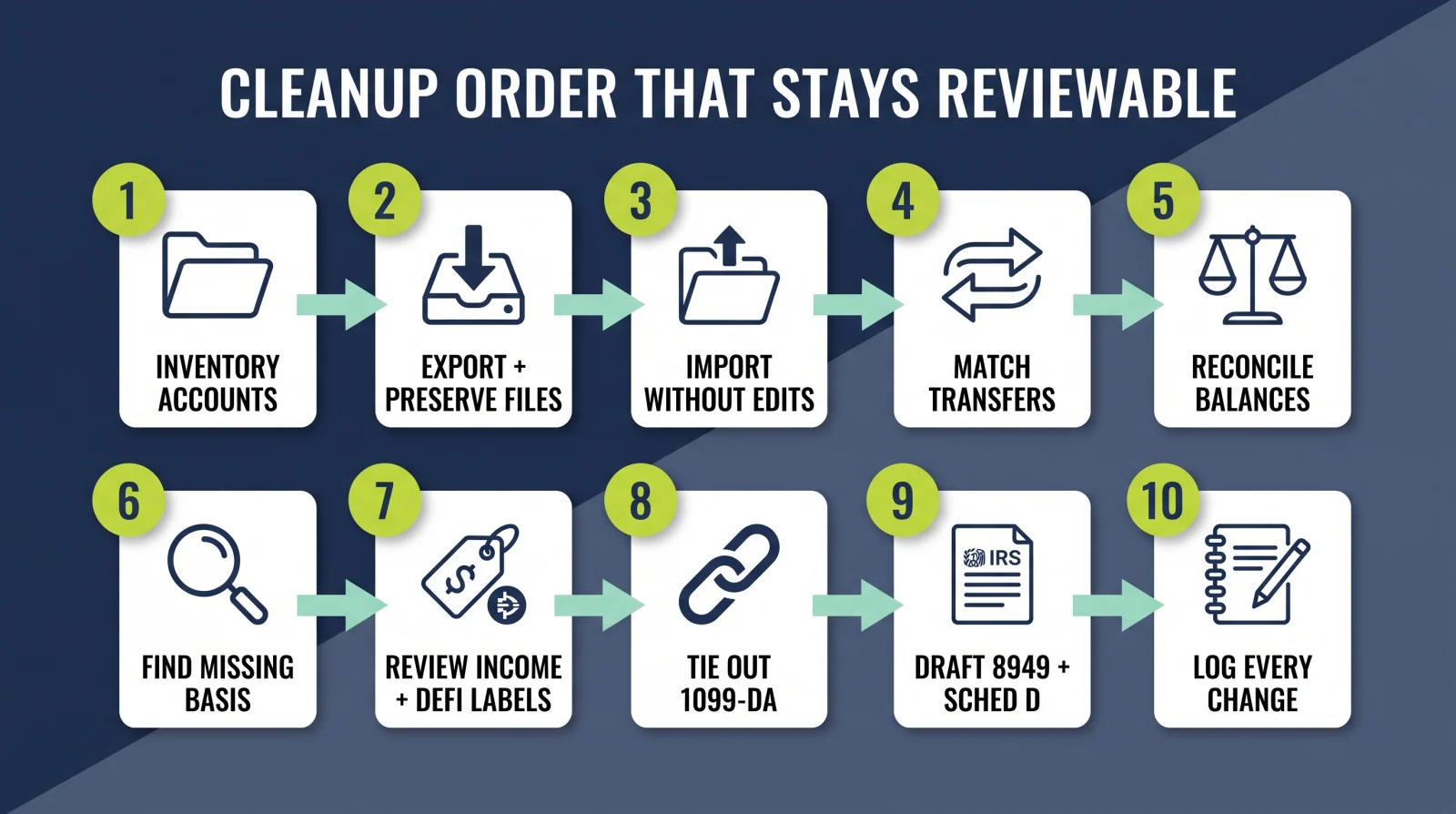
If your portfolio is manageable, work through these steps in order. The sequence matters: matching transfers before you touch cost basis prevents most of the manual edits people later regret.
- Create the complete account and wallet inventory.
- Export and preserve every source file.
- Import sources without manual edits.
- Match transfers between accounts you own.
- Reconcile asset quantities and ending balances.
- Investigate missing acquisition history and cost basis.
- Review income, DeFi, NFT, and derivative classifications.
- Tie broker-reported proceeds to the transaction ledger.
- Generate draft Form 8949, Schedule D, and Schedule 1 inputs.
- Review exceptions and preserve a change log.
Software is good at calculation and organization. It cannot know which wallets you own, whether a deposit came from a closed exchange, or why a bridge created two versions of one position until the underlying data is reconciled.
When done-for-you reconciliation makes sense
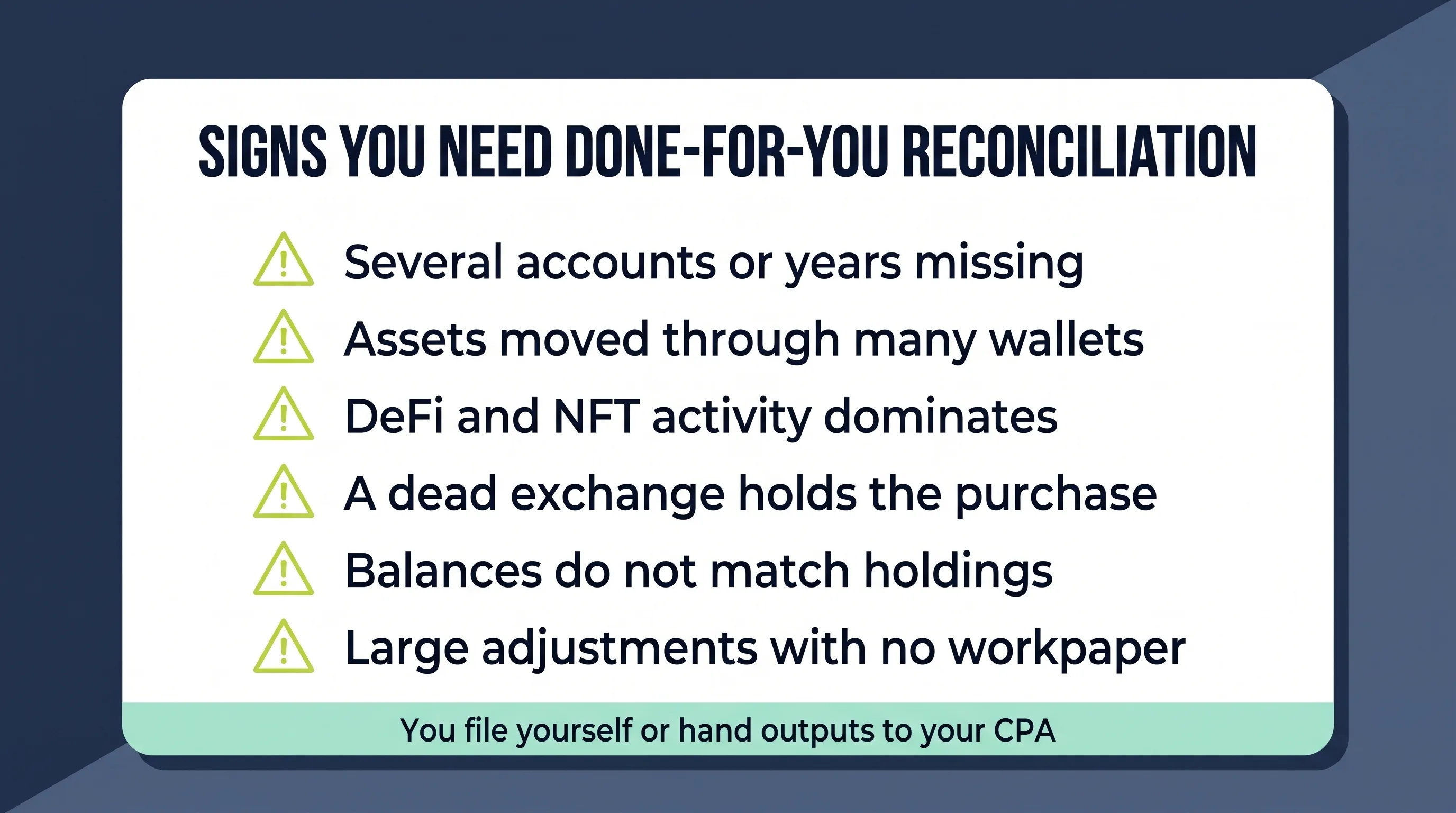
Professional reconciliation makes sense when several accounts or years are missing, assets moved through many wallets, DeFi and NFT activity dominates the file, a dead exchange holds the purchase history, or balances do not match what you actually hold. Any large adjustment also deserves a workpaper that explains it.
Count On Sheep performs Digital Asset Reconciliation for individual investors and active traders. Specialists collect the sources, match transfers, clean out duplicates and spam, reconstruct supported basis, and deliver CPA-ready Form 8949, Schedule D, and Schedule 1 inputs. Count On Sheep does not prepare or file your return and does not give tax advice. You file yourself or hand the outputs to your CPA.
Get the file organized before you file
A usable tax-season report starts with a complete transaction history. Gather every source, match transfers first, reconcile balances, and document each correction. That gives your filing software or CPA a record they can actually work from.
If you would rather hand off the cleanup, learn about the done-for-you crypto reconciliation service or book a short call below.
Frequently Asked Questions
Need help organizing my cryptocurrency transactions for tax season
Count On Sheep organizes your full crypto history before tax season. The team imports every exchange, wallet, and chain, fixes missing data and duplicates, and reconciles cost basis. You get clean, CPA-ready 8949 and Schedule D inputs whether you file yourself or use a CPA. The work is delivered by our former Big 4 (EY) crypto tax team.
What crypto records should I gather for tax season?
Gather complete exchange exports, wallet addresses, prior-year reports, Forms 1099-DA, purchase confirmations, bank records, and records for DeFi, NFTs, staking, mining, bridges, and closed accounts.
Are transfers between my own crypto wallets taxable?
Moving crypto between wallets you own generally is not a sale, but the transfer must be matched so the original acquisition date and cost basis continue into the destination wallet.
When should I get professional help organizing crypto transactions?
Get help when multiple years or accounts are missing, transfers remain unmatched, DeFi or NFT activity is misclassified, a closed exchange holds the purchase history, or software balances do not match actual holdings.