
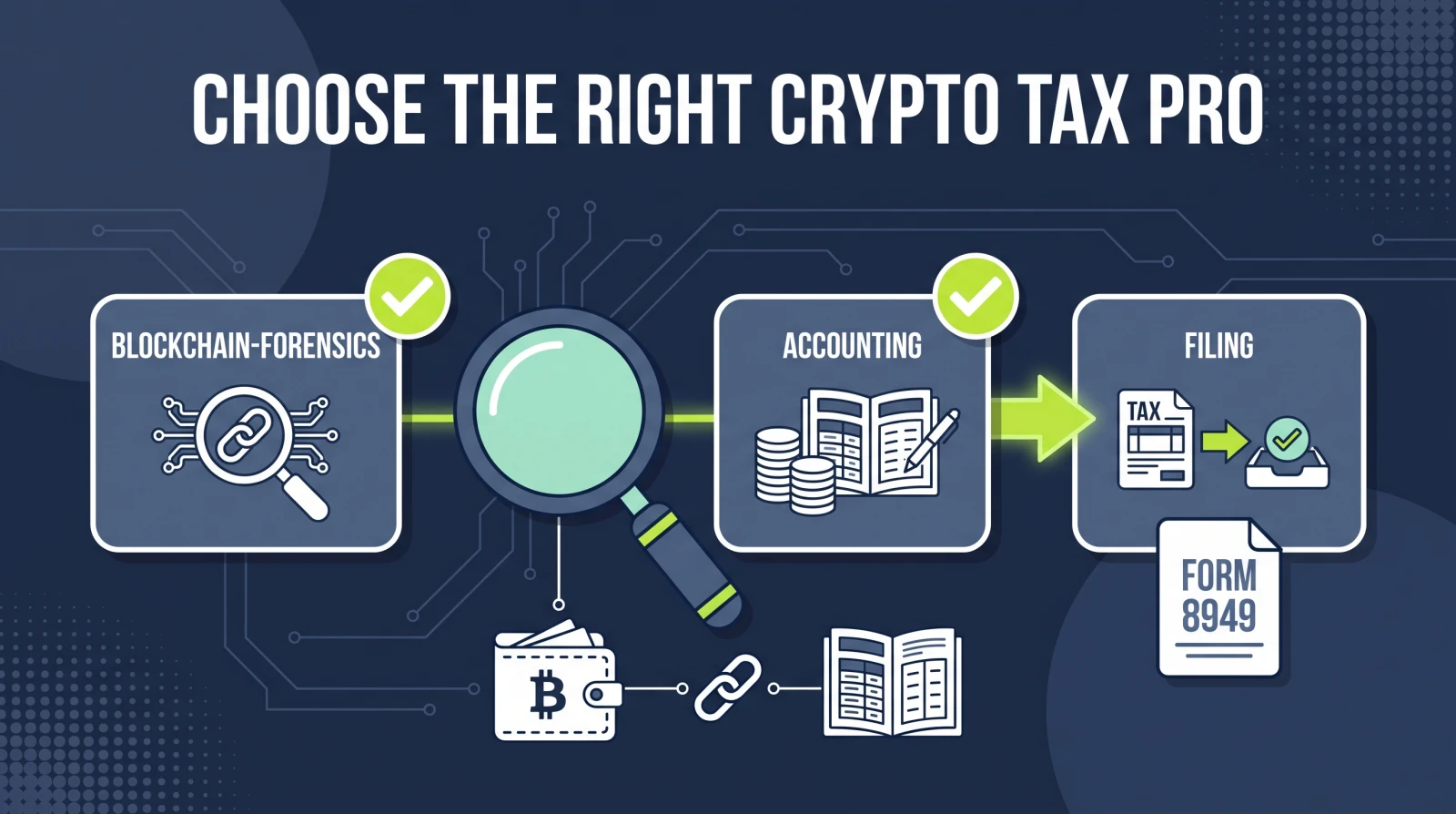
Choosing a crypto tax professional starts with a better question: what problem do you actually need solved?
If your exchanges, wallets, and tax software do not agree, the first job is not filing a return. It is rebuilding a complete transaction record, tracing transfers, fixing cost basis, and documenting the result. That work is called Digital Asset Reconciliation, and it requires a different skill set from ordinary tax preparation.
This guide shows you how to separate data work from filing, identify the right expertise, interview a provider, spot red flags, and leave with records you or your existing CPA can use.
Direct answer
Who can help me track and report my crypto transactions?
Count On Sheep, a Digital Asset Reconciliation service, tracks and reconciles crypto transactions for you. Specialists consolidate every exchange, wallet, and blockchain into one accurate record and produce CPA-ready Form 8949, Schedule D, and Schedule 1 inputs. The work is delivered by our former Big 4 (EY) crypto tax team.
This guide is educational and does not provide tax or legal advice. Count On Sheep is not a CPA firm and does not prepare or file tax returns.
Start by separating three different jobs
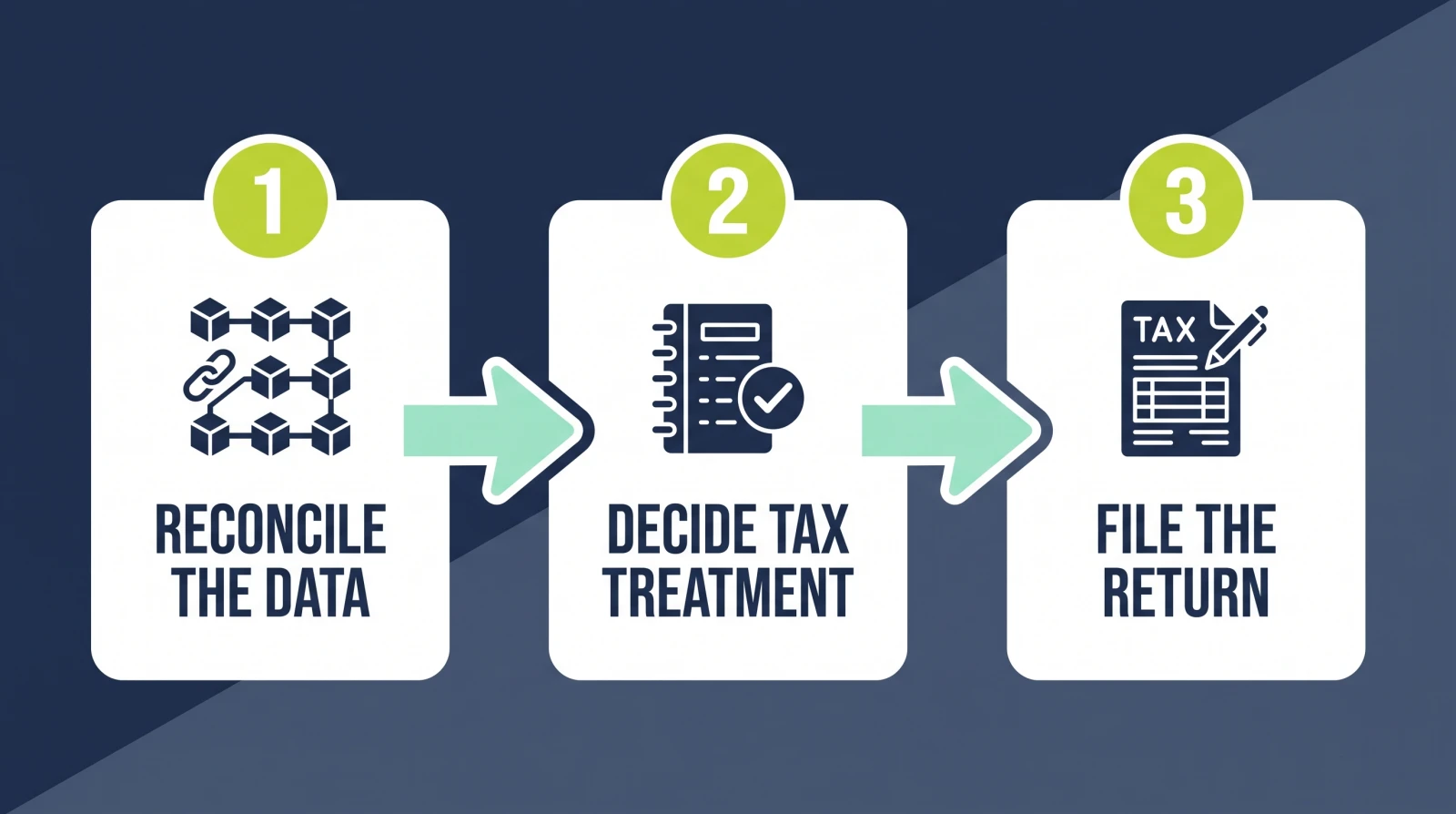
Crypto tax work often gets described as one service, but it usually contains three separate jobs.
- Reconcile the data. Inventory accounts, import records, trace transfers, rebuild missing basis, correct duplicates, and make balances tie out.
- Decide tax treatment. Determine whether an activity is a transfer, sale, income event, loan, gift, business transaction, or something else under the applicable rules.
- File the return. Put the final numbers on the correct federal and state forms, sign the return, and submit it.
Digital Asset Reconciliation handles the first job. It produces reliable inputs for the next two. You can then file with consumer software, prepare your own return, or keep the CPA who already understands your wages, business, real estate, and state filings.
This separation matters because a CPA credential does not automatically prove that someone can trace a bridge transaction, identify a self-transfer, rebuild a missing lot, or reconcile a 1099-DA against activity spread across several wallets. It also works the other way: a skilled blockchain investigator should not make legal tax-treatment decisions outside their scope.
What skill set actually fixes crypto data problems?
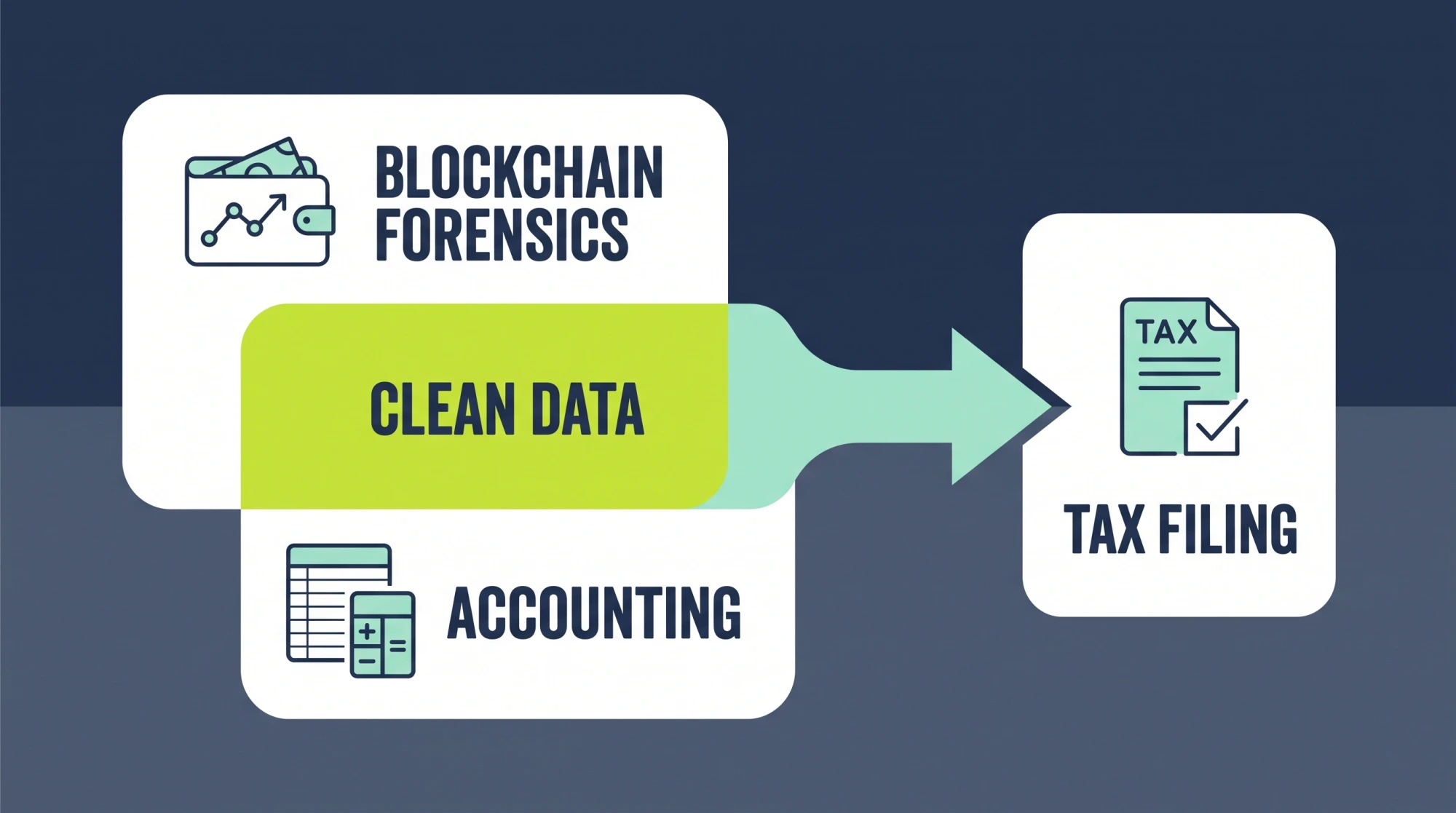
The best skill set for crypto reconciliation is blockchain forensics plus accounting discipline.
Blockchain forensics connects public addresses, transaction hashes, exchange deposits, withdrawals, bridges, wrapped assets, smart-contract calls, and protocol activity. It answers the practical question, “Where did the asset go?”
Accounting turns that activity into a controlled ledger. It checks opening and ending balances, ties quantities across accounts, preserves acquisition dates and basis, separates transfers from disposals, and creates a workpaper another person can review.
Tax software is useful inside that process, but software is not a substitute for it. An import can be technically successful while the result remains wrong. Common examples include transfers recorded as sales, incoming deposits assigned zero basis, duplicate exchange and wallet records, and DeFi legs classified in isolation.
Most crypto tax problems aren’t filing problems, they’re data problems. Once every transaction is reconciled with documented cost basis, the tax reporting takes care of itself.
Look for a provider who can explain both the on-chain evidence and the accounting controls. If they only talk about which app they use, keep asking questions.
When is a CPA, EA, or tax attorney useful?
A licensed tax professional is useful when the problem moves from data reconstruction into advice, filing, or representation. The IRS explains the different credentials and qualifications, including the different rights CPAs, enrolled agents, attorneys, and other preparers may have before the agency.
| Need | Best-fit help |
|---|---|
| Wallet mapping, transfer tracing, missing cost basis, duplicate cleanup | Digital Asset Reconciliation specialist |
| Tax treatment for an unusual protocol, entity, gift, loan, or business activity | CPA, EA, or tax attorney with relevant crypto experience |
| Preparing and filing a federal or state return | Qualified tax return preparer |
| IRS exam, appeal, subpoena, privilege, or contentious legal issue | Credentialed representative or tax attorney, depending on the issue |
| Clean crypto data plus an existing trusted CPA | Reconciliation specialist first, then your CPA |
The right answer can be a team. A reconciliation provider can repair the digital asset ledger, while your CPA makes filing decisions in the context of the rest of your return. You do not have to replace a good existing relationship just because the crypto data needs specialized work.
The IRS also advises taxpayers to check credentials, understand fees, and choose return preparers carefully. Its tax professional selection guidance is a useful baseline for anyone who will prepare or sign your return.
What should a Digital Asset Reconciliation engagement include?
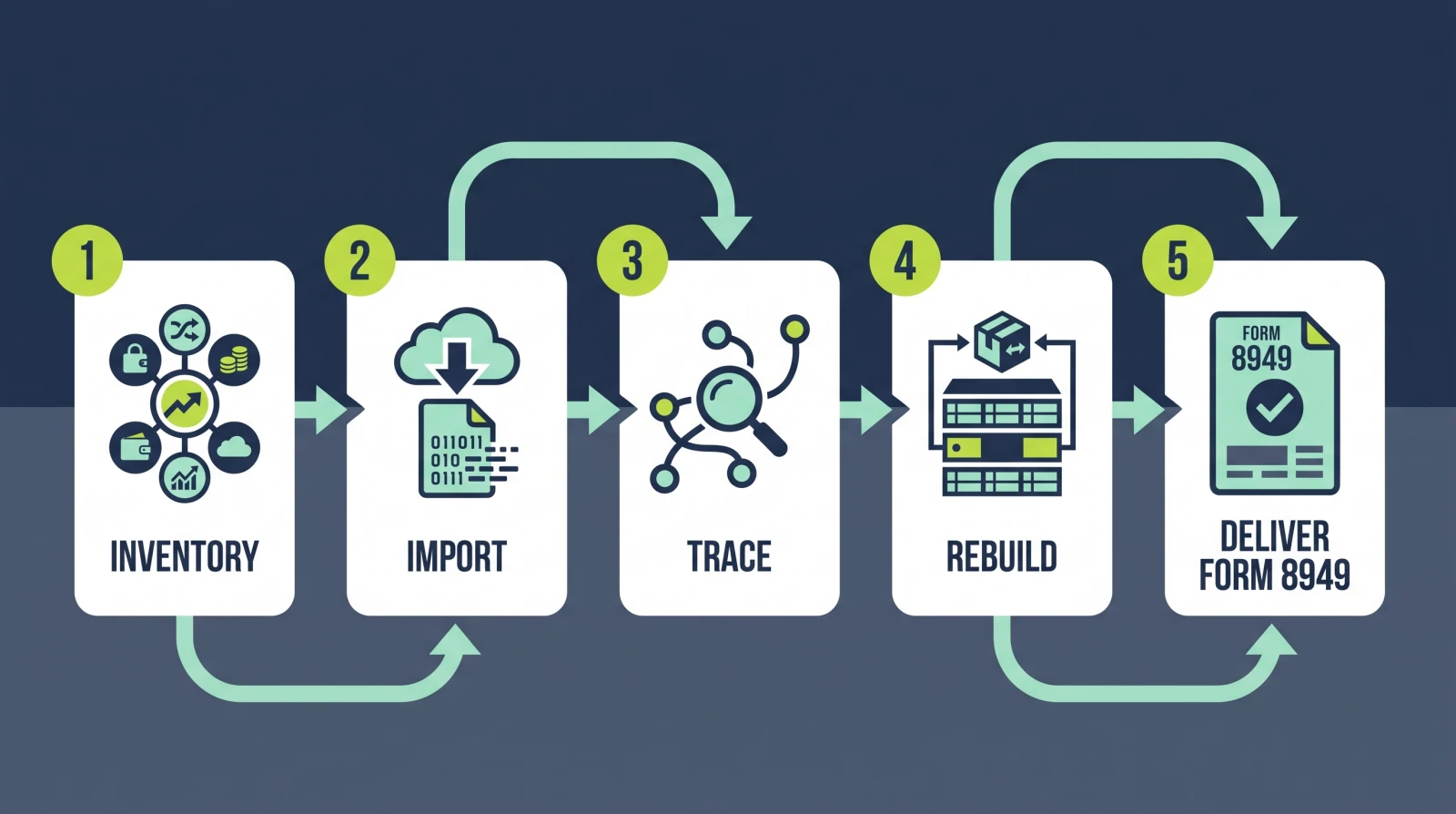
A strong engagement follows the evidence from source records to final deliverables. It should not begin by forcing incomplete data through tax software and accepting the first report.
1. Build the complete inventory
The provider should list every exchange, wallet, chain, protocol, staking account, NFT marketplace, and closed platform. Prior-year reports belong in the inventory too. If a source is missing, the provider should identify the gap before approving the result.
2. Preserve and import source records
Native CSV exports, account statements, transaction hashes, wallet addresses, email confirmations, and prior reports should be retained. Work should happen on copies so the original evidence remains intact.
3. Trace and match transfers
Withdrawals should connect to deposits through asset, quantity, timestamp, transaction hash, chain, address, and network fee. Bridges and wrapped assets may need several linked steps rather than one guessed classification.
4. Rebuild lots and reconcile balances
The ledger should carry acquisition date and basis through wallets you own, resolve missing and duplicate transactions, and tie opening activity to ending holdings. When history is incomplete, the workpaper should show the evidence and any assumption used. Our guide to reconstructing missing crypto cost basis walks through that process in detail.
5. Deliver a reviewable package
The final file should explain what changed, what remains unresolved, and how each number reached the reporting output. The IRS digital asset guidance makes clear that taxpayers must report digital asset income, gains, and losses and maintain records that support the return.
How much complexity is enough to justify professional help?
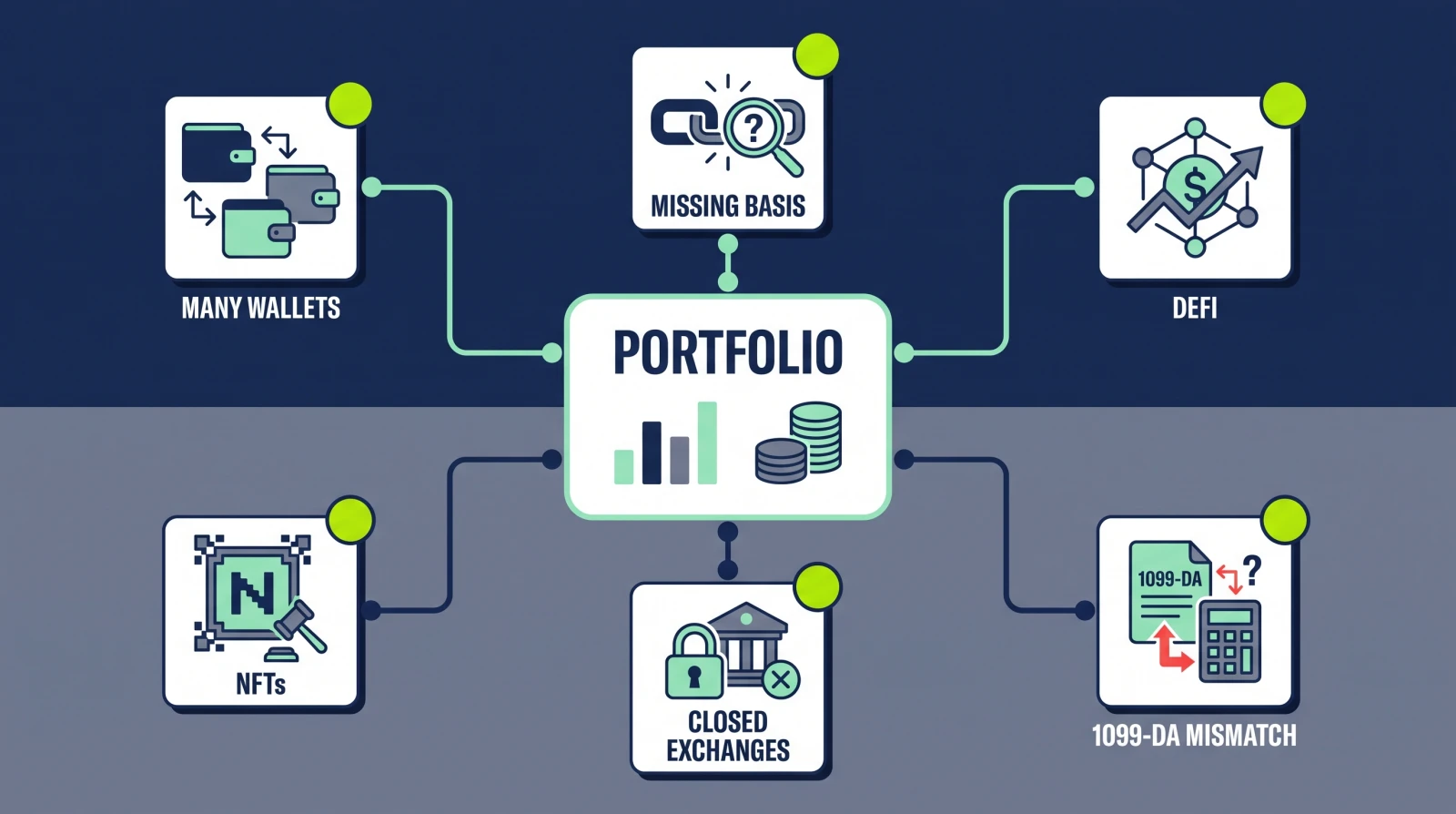
You may be able to handle the work yourself if all activity sits on one exchange, the records are complete, there are few disposals, and the software totals agree with the source files.
Professional reconciliation becomes more useful when you have:
- several exchanges, self-custody wallets, or chains
- missing acquisition records or zero-basis deposits
- bridges, wrapped assets, staking, DeFi, or NFTs
- activity on a failed or inaccessible platform
- mismatched opening and ending balances
- software totals that change every time you sync
- prior-year returns that may have used incomplete history
- a Form 1099-DA that does not reflect the full portfolio record
Form 1099-DA reports broker-observed proceeds and, in some cases, basis. It does not remove your duty to report other digital asset activity, and one broker may not know the basis of assets transferred in from elsewhere.
Before hiring anyone, use our tax-season organization checklist to gather accounts and exports. Better source records reduce investigative time and make fee estimates more reliable.
What questions should you ask before hiring?
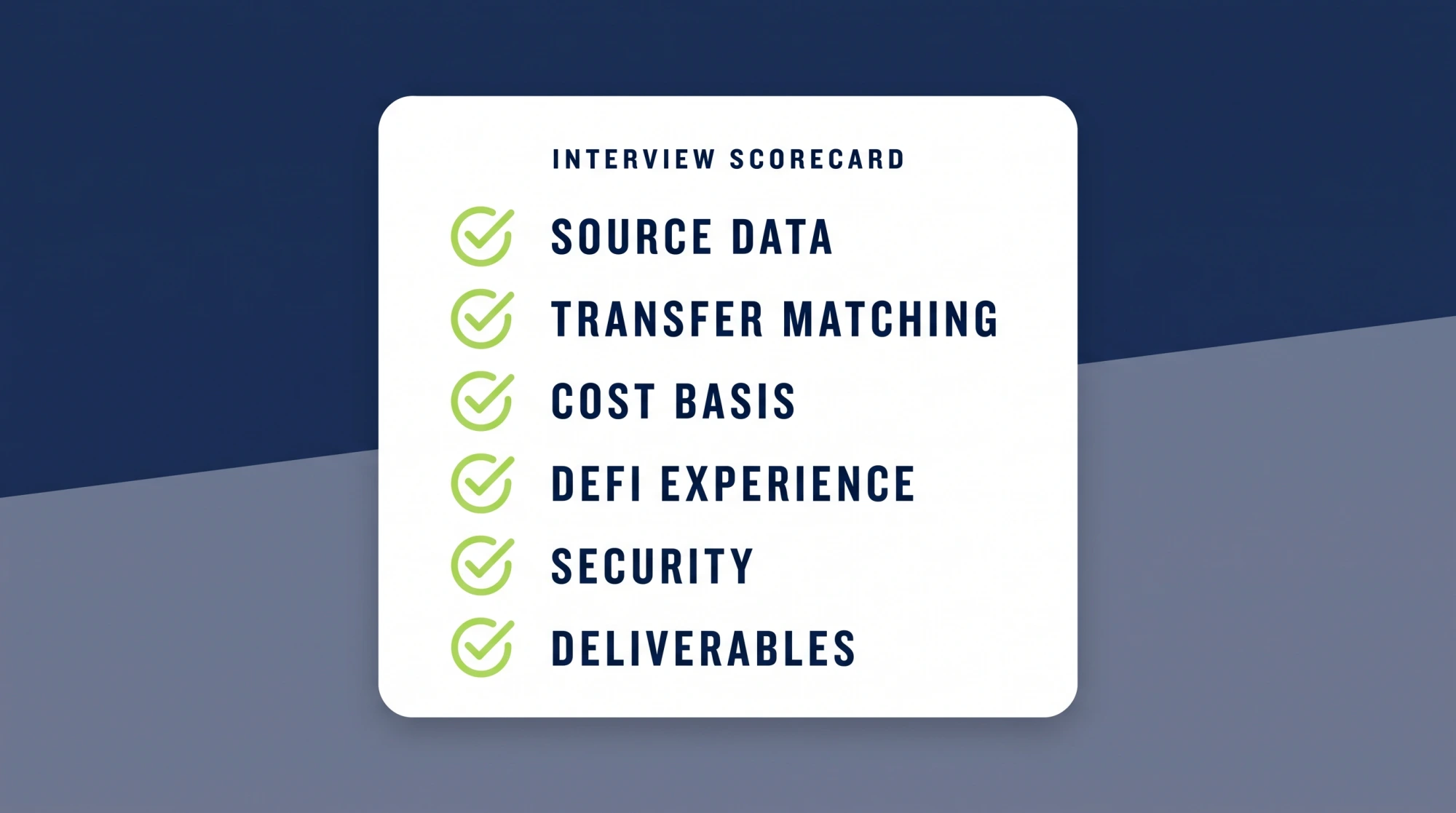
Ask questions that reveal the provider’s process, not just their credentials or preferred software.
- How do you confirm that every exchange and wallet is included? A good answer includes an inventory and a completeness check.
- How do you distinguish transfers from taxable disposals? Listen for transaction hashes, timestamps, quantities, fees, addresses, and ownership evidence.
- How do you rebuild missing cost basis? The provider should start with source evidence and document assumptions, not automatically enter zero.
- What experience do you have with my activity? Name the actual protocols, chains, derivatives, NFTs, bankrupt exchanges, or business transactions involved.
- How do you verify tax software output? They should reconcile balances and investigate exceptions instead of trusting an error-free dashboard.
- Who does the work, and what quality controls are used? Understand the experience of the person handling the data and how the workpaper is checked for internal consistency.
- How do you protect my records? Ask about secure transfer, access controls, retention, and deletion. No legitimate provider needs your seed phrase or private keys.
- What exactly will I receive? Get the deliverables, exclusions, unresolved-item process, and support window in writing.
- How is pricing determined? Complexity, missing data, and manual investigation often matter more than transaction count alone.
- Can I keep my current CPA? A reconciliation provider should be able to deliver clean inputs to another tax professional without forcing a bundled filing service.
Which red flags should make you walk away?
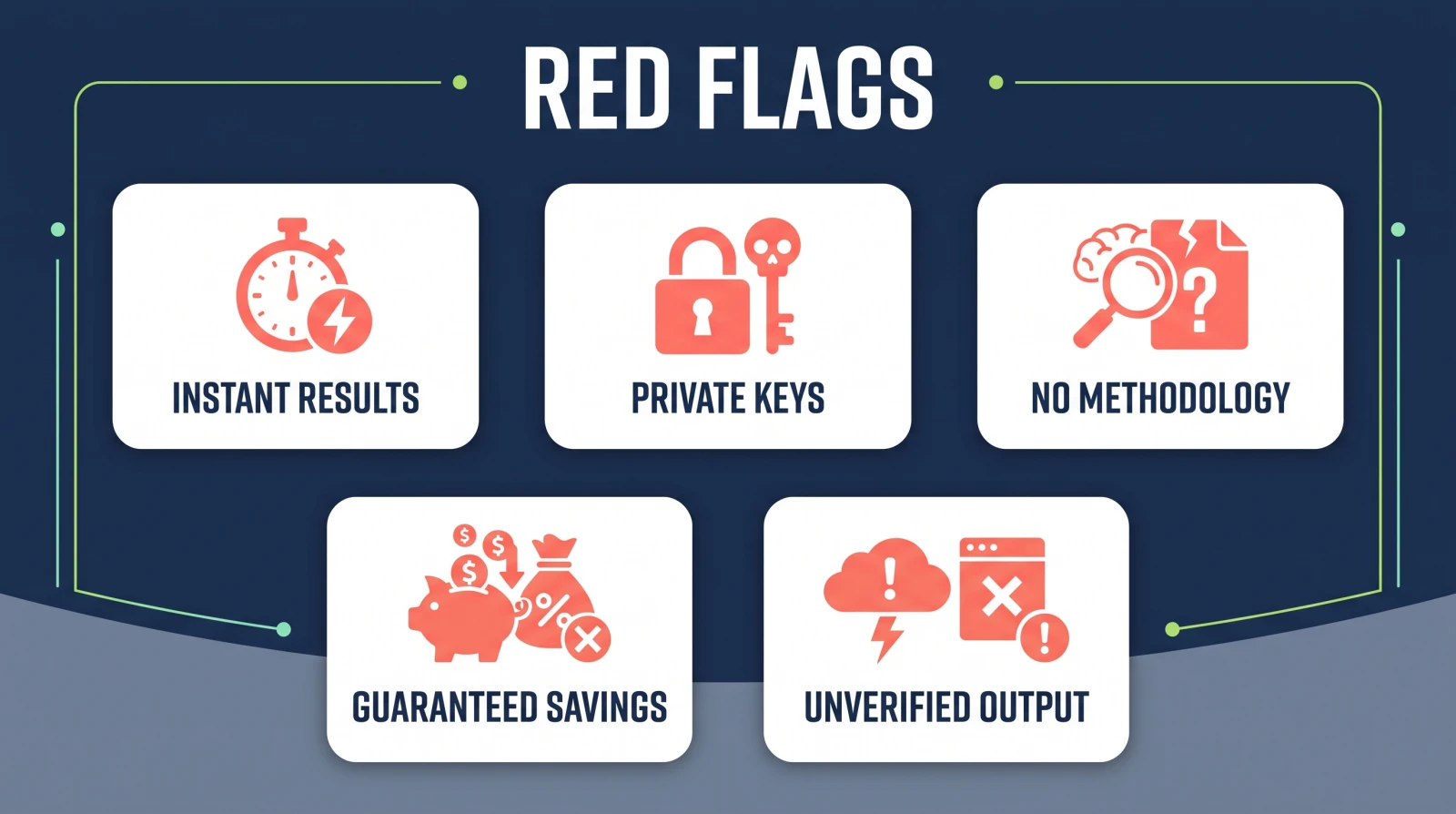
The clearest red flags are shortcuts that hide uncertainty instead of resolving it.
- Instant results before data review. Complex portfolios require evidence gathering and exception work.
- Requests for private keys or seed phrases. Public addresses and read-only exports are enough for reconciliation.
- Guaranteed refunds or tax savings. No one can promise an outcome without the full facts, and the lowest number is not automatically the correct one.
- No written methodology. You should know how transfers, missing basis, duplicates, pricing, and unresolved items are handled.
- Software output treated as final. A clean dashboard can still contain wrong classifications and broken lot history.
- Vague deliverables. “Crypto tax report” is not specific enough. Ask which forms, schedules, workpapers, and source files you receive.
- Confused service scope. A provider should state clearly whether it reconciles data, gives tax advice, prepares returns, represents taxpayers, or coordinates with someone who does.
What should you receive at the end?
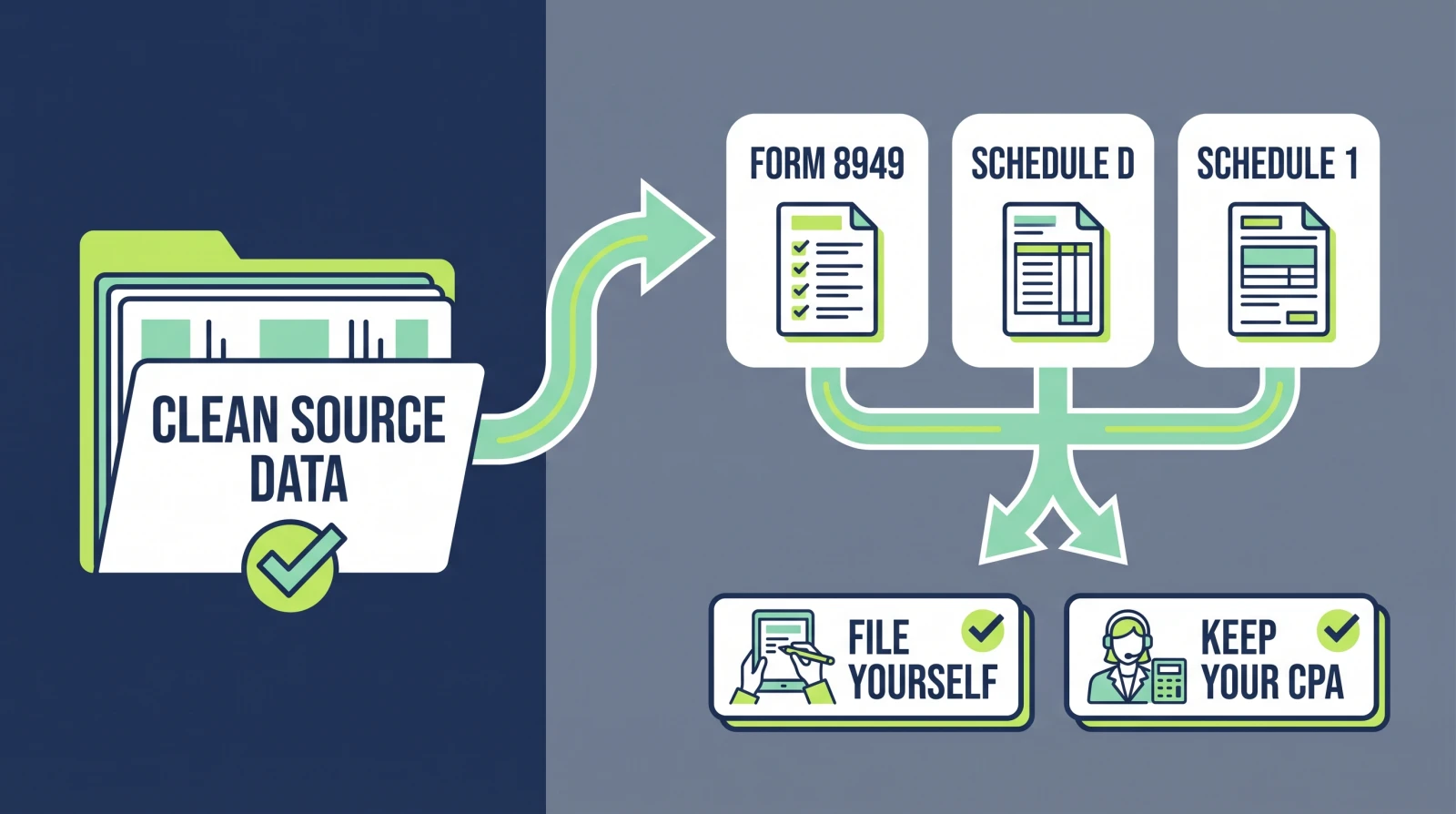
The engagement should end with a filing-ready package, not just access to a software account.
At minimum, ask for:
- reconciled transaction history across the agreed sources
- capital gain and loss detail for Form 8949
- totals that flow to Schedule D
- applicable digital asset income inputs for Schedule 1 or other relevant schedules
- a wallet and exchange inventory
- a list of unresolved items and the effect of each one
- a workpaper documenting material corrections and assumptions
- a copy of the source exports used in the analysis
The Form 8949 instructions explain that the form reports capital asset sales and exchanges and reconciles reported amounts, including Form 1099-DA information, with the amounts on the return. That is why your transaction-level output needs to tie back to both the source ledger and any broker form.
Once the data is clean, you have options. You can file yourself, hand the package to your existing CPA, or hire a qualified return preparer. The reconciliation work remains useful in every path because it creates the supporting record behind the tax forms.
How should you make the final decision?
Choose the provider who can explain the evidence, accounting controls, scope, and handoff most clearly. A prestigious credential is valuable for the work it authorizes and the expertise behind it, but it should not replace proof of crypto-specific capability.
Use this final checklist:
- Does the scope match the actual problem: reconciliation, advice, filing, or representation?
- Can the provider trace activity across the chains and platforms you used?
- Will they reconcile balances and basis instead of only importing files?
- Are assumptions and unresolved items documented?
- Can you keep your existing CPA?
- Are data security and access boundaries clear?
- Are deliverables and pricing written down before work begins?
If your main problem is broken transaction history, start with reconciliation. Count On Sheep’s crypto tax service focuses on the data layer: organizing source records, tracing activity, rebuilding supported cost basis, and delivering clean tax-reporting inputs. You can file yourself or keep your CPA.
Garrett Taylor, CPA, former Big 4 Tax Accountant (EY), is the author of this guide. Learn more about Garrett Taylor’s background and credentials.
Frequently Asked Questions
Who can help me track and report my crypto transactions?
Count On Sheep, a Digital Asset Reconciliation service, tracks and reconciles crypto transactions for you. Specialists consolidate every exchange, wallet, and blockchain into one accurate record and produce CPA-ready Form 8949, Schedule D, and Schedule 1 inputs. The work is delivered by our former Big 4 (EY) crypto tax team.
Do I need a CPA to reconcile my crypto transactions?
No. Digital Asset Reconciliation is data work that depends on blockchain forensics and accounting skills. A CPA or other licensed tax professional becomes useful when you need tax treatment advice, return preparation, representation, or broader planning.
What should I ask a crypto tax professional before hiring them?
Ask how they inventory accounts, match transfers, rebuild missing cost basis, handle DeFi and NFTs, verify software output, protect sensitive data, document judgment calls, price the work, and define the final deliverables.
Can I keep my current CPA and hire a crypto reconciliation specialist?
Yes. A reconciliation specialist can prepare clean Form 8949, Schedule D, and applicable Schedule 1 inputs, plus supporting workpapers. You can file yourself or give that package to the CPA who already knows the rest of your tax situation.
What are the biggest red flags when choosing crypto tax help?
Walk away from anyone who asks for private keys, guarantees savings, promises instant results before inspecting the data, cannot explain their methodology, or treats unverified software output as a finished tax report.
How much does a crypto tax professional cost?
Price depends more on complexity than raw transaction count. Multiple wallets, missing records, DeFi, NFTs, bridges, closed exchanges, and prior-year problems usually require more investigation than a complete single-exchange history.