

Updated for 2026: We re-tested the leading AI crypto trading bots, refreshed pricing and features, added current risk controls, and updated the US tax guidance.
The best AI crypto trading bot in 2026 is not the one with the boldest profit chart. It is the one whose logic you can inspect, whose permissions you can restrict, whose risk you can cap, and whose transaction history you can export.
That sounds less exciting than “set it and forget it.” It is also the difference between controlled automation and handing an unknown system the keys to your portfolio.
We reviewed the current page-one Google cohort, including Cryptohopper, CoinBureau, Stoic, Bitsgap, WunderTrading, Coinrule, Kraken, Binance, CoinLedger, Koinly, 3Commas, and real-user discussions. We also walked through public onboarding, strategy builders, paper-trading or backtesting paths, permission models, documentation, export options, and pricing for the tools below. We did not deposit client funds, claim a secret live return, or rank platforms by affiliate payout.
The resulting list separates true model-driven features from ordinary rule-based automation, then adds the part most comparisons skip: the security and tax consequences of letting software trade all day.
Pricing and features were checked on July 25, 2026. Plans, supported exchanges, and geographic availability change. Confirm the provider’s official site before subscribing. This guide is educational and is not investment or tax advice.
Quick comparison: the 10 best AI crypto trading bots
| Platform | Best for | Starting cost checked | Technology | Paper test | Main limitation |
|---|---|---|---|---|---|
| Coinrule | Beginner-friendly visual rules | Free; annual paid plans from $29.99/month | Rule-based with AI-assisted features | Yes | Advanced limits require paid plans |
| Cryptohopper | Strategy design and marketplace depth | Annual plans from $24.16/month | Hybrid | Yes | More settings and add-ons to manage |
| Pionex | Native grid and DCA bots | No separate bot subscription | Primarily rule-based | Selected tools | Custodial exchange risk and trading fees |
| 3Commas | Experienced multi-exchange traders | Paid plans vary | Hybrid automation | Yes | Complex setup and monitoring |
| Bitsgap | Grid automation and cross-exchange terminal | Paid plans vary | Rule-based with optimization | Yes | Grid strategies remain market-dependent |
| Stoic | Model-driven portfolio allocation | Management/subscription pricing varies | Model-driven | Limited public simulation | Fewer user-controlled rules |
| WunderTrading | TradingView and signal workflows | Free and paid plans | Rule-based | Yes | Depends heavily on signal quality |
| TradeSanta | Fast DCA and grid setup | Free trial and paid plans | Rule-based with assistant features | Yes | Less suitable for complex custom logic |
| Hummingbot | Developers and self-hosting | Open source | Programmable, integrations vary | Yes | Requires technical skill and maintenance |
| Binance Trading Bots | Native bots for eligible users | No separate subscription | Rule-based | Product-dependent | Availability and US eligibility differ |
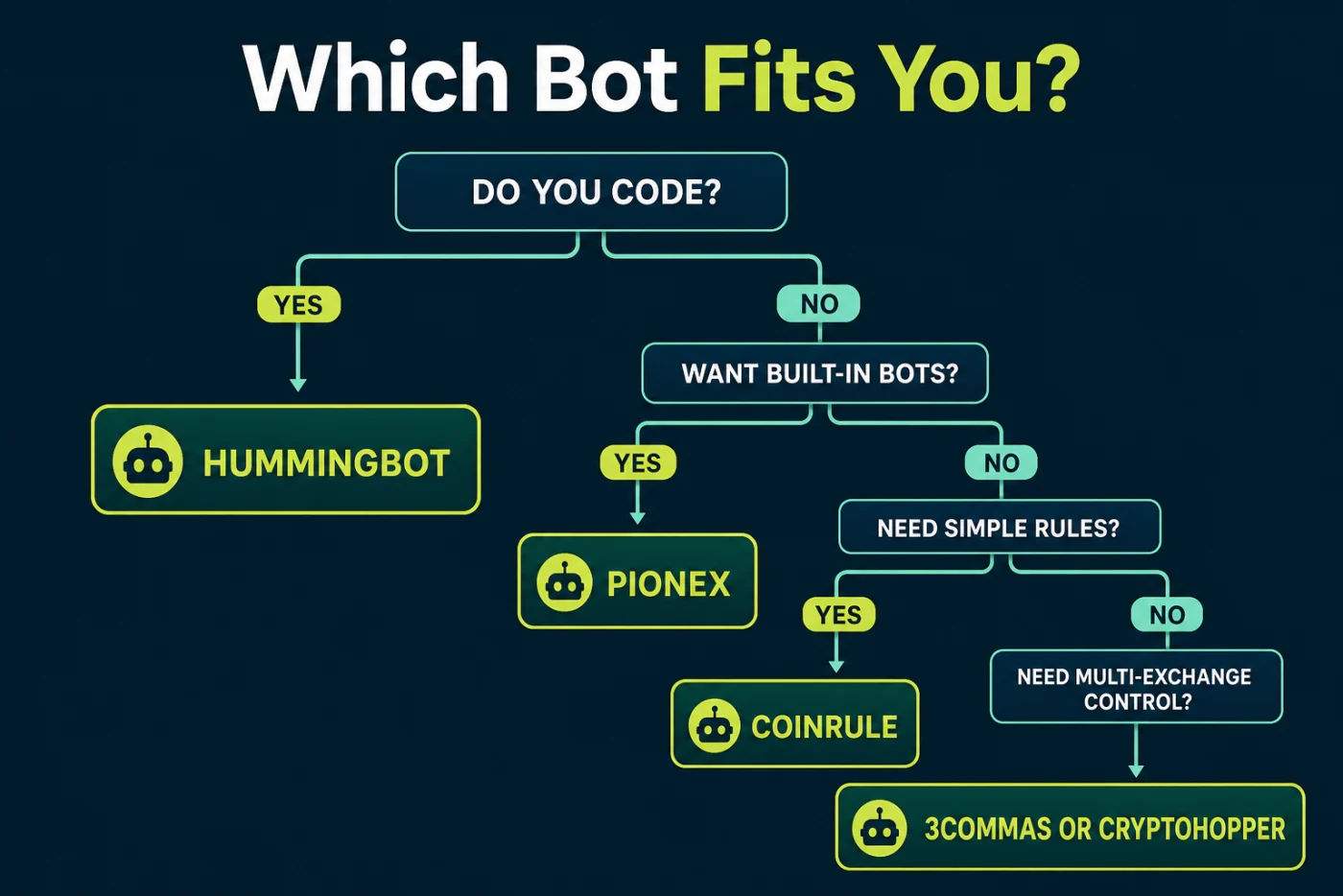
No platform is “best” in the abstract. The right choice depends on whether you want a native exchange bot, a third-party API layer, a transparent rule builder, or a model that changes allocation for you.
Match the strategy to the market
A bot type should match the job. Grid bots are designed to harvest repeated moves inside a range. DCA bots spread entries over time. Trend systems need a sustained move. Model-driven systems can adapt their signals, but they add model risk and are harder to audit.
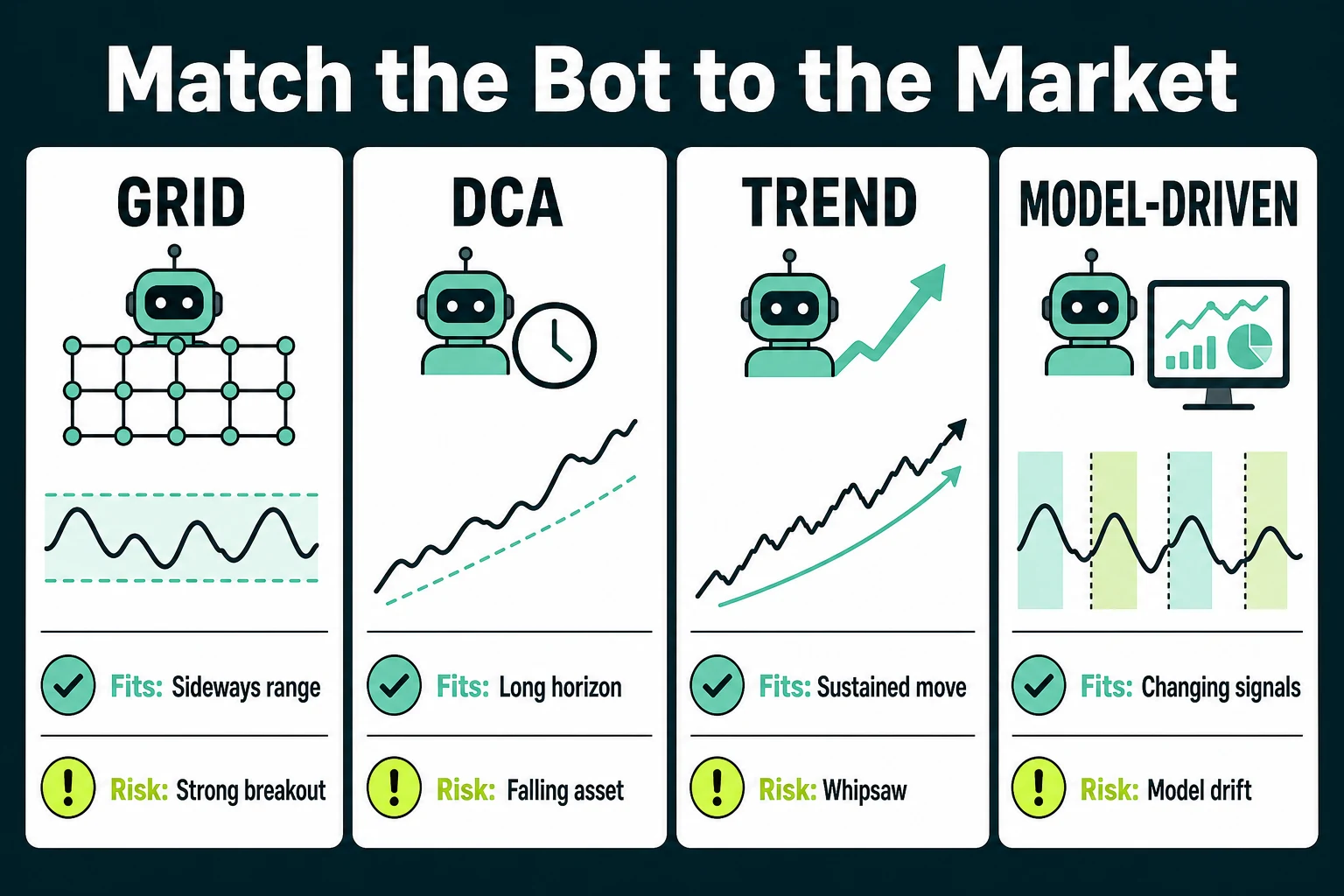
Use this simple filter:
- Choose grid only if you can define the range and the breakout response.
- Choose DCA only if you would still want to own the asset after a large decline.
- Choose trend only if the strategy has a clear exit when momentum reverses.
- Choose a model-driven product only if you understand what remains fixed when the model changes its signal.
What counts as an AI crypto trading bot?
Most products in this category are automated trading tools. Far fewer are adaptive AI systems.
A rule-based bot follows instructions such as:
- Buy $100 of BTC every Monday.
- Place grid orders between two fixed prices.
- Sell if the price falls 5% from the entry.
- Enter when RSI is below a set value and a moving average condition is met.
A hybrid platform may use AI to interpret plain English, optimize parameters, score signals, or propose a strategy, while the live execution still follows fixed rules.
A genuinely adaptive system uses a model to change an allocation or decision based on new data. That can include market-regime detection, volatility forecasting, or model-driven portfolio weights. “Adaptive” still does not mean clairvoyant. A model can overfit, drift, fail during an unfamiliar shock, or respond too slowly.
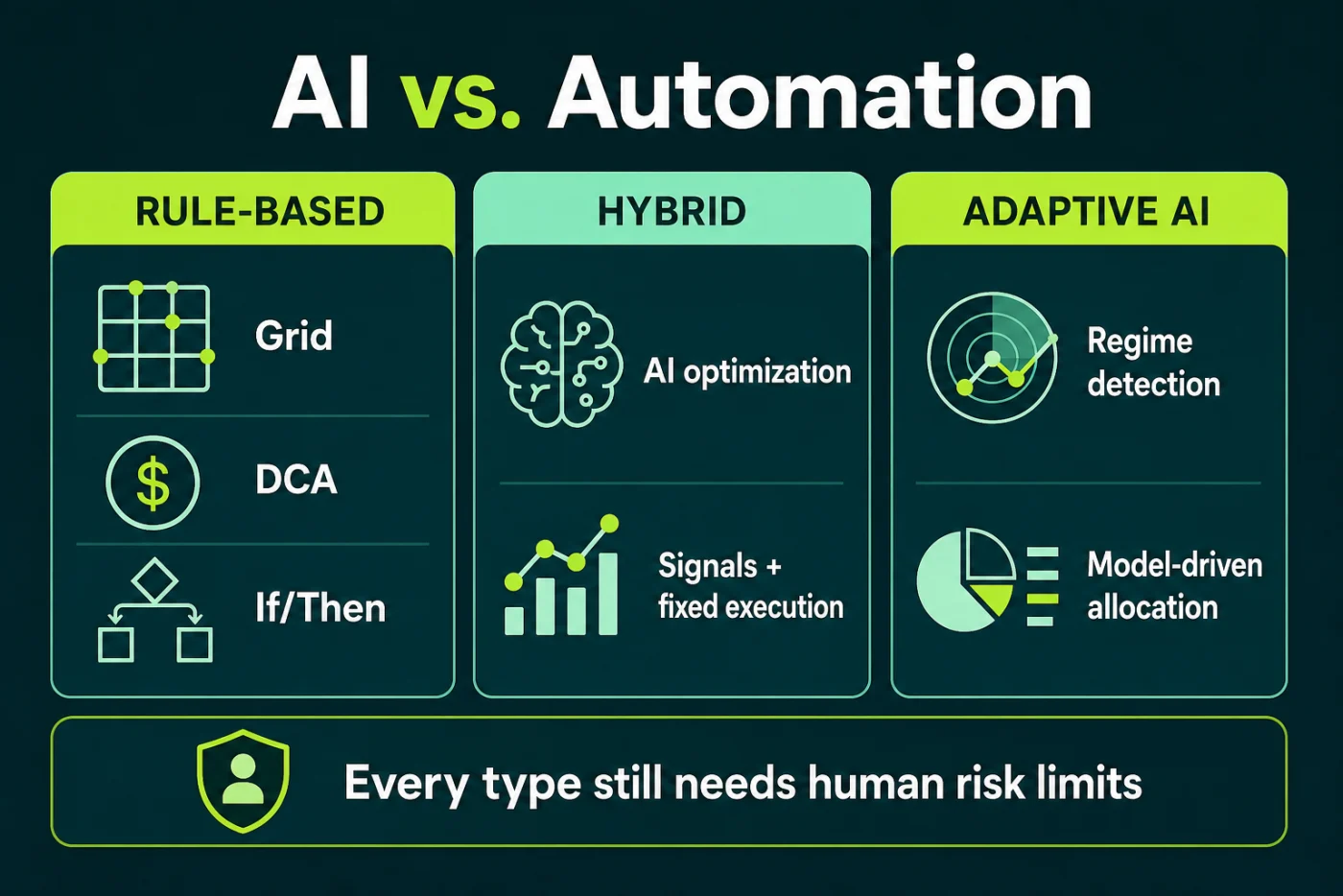
The distinction matters because it changes how you test the product. A fixed grid can be checked against clear rules. A model-driven strategy requires added questions: What inputs does it use? How often does it update? Can you see why allocation changed? What happens when the model is unavailable? Which risk limits remain fixed?
How we evaluated each bot
We used a repeatable, no-deposit review framework:
- Confirm the official product and current pricing.
- Identify whether automation is native to an exchange or connected through API keys.
- Build or inspect a basic strategy.
- Find the paper-trading, demo, or backtesting path.
- Review position sizing, stop conditions, maximum positions, and emergency controls.
- Check whether withdrawals can be disabled and IP restrictions are supported.
- Locate raw order, fill, fee, deposit, and withdrawal exports.
- Separate product facts from return claims or marketplace testimonials.
We did not call a platform “profitable” because of its marketing backtest. That claim would require the same strategy, capital, market, fee tier, slippage, and execution quality under controlled live conditions.
1. Coinrule: best no-code rule builder
Coinrule is our best starting point for someone who wants transparent automation without writing code. You can begin with templates or describe a strategy, then inspect and edit the resulting conditions before enabling it.
The official pricing page listed a free Starter tier with two live rules, two demo rules, one connected exchange, and a monthly-volume limit. The Investor plan was $29.99 per month when billed annually, and the Trader plan was $59.99 per month annually at the time of review.
Why it stands out:
- Rules remain visible instead of disappearing inside a black box.
- Demo rules let users learn the platform without immediate live risk.
- Templates cover DCA, trend, stop-loss, rebalancing, and indicator-based approaches.
- Trade-only API connections let the assets remain at the exchange.
Where it falls short:
- The most advanced limits and optimization features require higher tiers.
- A clear rule can still be a bad strategy.
- Users can mistake AI-assisted rule creation for an adaptive trading model.
Best fit: beginners and intermediate traders who value explainable logic.
2. Cryptohopper: best strategy laboratory
Cryptohopper combines paper trading, backtesting, a strategy designer, signals, templates, DCA tools, marketplace products, and higher-tier AI features. It has more room to experiment than most beginner platforms.
Official annual pricing displayed Explorer at $24.16 per month, Adventurer at $57.50, and Hero at $107.50 during our review. Hero included the platform’s AI strategy tools plus market-making and arbitrage features.
Why it stands out:
- Robust paper-trading environment.
- Broad strategy and indicator controls.
- Large marketplace for signals, templates, and copy products.
- Multiple subscription levels for different position counts and scan intervals.
Where it falls short:
- Marketplace add-ons can raise the real cost.
- More moving parts make it easier to build a system you do not fully understand.
- Repeatedly tuning a strategy on the same history can produce an overfit backtest.
Best fit: users willing to learn the settings and test several approaches before going live.
3. Pionex: best built-in exchange bots
Pionex puts grid, DCA, rebalancing, and other bots directly inside its exchange. There is no separate third-party bot connection and no separate bot subscription. Trading fees still apply to every executed order.
That structure is convenient. It also concentrates custody and automation with one venue.
Why it stands out:
- Fast setup for grid and DCA strategies.
- No additional bot subscription.
- No outside API connection to manage.
- Useful for traders who know they want one of the built-in strategy types.
Where it falls short:
- Most tools are automation, not adaptive AI.
- A grid can accumulate a falling asset or underperform a strong trend.
- Frequent fills compound trading fees and tax-lot volume.
- Product and jurisdiction availability must be confirmed before funding.
Best fit: cost-conscious users who want native bots and understand exchange custody risk.
4. 3Commas: best multi-exchange control center
3Commas connects supported exchange accounts to one interface for SmartTrade, DCA, grid, signal, and portfolio workflows. It is more of an active-trading operating system than a beginner bot.
Why it stands out:
- Multi-exchange management.
- Detailed order and position controls.
- Signal and TradingView integrations.
- Paper testing and strategy tools.
Where it falls short:
- API setup, exchange differences, and overlapping bots create operational complexity.
- A single incorrect permission or strategy scope can affect a large balance.
- Active configurations need active supervision.
Best fit: experienced traders who already understand order types, API permissions, and portfolio-level exposure.
5. Bitsgap: best grid-focused automation suite
Bitsgap combines an exchange terminal with grid, DCA, and related automation. Its appeal is cross-exchange access with visual strategy setup and testing.
Why it stands out:
- Strong grid-focused workflow.
- Demo mode for learning the system.
- One interface across supported exchanges.
- Optimization features can help users compare parameter sets.
Where it falls short:
- Optimization is not proof that a grid will work in the next market regime.
- Subscription cost sits on top of exchange trading fees.
- API security and exchange-specific restrictions still apply.
Best fit: traders who deliberately want grid or DCA strategies across more than one venue.
6. Stoic: best model-driven portfolio allocation
Stoic is closer to the model-driven end of the category. Its product focuses on systematic portfolio allocation rather than asking the user to construct dozens of if-then rules.
Why it stands out:
- Model-driven approach instead of a template marketplace.
- Better fit for users seeking portfolio allocation rather than rapid manual tuning.
- Less temptation to stack many conflicting strategies.
Where it falls short:
- Less user control over the model’s internal decision process.
- Pricing and supported connections vary by product.
- Model risk, drift, and changing market regimes remain.
Best fit: users who want a managed quantitative approach and accept less strategy transparency.
7. WunderTrading: best for TradingView workflows
WunderTrading is strongest for users who already develop signals in TradingView or want to automate copy, DCA, grid, and signal-driven strategies.
The platform is not a magic signal generator. Its value is executing a strategy reliably after the user supplies or selects the logic.
Best fit: traders comfortable with TradingView alerts, Pine Script, or external signals.
Main caution: execution can be flawless while the signal is wrong. Test the signal and the automation separately.
8. TradeSanta: best for quick bot setup
TradeSanta focuses on accessible DCA and grid automation with preset tools and an assistant-oriented setup.
Best fit: users who want a fast entry into standard automation.
Main caution: simplicity should not replace portfolio limits. A fast bot setup still needs a maximum allocation, stop condition, and plan for a persistent downtrend.
9. Hummingbot: best open-source developer option
Hummingbot is an open-source framework for building and running automated strategies across supported centralized and decentralized venues. It gives technical users the most control in this list.
Why it stands out:
- Local or self-hosted operation.
- Open-source strategy code.
- Extensible connectors and programmable logic.
- Strong fit for market-making and advanced workflows.
Where it falls short:
- Setup, secrets management, monitoring, and updates are your responsibility.
- “Open source” does not mean secure by default.
- Tax exports may require your own data pipeline.
Best fit: developers who want control and can maintain production trading software.
10. Native exchange bots: best for fewer moving parts
Binance and other exchanges offer native trading bots in eligible markets. Native bots avoid a third-party API connection, but they do not remove exchange risk, strategy risk, fees, or tax reporting.
US users must verify which entity and products they are legally eligible to use. A feature shown on a global exchange site may not exist on the US platform.
Best fit: eligible users who want standard grid, DCA, or rebalancing tools inside an exchange they already use.
Are AI crypto trading bots profitable?
Some are profitable during some periods. That is the only honest general answer.
Profitability depends on:
- Market direction and volatility
- Trading fees and spread
- Slippage between the signal and the fill
- Position sizing and leverage
- Maximum drawdown
- Strategy crowding
- Outages or delayed data
- How the strategy behaves outside the backtest period
A bot often looks better when a comparison ignores the value of simply holding the asset. If a grid earns 8% while BTC rises 30%, the bot produced a positive number but lost badly to the simplest benchmark.
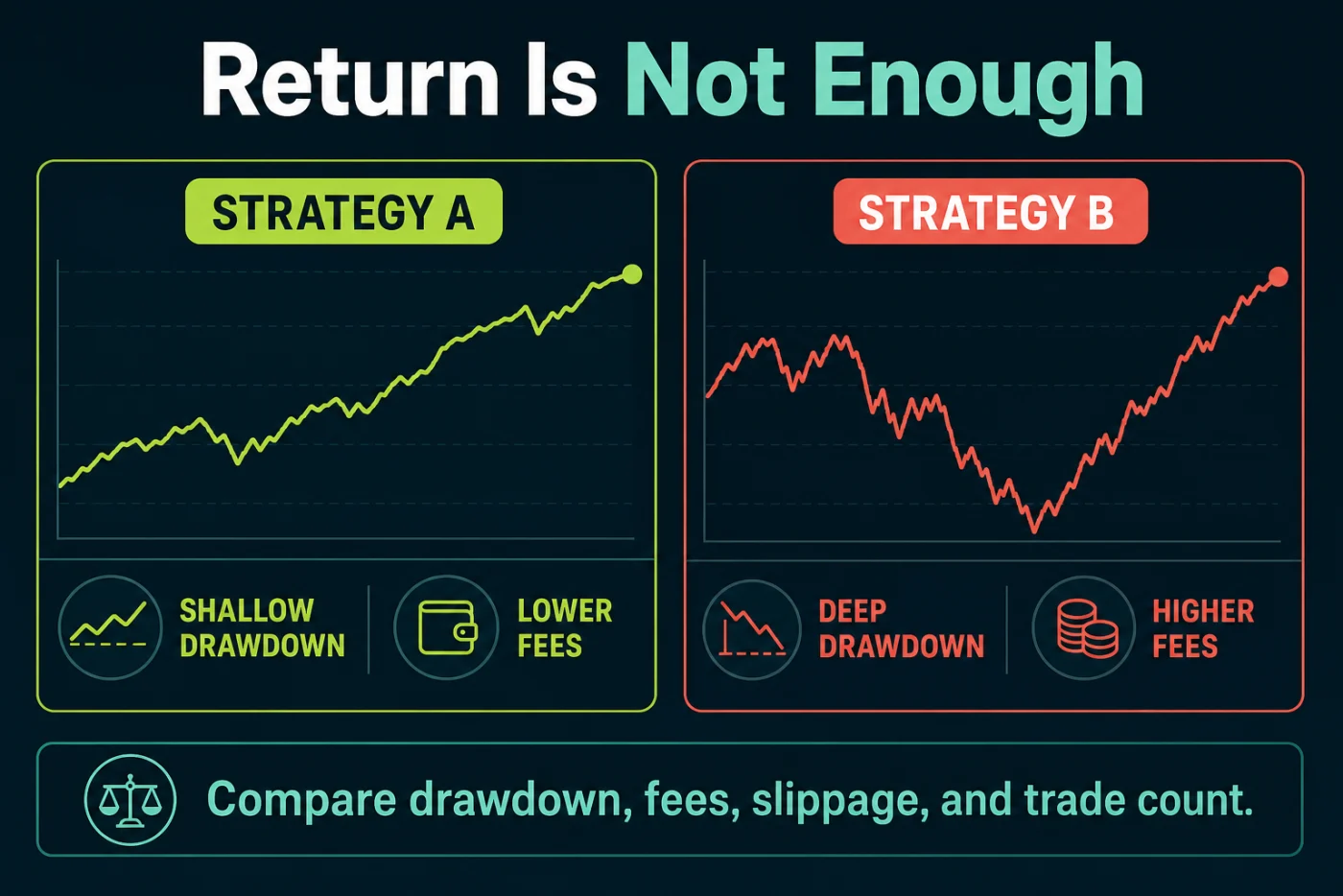
Two paper bots both finish a 90-day test up 10%. Bot A had a 7% maximum drawdown and placed 42 trades. Bot B fell 38%, recovered late, and placed 2,400 trades. Their headline return is identical. Their liquidation risk, fee drag, tax-lot volume, and chance that a real user would stop at the worst moment are completely different.
Set a risk budget before choosing a bot
Write the limits before you connect an exchange. A platform’s default settings should never decide how much of your portfolio it can control.
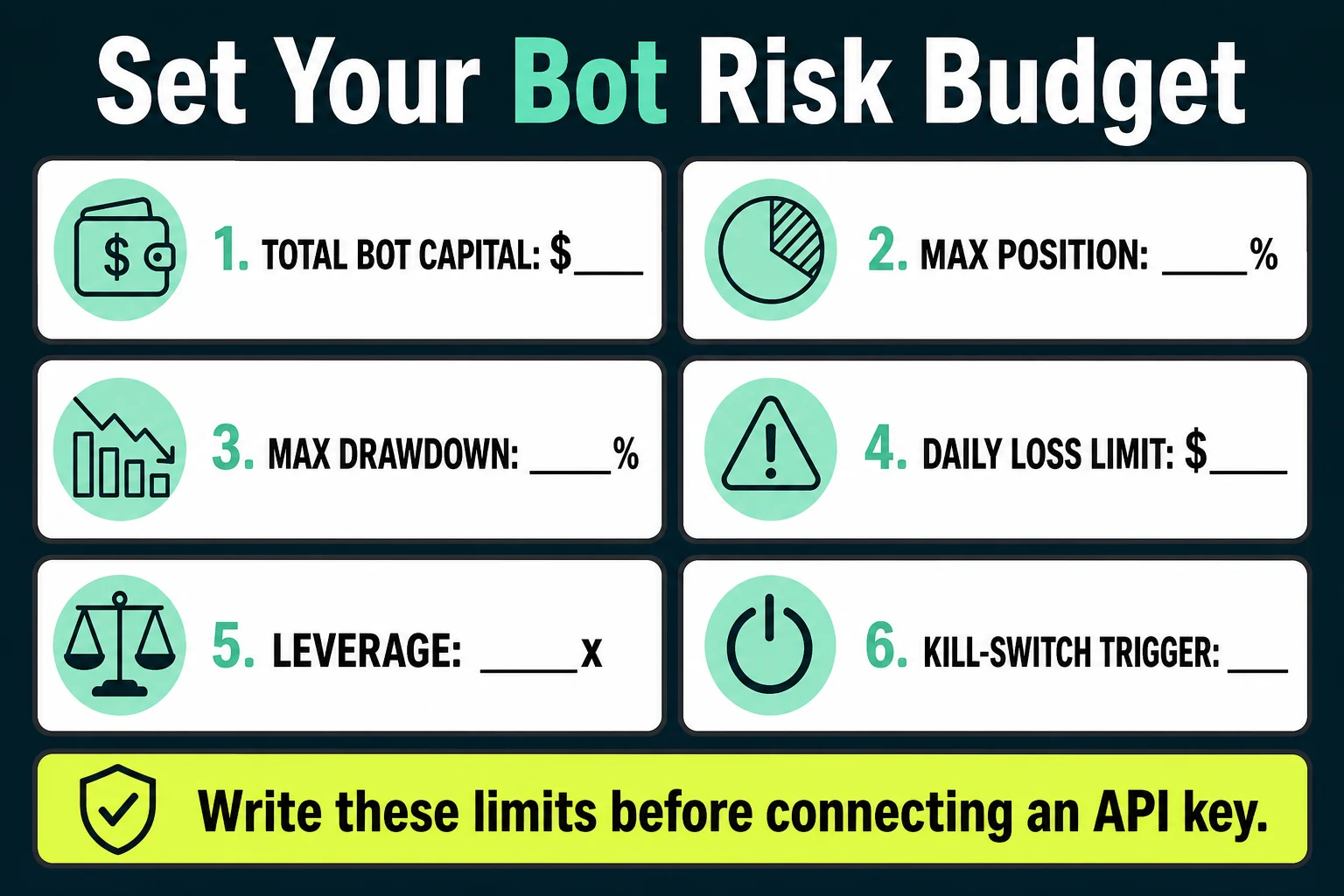
At minimum, define:
- Total bot capital: the maximum dollars exposed across every connected strategy.
- Maximum position: the largest share of bot capital allowed in one asset or pair.
- Maximum drawdown: the decline that pauses the strategy for review.
- Daily loss limit: the realized and unrealized loss that triggers a stop.
- Leverage: use zero until the unlevered strategy survives testing.
- Kill-switch trigger: the exact event that closes or disables the bot, such as an API error, price-feed divergence, or drawdown breach.
These are portfolio limits, not suggestions inside an individual strategy. If three bots can each use 50% of the account, you have not set a 50% cap.
The zero-risk test before live trading
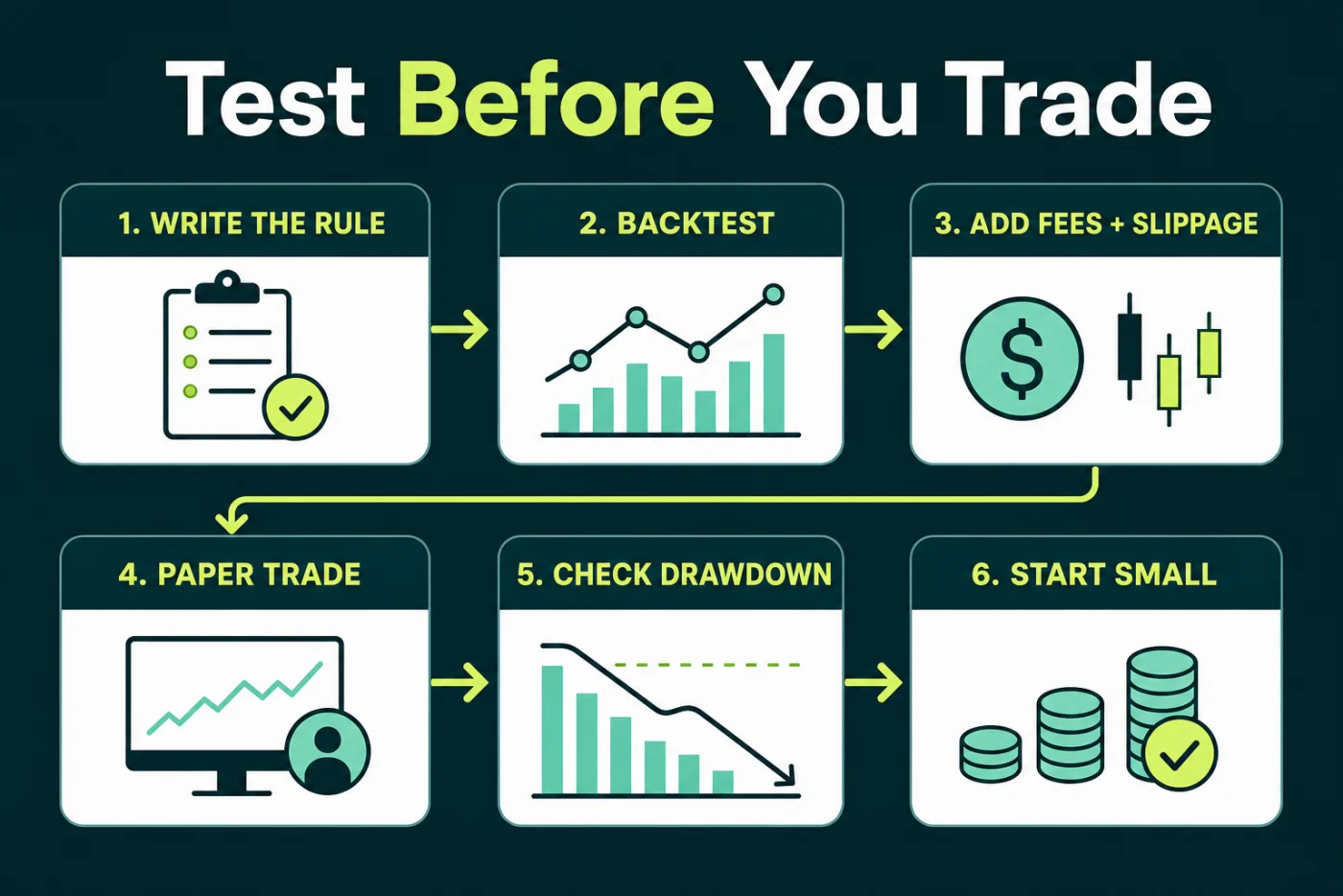
Write the strategy in plain English first. If you cannot state its entry, exit, position cap, stop condition, and failure case, you are not ready to automate it.
Then:
- Backtest across rising, falling, and sideways markets.
- Include realistic maker/taker fees.
- Add a conservative slippage assumption.
- Test against a simple buy-and-hold benchmark.
- Paper trade through live market movement.
- Record maximum drawdown, not only profit.
- Check whether fills match the intended rule.
- Start live with the smallest useful allocation.
- Set a portfolio-level loss limit and kill switch.
- Review every strategy after a material market-regime change.
A practical 30-day launch plan
Do not compress research, backtesting, paper trading, and live activation into one afternoon. A four-week sequence gives you time to see whether the system behaves as documented.
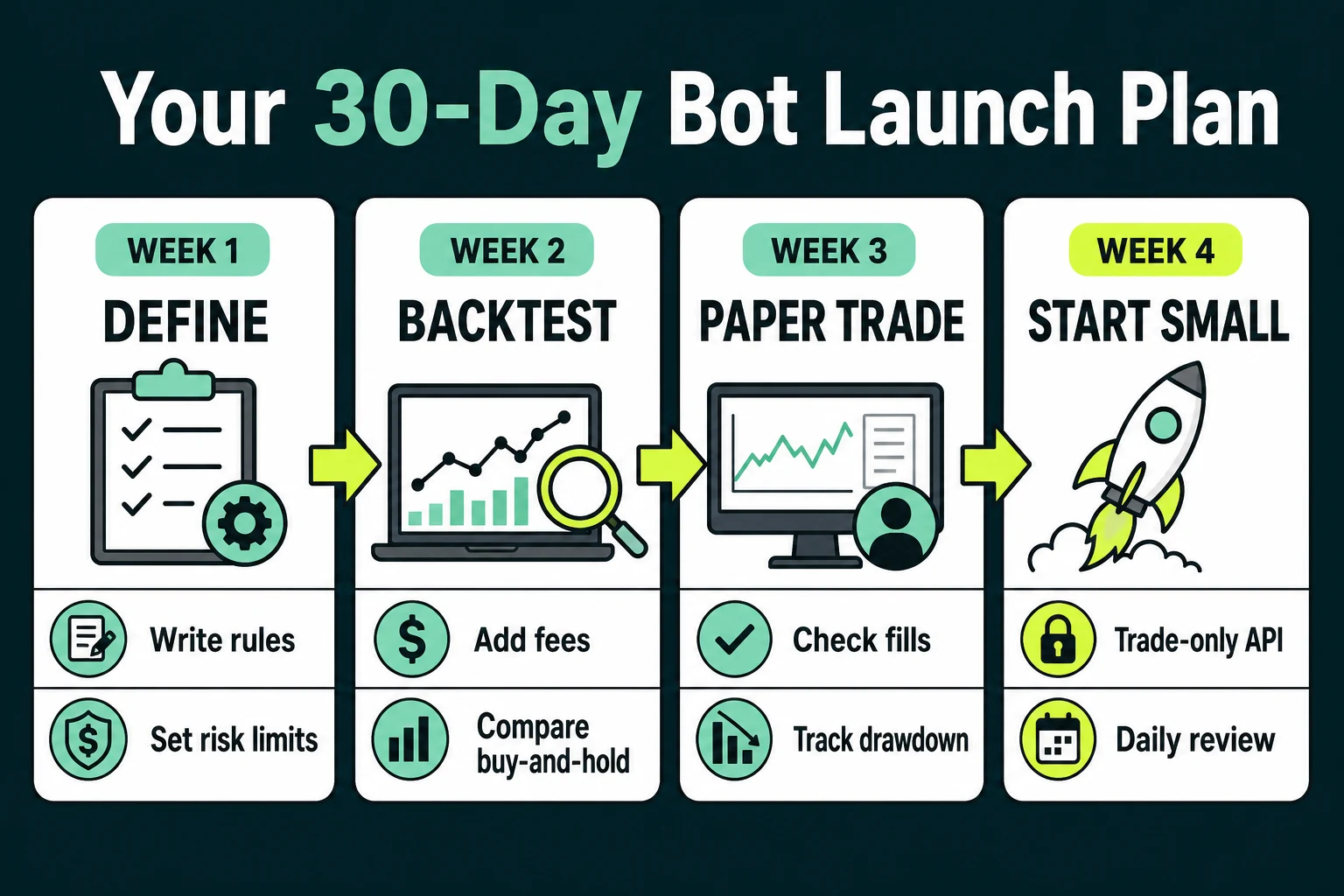
During week four, compare each live fill with the intended signal and paper result. Stop if the exchange pair, order type, quantity, fee, or timing does not match what you tested.
API-key security: the rules we would not compromise
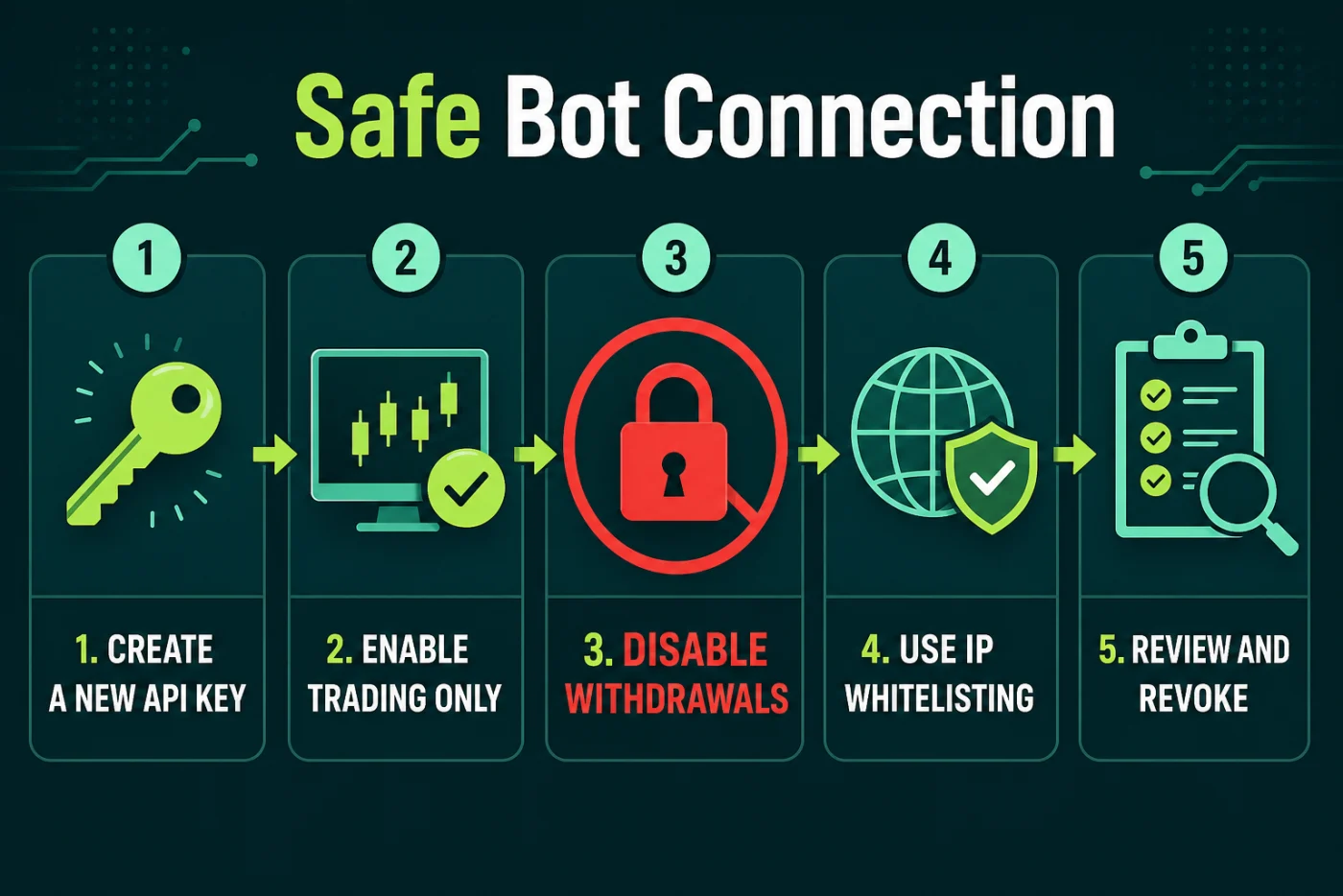
A third-party bot normally needs permission to view balances and place trades. It should not need permission to withdraw assets.
Use this setup:
- Create a dedicated API key for the bot.
- Enable only the minimum read and trading permissions.
- Disable withdrawals.
- Restrict the key to the provider’s documented IP addresses when supported.
- Use a separate exchange subaccount if available.
- Turn on strong two-factor authentication for both services.
- Never provide a seed phrase or private key.
- Review active keys regularly and revoke unused connections.
How to identify an AI trading-bot scam
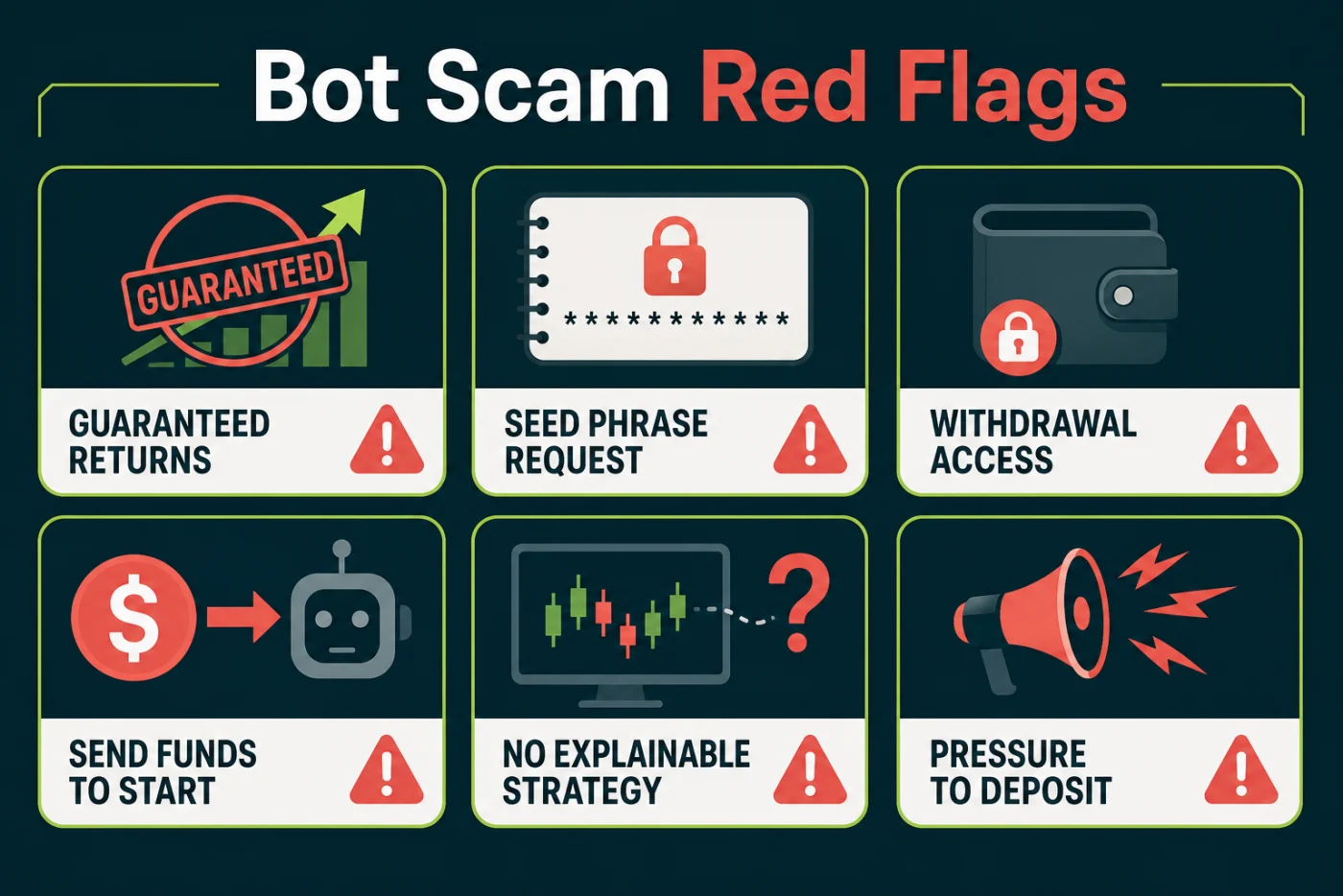
The strongest warning sign is certainty. Markets do not offer guaranteed returns, guaranteed win rates, or a fixed daily yield without risk.
Check for:
- Guaranteed daily or monthly returns
- Screenshots without verifiable order history
- A referral structure that matters more than the trading strategy
- Anonymous operators
- Pressure to deposit immediately
- No explanation of custody or permissions
- A request for withdrawal access
- A requirement to send funds to a wallet controlled by the promoter
- No legal entity, terms, or support process
How crypto bot trades are taxed in the US
For US federal tax purposes, a bot trade is a trade. Automation does not create a special exemption.
A sale for US dollars, exchange of one digital asset for another, or purchase made with crypto can create a taxable disposition. The gain or loss generally depends on the proceeds in US dollars, the adjusted basis of the units disposed of, and the applicable identification rules.
Buying crypto with US dollars is generally not a taxable event. Moving assets between wallets or accounts you own is generally not a disposition, although fees paid in crypto can have their own tax treatment.
Why bots create a harder tax file
A grid, arbitrage, or high-frequency strategy can create thousands of:
- Partial fills
- Fee entries
- Short holding periods
- Small gains and losses
- Transfers between subaccounts
- Trades across several pairs
- Basis adjustments
If one wallet or exchange is missing, software may treat an incoming transfer as having zero basis. That can overstate the gain dramatically.
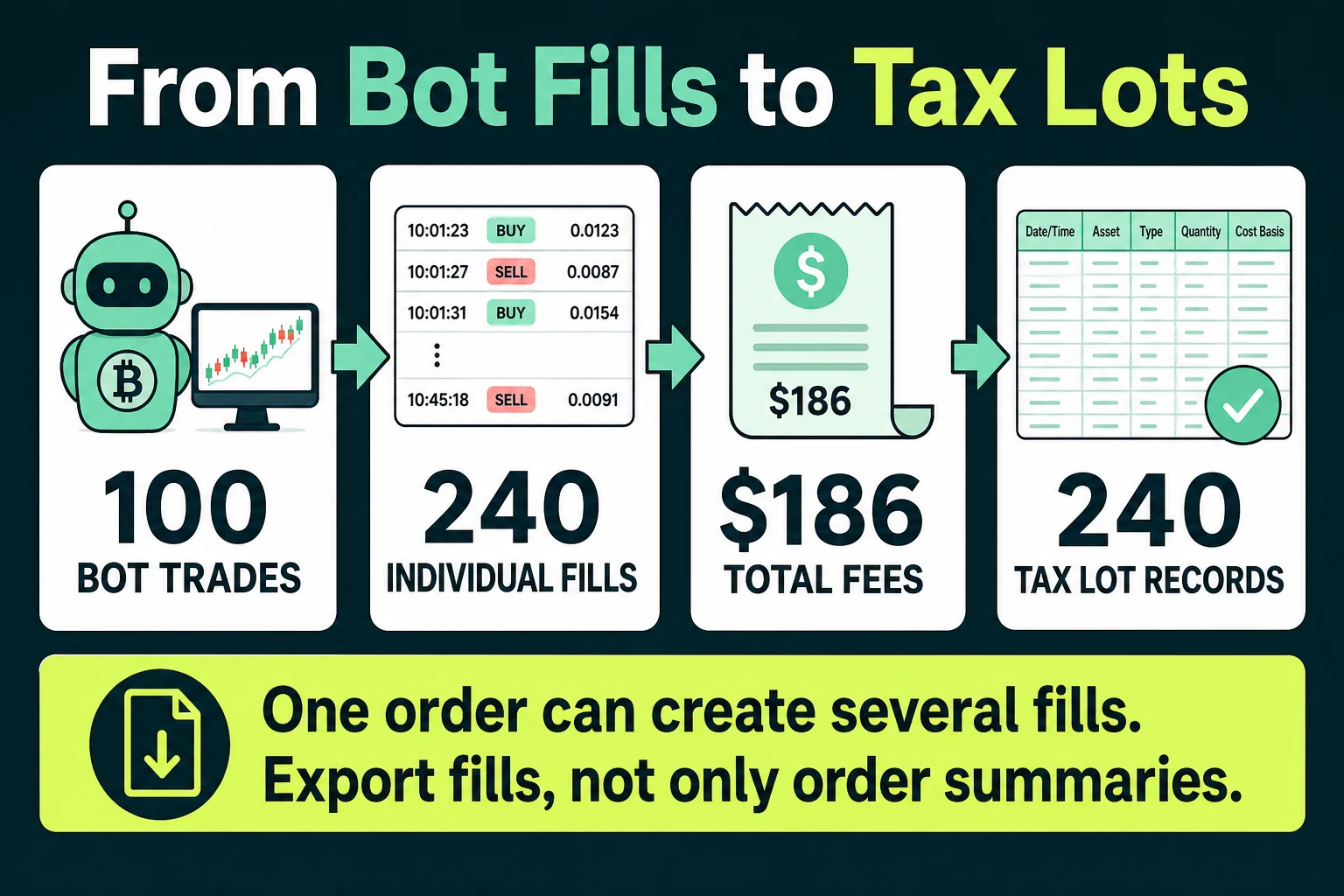
For example, suppose 100 bot orders produce 240 fills and $186 in trading fees. The tax file needs the 240 fill-level records, not 100 order headlines. Exporting only the bot dashboard can omit the timestamps, quantities, and fees needed to reconcile those lots.
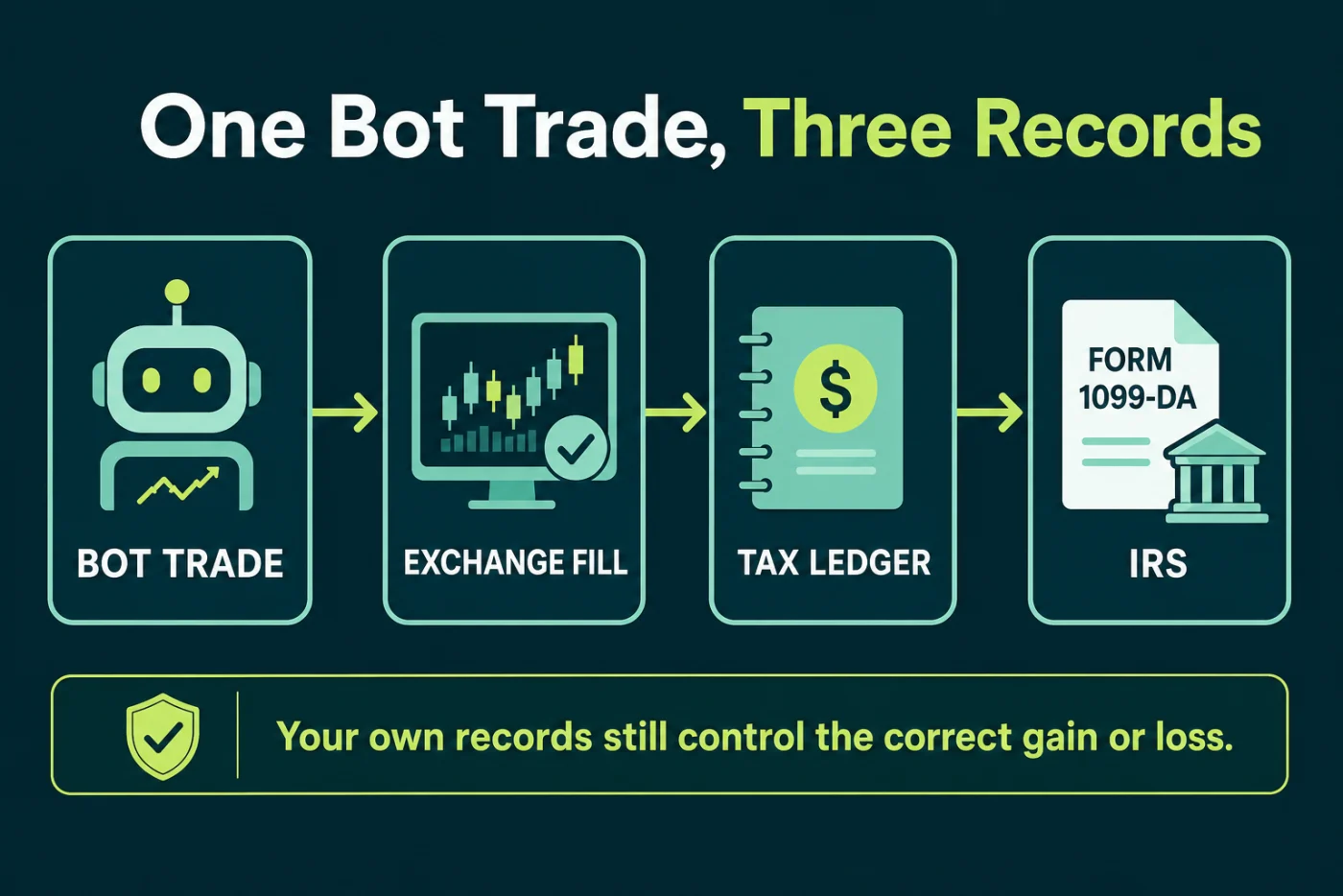
Form 1099-DA does not replace your records
US brokers began gross-proceeds reporting on Form 1099-DA for covered 2025 transactions reported in 2026. Broker basis reporting phases in for covered digital assets under the applicable rules. A form can still show missing or incomplete basis, especially for assets transferred into the broker.
The taxpayer remains responsible for an accurate return. Reconcile the broker form against the full transaction history instead of assuming the form contains every fact needed for Form 8949.
Per-wallet and per-account basis
Digital-asset basis tracking moved to a wallet-by-wallet or account-by-account framework beginning in 2025. That makes transfer records more important. A bot operating at one exchange cannot borrow basis from an unrelated wallet without a supported transfer trail.
Wash-sale treatment
As of our July 2026 review, the stock wash-sale rule in Internal Revenue Code Section 1091 generally does not apply to spot digital assets that are treated as property rather than stock or securities. Proposals can change, and other doctrines still matter. Do not build an aggressive rapid-loss strategy without current professional advice.
For the complete framework, read How Is Crypto Taxed in 2026?, the Form 1099-DA guide, and our explanation of per-wallet crypto cost basis.
Records to export every month
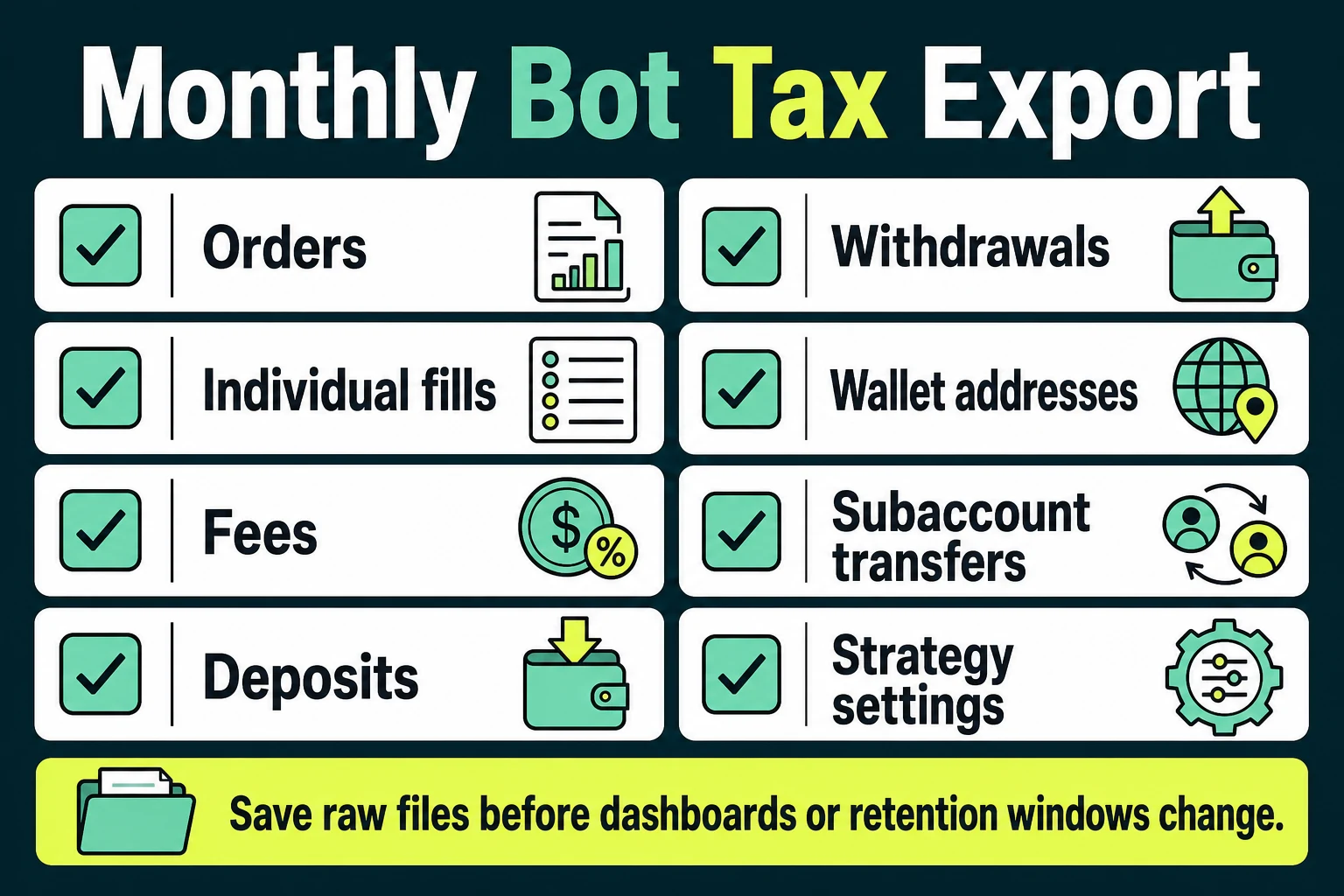
Do not rely on a bot’s profit dashboard. Export the raw exchange records:
- Orders and individual fills
- Timestamps and trading pairs
- Asset quantities and USD values
- Maker/taker fees
- Deposits and withdrawals
- Wallet addresses and transaction IDs
- Subaccount transfers
- Strategy name and settings
- API-connection dates
- Any manual trades made beside the bot
Store the original files in read-only form. Then keep a normalized working copy for tax software. Export again before closing an exchange, deleting a bot, or changing providers.
Use a consistent filename such as 2026-07-exchange-subaccount-fills.csv. Add a short note recording the bot name, strategy version, timezone, and any manual corrections. That makes a later reconciliation defensible instead of turning it into a memory exercise.
Final verdict
Choose by control and fit:
- Choose Coinrule if you want clear no-code logic.
- Choose Cryptohopper if you want to build and paper-test many strategies.
- Choose Pionex if you want native exchange bots without another subscription.
- Choose 3Commas if you are an experienced multi-exchange trader.
- Choose Bitsgap if grid automation is your main use case.
- Choose Stoic if you prefer model-driven allocation over manual rules.
- Choose Hummingbot if you want open-source control and can maintain it.
No bot removes the need to understand the strategy, restrict permissions, cap downside, and reconcile every trade. The tool should make execution more consistent. It should never make oversight disappear.
Need help reconciling bot trades?
High-frequency bot histories often overwhelm tax software when fees, subaccounts, transfers, and missing basis are mixed together. Count On Sheep rebuilds the complete digital-asset ledger and delivers a documented, CPA-reviewed report for your tax professional.
Sources and review notes
Platform features and pricing were checked against official product or pricing pages for Coinrule, Cryptohopper, Pionex, 3Commas, Bitsgap, Stoic, WunderTrading, TradeSanta, Hummingbot, and Binance.
Tax treatment was checked against the IRS digital-asset transaction FAQs, Form 1099-DA overview, 2026 Form 1099-DA instructions, and Revenue Procedure 2024-28. Product access, fees, and tax law can change after the review date.
Frequently Asked Questions
What is the best AI crypto trading bot in 2026?
Coinrule is our best starting point for transparent no-code rules, Cryptohopper offers the broadest strategy-building environment, Pionex is the simplest native exchange-bot option, 3Commas suits experienced multi-exchange traders, and Hummingbot is the strongest open-source choice for developers. The best fit depends on your skill, venue, strategy, and risk controls.
Are AI crypto trading bots profitable?
A bot can execute consistently, but it cannot make a weak strategy profitable. Results depend on market regime, fees, slippage, position sizing, drawdown, and whether the backtest reflects live conditions. No legitimate provider can guarantee returns.
Which AI tool is best for crypto trading?
Use Coinrule for visual rules, Cryptohopper for strategy design and paper trading, Bitsgap for grid-focused automation, Stoic for model-driven portfolio allocation, and Hummingbot if you want open-source control. Verify exchange and geographic support before paying.
Is there a free AI crypto trading bot?
Pionex includes built-in bots without a separate subscription, although trading fees still apply. Coinrule has a limited free tier, and Hummingbot is open source. Free does not mean risk-free, and many so-called AI tools are standard rule-based automation.
Can ChatGPT trade crypto for me?
ChatGPT can help explain or draft a strategy, but it should not be treated as an autonomous portfolio manager. Any live execution still needs a secure connection, deterministic risk limits, testing, monitoring, and a complete audit trail.
Do crypto trading bots create taxable transactions?
Yes. A bot-triggered sale, exchange, or spend is generally a taxable disposition under US federal tax rules, just like a manual transaction. One strategy can create thousands of tax lots, so complete exchange and wallet records matter.
Is transferring crypto to a trading bot taxable?
Connecting a third-party bot through a trade-only API is not taxable. Moving crypto between accounts you own is generally not a disposition, although fees paid in crypto can have tax consequences. The trades executed after the transfer can be taxable.
What records should I keep from a crypto bot?
Keep every order and fill, timestamps, asset quantities, fees, exchange and wallet exports, deposits, withdrawals, API-connection history, and strategy settings. Store the raw files monthly because dashboards and retention windows can change.