

A Koinly negative balance warning is the software telling you something simple but important: it sees more of a coin leaving your accounts than it ever saw arrive. If Koinly only knows about 3 ETH coming in but watches 5 ETH go out, the other 2 ETH had to come from somewhere it cannot see. That impossible math is what triggers the negative balance, or “missing purchase history,” warning.
This is not a bug, and it is not something to dismiss. Left alone, a negative balance quietly corrupts your cost basis and can make you pay tax on gains you never earned. Here is what causes it and exactly how to fix it.
Disclaimer: This guide is for informational purposes only. Always consult a qualified CPA regarding your specific situation.
What the Warning Actually Means
Koinly tracks every coin in and out across all your connected accounts. A negative balance is purely an accounting impossibility: you cannot dispose of coins you never acquired. So when the running total for a coin dips below zero, Koinly knows a purchase or deposit is missing and flags it.
The key insight is that the warning is almost never about the sale that triggered it. The sale is real. The problem is the acquisition Koinly cannot see, which usually sits in a different account entirely.
The Three Root Causes
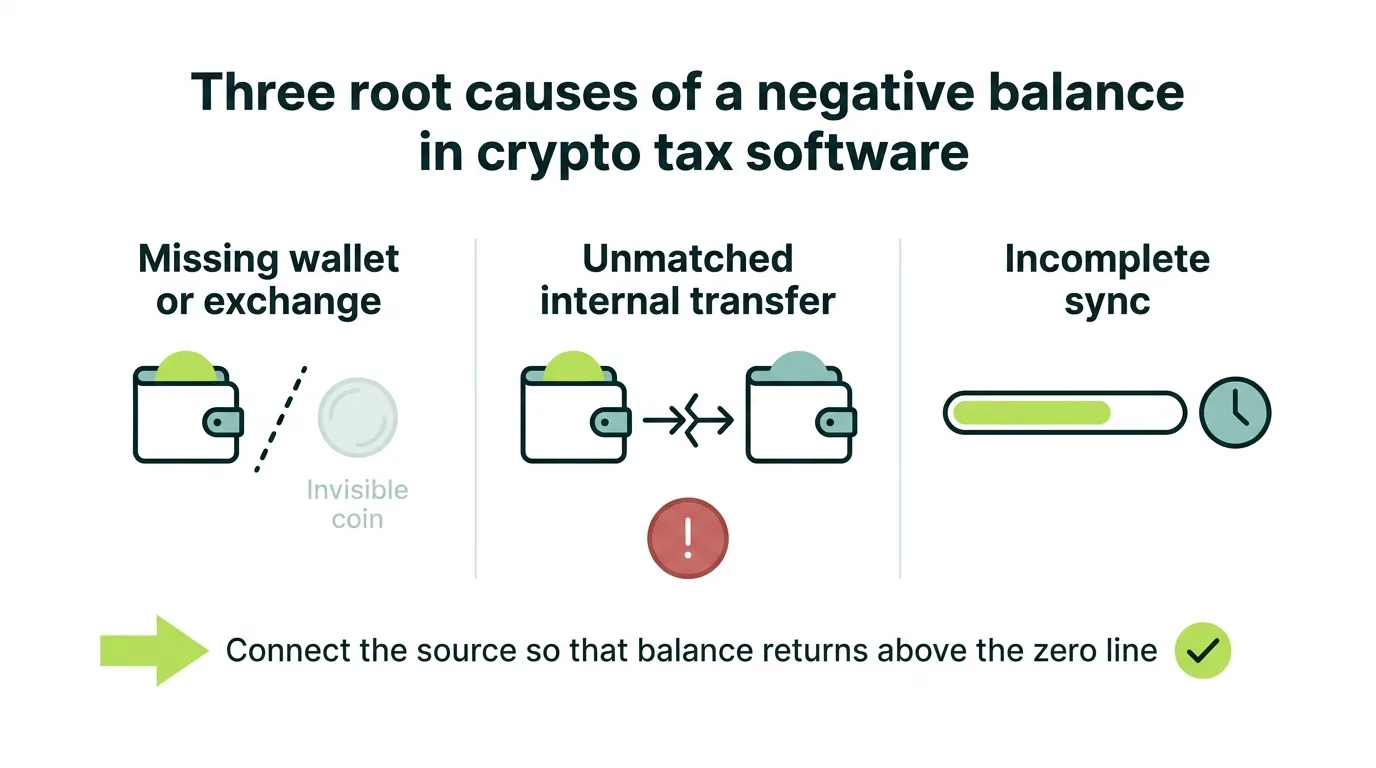
- A missing wallet or exchange. You acquired the coin on an account Koinly does not know about. The acquisition is invisible, so the later sale has nothing to match.
- An unmatched internal transfer. You moved coins between your own wallets. Moving coins is not taxable, but if Koinly cannot pair the withdrawal with the matching deposit, one side looks like coins appearing or vanishing from thin air.
- An incomplete sync. The account is connected, but the API pulled only part of the history and skipped the original purchase. This is common when an exchange API caps how far back it reaches. Our guide on finding and re-importing Koinly missing transactions covers how to widen a partial sync.
The Step-by-Step Fix
Work through these in order. Most negative balances resolve at step one or two.
- Identify the coin and the account. Note which coin is negative and which account the sale happened on. That tells you what you are tracing.
- Trace the origin. Figure out where that coin was first acquired or where it was transferred in from. This is the source Koinly is missing.
- Connect the missing source. Add the wallet or exchange where the acquisition lives. If it is a closed exchange, import a CSV of its history.
- Match the transfer. If the coins came from another of your own accounts, use Koinly’s transfer matching to pair the two sides so it is treated as a non-taxable move, not a disposal.
- Re-sync if the history was partial. If the source is already connected, re-import with a fresh read-only API key or a full CSV export to capture the older purchase.
- Confirm the warning clears. Once the acquisition is visible, the balance should return to a sensible number and the warning disappears.
How It Corrupts Your Cost Basis
This is why a negative balance is more than a cosmetic nag. When Koinly cannot find the purchase behind a sale, it frequently defaults the cost basis to $0. That means the entire sale price gets reported as profit.
Sell 2 ETH for $7,000 with a missing $5,000 purchase, and instead of a $2,000 gain you can end up reporting a $7,000 gain. Multiply that across a portfolio with several unresolved negative balances and you are looking at thousands in tax on phantom profit. If you are already seeing $0 cost basis show up, our Koinly cost basis fix walkthrough goes deeper on cleaning it up.
A client came to us in a panic because Koinly showed a $40,000 gain he was sure was wrong. The culprit was a single negative balance: he had bought SOL on an exchange that had since shut down and never connected it, then moved the SOL to his current wallet and sold it. Koinly saw the sale with no purchase, assigned $0 basis, and reported the whole thing as gain. We imported the closed exchange’s CSV, matched the transfer, and his actual gain came in near $9,000. One negative balance, a $31,000 swing.
When to Let a Service Reconcile It
If you have connected every account, matched every transfer, and negative balances still linger, the missing acquisitions are likely buried in closed exchanges, unsupported chains, or tangled DeFi. Chasing them by hand gets slow and error-prone. A crypto tax service can trace the origins, reconcile the full history, and produce a clean, defensible report. If your whole report feels tangled rather than just one coin, see our guide on getting a human to clean up a messy Koinly or CoinTracker report.
Key Takeaways
- Bottom line: a Koinly negative balance means it saw more of a coin leave than arrive, so a purchase or deposit is missing somewhere it cannot see
- The fix lives at the acquisition, not the sale. Trace where the coin originally came from and make that source visible
- The three root causes are a missing account, an unmatched transfer, and an incomplete sync, in roughly that order of likelihood
- Never delete the sale to silence the warning. Resolve the missing purchase so your records stay correct
- Decision point: if negative balances persist after everything is connected, the origins are likely buried, and a crypto tax service can reconcile them before you overpay on phantom gains
Frequently Asked Questions
What does a Koinly negative balance warning mean?
A negative balance means Koinly sees you disposing of more of a coin than it ever saw you acquire. In other words, you sold or sent 5 ETH but Koinly only has records of 3 ETH arriving. The missing 2 ETH has to have come from somewhere, so Koinly flags the impossible balance and warns that your purchase history is incomplete.
What causes a missing purchase history warning in Koinly?
The usual causes are a wallet or exchange that is not connected, an internal transfer between your own accounts that was never matched, or a sync that pulled only part of your history. Each leaves the original acquisition invisible, so the later sale has no purchase to match against and the balance goes negative.
How do I fix a negative balance in Koinly?
Find where the coin actually came from and make that source visible to Koinly. Connect the missing wallet or exchange, match the unmatched transfer, or re-sync to capture the full history. Once Koinly can see the original acquisition, the negative balance disappears and the cost basis corrects at the same time.
Why does a negative balance ruin my cost basis?
When Koinly cannot find a purchase, it often assigns $0 cost basis to the coin. That makes the entire sale price look like profit, so you get taxed on a gain you never actually earned. A single negative balance can inflate your reported gains by thousands of dollars if it flows into your tax report unresolved.
When should I get help with Koinly negative balances?
If you have connected every account and matched your transfers but negative balances persist, the missing acquisitions likely live on closed exchanges, unsupported chains, or in tangled DeFi activity. A crypto tax service can trace the origins, reconcile the history, and produce a defensible report, which is the faster path when a deadline is close.