
Canadian crypto profits are not automatically capital gains. CRA classifies the activity from all the facts, including transaction frequency, holding periods, market knowledge, time spent, and financing. Capital treatment currently includes 50% of a net capital gain in income. Business treatment includes 100% of net business profit. No official transaction-count or holding-period safe harbour was verified.
Last reviewed July 25, 2026. Critical rules checked against current CRA and Department of Finance sources.
Is crypto a capital gain or business income in Canada?
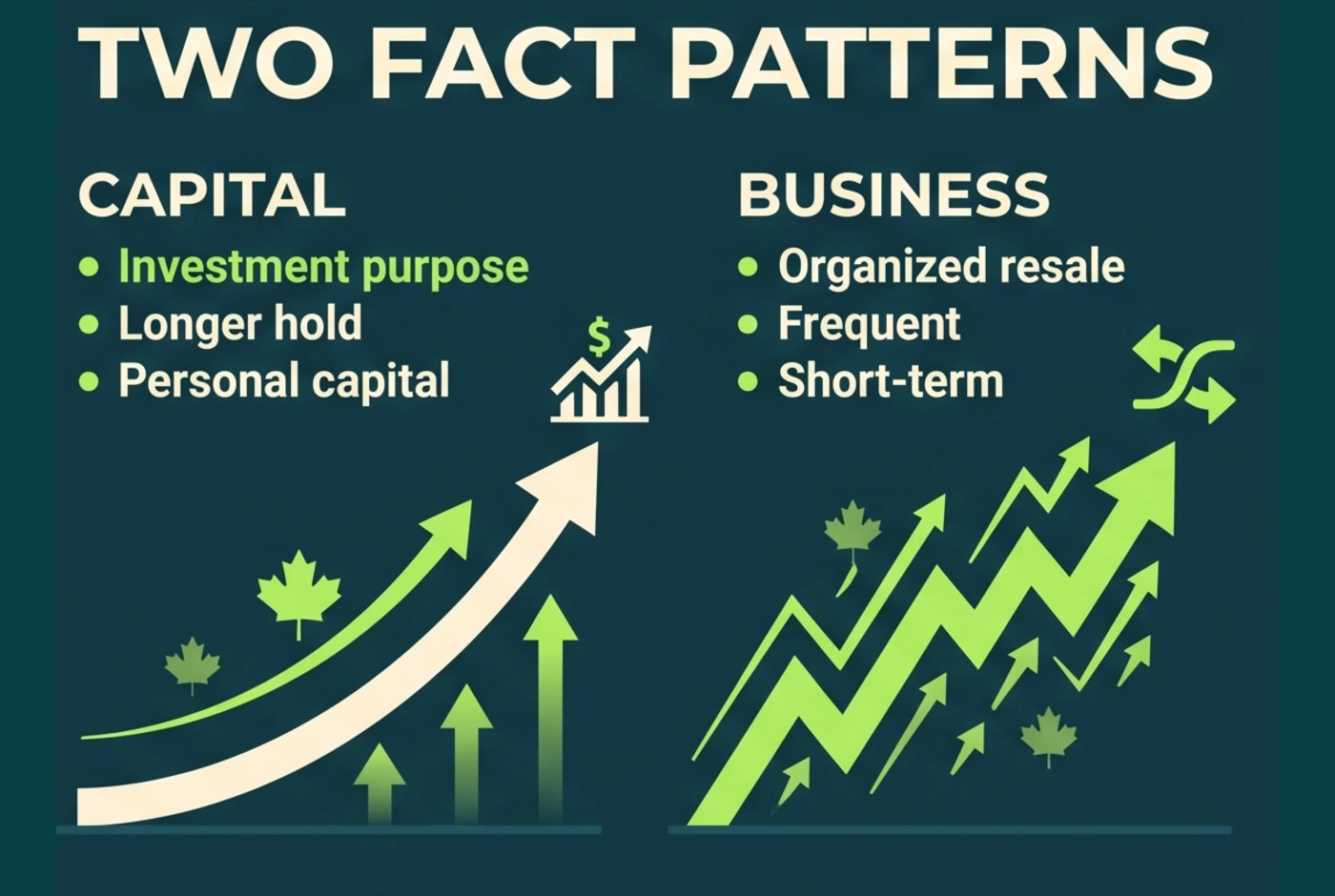
Capital-account pattern
A capital pattern usually begins with acquiring property as an investment, holding it while exposed to market risk, and disposing of it later. The taxpayer may research the asset and make several trades without operating a business. The evidence tends to show long-term ownership, limited turnover, personal capital, and reasons for sale that fit an investment plan.
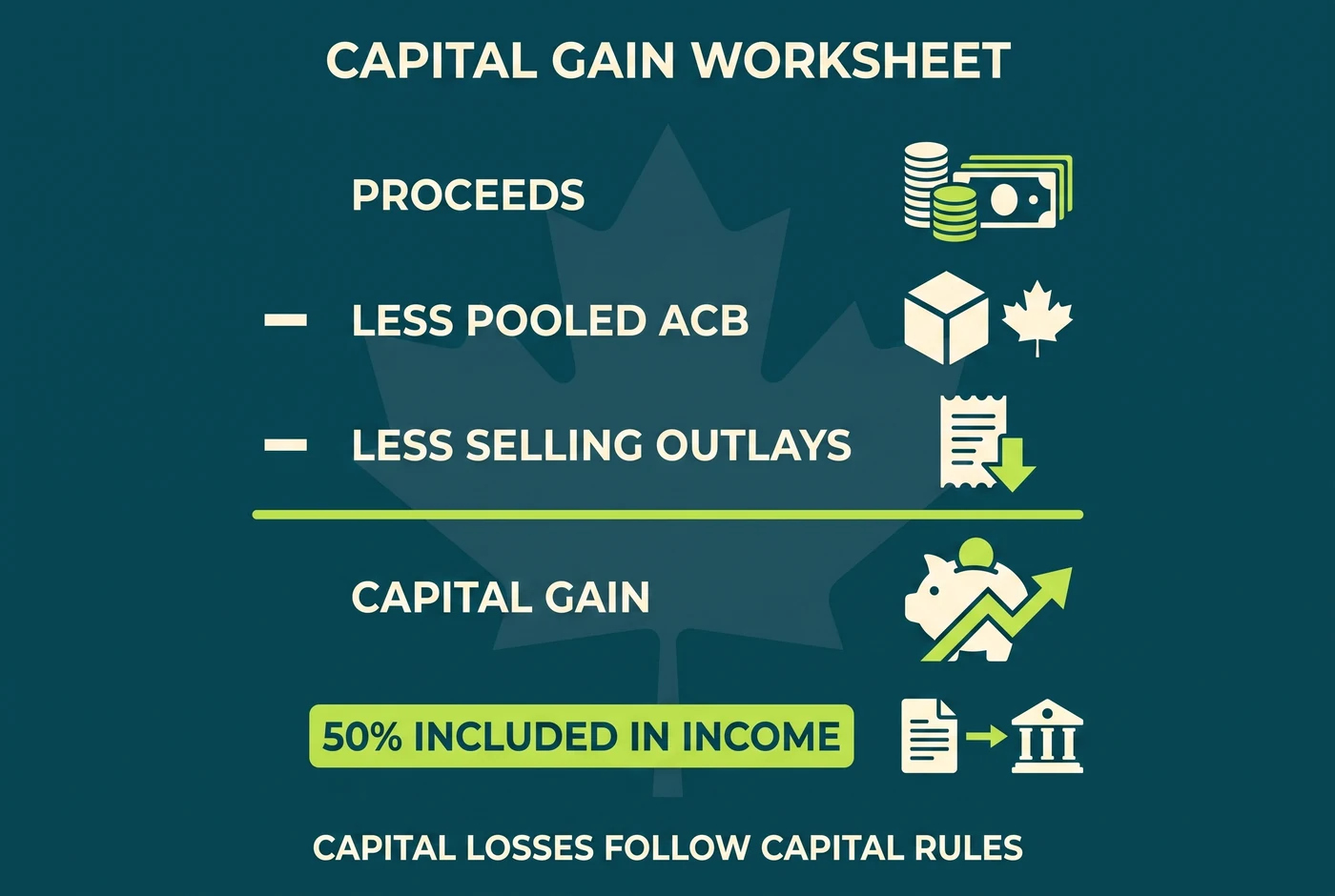
Capital classification brings each disposition into the capital-gain calculation. Proceeds, pooled adjusted cost base, and selling outlays determine the gain or loss. Under the current federal rule, 50% of a net capital gain is included in income. Capital losses generally apply against taxable capital gains rather than employment or other ordinary income.
Business or adventure-in-the-nature-of-trade pattern
A business pattern looks more like an organized profit operation. The taxpayer may trade frequently, hold positions briefly, apply specialized market knowledge, devote substantial time to research and execution, use automation, and finance positions with debt or leverage. The full net business profit is included in income before considering other return items.
A person does not need a registered company, employees, or a public storefront to have business income. CRA also recognizes an adventure or concern in the nature of trade, which can capture an isolated acquisition and resale when the facts show a commercial resale plan.
Why intent and conduct both matter
Stated intent is evidence, but conduct tests whether the statement is credible. A note saying "long-term investment" carries little weight if the activity shows rapid turnover, daily execution, borrowed capital, and a repeatable resale strategy. Conversely, one short holding period does not necessarily override a documented long-term portfolio with an unusual sale caused by changed circumstances.
The strongest file is contemporaneous. Keep the plan that existed when positions were acquired, not a retrospective paragraph written after a profitable year. Changes in strategy should be dated and explained, especially if some assets are treated differently or the pattern changed between years.
Why labels used by an exchange or software do not decide the result
Exchanges describe products, not Canadian tax law. Software may call every profitable disposal a capital gain because that is its default report. Neither label replaces a fact review. The classification should be applied before the final tax summary is generated, and unresolved cases should remain visible rather than silently falling into a default category.
| Evidence area | Capital-account pattern | Business pattern |
|---|---|---|
| Purpose | Investment and long-term appreciation | Resale profit or operating activity |
| Transactions | Occasional and portfolio-driven | Frequent, regular, or systematic |
| Holding | Generally longer with investment reasons | Often brief with planned turnover |
| Time and systems | Periodic monitoring | Substantial research, automation, and operations |
| Financing | Personal capital and ordinary portfolio risk | Debt, leverage, or repayment tied to resale |
| Accounting | Pooled ACB and capital gains | Revenue, inventory, cost, and allowable expenses |
The five CRA factors for crypto traders
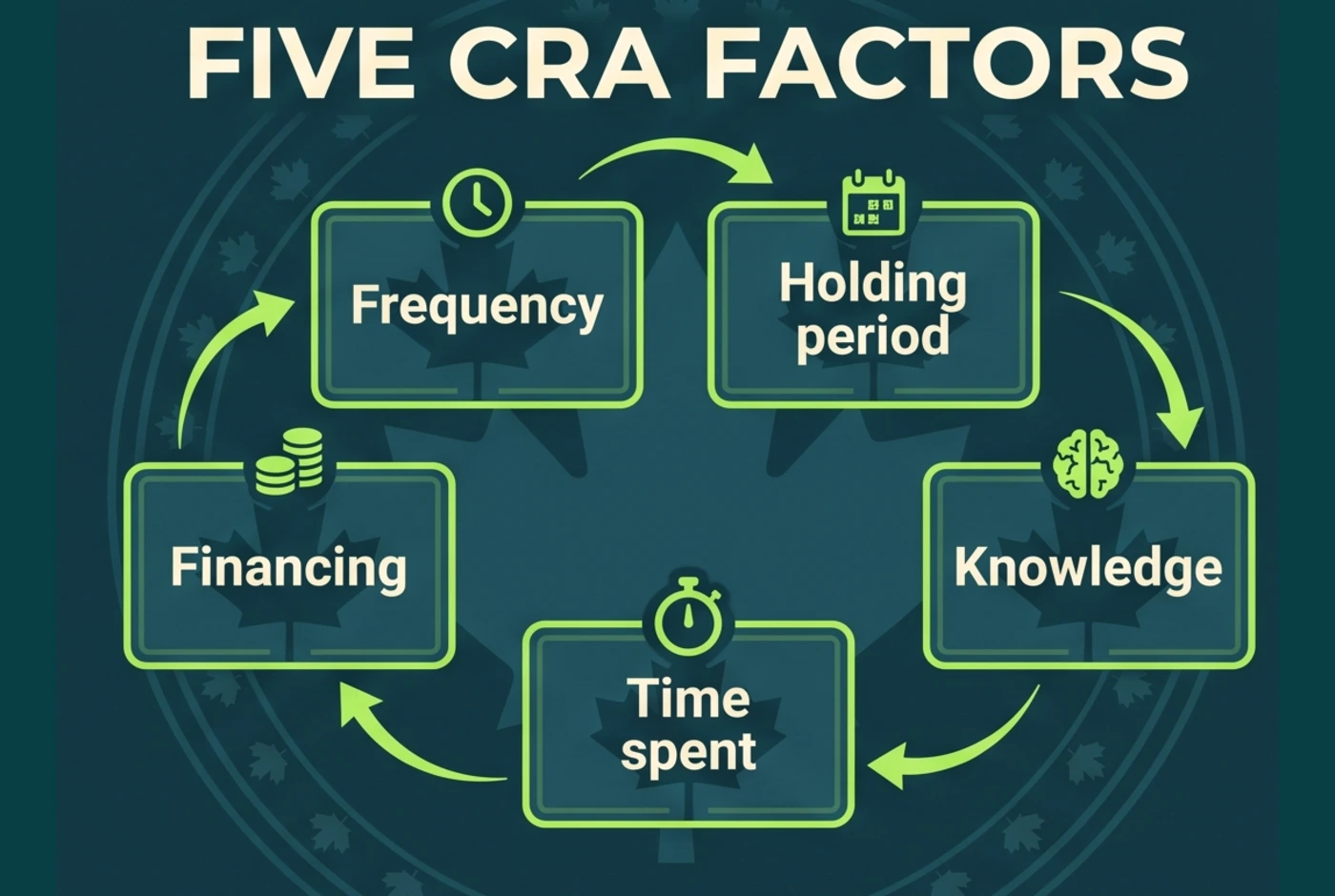
CRA identifies five relevant factors in its crypto transaction guidance. They organize the evidence, but they are not a points test. One strong fact can matter more than several weak ones, and the factors need to be read together.
Frequency of transactions
Count the number and regularity of trades, then look at the pattern behind the count. Daily algorithmic execution, repeated round trips, and a continuing strategy look more business-like than a few portfolio rebalances.
Investor pattern: A holder makes a few purchases and one annual rebalance. Business pattern: A bot opens and closes positions throughout most trading days. The examples point in different directions, but neither determines the conclusion alone.
Period of ownership
Calculate actual holding periods by asset and strategy. Median holding time, rapid turnover, and the reason for each major sale are more useful than one selected example. Short ownership often supports a resale pattern, while long ownership can support investment.
Investor pattern: Assets are held through several market cycles and sold after a change in personal circumstances. Business pattern: Positions are acquired with preset intraday or weekly exit targets.
Knowledge and experience
Specialized knowledge can show that the activity was conducted commercially. Review professional background, trading experience, research methods, technical expertise, and whether that knowledge was actively used to produce short-term profit.
Investor pattern: General research supports a long-term allocation. Business pattern: Professional market experience is applied to systematic arbitrage or high-frequency strategies. Knowledge alone does not create a business.
Time spent
Keep evidence of daily monitoring, strategy development, execution, reconciliation, and system maintenance. A substantial and regular time commitment can support business treatment, particularly when the activity has operating routines.
Investor pattern: The taxpayer reviews the portfolio periodically. Business pattern: The taxpayer spends several hours most days researching, operating bots, monitoring margin, and adjusting positions.
Financing
Debt can point toward a resale operation when repayment depends on selling at a profit. Preserve loan agreements, margin statements, collateral records, interest, and the intended repayment source. Leverage also changes the economic risk of the strategy.
Investor pattern: Purchases use personal savings with no scheduled repayment. Business pattern: Borrowed funds or margin finance short-term positions that must be closed to repay the debt.
Can one crypto trade be business income?
Adventure or concern in the nature of trade
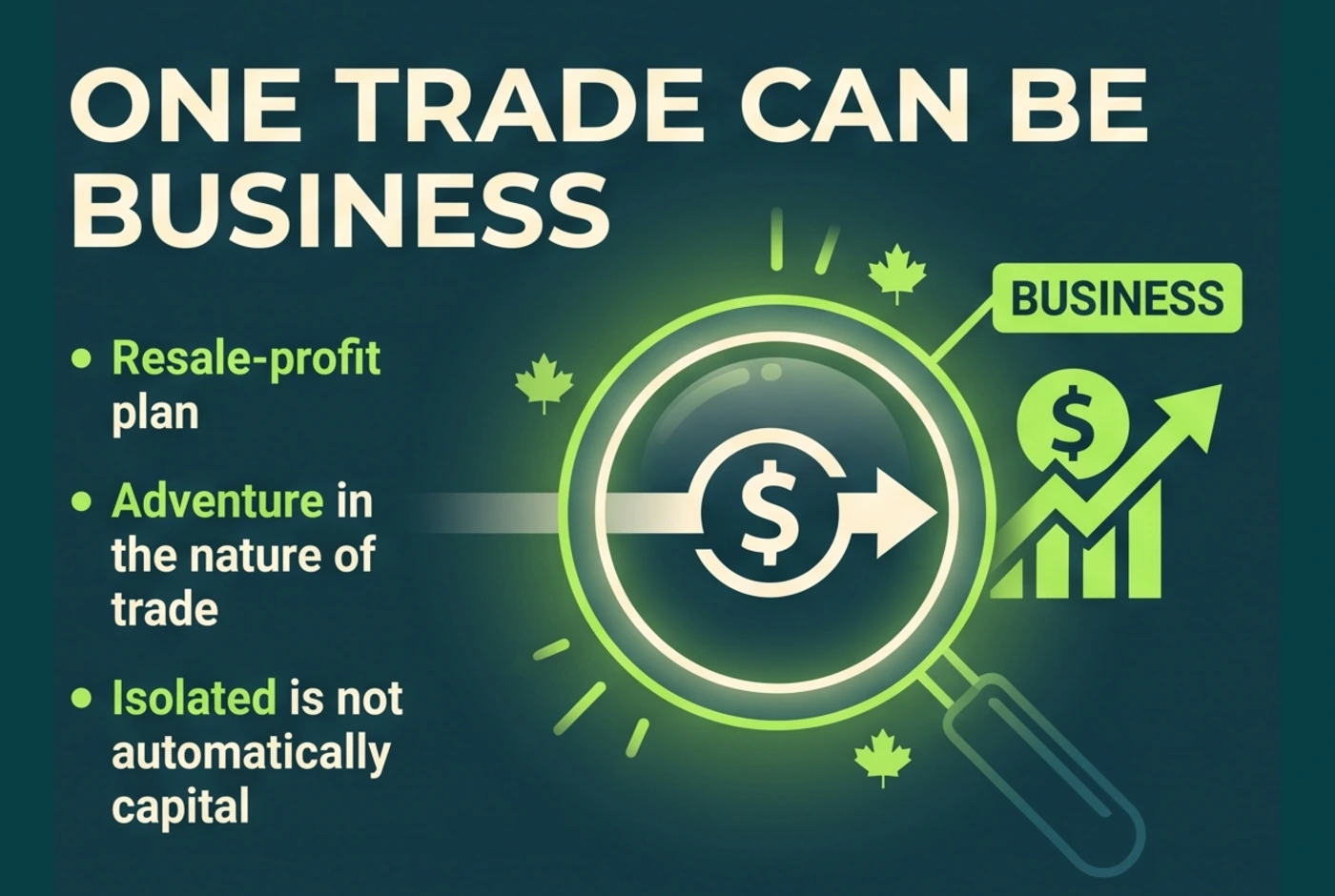
Yes. CRA's crypto guidance says even an isolated transaction can be business income when it is an adventure or concern in the nature of trade. The concept prevents an organized commercial resale from becoming capital solely because it happened once.
Evidence of a resale-profit plan
Relevant evidence can include a plan to acquire and quickly resell, negotiations or market work completed before purchase, financing that requires an early exit, marketing or buyer outreach, a short expected hold, and an absence of investment use. No single document is mandatory, but the story should fit the actions.
Why an isolated transaction is not automatically capital
Transaction count is only one fact. A one-time acquisition undertaken as a commercial resale project may be more business-like than a larger set of passive portfolio adjustments. Start with the purpose at acquisition, then test it against the actual holding, financing, work performed, and disposal.
Is crypto day trading always business income?
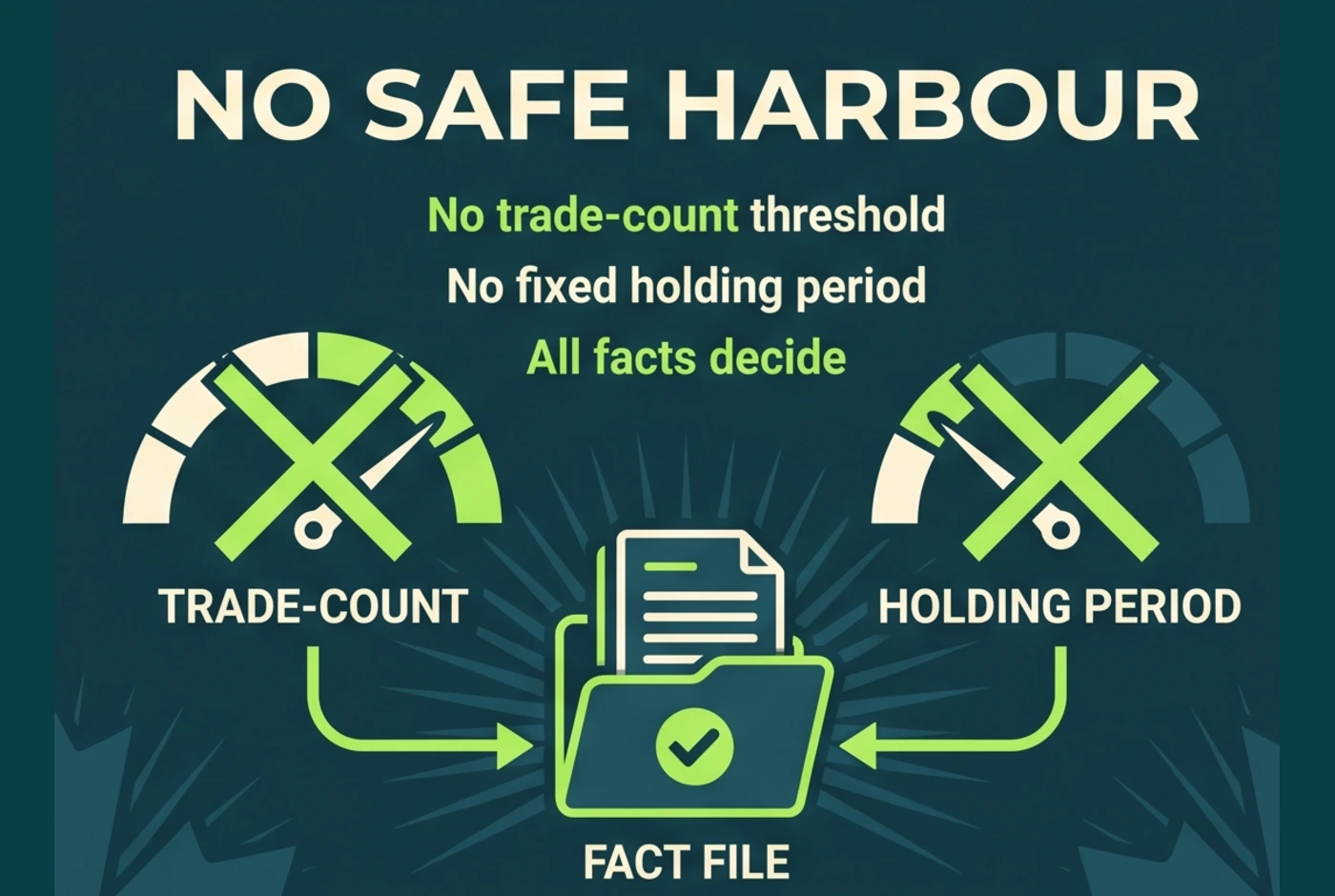
No official trade-count threshold
The reviewed CRA sources did not provide a trade count that automatically creates a business. A threshold such as 50, 100, or 500 trades should not be presented as law. Frequency matters because it can show an organized pattern, not because a hidden counter flips the classification.
No fixed holding-period threshold
The same is true for holding time. CRA identifies short periods of ownership as relevant but does not provide a verified number of days that guarantees capital or business treatment. A position held for 31 days is not automatically capital, and one sold after a week is not automatically business.
Why high frequency and short holding periods still matter
The absence of a safe harbour does not make the factors meaningless. High frequency and short holding periods can be strong evidence of a resale operation, especially when joined by specialized knowledge, substantial time, and debt financing. The conclusion gets stronger when the pattern is regular and intentional.
Bots, leverage, and systematic strategies
Automation can make a strategy more organized even when the taxpayer is not clicking each trade. Keep bot configuration, deployment dates, strategy notes, API records, margin statements, and change logs. Leverage and systematic execution do not automatically decide the issue, but they can make the conduct look more like an operating business.
50% capital-gain inclusion versus 100% business-income inclusion
Inclusion rate is not the final tax rate
A 50% capital inclusion rate does not mean a taxpayer pays 50% tax on the gain. It means half of the net capital gain enters income before the rest of the return is calculated. Business treatment places the full net business profit in income. Provincial or territorial rates and other return items apply afterward.
Capital-loss treatment
Capital losses generally apply against taxable capital gains under the capital rules, not ordinary employment income. The superficial-loss rule can deny a current loss and add it to replacement-property ACB when its acquisition and continued-ownership conditions are met.
Business expenses and net profit
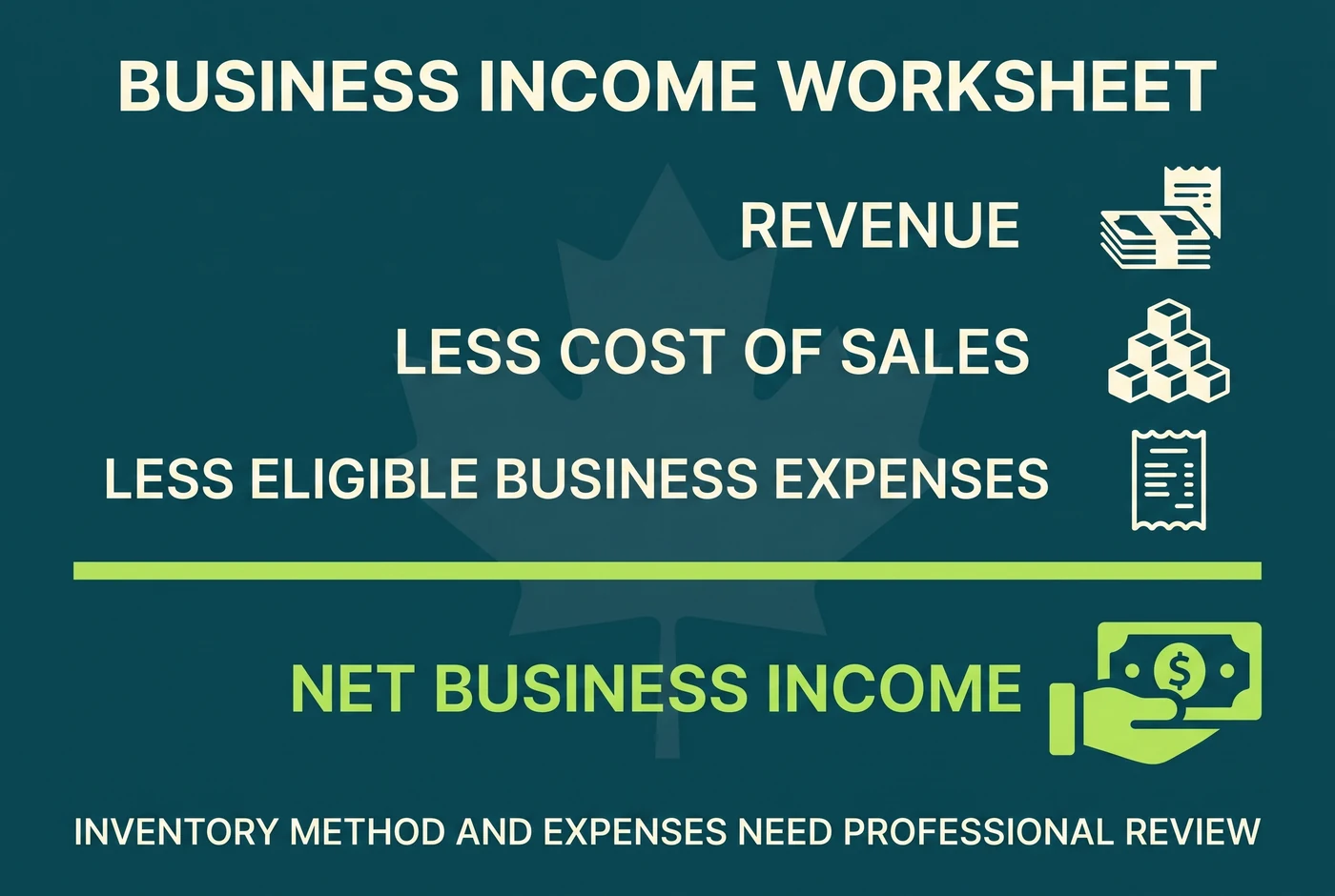
Business income starts from net business profit, not gross trading proceeds. Allowable expenses and inventory or cost-of-sales treatment may apply, but there is no universal deduction list for every crypto trader. Personal costs, capital items, mixed-use expenses, and unsupported estimates require care.
Provincial or territorial tax and other income
The inclusion amount is combined with other income and taxed through the full federal and provincial or territorial calculation. Credits, deductions, current losses, carryovers, and the taxpayer's location can all move the final balance. This comparison isolates classification impact rather than estimating tax.
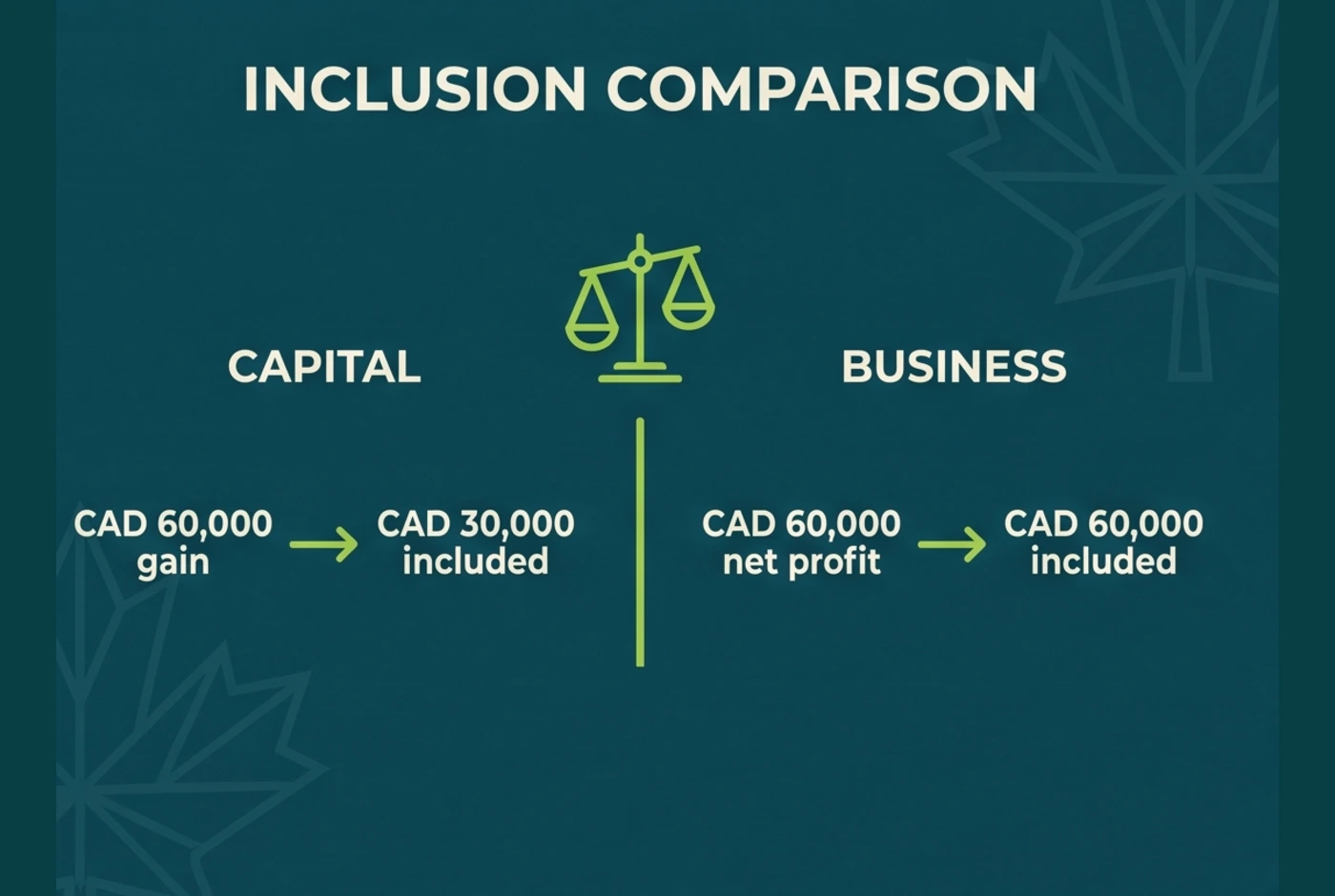
| Treatment | Economic profit | Amount included before other return items |
|---|---|---|
| Capital | CAD 60,000 capital gain | CAD 30,000 taxable capital gain |
| Business | CAD 60,000 net business profit | CAD 60,000 business income |
The former proposal to increase the capital-gains inclusion rate to two-thirds was cancelled. The current federal rule in CRA Guide T4037 remains 50%, so the CAD 60,000 capital example includes CAD 30,000 rather than CAD 40,000.
How business classification changes crypto accounting
Inventory rather than capital property
Assets held in the business may be inventory rather than capital property. That changes how opening and closing holdings, cost, and disposals are reported. A taxpayer should not mix a capital ACB schedule with a business inventory conclusion without reconciling the difference.
Revenue and cost of sales
Business reporting separates revenue from the cost of property sold. Gross exchange proceeds are not the same as net profit. The transaction ledger still needs complete Canadian-dollar values, but the summary should follow the business method selected with the Canadian tax professional.
Potential business expenses
Exchange charges, data services, professional fees, systems, interest, and other costs may be relevant when they satisfy the applicable business rules. The answer depends on purpose, support, capital-versus-current character, and personal use. Keep invoices and allocation notes rather than relying on broad categories.
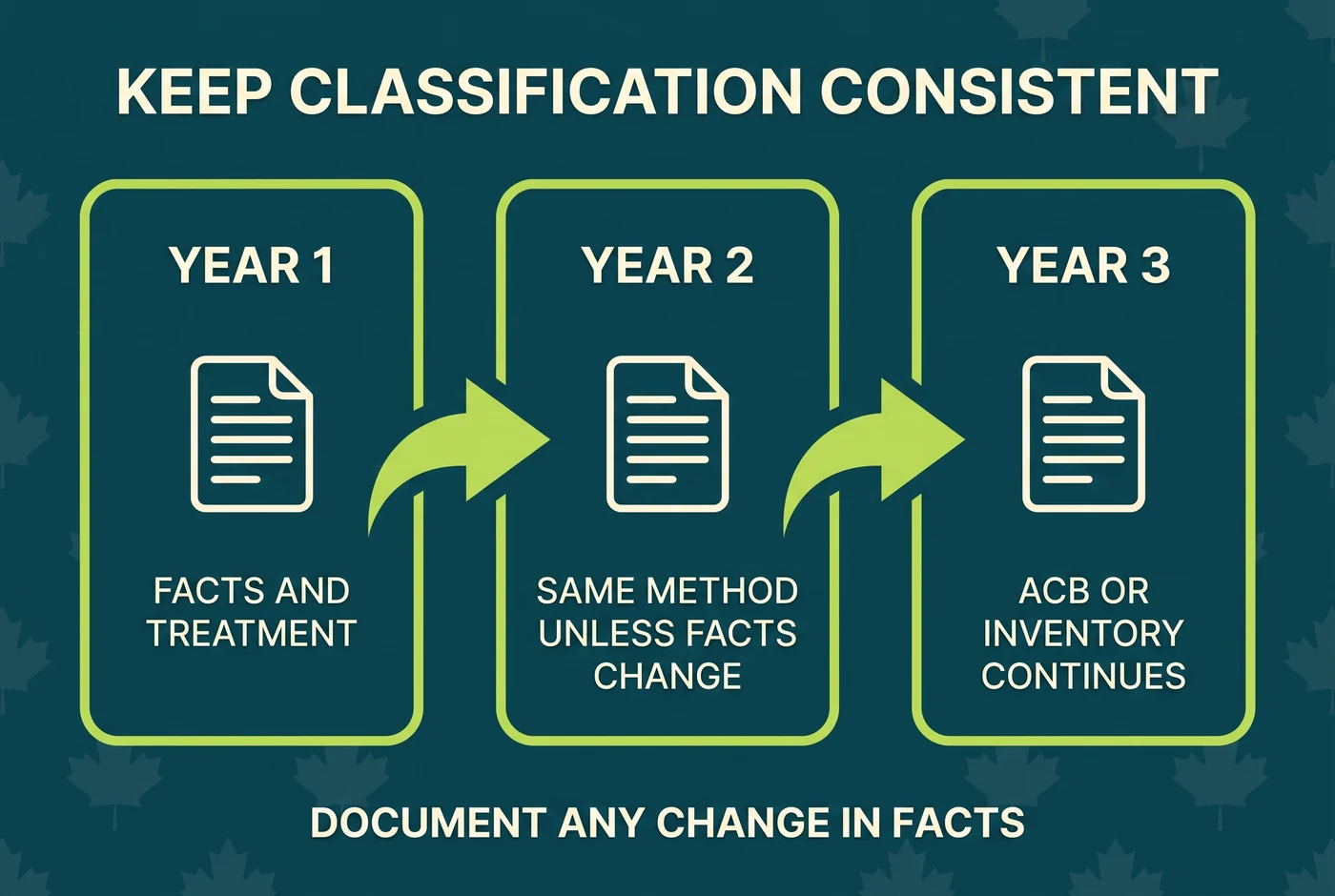
Consistent treatment across years
A classification change can affect opening inventory, prior loss treatment, and the connection between years. Consistency does not rescue an incorrect position, but unexplained year-to-year switches can make the file harder to defend. Document when the strategy changed and why.
GST/HST and other issues for professional review
Business classification can raise issues beyond income inclusion, including GST/HST, business registration, home-office or mixed-use allocations, and entity-level reporting. This guide does not provide a universal answer. Route those facts to the client's Canadian tax professional.
How capital classification changes crypto accounting
Pooled adjusted cost base
Identical property is generally averaged into an ACB pool. Add acquisition cost and eligible acquisition expenses, divide by units held, and allocate the proportional pool cost to each disposition. Owned wallets do not create separate tax lots for the same property.
Proceeds and selling outlays
Measure proceeds in Canadian dollars, subtract allocated ACB, and subtract eligible selling outlays. Token-to-token trades need Canadian-dollar fair market value even when no cash appears.
Superficial losses
A loss can be denied when the taxpayer or an affiliated person acquires the same or identical property in the 61-day window and still owns it 30 days after the sale. The denied loss is generally added to replacement-property ACB.
Net capital losses
Net capital losses generally apply against taxable capital gains under the rules in CRA Guide T4037. They do not simply reduce salary. The detailed pool, partial-sale, swap, and fee arithmetic is in our guide to calculate Canadian crypto gains using adjusted cost base.
A practical classification decision tree
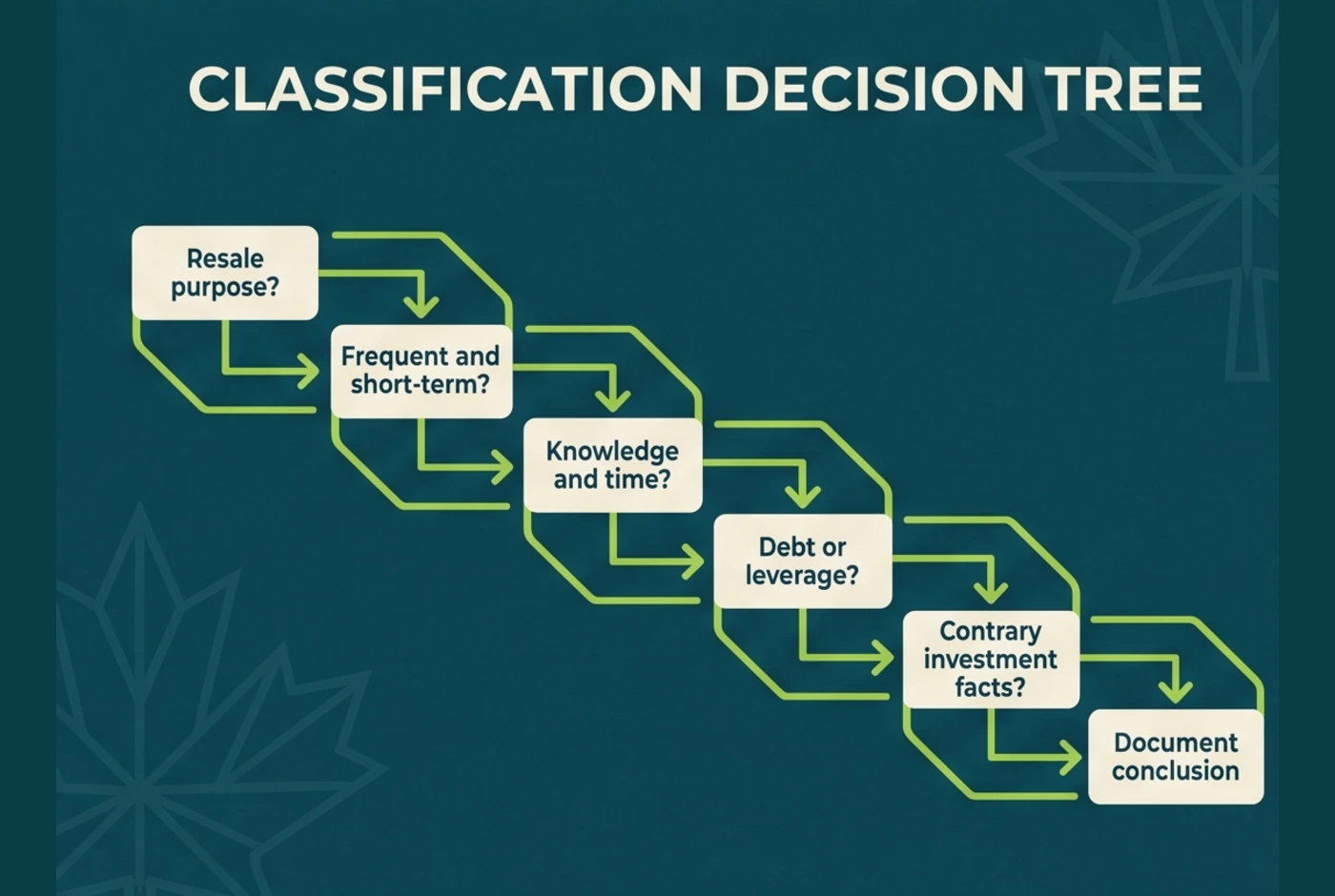
- Was the asset acquired primarily for resale at a profit?
- Is trading frequent, organized, and short-term?
- Does the taxpayer have specialized knowledge and spend substantial time?
- Was debt or leverage used in a way that implies resale?
- Is the conduct consistent with an operating business?
- Are there contrary long-term-investment facts?
- Are any transactions isolated adventures in the nature of trade?
- Is the conclusion documented and applied consistently?
The sequence helps organize evidence. It is not a statutory test, scoring model, or automated answer. A "yes" does not count as a point, and several "no" answers do not create a safe harbour. Use it to identify what the Canadian tax professional needs to decide.
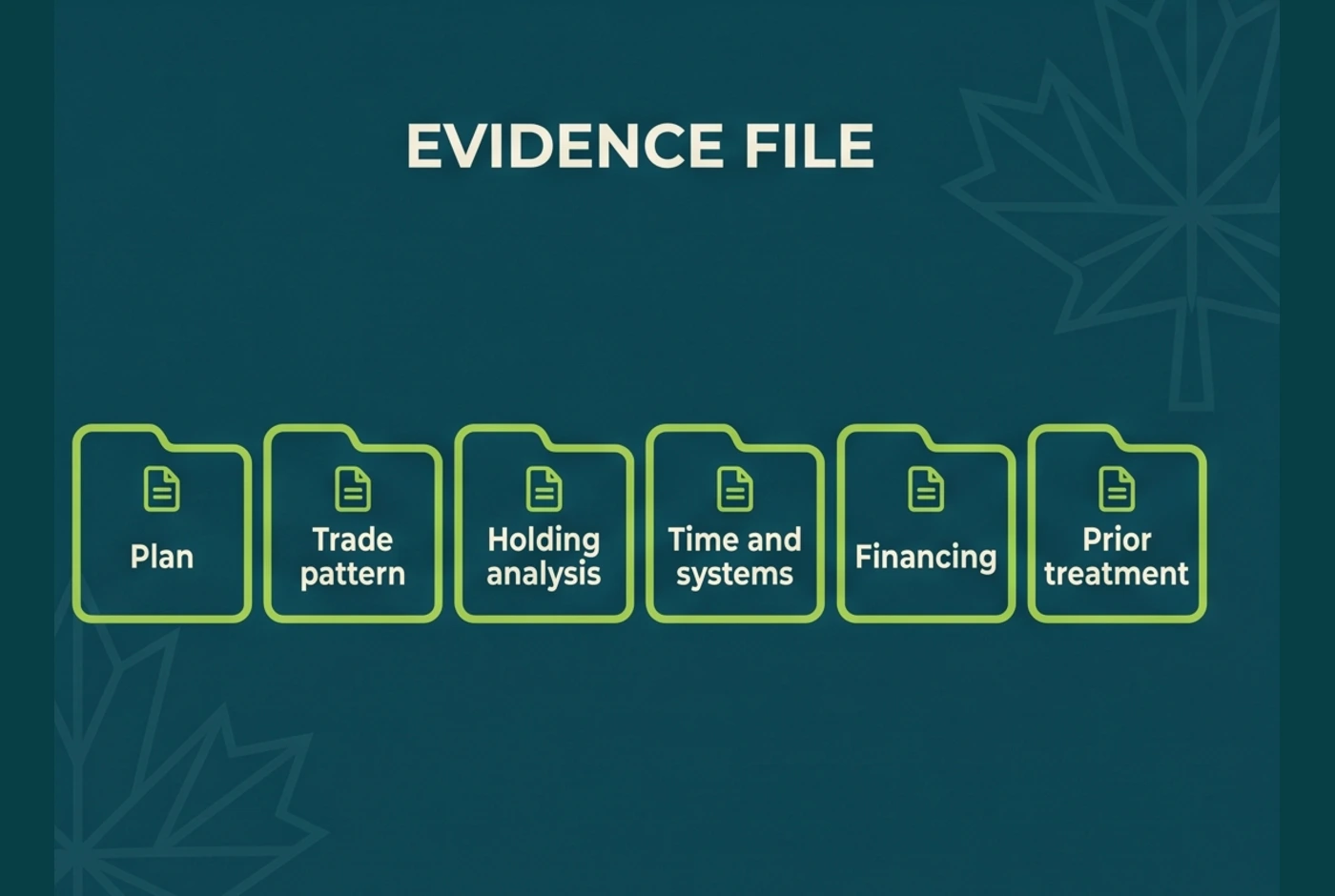
What records support the classification?
Contemporaneous investment or trading plan
Keep dated notes from the time of acquisition. Record whether the goal was long-term appreciation, income, hedging, market making, arbitrage, or rapid resale. Update the plan when the strategy changes.
Transaction frequency and holding-period analysis
Produce a complete trade count by month and strategy, distribution of holding periods, turnover, position concentration, and reasons for major exits. Avoid cherry-picking one long hold from an otherwise rapid pattern.
Research, time, systems, and automation
Preserve research files, time records, bot configurations, API logs, execution routines, monitoring systems, and change histories. These show what work was actually performed and how organized it was.
Financing and leverage records
Keep loan agreements, margin statements, collateral records, interest, liquidation notices, and repayment plans. Explain whether repayment depended on a quick resale or came from unrelated funds.
Accounting and prior-return treatment
Preserve prior ACB schedules, inventory workpapers, financial statements, tax summaries, and classification memos. If the approach changes, bridge the opening amounts and explain the reason.
Reasons for acquiring and disposing of major positions
A transaction-level note can distinguish an investment sale after changed circumstances from a preplanned resale. Support the explanation with price alerts, liquidity needs, protocol changes, risk controls, or contemporaneous communications where available.
What happens if CRA reclassifies crypto activity?
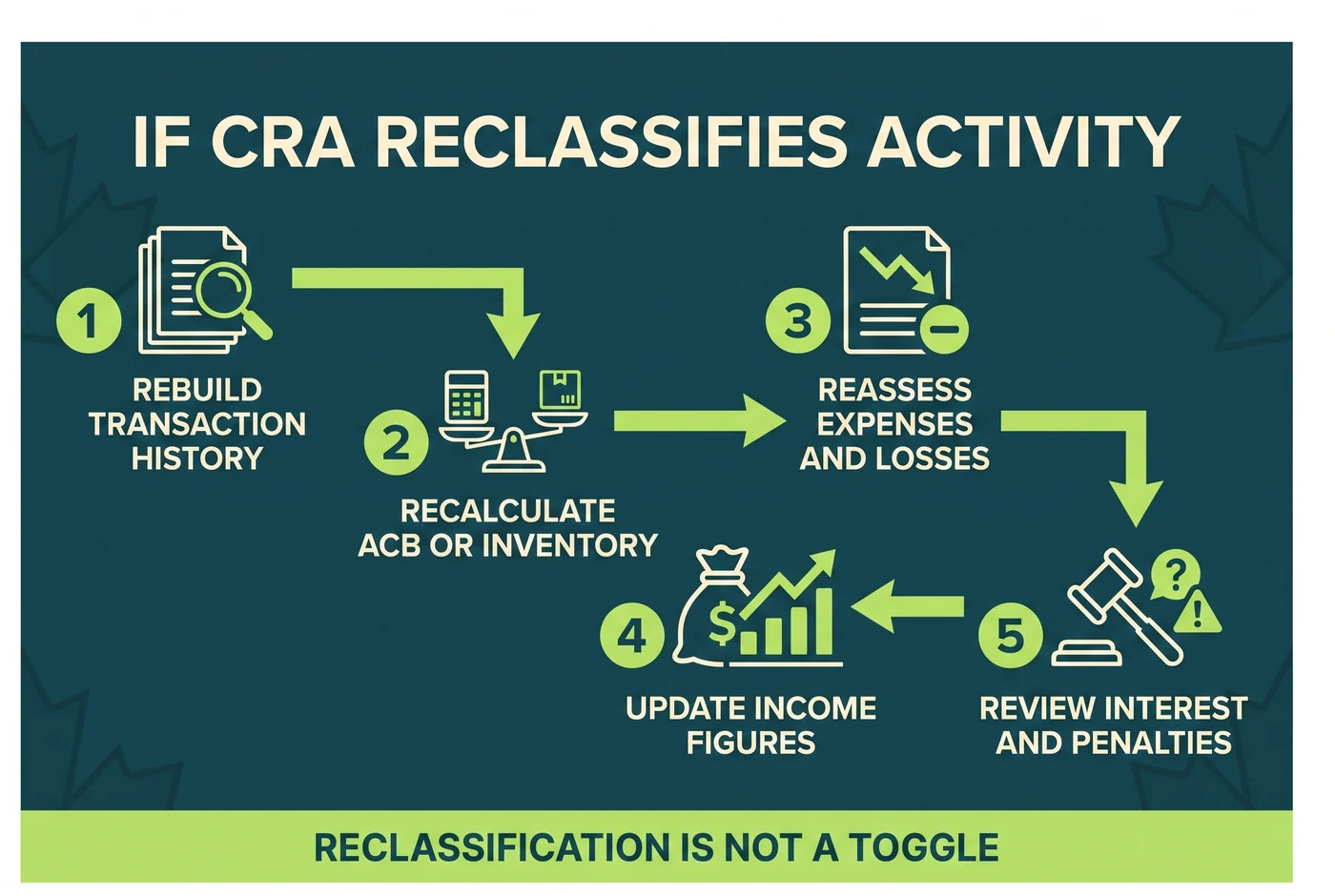
Changed income inclusion
A capital-to-business change can move from 50% inclusion of a net capital gain to 100% inclusion of net business profit. The business result is not produced by doubling the capital gain, because inventory, expenses, and loss rules can also change.
Recalculation of inventory, expenses, and losses
Opening and closing holdings may need business inventory treatment. Costs and expenses need support under the business rules, while capital losses and superficial-loss adjustments may no longer fit the same way. Rebuild the ledger consistently rather than changing only the return summary.
Interest and penalties
A reassessment can bring additional tax, interest, and penalties depending on the facts and conduct. Do not estimate those amounts from a generic percentage. The Canadian tax professional should review the years, positions, disclosure history, and procedural options.
Need to rebuild transaction-level evidence
A reclassification review needs more than annual exchange totals. Reconstruct each relevant acquisition, disposition, transfer, fee, reward, and closing balance in CAD. Then connect the transaction pattern to the five factors and business accounting.
When Voluntary Disclosures may be relevant
CRA's revised Voluntary Disclosures Program is case-specific and generally requires action before an audit or investigation begins. Acceptance and relief cannot be promised. Our guide to how the CRA can obtain crypto data covers the current Coinsquare, CARF, audit-record, and VDP framework.
How COS handles an unresolved classification
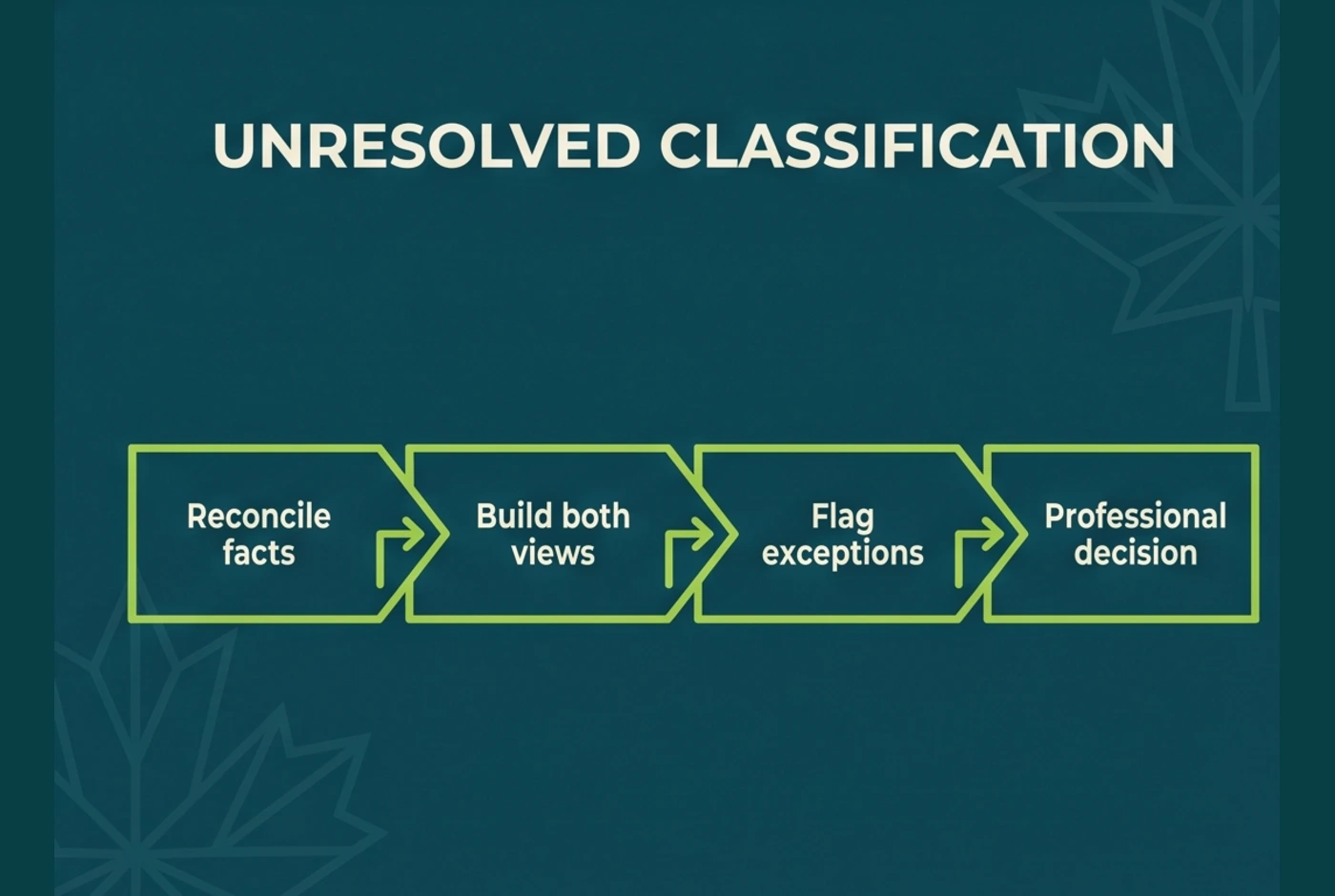
Reconcile the facts before applying a label
Count On Sheep first rebuilds the activity across exchanges, wallets, and protocols. A complete ledger reveals frequency, holding periods, financing-related events, automation, transfers, rewards, and closing positions without forcing an early classification.
Produce capital and business views where needed
When the classification is genuinely unresolved and material, the workpapers can show the impact under the relevant capital and business approaches. That gives the Canadian tax professional useful figures for a decision rather than one opaque software default.
Flag assumptions and material exceptions
The exception log records missing data, disputed prices, unusual protocol rights, possible superficial losses, classification assumptions, and positions that depend on professional advice. Uncertainty stays visible.
Give CRA-ready workpapers to the client's Canadian tax professional
The final package includes the reconciled ledger, calculation views, classification evidence summary, source and valuation notes, and material exceptions. See the full scope of CRA-ready crypto reconciliation for your Canadian tax professional. COS does not decide the legal position or file the Canadian return.
For the broad CRA rules, taxable-event map, records, and return orientation, return to the Canada Crypto Tax Guide 2026.
Get CRA-ready figures for your Canadian tax professional
Count On Sheep reconciles complex digital-asset activity into CRA-ready figures and workpapers for your Canadian tax professional. We do not file Canadian tax returns.
Talk to a Canadian crypto tax specialistCanada crypto tax FAQs
Is crypto taxed as income or capital gains in Canada?
It can be either. CRA considers all the facts, including frequency, holding periods, market knowledge, time spent, and financing. Capital treatment currently includes 50% of a net capital gain in income. Business treatment includes 100% of net business profit before other return items.
Is crypto day trading business income in Canada?
Frequent, organized, short-term trading can support business classification, especially when combined with specialized knowledge, substantial time, automation, or debt financing. CRA does not provide a verified trade-count or holding-period threshold that automatically decides the result.
How much tax do I pay on crypto capital gains in Canada?
The current federal rule includes 50% of a net capital gain in income. That is not a 50% tax rate. Final tax depends on your province or territory, other income, available losses, deductions, and credits.
What factors does CRA use to classify a crypto trader?
CRA identifies frequency of transactions, short periods of ownership, knowledge of or experience in the market, substantial time spent studying markets and investigating purchases, and debt financing. No single factor is determinative.
Can one crypto trade count as business income?
Yes. An isolated transaction can be an adventure or concern in the nature of trade when the evidence shows a resale-profit plan or business-like conduct. One transaction is not automatically capital merely because it is isolated.
What happens if CRA reclassifies my crypto gains as business income?
The amount included in income can change, and the records may need to be rebuilt using business revenue, inventory, cost, expense, and loss concepts. Interest and penalties may also be relevant. A Canadian tax professional should decide the position using complete transaction-level evidence.