
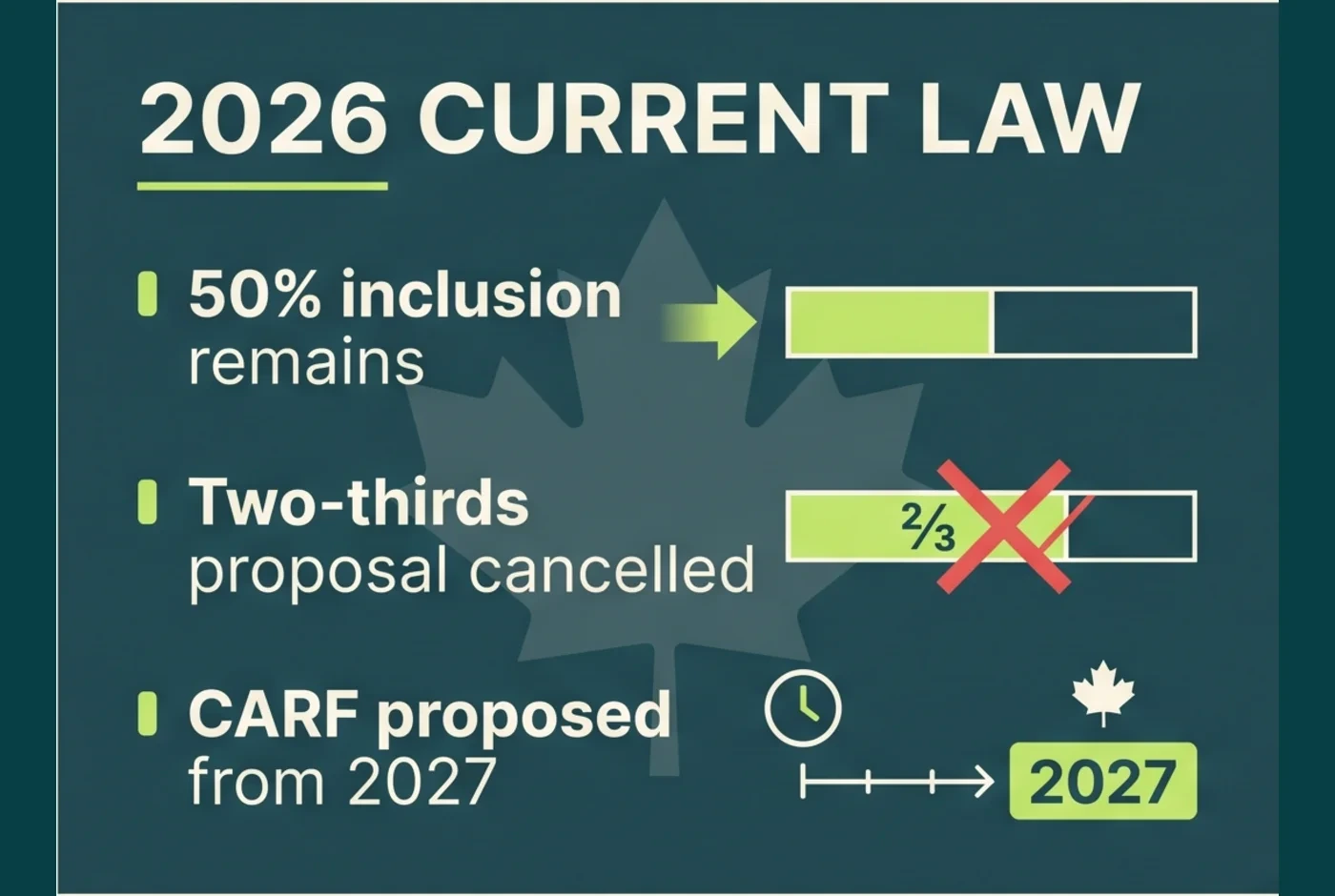
Crypto is not a separate tax category in Canada. A transaction can produce business income, property income, or a capital gain or loss. The current capital-gains inclusion rate remains 50%, and the proposed two-thirds increase was cancelled. Sales, swaps, spending, gifts, mining, and rewards may matter even when nothing reaches a bank account. Correct reporting starts with complete records valued in Canadian dollars and a classification that fits the facts.
Last reviewed July 25, 2026. Critical rules checked against current CRA and Department of Finance sources.
Canada crypto tax at a glance
How does the CRA tax crypto in Canada in 2026?
The short answer for investors
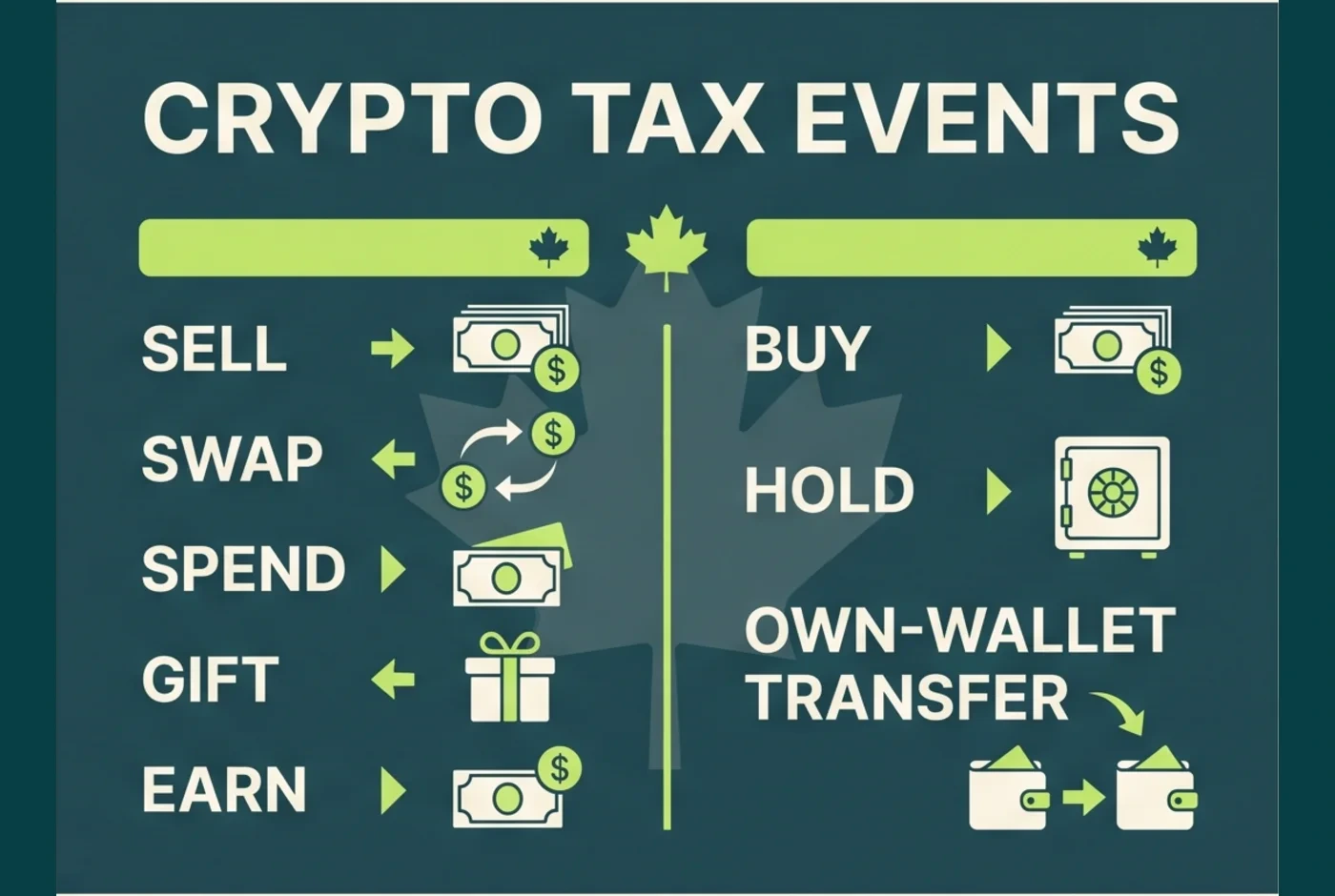
An investor normally starts on capital account. Buying crypto does not create a gain by itself, and neither does simply holding it. A gain or loss is measured when there is a disposition, such as a sale for Canadian dollars, a token swap, a purchase made with crypto, or a gift to another person. The calculation uses the proceeds of disposition, the adjusted cost base of the property disposed of, and eligible selling outlays.
Under the current federal rule, one-half of a net capital gain is the taxable capital gain included in income. That 50% figure is an inclusion rate, not the tax rate applied to your return. The final tax depends on the taxpayer's province or territory, other income, available losses, deductions, and credits. Capital losses generally offset taxable capital gains rather than ordinary employment income.
The short answer for active traders and businesses
Active crypto activity can instead be business income. CRA looks at the whole pattern, including frequency, short holding periods, knowledge of the market, time spent researching and operating the activity, and debt financing. If the activity is a business, the full net profit is included in income and the accounting moves to business revenue, inventory, and expense concepts.
There is no verified transaction-count or holding-period safe harbour in the official sources reviewed for this guide. A person with 500 trades is not classified by a single number, and a person with one trade is not guaranteed capital treatment. CRA also recognizes an adventure or concern in the nature of trade, which means an isolated transaction can produce business income when the facts show a resale-profit operation.
What changed for 2026, and what did not
The proposed increase that would have applied a two-thirds inclusion rate to some individual capital gains did not become the current rule. Budget 2025 said the government would not proceed with the increase. The current CRA capital-gains guide still describes the taxable capital gain as one-half of the capital gain. Older articles that call the proposal merely delayed are now stale.
Canada's proposed Crypto-Asset Reporting Framework schedule also changed. The 2026 Spring Economic Update deferred the proposed application date to January 1, 2027. Department of Finance explanatory notes describe provider returns as due before May 2 of the following year, which would place the first proposed return before May 2, 2028. The Department of Finance explanatory notes remain subject to enactment and implementation.
The 2025 Schedule 3 contains a dedicated crypto-assets line. Final 2026 forms and line numbers were not available in the official material reviewed on July 25, 2026, so they need to be checked before anyone files a 2026 return. The tax rule and the box used to report it are related, but they are not the same thing.
Which crypto transactions are taxable?
Selling crypto for Canadian dollars
A sale is a disposition. On capital account, the gain is generally the Canadian-dollar proceeds minus the allocated ACB and selling outlays. On business account, the sale belongs in the business computation. The amount later transferred from the exchange to a bank does not replace the transaction-date calculation.
Trading one crypto-asset for another
A crypto-to-crypto trade can be a disposition even though no Canadian dollars move. The asset given up needs Canadian-dollar proceeds, and the property received needs a Canadian-dollar cost. Keep the price source, timestamp, time zone, units, and fees so the two sides can be reproduced later.
Spending crypto on goods or services
Spending crypto is another form of disposition because property leaves the owner in exchange for value. The fair market value of what was bought can help establish proceeds. A payment processor or card can hide the disposal inside a consumer purchase, which is why source-level transaction records matter.
Giving crypto to another person
A gift can still require a disposition calculation. The exact tax result can depend on the recipient and related-party rules, so the transfer should not be dropped from the ledger merely because no cash was received. Keep the wallet addresses, value, date, relationship, and any supporting agreement.
Receiving mining, staking, employment, or business payments
Crypto received for work or business activity can be income. CRA says most mining activities are businesses because they involve significant resources and activity, although classification remains fact-dependent. Rewards from centralized-exchange staking are generally income when credited to the wallet. The amount included in income generally becomes relevant to the cost of those units for a later disposition.
Moving crypto between your own wallets
Moving crypto between wallets with the same beneficial owner is not a disposition by itself. The difficult part is proving that both addresses belong to the same person and matching the outgoing amount, incoming amount, timing, network fee, and any bridge or wrapper mechanics. If one side is missing, software may record a false sale or create unsupported cost.
| Transaction | Possible tax event | Likely value needed | Record to keep | Detailed guide |
|---|---|---|---|---|
| Sell for CAD | Capital disposition or business revenue | CAD proceeds on sale | Trade confirmation and fee | Calculator |
| Swap tokens | Disposition of asset given up | CAD value of both sides | Timestamp, source, units, fee | Calculator |
| Spend crypto | Disposition for value received | CAD value of purchase | Invoice and payment record | Guide |
| Give crypto | Possible disposition at market value | CAD market value | Recipient, relationship, and hash | Guide |
| Receive a reward | Possible income, then later disposition | CAD value when credited | Reward statement and wallet record | DeFi guide |
| Move between own wallets | No disposition by itself | Fee and any converted asset | Both addresses and transaction hash | Accountant guide |
Is your crypto a capital gain or business income?
Why classification changes the amount included in income
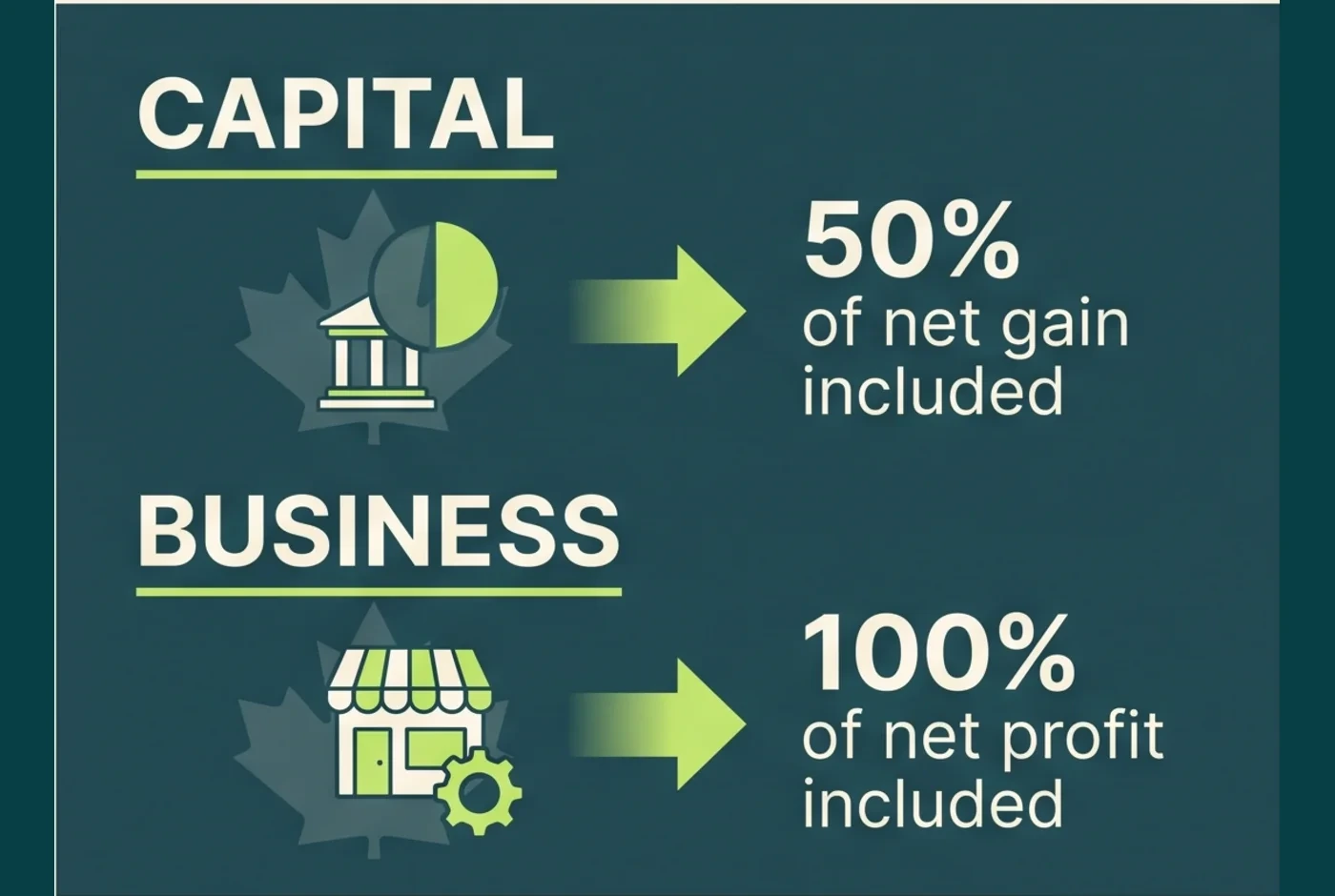
Classification changes the tax base before provincial rates or credits are considered. A CAD 60,000 capital gain currently creates a CAD 30,000 taxable capital gain. A CAD 60,000 net business profit places the full CAD 60,000 in business income. Business treatment may also bring inventory, cost-of-sales, and expense questions that do not belong in a capital ACB schedule.
The five CRA factors
CRA points to frequency of transactions, short periods of ownership, knowledge or experience in the market, substantial time spent studying markets and investigating purchases, and debt financing. These are evidence categories, not a scorecard. A strong business pattern across several factors can outweigh the taxpayer's preferred label, while a long-term investment record may support capital treatment despite occasional active periods.
Why there is no day-trading safe harbour
The official CRA material reviewed for this cluster did not provide a number of trades, dollar value, or holding period that guarantees either result. Rules of thumb such as "under 100 trades is capital" or "anything held for 30 days is investing" should not be published as law. A defensible file shows what the taxpayer intended, what they did, how they financed it, and how consistently the position was reported.
Why one transaction can still be an adventure in the nature of trade
A single acquisition made as part of a resale-profit plan can be an adventure or concern in the nature of trade. That prevents a taxpayer from assuming an isolated trade is automatically capital. The full classification framework, evidence prompts, and worked inclusion comparison are in our capital gains vs business income for crypto guide.
How to calculate a Canadian crypto capital gain
The proceeds minus ACB minus selling-expenses formula
The capital-gain formula is proceeds of disposition minus adjusted cost base minus selling outlays and expenses. Each part must be in Canadian dollars. An exchange total expressed in US dollars or a token quote is not ready for a Canadian calculation until the amount has been converted using a defensible transaction-date rate.
Why Canada uses pooled adjusted cost base
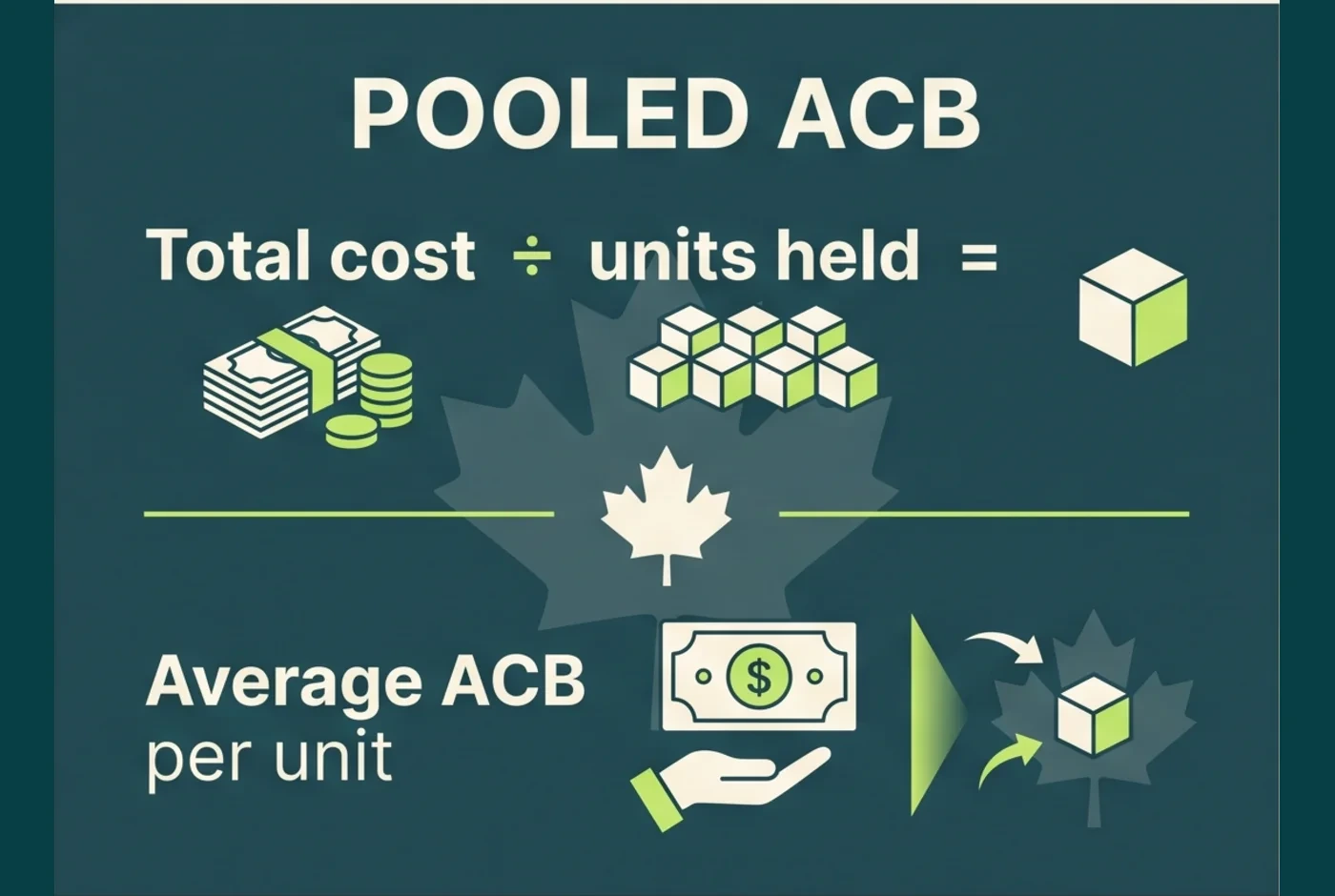
Identical property is generally averaged. When a new acquisition enters the pool, its cost is added to the existing total cost and the combined amount is divided by all units held. A disposal takes a proportional share of that pool. Wallet location does not create a new ACB pool when the beneficial owner and property are the same.
Acquisition fees, selling fees, and CAD conversion
Acquisition expenses such as commissions generally increase cost. Selling outlays are generally subtracted in the gain formula. Fees must be mapped to the transaction that incurred them and should not be counted on both sides. Protocol gas is more fact-sensitive because the payment may dispose of a fee token and the underlying transaction may create a different property right.
Crypto-to-crypto trades
A swap needs two records: the disposition of the asset given up and the acquisition of the asset received. The Canadian-dollar fair market value is central to both sides. Thin liquidity, slippage, bundled fees, and inconsistent exchange clocks can produce mismatched results, so keep the source and timestamp with the calculation.
This example calculates the federal inclusion amount, not a final tax bill. For a complete ledger, swap example, fee treatment, and superficial-loss timeline, see how to calculate Canadian crypto gains using adjusted cost base.
How the superficial loss rule can defer a crypto loss
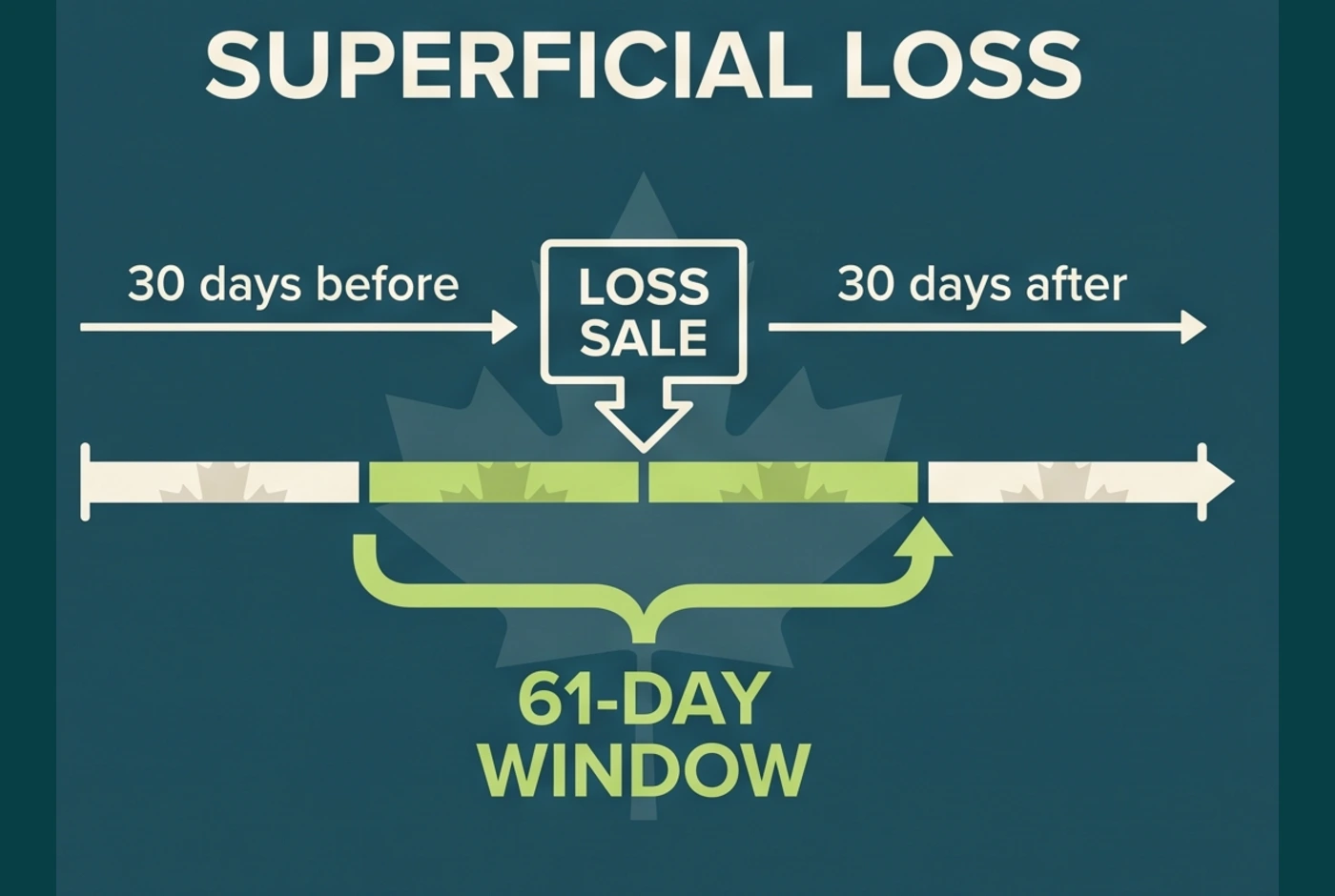
The 61-day window
The superficial-loss test spans the period that begins 30 days before a disposition and ends 30 days after it. Calling this only a "30-day rule" misses half the window and can lead someone to look at the wrong set of acquisitions.
The acquisition and continued-ownership conditions
Timing alone is not enough. The taxpayer or an affiliated person must acquire the same or identical property in the window, and the taxpayer or an affiliated person must still own or have the right to acquire it 30 days after the disposition. Both the acquisition condition and the continued-ownership condition matter.
How a denied loss can affect the replacement property's ACB
A superficial loss is generally denied when the rule applies and added to the ACB of the substituted property. This defers the loss rather than necessarily erasing it forever. Partial quantities, several accounts, and affiliated-person transactions can make the allocation more involved than a one-line adjustment.
Same and identical property questions
The rule uses the language "same or identical property." A like-named wrapped token, staked receipt token, or bridged representation should not be assumed identical without considering the legal and economic rights involved. Where the answer affects a material loss, preserve the protocol documentation and refer the conclusion to the Canadian tax professional.
How mining, staking, and DeFi are taxed
Mining as a business activity
CRA says most mining activities are businesses because of the resources and activity involved, while still treating classification as fact-dependent. Where mining is a business, the Canadian-dollar value of the crypto received is included in business income when earned. Equipment, electricity, inventory, and other consequences require a business-level review rather than a blanket deduction list.
Centralized-exchange staking rewards
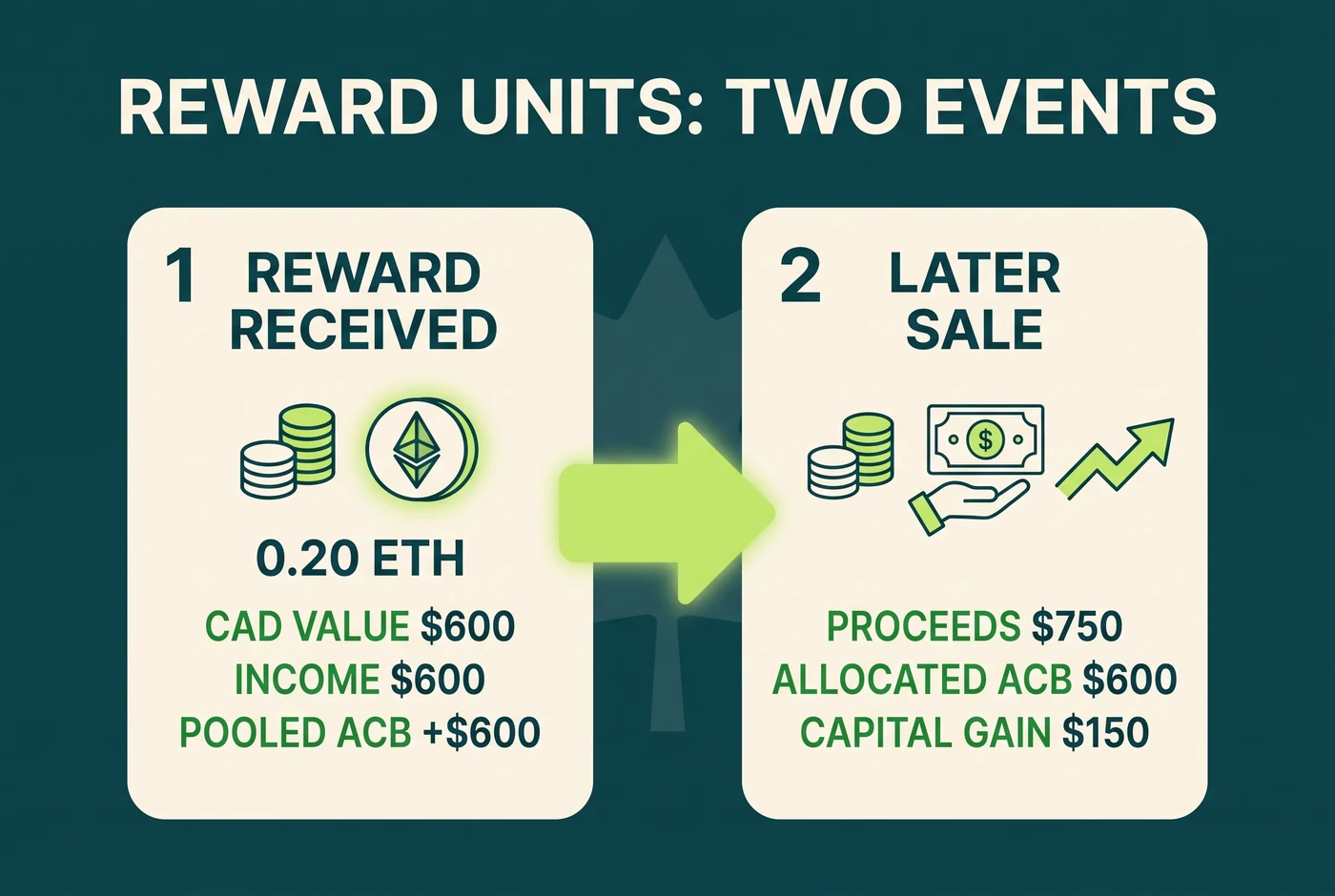
CRA says rewards from centralized crypto-exchange staking are generally income when credited to the wallet. If 0.5 ETH is credited when one ETH is worth CAD 2,000, the initial income amount is generally CAD 1,000. That valuation should be attached to the reward record.
Later dispositions of reward units
The amount included as income generally becomes relevant to the cost of the reward units. If those same 0.5 ETH are later sold for CAD 1,300, a separate CAD 300 gain may arise, subject to classification and pooled ACB facts. Recording only the reward income or only the later sale creates an incomplete tax history.
DeFi treatment that CRA has not specifically resolved
The reviewed CRA sources do not provide one generally applicable rule for every liquidity-pool deposit, wrapper, decentralized loan, collateral liquidation, receipt token, or restaking arrangement. The analysis should ask whether beneficial ownership changed, whether a materially different property or legal right was created, what the event was worth in CAD, and what documentation supports the position.
That conditional approach is explained transaction by transaction in the Canada DeFi and staking tax guide. It separates what CRA has clearly said about centralized staking and mining from protocol treatment that remains fact-specific.
Can crypto be tax-free in Canada?
Buying and holding
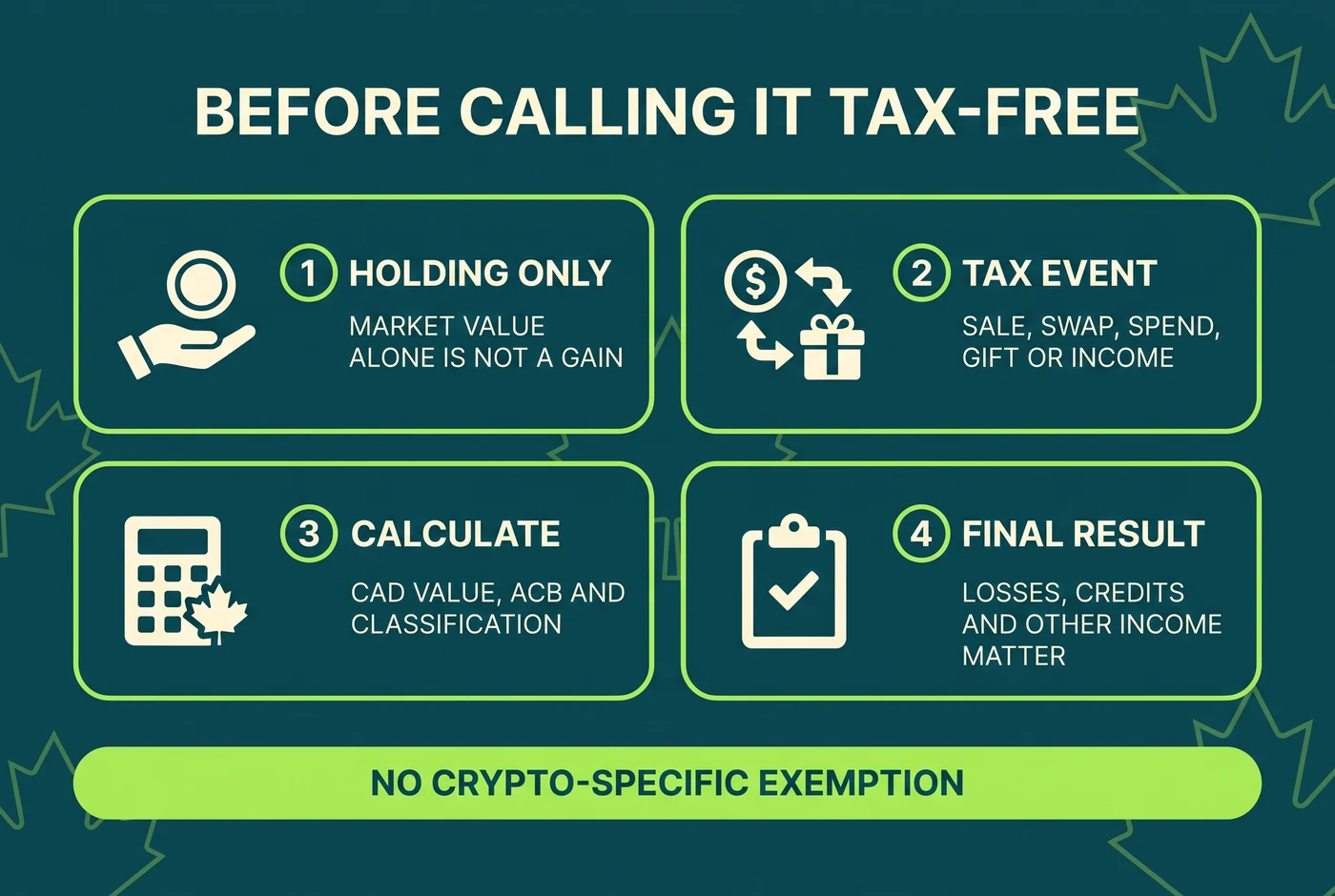
Merely buying and holding crypto, without a disposition or income receipt, generally does not create a capital gain at that time. Calling the asset "tax-free" is still misleading because a later sale, swap, spend, gift, or reward can create a reportable amount.
Losses, deductions, credits, and no final balance owing
A taxpayer can have a reportable transaction but no incremental tax payable after valid losses, deductions, and credits are applied to the whole return. Reporting and payment are separate questions. A capital loss is generally applied against taxable capital gains, not ordinary employment income.
Why the basic personal amount is not a crypto exemption
The federal basic personal amount is a non-refundable credit, not a crypto allowance or reporting floor. For 2026, the maximum federal amount is CAD 16,452 and the minimum is CAD 14,829, with the amount phased down based on net income. Those figures do not make crypto below that amount invisible.
Why there is no USD 600 or CAD 10,000 crypto-tax floor
No crypto-specific USD 600 or CAD 10,000 taxpayer exemption was found in the CRA sources reviewed. FINTRAC's CAD 10,000 large virtual-currency transaction rule is an anti-money-laundering duty for reporting entities, not a tax-free amount for an investor. Read the focused guide on when crypto can result in no tax payable for the holding, withdrawal, loss, and credit scenarios.
Does the CRA know about your crypto?
Exchange, KYC, banking, and blockchain records
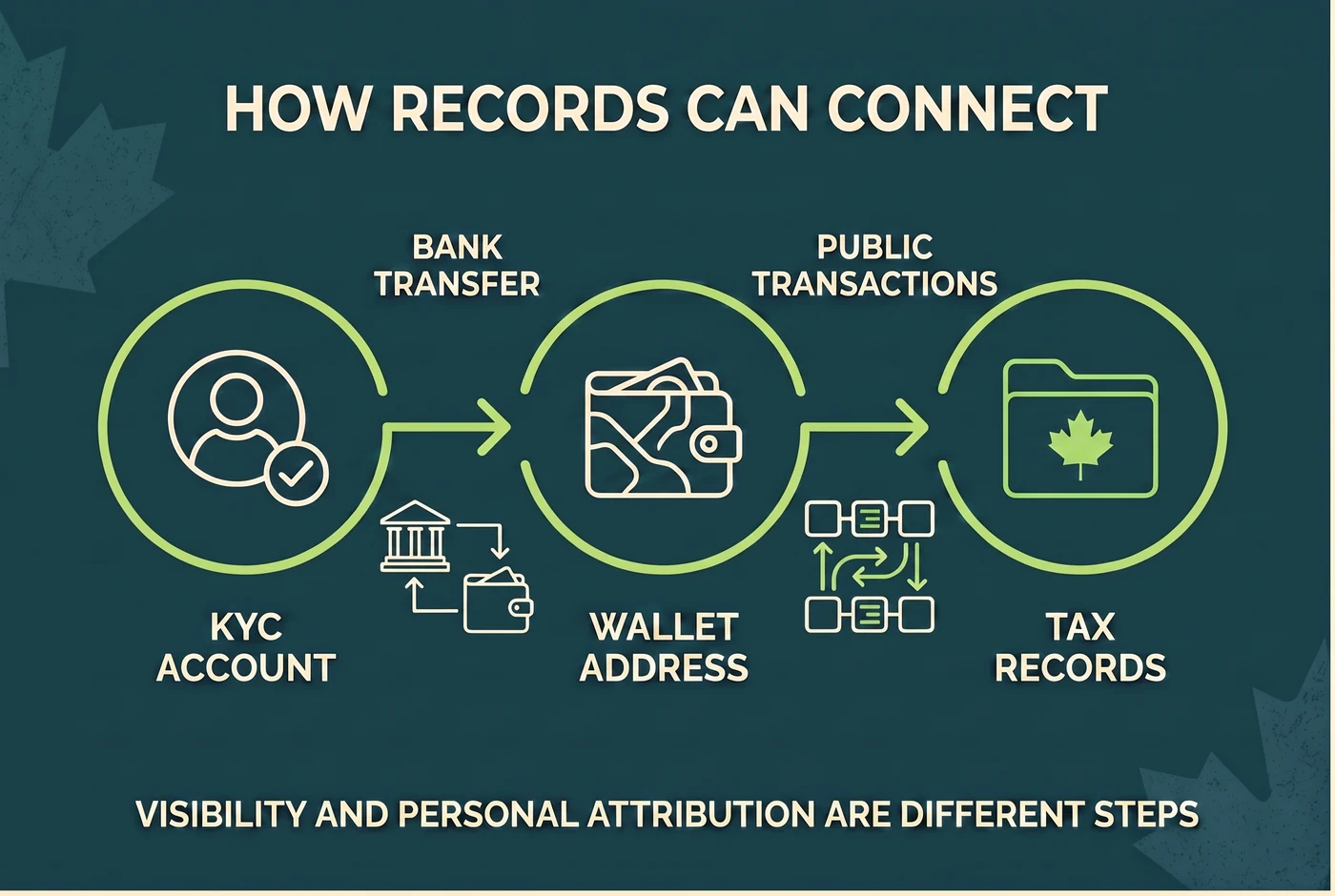
Exchanges can hold identity, account, trade, deposit, withdrawal, and wallet information. Banking records can show fiat flows, while public blockchains expose transaction paths. These sources can be connected, but public transaction visibility is not the same as automatic attribution of every wallet to a named person.
What the Coinsquare court order established
On March 19, 2021, the Federal Court authorized a CRA requirement to Coinsquare in docket T-1114-20. The order covered specified customer cohorts and required records that included KYC information, deposits, withdrawals, fiat and crypto transfers, wallet addresses, and trading details. It proves that CRA can use lawful processes to compel detailed exchange records. It does not prove every platform automatically sends every transaction.
Canada's proposed CARF timeline
Canada's current official proposal applies CARF from January 1, 2027, with a provider information return due before May 2 of the following year. On that proposal, the first return would be due before May 2, 2028. The legislation and implementation should be rechecked before publication or filing because the proposal is not a completed reporting event.
Voluntary disclosure of omitted activity
CRA's revised Voluntary Disclosures Program took effect October 1, 2025. Applications are assessed case by case and generally need to be made before an audit or investigation begins, be complete, involve potential penalties or interest, cover sufficiently overdue information, and include estimated payment or a payment arrangement request. Relief is not guaranteed. See how the CRA can obtain crypto data for the current program framework and audit-record checklist.
Do Canadian crypto holders need Form T1135?
The CAD 100,000 aggregate cost threshold
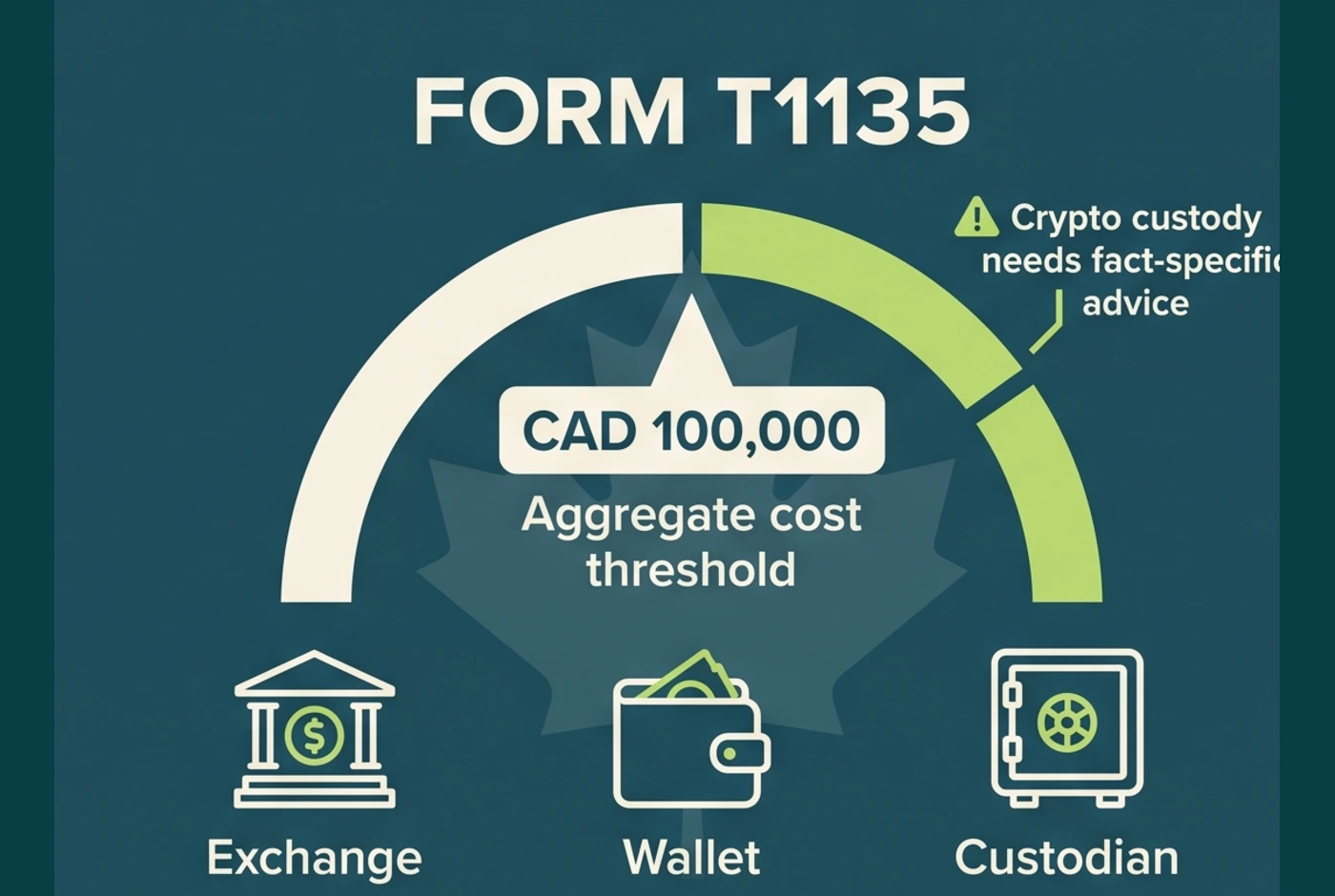
Form T1135 is generally required when a Canadian resident owns specified foreign property with a total cost amount above CAD 100,000 at any point in the year. The threshold is based on aggregate cost amount, not fair market value and not CAD 100,000 per asset.
Simplified and detailed reporting thresholds
Simplified Part A reporting may be available when the total cost is above CAD 100,000 but remains below CAD 250,000 throughout the year. Detailed Part B reporting generally applies if the total reaches CAD 250,000 or more. This is separate from the income or gain calculation.
Why crypto situs and custody need fact-specific advice
The official T1135 material reviewed for this guide did not categorically resolve every crypto custody structure. A foreign exchange, foreign custodian, self-hosted wallet, and decentralized protocol should not all be labelled reportable or non-reportable by default. Property location and the rights held need fact-specific advice from the client's Canadian tax professional.
What records does the CRA expect?
Transaction, wallet, and exchange data
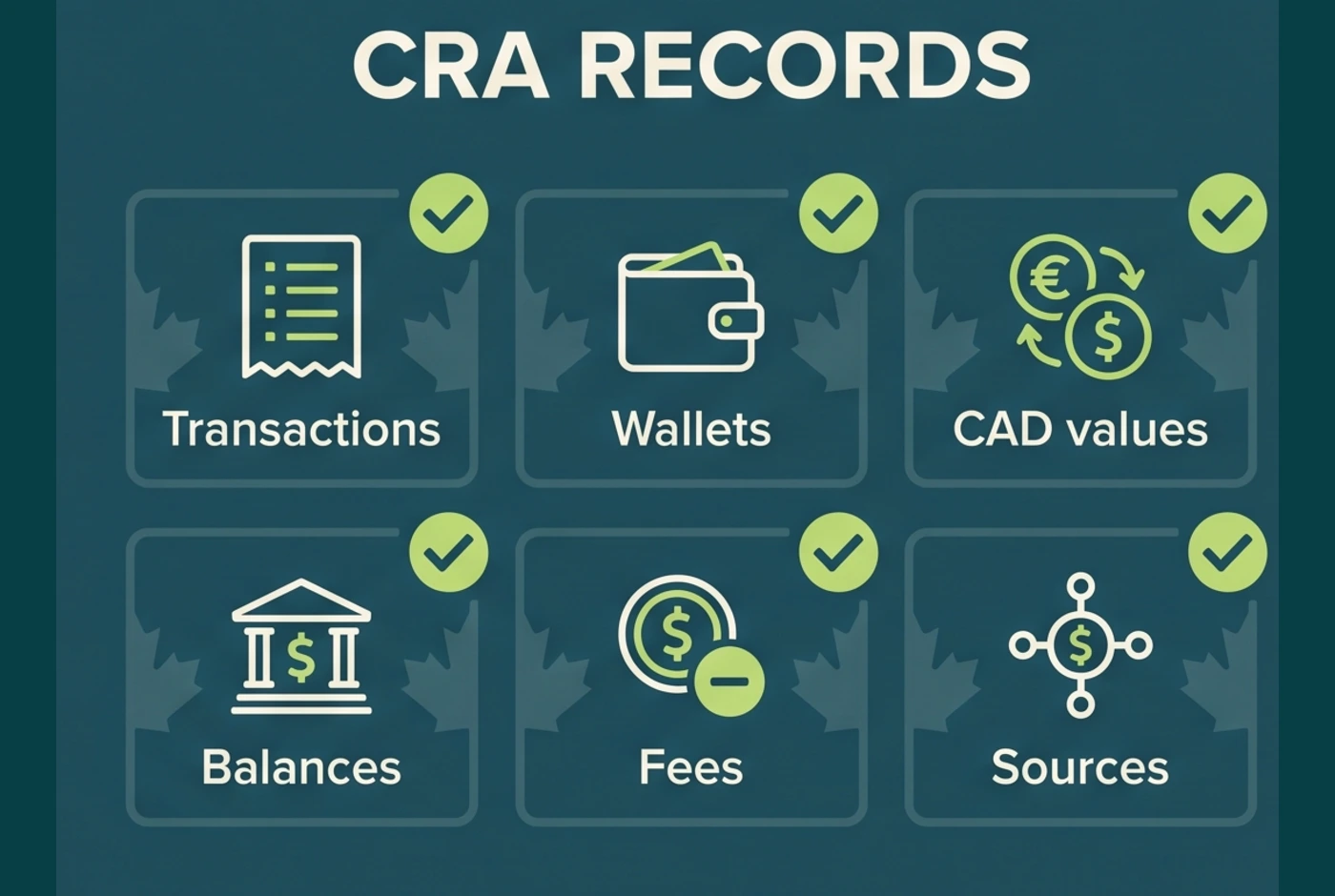
CRA asks crypto users to keep the units and type of asset, transaction date and time, Canadian-dollar value, nature of the transaction, counterparty details where relevant, wallet addresses, beginning and ending balances, and costs. Exchange statements, receipts, protocol exports, and raw CSV files should stay with the workpapers. The full list appears in CRA's books and records guidance for crypto-assets.
Canadian-dollar values and exchange-rate sources
A price without a source or time cannot be reproduced. Keep the market or exchange used, timestamp, time zone, quote currency, conversion rate, and any liquidity adjustment. This is especially important for token-to-token trades, low-liquidity rewards, and transactions that appear differently across data sources.
Beginning and ending balances
Balances are an accounting control. If opening holdings plus acquisitions minus dispositions do not equal closing holdings, something is missing, duplicated, or misclassified. A year-end balance check can expose unmatched transfers and unsupported negative balances before they flow into ACB.
Why transfers, duplicates, missing basis, and protocol events need reconciliation
A same-owner transfer often appears as a withdrawal in one source and a deposit in another. If those legs are not matched, software can create a false disposal and a new acquisition. Duplicate imports can double income. Missing exchange history can leave the ACB unsupported. Protocol events may bundle several economic steps into one transaction hash. Reconciliation resolves these data problems before the tax position is finalized.
Six-year record-retention rule
CRA generally requires supporting crypto records to be kept for at least six years. Retaining only a final PDF tax summary is weak evidence because it does not preserve source data, transformation steps, pricing, or unresolved assumptions.
Where crypto appears on a Canadian return
Capital transactions and Schedule 3
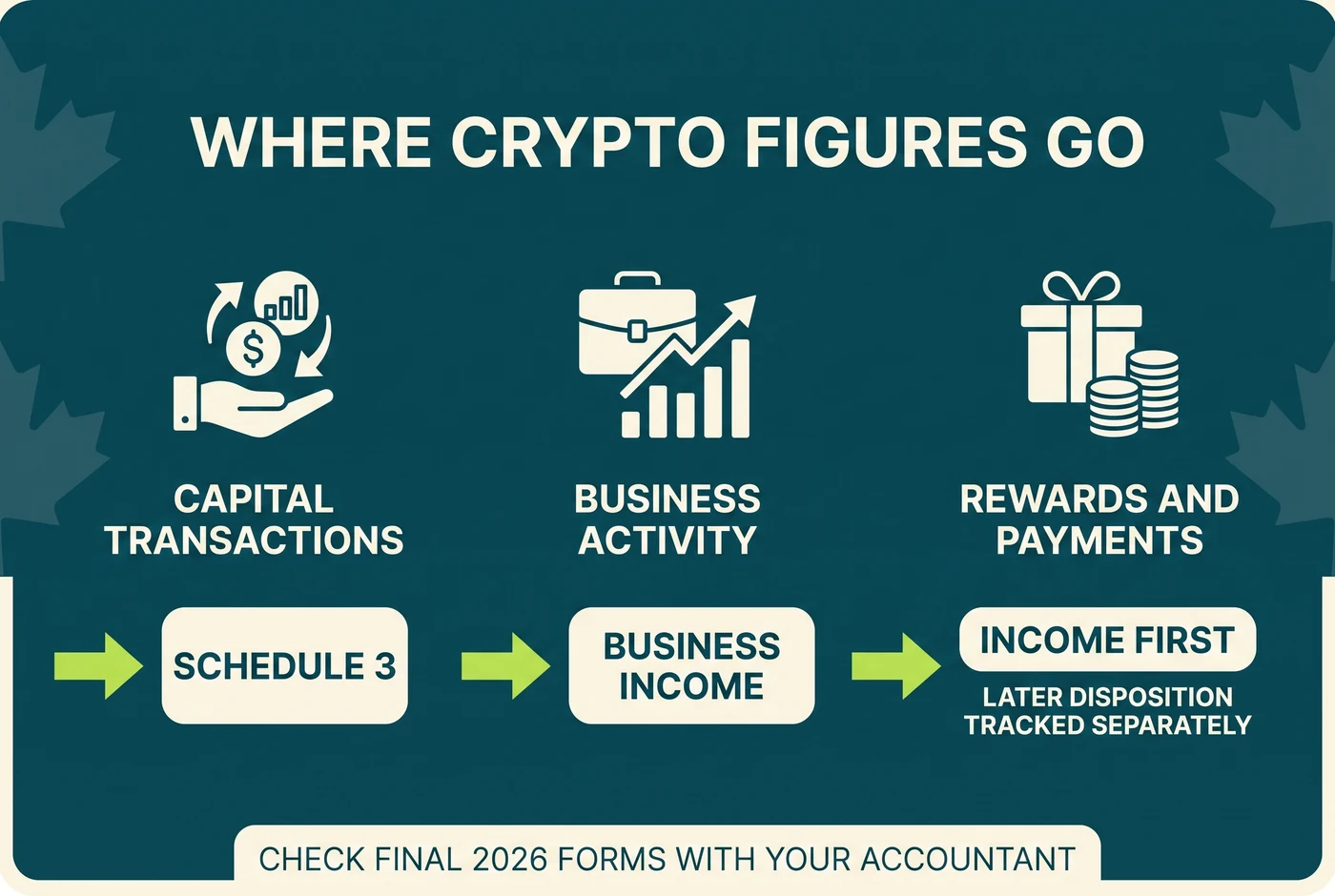
The latest official 2025 Schedule 3 reviewed for this guide has a dedicated line 7 for crypto-assets, with total proceeds at line 15200 and total gain or loss at line 15301. Those 2025 line numbers are useful orientation, not permission to assume the final 2026 form will be identical.
Business income
Business-classified crypto belongs in the business computation, where revenue, inventory or cost of sales, and allowable expenses can apply. The exact return placement depends on the taxpayer and business structure, which is work for the Canadian tax professional after the crypto records are reconciled.
Income and later disposition of reward units
Reward units can create two separate layers. The initial Canadian-dollar value may be income, and a later sale or swap may create a gain or loss measured from the relevant cost. A complete ledger links those records so the same value is not counted twice or omitted.
Why final 2026 forms must be checked before filing
Forms, line numbers, and administrative instructions can change after a guide is written. The client's Canadian tax professional should check the final 2026 package and decide where the reconciled figures belong. Count On Sheep does not prepare, submit, sign, or file the Canadian return.
From raw crypto data to CRA-ready figures
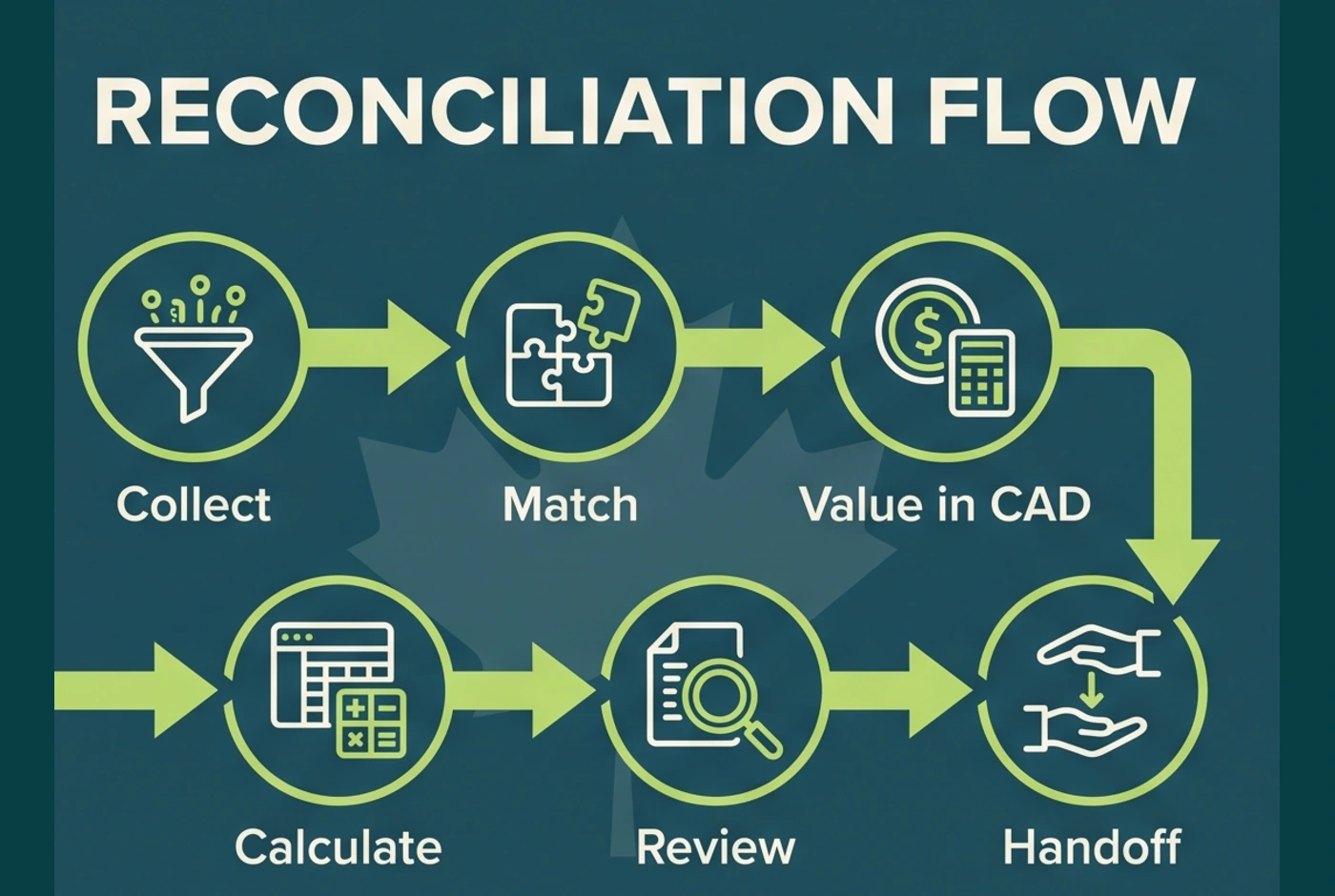
Gather exchange, wallet, and protocol histories
Start with a complete source map that includes accounts that no longer exist. List exchanges, wallets, chains, bridges, staking accounts, NFT marketplaces, protocols, fiat banks, and prior-year reports. Closed platforms and old addresses can carry ACB that affects later years.
Normalize transactions and match same-owner transfers
Each source uses different names, time zones, units, and status codes. Normalization puts them into one ledger. Transfer matching then links withdrawals to deposits and records fees without converting ordinary wallet movements into sales.
Value events in CAD and calculate ACB
Every relevant event receives a Canadian-dollar value tied to a reproducible source. Identical property is rolled through its ACB pool, disposals receive allocated cost, and selling outlays are mapped without double counting.
Flag classification and missing-data exceptions
A good workpaper does not bury uncertainty. It identifies missing history, unsupported values, negative balances, unusual protocol rights, superficial-loss candidates, business-classification questions, and T1135 facts that need a professional decision.
Deliver workpapers to the client's Canadian tax professional
The handoff should include a reconciled transaction ledger, ACB roll-forward by asset, proceeds and gains, income schedules, transfer matching, valuation notes, source archive, and unresolved-items log. For a detailed intake and quality checklist, see CRA-ready crypto reconciliation for your Canadian tax professional.
Get CRA-ready figures for your Canadian tax professional
Count On Sheep reconciles complex digital-asset activity into CRA-ready figures and workpapers for your Canadian tax professional. We do not file Canadian tax returns.
Work with our Canada crypto tax teamCanada crypto tax FAQs
How much tax will I pay on crypto in Canada?
There is no single Canadian crypto tax rate. If the activity is on capital account, the current federal rule includes 50% of the net capital gain in income. If it is a business, the full net business profit is included. Your final tax also depends on your province or territory, other income, losses, deductions, and credits.
Do I have to report crypto under $600 in Canada?
Canada has no crypto-specific $600 reporting floor in the CRA guidance reviewed for this guide. A sale, swap, purchase with crypto, gift, or income receipt can be relevant even when the amount is small. Buying and holding without a disposition or income receipt generally does not create a capital gain at that time.
How much crypto can I withdraw without paying taxes?
A bank withdrawal is not the universal tax trigger. Tax can arise earlier when crypto is sold, swapped, spent, gifted, or received as income. The taxable amount depends on the gain or income, not simply the amount transferred to a bank. There is no Canadian crypto cash-out allowance.
Can the CRA track crypto wallets?
Public blockchains expose transaction data, and exchange, KYC, and banking records can help connect activity to a person. The 2021 Coinsquare court order also shows that CRA can compel detailed exchange records through lawful processes. That does not prove CRA can always identify every self-hosted wallet or that every exchange automatically reports every transaction.
What happens if I do not report crypto?
Unreported crypto activity can lead to reassessments, interest, and penalties. CRA has a Voluntary Disclosures Program, but eligibility and relief are assessed case by case. Anyone correcting prior years should rebuild the records and speak with a Canadian tax professional before an audit or investigation begins.
How can I legally reduce crypto tax in Canada?
Accurate ACB, eligible transaction costs, valid capital losses, and consistent classification can all affect the result. A superficial loss may be denied when the acquisition and continued-ownership conditions are met, so loss planning needs care. Your Canadian tax professional can apply the rules to your full return once the transaction history is reconciled.
More Canada crypto tax guides
Primary sources include the CRA crypto transaction guide, CRA Guide T4037, and the 2026 Department of Finance CARF explanatory notes. This guide is general information, not legal or tax advice.