
Canada has no crypto-specific tax-free allowance, cash-out threshold, or USD 600 reporting floor. Buying and holding alone generally creates no capital gain. A sale, swap, spend, gift, reward, or business receipt may matter even when no money reaches a bank. A transaction can be reportable while losses, deductions, credits, or low total income leave no final tax payable.
Last reviewed July 25, 2026. Critical rules checked against current CRA and Department of Finance sources.
Is any amount of crypto tax-free in Canada?
No crypto-specific exemption
The reviewed CRA guidance does not create a special allowance for the first CAD 100, CAD 600, CAD 10,000, or any other amount of crypto activity. The ordinary income and capital rules apply to the transaction. This is why the useful question is not simply how much crypto you own. It is what happened, how the activity is classified, and what the Canadian-dollar result was.
A small disposition can produce a small gain, no gain, or a loss. A small reward can still be income. Those outcomes may have little or no effect on the final balance, but that is a result of the whole return. It is not a threshold that makes the underlying event disappear.
No tax merely for holding
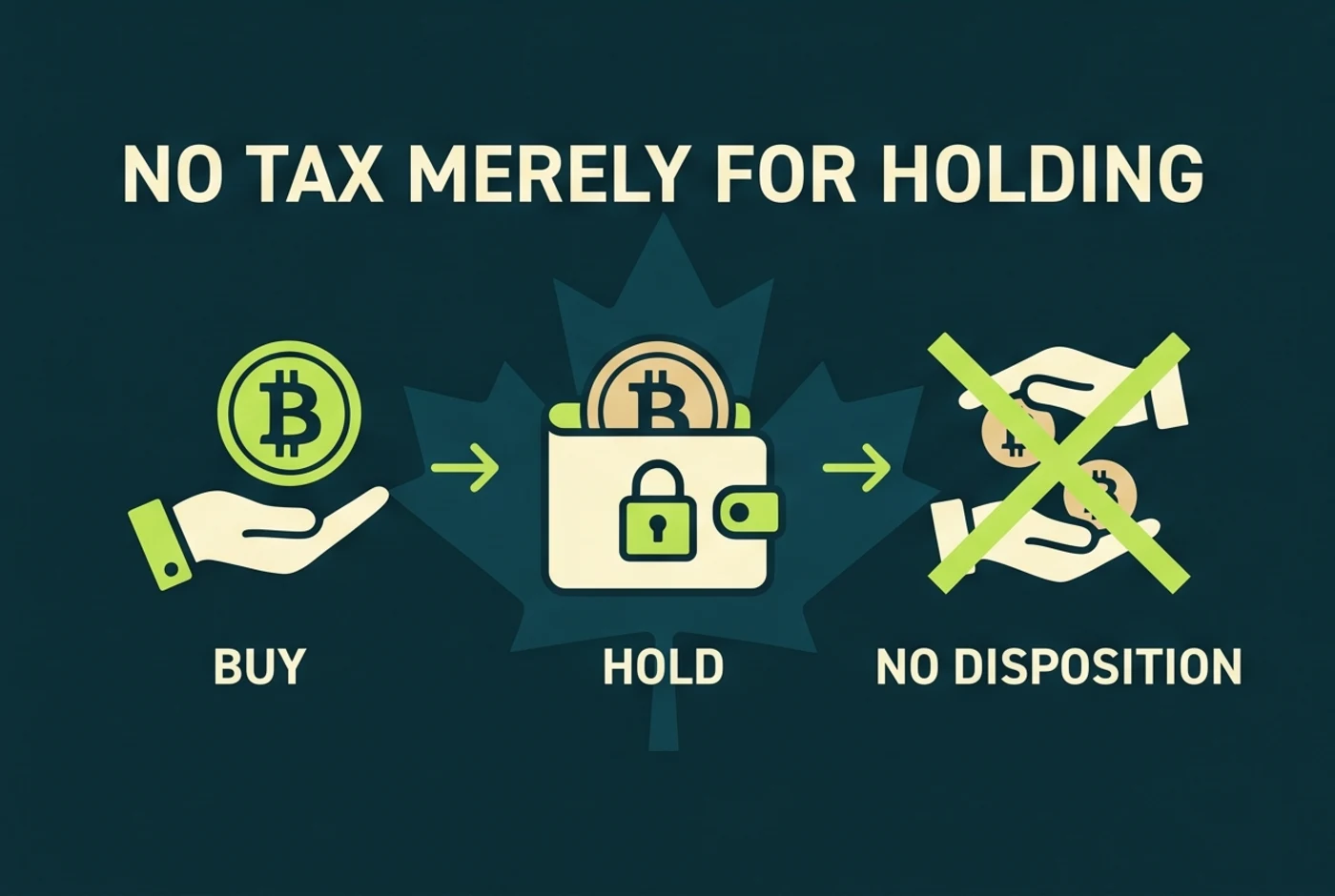
Buying crypto with Canadian dollars and keeping it generally does not create a capital gain at the time of purchase. Price appreciation while the asset remains held is not, by itself, a disposition. The position changes when the owner sells, swaps, spends, or gives the asset away, or receives a new amount as income.
Holding is not the same as having no recordkeeping job. Purchase confirmations, fees, units, date and time, and Canadian-dollar value establish the asset's adjusted cost base. Without those records, a later sale can look far more profitable than it was because the acquisition cost is missing.
Reporting and tax payable are different
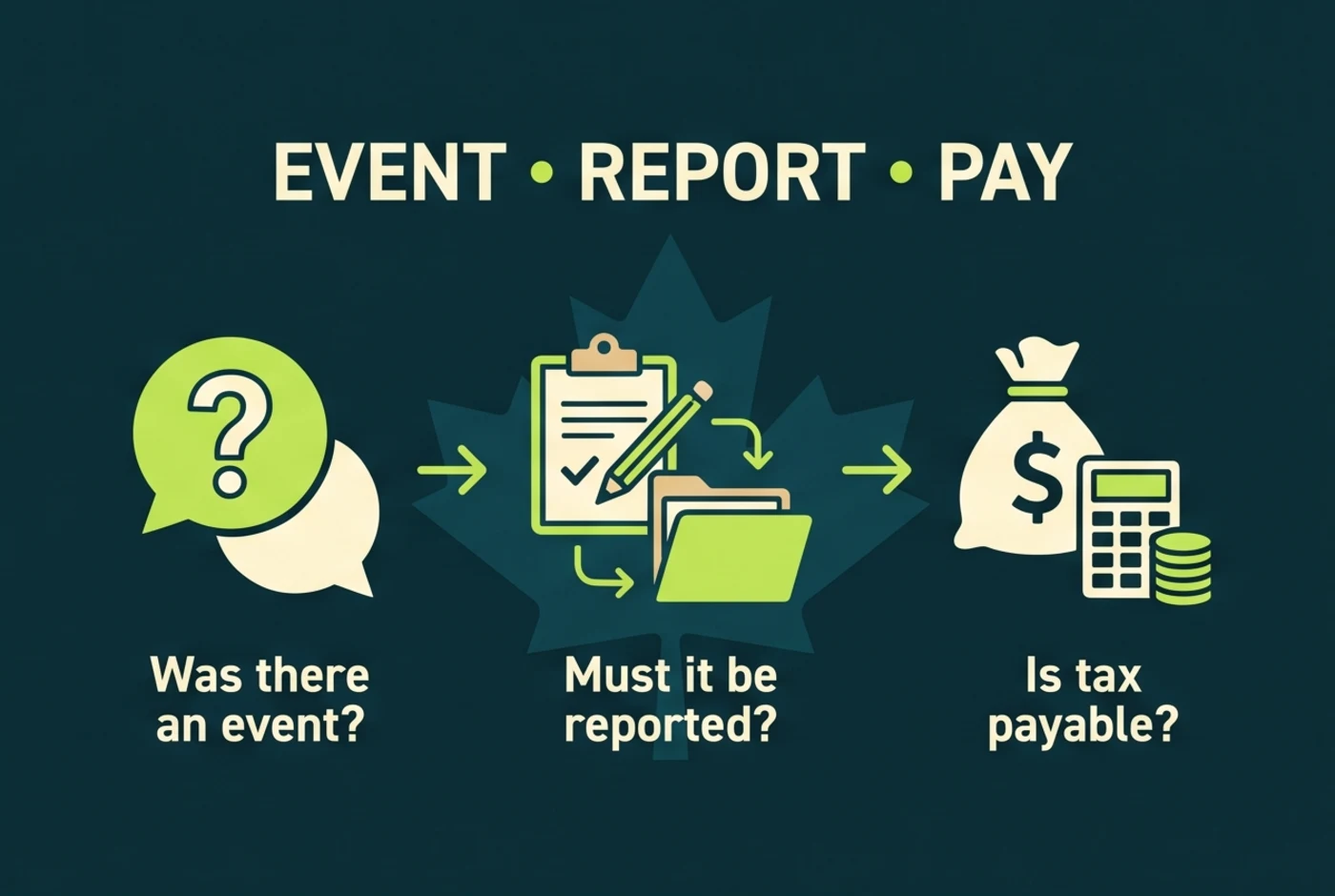
Work through three separate questions. First, was there a disposition or income receipt? Second, does that result belong on the return as a gain, loss, business amount, or other income? Third, after all income, losses, deductions, and credits are included, is there a balance payable? Jumping straight to the third question is where most threshold myths begin.
| Question | Example | Result to investigate |
|---|---|---|
| Was there an event? | Sale, swap, spend, gift, or reward | May require a transaction calculation |
| Must it be reported? | Gain, loss, business income, or property income | Often yes, based on the event and classification |
| Is tax payable? | Full federal and provincial or territorial return | May be zero after all return items |
When can crypto result in no tax payable?
You only bought and held it
A holder who buys CAD 5,000 of BTC and makes no sale, swap, purchase, gift, or income receipt generally has no capital gain merely because BTC rises in value. The unrealized increase still matters for financial planning, but it is not the same as a disposition calculation.
Your transaction created no gain
A disposition can produce proceeds equal to adjusted cost base and selling outlays. In that case, the capital calculation produces no gain. This is not an exemption based on the sale amount. It is an arithmetic result supported by the pooled ACB, fees, and Canadian-dollar proceeds.
Capital losses offset taxable capital gains
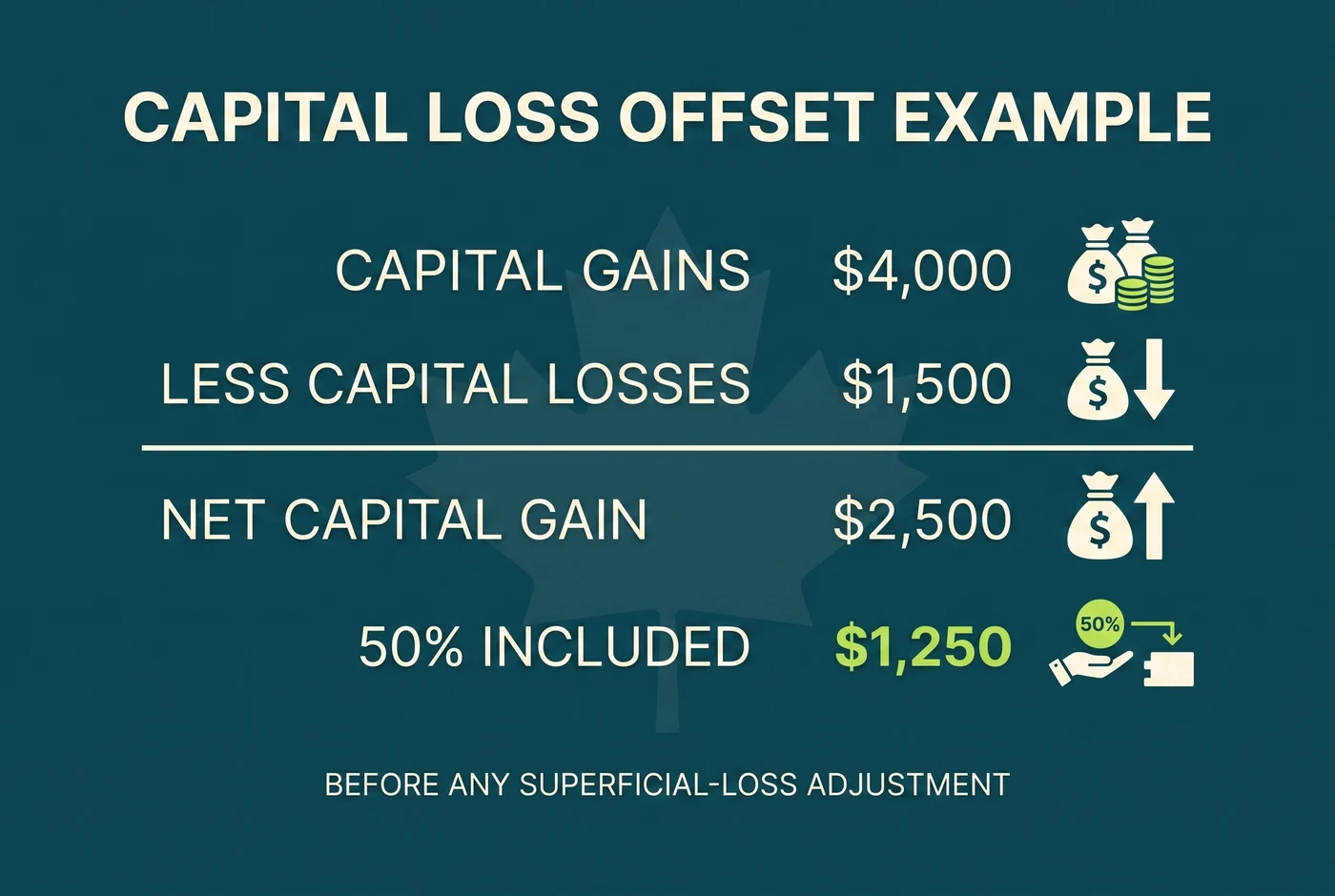
Net capital losses generally apply against taxable capital gains under the rules in CRA Guide T4037. They do not simply reduce salary or other ordinary income. A person with current gains and valid capital losses may therefore have a smaller taxable capital gain, or none after the permitted netting.
Credits and low total income reduce the balance
Non-refundable credits can reduce tax otherwise payable. Low total income can also mean a small crypto inclusion produces no final balance. The result depends on the taxpayer's complete federal and provincial or territorial return, not on crypto viewed in isolation.
You transferred crypto between your own wallets
CRA says moving crypto between wallets owned by the same person is not a disposition by itself. The transfer still needs to be matched so it is not mistaken for a sale. Network fees, wrappers, bridges, and missing receiving records can create additional questions, so "internal transfer" should be documented rather than assumed.
Does the 2026 basic personal amount make crypto tax-free?
Maximum and minimum federal BPA for 2026
The federal basic personal amount for 2026 has a maximum of CAD 16,452 and a minimum of CAD 14,829, with the amount phased down based on net income. The first federal personal income-tax bracket for 2026 is 14%. Those figures come from current Department of Finance and CRA material, but they do not create a crypto reporting floor.
Why a non-refundable credit is not an exemption
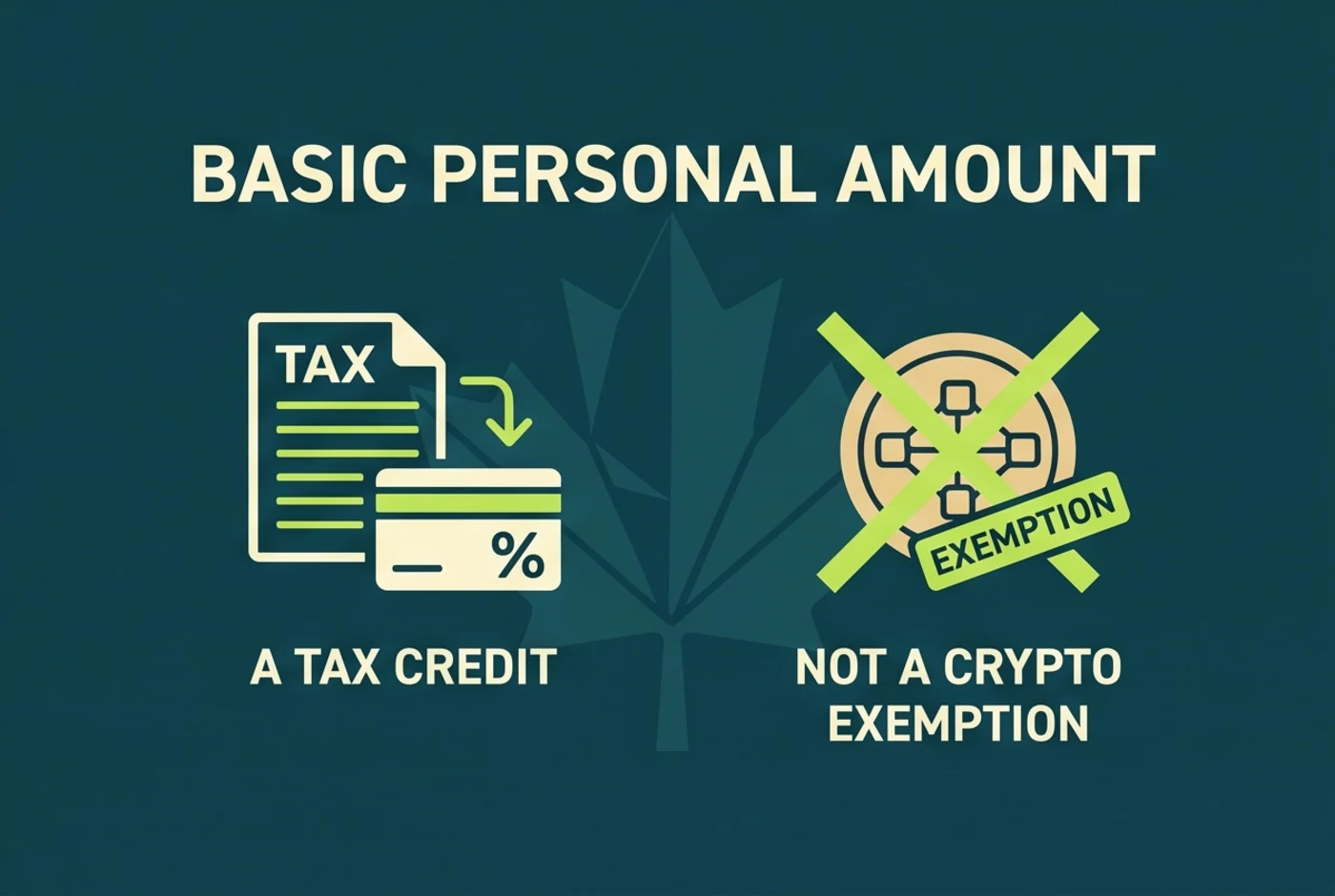
The BPA is a non-refundable tax credit. It is used in the return calculation to reduce federal tax otherwise payable. It does not erase a disposition, change proceeds, create ACB, or turn crypto income into a non-reportable receipt. Calling it a crypto allowance confuses a credit calculation with the tax character of a transaction.
Province or territory and other income still matter
Canadian tax is not calculated from one federal number. Province or territory, employment income, business income, investment income, deductions, losses, and other credits all affect the final result. A person with no other income can have a different balance from an employed person who realizes the same crypto gain.
Why you may still need to report the transaction
Suppose an investor has a CAD 1,000 capital gain. At the current 50% inclusion rate, the taxable capital gain is CAD 500. A low-income taxpayer may ultimately owe no additional tax after the full return is calculated. An employed taxpayer may see the same CAD 500 added to taxable income. In both cases, the disposition needs a defensible calculation.
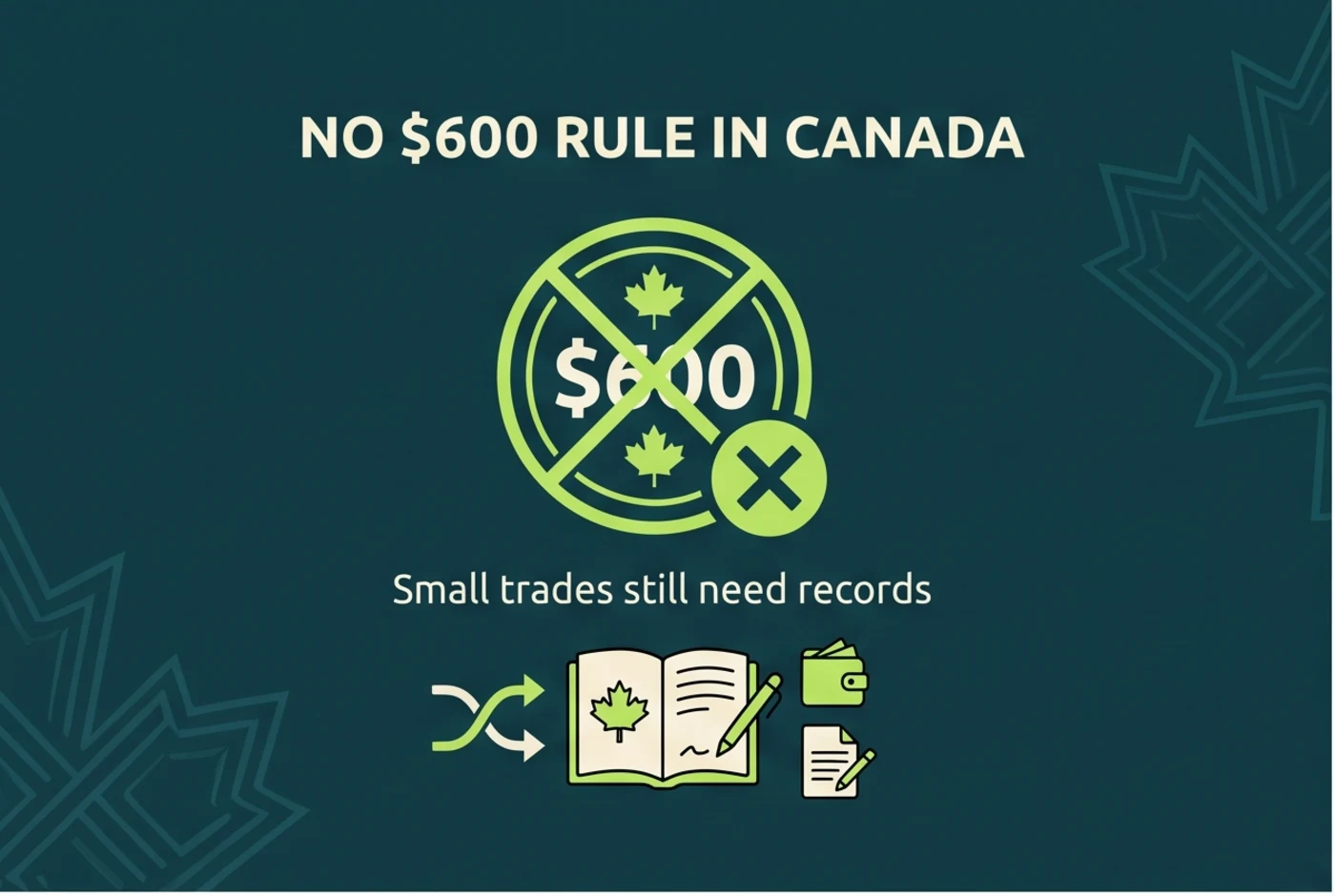
There is no $600 crypto reporting rule in Canada
Why US thresholds do not apply
Search results and social posts often repeat a USD 600 figure drawn from US forms, payment rules, or reporting discussions. Those thresholds do not create a Canadian crypto exemption. Canadian taxpayers should start with CRA rules and Canadian-dollar records rather than importing a US platform's FAQ.
Why small dispositions still need records
Small transactions can accumulate. A series of CAD 25 swaps may change several ACB pools, create proceeds, and establish costs for new assets. Leaving them out can distort a later large sale even if each individual transaction seems immaterial at the time.
Why exchange slips do not define the tax event
Receiving no slip does not prove there was no tax event, and receiving a platform document does not settle classification or cost. A taxpayer's obligation follows the transaction and the applicable Canadian rules. Reconcile the source data rather than using a slip threshold as a substitute for the ledger.
The broader event rules are explained in the Canada Crypto Tax Guide 2026. CRA visibility, exchange records, and reporting processes are covered in our guide to how the CRA can obtain crypto data.
Is CAD 10,000 a crypto-tax threshold?
FINTRAC's large virtual-currency reporting rule
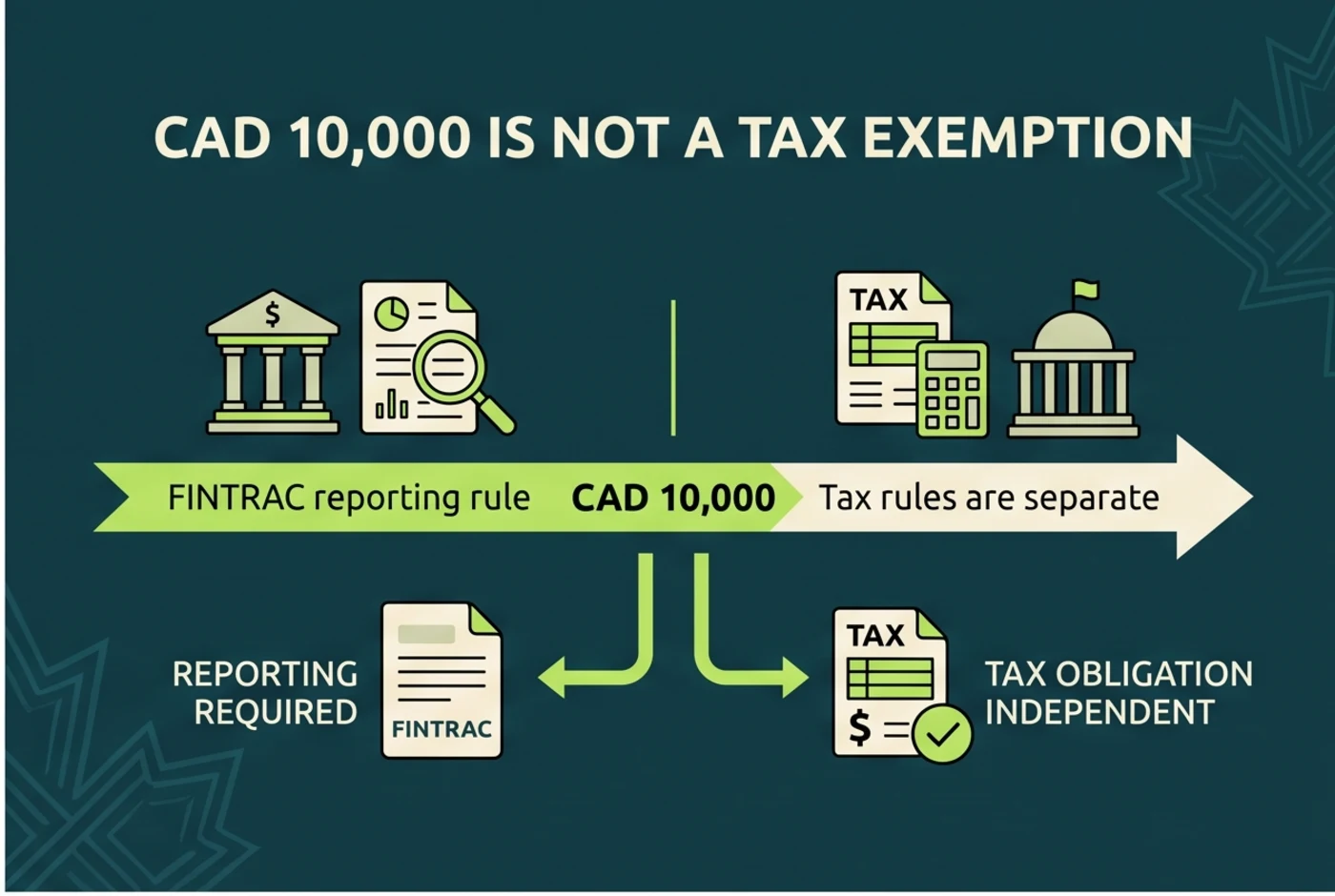
FINTRAC has a large virtual-currency transaction reporting framework for reporting entities. The CAD 10,000 figure belongs to anti-money-laundering compliance, including aggregation rules and reports filed by entities subject to the regime. It is not a general calculation of an individual's income tax.
Why an AML rule for reporting entities is not a taxpayer exemption
A reporting entity's duty to file an AML report and a taxpayer's duty to calculate a gain or income are separate. A transaction below CAD 10,000 can be taxable. A transaction above CAD 10,000 is not automatically taxable in full. Its tax result still depends on the event, proceeds, cost, fees, and classification.
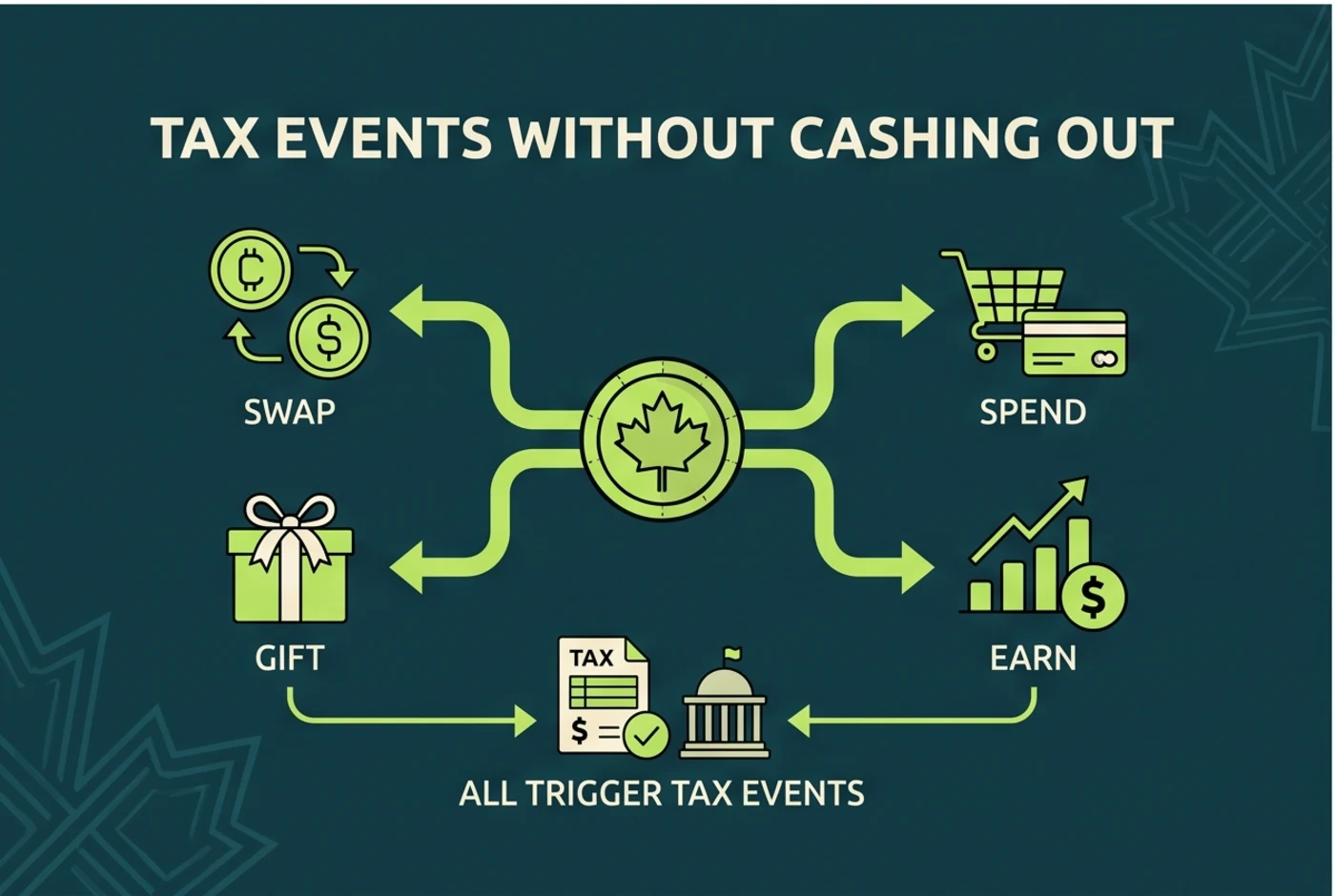
Why cashing out is not the only taxable event
A person can dispose of crypto through a token swap or a purchase without ever touching a Canadian bank. Conversely, a bank withdrawal might move fiat that came from an earlier sale whose tax result was already determined. The amount crossing the bank is useful reconciliation evidence, but it does not define the legal event.
Which events can create tax without cashing out?
Swapping BTC for ETH
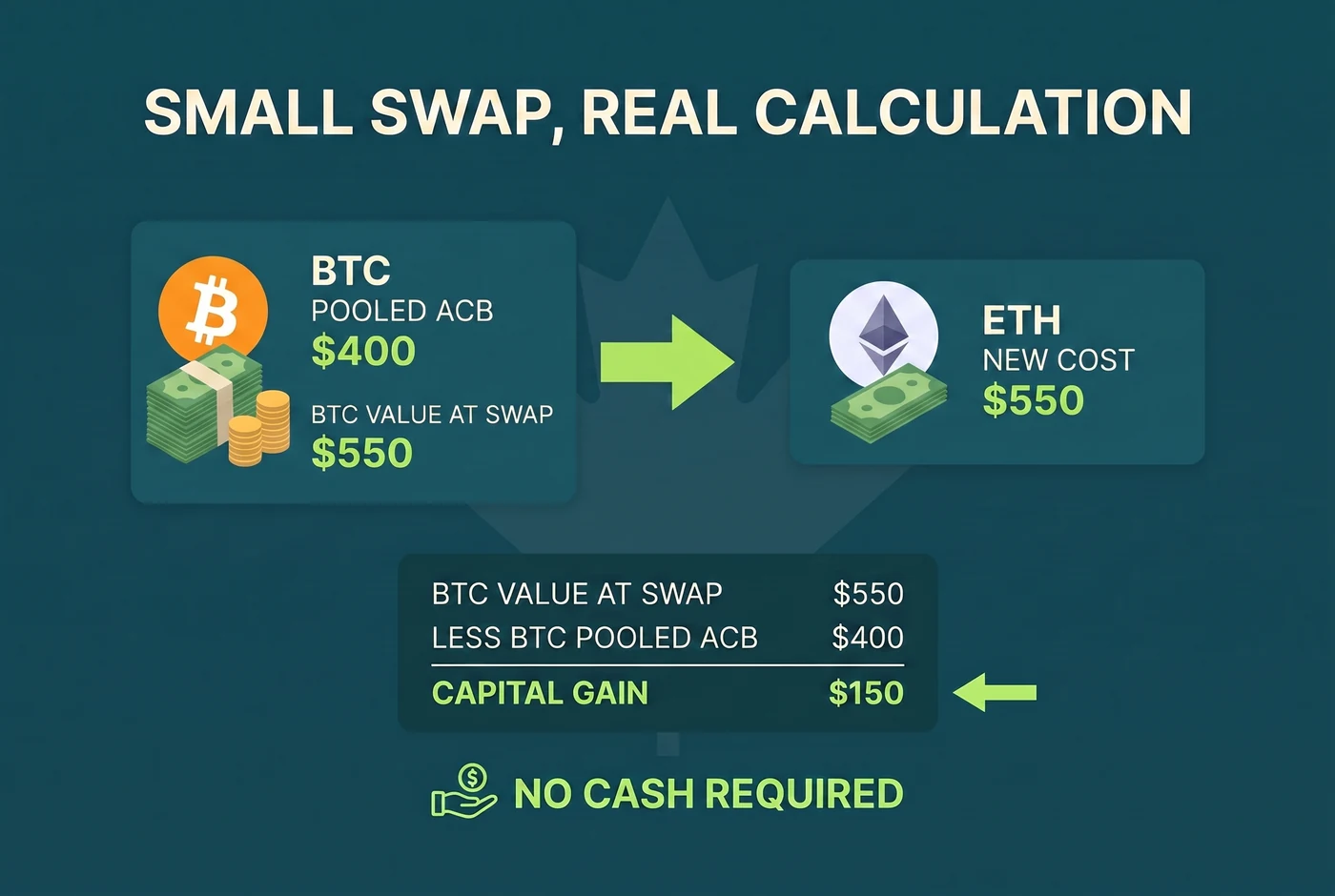
A crypto-to-crypto trade can be a disposition of the BTC given up. Measure its Canadian-dollar fair market value, compare that amount with the allocated BTC ACB and eligible fees, then establish the Canadian-dollar cost of the ETH received. No bank withdrawal is needed for the calculation.
Buying goods or services with crypto
Spending crypto is an exchange of property for value. The crypto leaves the owner, so the transaction can require a disposition calculation. Preserve the invoice, payment record, amount and type of crypto, and the Canadian-dollar value at the time.
Giving crypto away
A gift can be a disposition even when the sender receives no cash. Related-person rules and the identity of the recipient may affect the result, so keep the transaction hash, value, date, relationship, and any agreement or correspondence.
Receiving staking or mining rewards
CRA says rewards from centralized-exchange staking are generally income when credited to the wallet. Most mining activity is business activity because of the resources and activity involved, although the facts still matter. The Canadian-dollar amount included as income is also relevant to the cost of the reward units when they are later sold.
Receiving crypto for work or business
Crypto received as compensation does not become tax-free because the payer used a token instead of dollars. Establish the Canadian-dollar fair market value, connect the receipt to the work or sale, and preserve the invoice, agreement, and wallet evidence.
Can a crypto loss mean nothing is owed?
Capital losses versus business losses
Classification comes first. A capital loss generally stays within the capital-loss system and can be applied against taxable capital gains under CRA's rules. A business loss is determined through the business computation. It should not be created by moving a transaction from one category to another merely because that produces a preferred answer.
Why reporting the loss can matter
A properly supported capital loss can reduce current taxable capital gains or remain available under the applicable carry rules. Omitting a losing year can also break opening ACB and make later years wrong. Complete records matter when the transaction did not produce current tax.
How the superficial-loss rule can deny or defer a loss
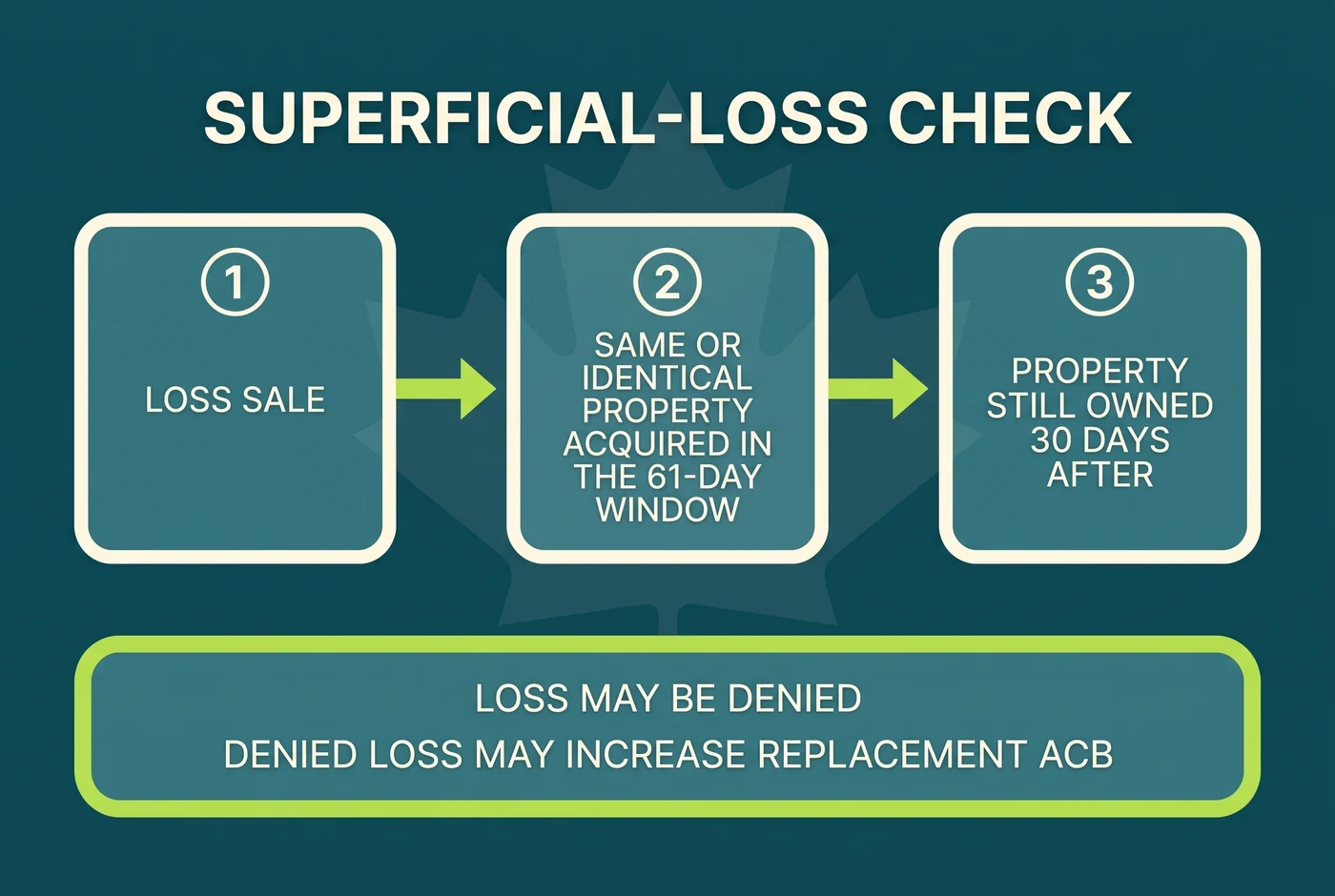
A superficial loss can arise when the taxpayer or an affiliated person acquires the same or identical property during the period beginning 30 days before and ending 30 days after the sale, and still owns or has a right to acquire it 30 days after the sale. The denied loss is generally added to the ACB of the replacement property.
This is a 61-day window with an acquisition condition and a continued-ownership condition, not a slogan to wait 30 days. Partial quantities and affiliated-person facts can complicate the calculation. Use the guide to calculate Canadian crypto gains using adjusted cost base for the ACB and superficial-loss mechanics.
How much crypto can you withdraw without paying tax?
The withdrawal is not the universal trigger
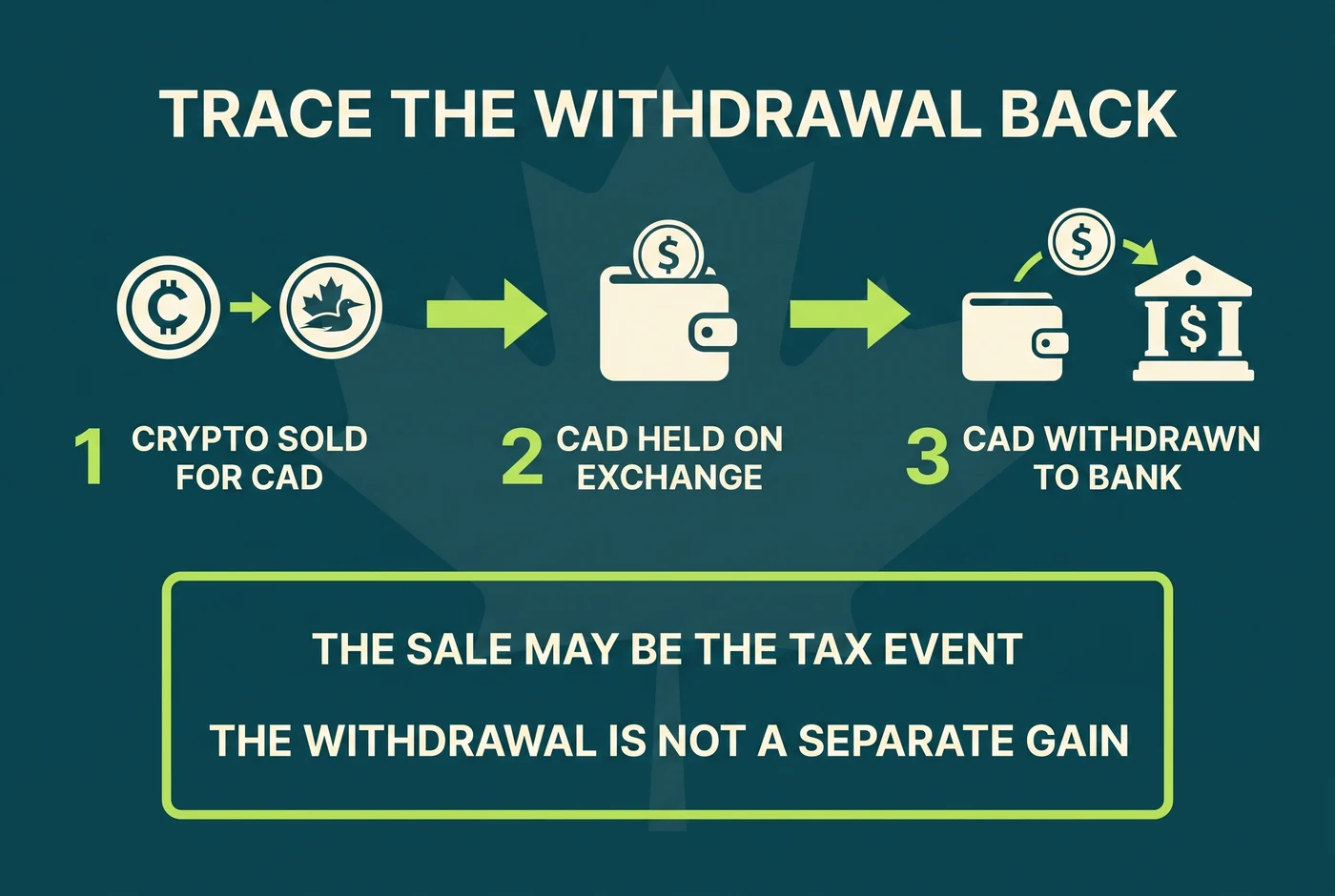
There is no universal withdrawal amount that can be moved tax-free. Identify the transaction that created the fiat or the crypto being withdrawn. A transfer of already-owned fiat between the taxpayer's accounts is different from the sale that generated it.
Trace the earlier sale or swap
Exchange records may show a token sale on Monday and a bank withdrawal on Friday. The sale is where proceeds and ACB are measured. If an earlier token swap occurred before the sale, that swap can be another disposition. Reconciliation should follow the sequence rather than treating Friday as the whole event.
Separate principal from gain
Withdrawing CAD 20,000 does not mean the taxpayer has CAD 20,000 of income. Some amount may represent recovered cost and some may represent a gain. On capital account, proceeds minus allocated ACB and selling outlays determine the capital gain. On business account, revenue, inventory cost, and expenses determine net profit.
Reconcile fiat and crypto records
Match bank deposits to exchange withdrawals and exchange sales. Then trace the crypto acquisition or receipt that supplied the asset sold. This catches duplicate deposits, missing sales, unsupported basis, and transfers that software may have labelled incorrectly.
How to answer the question for your own records
Identify every disposition and income receipt
Start with all exchanges, wallets, addresses, chains, protocols, and fiat accounts. Record sales, swaps, spending, gifts, rewards, compensation, and business receipts. Match transfers before classifying unmatched withdrawals as dispositions.
Classify capital versus business activity
CRA considers frequency, holding periods, market knowledge, time spent, and financing. No single factor decides the result. The detailed comparison and evidence prompts are in our guide to capital gains vs business income for crypto.
Calculate CAD value and ACB
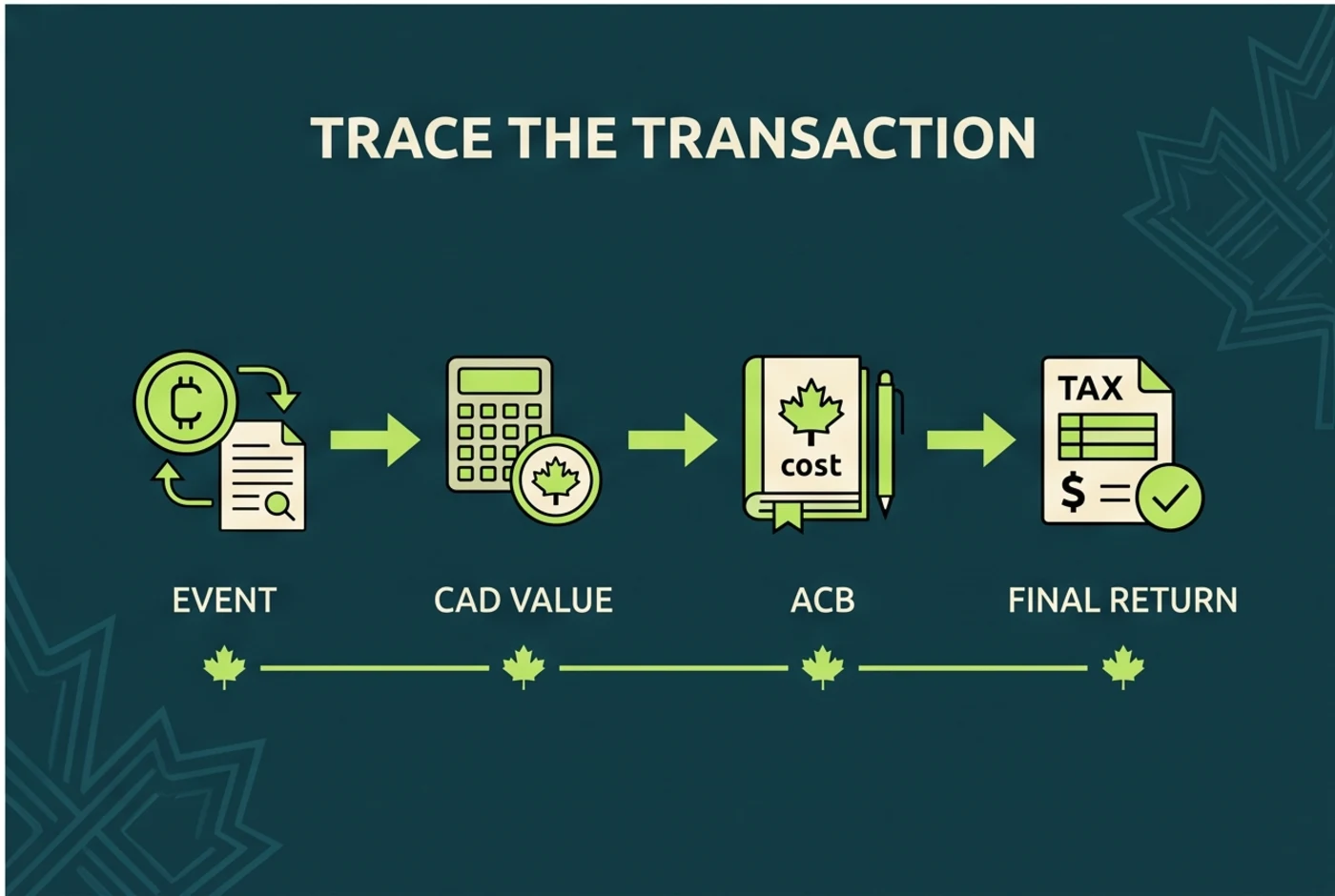
Convert each event to Canadian dollars using a documented source and consistent timestamp. Build pooled ACB for identical property, include appropriate acquisition costs, allocate cost to dispositions, and preserve selling outlays. Do not silently set missing basis to zero.
Apply losses and provide figures to the Canadian tax professional
Apply the correct capital or business loss rules, test superficial losses, and document unresolved items. The Canadian tax professional can then place the accepted figures into the full return and determine whether any tax is payable.
Get CRA-ready figures for your Canadian tax professional
Count On Sheep reconciles complex digital-asset activity into CRA-ready figures and workpapers for your Canadian tax professional. We do not file Canadian tax returns.
Explore our Canadian crypto tax serviceCanada crypto tax FAQs
Do I have to report crypto under $600 in Canada?
Canada has no crypto-specific $600 reporting floor in the CRA guidance reviewed for this page. A small sale, swap, spend, gift, or income receipt can still need a calculation and proper reporting. The amount is relevant to the result, but it does not create an exemption.
How much crypto can I cash out without paying taxes?
There is no Canadian crypto cash-out allowance. The tax event may have occurred before the withdrawal, such as when crypto was sold, swapped, spent, or earned. Tax depends on the gain or income and the rest of the return, not simply the bank transfer.
Is buying and holding crypto taxable in Canada?
Merely buying and holding crypto generally does not create a capital gain at that time. A later disposition or an income receipt is a separate event. Keep purchase records because the Canadian-dollar cost and fees may be needed for adjusted cost base when the asset is eventually disposed of.
Do I report a crypto sale if I made no profit?
A disposition can still need to be reported even when it produces no gain. If it produces a capital loss, reporting can preserve that loss for use under the capital-loss rules. The transaction needs enough evidence to establish proceeds, adjusted cost base, and selling expenses.
Can crypto losses reduce tax in Canada?
Capital losses generally apply against taxable capital gains, not employment income. Business losses follow different rules. A superficial loss can be denied when the acquisition and continued-ownership conditions are met, so a quick repurchase needs careful review.
What is the 30-day rule for crypto in Canada?
The superficial-loss test is broader than a simple 30-day waiting rule. It spans the period beginning 30 days before and ending 30 days after the sale, and it also asks whether the taxpayer or an affiliated person still owns the same or identical property 30 days after the sale.