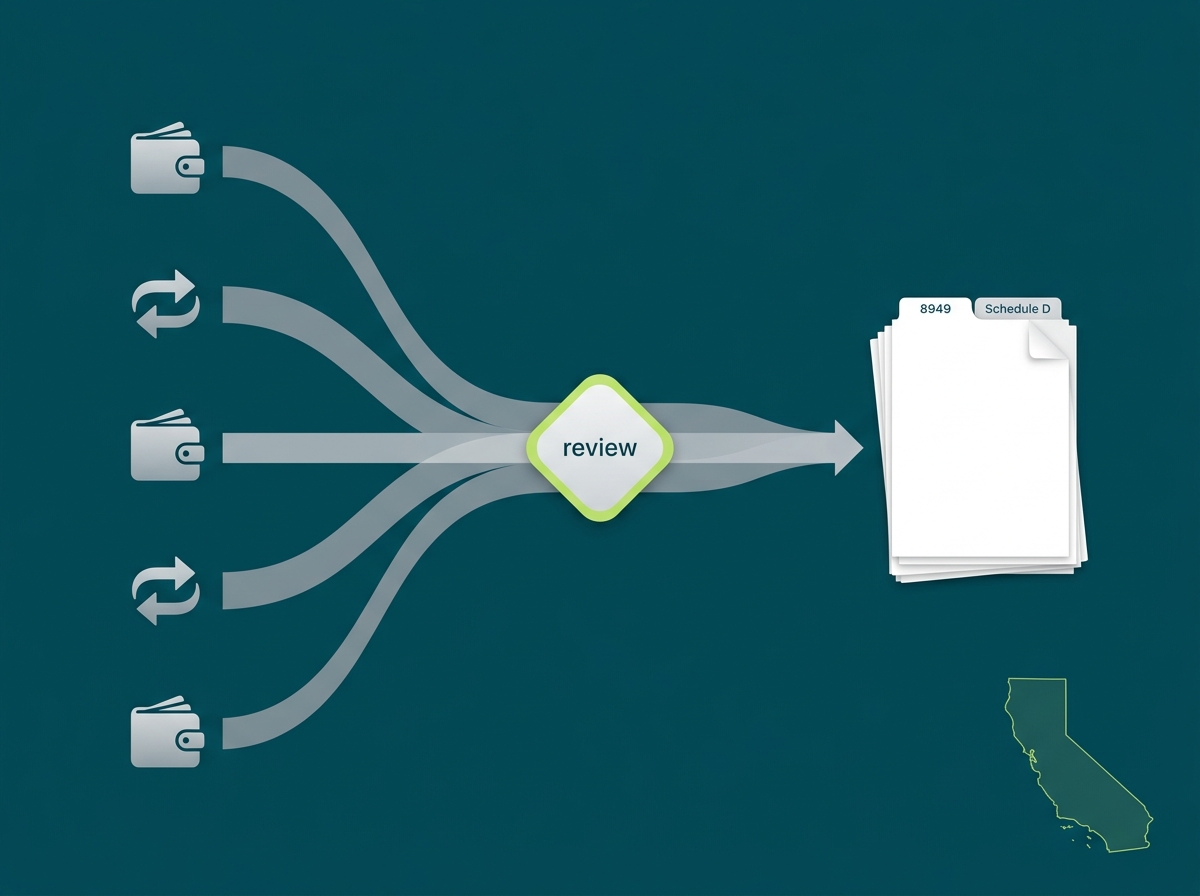
Big 4 trained, crypto native. We bridge DeFi and TradFi for your 8949.
California's 13.3% top rate makes every federal crypto number matter. We produce CPA-ready 8949, Schedule D, and Schedule 1 inputs for Los Angeles, San Francisco, and San Diego investors.
Former Big 4 + CPA leadershipCrypto native, blockchain expertsServing California
Keep your CPA. We do the crypto. · By the Count On Sheep team · Reviewed August 2026
Serving all of California
What you getForm 8949Schedule DSchedule 1
Featured In
CA
Key Facts
Key Facts About Crypto Tax Service in California
California has the largest crypto investor base in the U.S. and the highest state rate at 13.3%. With FTB residency audits aggressive on high earners, accurate per-wallet crypto tax work is what separates a defensible return from a mess.
01California taxes crypto gains as ordinary income up to 13.3%, the highest in the U.S.
02California conforms to federal crypto tax treatment (cost basis, FIFO/specific-ID, gain classification).
03California offers no preferential long-term capital gains rate at the state level.
04The Franchise Tax Board (FTB) actively audits residency claims for high earners exiting the state.
05Rebuilding cost basis across exchanges, wallets, and DeFi is the highest-leverage step for a defensible California return.
06Count On Sheep delivers CPA-ready 8949, Schedule D, and Schedule 1 inputs, your CPA files, or you file with TurboTax.
The Problem. How We Solve It.
Crypto tax software gives you data. We make it filing-ready.
Before you file yourself or hand anything to a CPA, the crypto activity has to be reconciled. That is how California investors avoid duplicate disposals, unsupported basis, overstated gains, and preventable tax. Clean records improve accuracy, preserve legitimate deductions and losses, and let you reconcile each 1099-DA against the complete transaction history.
The problem
Raw exports are not a tax return.
Exchange exports leave transfers, fees, and missing cost basis unresolved.
DeFi, staking, NFTs, bridges, and wallet-to-wallet moves rarely arrive filing-ready.
1099-DA reports can show proceeds without the complete basis history needed to calculate the right gain or loss.
What you receive
The inputs required to finish your crypto taxes.
A reconciled transaction ledger across every wallet, exchange, chain, and protocol.
Completed Form 8949 inputs and Schedule D totals for capital gains and losses.
Schedule 1 inputs for applicable crypto income, plus payment-income workpapers your tax preparer can classify correctly.
Real Stories, Real Results
What Our Clients Say
Reputation is everything! See what our clients are saying about our service and team.
★★★★★
"This team is a life saver. They are professional, communicate very fast and are pleasant to deal with."
Chris ChambersGoogle Review
★★★★★
"Matt was professional, thorough, timely and had a great understanding of my situation."
Jo JustusGoogle Review
★★★★★
"Reconciled all my previous years and set me up for a clean slate moving forward. Very thorough and transparent."
Jon AbramsGoogle Review
Book a Meeting
Talk with a crypto tax service specialist.
Choose a free scoping call or a paid consultation with a former Big Four auditor. We will review your California crypto tax situation and map the cleanest path to filing-ready records.
Free scoping call or paid consult with a former Big Four auditor
Written quote first scope reviewed before any work begins
Video meetings secure document sharing and read-only access
Serving California
From Los Angeles to every metro in California
California crypto investors in Los Angeles, San Francisco, San Diego, Sacramento, San Jose and surrounding metros throughout the state.
California crypto investors face a unique double stack: federal capital gains plus the country's highest state rate at 13.3%, with an additional 1% surcharge over $1M. Residents from Los Angeles to San Francisco to San Diego deal with FTB residency audits, AB-150 PTET planning, and heightened scrutiny on reported gains. We pull every wallet, exchange, and DeFi protocol into one ledger, classify each event, and hand off CPA-ready 8949, Schedule D, and Schedule 1 inputs. Count On Sheep is your crypto tax service specialist in California. Your CPA stays your CPA. We handle the crypto side, they file with the state and IRS.
Applies to every California resident, on top of the state layer above.
Event
Federal treatment
Selling crypto for USD
Capital gain (short or long-term)
Crypto-to-crypto swapCommonly missed
Capital gain on both legs
Mining income
Ordinary income at FMV on receipt; basis for later sale
Staking rewards
Ordinary income at FMV on receipt
Airdrop received
Ordinary income at FMV on receipt
NFT sale
Capital gain (collectible rules may apply for some)
DeFi yield / LP rewards
Ordinary income at FMV on receipt
Reportable on Form 8949, Schedule D, Schedule 1 (or Schedule C for mining as a trade or business). Count On Sheep produces these inputs from your complete on-chain history.
California Deep Dive
Build the federal crypto ledger before calculating the California result
California taxes capital gains as ordinary income and does not provide a separate lower rate for long-term gains. The state calculation therefore begins with dependable federal proceeds, basis, holding periods, and income classifications, then adds California residency and adjustment questions for your CPA to resolve.
01
California cannot fix an incomplete Form 8949
A California return may reference federal capital-gain information, but that does not make a broker export complete. Assets can move through Coinbase, Kraken, hardware wallets, decentralized exchanges, bridges, liquidity pools, and closed accounts before the final sale. Each movement has to be classified before the taxable disposals can be trusted.
The reconciliation begins with the full ownership history. We match transfers, rebuild unsupported acquisition lots, remove duplicates, price missing events, and document classifications. That produces the Form 8949 detail and Schedule D totals your CPA needs before applying California rules.
02
California gives capital gains no separate preferential state rate
The Franchise Tax Board states that California does not have a lower tax rate for capital gains. Long-term status can still matter federally, but the state taxes capital gains through its ordinary income rate structure. That makes an understated or zero basis costly at both levels.
Count On Sheep does not calculate the complete California liability or prepare the return. We deliver the crypto proceeds, supported basis, dates, adjustments, and income categories. Your CPA combines those records with wages, business income, deductions, credits, and every other item on the California return.
03
Move-year records need a transaction timeline and a residency file
California residents are generally taxed on income regardless of source, while part-year and nonresident rules depend on timing and sourcing. A move near a large crypto disposal creates two separate evidence problems: when the transaction occurred and when residency changed.
We solve the transaction side by documenting timestamps, wallet movements, exchange fills, proceeds, and lot history. Your CPA or attorney evaluates domicile and residency using travel, housing, employment, family, and other facts outside the ledger. Keeping those evidence sets distinct produces a cleaner handoff.
04
California worked example: transferred Bitcoin with missing basis
Assume an investor buys Bitcoin for $80,000 in an older exchange account, moves it to self-custody, later deposits it at a new broker, and sells it for $200,000. If the receiving broker reports proceeds but no basis, an unreconciled file can imply a $200,000 gain instead of the supported $120,000 gain.
The missing $80,000 does not reappear through keyword settings or an assumed average. It requires the acquisition record and transfer chain. Once documented, the corrected lot can flow to Form 8949, and the $80,000 difference affects both federal and California calculations.
05
DeFi and token compensation create different California inputs
A token swap or liquidity-position exit can create a capital disposal, while staking rewards, airdrops, compensation, and some business receipts can create ordinary income. The same asset may generate income when received and a later gain or loss when sold. Combining those events into one undifferentiated gain number breaks the filing trail.
We separate disposition records for Form 8949 and Schedule D from digital-asset income inputs for Schedule 1 or Schedule C, depending on the facts your CPA applies. The result is not a tax return. It is a reconciled set of inputs that explains where each crypto number came from.
06
What a California CPA receives from Count On Sheep
The handoff includes Form 8949-ready transaction detail, Schedule D summaries, digital-asset income inputs, closing lot inventories, transfer matching, unresolved-item notes, and workpapers documenting material assumptions. It also identifies broker statements such as Form 1099-DA that must be reconciled to the ledger.
Your CPA reviews the package, resolves return-level elections and California adjustments, combines the crypto results with the rest of your finances, and files. That division of work lets the blockchain specialists concentrate on the evidence while the return preparer retains control of the complete tax position.
07
Federal and California Schedule D differences stay visible
The Franchise Tax Board instructs taxpayers to use California Schedule D (540) when state treatment differs from federal treatment. The crypto engagement should therefore preserve federal transaction detail and identify facts that may require return-level California review instead of replacing both calculations with one blended total.
Our export keeps disposal dates, proceeds, basis, holding period, and adjustments at the lot level. Your CPA decides whether California modifications are required and records them on the appropriate state forms. This review path is especially important when prior-year carryovers, residency changes, or non-crypto capital items affect the state result.
08
A California review should begin before the filing deadline
Missing exchange records and unsupported wallet deposits take time to investigate. Waiting until the return is otherwise complete leaves the CPA with only two poor choices: delay filing or accept unresolved crypto numbers. Starting with the ledger lets the difficult evidence work happen before the return bottleneck.
The scoping call identifies accounts, chains, years, transaction volume, DeFi activity, broker forms, and known gaps. After reconciliation, the handoff includes open questions clearly enough for the taxpayer and CPA to resolve them without reverse-engineering our software.
California records to gather before crypto reconciliation
Exports or read-only access for every current and closed exchange account
Public addresses for hardware wallets, browser wallets and every chain used
Prior-year Form 8949 files and year-end lot inventories
Form 1099-DA and other broker statements that report digital-asset proceeds
Token compensation, staking, airdrop and business-payment records
Move date and transaction chronology if California residency changed
Common Issues
What we untangle for California crypto investors
California pattern 01
FTB residency audits on high earners exiting California with unrealized crypto positions
California pattern 02
AB-150 PTET interplay for crypto trading entities and pass-through structures
California pattern 03
Heightened FTB scrutiny on large reported gains with weak basis documentation
Primary Sources
Authorities used for this California crypto tax guide
Reviewed August 2026. These first-party resources support the general federal and state information on this page. Your CPA applies the current instructions to your return; Count On Sheep supplies the reconciled crypto records and form-ready inputs.
Review the Form 8949, Schedule D, income, cost-basis, and supporting workpapers delivered after reconciliation.
FAQ
Common questions, California edition
Does California give crypto a lower long-term capital-gains rate?
No. The California Franchise Tax Board states that California does not have a lower rate for capital gains. Long-term status can reduce the federal rate, but California taxes capital gains through its ordinary income rate structure.
Why reconcile Form 1099-DA before filing in California?
A broker may report proceeds without basis for assets transferred from another exchange or wallet. Reconciliation traces the acquisition and movement history so supported basis, dates, and adjustments can be reported on Form 8949 instead of accepting an unsupported zero basis.
Can Count On Sheep determine whether I am a California resident?
No. We provide the crypto transaction chronology. Your CPA or attorney applies California residency and sourcing rules using housing, travel, employment, family, and other evidence outside the blockchain ledger.
What does Count On Sheep deliver to a California CPA?
We deliver Form 8949-ready disposal detail, Schedule D totals, Schedule 1 or business-income inputs, transfer matching, closing lots, broker-statement reconciliation, and workpapers documenting material assumptions and unresolved items.
Does Count On Sheep file California tax returns?
No. We reconcile the crypto activity and prepare the supported inputs. Your CPA combines them with the rest of your tax information and files the federal and California returns, or you use the federal inputs in a self-filing workflow.
What records should a California crypto investor provide?
Provide all exchange exports or read-only access, public wallet addresses, prior Form 8949 files, opening lot inventories, Forms 1099-DA, income records, and move dates if California residency changed.
Ready to get your crypto tax handled and CPA-ready?
Book a free scoping call or call us directly. We serve California residents.