
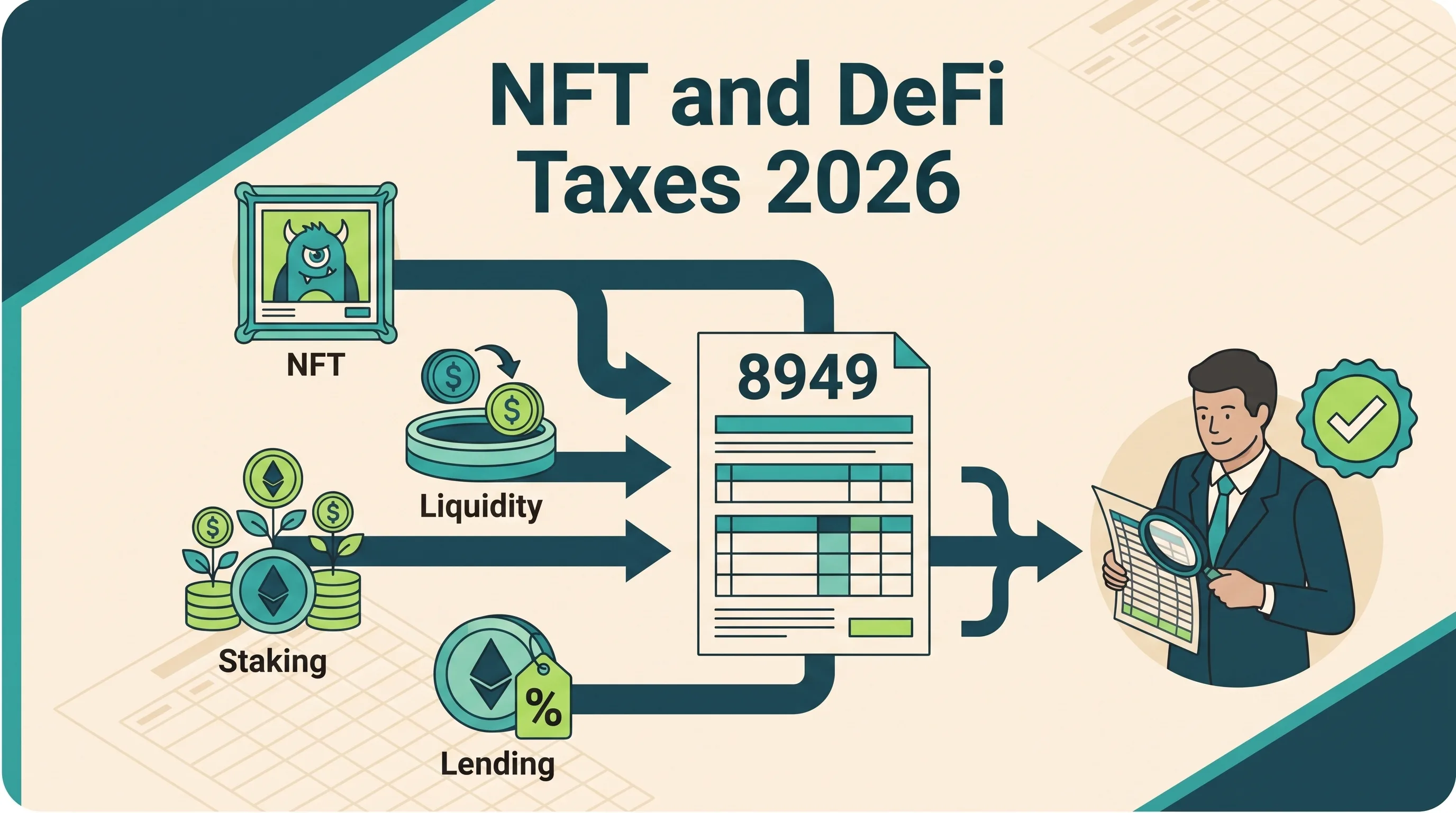
NFTs and DeFi protocols create some of the most complex tax situations in crypto. Every mint, swap, liquidity deposit, and yield payout can trigger a taxable event. The IRS treats digital assets as property, and that classification applies to NFTs, LP tokens, wrapped assets, and DeFi interest alike. Understanding exactly when and how each transaction is taxed can save you thousands and keep you out of trouble.
This guide covers the full scope of NFT and DeFi taxation for 2026, including the 28% collectible rate risk for NFTs, the hidden tax trap in liquidity pool deposits, and how staking and lending income is reported.
For a complete overview of how crypto is taxed, start with our 2026 Crypto Tax Guide. This article goes deeper on NFT and DeFi-specific scenarios.
If your activity spans multiple wallets and protocols, use the crypto tax service locations hub to connect this national guidance with the state and city service page for your filing situation.
How NFTs Are Taxed: Standard vs. Collectible Rates
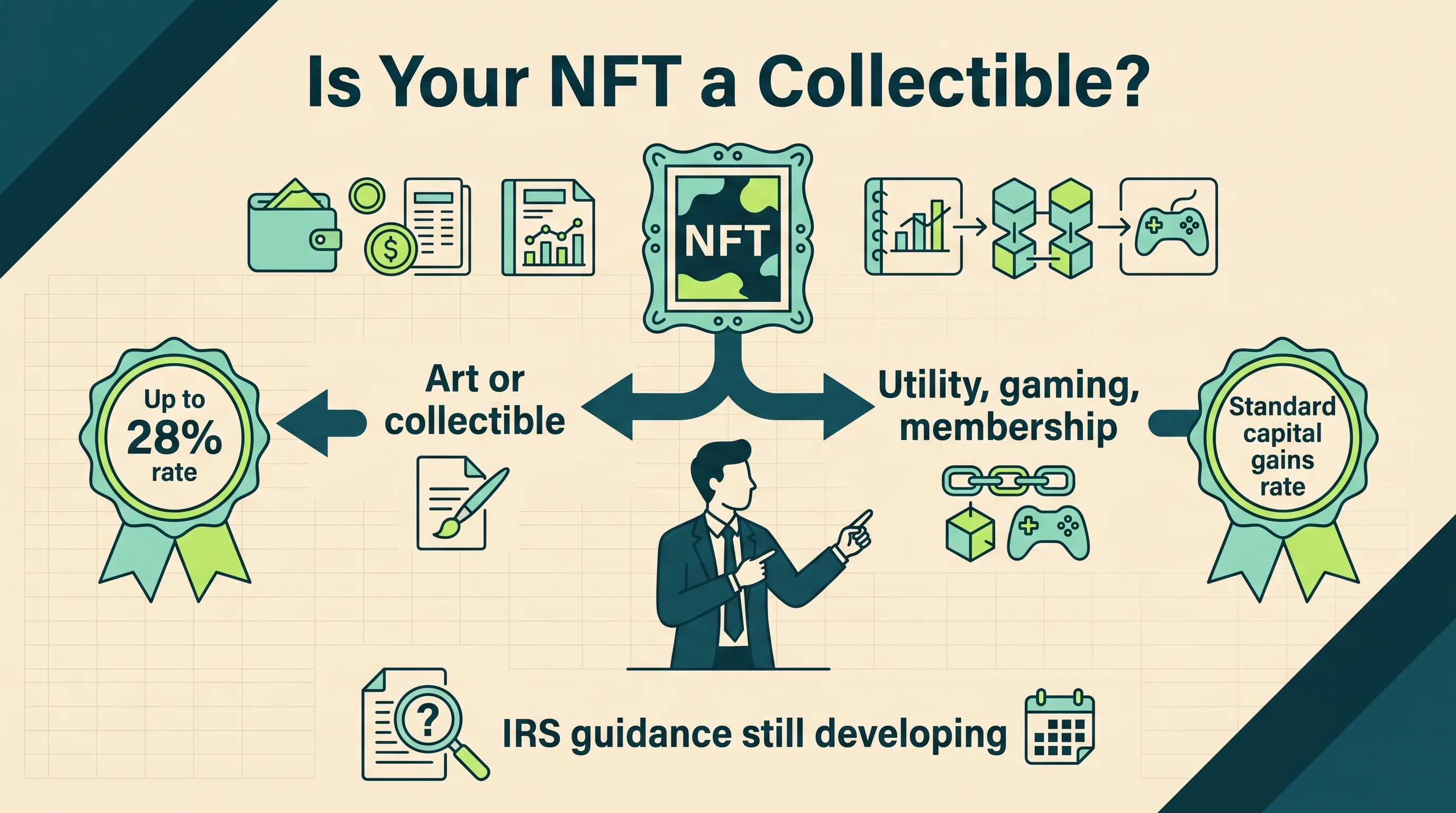
The IRS released Notice 2023-27 proposing that certain NFTs be classified as collectibles under Section 408(m). That matters because collectibles are taxed at a maximum long-term capital gains rate of 28%, compared to the standard 20% maximum for other capital assets.
The classification depends on what the NFT represents:
- Art-based NFTs (digital art, generative art, profile pictures tied to art): likely collectibles, subject to the 28% rate on long-term gains.
- Non-art NFTs (gaming items, membership passes, domain names, event tickets): likely standard capital assets, taxed at 0%, 15%, or 20% depending on income.
Short-term gains on all NFTs are taxed as ordinary income regardless of classification. The collectible distinction only affects long-term holdings (held longer than one year).
Buying, Selling, and Minting NFTs
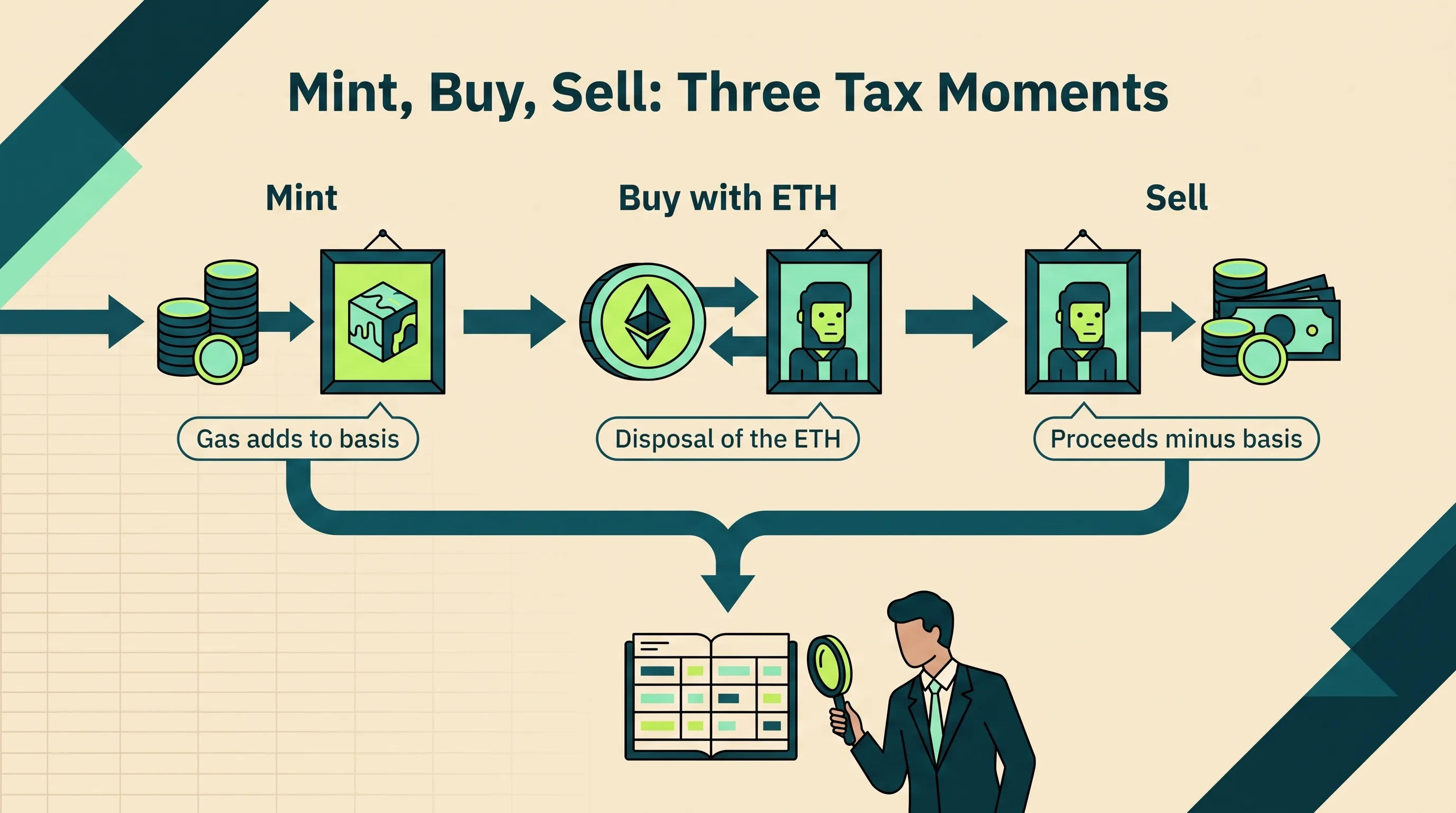
Each step in the NFT lifecycle has its own tax treatment.
Minting an NFT (as a buyer): When you mint an NFT, you are exchanging crypto (usually ETH) for the NFT. This is a taxable disposition of the crypto you spent. If the ETH appreciated since you acquired it, you owe capital gains tax on that appreciation. Your cost basis in the new NFT equals the fair market value of the crypto spent, plus any gas fees.
Selling an NFT: When you sell an NFT for crypto or fiat, you realize a capital gain or loss. The gain equals the sale price (proceeds) minus your cost basis (what you paid to acquire it, including gas fees).
Minting and Selling an NFT
You mint an NFT for 2 ETH when ETH is worth $3,000. Your cost basis in the NFT is $6,000. Six months later, you sell the NFT for 4 ETH when ETH is worth $3,500. Sale proceeds: $14,000. Taxed at short-term rates because you held for less than one year.
NFT creator royalties: If you are the creator of an NFT, royalties received on secondary sales are taxed as ordinary income. If creating NFTs is your trade or business, this income goes on Schedule C. Read more in our crypto income tax guide.
NFT Taxation: How the IRS Treats NFTs
NFT taxation starts with one core rule: the IRS treats an NFT as property, not as currency. That means the moment you dispose of an NFT, whether by selling it, swapping it for another token, or trading it for a different NFT, you have a reportable capital gain or loss. There is no separate “NFT tax” bracket; the rules borrow from the same property framework that governs the rest of your crypto.
Where NFT tax gets its own wrinkle is the collectible question covered above. If an NFT points to underlying art, the IRS may treat it as a Section 408(m) collectible, pushing long-term gains up to the 28% rate. For non-art NFTs, standard 0/15/20% long-term rates apply. Getting that classification right on each token is a big part of what makes nft and taxes harder than a plain coin sale.
Holding period matters just as much. Sell within a year and the gain is short-term, taxed at your ordinary income rate regardless of collectible status. Hold longer than a year and the collectible-versus-standard split kicks in. Because most NFT trades happen inside marketplaces that do not issue 1099 forms, the burden of proving your holding period and cost basis falls entirely on you.
Taxes on NFT Sales, Mints, Royalties, and Airdrops
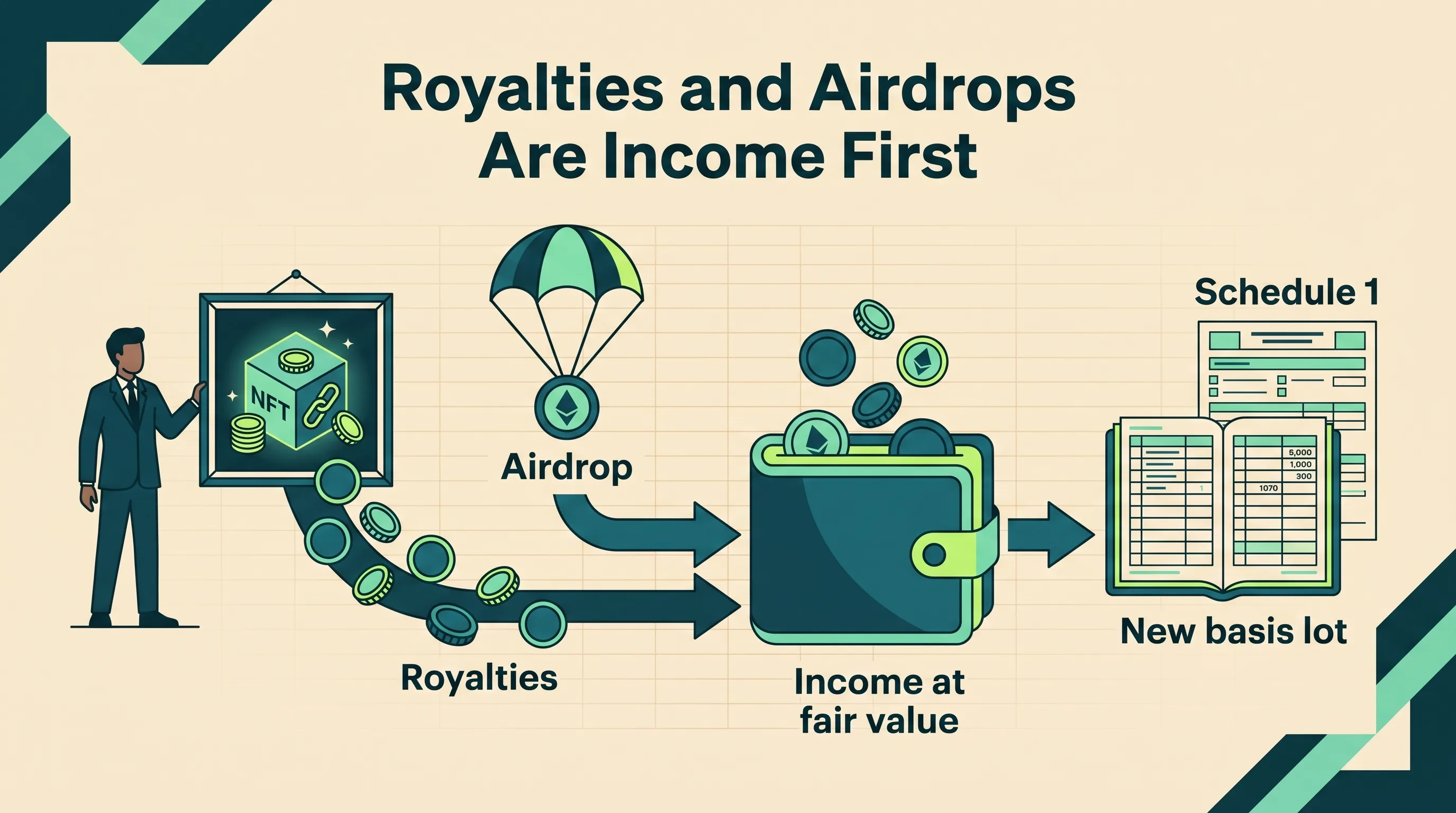
The taxes on NFT activity change depending on what you actually did. Four scenarios cover most of what investors and creators run into, and each one is reported differently.
- NFT sales. Selling an NFT for crypto or fiat is a capital gains event. Proceeds minus cost basis (including gas) equals your gain or loss, reported on Form 8949 and Schedule D.
- Minting. Paying ETH to mint disposes of that ETH, so any appreciation on the coin is taxable even before the NFT does anything. The crypto you spent, plus gas, becomes the NFT’s basis.
- Royalties. Creator royalties on secondary sales are ordinary income at fair market value when received. Run as a business, they land on Schedule C and carry self-employment tax.
- Airdrops. A free NFT or token airdrop is ordinary income equal to its fair market value on the day you gain control. That value also sets your cost basis for the eventual sale.
NFT Airdrop Then Sale
You receive an airdropped NFT worth $800 when it hits your wallet. That $800 is ordinary income now. Ten months later you sell it for $2,300. Because you held under a year, the $1,500 difference is a short-term capital gain on top of the income you already reported.
Double-counting is the most common mistake here. The income you report on an airdrop or royalty is not the same dollar as the later capital gain; the first sets your basis, the second measures growth from that basis. If you need professional NFT tax preparation, see our NFT tax services.
Liquidity Pools: The Hidden Tax Trap
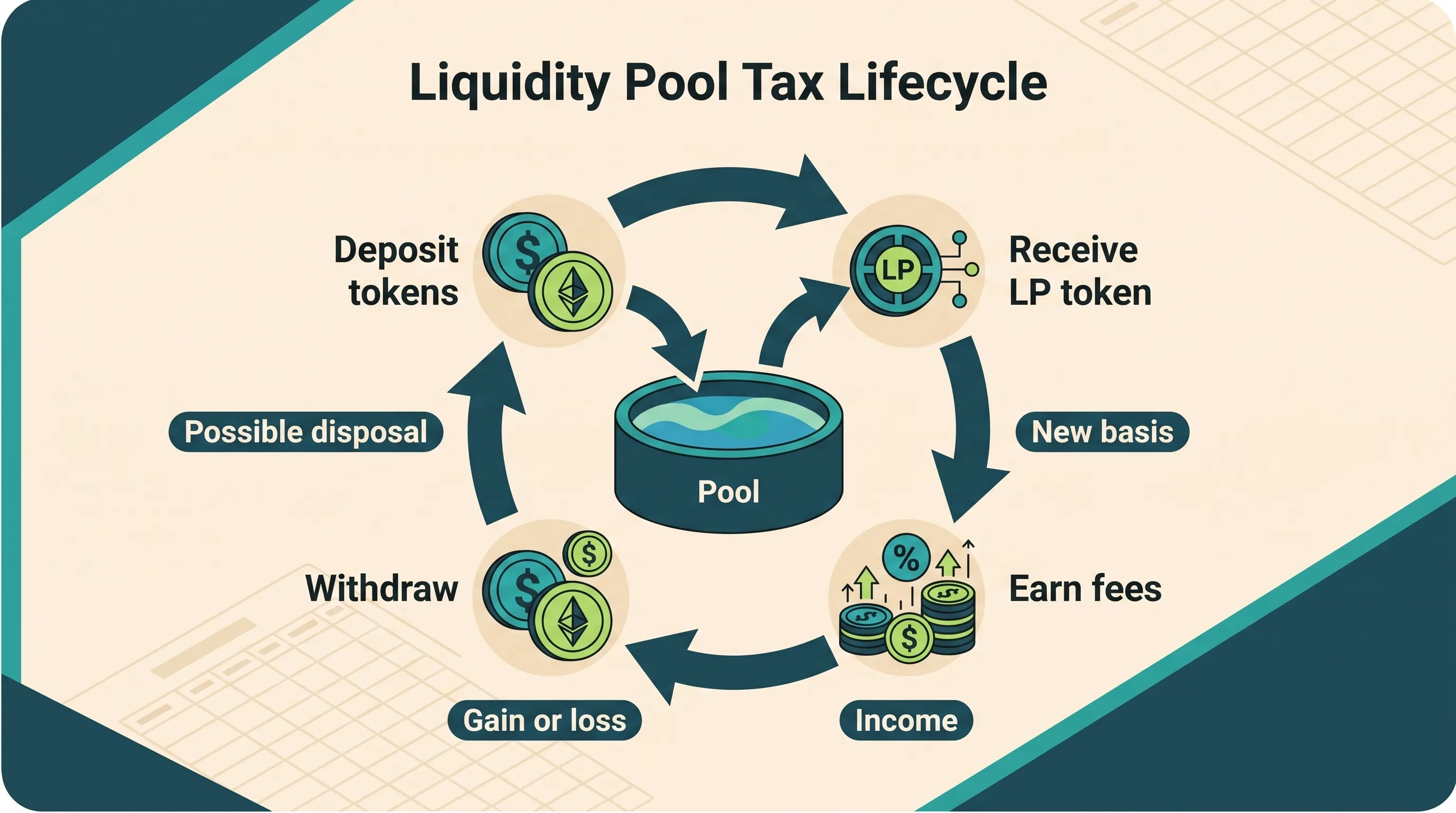
Providing liquidity to a DeFi protocol (Uniswap, Curve, Balancer, and others) involves depositing tokens into a pool in exchange for LP tokens. This is where many crypto users get caught off guard.
Depositing Into a Liquidity Pool
Under current IRS guidance, depositing tokens into a liquidity pool is likely treated as a taxable exchange. You are disposing of your original tokens and receiving LP tokens in return. If your deposited tokens have appreciated since you bought them, you owe capital gains tax at the time of deposit.
LP Deposit Tax Trigger
You deposit 5 ETH (cost basis $2,000 each, current price $3,200 each) and $16,000 USDC into a Uniswap pool. The ETH disposition triggers a gain of 5 x $1,200 ($3,200 - $2,000) = $6,000. You owe tax on that gain even though you did not sell for cash. Your new LP tokens receive a cost basis of $32,000.
Withdrawing From a Liquidity Pool
When you withdraw, you are disposing of your LP tokens and receiving the underlying assets back. The difference between the fair market value of what you receive and your LP token cost basis determines your gain or loss.
Impermanent Loss: Not Deductible Until Realized
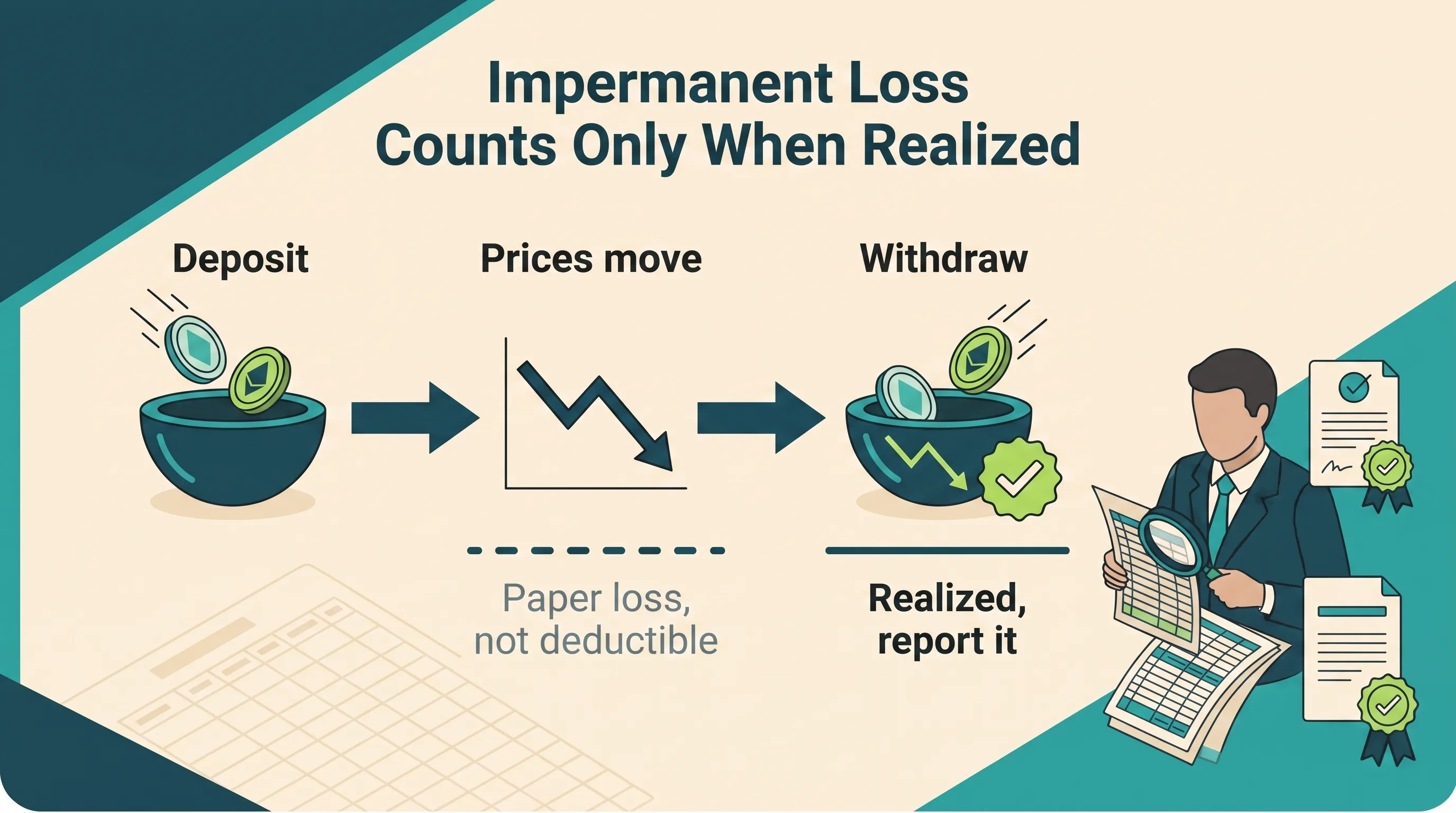
Impermanent loss occurs when the price ratio of tokens in your liquidity pool changes compared to when you deposited. While your pool position may show a paper loss relative to simply holding the tokens, the IRS does not recognize this as a deductible loss.
The loss only becomes tax-relevant when you withdraw from the pool. At that point, the impermanent loss is baked into the fair market value of the tokens you receive. If the total value received is less than your LP token cost basis, you can claim a capital loss on the withdrawal.
This is an important distinction. You cannot deduct impermanent loss while your tokens remain in the pool.
DeFi Staking vs. Lending: Different Activities, Same Tax Treatment
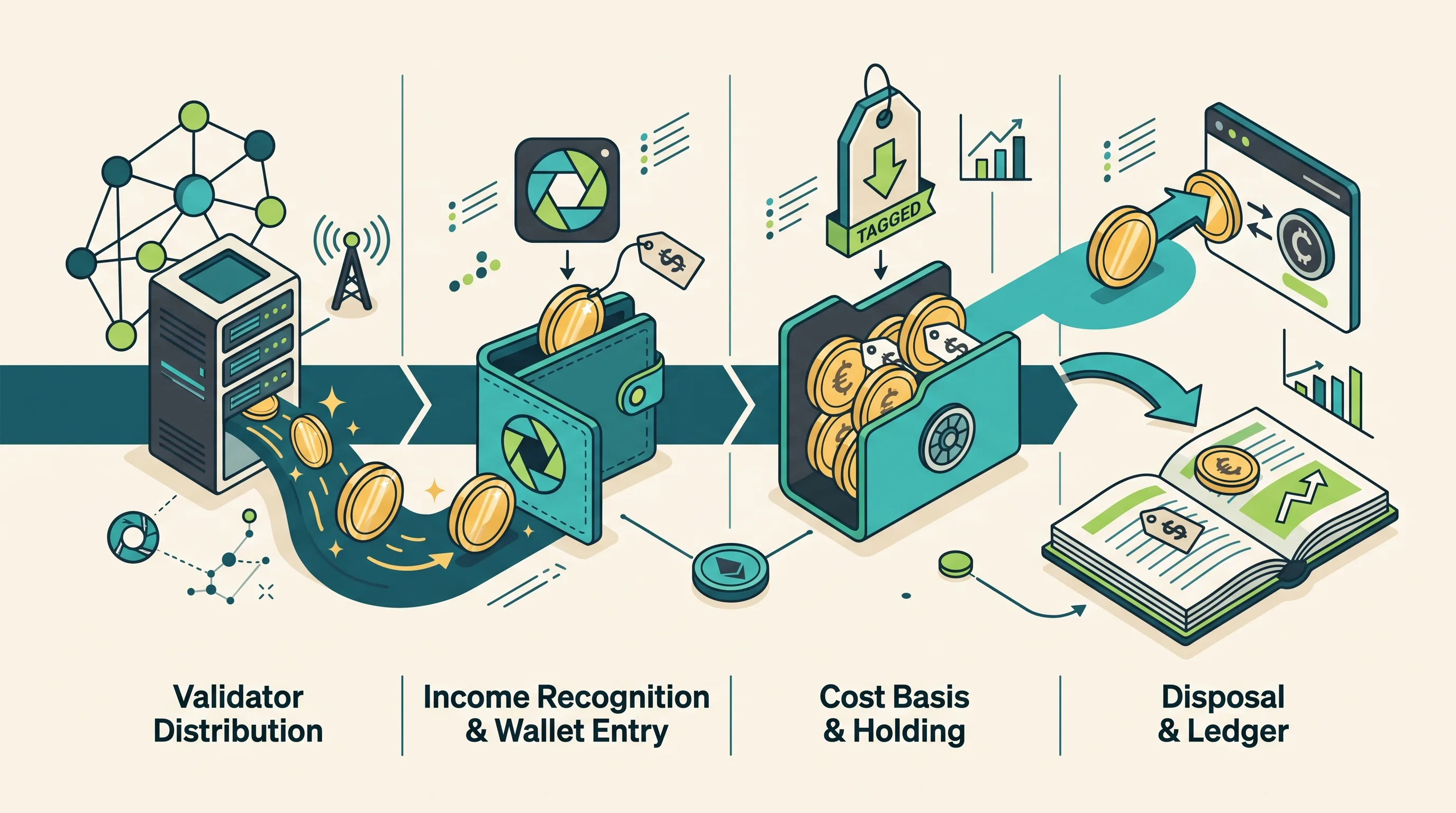
Both staking and lending generate income that the IRS taxes as ordinary income. However, the mechanics differ.
DeFi Staking Rewards
Staking rewards (whether through proof-of-stake validation, liquid staking protocols like Lido, or staking on platforms like EigenLayer) are taxed as ordinary income at the fair market value when you receive or gain control of the tokens. This is consistent with the IRS position in Revenue Ruling 2023-14.
Your cost basis in the received tokens equals the fair market value at the time of receipt. When you later sell or exchange those tokens, any further gain or loss is treated as a capital gain or loss.
For more guidance on staking taxation, see our guide on crypto income tax for staking, mining, and airdrops.
DeFi Lending Interest
Interest earned from lending protocols (Aave, Compound, Morpho, and similar platforms) is taxed as ordinary income when it accrues to your wallet or becomes available to claim. Report this income on Schedule B of your tax return.
The key challenge is tracking the continuous accrual of interest tokens. Many lending protocols update your balance with every block, creating thousands of micro-income events. Most crypto tax software aggregates these into a single reportable figure per tax year.
Whether you earn yield through staking, lending, or liquidity provision, the IRS treats it all as ordinary income when received.
Wrapped Tokens and Bridges
Wrapping Tokens (ETH to WETH)
The IRS has not issued a definitive ruling on wrapped tokens. However, wrapping a token (converting ETH to WETH, for example) is most conservatively treated as a taxable exchange. You are disposing of one asset (ETH) and receiving a different asset (WETH). If the ETH has appreciated, you would owe capital gains tax.
Some tax professionals argue that wrapping is a non-taxable “like-kind” event or a mere change in form. Until the IRS provides clear guidance, the safest approach is to treat it as taxable and track your cost basis in the wrapped token accordingly.
Cross-Chain Bridges
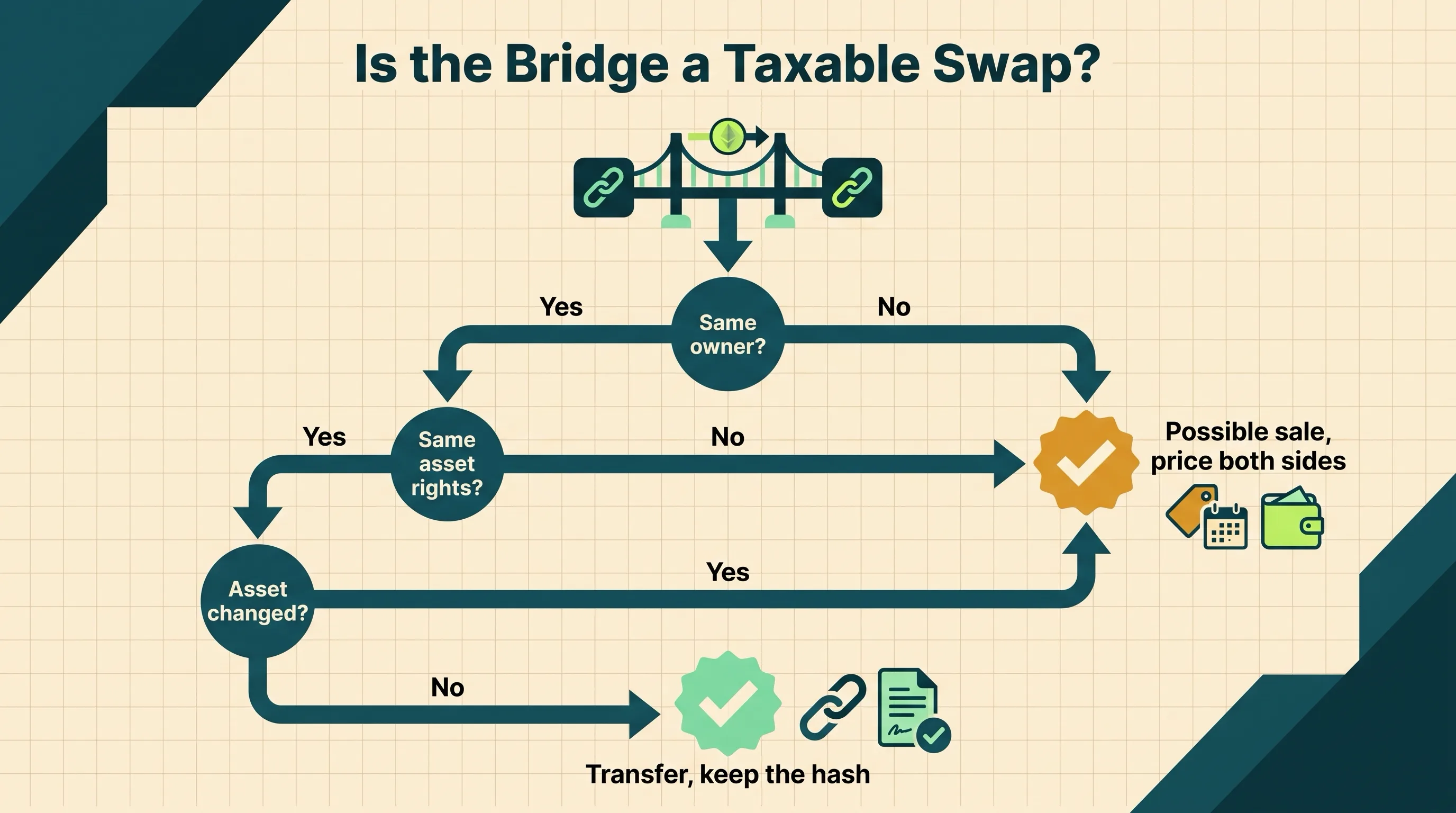
Bridging tokens from one blockchain to another (e.g., ETH on Ethereum to ETH on Arbitrum) raises similar questions. If the bridged token is truly the same asset on a different chain, it may not be a taxable event. If the bridge involves swapping for a different wrapped or synthetic version, it is likely taxable.
Track every bridge transaction with timestamps, amounts, and fair market values. This documentation protects you regardless of how future IRS guidance treats bridges.
Yield Farming: Stacking Tax Events
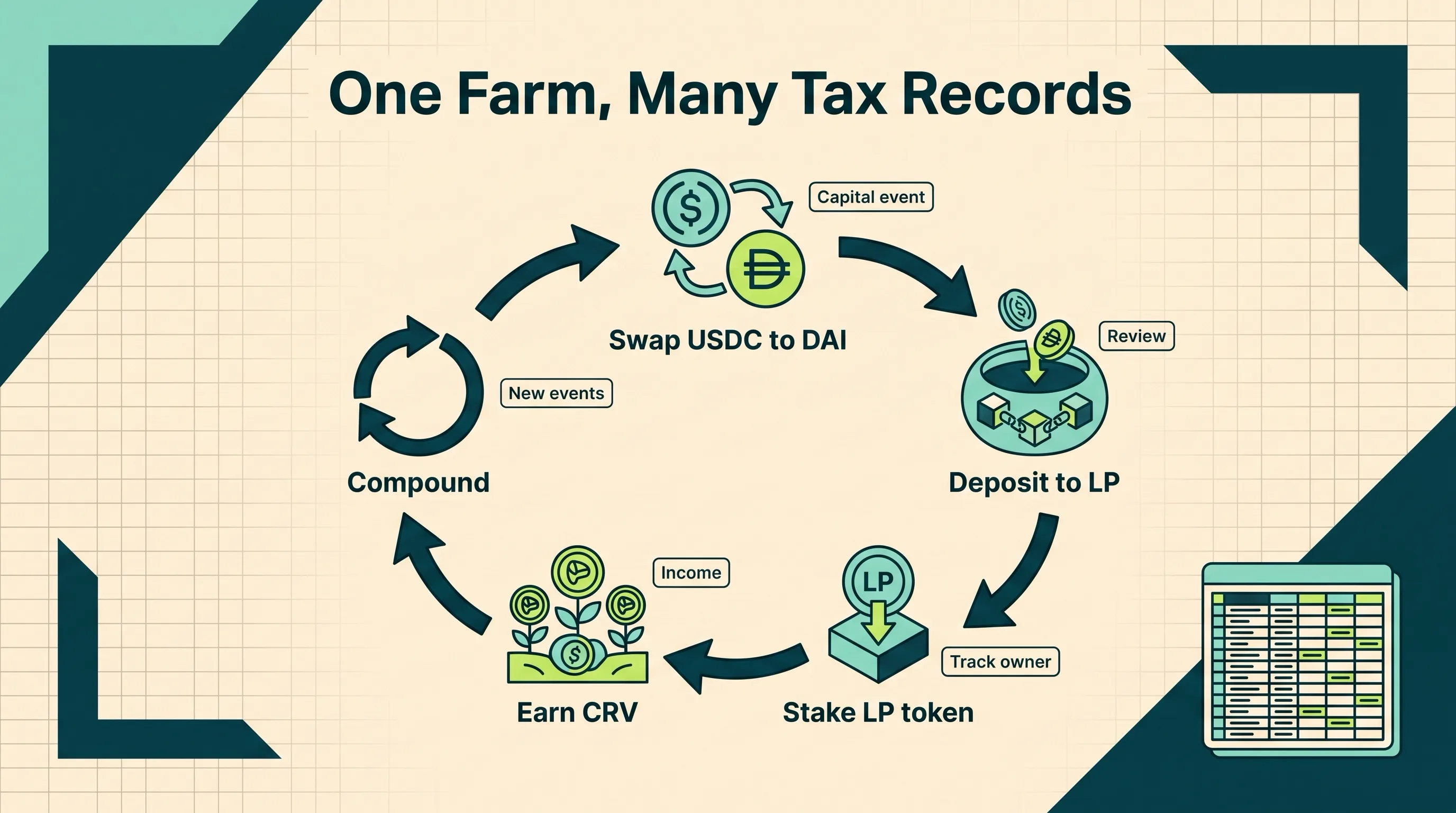
Yield farming compounds the complexity by combining multiple taxable activities in sequence. A typical yield farming strategy might involve:
- Exchanging Token A for Token B (taxable disposition of Token A)
- Depositing Token A and Token B into a liquidity pool (taxable exchange for LP tokens)
- Staking LP tokens in a farm contract (may or may not be taxable, depending on whether you receive a receipt token)
- Claiming reward tokens (ordinary income at fair market value)
- Selling reward tokens (capital gain or loss)
Each step is a separate tax event. A single yield farming position can generate five or more taxable transactions before you even withdraw your original capital.
Reporting DeFi on Your Tax Return
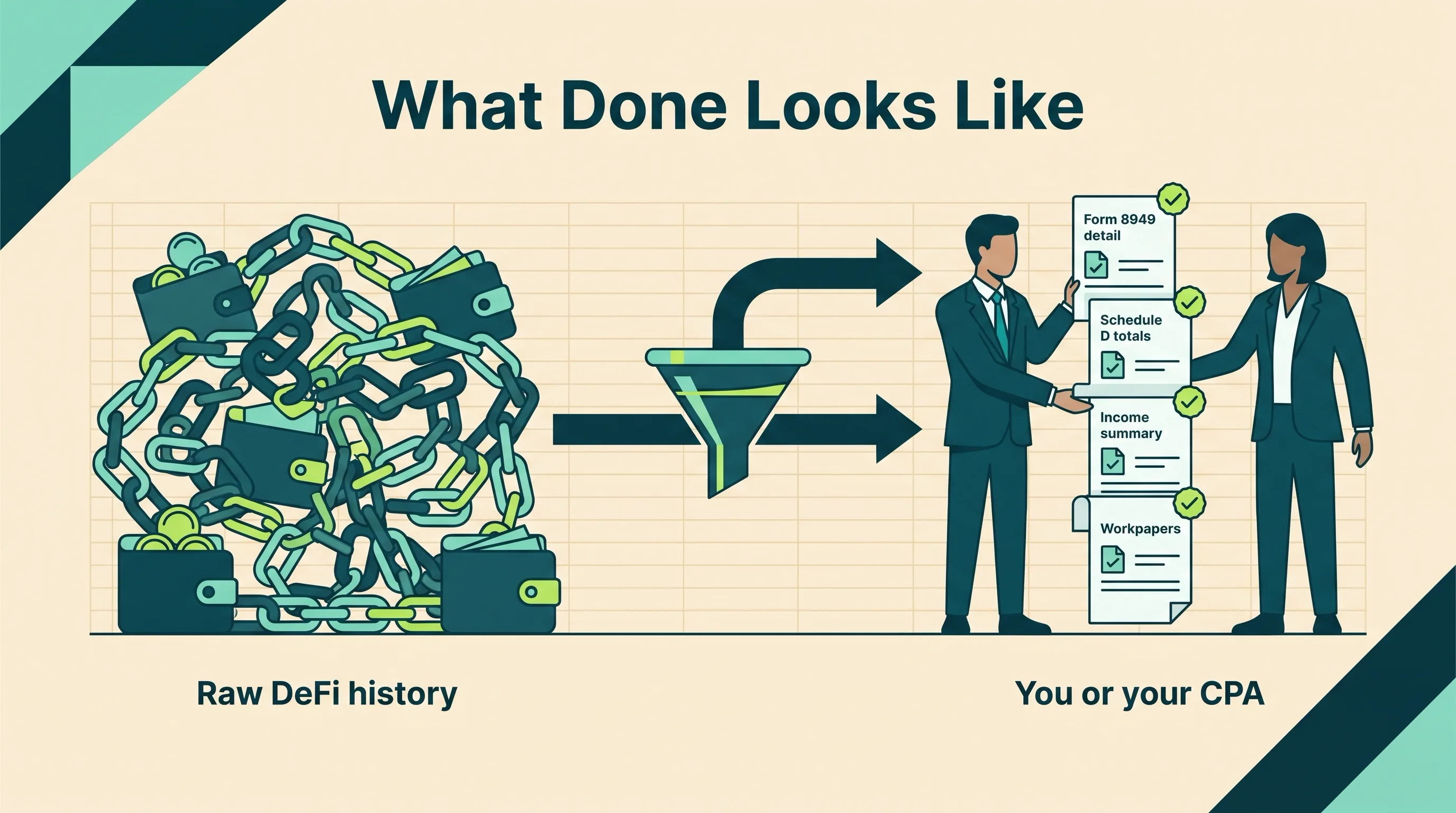
DeFi income and gains are reported on the same crypto tax forms as other crypto transactions:
| Activity | Tax Form | Tax Type |
|---|---|---|
| Selling or swapping NFTs | Form 8949 / Schedule D | Capital gains or losses |
| LP deposit (token disposition) | Form 8949 / Schedule D | Capital gains or losses |
| LP withdrawal | Form 8949 / Schedule D | Capital gains or losses |
| Staking rewards received | Schedule 1 or Schedule C | Ordinary income |
| Lending interest earned | Schedule B | Ordinary income |
| NFT creator royalties | Schedule C | Ordinary income + SE tax |
| Yield farming rewards | Schedule 1 or Schedule C | Ordinary income |
The biggest challenge with DeFi reporting is data collection. On-chain transactions do not generate 1099 forms. You are responsible for pulling transaction data from block explorers or using crypto tax software that connects to your wallets.
If you have significant DeFi activity, consider working with a specialist. Our Digital Asset Reconciliation (DAR) services are built for clients with complex on-chain positions, delivering clean inputs for your Form 8949, Schedule D, and Schedule 1 that you can file yourself or hand to your CPA.
For strategies on offsetting gains from DeFi activity, read our guide on crypto tax loss harvesting and the 2026 wash sale rules. And for a broader look at how capital gains work across all crypto, see our crypto capital gains tax guide.
NFT Tax Write Offs and Loss Deductions
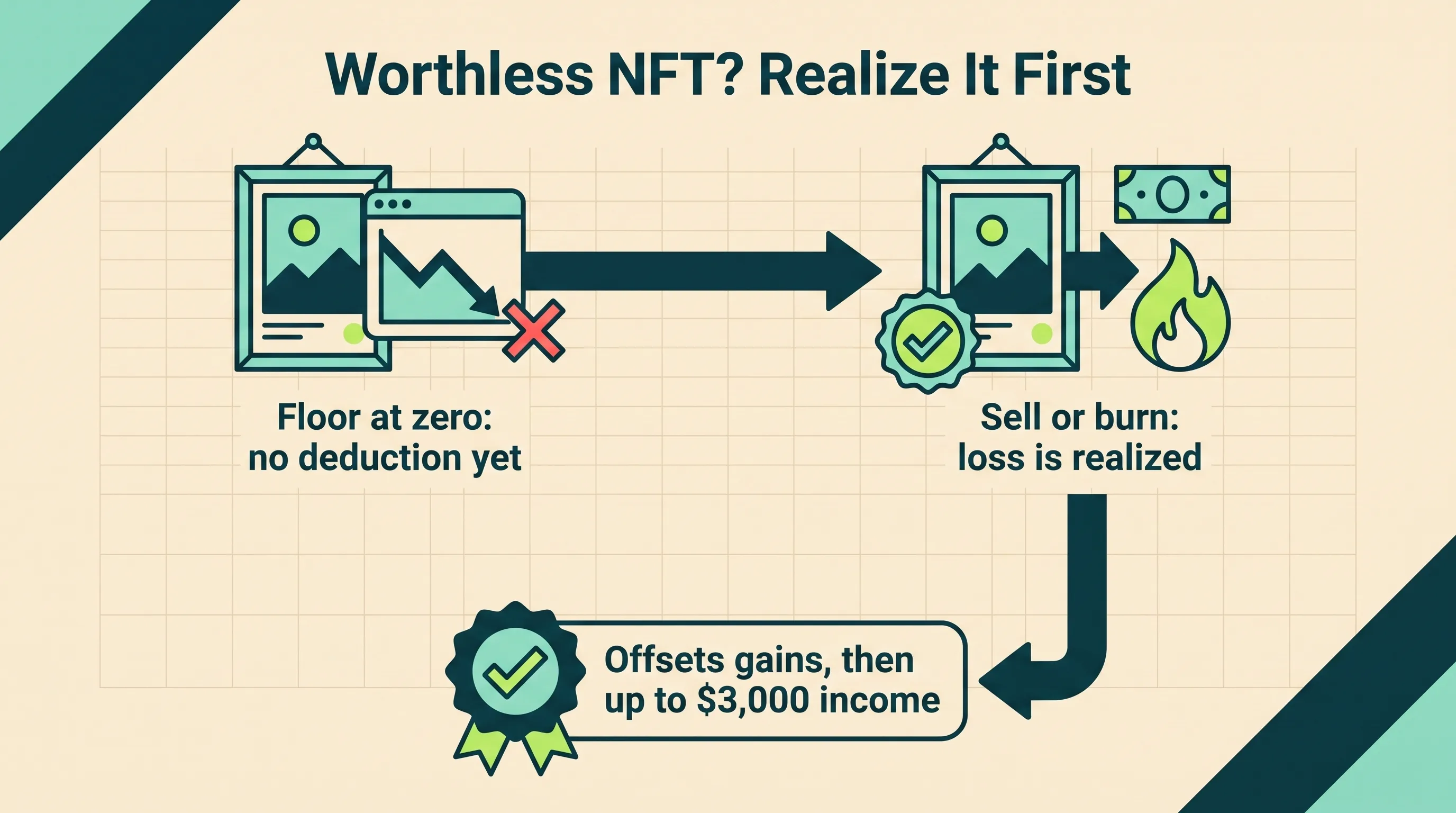
An NFT tax write off works the same way any capital loss does: sell or dispose of the NFT for less than your cost basis, and the realized loss offsets your capital gains. If your NFT losses exceed your gains, you can deduct up to $3,000 against ordinary income each year and carry the rest forward. This is one of the few bright spots in a down market, and it is why tracking basis on every token matters.
The loss has to be realized to count. Watching your floor price collapse does nothing for your return; you need an actual disposition. That can mean selling on a marketplace, or sending the NFT to a burn address if no buyer exists. Keep the transaction hash either way, because a paper drop in value is not a deductible NFT tax write off until you close the position.
Offsetting Gains With an NFT Loss
You realized $9,000 in gains from token swaps this year. You also hold an NFT bought for $5,000 that is now worth almost nothing. Selling it for $200 locks in a $4,800 capital loss, cutting your taxable gains to $4,200.
Two cautions on the nft tax write off. First, review the current 2026 wash sale rules before you act. Second, personal-use collectibles that lose value are not always deductible the way investment property is, which makes your intent and documentation important. Report every realized NFT loss on the standard crypto tax forms alongside your other dispositions.
NFT Tax Reporting Step-by-Step
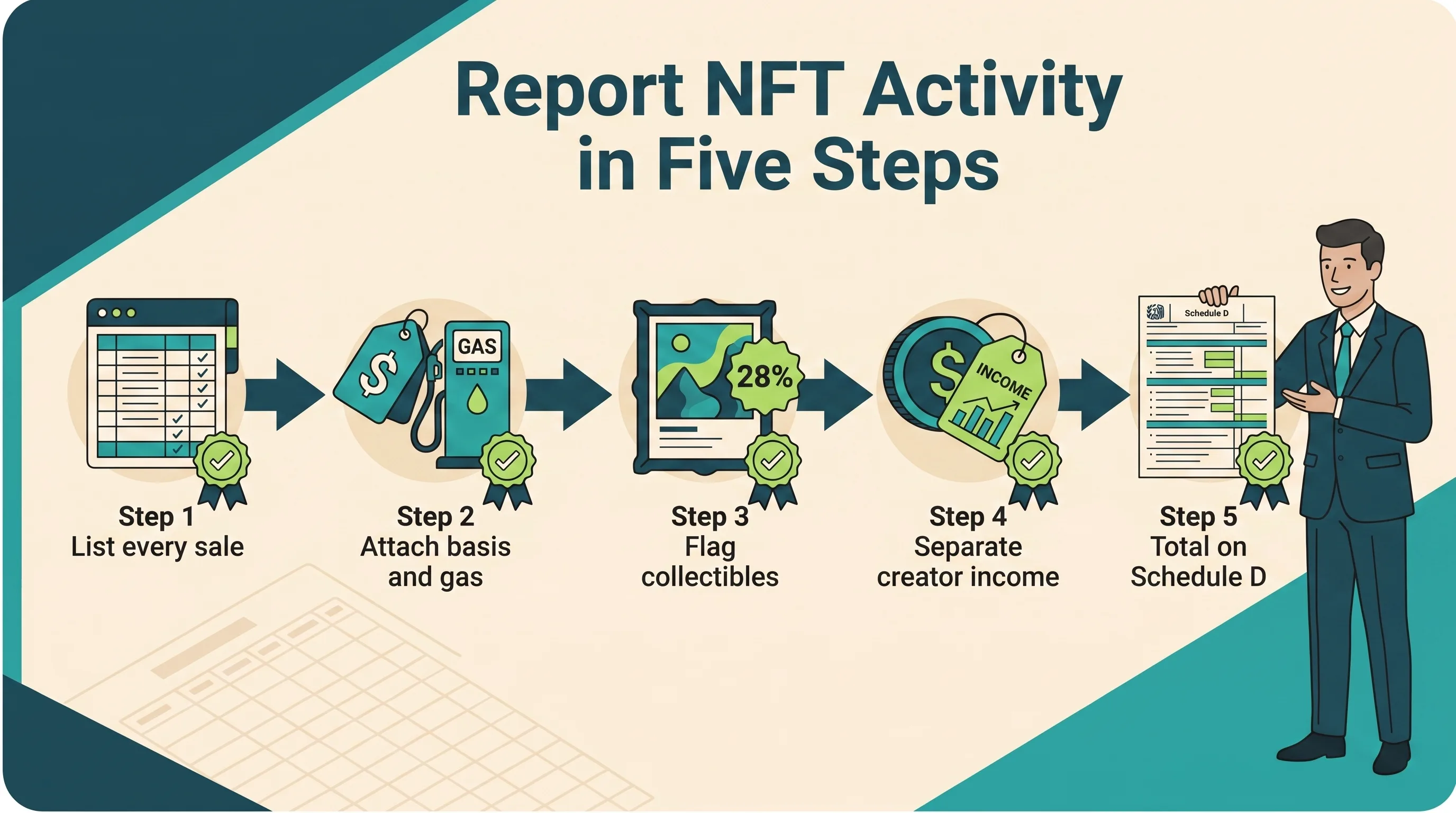
NFT reporting breaks down into a repeatable sequence. Work through it once per wallet and the numbers line up cleanly on your return.
- Pull every transaction. Export mints, buys, sales, transfers, and airdrops for each wallet from a block explorer or connected tool. Marketplaces do not send 1099s, so this is on you.
- Set cost basis. For each NFT, record what you paid plus gas. For airdrops and royalties, use the fair market value on the day you received them.
- Classify each token. Flag art-based NFTs that may hit the 28% collectible rate versus standard capital assets, and note the holding period.
- Separate income from gains. Royalties and airdrops go to Schedule 1 or Schedule C as ordinary income; sales and swaps go to Form 8949 and Schedule D.
- Reconcile and answer the digital asset question. Tie totals back to your wallet balances and check “Yes” on the Form 1040 digital asset question.
If the volume is high or you traded across several chains, human-verified crypto tax preparation removes the guesswork and produces documentation your CPA can file directly.
Bottom Line: What to Do Next
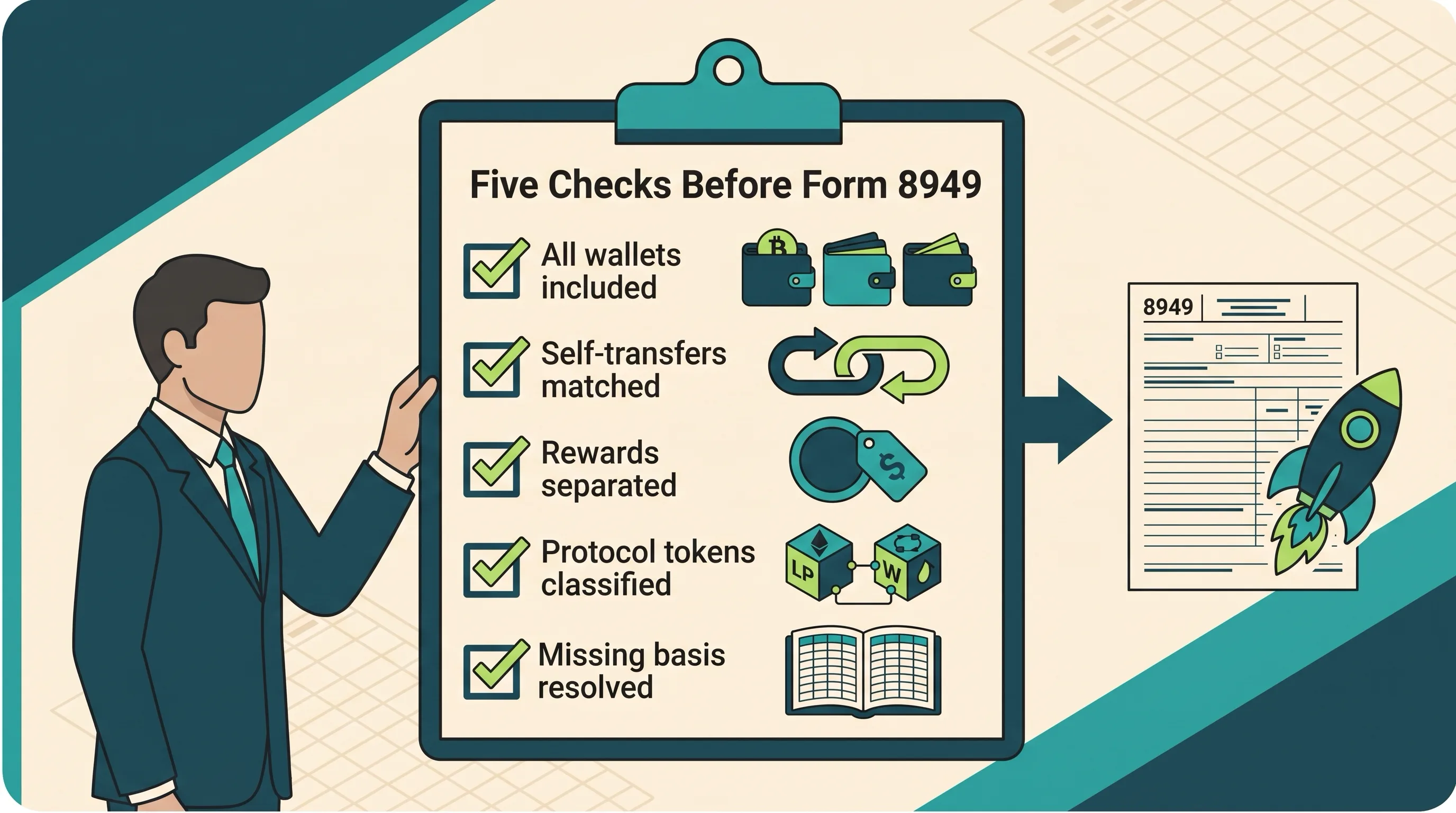
NFT and DeFi taxes are not optional, and they are not simple. Every mint, swap, deposit, and reward claim creates a tax obligation that must be tracked and reported. The 28% collectible rate on art NFTs, the taxable nature of LP deposits, and the ordinary income treatment of staking and lending rewards all add up quickly.
Here is what you should do now:
- Audit your DeFi positions. Identify every liquidity pool, staking contract, and lending position you participated in during 2025 and 2026.
- Track your cost basis. Record the fair market value of every deposit, withdrawal, wrap, and bridge. Include gas fees.
- Classify your NFTs. Determine whether each NFT you sold or plan to sell qualifies as a collectible or a standard capital asset.
- Use crypto tax software. Tools like Koinly, CoinTracker, or CoinLedger can parse DeFi transactions automatically.
- Get professional help. If your DeFi activity spans multiple chains and protocols, a crypto-specialized CPA can ensure accuracy and find deductions you might miss.
Count On Sheep specializes in crypto tax for DeFi-active clients. Schedule a consultation and let our team handle the complexity so you can focus on your portfolio.
Frequently Asked Questions
Are NFTs taxed as collectibles?
Art-based NFTs may be subject to the 28% collectible capital gains rate. Non-art NFTs (gaming items, memberships) follow standard capital gains rates. The IRS is still finalizing guidance.
Is providing liquidity to a DeFi pool taxable?
Depositing tokens into a liquidity pool is likely a taxable property exchange under current IRS guidance. You may owe capital gains tax at the time of deposit.
How is DeFi lending interest taxed?
Interest earned from DeFi lending platforms is taxed as ordinary income at fair market value when received. Report it on Schedule B.
Is impermanent loss tax deductible?
No. Impermanent loss is not recognized as a tax event until you withdraw from the liquidity pool. Only realized losses are deductible.
Do I owe taxes on wrapped tokens?
The IRS has not issued definitive guidance, but wrapping a token (e.g., ETH to WETH) is likely a taxable exchange event. Track the fair market value at the time of wrapping.
Can I claim an NFT tax write off on a worthless NFT?
Yes, but only once the loss is realized. You must sell or burn the NFT to lock in a capital loss; a drop in floor price alone is not deductible. Realized NFT losses offset capital gains, and up to $3,000 of excess loss can be applied against ordinary income per year.
How are taxes on NFT airdrops handled?
An airdropped NFT is ordinary income equal to its fair market value on the day you gain control of it. That same value becomes your cost basis, so a later sale is taxed only on the gain above it.