








(858) 434-7547
Crypto Tax Service in Florida

Crypto Tax Service
in Florida

Big 4 trained, crypto native. We bridge DeFi and TradFi for your 8949.

No state income tax in Florida means the federal 8949 is the whole equation. We produce CPA-ready 8949, Schedule D, and Schedule 1 inputs for Miami, Fort Lauderdale, and Tampa investors.

Get StartedCall (858) 434-7547
Former Big 4 + CPA leadershipCrypto native, blockchain expertsServing Florida

Keep your CPA. We do the crypto. · By the Count On Sheep team · Reviewed August 2026

Florida crypto tax service specialist hero image
Serving all of Florida
What you getForm 8949Schedule DSchedule 1
Key Facts

Key Facts About Crypto Tax Service in Florida

Florida has no state income tax and one of the largest crypto-investor populations in the country. Miami and Tampa residents arrive from high-tax states regularly, often with multi-year crypto tax work backlogs from before they relocated.

Questions first?(858) 434-7547
  1. Florida has no state income tax, crypto gains are taxed only at the federal level.
  2. Federal reporting still requires Form 8949, Schedule D, and the digital-asset question on Form 1040.
  3. Miami's crypto-native founder community drives some of the most complex crypto tax work in the U.S.
  4. Recent movers from high-tax states often need multi-year backlog crypto tax work, not just current year.
  5. As your crypto tax service specialist, Count On Sheep delivers CPA-ready 8949 and Schedule D inputs, your CPA files, or you load TurboTax.
The Problem. How We Solve It.

Crypto tax software gives you data. We make it filing-ready.

Before you file yourself or hand anything to a CPA, the crypto activity has to be reconciled. That is how Florida investors avoid duplicate disposals, unsupported basis, overstated gains, and preventable tax. Clean records improve accuracy, preserve legitimate deductions and losses, and let you reconcile each 1099-DA against the complete transaction history.

The problem

Raw exports are not a tax return.

  • Exchange exports leave transfers, fees, and missing cost basis unresolved.
  • DeFi, staking, NFTs, bridges, and wallet-to-wallet moves rarely arrive filing-ready.
  • 1099-DA reports can show proceeds without the complete basis history needed to calculate the right gain or loss.
What you receive

The inputs required to finish your crypto taxes.

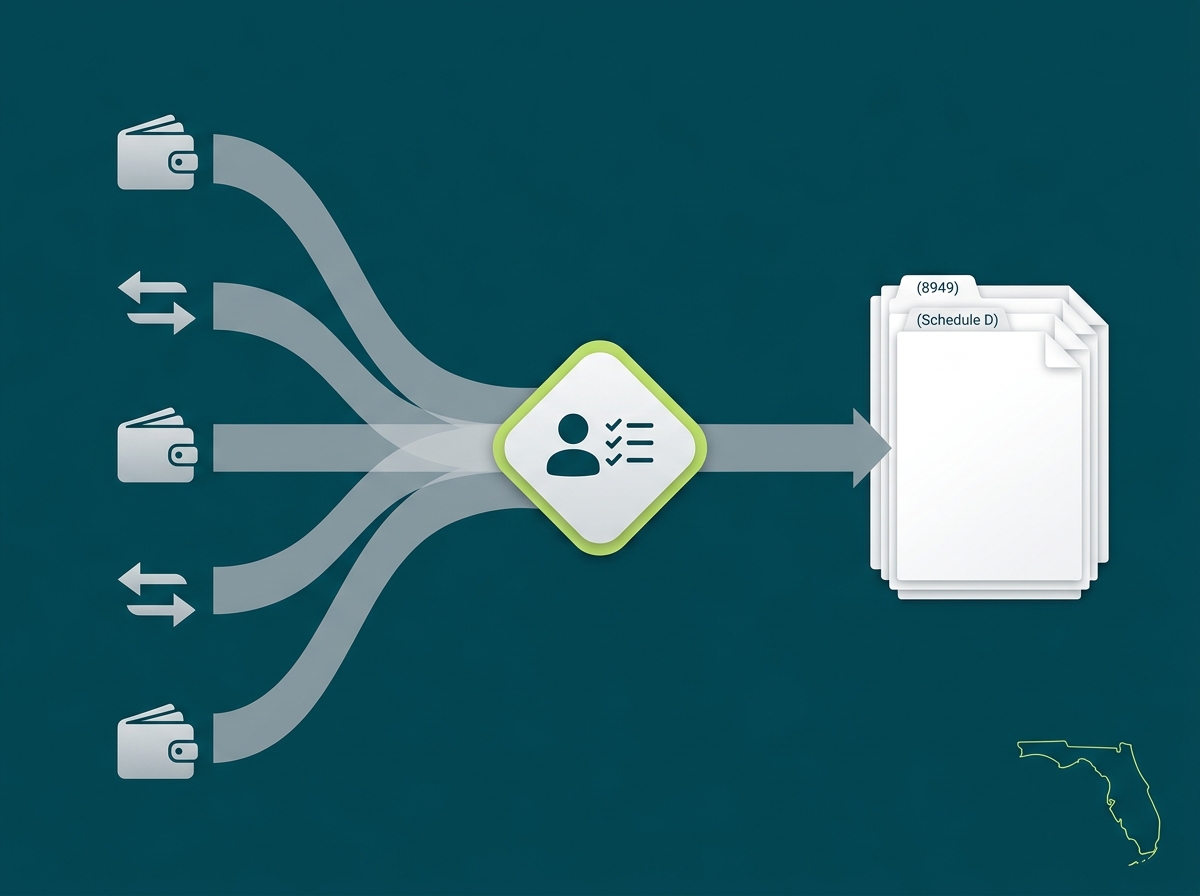
  • A reconciled transaction ledger across every wallet, exchange, chain, and protocol.
  • Completed Form 8949 inputs and Schedule D totals for capital gains and losses.
  • Schedule 1 inputs for applicable crypto income, plus payment-income workpapers your tax preparer can classify correctly.
Real Stories, Real Results

What Our Clients Say

Reputation is everything! See what our clients are saying about our service and team.

★★★★★

"This team is a life saver. They are professional, communicate very fast and are pleasant to deal with."

Chris ChambersGoogle Review
★★★★★

"Matt was professional, thorough, timely and had a great understanding of my situation."

Jo JustusGoogle Review
★★★★★

"Reconciled all my previous years and set me up for a clean slate moving forward. Very thorough and transparent."

Jon AbramsGoogle Review
Book a Meeting

Talk with a crypto tax service specialist.

Choose a free scoping call or a paid consultation with a former Big Four auditor. We will review your Florida crypto tax situation and map the cleanest path to filing-ready records.

  • Free scoping call or paid consult with a former Big Four auditor
  • Written quote first scope reviewed before any work begins
  • Video meetings secure document sharing and read-only access
Serving Florida

From Miami to every metro in Florida

Florida crypto investors in Miami, Fort Lauderdale, Tampa, Orlando, Jacksonville and surrounding metros throughout the state.

Florida residents from Miami to Tampa to Jacksonville pay no state income tax, but federal crypto tax work is a full-time job for active investors here. Miami's crypto-native founder and fund community runs some of the most complex DeFi, venture-token, and NFT activity in the country. New arrivals often carry multi-year backlogs from CA, NY, or NJ. We pull every wallet, exchange, and DeFi protocol into one ledger and hand off CPA-ready 8949, Schedule D, and Schedule 1 inputs. Count On Sheep is your crypto tax service specialist in Florida. Your CPA stays your CPA. We handle the crypto, they file the federal return.

City guides
Florida crypto tax service specialist flow illustration
Statewide · secure video meetings
Florida Tax Facts

How Florida treats crypto for tax

State Income Tax
None
No state income tax (constitutionally prohibited)
Federal Conformity
n/a
State-Specific Crypto Guidance: None issued as of 2026

Federal Crypto Tax Treatment

Applies to every Florida resident, on top of the state layer above.

Event
Federal treatment
Selling crypto for USD
Capital gain (short or long-term)
Crypto-to-crypto swapCommonly missed
Capital gain on both legs
Mining income
Ordinary income at FMV on receipt; basis for later sale
Staking rewards
Ordinary income at FMV on receipt
Airdrop received
Ordinary income at FMV on receipt
NFT sale
Capital gain (collectible rules may apply for some)
DeFi yield / LP rewards
Ordinary income at FMV on receipt

Reportable on Form 8949, Schedule D, Schedule 1 (or Schedule C for mining as a trade or business). Count On Sheep produces these inputs from your complete on-chain history.

Florida Deep Dive

Federal crypto reporting plus move-year continuity for Florida residents

Florida does not impose an individual income tax, but its crypto investors still need a complete federal ledger. The distinctive Florida problem is continuity: many new residents arrive with assets, basis, prior-state returns, and unresolved transactions accumulated before the move.

Florida removes the individual state layer, not federal reporting

Selling, exchanging, or spending digital assets can still create federal capital gains and losses. Staking, mining, airdrops, compensation, and business receipts can create income. Florida residency does not erase those federal events or the records required to support them.

Count On Sheep reconciles the digital-asset activity into Form 8949, Schedule D, Schedule 1, and business-income inputs. Your CPA completes the federal return and determines whether any prior-state, entity, or other filing remains necessary.

Assets do not receive new basis merely because the owner moved

A taxpayer who bought crypto while living in another state generally carries the same acquisition history into Florida. Moving the asset to a new wallet or broker after relocation also does not create a new purchase price. Missing records from before the move therefore remain a current filing problem.

We trace those lots through old exchange accounts, self-custody wallets, and later deposits. The supported original cost, acquisition date, and subsequent activity become part of the Florida resident’s federal ledger even when the transaction history spans several states.

A move year needs exact disposal timestamps

The former state may evaluate transactions completed while the taxpayer was still a resident or apply its own sourcing rules. A monthly software summary cannot show whether a disposal occurred before or after the documented move date. The ledger needs the actual timestamp and source record.

Count On Sheep supplies the crypto chronology. The taxpayer and CPA supply the independent residency evidence and apply each jurisdiction’s rules. That avoids making unsupported state conclusions from blockchain activity alone.

Florida worked example: old California lot sold after relocation

Assume an investor acquired a token for $50,000 while living in California, moved to Florida, transferred the token into a new broker, and later sold it for $140,000. The new broker may show $140,000 of proceeds and no basis, but the move did not eliminate the supported $50,000 acquisition cost.

Reconciliation connects the original purchase, owned-wallet transfers, move chronology, and final sale. Your CPA determines which state rules apply to the transaction. Our role is to prevent a missing-basis report from overstating the federal gain by $50,000.

Miami DeFi and international activity still needs source-by-source evidence

Florida portfolios can include decentralized exchanges, NFT marketplaces, token ventures, offshore platforms, and dollar or stablecoin off-ramps. The location of a platform does not make its transactions invisible, and an offshore account can introduce reporting questions beyond the crypto ledger.

We reconcile the transactions and identify accounts or data gaps that need CPA review. FBAR, FATCA, entity, residency, and international-tax decisions remain with the return preparer or attorney. The workpapers make those conversations concrete by showing the actual accounts and flows.

The Florida handoff preserves prior-year continuity

The deliverable includes current Form 8949 inputs, Schedule D totals, digital-asset income schedules, transfer matching, closing positions, broker-report reconciliation, and notes on unresolved prior-year lots. When prior returns supplied opening inventory, we tie the current work back to those records.

That continuity matters after a move because the federal portfolio did not restart at the state line. Your CPA can see which lots originated in earlier years, what was sold after relocation, and which questions require former-state analysis.

A Florida address does not answer former-state residency questions

Changing a mailing address, exchange profile, or driver license is not the complete legal test for leaving another state. California, New York, and other jurisdictions evaluate broader facts. The crypto ledger should not claim that a gain belongs only to Florida because the broker profile changed before the sale.

We report the exact transaction chronology and the account evidence available. Your CPA or attorney builds the residency position from the complete facts and applies each state’s law. This separation protects the accuracy of both the ledger and the residency file.

Inherited and gifted crypto needs predecessor records

Florida residents may receive digital assets from family members, trusts, or estates. The wallet transfer itself does not establish the correct tax basis. Gift basis, inherited basis, acquisition date, valuation, and later sale treatment depend on documents outside the blockchain transaction.

We trace the units after receipt and connect them to the documents supplied. Your CPA determines the correct starting basis and holding period. If the predecessor information is incomplete, the exception remains visible before any later disposal report is finalized.

Crypto businesses in Florida still need revenue-to-wallet controls

A Florida company that invoices in dollars and accepts crypto needs the invoice, receipt value, customer payment, wallet deposit, and later disposition to agree. Without that chain, revenue can be duplicated, omitted, or disconnected from the basis used when the asset is sold.

Count On Sheep reconciles the digital-asset flow. The company’s bookkeeper and CPA control accounts receivable, expenses, payroll, entity filings, and other business records. The handoff shows how the wallet activity ties back to the records they maintain.

NFT and venture-token records need contracts and marketplace history

Miami investors and founders may hold NFTs, token warrants, locked allocations, or venture distributions that do not resemble ordinary exchange trades. Marketplace proceeds, creator royalties, gas, vesting, purchase agreements, and entity records can all affect the eventual reporting analysis.

We connect the on-chain activity to the documents provided and keep uncertain terms visible. Your CPA or attorney interprets the contract, decides character and timing, and determines whether the activity belongs to an individual, business, partnership, trust, or fund.

Stablecoin off-ramps should reconcile to cash and bank records

A transfer from a wallet to an exchange followed by a stablecoin sale and bank withdrawal can create several records for one economic cash-out. If those records are imported without matching, proceeds can be duplicated or the wallet deposit can receive zero basis.

We connect the on-chain transfer, exchange conversion, fees, and withdrawal. The business or taxpayer retains bank statements and source-of-funds documentation. The CPA receives a crypto ledger that explains how the dollars reached the account without counting the same value twice.

Florida closing lots preserve the history for future sales

Many new residents move long-held assets into new custody after arriving. A closing inventory records the remaining quantity, acquisition date, supported basis, and current location without pretending that the custody change was a new purchase.

That inventory becomes the next year’s opening file and supports later Form 8949 reporting. It also tells the CPA which lots originated before the move and which unresolved records still need attention before a large disposition.

Florida crypto records, especially after a move

  • Every exchange and wallet record from before and after Florida residency
  • Prior-year federal and former-state returns involving crypto
  • Opening lot inventories and Form 8949 files from the prior preparer
  • Move dates and supporting residency documents for your CPA
  • DeFi, NFT, offshore-platform and stablecoin transaction histories
  • Forms 1099-DA and other statements that may lack transferred basis
Common Issues

What we untangle for Florida crypto investors

Florida pattern 01

Recent movers from CA, NY, NJ with multi-state tax-year histories and unrealized positions

Florida pattern 02

Miami crypto-native founders and funds with complex DeFi and venture-token activity

Primary Sources

Authorities used for this Florida crypto tax guide

Reviewed August 2026. These first-party resources support the general federal and state information on this page. Your CPA applies the current instructions to your return; Count On Sheep supplies the reconciled crypto records and form-ready inputs.

Crypto Tax Resource Path

Go from Florida guidance to the records your CPA needs

Follow the Florida service path into the national forms, basis, DeFi, and reconciliation guidance behind the local engagement.

Florida: National crypto tax service

See how Count On Sheep turns exchange, wallet, DeFi, NFT, and income activity into one CPA-ready reconciliation package.

Florida: Form 1099-DA guide

Understand broker-reported proceeds, transferred assets, missing basis, and the records needed to reconcile the form.

Florida: Fix missing or incorrect cost basis

Follow the evidence path from prior exchanges and self-custody wallets to supported Form 8949 basis.

Florida: DeFi and NFT tax records

Learn what to preserve for liquidity pools, staking, lending, bridges, NFTs, and related income or disposal events.

Florida: What a CPA-ready report contains

Review the Form 8949, Schedule D, income, cost-basis, and supporting workpapers delivered after reconciliation.

FAQ

Common questions, Florida edition

Does Florida tax individual crypto gains?

Florida does not impose an individual income tax. Federal tax and reporting still apply, and a former state may have questions for transactions completed around a move or under its own sourcing rules.

Does moving to Florida reset my crypto cost basis?

No. A move does not create a new purchase price or acquisition date. The supported history from the original acquisition follows the asset through owned-wallet transfers and into later federal reporting.

What should a new Florida resident provide?

Provide exchange and wallet records from before and after the move, prior federal and former-state returns, opening lot inventories, Forms 1099-DA, the move date, and records for DeFi, NFT, staking, or business activity.

Can Count On Sheep decide which state taxes a move-year sale?

No. We document the transaction date, proceeds, basis, and lot history. Your CPA or attorney applies each state’s residency and sourcing rules using evidence outside the crypto ledger.

How are offshore exchanges handled for a Florida client?

We reconcile the available transaction history and identify accounts or gaps for review. Your CPA or attorney determines FBAR, FATCA, entity, residency, and other international reporting obligations.

What is included in the Florida CPA-ready package?

Form 8949 inputs, Schedule D totals, digital-asset income schedules, transfer matching, closing positions, broker-report reconciliation, prior-year continuity notes, and a list of unresolved items.

Ready to get your crypto tax handled and CPA-ready?

Book a free scoping call or call us directly. We serve Florida residents.

Call (858) 434-7547Get Started

Keep your CPA. We do the crypto.

Nearby States

Serving Crypto Investors in Nearby States

The same crypto tax reconciliation, wherever you file from next.

GeorgiaAlabamaView all 50 states →