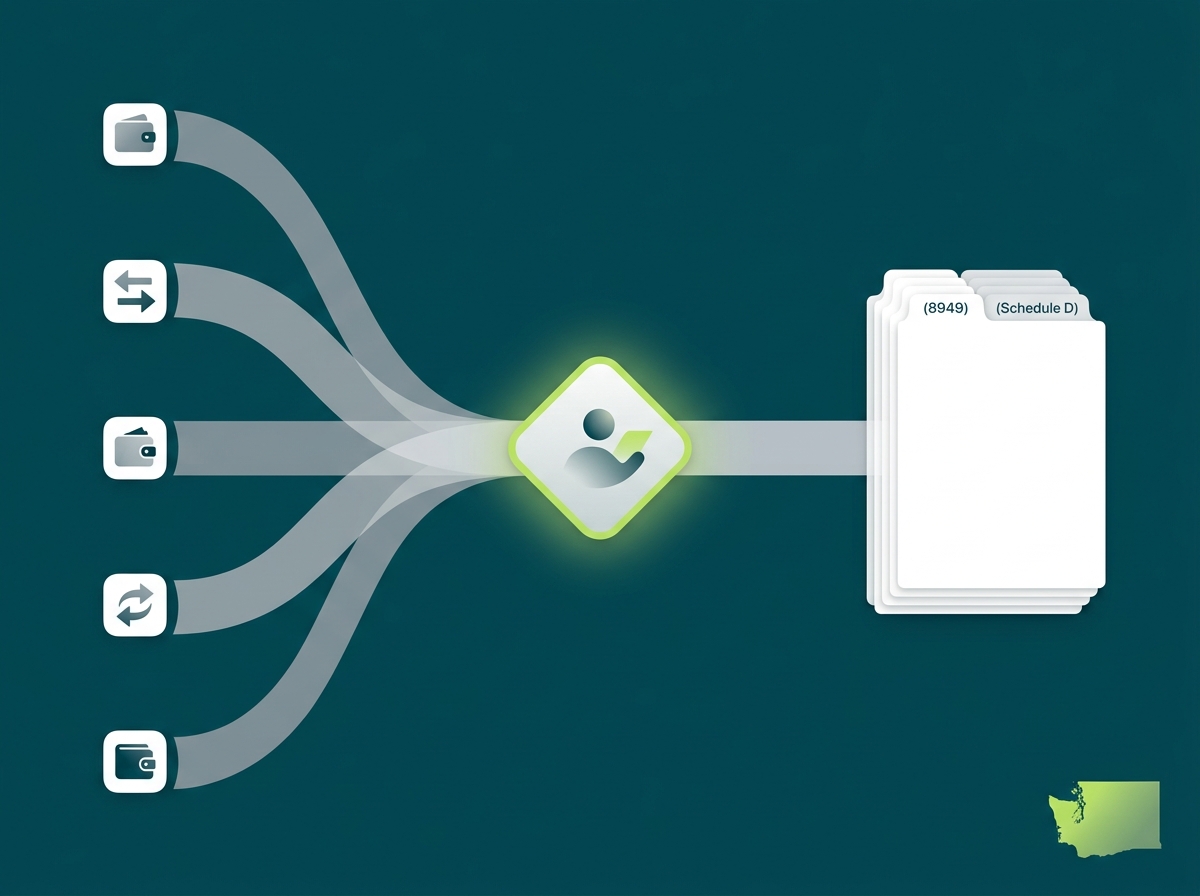
Big 4 trained, crypto native. We bridge DeFi and TradFi for your 8949.
Washington taxes no wages, but large net long-term gains can trigger a separate state capital-gains filing. We deliver the CPA-ready Form 8949, Schedule D, and Schedule 1 inputs that calculation starts with.
Former Big 4 + CPA leadershipCrypto native, blockchain expertsServing Washington
Keep your CPA. We do the crypto. · By the Count On Sheep team · Reviewed August 2026
Serving all of Washington
What you getForm 8949Schedule DSchedule 1
Featured In
WA
Key Facts
Key Facts About Crypto Tax Service in Washington
Washington has no state income tax on wages, but its separate capital-gains tax can apply to net long-term gains above an indexed deduction. For tax year 2025, the standard deduction is $278,000, the base rate is 7%, and taxable gains above $1 million face an additional 2.9%. Per-lot holding periods and basis determine which crypto gains enter that calculation.
01Washington has no state tax on wages, but for tax year 2025 it taxes net long-term capital gains above a $278,000 standard deduction at 7%, with a 2.9% surtax above $1 million of taxable gain.
02Federal reporting still requires Form 8949, Schedule D, and the digital-asset question on Form 1040.
03Crypto long-term gains count toward the WA capital-gains threshold, per-lot accuracy is critical.
04Seattle / Bellevue tech employees often combine RSUs and crypto, requiring combined basis tracking.
05As your crypto tax service specialist, Count On Sheep produces CPA-ready 8949 and Schedule D inputs. Your CPA files, or you load TurboTax.
The Problem. How We Solve It.
Crypto tax software gives you data. We make it filing-ready.
Before you file yourself or hand anything to a CPA, the crypto activity has to be reconciled. That is how Washington investors avoid duplicate disposals, unsupported basis, overstated gains, and preventable tax. Clean records improve accuracy, preserve legitimate deductions and losses, and let you reconcile each 1099-DA against the complete transaction history.
The problem
Raw exports are not a tax return.
Exchange exports leave transfers, fees, and missing cost basis unresolved.
DeFi, staking, NFTs, bridges, and wallet-to-wallet moves rarely arrive filing-ready.
1099-DA reports can show proceeds without the complete basis history needed to calculate the right gain or loss.
What you receive
The inputs required to finish your crypto taxes.
A reconciled transaction ledger across every wallet, exchange, chain, and protocol.
Completed Form 8949 inputs and Schedule D totals for capital gains and losses.
Schedule 1 inputs for applicable crypto income, plus payment-income workpapers your tax preparer can classify correctly.
Real Stories, Real Results
What Our Clients Say
Reputation is everything! See what our clients are saying about our service and team.
★★★★★
"This team is a life saver. They are professional, communicate very fast and are pleasant to deal with."
Chris ChambersGoogle Review
★★★★★
"Matt was professional, thorough, timely and had a great understanding of my situation."
Jo JustusGoogle Review
★★★★★
"Reconciled all my previous years and set me up for a clean slate moving forward. Very thorough and transparent."
Jon AbramsGoogle Review
Book a Meeting
Talk with a crypto tax service specialist.
Choose a free scoping call or a paid consultation with a former Big Four auditor. We will review your Washington crypto tax situation and map the cleanest path to filing-ready records.
Free scoping call or paid consult with a former Big Four auditor
Written quote first scope reviewed before any work begins
Video meetings secure document sharing and read-only access
Serving Washington
From Seattle to every metro in Washington
Washington crypto investors in Seattle, Tacoma, Bellevue, Spokane, Redmond and surrounding metros throughout the state.
Washington crypto investors in Seattle, Spokane, Tacoma, Vancouver, and Bellevue pay no state tax on wages, but the state can tax net long-term capital gains above an indexed deduction. For tax year 2025, the deduction is $278,000 and the rate reaches 9.9% on taxable gains above $1 million. Per-lot crypto tax work distinguishing short-term and long-term disposals is what determines which gains flow into the separate Washington calculation. We rebuild the ledger and hand off CPA-ready Form 8949, Schedule D, and Schedule 1 inputs. Your CPA uses those records for the federal return and any required Washington capital-gains filing.
No tax on wages; for tax year 2025, Washington taxes net long-term capital gains above the $278,000 standard deduction at 7%, with a 2.9% surtax on taxable gains above $1 million
Applies to every Washington resident, on top of the state layer above.
Event
Federal treatment
Selling crypto for USD
Capital gain (short or long-term)
Crypto-to-crypto swapCommonly missed
Capital gain on both legs
Mining income
Ordinary income at FMV on receipt; basis for later sale
Staking rewards
Ordinary income at FMV on receipt
Airdrop received
Ordinary income at FMV on receipt
NFT sale
Capital gain (collectible rules may apply for some)
DeFi yield / LP rewards
Ordinary income at FMV on receipt
Reportable on Form 8949, Schedule D, Schedule 1 (or Schedule C for mining as a trade or business). Count On Sheep produces these inputs from your complete on-chain history.
Washington State Deep Dive
How Washington State crypto records become a filing-ready tax package
Washington starts from federal net long-term capital gains, so the state answer is only as reliable as the wallet-level acquisition dates, proceeds, basis, and transfer history behind Form 8949. The purpose of reconciliation is to make those inputs consistent before your CPA prepares either return.
01
First separate long-term disposals from everything else
Washington does not apply its capital-gains tax to wages, staking income, mining income, or short-term capital gains. It focuses on net long-term capital gains after the state calculation and available deductions. That makes the acquisition date of each crypto lot a state-level fact, not just a federal detail.
A transfer between your own wallets should preserve the original acquisition date and basis. When software treats that transfer as a sale, loses the inbound lot, or assigns a zero basis, it can create a false gain and an incorrect holding period. We match both sides of the transfer before any Washington total is produced.
02
Then reconcile Form 1099-DA against the complete ledger
Form 1099-DA can report proceeds from a broker, but a broker may not have the basis for assets that arrived from another exchange or self-custody wallet. Reporting the proceeds is still necessary. The reconciliation job is to document the missing acquisition history and place the supported basis and adjustments on Form 8949.
The completed ledger should explain every disposal, not merely match one broker statement. It should include centralized exchanges, self-custody wallets, bridges, decentralized exchanges, liquidity positions, staking receipts, and any manual transactions that affect basis. That is the record your CPA uses to reconcile broker reporting with the return.
03
Washington worked example: a $500,000 long-term gain
Assume a Washington resident has $500,000 of net long-term capital gain for tax year 2025 and no other adjustment, exemption, credit, or deductible charitable contribution. Subtracting the $278,000 standard deduction leaves $222,000 of taxable Washington capital gain. At the 7% base rate, the illustrative state tax is $15,540.
That example changes if the federal ledger includes short-term lots, unsupported zero-basis entries, duplicated transactions, excluded assets, other long-term gains or losses, or facts affecting Washington allocation. It is not a quote or tax recommendation. It shows why a lot-level federal result must be completed before the state calculation can be trusted.
04
What your CPA-ready Washington package contains
Count On Sheep delivers the transaction detail and workpapers behind the crypto portion of the return: Form 8949 inputs with proceeds, basis, dates, holding period and adjustments; Schedule D totals; Schedule 1 inputs for staking, rewards and other digital-asset income; and Schedule C inputs when crypto was received through a trade or business.
The package also includes reconciliation workpapers that identify transfers, unresolved items, assumptions and the source records used. Your CPA applies the current federal and Washington instructions, combines the crypto results with the rest of your tax picture, and files the returns. If you self-file federally, the same supported inputs are available for your software workflow.
05
Seattle and Bellevue portfolios often mix equity compensation with crypto
A Washington capital-gains return is not calculated from crypto in isolation. Long-term gains from taxable stock sales can occupy part of the same state deduction before a Bitcoin, Ethereum, or token disposal is added. Seattle and Bellevue taxpayers with employer equity therefore need their CPA to see a combined capital-gains picture, even when Count On Sheep is engaged only for the digital-asset ledger.
We keep the boundary clear. Our workpapers identify the reconciled crypto proceeds, basis, holding periods, and net results. Your CPA adds stock, partnership, business, charitable, residency, and other tax facts outside the crypto engagement. This avoids pretending that one wallet report can calculate the complete Washington liability.
06
Domicile dates matter when a large disposal occurs around a move
Washington allocates gains under its own domicile rules, while a former state may apply separate residency and sourcing standards. If a taxpayer moves between California and Washington near a large crypto sale, the ledger needs a dependable disposal timestamp and the tax file needs independent evidence supporting the move date. One set of records cannot substitute for the other.
Count On Sheep supplies the transaction chronology: when the asset was acquired, where it moved, when control changed, what was received, and how basis was supported. Your CPA or attorney evaluates domicile and state allocation. Keeping those roles separate produces a cleaner audit trail and prevents unsupported residency conclusions from being embedded in crypto software.
Washington State records to collect before reconciliation
Every exchange export or read-only connection, including closed accounts
Public wallet addresses for every chain and self-custody wallet used
Acquisition records for assets transferred into a broker that lacks basis
Prior-year Form 8949 files and closing lot inventories
Staking, mining, airdrop and crypto-payment records with receipt dates and values
Move dates if Washington domicile changed during a year with large disposals
Common Issues
What we untangle for Washington crypto investors
Washington pattern 01
Washington's tiered tax on net long-term gains above an indexed deduction makes per-event holding-period and basis accuracy critical
Washington pattern 02
Seattle / Bellevue tech-employee RSU-plus-crypto stacks with high six-figure activity
Primary Sources
Authorities used for this Washington crypto tax guide
Reviewed August 2026. These first-party resources support the general federal and state information on this page. Your CPA applies the current instructions to your return; Count On Sheep supplies the reconciled crypto records and form-ready inputs.
Review the Form 8949, Schedule D, income, cost-basis, and supporting workpapers delivered after reconciliation.
FAQ
Common questions, Washington edition
How does Washington's capital-gains tax interact with crypto?
Washington starts with federal net long-term capital gains and applies an indexed standard deduction. For tax year 2025, the deduction is $278,000, the base rate is 7%, and taxable gains above $1 million face an additional 2.9%. Whether a crypto disposal enters that calculation depends on accurate acquisition dates, holding periods, proceeds, and basis.
Does Washington State tax every type of crypto income?
No. Washington does not tax wages, staking income, mining income, or short-term capital gains through its capital-gains tax. It starts with net long-term capital gains, then applies the state calculation and indexed deduction. Federal tax can still apply to every one of those categories.
What is the Washington capital-gains deduction for tax year 2025?
The standard deduction is $278,000 of net long-term capital gain for tax year 2025. Washington applies a 7% base rate above the deduction and an additional 2.9% to taxable gains above $1 million. The Department of Revenue adjusts the deduction annually.
Why does crypto cost basis matter in Washington State?
Basis determines the size of each federal gain, while the acquisition date determines whether the lot is long-term and enters the Washington calculation. A missing inbound transfer can create both a false zero-basis gain and the wrong holding period.
How should Form 1099-DA be handled when basis is missing?
The proceeds reported by the broker still need to be reconciled. We trace assets back through prior exchanges and self-custody wallets, document supported basis and acquisition dates, and produce Form 8949 inputs that reconcile the broker statement with the complete ledger.
Does Count On Sheep file the Washington capital-gains return?
No. Count On Sheep reconciles the crypto activity and produces Form 8949, Schedule D, Schedule 1, and supporting workpaper inputs. Your CPA combines those records with the rest of your tax position and files the federal return and any required Washington capital-gains return.
What records should a Washington crypto investor provide?
Provide every exchange export or read-only connection, public wallet addresses, prior-year Form 8949 files, closing lot inventories, staking or mining records, and any move dates that affect Washington domicile. Include closed accounts and assets transferred into brokers that do not know the original basis.
Ready to get your crypto tax handled and CPA-ready?
Book a free scoping call or call us directly. We serve Washington residents.