

If you filed a tax extension in April, your 2025 federal return is due October 15, 2026. That is a hard deadline. There is no second extension for individuals, and the moment it passes, the most expensive penalty in the IRS playbook starts running on whatever you owe.
For crypto investors, the extension window exists for one reason: the records were a mess in April. Multiple exchanges, a few wallets, some DeFi activity, and a 1099-DA that did not match anything. Six months later, the mess has not fixed itself. This guide covers exactly what happens if you miss October 15, why crypto makes extension season harder, and the cleanup steps to run now, in order.
Disclaimer: This guide is for informational purposes only. Penalty and interest amounts depend on your specific facts, so consult a qualified CPA about your situation.
What Your Tax Extension Actually Bought You
A tax extension moves your filing deadline, not your payment deadline. Filing Form 4868 by April 15, 2026 gave you until October 15, 2026 to file your 2025 return. Any tax you owed was still due back in April.
Here is what that means in practice. If you owe money and did not pay it with your extension, two meters have been running since April 16:
- Interest on the unpaid balance, currently 7% for the third quarter of 2026, compounded daily.
- The late-payment penalty: 0.5% of the unpaid tax for each month or part of a month, up to 25%.
There is one useful carve-out: if you paid at least 90% of your actual tax by April 15 and pay the rest when you file, the IRS generally waives the late-payment penalty for the extension period. Interest still applies, but it is small money by comparison.
So the extension protected you from the big penalty, the failure-to-file penalty. It keeps protecting you only if you actually file by October 15.
What Happens If You Miss October 15
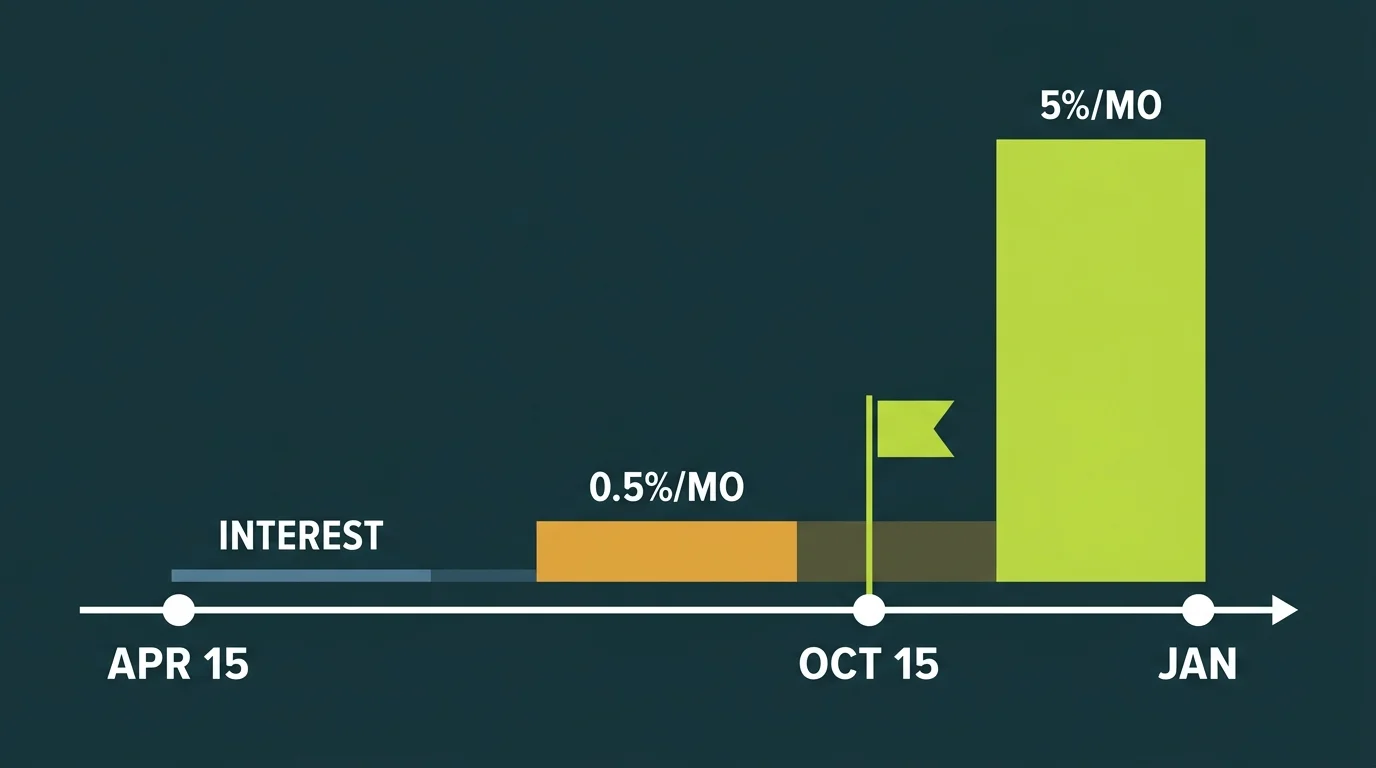
Miss the extension deadline and the failure-to-file penalty kicks in: 5% of your unpaid tax for each month or part of a month the return is late, capped at 25%. That is ten times the rate of the late-payment penalty. When both penalties apply in the same month, the failure-to-file portion drops to 4.5% so the combined hit is 5% per month, but the cap math still gets ugly fast.
Two more details worth knowing:
- File more than 60 days after the deadline and the minimum failure-to-file penalty for 2025 returns is the lesser of $525 or 100% of the unpaid tax. Even a small balance triggers it.
- Interest never stops. It compounds daily on the tax, and penalties accrue their own interest too.
One thing that surprises people: these penalties are a percentage of unpaid tax. If you are owed a refund, there is no failure-to-file penalty at all, though you forfeit the refund entirely if you wait more than three years to claim it. Most crypto investors on extension are not in refund territory, which is exactly why the deadline matters.
Why Extension Filers With Crypto Are in a Tougher Spot
Most extension filers just needed a K-1 that showed up late. Crypto extension filers usually have a structural problem: the data needed to compute gains does not live in any one place.
The typical picture looks like this. Trades across two or three exchanges, some of them closed or migrated. Self-custody wallets with swaps and bridging. Staking rewards trickling in weekly. Cost basis that vanished every time coins moved between platforms. None of it adds up to a Form 8949 without real reconciliation work.
And 2026 raised the stakes. This is the first filing season with Form 1099-DA, the new broker form for digital assets. For 2025 transactions, exchanges reported your gross proceeds to the IRS, but in most cases not your cost basis. The IRS sees what you sold. It does not see what you paid. If you file numbers that do not line up with those proceeds, or skip filing, the mismatch is sitting in their system.
There is also a newer wrinkle in how basis must be tracked. Since January 1, 2025, cost basis is tracked wallet by wallet rather than across your whole portfolio, under the per-wallet rules in Rev Proc 2024-28. If your software is still lumping everything into one universal pool, your 2025 numbers may be wrong even if every transaction imported cleanly.
Your Crypto Cleanup Checklist Before October 15

Work these steps in order. Each one feeds the next, and skipping ahead is how phantom gains end up on a return.
Step 1: List every account and wallet you touched in 2025. Exchanges, wallets, DeFi protocols, NFT marketplaces, even the platform you only used once. A single missing wallet can break the cost basis chain for everything downstream.
Step 2: Export complete transaction histories. Full-year CSVs or API connections from every exchange, and transaction records for every wallet address. Do this early. Closed or migrated platforms can take weeks to produce records, and October is their busy season too.
Step 3: Collect your 1099-DA forms and match them. Every 1099-DA you received went to the IRS as well. Check that the gross proceeds on each form appear in your transaction data. Unexplained gaps are the first thing to resolve, not the last.
Step 4: Reconcile cost basis, wallet by wallet. This is the heavy lift. Every disposal needs an acquisition date and price behind it, tracked per wallet for 2025. Watch for the classic failure modes: transfers between your own wallets misread as sales, missing basis defaulting to zero, and staking income double-counted as both income and a zero-basis sale.
Step 5: Classify your income events. Staking rewards, airdrops, mining, and interest are ordinary income at fair market value when received. That value then becomes the cost basis for the eventual sale. Miss the income event and you get penalized twice: understated income now, overstated gain later.
Step 6: Build Form 8949 and Schedule D from the reconciled data. Once every disposal has proceeds, basis, dates, and holding period, the forms are mechanical. Our complete guide on how to do your crypto taxes walks through the full filing process, forms included.
Step 7: Answer the digital asset question and file. Every Form 1040 asks whether you received or disposed of digital assets during the year. Answer it accurately. It is signed under penalty of perjury, and a false “No” is far worse than a messy “Yes.”
If you ran your data through Koinly or CoinTracker back in March and the output looked wrong, that is normal for complex histories. Software gets you 80% of the way and stalls on transfers, DeFi, and missing basis. Our guide on fixing a messy Koinly or CoinTracker report covers why that happens and what cleanup actually involves.
The Real Cost of Blowing the Deadline
Jordan filed Form 4868 in April 2026, owing about $8,000 on 2025 crypto gains he had not finished calculating. He paid nothing with the extension. Life happened, October 15 slipped by, and he finally filed in late January 2027. The damage: roughly $400 in late-payment penalties running since April, about $1,440 in failure-to-file penalties for the months past October 15, and around $430 in daily-compounding interest. Call it $2,270 added to an $8,000 bill, a 28% surcharge. If Jordan had filed by October 15 and set up a payment plan, the same situation would have cost him roughly $500 in penalties and interest. Filing by the deadline, even without paying a dollar of the balance, would have saved him about $1,750.
The lesson generalizes. The expensive mistake is not owing money. It is failing to file because the records were not ready. If October arrives and you cannot pay the full balance, file anyway and use an IRS payment plan. The failure-to-file penalty is the one you can always avoid.
Already Know a Past Year Is Wrong?
Extension season has a way of surfacing older problems. While rebuilding 2025 records, plenty of investors discover that 2023 or 2024 was under-reported too: a forgotten wallet, staking income that never made it onto a return, or basis that was guessed at.
The fix is a separate process, not something to cram into your October filing. An amended return on Form 1040-X corrects prior years, and doing it proactively is consistently better than waiting for the IRS to spot the mismatch. If you have already received a nudge, our guide on IRS crypto letters 6173, 6174, and 6174-A explains what each letter means and how to respond.
Get 2025 filed by October 15 first. Then fix the old years with the same reconciled data. For the full picture of how crypto is taxed, rates, and forms, our Crypto Tax Guide 2026 is the place to start. The crypto tax compliance guide covers the recordkeeping standard, and the printable 2026 crypto tax guide is useful when you want a filing checklist beside you.
Get Your Crypto Records Cleaned Up Before October 15
Here is the honest math on timing. A multi-exchange, multi-wallet reconciliation takes weeks when it is done right: gathering exports, matching transfers, rebuilding basis, resolving 1099-DA gaps. Starting in early September is comfortable. Starting on October 10 is not.
This is exactly the work Count On Sheep does. We take the raw exports, the broken software reports, and the unexplained 1099-DA proceeds, and we rebuild your complete transaction history into an accurate, defensible Form 8949 and Schedule D. You file on time with numbers that match what the IRS already has. If your extension exists because the crypto side was too messy to finish in April, hand us the mess now and beat the deadline with room to spare.
Key Takeaways
- Your extended 2025 return is due October 15, 2026, and there is no second extension
- The extension moved your filing deadline only; interest and late-payment penalties have run on any unpaid balance since April
- Missing October 15 triggers the failure-to-file penalty: 5% per month up to 25%, with a $525 minimum once you are 60 days late
- This is the first 1099-DA season, so the IRS already has your gross proceeds; your records need to explain them
- Cost basis is now tracked per wallet, and reconciling it is the real work, so start the cleanup in September, not October
- If you cannot pay in full, file anyway; the failure-to-file penalty is ten times the failure-to-pay penalty
Frequently Asked Questions
What happens if you miss the October 15 tax extension deadline?
The failure-to-file penalty starts running: 5% of your unpaid tax for each month or part of a month the return is late, up to 25%. If you are more than 60 days past the deadline, the minimum penalty for 2025 returns is the lesser of $525 or 100% of the tax due. That stacks on top of the late-payment penalty and daily-compounding interest that have been running since April.
What happens if you don't file a crypto tax return?
You face the same penalties as any non-filer: a failure-to-file penalty of 5% per month up to 25% of the unpaid tax, a late-payment penalty, and interest that compounds daily. On top of that, exchanges now send Form 1099-DA to the IRS, so the agency often already knows you had crypto proceeds. Not filing does not hide the activity. It just removes your cost basis from the record and makes the eventual bill worse.
Does the IRS know if I have crypto?
In most cases, yes. US exchanges issue Form 1099-DA reporting your gross proceeds directly to the IRS starting with 2025 transactions. The IRS has also used John Doe summonses to pull customer records from major platforms and works with blockchain analytics firms to trace on-chain activity. Assume any activity on a US exchange is visible, and plan your filing around matching those records, not avoiding them.
Do I need to report crypto on my taxes in 2026?
Yes. Every Form 1040 asks whether you received, sold, exchanged, or otherwise disposed of a digital asset during the year, and you answer it under penalty of perjury. Selling, trading one coin for another, spending crypto, and earning staking or airdrop income are all reportable. Simply buying and holding with US dollars is not taxable, but you still answer the digital asset question honestly.
Do you have to report cryptocurrency under $600?
Yes. There is no $600 minimum for reporting crypto gains or income. The $600 figure comes from certain 1099 issuance thresholds, which control when a platform must send a form, not whether you owe tax. A $50 gain from a coin swap is technically reportable. Small amounts rarely change your bill much, but leaving them off creates mismatches with what exchanges report.
How can I legally reduce the taxes I owe on crypto?
Hold assets for more than a year to qualify for long-term capital gains rates, harvest losses to offset gains, make sure every disposal carries its full cost basis so you are not taxed on phantom gains, and consider gifting or donating appreciated coins. The single biggest fix for most investors is complete cost basis records. Missing basis means the IRS treats proceeds as nearly all gain, which inflates the bill.