
Kalshi will not send you a tax form for your trading profit. Not because you got lucky, and not because the income is exempt. The exchange simply has no 1099 obligation for event contract gains, so the entire reporting job lands on you.
That job comes with a genuinely unsettled legal question (is this capital gains, gambling, or a Section 1256 contract?), a profit and loss statement that is a summary rather than a tax document, and zero withholding along the way.
This guide covers Kalshi taxes for 2026 end to end: exactly which forms Kalshi sends and which it never will, the Section 1256 debate with the actual math on both sides, how losses work under each characterization, and a step-by-step path to reporting it all correctly.
Disclaimer: This guide is for informational purposes only and is not tax advice. The characterization of event contracts is unsettled law. Talk to a qualified tax professional about your specific situation.
Do You Have to Pay Taxes on Kalshi Winnings?
Yes. All Kalshi profits are taxable income, from your first winning contract onward. There is no minimum amount that makes winnings exempt, no hobby exception, and no rule that ties your obligation to whether a form arrived in the mail.
People get tripped up here because the paperwork is so thin. A stock broker sends a 1099-B and the IRS gets a copy, so the matching is automatic. Kalshi sends nothing for your trading, so it feels like the income is off the radar. It is not. Kalshi is a CFTC-regulated designated contract market that verifies the identity of every customer. The records exist, they are complete, and the government can request them. The absence of a 1099 changes who does the math, not whether tax is owed.
One more expectation to reset: Kalshi withholds nothing. When a contract pays out, you get the full dollar. The tax on that dollar is your problem in April, or earlier. If your Kalshi profits push what you owe past $1,000 beyond your paycheck withholding, the IRS expects quarterly estimated payments during the year, not one catch-up check at filing time.
What Tax Forms Does Kalshi Send?
Kalshi issues exactly four document types, and none of them reports your event contract profit or loss. Per Kalshi’s own help center:
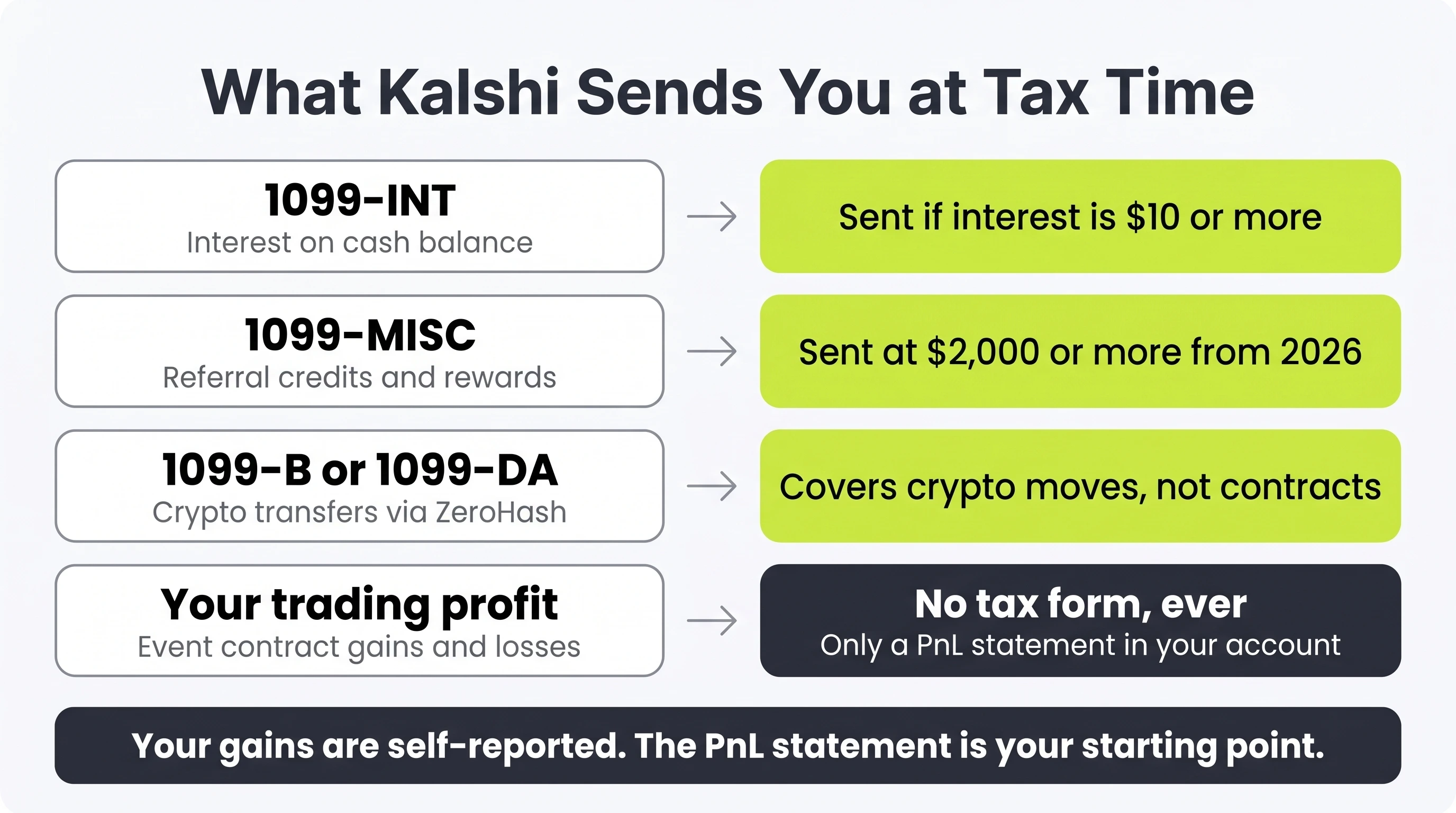
- 1099-INT if you earned $10 or more of interest on your cash balance during the year.
- 1099-MISC for referral credits, bonuses, and other rewards. The One Big Beautiful Bill Act raised the MISC reporting threshold to $2,000 for payments starting in 2026, so smaller reward totals may generate no form (they are still taxable).
- 1099-B or 1099-DA only for crypto deposits and withdrawals handled by ZeroHash, Kalshi’s crypto transfer partner. These cover the crypto movement, not your contract trading.
- A profit and loss statement, found under the Tax Info section of your account. This is the number that matters, and it is not a tax form. Nobody files it with the IRS. It exists so you can do your own reporting.
Read that list again and notice what is missing: any document covering the thing you actually do on Kalshi. Your gains and losses from trading event contracts are self-reported, full stop.
Is Kalshi Taxed as Gambling or Capital Gains?
The IRS has never said how event contract profits should be characterized, which leaves three defensible positions with three different outcomes. Most traders and most tax software land on capital gains. Here is the landscape:
Capital gains treats each contract as property: buy, sell or resolve, report the difference on Form 8949 and Schedule D. Since almost no event contract is held over a year, gains are short-term and taxed at your ordinary income rate. This fits how Kalshi actually works: an order book, bid-ask spreads, positions you can exit early.
Section 1256 is the aggressive position, covered in depth in the next section, and it can meaningfully cut your rate.
Gambling is the risk case. If a contract is functionally a bet (sports contracts sit closest to this line), profits could be ordinary income with losses deductible only if you itemize, only against winnings, and starting in 2026, only up to 90% of losses.
For the full three-way breakdown across every platform, see our complete guide to prediction market taxes.
The Section 1256 Question, Answered Plainly
Here is the honest answer: Kalshi contracts might qualify for Section 1256, nobody can promise it, and the exchange’s own behavior suggests it is not taking that position for you.
The case for: Section 1256 gives contracts traded on CFTC-qualified exchanges a special deal, with 60% of gains taxed as long-term and 40% as short-term regardless of holding period, reported on Form 6781, with open positions marked to market on December 31. Kalshi is a CFTC-designated contract market, which is the entire foundation of the argument.
The case against: nobody knows whether event contracts fit the statutory definitions Section 1256 actually lists (regulated futures contracts, nonequity options, and a few others). The IRS has issued no guidance blessing the position. And here is the tell: real futures brokers send a 1099-B with your Section 1256 totals in it. Kalshi sends nothing of the sort. The exchange is not treating its own contracts as 1256 property on your behalf.
What does the difference look like in dollars?
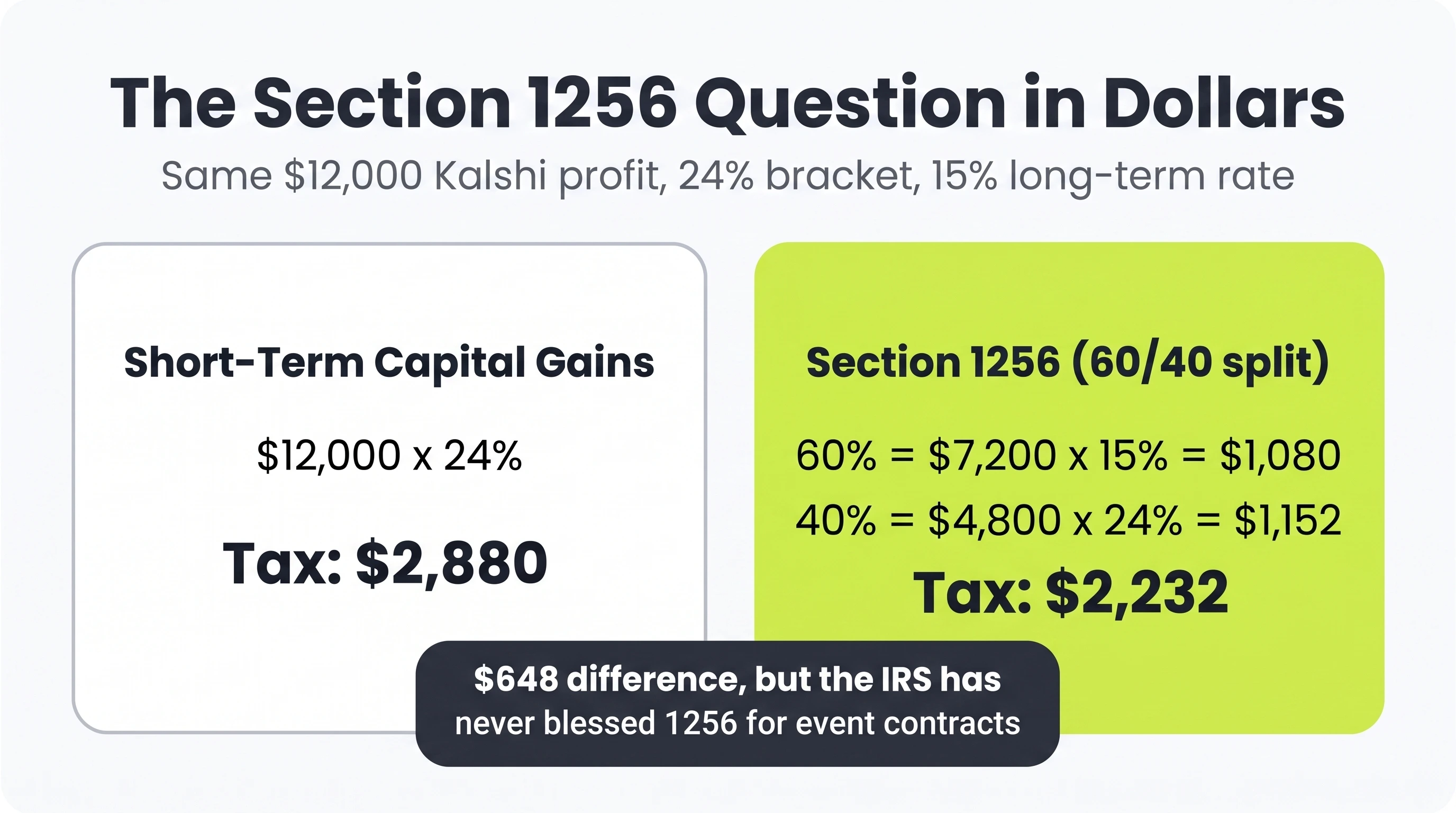
Say you clear $12,000 of net Kalshi profit in 2026, you are in the 24% bracket, and your long-term capital gains rate is 15%:
- Short-term capital gains: $12,000 at 24% = $2,880.
- Section 1256: 60% of $12,000 ($7,200) at 15% = $1,080, plus 40% ($4,800) at 24% = $1,152. Total: $2,232.
That is $648 saved on the same trades, and the gap scales with volume. Which is exactly why the position is tempting and exactly why it deserves a professional’s sign-off before you take it. If the IRS later disagrees, you amended returns and interest, not the blog you read, will be the cleanup.
How Kalshi Losses Work
Losses follow whichever characterization you chose, and the three regimes treat them very differently:
- Capital treatment: losses offset your capital gains without limit (Kalshi losses can shelter stock gains), then up to $3,000 of ordinary income per year, with the rest carried forward indefinitely.
- Section 1256 treatment: same capital loss rules, plus an election to carry net 1256 losses back three years against prior 1256 gains, and year-end mark-to-market means December losses count even on unresolved positions.
- Gambling treatment: deductible only if you itemize, only against winnings, and for tax years starting in 2026 the One Big Beautiful Bill Act caps the deduction at 90% of losses. Win $20,000 and lose $20,000 and you still owe tax on $2,000 of phantom income.
That 90% cap is new for 2026 and it changes the stakes. Before, gambling characterization was inconvenient. Now it is expensive in proportion to your volume, which matters most for high-frequency sports contract traders, the exact group most likely to face the gambling argument.
Maria trades Kalshi weather and Fed markets all year: $9,400 in winning positions, $6,200 in losers, for $3,200 of real profit. Under capital treatment she reports $3,200 of net short-term gain and her tax at 22% is $704. If her activity were characterized as gambling, she reports $9,400 of income and can deduct at most $5,580 (90% of $6,200, and only if she itemizes). Taxable: $3,820 even in the best case, and $9,400 if she takes the standard deduction. Same trades, up to $1,364 more tax.
How to Report Kalshi on Your Taxes, Step by Step
Reporting Kalshi comes down to five steps: export, compute, characterize, file, reconcile.
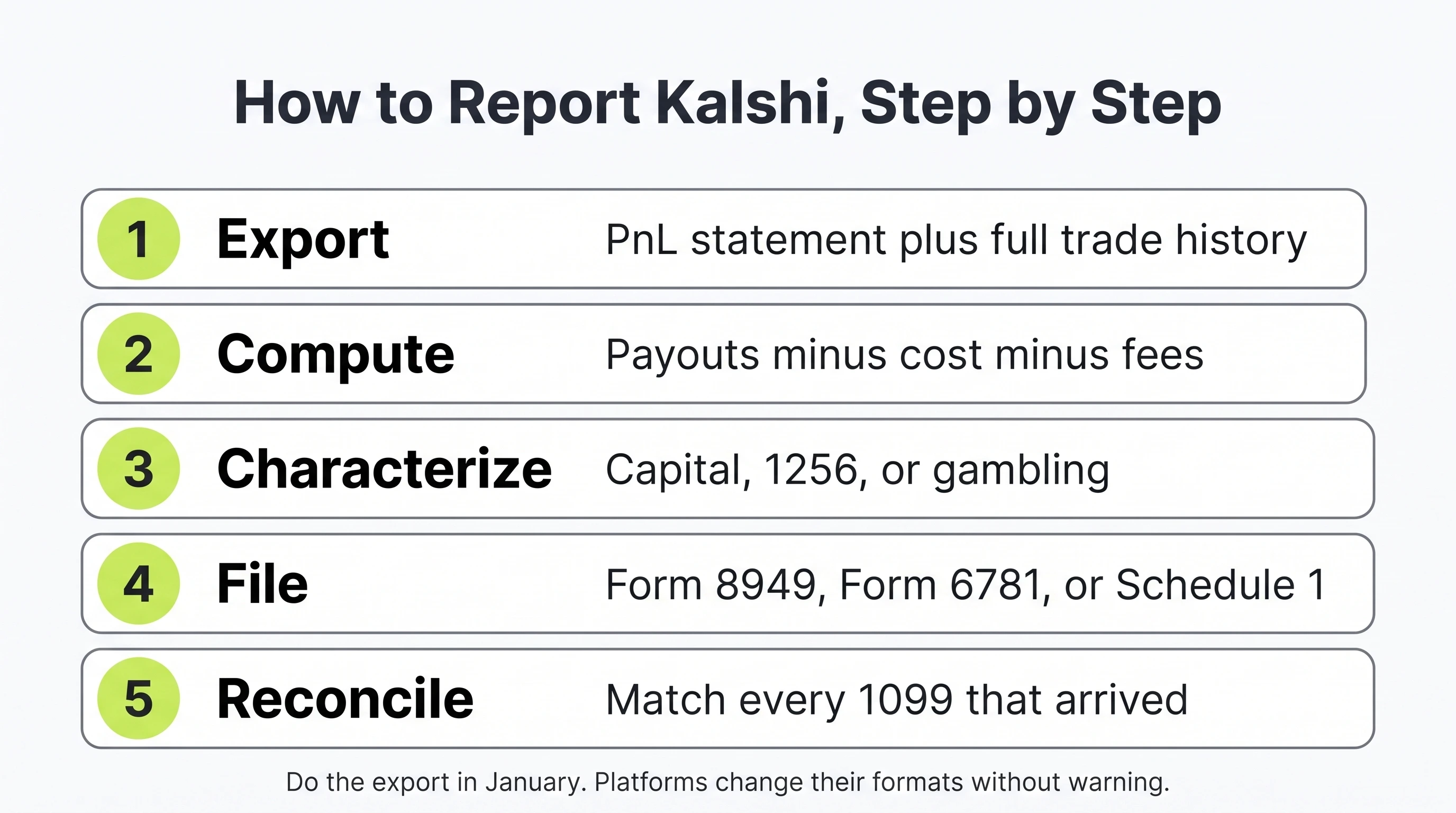
- Export your records. PnL statement plus full trade history from the Tax Info page, every January.
- Compute your real net profit. Payouts minus cost minus trading fees. Fees belong in your basis; do not report gross winnings and forget the costs.
- Pick your characterization. Capital gains for most people, Section 1256 only with professional advice, and be honest with yourself about sports contracts.
- File the matching forms. Capital: every closed position on Form 8949, totals to Schedule D. Section 1256: net figure on Form 6781. Gambling: winnings on Schedule 1, itemized losses on Schedule A subject to the 90% cap.
- Reconcile the forms that did arrive. The 1099-INT and any 1099-MISC are in the IRS matching system. Report the interest and rewards exactly as stated, separately from your trading result.
If you also moved crypto in or out of Kalshi through ZeroHash, those transfers have their own tax life: deposits and withdrawals of crypto are disposals or acquisitions under prediction market tax rules, and the 1099-B or 1099-DA that ZeroHash generates needs to match your return too.
The Record-Keeping Trap Nobody Warns You About
An active Kalshi year produces hundreds or thousands of fills: partial exits, resolved contracts, fees on each order, maybe interest and a referral bonus mixed in. The PnL statement compresses all of it into one number. Your tax return, under capital treatment, technically wants position-level detail.
Most traders handle this with a spreadsheet and patience. Where it genuinely breaks down is when Kalshi is one piece of a bigger picture: crypto deposits through ZeroHash, trading on Polymarket where every settlement is a stablecoin disposal, a wallet or two, and an exchange account feeding it all. At that point you are not doing arithmetic anymore, you are reconstructing a ledger across platforms that do not talk to each other.
That reconstruction is what Count On Sheep does all day. We are a done-for-you crypto tax reconciliation service: hand us the accounts and wallets, and we rebuild the full history, match it against every form the IRS received, and deliver filing-ready numbers your tax preparer can defend. If your prediction market activity touches crypto anywhere in the chain, that is our home turf.
Key Takeaways
- Kalshi sends no tax form for trading profit: just a 1099-INT for interest, a 1099-MISC for rewards, and 1099-B/DA for ZeroHash crypto transfers
- All winnings are taxable from the first dollar, with no minimum threshold and no withholding by the platform
- The IRS has not ruled on characterization: capital gains is the common position, Section 1256 (60/40 on Form 6781) is the aggressive one, gambling is the risk case
- The 2026 OBBBA rule caps gambling loss deductions at 90%, creating phantom income for break-even traders
- Export your PnL statement and full trade history every January, and make quarterly estimated payments in profitable years
Frequently Asked Questions
Do I have to pay taxes on Kalshi winnings?
Yes. Every dollar of profit from Kalshi event contracts is taxable income, no matter how small. There is no minimum threshold that makes winnings exempt, and it does not matter that Kalshi sends no tax form for your trading profit. The IRS taxes the income either way.
Will Kalshi send me a 1099?
Not for your trading profit. Kalshi issues a 1099-INT if you earned $10 or more of interest on your cash balance, a 1099-MISC for referral credits and rewards, and 1099-B or 1099-DA forms only for crypto transfers handled by its partner ZeroHash. Your event contract gains and losses appear only in the profit and loss statement inside your account.
Does Kalshi automatically pay or withhold taxes?
No. Kalshi withholds nothing from your winnings. If you have a profitable year, you may need to make quarterly estimated tax payments, because waiting until April can trigger an underpayment penalty once you owe $1,000 or more beyond your withholding.
Is Kalshi taxed as gambling or capital gains?
The IRS has not ruled. Most traders report Kalshi profits as capital gains on Form 8949, some take the aggressive Section 1256 position (a 60/40 long-term/short-term split on Form 6781), and gambling treatment is the risk case, especially for sports contracts. Whichever position you take, apply it consistently.
How much do I have to make on Kalshi before I have to file?
There is no Kalshi-specific threshold. If you are required to file a return at all, your Kalshi profit belongs on it, whether that profit is $40 or $40,000. The $2,000 1099-MISC threshold that applies to referral rewards is a reporting trigger for Kalshi, not a tax exemption for you.
Does Kalshi report my trading to the IRS?
Kalshi files copies of the 1099s it issues (interest, rewards, crypto transfers) with the IRS, but it does not send the IRS a record of your trading profit. That gap does not make the income invisible: Kalshi is a fully KYC'd, CFTC-regulated exchange, and its records are available to the government on request.