
Polymarket has the strangest tax profile of any prediction market, and it is not because of the predictions. It is the money. Every trade settles in stablecoins, and the IRS treats stablecoins as property, so a single bet quietly generates a chain of reportable crypto disposals that no dollar-settled platform ever creates.
Add the second quirk: the on-chain platform sends no tax forms at all. No 1099, no annual statement, nothing. And then the third: the exchanges where you bought your USDC and cashed it back out do report, on Form 1099-DA, which means the IRS sees the two ends of your activity with a blank in the middle that only your records can fill.
This guide walks through all of it: what is taxable on Polymarket, why the stablecoin mechanics matter, what the QCX-run US exchange changes, how losses work, and how to actually report a year of trading.
Disclaimer: This guide is for informational purposes only and is not tax advice. The characterization of event contracts is unsettled law. Talk to a qualified tax professional about your specific situation.
Do You Get Taxed on Polymarket?
Yes, and on two levels at once. Your prediction profits are taxable income, the same as on any platform. And because Polymarket settles in stablecoins rather than dollars, every purchase, sale, and redemption is also a disposal of a digital asset under IRS property rules, each one reportable on Form 8949.
The common characterization for Polymarket positions is capital asset treatment: you bought outcome shares, you sold or redeemed them, and the difference is a capital gain or loss. (The broader gambling vs. capital vs. Section 1256 debate applies across the industry; our prediction market taxes guide covers the three-way split. Polymarket’s on-chain version has the weakest Section 1256 argument because your activity does not run through a CFTC exchange.)
What Polymarket does not do is help you. The on-chain platform takes no KYC and issues no tax documents at any amount. There is no $600 threshold below which profits become exempt; that number is about when certain payers must issue forms, and Polymarket issues none regardless. The income is taxable from the first dollar, and the reporting is entirely on you.
One Bet, Five Taxable Checkpoints
The cleanest way to understand Polymarket taxes is to follow one bet through its whole life. Say you put $500 on an outcome you like at 40 cents:
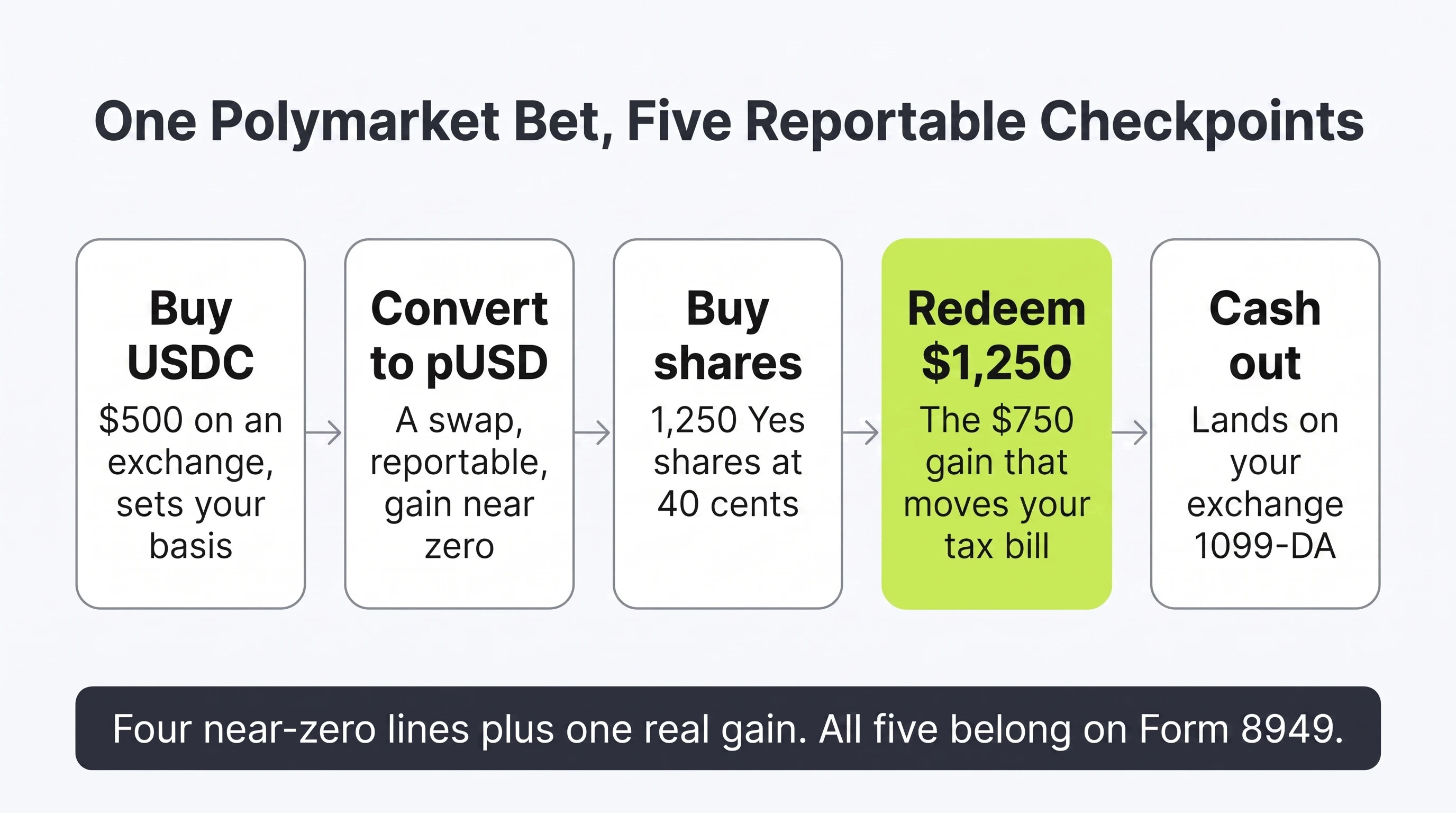
- Buy 500 USDC on an exchange for $500. Not taxable yet, but the exchange records your basis, and this purchase feeds its 1099-DA reporting when you later dispose.
- Convert USDC to pUSD to fund the account. Since April 2026 Polymarket runs on pUSD, a token backed 1:1 by Circle’s USDC. The conversion is a swap of one digital asset for another: reportable, even though the gain rounds to zero.
- Spend 500 pUSD on 1,250 Yes shares at $0.40. You disposed of the pUSD (another near-zero line) and opened your position.
- The market resolves Yes and you redeem 1,250 pUSD. Here is your actual money: a $750 gain, the one line on this list that moves your tax bill. Your new pUSD carries a $1,250 basis.
- Convert back to USDC and cash out through your exchange. One or two more disposals, each roughly break-even, each still a reportable line, and the final sale lands on your exchange’s 1099-DA.
One bet. Five checkpoints. Four of them are zeros that still belong on paper, and one of them is $750 of taxable gain. Now multiply by a year of active trading and you see the real shape of the problem: hundreds of stablecoin micro-disposals wrapped around the handful of numbers that matter.
No 1099 From Polymarket, but the IRS Still Sees the Ends
The trap in Polymarket taxes is asymmetric visibility: the platform reports nothing, but the regulated exchanges on either side of it report everything they touch.
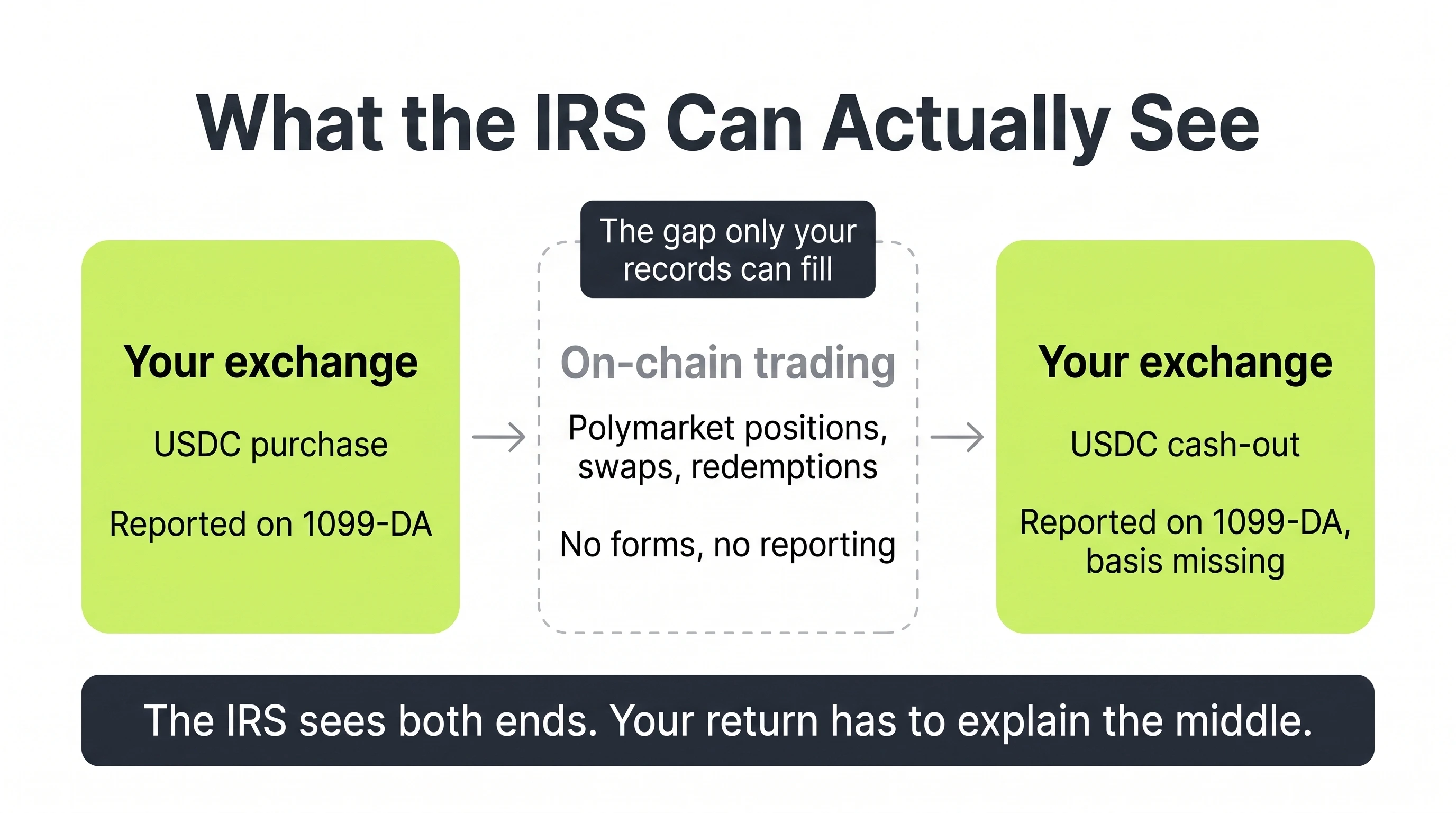
Here is how that plays out. You bought USDC at Coinbase, moved it on-chain, traded for six months, and cashed out $9,000 back through Coinbase. Coinbase’s 1099-DA shows the disposals it saw, and the cash-out leg arrives with missing or incomplete basis because Coinbase never saw what happened on-chain. The IRS computer now holds a form showing proceeds, a return that needs to explain them, and no middle chapter.
If your records are complete, the middle chapter is easy: wallet history, trade exports, basis intact across every hop. If they are not, you are reconstructing months of on-chain activity after the fact, which is dramatically harder than exporting it while the account is active.
Two more things worth knowing on the visibility front. The blockchain itself is a permanent public record; anyone who links your wallet to you can read your entire history. And Polymarket’s regulated US exchange, run through QCX after the $112 million acquisition, is a separate KYC’d venue that is expected to issue broker forms for activity there. The no-forms world is specifically the on-chain platform, and the direction of travel is toward more reporting, not less.
Can You Write Off Polymarket Losses?
Yes. Under capital treatment, Polymarket losses work like any other capital loss: they offset your capital gains without limit, then up to $3,000 of ordinary income per year, with the remainder carried forward to future years.
That makes losing positions genuinely useful. A rough year on Polymarket can shelter gains from stocks or other crypto activity, and there is a strategic angle too: because outcome shares are distinct assets, loss positions can be closed to realize the loss rather than held to expiration out of inertia.
The catch is proof. A loss deduction is a claim about your cost basis, and your cost basis lives in records Polymarket will not compile for you. No export, no deduction you can defend.
Dev finishes 2026 with $4,200 of gains on political markets and $7,000 of losses on sports and crypto-price markets: a net $2,800 loss. He offsets the $4,200 of gains fully, deducts $2,800 against ordinary income (under the $3,000 cap), and carries nothing forward. At his 24% bracket the loss harvest is worth roughly $672 in tax saved. It only works because he exported his trade history in January and can show basis on all of it.
One warning for high-volume sports traders: if your activity were ever characterized as gambling rather than capital, the 2026 rules are harsh (itemizers only, losses capped at 90%, only against winnings). The capital position is the norm for Polymarket, but characterization across prediction markets is unsettled, and consistency is your friend.
How to Report Polymarket on Your Taxes
Reporting a year of Polymarket comes down to reconstructing the ledger, then filing the totals:
- Export everything. Trade history from the Polymarket interface, plus the full transaction log of every wallet you used, plus records from the exchanges on both ends. January, every year.
- Match the chain end to end. Every deposit should trace from an exchange purchase, every withdrawal back to a cash-out. Basis has to survive each hop: exchange to wallet, USDC to pUSD, pUSD to shares and back.
- Compute real gains per position. Redemptions and sales minus cost. Keep the stablecoin legs as separate near-zero lines rather than netting everything invisibly.
- File on Form 8949 and Schedule D. Positions and stablecoin disposals both. Then answer yes to the digital asset question on Form 1040; with on-chain activity, it is unambiguously yes.
- Reconcile the 1099-DA. Whatever your exchange reported must reconcile with your return. Mismatches do not always mean more tax; they always mean explaining.
If reading that list produced a sinking feeling, that is a records problem, not a math problem, and it is the exact problem Count On Sheep exists for. We are a done-for-you crypto tax reconciliation service: you hand us wallets and exchange accounts, we rebuild the complete history (Polymarket legs included), reconcile it against every form the IRS received, and deliver filing-ready numbers your tax preparer can defend. On-chain prediction markets are not an edge case for us. They are the job.
Compare that with Kalshi’s dollar-settled setup, where the records problem is one platform’s CSV. Polymarket’s tax difficulty is crypto tax difficulty, and it rewards the same discipline: complete exports, intact basis, no gaps.
Key Takeaways
- Polymarket profits are taxable and every stablecoin trade around them is a separate crypto disposal under IRS property rules
- The on-chain platform sends no 1099s at any amount, but exchange 1099-DA forms expose your USDC purchases and cash-outs
- One bet creates as many as five reportable checkpoints, most of them near-zero but all of them ledger lines
- Losses are deductible under capital treatment ($3,000 net against ordinary income, unlimited against gains) if your basis records hold up
- Export trade history and wallet logs every January; reconstructing the middle of the chain later is the expensive way
Frequently Asked Questions
Do I get taxed on Polymarket?
Yes. Polymarket profits are taxable income in the US, and because the platform settles trades in stablecoins (USDC, converted to pUSD since April 2026), every purchase, sale, and redemption is also a disposal of a digital asset under IRS property rules. You owe tax on your prediction profits and you owe reporting on the stablecoin legs around them.
Is Polymarket reported to the IRS?
The on-chain Polymarket platform sends no 1099s and does not report your trading to the IRS. But the exchanges on either side of your activity do: the platform where you bought USDC and the one where you cashed out both file 1099-DA forms. The IRS sees the ends of the chain even though it cannot see the middle.
Can you write off Polymarket losses?
Yes, under the common capital-asset position. Polymarket losses offset your other capital gains without limit, then up to $3,000 of ordinary income per year, with the excess carried forward. To claim any of it you need records proving your cost basis on every position, which is exactly what the platform does not hand you.
Do I owe taxes on Polymarket if I made less than $600?
Yes. The $600 figure is a form-issuance threshold for certain payers, not an income exemption, and Polymarket issues no forms at any amount anyway. Every dollar of profit is taxable. Small amounts are still reportable even when no paperwork exists.
What tax form do I use for Polymarket?
Under the common capital treatment, each closed position and each stablecoin disposal goes on Form 8949, with totals flowing to Schedule D. If you cashed out through an exchange that issued a 1099-DA, your return needs to line up with it. You also answer yes to the digital asset question on Form 1040.
Does converting USDC to pUSD trigger taxes?
It is a swap of one digital asset for another, which is reportable as a disposal even though the gain is usually zero or a few cents. The dollar impact is trivial; the record-keeping impact is not, because every conversion adds a line your Form 8949 should account for.