
Prediction market profits are taxable, and in most cases nobody sends you a form saying so. That is the whole problem in one sentence. Kalshi does not issue a 1099 for your trading gains. Polymarket does not either, and every trade there is also a crypto disposal because it settles in stablecoins. Robinhood hands you an “annual statement” that says, in its own fine print, that it is not a tax form.
Meanwhile the IRS has never said whether event contract profits are gambling income, capital gains, or Section 1256 contracts. Three defensible answers, three different tax bills, and the paperwork burden lands on you either way.
This guide walks through how prediction market taxes actually work in 2026: what each platform reports (and does not), how the characterization debate shakes out in dollars, why crypto-settled markets like Polymarket are a different animal entirely, and what records to keep so filing season is a formality instead of a forensic project.
Disclaimer: This guide is for informational purposes only and is not tax advice. The characterization of event contracts is unsettled law. Talk to a qualified tax professional about your specific situation.
Are Prediction Market Winnings Taxable?
Yes. All prediction market profits are taxable income in the US, regardless of platform, amount, or whether you received a tax form. There is no $600 free pass and no “it was just a hobby” exemption.
That surprises people because the reporting infrastructure is so thin. With stocks, your broker sends a 1099-B and the IRS gets a copy. With prediction markets in 2026, the most common situation is: you made money, the platform sent nothing, and the IRS is relying on you to volunteer the number.
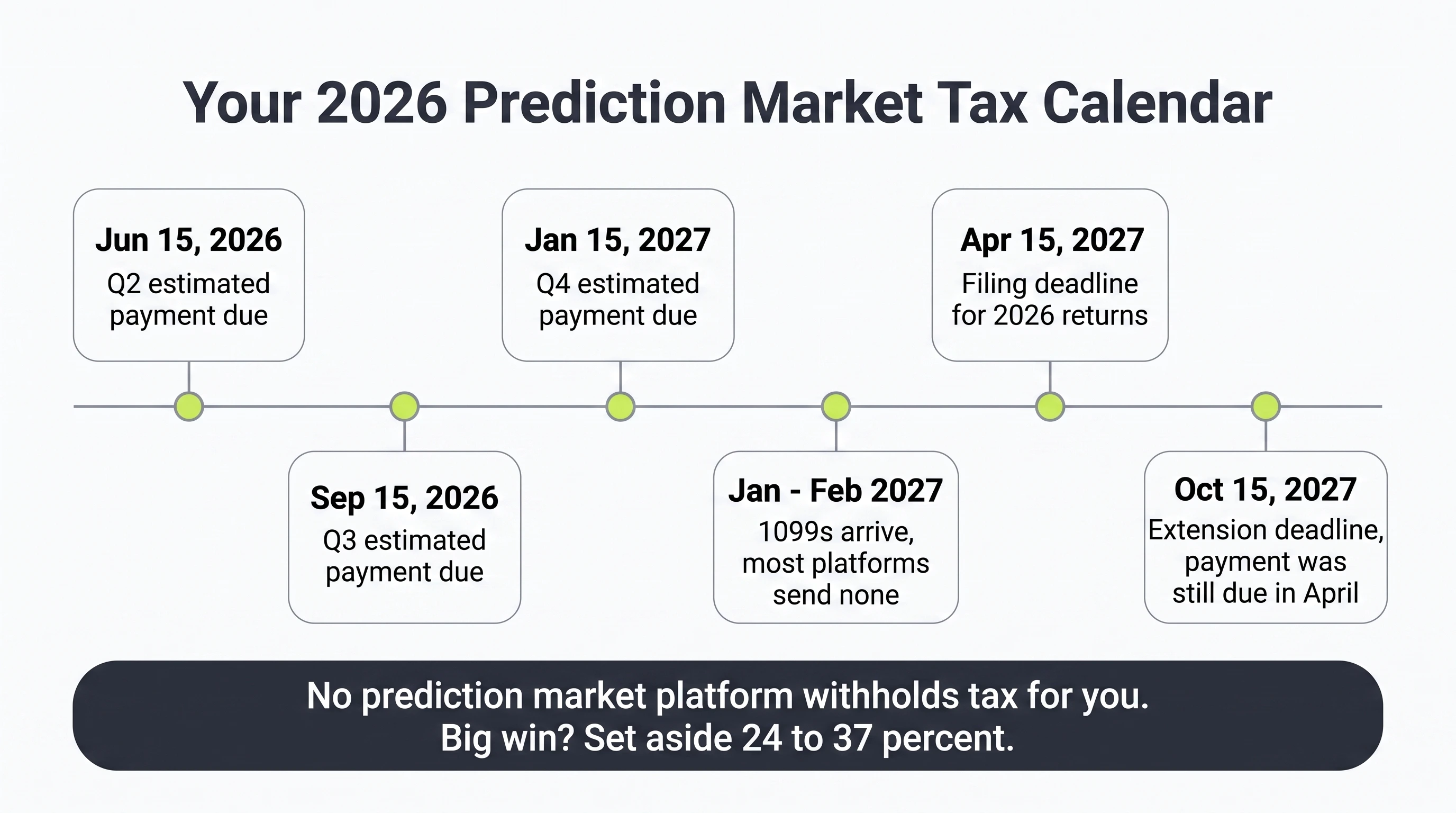
Do not read the silence as safety. Fiat platforms keep full KYC records the government can request, and crypto-settled platforms leave a permanent public trail on-chain. The IRS has also been expanding digital asset reporting through Form 1099-DA, which started arriving for the 2025 tax year and pulls stablecoin activity into view. The gap between “no form arrived” and “the IRS can see it” is closing fast.
The real question was never whether you owe tax. It is how the income gets characterized, because that decides your rate and what happens to your losses.
Gambling, Capital Gains, or Section 1256? The Unsettled Question
The IRS has issued no guidance on how event contract profits should be classified, so taxpayers and their advisors are choosing between three frameworks. Each is defensible. Each produces a different tax bill.
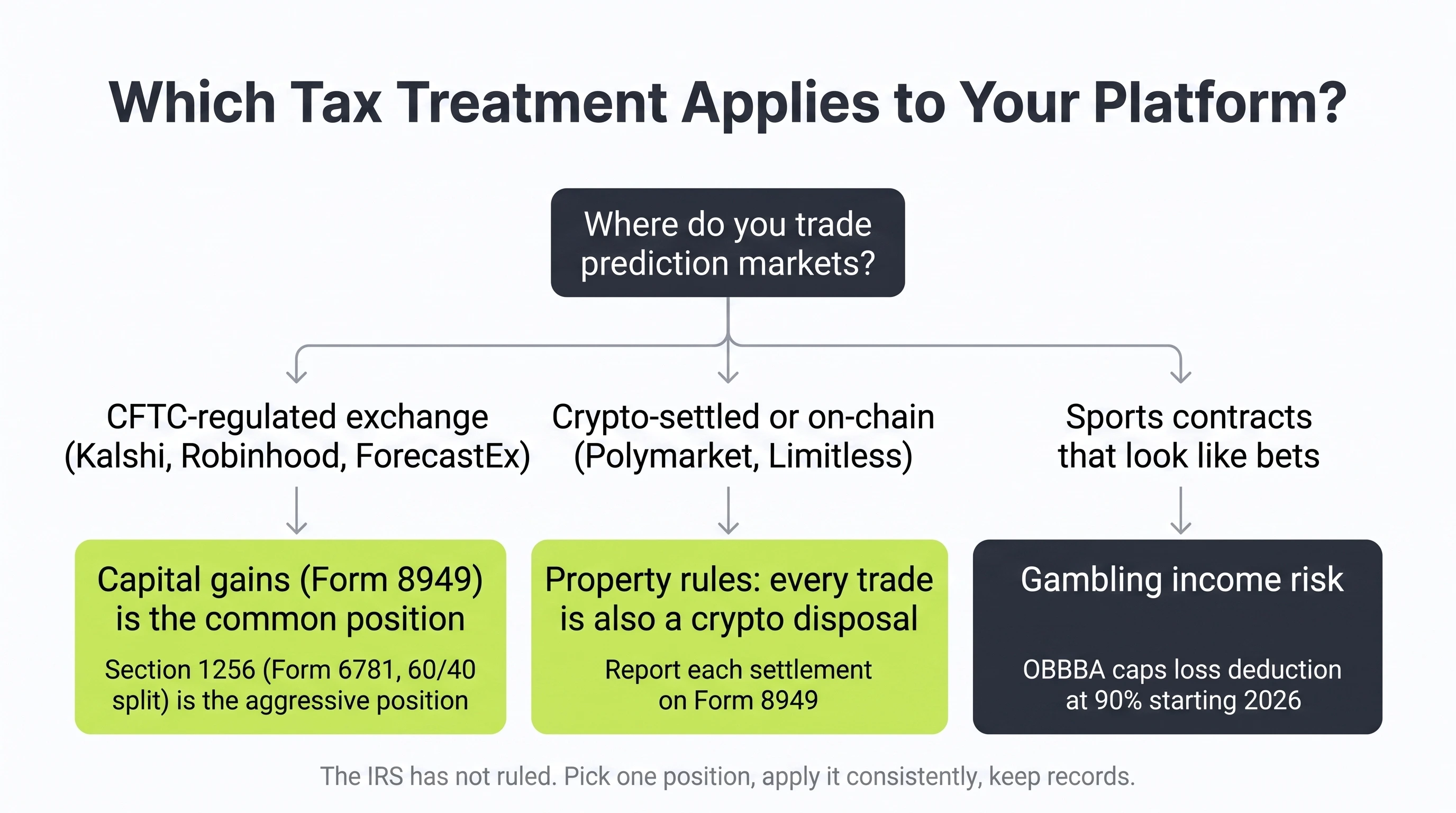
Here is the short version of each position:
Capital gains treatment. An event contract is property. You buy it, you sell it or it resolves, and the difference is a capital gain or loss on Form 8949 and Schedule D. Held a year or less (which describes nearly every event contract), gains are short-term and taxed at your ordinary income rate, same as other short-term capital gains. This is the position most traders and most tax software land on, because it fits how the contracts actually trade: an order book, bid-ask spreads, positions you can exit before resolution.
Section 1256 treatment. Kalshi, ForecastEx, and Polymarket’s US exchange are CFTC-designated contract markets. Section 1256 of the tax code gives contracts traded on qualified exchanges a special deal: 60% of gains count as long-term and 40% as short-term regardless of holding period, reported on Form 6781, with open positions marked to market at year end. For an active trader that 60/40 split is a meaningful rate cut. The catch: nobody knows for certain that event contracts fit the statutory definitions, the exchanges do not issue the 1099-B a futures broker normally would, and the IRS has never blessed the position. Tax professionals describe it as the aggressive option.
Gambling treatment. If the contract is functionally a bet, especially a sports contract, the IRS could treat profits as gambling income: ordinary rates, reported as other income, with losses deductible only if you itemize and only against winnings. Starting in 2026 this position carries a new penalty we cover below: the loss deduction is capped at 90%.
One more wrinkle: wash sale rules. If prediction contracts are capital assets, selling at a loss and immediately rebuying the same position could trigger wash sale treatment the way it does for securities. If they are Section 1256 contracts or gambling, wash sales do not apply. Unsettled, like everything else here. Note it and move on.
How Each Platform Is Taxed: The Comparison Table
No two prediction markets have the same tax profile. The table below covers the major US-accessible platforms as of July 2026: who regulates them, what tax form (if any) covers your trading, what currency settles your trades, and where the characterization debate stands for each.
| Platform | Regulator | 1099 for trading? | Settlement | Likely characterization | Loss treatment |
|---|---|---|---|---|---|
| Kalshi | CFTC (designated contract market) | No. 1099-INT for interest, 1099-MISC for rewards, 1099-B/DA for crypto transfers only | USD | Contested: capital gains most common; Section 1256 argued; sports contracts risk gambling | Follows whichever characterization you take |
| Polymarket (on-chain) | None for the on-chain platform (US arm QCX is a CFTC DCM) | No 1099s from the on-chain platform | USDC, converted to pUSD since April 2026 | Capital asset is the common position, plus every settlement is a stablecoin disposal | Capital loss rules: offset gains plus $3,000/yr |
| Robinhood event contracts | CFTC (contracts trade on Kalshi’s and ForecastEx’s exchanges via Robinhood Derivatives) | No. An “Event Contracts Annual Statement” that is explicitly not a tax form | USD | Same contested three-way split as Kalshi | Follows characterization |
| PredictIt | CFTC (operates after surviving the CFTC’s shutdown attempt) | Yes: 1099-MISC at $600+ net winnings ($2,000 threshold for 2026 payments) | USD | Reported as other income via 1099-MISC; gambling vs. capital debated | Murky: offsetting losses against 1099-MISC income takes care |
| IBKR ForecastEx | CFTC (DCM and clearinghouse) | 1099-MISC, which has reported gross proceeds as other income; incentive coupons also taxable | USD | Strongest Section 1256 argument on paper; IBKR’s own reporting says other income | 1256 or capital, depending on position |
| Crypto.com event contracts | CFTC (Crypto.com Derivatives North America, the former Nadex) | No dedicated event contract 1099 confirmed; 1099-DA covers crypto-side dispositions | USD (crypto funding triggers separate disposals) | Same contested three-way split | Follows characterization |
| On-chain markets (Limitless, SX Bet, Myriad, Azuro) | None (decentralized or offshore) | Nothing, ever | USDC or other crypto | Capital asset, plus every trade is a crypto disposal | Capital loss rules |
See the on-chain prediction market tax rules below for Limitless, SX Bet, Myriad, Azuro-powered apps, Overtime, and Drift BET.
Three patterns worth pulling out of that table:
First, almost nobody 1099s your trading profit. PredictIt is the exception, and IBKR’s version creates its own mess by reporting gross proceeds instead of net profit. Everyone else hands you a statement and wishes you luck.
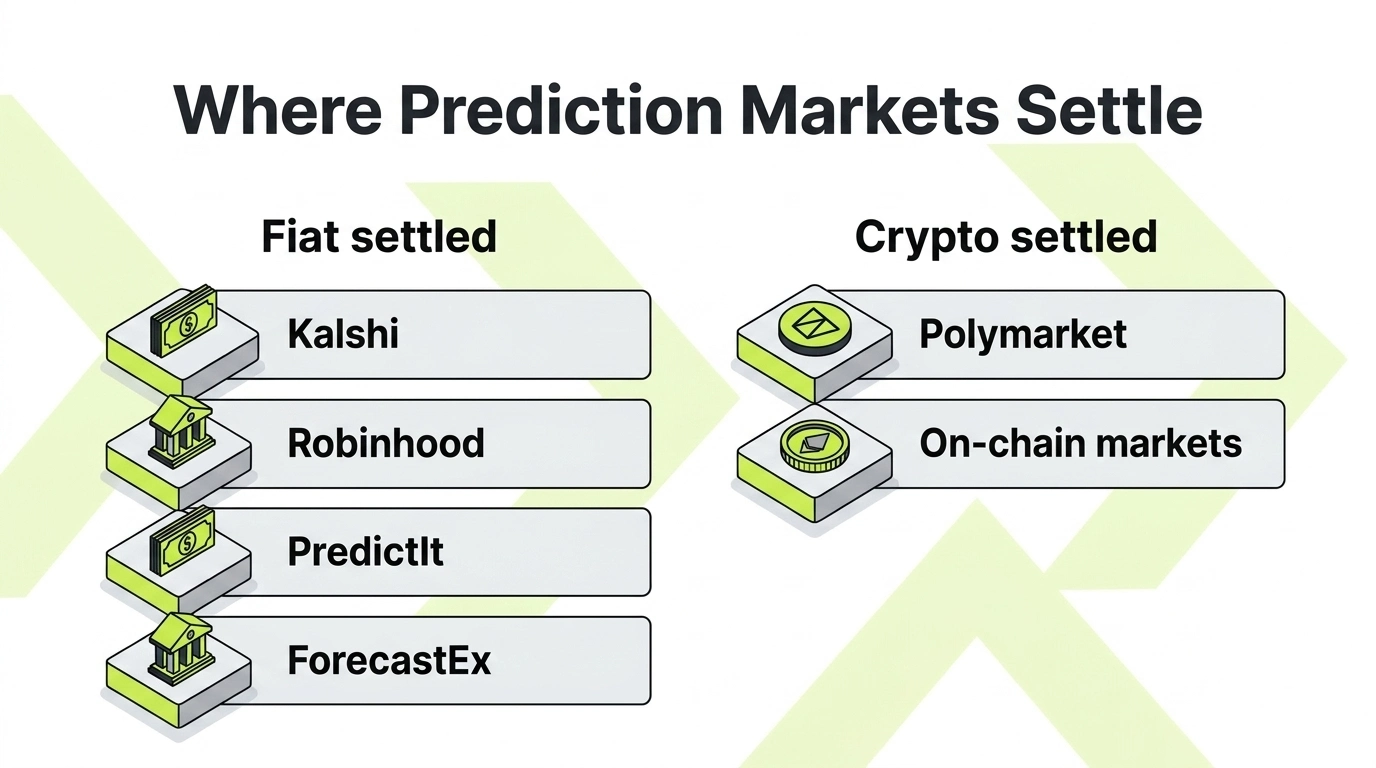
Second, settlement currency splits the universe in two. Dollar-settled platforms (Kalshi, Robinhood, PredictIt, ForecastEx, Crypto.com) give you one tax question: how is the profit characterized? Crypto-settled platforms give you two: the same characterization question, plus a full crypto disposal trail, because the IRS treats digital assets as property and every stablecoin you spend or receive is a disposition.
Third, “CFTC-regulated” does not mean “taxed like futures.” Every fiat platform on this list except PredictIt runs on a CFTC-designated contract market, which is the entire basis of the Section 1256 argument. And yet not one of them issues the Form 1099-B that actual futures brokers send. The exchanges themselves are not taking the 1256 position on your behalf.
Kalshi Taxes: No 1099 for Your Trading Profit
Kalshi sends no tax form for your event contract gains or losses. (For the full platform breakdown, including the Section 1256 math and a step-by-step reporting walkthrough, see our dedicated Kalshi taxes guide.) Per its help center, Kalshi issues exactly four documents, none of which covers trading: a 1099-INT for interest of $10 or more on cash balances, a 1099-MISC for referral credits and rewards, and 1099-B or 1099-DA forms only for crypto transfers handled by its partner ZeroHash. Your profit and loss lives in the PnL statement under the Tax Info page of your account, and turning that into a tax return is your job.
Here is what the math looks like in practice.
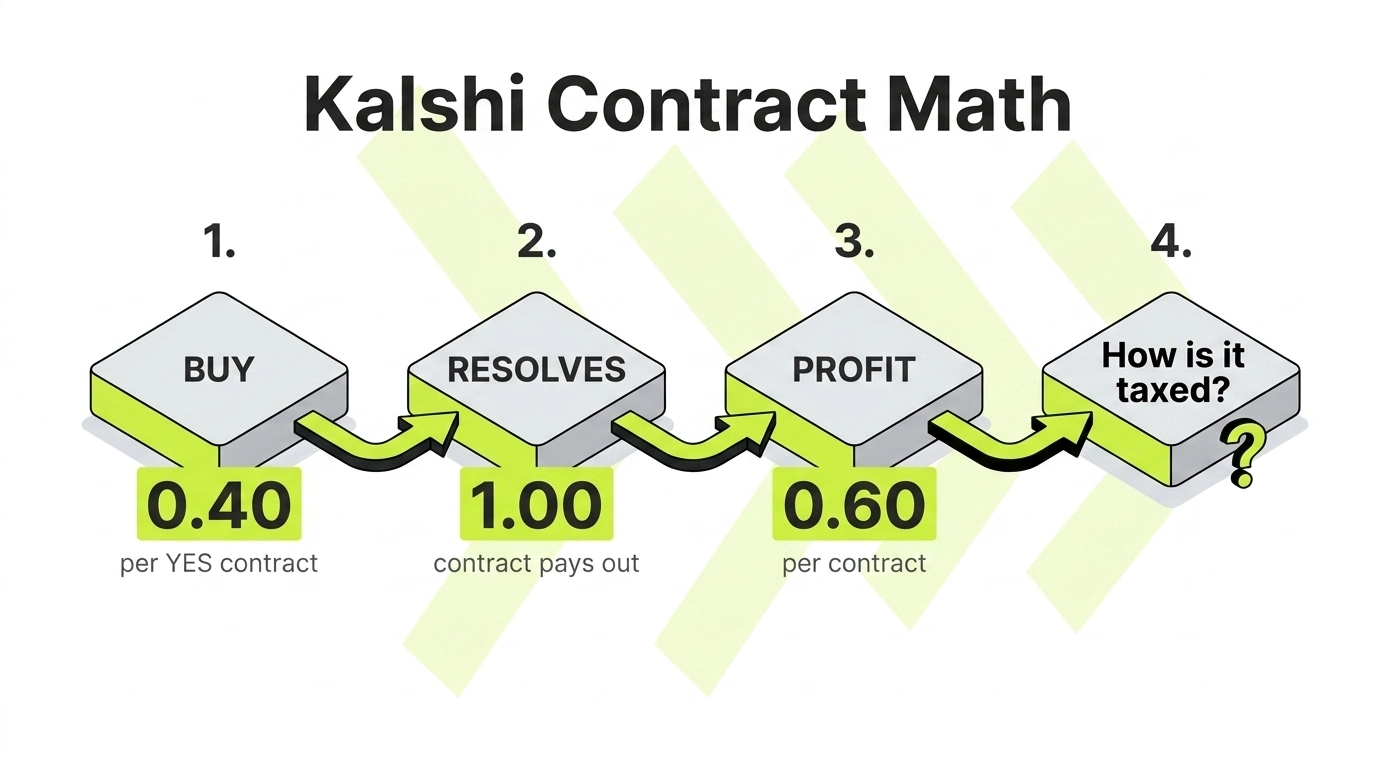
Say you buy 500 “Yes” contracts at $0.40 each. Cost: $200. The event happens, the market resolves Yes, and each contract pays out $1.00. You receive $500. Profit: $300 (Kalshi’s trading fees trim this slightly, and fees belong in your cost basis).
Now run that $300 through the three frameworks, assuming you are in the 24% bracket with a 15% long-term capital gains rate:
- Capital gains (short-term): $300 taxed at 24% = $72.
- Gambling income: $300 at ordinary rates = $72, but your losses just got a worse deal (see the losses section).
- Section 1256: 60% of $300 ($180) at 15% = $27, plus 40% ($120) at 24% = $28.80. Total: $55.80.
Same trade, a $16 spread on a $300 profit. Scale that to an active trader clearing $50,000 a year and the 1256 question is worth thousands of dollars. That is exactly why people argue about it, and exactly why you should not adopt the aggressive answer casually. The IRS is not bound by anyone’s blog post, including this one.
Multiply the example by a real trading year and the practical problem appears: hundreds or thousands of fills, partial exits before resolution, fees on each order. The PnL statement summarizes it, but if you ever need to substantiate individual positions, the raw trade history is what counts. Download it every January. Platforms redesign their exports without warning.
Polymarket Taxes: Every Trade Is a Crypto Disposal
Polymarket profits are taxable like every other prediction market, but Polymarket adds a second layer no dollar-settled platform has: it settles in stablecoins, so every trade is also a disposal of a digital asset under IRS property rules. You are not just tracking predictions. You are running a crypto ledger. (We break the whole platform down, checkpoint by checkpoint, in our Polymarket taxes guide.)
Since April 2026, trading collateral is pUSD (Polymarket USD), a token backed 1:1 by Circle’s USDC, replacing the bridged USDC.e that the platform ran on for years. Functionally it pegs to the dollar. For tax purposes it is still property, and converting USDC to pUSD is itself arguably a disposal event.
Walk through one round trip and count the taxable checkpoints:
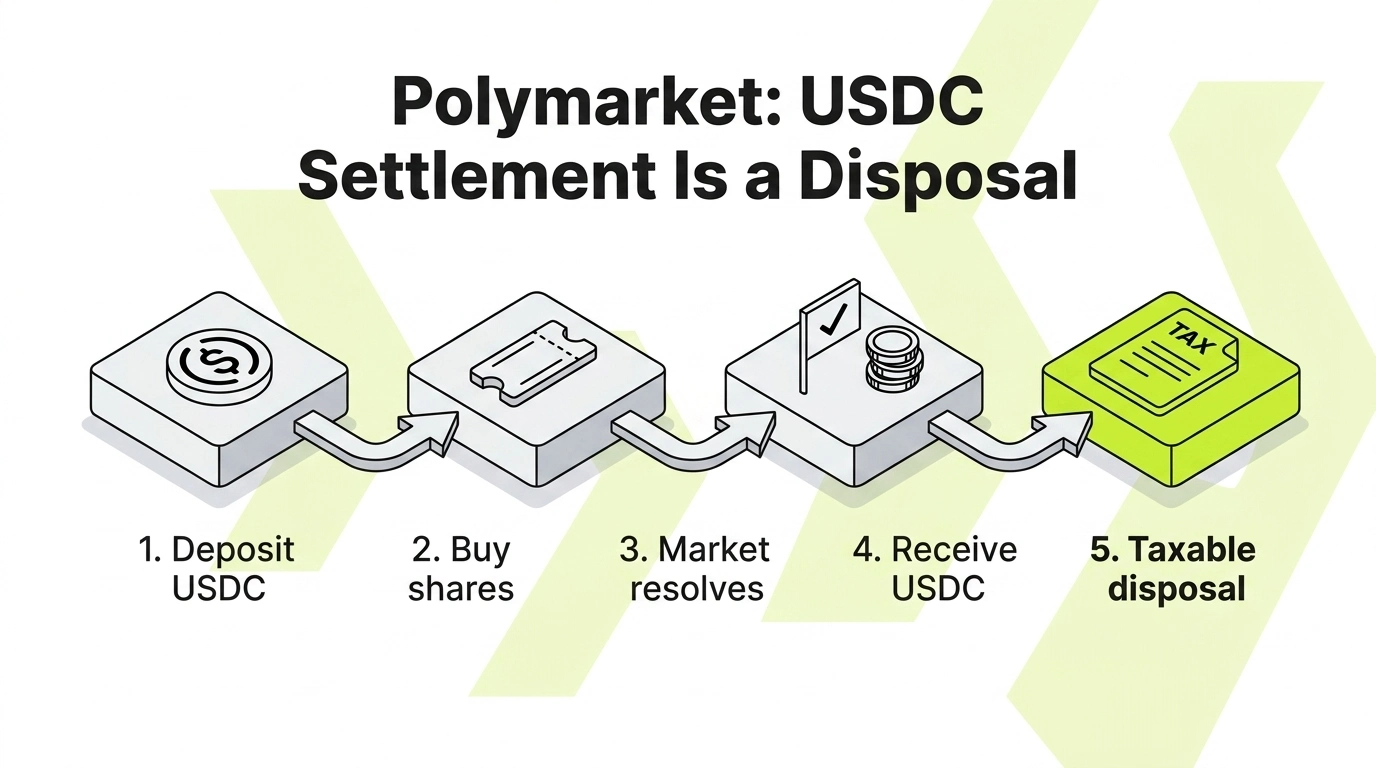
- You buy 1,000 USDC on an exchange for $1,000. Not taxable yet, but this sets your cost basis, and the exchange records it (this leg can show up on a 1099-DA when you eventually dispose).
- You convert USDC to pUSD to fund your account. A swap of one digital asset for another: reportable, even though the gain is pennies or zero.
- You spend 1,000 pUSD on 2,500 “Yes” shares at $0.40. Disposing of the pUSD (another reportable line) and opening your position.
- The market resolves Yes. You receive 2,500 pUSD. The position closes with a $1,500 gain, the one number on this list that actually moves your tax bill. Your new pUSD carries a $2,500 basis.
- You convert back to USDC, withdraw to your exchange, and sell for dollars. One or two more disposals, each roughly break-even, each still a line item.
One bet. As many as five reportable events, four of which round to zero gain and one of which is worth $1,500. Nobody sends you a form for any of it: the on-chain platform has no 1099 obligation and takes no KYC. (Polymarket’s regulated US exchange, run through QCX after its $112 million acquisition, is a different entity and is expected to issue broker forms for activity on that venue. The on-chain platform most traders know is not that.)
Here is where the trap closes. The IRS can see the two ends of that chain: your exchange reports the USDC purchase and the final cash-out on 1099-DA. It cannot see the middle, and the cash-out leg lands with missing basis. A year of active trading produces hundreds of stablecoin micro-disposals wrapped around your actual profits, and if you cannot reconstruct the middle, you get to explain a 1099-DA that matches nothing on your return.
This is the same failure mode we see constantly in crypto gambling and sweepstakes activity: the platform is a black box, the wallet trail is the only record, and the person who exports their history in January has a filing exercise while the person who did not has an archaeology project.
On-Chain Crypto Prediction Markets Beyond Polymarket
Polymarket is only one part of the on-chain market. The same crypto-disposal rules apply to faster price markets, sports order books, embedded markets, and the protocols that supply betting infrastructure. None of the platforms below provides a complete US tax form for the full activity.
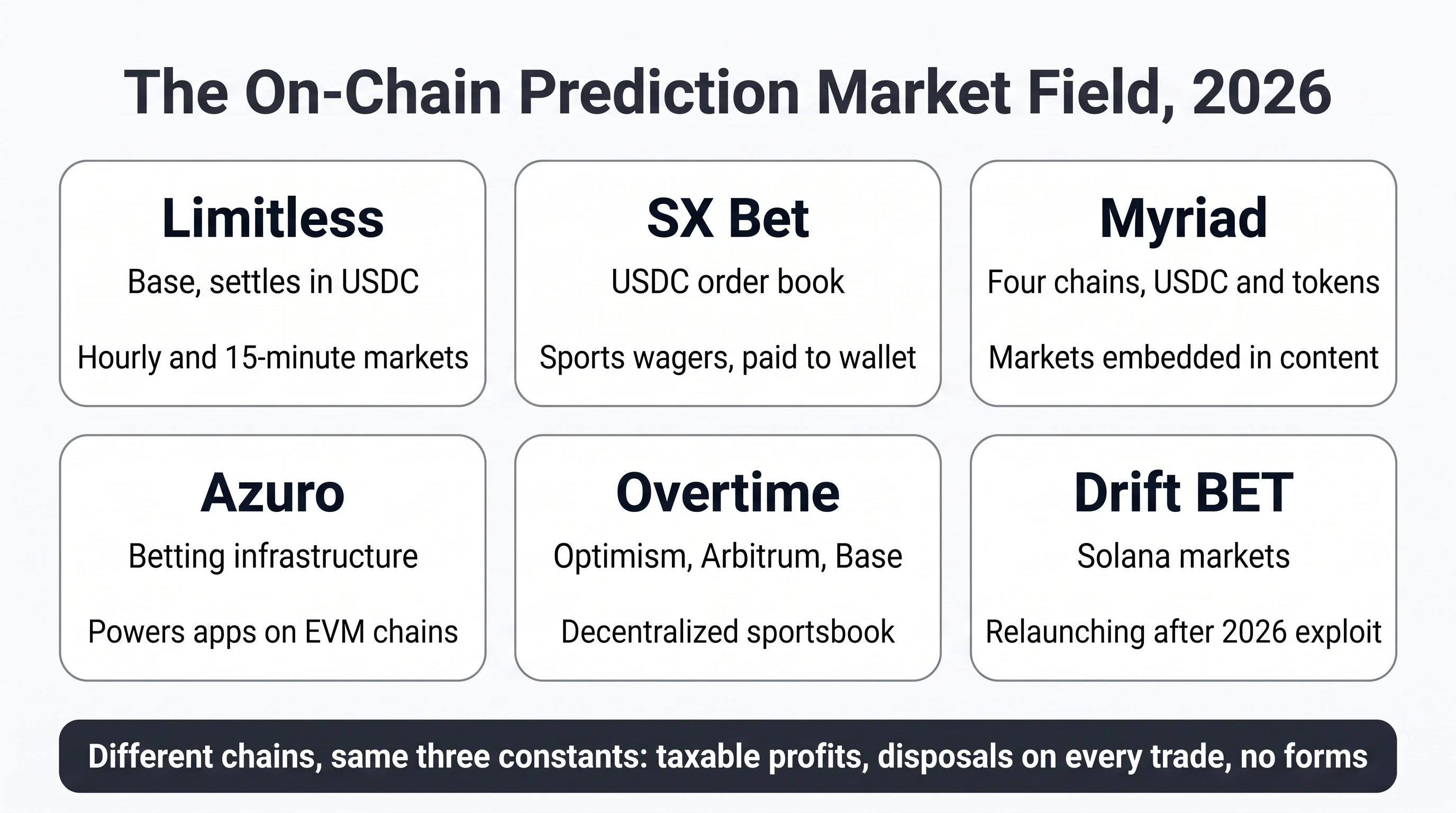
- Limitless runs on Base, uses USDC collateral, and lists hourly and 15-minute crypto markets alongside longer-duration markets.
- SX Bet is a peer-to-peer sports prediction market with a USDC-denominated order book. Funds move from user wallets into escrow and settle back to the winner on-chain.
- Myriad has operated markets across Arbitrum, Abstract, BNB Chain, and Linea. Its current developer documentation identifies BNB Smart Chain as the main deployment, with most markets denominated in USD1 and some still in USDT.
- Azuro is infrastructure used by betting applications rather than a single destination. Its current developer hub lists Polygon, Gnosis, Base, and Chiliz.
- Overtime runs sports markets on Optimism, Arbitrum, and Base through permissionless smart contracts.
- Drift BET brought prediction markets to Solana. Drift’s later protocol changes and recovery work do not erase the historical BET transactions recorded on Solana.
Anatomy of one $200 USDC wager
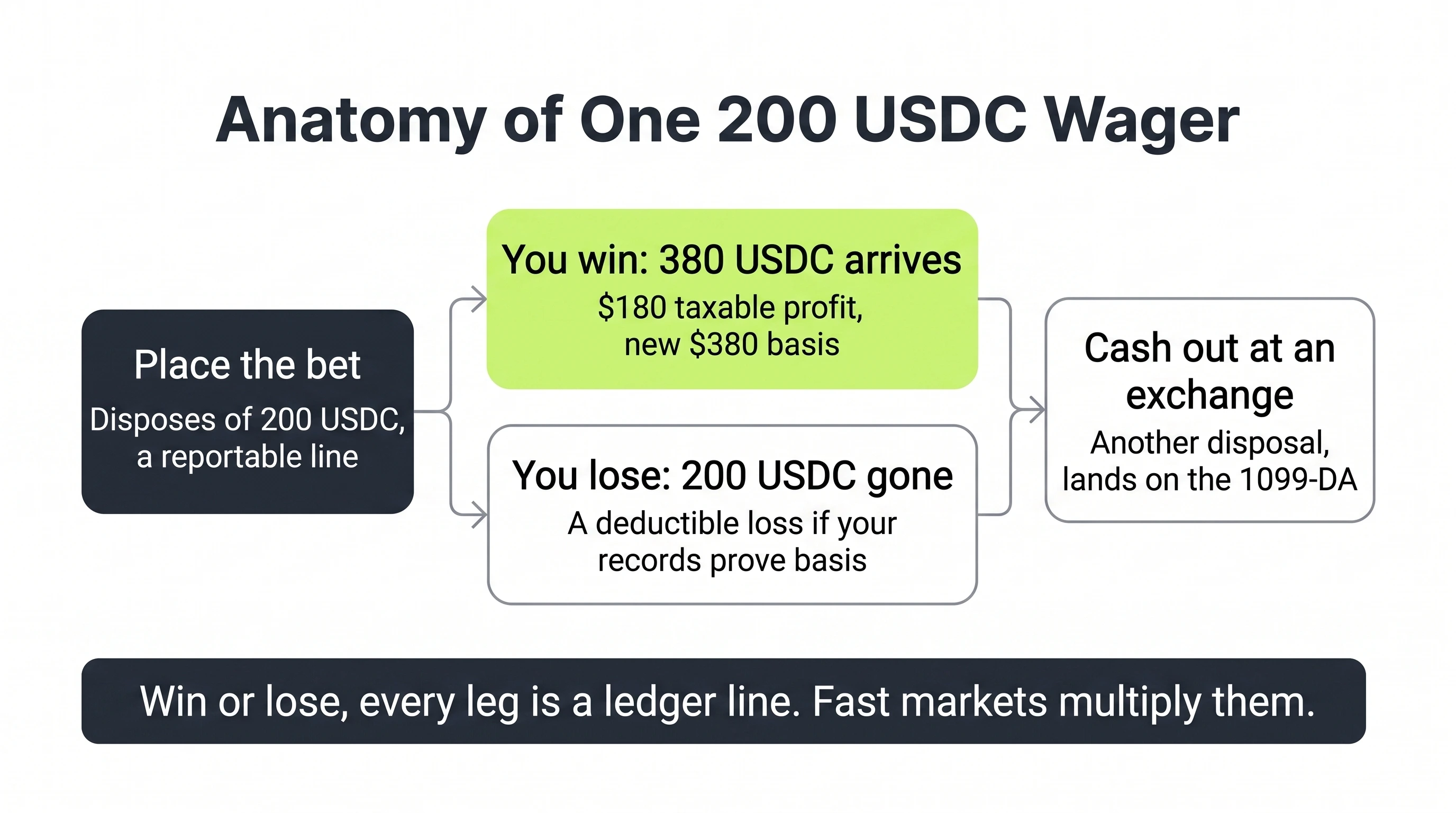
- Placing the wager disposes of 200 USDC. The stablecoin gain may be zero, but the disposal still belongs on Form 8949.
- A win creates profit and fresh basis. If the wager pays 380 USDC, the $180 profit is taxable and the 380 USDC starts with $380 of basis.
- A loss follows the selected characterization. Capital, Section 1256, and gambling treatment produce different loss rules.
- Cashing out creates another disposal. The exchange cash-out may appear on Form 1099-DA and needs the basis carried from the payout.
High-frequency 15-minute markets can turn one active month into thousands of reportable disposals. The calculation is manageable when every leg stays tied to the wallet history. It becomes expensive when deposits, wagers, payouts, and exchange withdrawals sit in separate exports.
Sports wagers need consistent characterization
Binary event contracts tied to elections, prices, or economic outcomes are often reported as capital assets. Sports wagering on SX Bet and Overtime sits closer to gambling treatment, which matters because the 2026 gambling-loss deduction is capped at 90% of losses.
A bettor with $30,000 of wins and $30,000 of losses breaks even in cash. Under the 2026 gambling rule, only $27,000 of losses are deductible, leaving $3,000 of phantom taxable income. Substantially similar sports wagers should be treated consistently. Reporting SX Bet as gambling and Overtime as capital gains for the same kind of activity creates a position that is hard to defend.
Robinhood, PredictIt, ForecastEx, and Crypto.com: Quick Notes
The remaining platforms each have one quirk worth knowing. Here they are without padding.
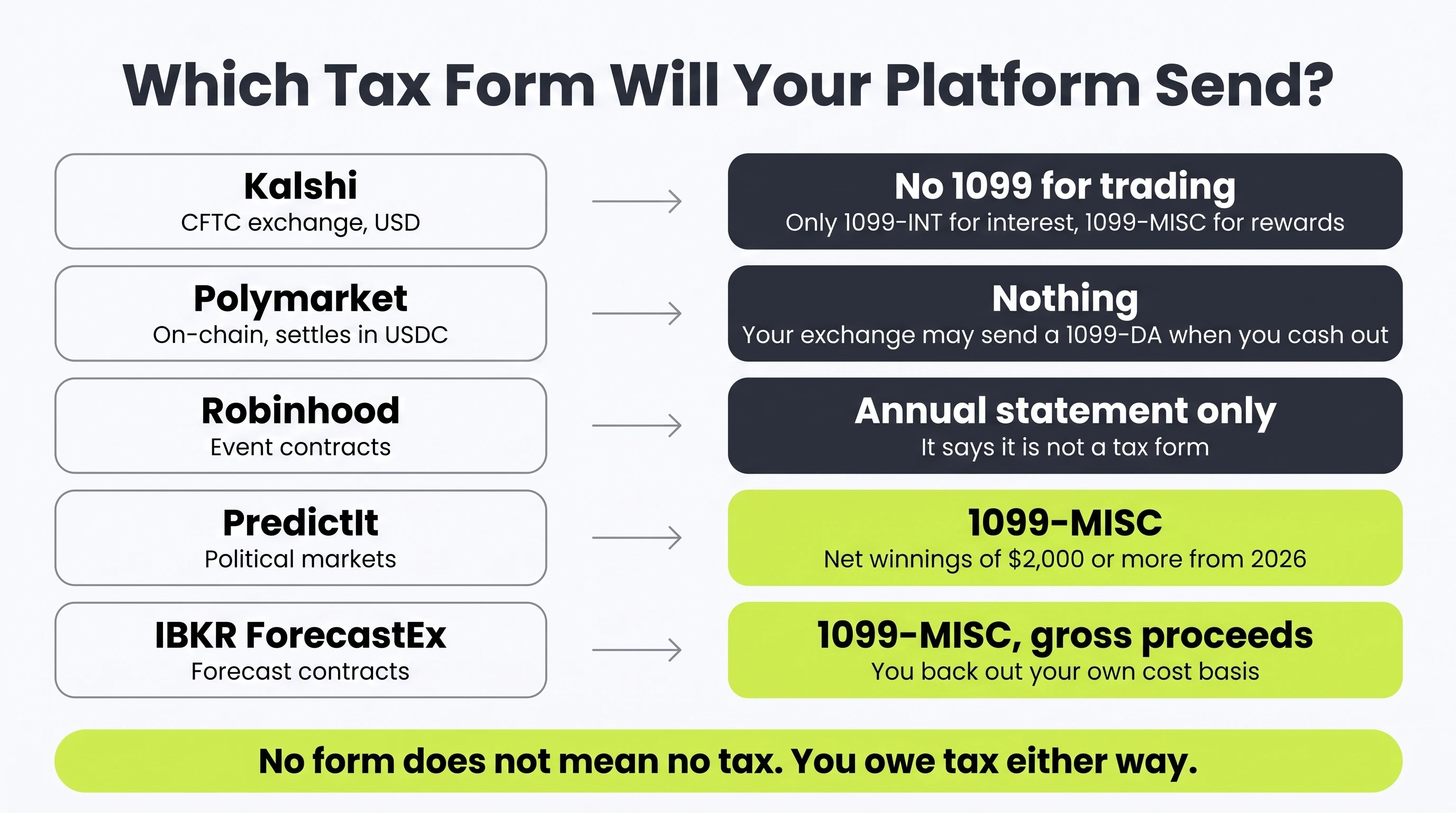
Robinhood event contracts. Offered through Robinhood Derivatives, with the actual contracts trading on CFTC-regulated exchanges (Kalshi’s exchange powers Robinhood’s prediction markets hub; earlier election contracts ran through ForecastEx). We cover the pipeline gap in detail in our Robinhood prediction market taxes guide. For tax year 2025 Robinhood issued no 1099-B and no 1099-DA for event contracts. You get an “Event Contracts Annual Statement” that states it is not a substitute tax reporting form. Regular Robinhood activity still generates its normal consolidated 1099, which covers stocks and crypto but not these contracts. Self-report, same three-framework debate as Kalshi.
PredictIt. The old-timer, still running its political markets after surviving the CFTC’s attempt to pull its no-action relief. Two things set it apart. It actually sends a 1099-MISC when your net winnings cross the threshold ($600 historically; the One Big Beautiful Bill Act raises the MISC threshold to $2,000 for payments starting in 2026). And its fees are brutal for tax math: 10% of profits on winning trades plus 5% of withdrawals, which belong in your calculation of actual net income. Because PredictIt reports on a MISC as other income rather than a broker form, matching your own gain/loss calculation to the form takes some care.
Interactive Brokers ForecastEx. On paper the cleanest Section 1256 candidate: ForecastEx is a CFTC-designated contract market and clearinghouse, and its contracts look the most like traditional derivatives. In practice IBKR’s reporting has undercut the elegance by putting ForecastTrader proceeds on a 1099-MISC as other income, gross proceeds rather than net profit, which forces traders to back out their own cost basis on Schedule 1. ForecastEx also pays “incentive coupons” (interest on your collateral, paid monthly), which are taxable income. If any event contract eventually wins formal 1256 status, expect it to happen here first.
Crypto.com event contracts. Traded through Crypto.com Derivatives North America, the CFTC-regulated exchange formerly known as Nadex. Contracts settle in dollars, so no disposal-per-trade problem on the contracts themselves. But most people fund from the Crypto.com app, and funding an account by converting crypto is its own taxable disposal, with the crypto side covered by Crypto.com’s 1099-DA reporting. No dedicated event contract 1099 has been confirmed.
How Losses Work (and the New 90% Problem)
Loss treatment depends entirely on characterization, and 2026 made the gambling answer meaningfully worse. Here is each regime:
Capital loss treatment. Losses offset capital gains without limit, then up to $3,000 of ordinary income per year, with the excess carried forward. A bad year on Kalshi can shelter a good year on your brokerage account. This symmetry is a real argument for capital treatment for active traders.
Section 1256 treatment. Net 1256 losses follow capital loss rules, with one bonus: you can elect to carry them back three years against prior 1256 gains. Open positions get marked to market at year end, so December losses count even if the market has not resolved.
Gambling treatment. This is where it gets ugly. Gambling losses were already deductible only if you itemize (most people do not) and only up to winnings. The One Big Beautiful Bill Act, effective for tax years beginning after December 31, 2025, caps the deduction at 90% of losses. The arithmetic produces phantom income: win $50,000 and lose $50,000 in the same year, a perfect break-even, and you can deduct only $45,000. You owe tax on $5,000 you never made. At 24%, that is a $1,200 bill for the privilege of breaking even.
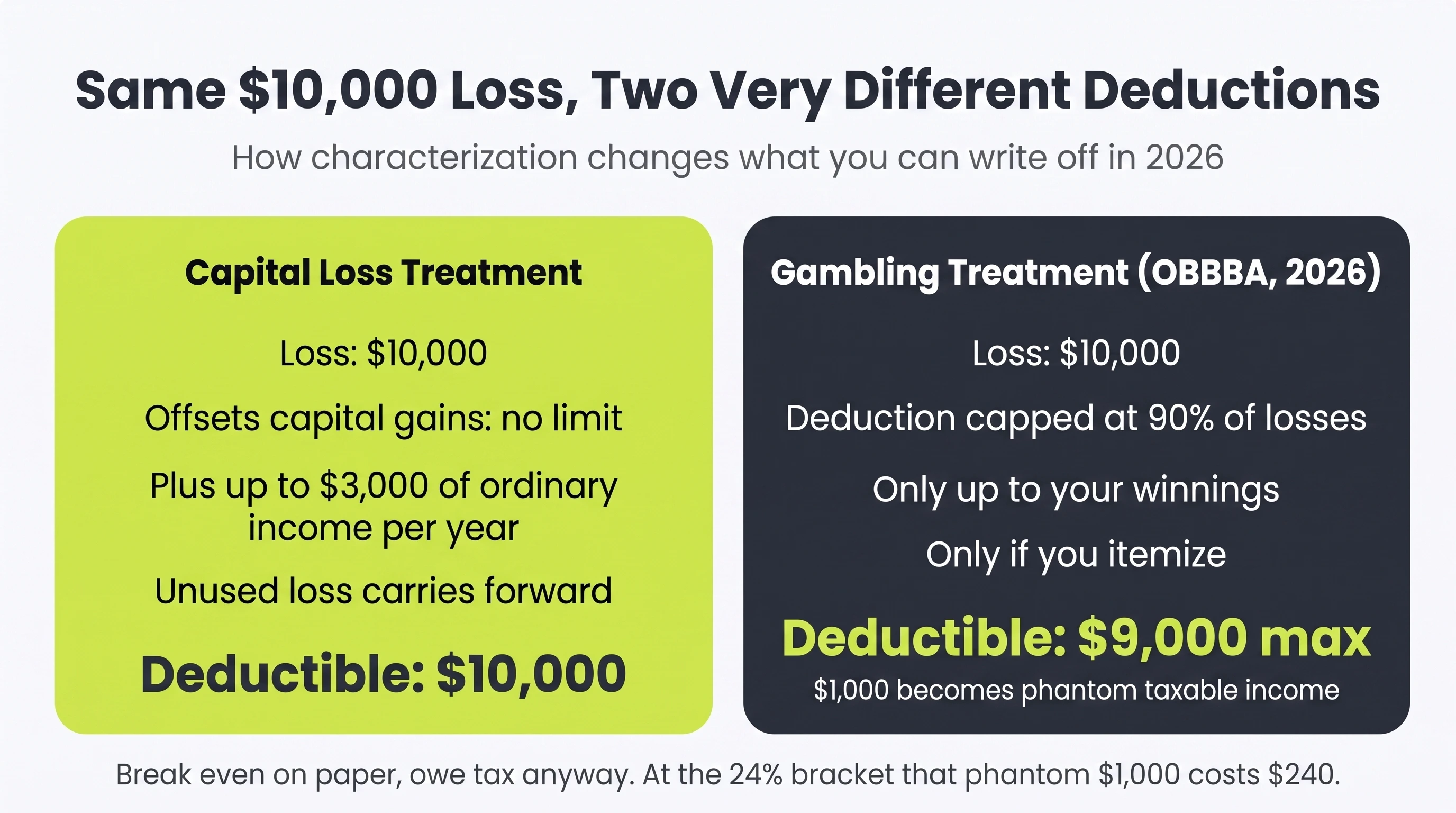
That 90% rule raises the stakes of the whole characterization debate. Before 2026, gambling treatment was merely inconvenient. Now, for a high-volume trader who churns positions, it is expensive in a way that compounds with volume. Sports event contracts sit closest to the gambling line, which is worth weighing before you build a high-frequency strategy around them.
A trader runs $80,000 of winning positions and $75,000 of losing positions across a year of sports contracts: $5,000 of actual profit. Under capital treatment, tax lands on $5,000. Under gambling treatment with the 2026 rule, only $67,500 of the losses are deductible (90% of $75,000), so taxable income is $12,500: two and a half times the real profit. Same trades, same money, $1,800 more tax at the 24% bracket. Characterization is not an academic question.
State Taxes: The 2026 Fight Over Prediction Markets
Federal characterization is only half the story now. In 2026 the states opened a second front, and while their new taxes mostly target the platforms rather than traders, the fallout reaches your account.
The scoreboard as of July 2026:
- Kentucky enacted a 14.25% excise tax on prediction market operators in April 2026 (House Bills 757 and 904), effective January 2027, with “transaction fee” defined broadly enough to sweep in the amounts consumers pay for contracts. The CFTC sued Kentucky, arguing federal preemption, and a coalition of operators including Kalshi, Crypto.com, and Polymarket filed its own challenge.
- Illinois reclassified sports event contracts as “exchange wagers” under its Sports Wagering Act in mid-2026: a $15 million license and a tiered transaction tax of 1.75% to 3.5%. Kalshi promptly sued.
- New Jersey lost at the Third Circuit in April 2026, which held that the Commodity Exchange Act preempts state gambling law for contracts on a federally designated exchange. The state is weighing a Supreme Court petition.
- Nevada went the other way: a state court injunction keeps Kalshi’s sports and election contracts blocked for Nevada residents, with the appeal pending at the Ninth Circuit.
What this means for you as a trader, concretely:
Operator taxes are not your taxes, but you will pay them anyway. Excise taxes on transaction fees get passed through as higher fees or wider spreads. Watch your platforms’ fee schedules through 2027.
Your state income tax obligation is separate and already exists. Most states with an income tax will tax your prediction market profits under their normal rules, and state treatment of gambling losses is often harsher than federal (some states allow no gambling loss deduction at all). The federal characterization question replays at the state level with 50 different answers.
Access can change midyear. Nevada traders got locked out of new positions by injunction. If a court order or state law forces a platform to close your positions or restrict your account, the resolutions and exits are still taxable events, on whatever timeline the litigation dictates. One more reason your records should live with you, not the platform.
How to Report Prediction Market Winnings, Step by Step
Reporting comes down to picking a characterization, calculating your real net profit, and putting it on the matching forms. The mechanics:
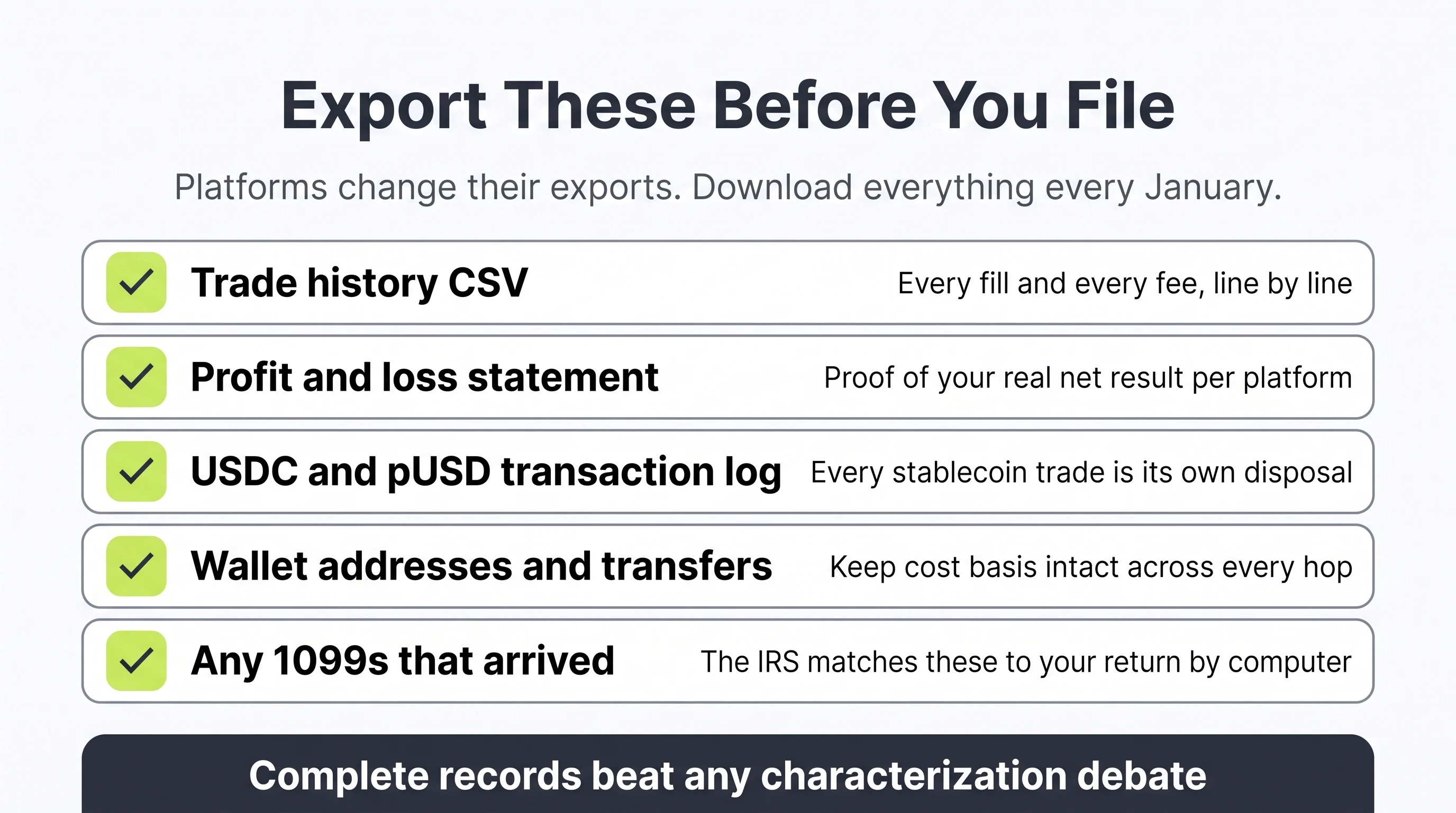
- Export everything first. Full trade history and PnL statement from every platform, plus wallet transaction logs for on-chain activity. January, every year, before formats change.
- Compute actual net profit per platform. Payouts minus cost minus fees. On PredictIt, remember the 10% profit fee and 5% withdrawal fee. On crypto-settled platforms, this step includes matching every stablecoin movement.
- Pick your characterization and file accordingly. Capital treatment goes on Form 8949 and Schedule D, transaction by transaction. Section 1256 goes on Form 6781 with the 60/40 split. Gambling goes on Schedule 1 as other income, with itemized losses on Schedule A subject to the 90% cap.
- Reconcile against whatever forms did arrive. A PredictIt 1099-MISC, an IBKR 1099-MISC showing gross proceeds, a 1099-DA from the exchange where you cashed out USDC. The IRS matches these by computer. If your return tells a different story than the forms, your return needs to explain the difference, not ignore it.
- Answer the digital asset question honestly. If you touched Polymarket or any on-chain market, the digital asset question on Form 1040 is a yes.
The Real Problem Is Records, Not Rules
Notice what every section of this guide kept circling back to. Not the rates. The records.
The characterization debate will get resolved eventually, by the IRS or the courts, and whatever the answer is, it will be applied to the transaction history you can produce. The trader with a complete, reconciled ledger adapts to any ruling in an afternoon. The trader with three platforms, a dead wallet, and a 1099-DA that matches nothing is in trouble under every framework.
Dollar platforms make this merely tedious. Crypto-settled platforms make it genuinely hard: hundreds of stablecoin disposals, transfers between wallets and exchanges, basis that has to survive every hop, and zero help from the platform. That reconstruction work, matching every on-chain movement to a cost basis and a clean Form 8949, is exactly what Count On Sheep does all day. We are a done-for-you crypto tax reconciliation service: you hand us the wallets and exchange accounts, we rebuild the history, reconcile it against whatever forms the IRS received, and deliver filing-ready numbers your tax preparer can defend.
If an on-chain platform has no export or later shuts down, the wallet history still survives. Reconstructing it means decoding contract calls, carrying basis across each stablecoin hop, and matching the results to the exchange transactions at either end. A dedicated prediction-market wallet makes that work much faster and reduces the chance that unrelated DeFi activity hides a wager or payout.
If your prediction market activity lives on Polymarket or anywhere else on-chain and the ledger is already messy, that is our home turf. Start with our full crypto tax guide if you want the broader rules, or skip the homework and talk to us.
Key Takeaways
- All prediction market profits are taxable, and most platforms send no 1099 for trading gains: Kalshi, Polymarket, and Robinhood event contracts all leave reporting to you
- The IRS has not ruled on characterization; capital gains is the common position, Section 1256 (60/40) is the aggressive one, and gambling is the risk, especially for sports contracts
- The One Big Beautiful Bill Act caps gambling loss deductions at 90% starting in 2026, creating phantom taxable income for break-even bettors
- Polymarket, Limitless, SX Bet, Myriad, Azuro-powered apps, Overtime, and Drift BET all create wallet-level records that may need reconstruction
- Crypto-settled wagers can create disposals when stablecoins are placed, paid out, and cashed out, while 1099-DA reporting exposes the exchange endpoints
- States opened a 2026 tax war on prediction markets (Kentucky’s 14.25% excise, Illinois licensing, the New Jersey and Nevada preemption fights); expect fee pass-through and midyear access changes
- Whatever characterization wins, complete records win with it: export trade histories every January, keep wallet-level basis intact, and use a dedicated wallet when possible
Frequently Asked Questions
Do you have to pay taxes on prediction market winnings?
Yes. Profits from Kalshi, Polymarket, Robinhood event contracts, and every other prediction market are taxable income in the US, whether or not the platform sends you a tax form. What the IRS has not decided is how to classify those profits: gambling income, capital gains, or Section 1256 contracts. Most traders report them as capital gains, but the question is unsettled.
Does Kalshi send a 1099 for trading profits?
No. Kalshi does not issue any 1099 for your event contract profit or loss. Per Kalshi's own help center, it issues a 1099-INT for interest of $10 or more, a 1099-MISC for referral credits and rewards, and 1099-B or 1099-DA forms only for crypto transfers handled by ZeroHash. Your trading gains come from the profit and loss statement in your account, and reporting them is on you.
Do you pay taxes on Polymarket?
Yes, twice over in a sense. Your prediction profits are taxable, and because Polymarket settles trades in USDC (converted to pUSD since April 2026), every purchase, sale, and redemption is also a disposal of a digital asset under IRS property rules. Each one belongs on Form 8949, even when the stablecoin gain rounds to zero. The on-chain platform sends no 1099, so the records burden is entirely yours.
Are prediction markets taxed as gambling or capital gains?
The IRS has not ruled. Three positions exist: gambling income (ordinary rates, losses only as itemized deductions), capital gains (most common in practice, with the $3,000 net loss limit), and Section 1256 treatment (60/40 long-term/short-term split for CFTC-regulated contracts, reported on Form 6781). Sports contracts carry the highest risk of gambling treatment. Pick a position, apply it consistently, and keep records that support it.
Can you write off prediction market losses?
It depends on how you characterize the activity. Under capital gains treatment, losses offset other capital gains plus up to $3,000 of ordinary income per year, with carryforward. Under gambling treatment the math got worse in 2026: the One Big Beautiful Bill Act caps the deduction at 90% of losses, only up to winnings, and only if you itemize. A gambler who wins and loses $50,000 in the same year still owes tax on $5,000 of phantom income.
Do I have to report prediction market winnings if I never got a tax form?
Yes. Most prediction market platforms send no 1099 for trading profits at all, and no minimum threshold makes income exempt. The IRS taxes the income whether or not paperwork exists. Download your trade history or profit and loss statement before year end, because platforms change their exports, and reconstructing on-chain activity after the fact is much harder.
Do on-chain prediction markets report to the IRS?
On-chain and offshore platforms generally do not provide a complete US tax form for prediction-market activity. Exchanges may still report the stablecoin purchase or cash-out on Form 1099-DA, and the blockchain preserves the transactions between those endpoints.
How is betting with USDC taxed?
Placing the wager disposes of USDC, a win creates taxable profit and fresh basis in the payout, and cashing out creates another disposal. Stablecoin gains may be close to zero, but each leg still belongs in the digital asset ledger.
What if an on-chain platform has no export or shuts down?
The wallet history remains on the blockchain even if the platform changes or disappears. A complete report may require decoding contract interactions, restoring basis across transfers, and matching the wallet activity to exchange deposits and withdrawals.