

Robinhood built its reputation on making taxes almost automatic. Trade stocks all year and a tidy consolidated 1099 lands in February with every sale itemized, the IRS gets its copy, and tax software slurps the whole thing in one import.
Then you trade Robinhood’s prediction markets, wait for that same tidy form, and get something different: an “Event Contracts Annual Statement” that announces, in its own fine print, that it is not a tax form. Nothing about your event contracts appears on your consolidated 1099. Nothing goes to the IRS. The most hand-holding broker in America suddenly hands you nothing.
This guide explains why that gap exists, what the annual statement actually is, and exactly how to report Robinhood prediction market gains and losses for 2026.
Disclaimer: This guide is for informational purposes only and is not tax advice. The characterization of event contracts is unsettled law. Talk to a qualified tax professional about your specific situation.
Do You Pay Taxes on Robinhood Prediction Markets?
Yes. Every dollar of profit from Robinhood event contracts is taxable income, whether you traded election markets, sports, economics, or weather. No minimum threshold exempts small winnings, and the absence of a tax form changes nothing about the obligation.
The confusion is understandable, because Robinhood trained its users to expect automatic tax paperwork. The reality: prediction markets are offered through Robinhood Derivatives, a separate entity from the broker-dealer, and the contracts themselves trade on external CFTC-regulated exchanges. Robinhood’s prediction markets hub runs on Kalshi’s exchange, and its earlier election contracts ran through ForecastEx. Your order goes through Robinhood’s interface, but the asset lives outside the pipeline that generates your consolidated 1099.
Different pipeline, different paperwork. Which for tax year 2025 meant: no 1099-B, no 1099-DA, no IRS copy of anything related to your event contracts.
Two Pipelines, Two Very Different Tax Experiences
The cleanest way to see the problem is side by side:
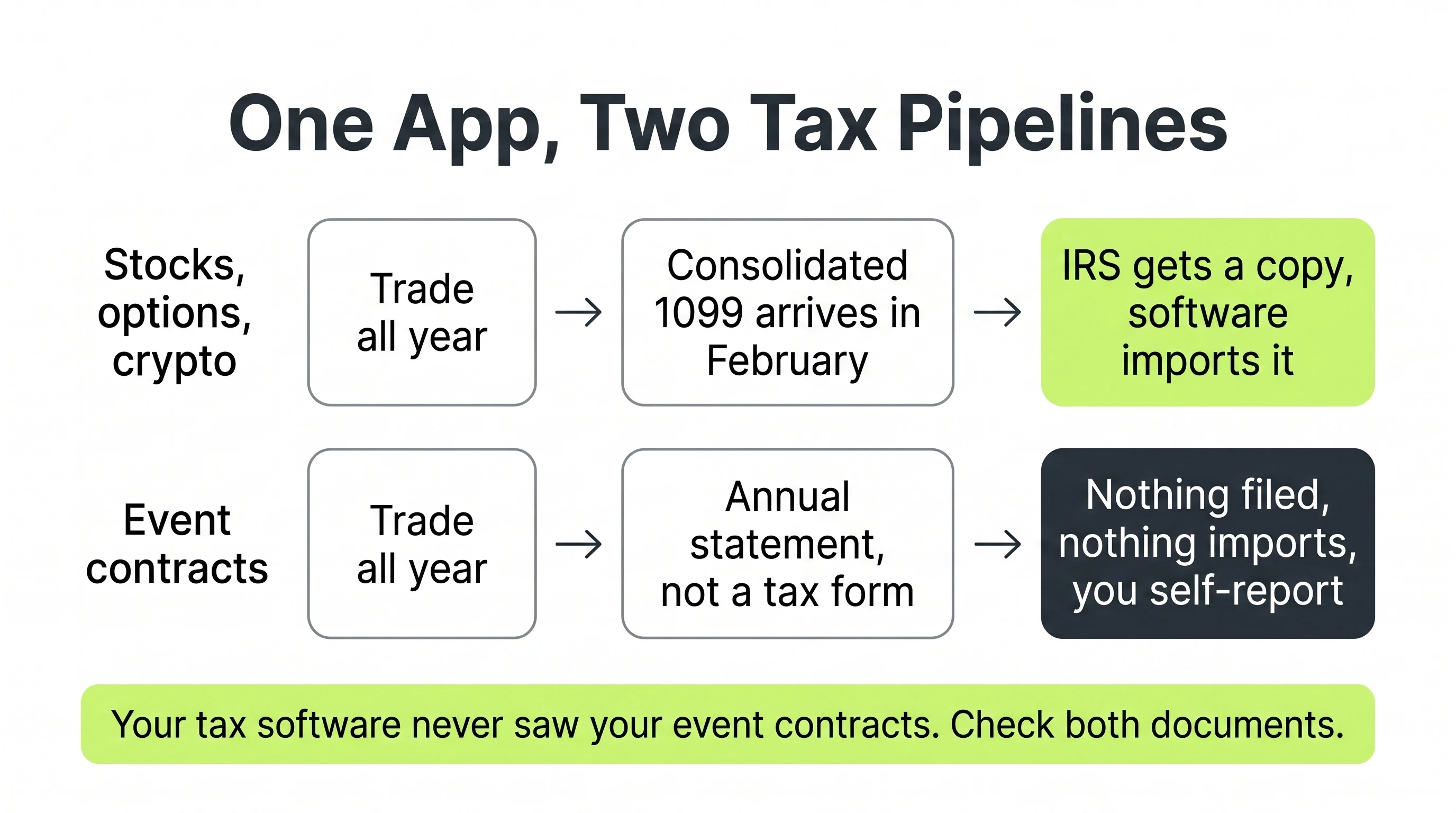
Your stocks, options, and crypto on Robinhood flow into the consolidated 1099: itemized sales, cost basis mostly tracked for you, an IRS copy filed, and clean import into tax software. (Crypto has its own quirks, covered in our Robinhood crypto taxes guide.)
Your event contracts flow into the Event Contracts Annual Statement: a summary of your trading activity that is explicitly not a tax form, is not filed with the IRS, and will not import anywhere. It exists so you have the numbers to self-report. That is the entire scope of the help you are getting.
Gambling, Capital Gains, or Section 1256?
The IRS has not ruled on how event contract profits are characterized, and Robinhood’s contracts sit in exactly the same three-way debate as everyone else’s. The short version:
- Capital gains is the common position: each contract is property, reported on Form 8949 and Schedule D, short-term for nearly all positions.
- Section 1256 is the aggressive position. The underlying exchanges (Kalshi’s DCM, ForecastEx) are CFTC-regulated, which is the argument’s whole foundation, but no exchange or broker issues the 1099-B that real futures reporting produces, and the IRS has never blessed event contracts as 1256 property. The prize is the 60/40 long-term/short-term split on Form 6781.
- Gambling is the risk case, strongest for sports contracts, and it got expensive in 2026.
The full debate, including the worked math on each side, lives in our prediction market taxes guide and its Kalshi deep dive, both of which apply directly since your Robinhood contracts trade on Kalshi’s exchange.
What Your Losses Are Worth in 2026
Characterization matters most when you lose, because the three regimes value the same loss very differently:
- Capital treatment: losses offset capital gains without limit, then up to $3,000 of ordinary income a year, with indefinite carryforward. Your event contract losses can shelter stock gains sitting in the same app.
- Section 1256 treatment: capital loss rules plus a three-year carryback election against prior 1256 gains.
- Gambling treatment: itemizers only, losses only against winnings, and starting in 2026 the One Big Beautiful Bill Act caps the deduction at 90% of losses.
Jordan trades Robinhood sports contracts through football season: $6,000 of wins, $5,500 of losses, $500 of real profit. Under capital treatment, tax lands on $500 (about $120 at the 24% bracket). Under gambling treatment with the 2026 cap, only $4,950 of losses are deductible even if Jordan itemizes, so taxable income is $1,050, more than double the actual profit. If Jordan takes the standard deduction like most filers, the whole $6,000 is taxable: $1,440 of tax on a $500 profit.
That scenario is why sports-heavy event contract trading deserves a conversation with a tax professional before it scales. The gambling characterization is unresolved, and its downside got dramatically worse this year.
How to Report Robinhood Event Contracts, Step by Step
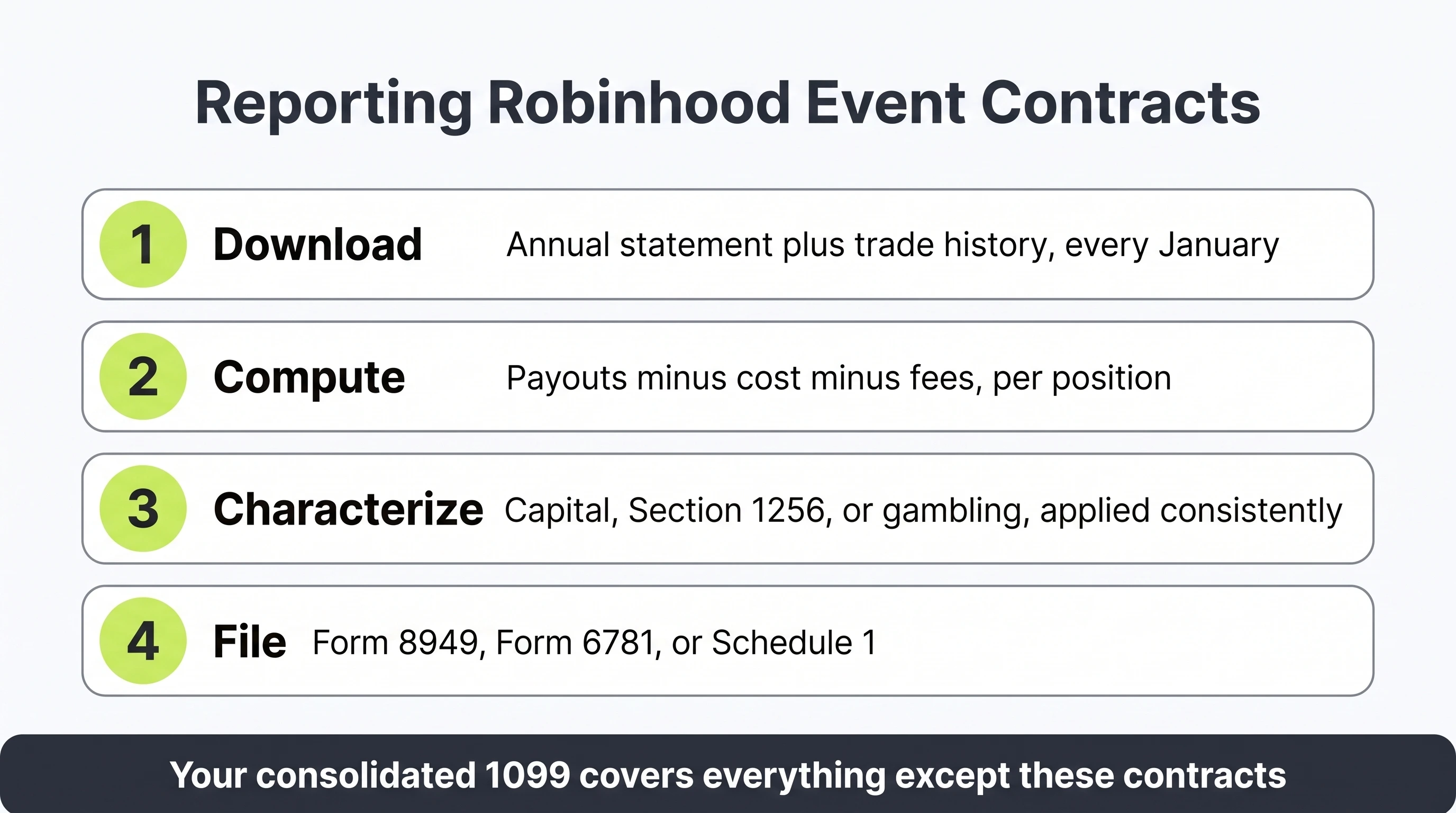
- Download the Event Contracts Annual Statement plus your detailed trade history from the app. Do it in January; export formats change without notice.
- Compute your real net profit. Payouts minus cost minus fees, position by position if you are taking capital treatment.
- Pick a characterization and stay consistent. Capital gains for most people; Section 1256 only with professional advice; be honest about sports contracts.
- File the matching forms. Form 8949 and Schedule D for capital, Form 6781 for 1256, Schedule 1 plus itemized Schedule A losses for gambling.
- Keep your other Robinhood reporting separate. The consolidated 1099 still covers your stocks, options, and crypto, and the IRS matches it by computer. Event contracts are an addition to your return, not a replacement for anything on the 1099.
When One App Becomes Three Tax Problems
Here is the situation we see constantly: one Robinhood account, three different tax regimes. Stocks with broker-tracked basis. Crypto with its own reporting rules and a 1099-DA. And now event contracts with no reporting at all. Add an outside wallet or a second platform like Polymarket and the year-end picture stops being something a single CSV can describe.
Count On Sheep is a done-for-you crypto tax reconciliation service built for exactly that mess. We take every account and wallet you have, rebuild the complete transaction history, reconcile it against every form the IRS actually received, and hand you filing-ready numbers your tax preparer can defend. The event contract characterization question stays yours to make with your advisor; the ledger that supports whichever answer you pick is what we deliver.
Key Takeaways
- Robinhood event contract profits are fully taxable, but they never appear on your consolidated 1099 and no form goes to the IRS
- The Event Contracts Annual Statement says it is not a tax form, and it means it: reporting is entirely self-service
- Contracts trade on CFTC-regulated exchanges (Kalshi’s DCM, ForecastEx), which fuels the same capital vs. 1256 vs. gambling debate as every prediction market
- Losses are worth the most under capital treatment; the 2026 gambling rules cap deductions at 90% for itemizers only
- Export your statement and trade history every January and reconcile against the consolidated 1099 so nothing falls through the pipeline gap
Frequently Asked Questions
Do I pay taxes on Robinhood prediction markets?
Yes. Profits from Robinhood event contracts are taxable income, the same as gains anywhere else. What changes is the paperwork: Robinhood sends no 1099 for event contract trading, so the income does not appear on your consolidated 1099 and reporting it is entirely up to you.
Does Robinhood send a 1099 for event contracts?
No. For tax year 2025 Robinhood issued no 1099-B and no 1099-DA for event contracts. Instead you receive an Event Contracts Annual Statement, which states in its own text that it is not a tax form and not a substitute for one. It summarizes your activity so you can self-report.
Are Robinhood prediction markets considered gambling for taxes?
Unsettled. The contracts trade on CFTC-regulated exchanges, and the IRS has not ruled on characterization. Capital gains treatment is the most common position, Section 1256 is argued because of the CFTC venue, and gambling treatment is the risk case, especially for sports markets. Whatever you pick, apply it consistently.
Are Robinhood prediction market losses tax deductible?
Under the common capital treatment, yes: losses offset capital gains without limit, then up to $3,000 of ordinary income per year, with carryforward. Under gambling treatment the 2026 rules are much worse, capping deductions at 90% of losses for itemizers only. Characterization decides what your losses are worth.
Why did my Robinhood consolidated 1099 not include my event contracts?
Because event contracts run through Robinhood Derivatives and trade on external CFTC exchanges, outside the broker-dealer pipeline that generates your consolidated 1099. Stocks, options, and crypto flow into the consolidated form; event contracts flow into a separate annual statement that is not filed with the IRS.
How do I report Robinhood event contracts on my tax return?
Download the Event Contracts Annual Statement and your trade history, compute net profit including fees, then report under your chosen characterization: Form 8949 and Schedule D for capital treatment, Form 6781 for a Section 1256 position, or Schedule 1 as other income under gambling treatment.