
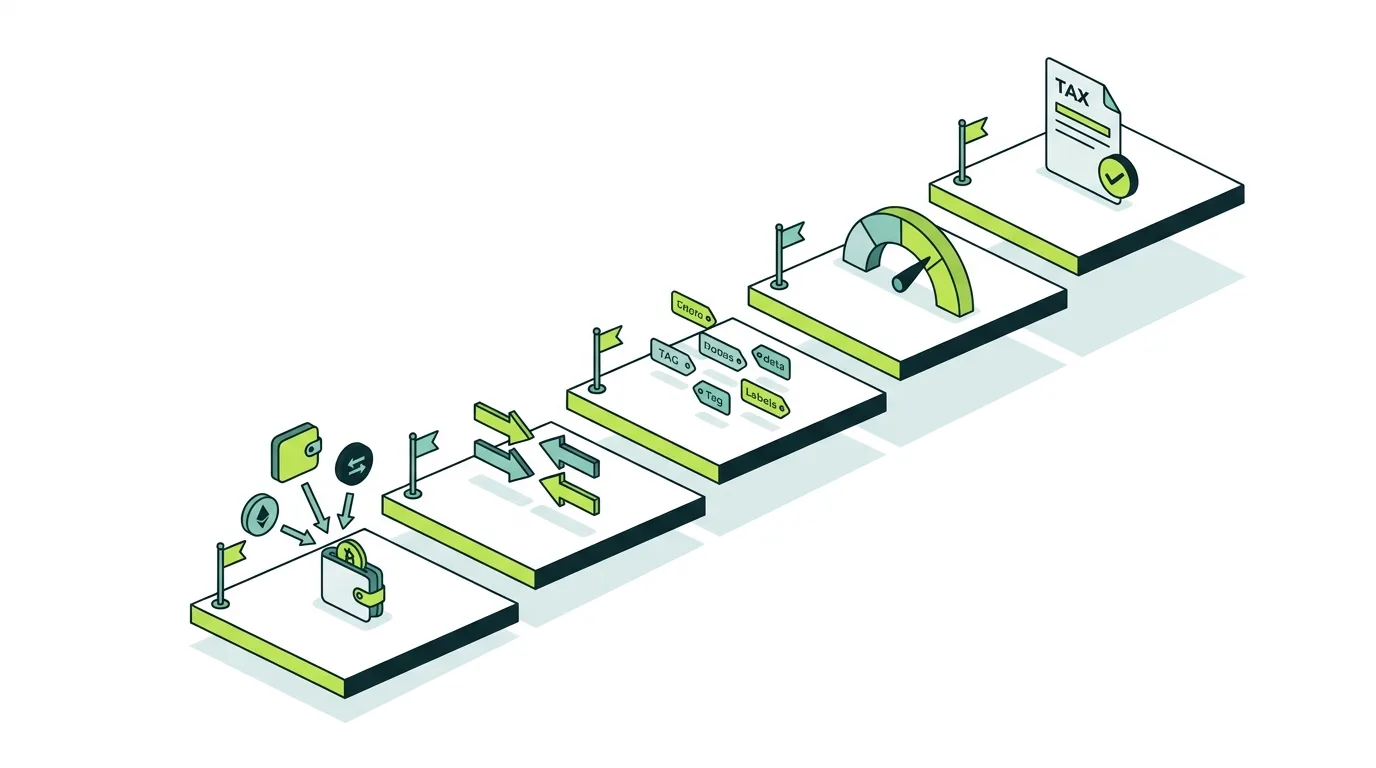
Most people do not need to learn every feature in Koinly. They need to build five skills in the right order. Connect, reconcile, classify, optimize, file. Master those stages and a clean, defensible crypto tax report stops feeling like luck and starts feeling like a process.
This is the learning path, stage by stage, so you know exactly what to practice and in what order.
Disclaimer: This guide is for informational purposes only. Always consult a qualified CPA regarding your specific situation.
Quick answer (TL;DR): Learn Koinly as a progression of five skills. Stage 1, connect every wallet and exchange and set your base currency and cost basis method. Stage 2, reconcile by clearing the warnings panel and matching balances. Stage 3, classify staking, airdrops, swaps, and DeFi correctly. Stage 4, optimize your cost basis method and apply per-wallet tracking. Stage 5, generate Form 8949 and Schedule D and file. Connecting is easy. Reconciling and classifying are where the skill lives.
If you want the single linear walkthrough instead of the skill-by-skill framing, our how to use Koinly tutorial covers the same steps as one sit-down. This post is for people who want to understand each stage well enough to repeat it every year.
Stage 1: Learn to Connect
The first skill is getting complete, clean data into Koinly. Before you import anything, set three things: your base currency, your tax residency, and your cost basis method. These drive every later calculation, and changing them afterward forces a full recalculation.
Then connect everything:
- Exchanges: add each one with a read-only API key or a CSV export. Read-only access lets Koinly import your history without ever being able to move or trade your funds.
- Wallets: add by pasting the public address. Koinly reads the chain and pulls your on-chain activity.
The skill here is completeness. Connect the accounts you forgot about, not just the ones you use today.
If you are brand new and want the gentlest on-ramp before tackling stages, start with our Koinly for beginners guide, then come back here for the full path.
Stage 2: Learn to Reconcile
This is the stage that separates people who use Koinly from people who trust their Koinly report. Once your accounts are connected, let Koinly fully sync. On a large or multi-chain portfolio the first sync can take a while. Then open the warnings panel, because this is your real curriculum.
The warnings that matter most:
- Missing cost basis. A disposal with no recorded purchase. Left alone, it inflates your gain.
- Unmatched transfers. A move between your own wallets that Koinly read as a sale plus a separate purchase.
- Mislabeled transactions. Staking, airdrops, swaps, and DeFi events tagged incorrectly.
Work them top to bottom. Match transfers first, because linking a withdrawal from one of your wallets to the deposit in another removes a phantom sale and a phantom buy in a single move. Then resolve missing cost basis by connecting the source account or entering the original purchase.
The final reconcile skill is balance matching. Compare what Koinly says you hold to what your accounts actually hold. If Koinly shows 1.2 ETH and your wallet shows 1.2 ETH, the history behind it is probably complete.
A user was convinced Koinly was broken because it showed a five-figure gain on a year he barely traded. The cause was three unmatched transfers between his own wallets. Koinly had counted each move out as a taxable sale. Matching the transfers dropped his reported gain to what it actually was. The software was right. The data was just incomplete.
Stage 3: Learn to Classify
Reconciling removes phantom transactions. Classifying makes the real ones correct. This is the judgment stage, and it is where most self-taught users quietly go wrong.
You are learning to label each transaction with the right tax treatment:
- Staking and rewards are usually income at the time you receive them.
- Airdrops can be income on receipt depending on the facts.
- Swaps are disposals of one asset and acquisition of another.
- Liquidity and DeFi moves vary, and Koinly’s default guess is not always right.
The skill is consistency. Pick a defensible treatment for each transaction type and apply it the same way every time. If your DeFi history is heavy, our DeFi import guide for Koinly goes deeper on the trickiest labels.
Stage 4: Learn to Optimize
Once your data is clean and correctly labeled, you can think about your gain. For US filers the default cost basis method is FIFO. Koinly also supports HIFO and other methods where allowed, and the method you choose changes your taxable gain.
Two rules shape this stage in 2026:
- Per-wallet cost basis (Rev. Proc. 2024-28). From January 1, 2025, the IRS requires per-wallet basis tracking and ends universal pooling. The one-time safe-harbor allocation locks in on your 2025 return, filed in 2026. Confirm Koinly is set to apply per-wallet basis.
- Method consistency. Pick a method you can apply consistently and document. If your portfolio is large, get a second opinion before you commit.
Here is why the method matters. Say you bought 1 BTC at 20,000 and another at 40,000, then sold 1 BTC for 50,000. Under FIFO you dispose of the 20,000 lot and report a 30,000 gain. Under HIFO you dispose of the 40,000 lot and report a 10,000 gain. Same sale, very different tax, decided entirely by the method and your records. Learning to see that choice, instead of accepting whatever Koinly shows by default, is the whole point of this stage. For a deeper breakdown, see our guide on FIFO vs HIFO vs Spec ID.
Stage 5: Learn to File
The final skill is turning a clean report into filed forms. Once your warnings are cleared, balances reconcile, and classifications are correct, generate your report. For US filers that means Form 8949 and Schedule D, plus a TurboTax export or an accountant-ready file if you are handing it off.
Know the boundary: Koinly produces the forms, it does not file them. You file, your preparer files, or a done-for-you crypto tax service reconciles and files for you. One more 2026 wrinkle to plan for: your first Form 1099-DA, arriving in early 2026, will often report proceeds with no cost basis, which makes a sale look like pure profit. Reconciling that form against your real purchase history is exactly the skill you built in stage 2.
Want the Guided Version of This Path?
You can absolutely learn these five stages on your own with the steps above. The faster route is to be walked through each stage, with the exact fixes for the warnings and labels that cause the most damage, so you skip the expensive trial and error.
Learn Koinly the guided way
The DIY Crypto Tax Course on Koinly walks you through every stage in this path, built by former Big 4 accountants. Self-paced, lifetime access.
- Connect every wallet and exchange the right way
- Fix cost basis, DeFi labels, and missing history
- File Form 8949, Schedule D, and Schedule 1 with confidence
That is exactly what the DIY Crypto Tax Course on Koinly is built for: the same connect, reconcile, classify, optimize, file path, taught screen by screen.
Key Takeaways
- Bottom line: Koinly stops being overwhelming once you treat it as five stages run in order, where skipping ahead is what creates the wrong numbers people complain about
- Completeness comes first. Connect every account, including dead ones, before you import a single transaction
- The warnings panel is the heart of the work, not a chore. Match transfers and reconcile balances there before you trust any figure
- Classification is where self-taught users slip. Label staking, airdrops, swaps, and DeFi the same consistent way every time, then lock in a documented basis method with per-wallet applied for 2025
- Decision point: Stage 5 is filing, and Koinly only produces Form 8949 and Schedule D. From there you file yourself, or hand the return to a service if the cleanup outgrew you
Frequently Asked Questions
How long does it take to learn Koinly?
A simple portfolio can be learned in an afternoon: connect, sync, download. The skill that takes longer is reconciliation, which is reading the warnings panel and knowing how to resolve missing cost basis, unmatched transfers, and mislabeled DeFi. Most people get comfortable after one full tax year of practice, or much faster with a structured course that shows the exact fixes.
What is the right order to learn Koinly in?
Learn it in the order the work actually happens: connect every account first, then reconcile your data, then classify transactions correctly, then optimize your cost basis method, and finally file. Skipping ahead to the forms before you reconcile is the single most common mistake, because the report will look finished while the numbers are still wrong.
Do I need to know accounting to learn Koinly?
No. Koinly does the math. What you are learning is judgment: how to tell a transfer from a sale, how to label a staking reward, and how to spot a missing wallet. Those are pattern-recognition skills, not accounting degrees. A good course teaches the patterns so you do not learn them through expensive trial and error.
Why are my Koinly numbers still wrong after I learned the basics?
Almost always a missing account, unmatched transfers that look like sales, zero or missing cost basis, or mislabeled DeFi transactions. Koinly flags most of these in its warnings panel. Learning to read and clear those warnings is the difference between a clean-looking report and a correct one.
What cost basis method should I learn to use in Koinly?
Most US filers use FIFO, and Koinly also supports HIFO and other methods where allowed. The method changes your gain, and as of 2025 the IRS requires per-wallet tracking under Rev. Proc. 2024-28. Learn to pick one method you can apply consistently and document, then confirm Koinly is set to per-wallet basis.
Does learning Koinly mean I can file my own crypto taxes?
Yes, for most portfolios. Once you can connect, reconcile, classify, and generate Form 8949 and Schedule D, you can file yourself or hand a clean export to a preparer. Koinly is the reconciliation engine, not the filer, so you still submit the return. For very large or messy histories, a done-for-you service may be the better call.
Is there a guided way to learn Koinly instead of trial and error?
Yes. Our DIY Crypto Tax Course on Koinly walks you through the entire path, from connecting accounts to filing Form 8949 and Schedule D, so you skip the mistakes that inflate your gain. It is built by former Big 4 accountants and is self-paced with lifetime access.