
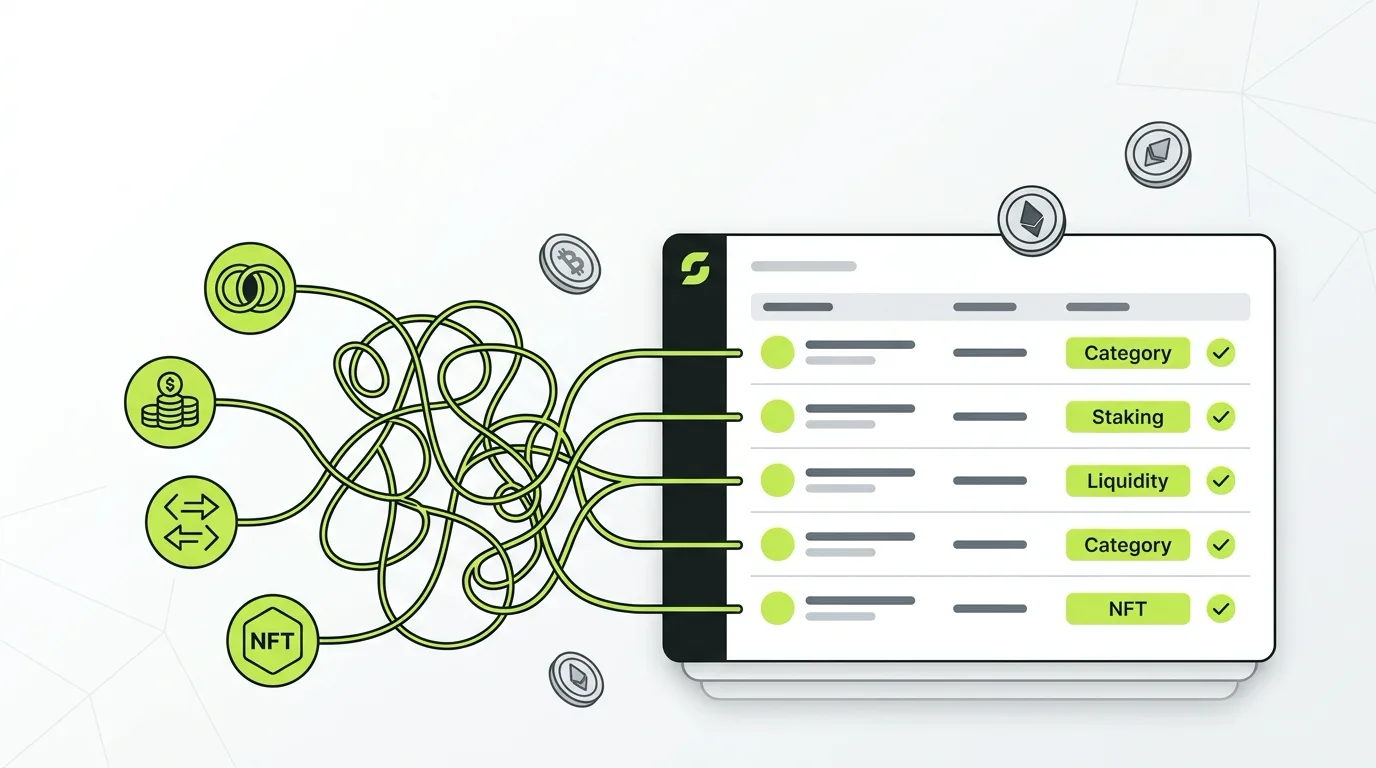
Koinly DeFi import is where Koinly goes from “mostly automatic” to “needs your attention.” The platform is genuinely good at pulling on-chain data, but a single DeFi action can look like three different things to an importer, and that is where the errors creep in.
There are really two problems people run into: Koinly not importing DeFi transactions at all, and Koinly importing them but labeling them wrong. They have different fixes, so let us separate them.
Disclaimer: This guide is for informational purposes only. Always consult a qualified CPA regarding your specific situation.
How Koinly Imports DeFi (Quick Answer)
Koinly pulls DeFi activity by reading your public wallet address on each blockchain. It is not an API login like an exchange. That means two things: you must add the wallet address for every chain you used, and Koinly has to interpret raw on-chain contract calls, which is far harder than reading a clean exchange trade.
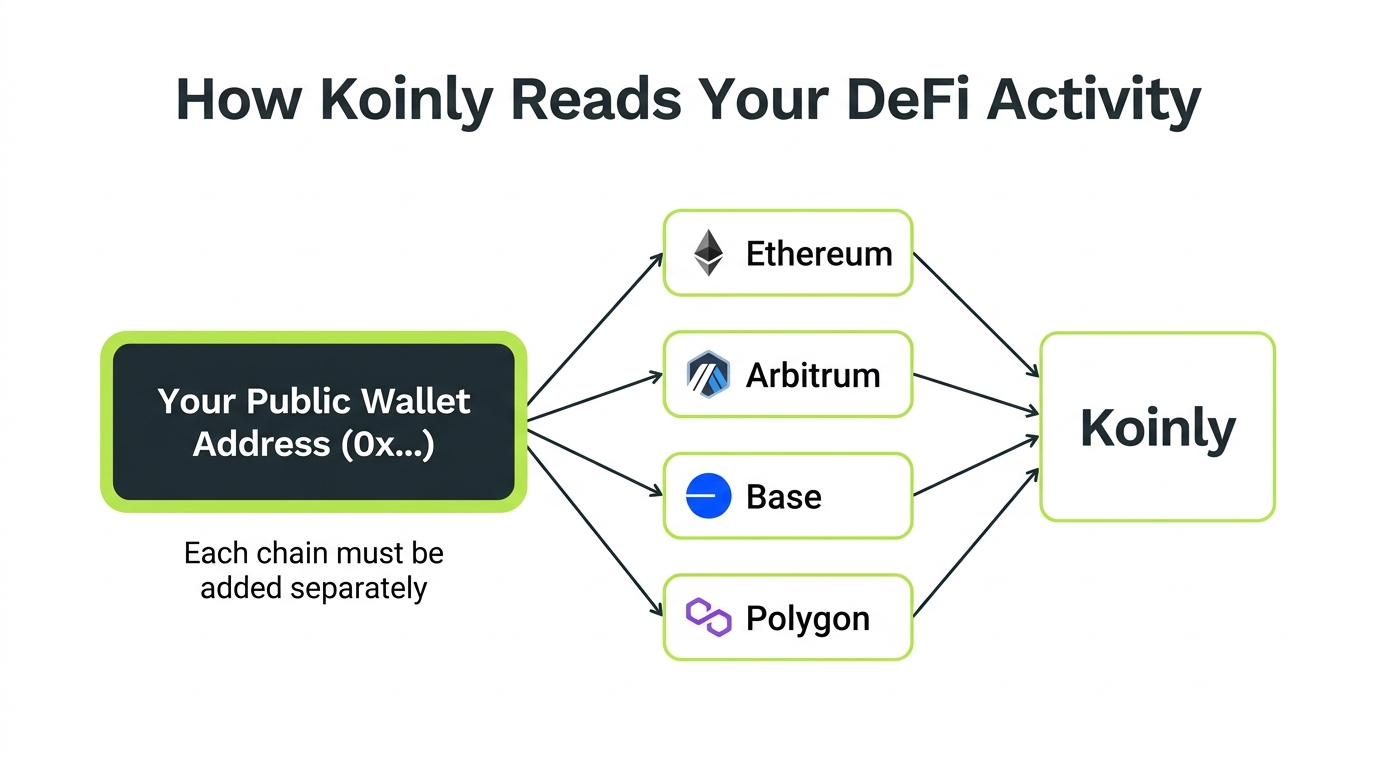
This is why the same wallet can import perfectly on Ethereum but show nothing on Arbitrum: the Arbitrum chain was never added.
Problem 1: Koinly Is Not Importing DeFi Transactions
If activity is simply missing, work through these in order:
- Add the wallet on every chain it used. One address can be active on Ethereum, Arbitrum, Base, Optimism, Polygon, and more. Each chain is a separate sync in Koinly. If chains will not sync at all, start with the Koinly not working fixes.
- Re-sync after adding chains. New chains do not backfill until you trigger a sync.
- Check for unsupported or obscure protocols. Very new or niche protocols may not auto-import. Those transactions can be added manually or via CSV.
- Confirm the address is correct. A single wrong character means Koinly reads an empty or unrelated wallet.
Problem 2: Koinly Is Labeling DeFi Transactions Wrong
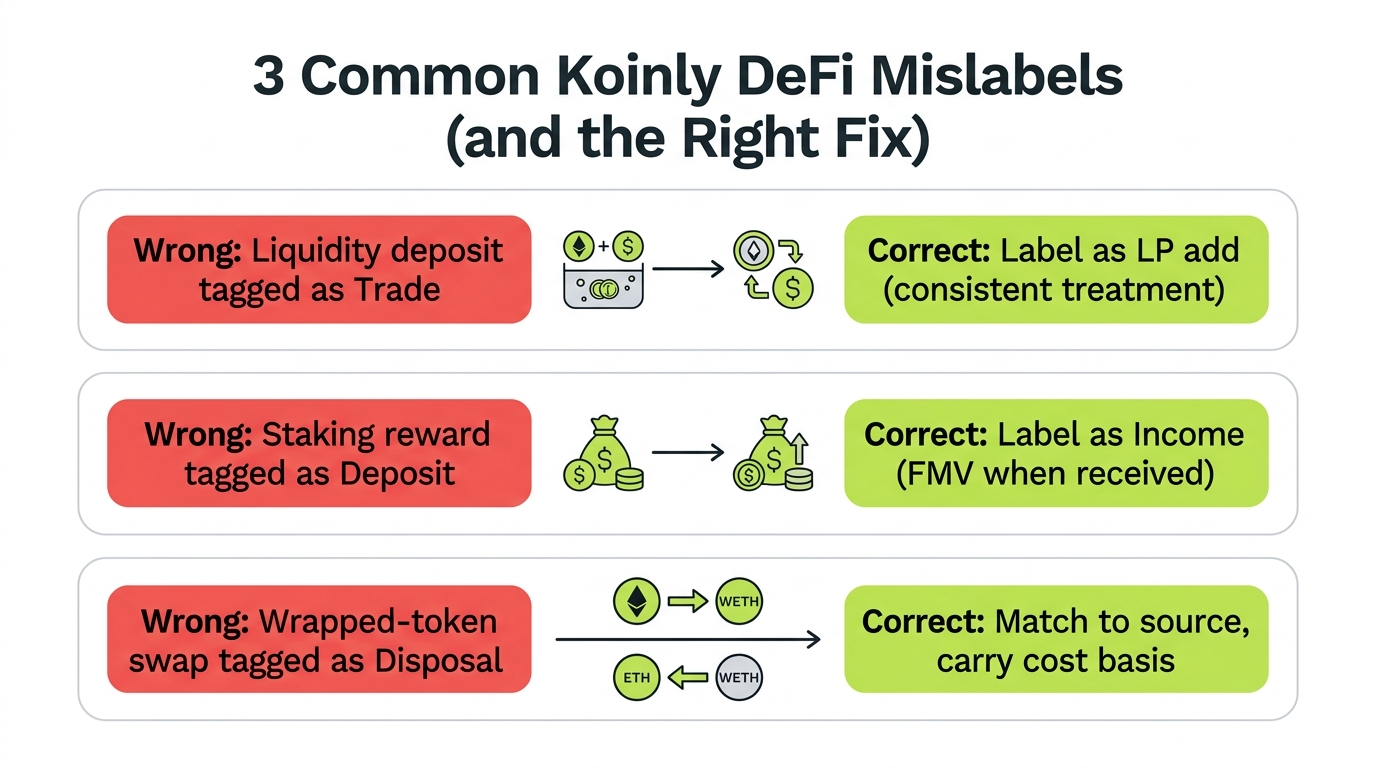
This is the more common and more dangerous problem, because the data is there but the tax treatment is wrong. Here is how the three worst offenders break.
Liquidity Pools
Adding liquidity often imports as a trade plus an LP token, and removing it imports as another set of trades. If you label these inconsistently, your gains will not reconcile. Pick a treatment, apply it the same way every time, and document it.
Staking and Lending Rewards
Rewards should generally be tagged as income at fair market value when you control them. Koinly sometimes imports them as plain deposits, which hides taxable income. Re-tag every reward stream as income.
Wrapped and Bridged Tokens
Wrapping ETH to WETH or bridging an asset across chains can read as a disposal with a $0 cost basis on the new token. That manufactures a fake gain. Match the wrapped or bridged token back to its source so the basis carries over. If you are seeing $0 basis elsewhere too, our guide on fixing wrong Koinly cost basis covers the full repair order.
The DeFi Cleanup Workflow
A client’s Koinly showed $80,000 in DeFi gains that terrified him. The real issue: he provided liquidity on three chains, and Koinly had imported each LP entry and exit as separate trades with broken cost basis, plus tagged his staking rewards as deposits. After we added the two missing chains, matched the wrapped tokens, re-labeled the LP activity consistently, and tagged rewards as income, his actual gain was about $19,000 with roughly $6,000 of separately reported staking income. The $80,000 figure was an artifact of bad labels.
Run DeFi cleanup in this sequence:
- Add and sync every chain each wallet touched
- Compare Koinly against a block explorer to find missing activity
- Fix cost basis on wrapped, bridged, and LP tokens first (they cause the biggest distortions)
- Re-label staking and lending rewards as income
- Apply one consistent LP treatment across every pool
- Regenerate the report and sanity-check the gains before the numbers flow onto your crypto tax forms
When to Hand DeFi to a CPA
DeFi is the single most common reason crypto investors stop trying to self-file. If you have real LP, lending, bridging, or multi-chain activity, the labeling decisions carry actual tax consequences and the guidance is still evolving. A crypto tax CPA who genuinely understands DeFi will classify it consistently, choose defensible treatments, and stand behind them. That is worth far more than a best guess the night before a deadline. See when to bring in a Koinly expert, or let a done-for-you Koinly tax filing service handle the reconciliation end to end.
Key Takeaways
- Bottom line: DeFi errors split cleanly into two buckets, missing data and wrong labels, and naming which one you have tells you exactly what to fix
- For missing transactions, the cause is almost always a chain you never added, so sync every chain the wallet ever touched before anything else
- For wrong transactions, the data is there but mistagged. Re-label with the correct treatment, and watch LP, staking rewards, and wrapped or bridged tokens closely since they distort the most
- Consistency beats perfection. Pick a defensible treatment and apply it the same way every time rather than chasing the theoretically ideal label
- Decision point: DeFi is the single area where a crypto CPA most reliably earns the fee, so if liquidity pools or bridges have your report tangled, hand it off
Frequently Asked Questions
Why is Koinly not importing my DeFi transactions?
Koinly imports on-chain activity by reading your public wallet address, not an API. If DeFi transactions are missing, the usual causes are that the wallet address was not added, the specific chain (Arbitrum, Base, Polygon, and so on) was not synced, or the protocol used contract interactions Koinly could not auto-label. Add every chain the wallet touched and re-sync to pull the missing activity.
Why does Koinly label my DeFi transactions wrong?
DeFi is hard to classify automatically because a single on-chain action can look like several things. Koinly may tag a liquidity deposit as a trade, a reward as a deposit, or a wrapped-token swap as a disposal. These are labeling errors, not lost data. You fix them by re-tagging the transaction with the correct Koinly label so the tax treatment is right.
How do I fix liquidity pool transactions in Koinly?
Adding and removing liquidity often shows up as two trades plus an LP token. Decide on a consistent treatment (many treat entering and exiting an LP as taxable swaps), then label the transactions the same way every time. Document your method. Inconsistent LP handling is one of the biggest sources of wrong DeFi gains.
Does Koinly handle staking rewards correctly?
Koinly can import staking rewards, but it does not always tag them as income automatically. Staking rewards are generally taxable as ordinary income at fair market value when you gain control of them. Check that rewards are labeled as income, not as deposits or transfers, or your income will be understated.
Why are my DeFi gains so high in Koinly?
Usually because of missing cost basis or misclassified transfers. When Koinly imports a token received from a protocol but cannot trace its cost, it assumes a $0 basis, so the later sale looks like pure profit. Wrapped tokens, bridged assets, and LP tokens are common offenders. Trace the source or set the correct basis to fix it.
Should I hire a CPA for DeFi crypto taxes?
DeFi is where most investors hit the wall. If you have meaningful LP, lending, bridging, or multi-chain activity, the classification calls have real tax consequences and the IRS treatment is still evolving. A crypto CPA who knows DeFi can label it consistently and defend the positions, which is worth far more than a guess.