

Koinly is a great tool, but at some point the problem stops being “which button do I click” and becomes “which tax treatment is actually correct and defensible.” That is the line where a Koinly expert or crypto tax specialist earns their fee. This guide tells you exactly when you have crossed it.
You do not need a professional for a clean portfolio. You very much want one when your account hits the signs below, because the cost of a wrong report, in overpaid tax or an IRS problem, dwarfs the cost of getting it right.
Disclaimer: This guide is for informational purposes only. Always consult a qualified CPA regarding your specific situation.
The DIY Line: When Koinly Alone Is Enough
If you bought and sold a few coins on one or two major exchanges, transferred little, and touched no DeFi, Koinly plus a careful review will get you a correct report. You do not need us. Connect everything, clear the warnings, verify the totals, and file. And if you are not sure Koinly is even the right tool for your situation, our crypto tax software buyer’s guide compares it against the alternatives.
Here is the quick decision matrix we use:
| Your situation | DIY Koinly | Koinly + review | Koinly + specialist |
|---|---|---|---|
| Under ~100 trades, 1-2 exchanges, no DeFi | Yes | ||
| Active trading, some transfers, light DeFi | Yes | ||
| High volume or multi-chain | Yes | ||
| Meaningful DeFi, staking, liquidity pools | Yes | ||
| Years of unreconciled history | Yes | ||
| 1099-DA mismatch or IRS notice | Yes |
Koinly remains your tool in every row. What changes is how much human judgment sits on top of it.
The 6 Signs You Need a Koinly Expert
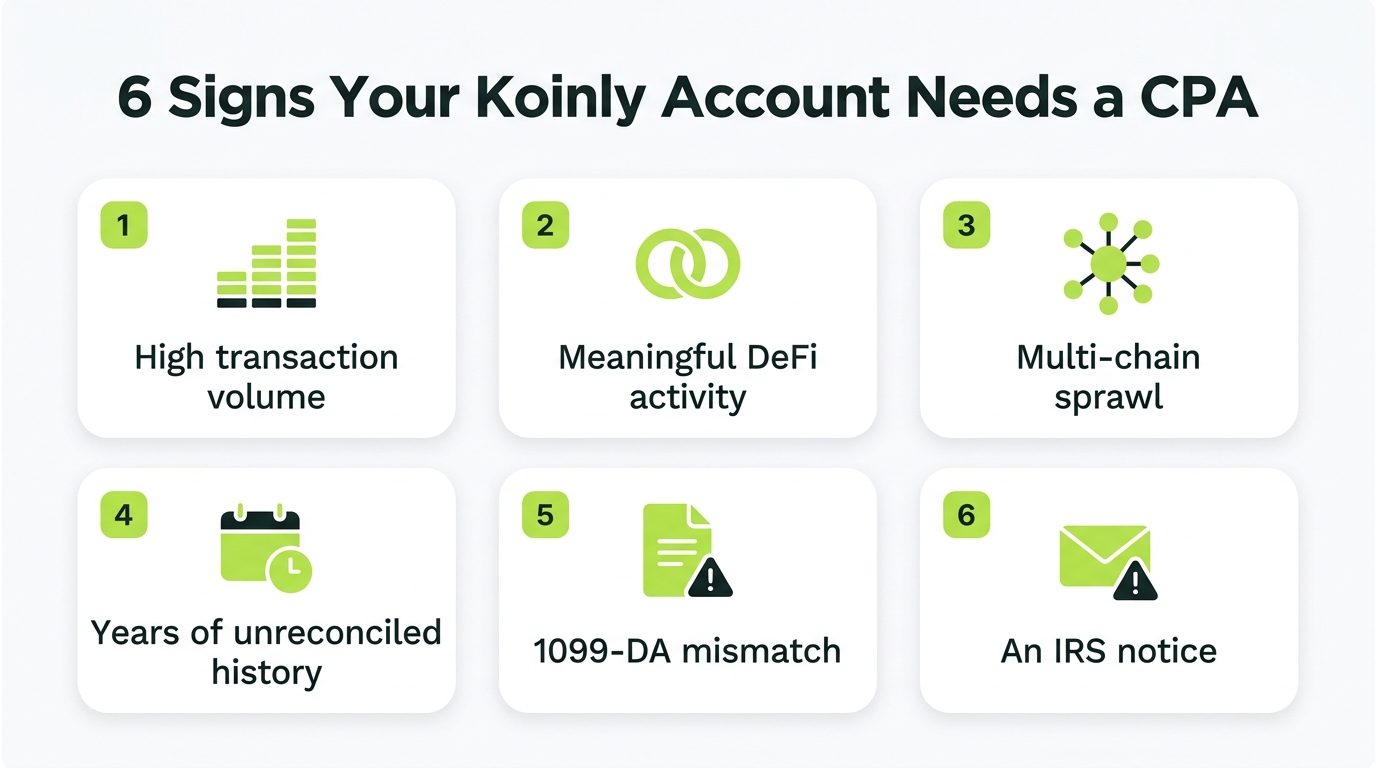
- High transaction volume. Thousands of trades across many accounts, where manual cleanup eats days and errors hide easily.
- Meaningful DeFi activity. Liquidity pools, staking, lending, wrapped and bridged tokens that Koinly mislabels and that carry real tax consequences (our Koinly DeFi import guide shows what is fixable yourself first).
- Multi-chain sprawl. Activity across many blockchains where one missing chain throws off cost basis everywhere downstream.
- Years of unreconciled history. Old gaps stacked on top of each other, including coins from exchanges that no longer exist.
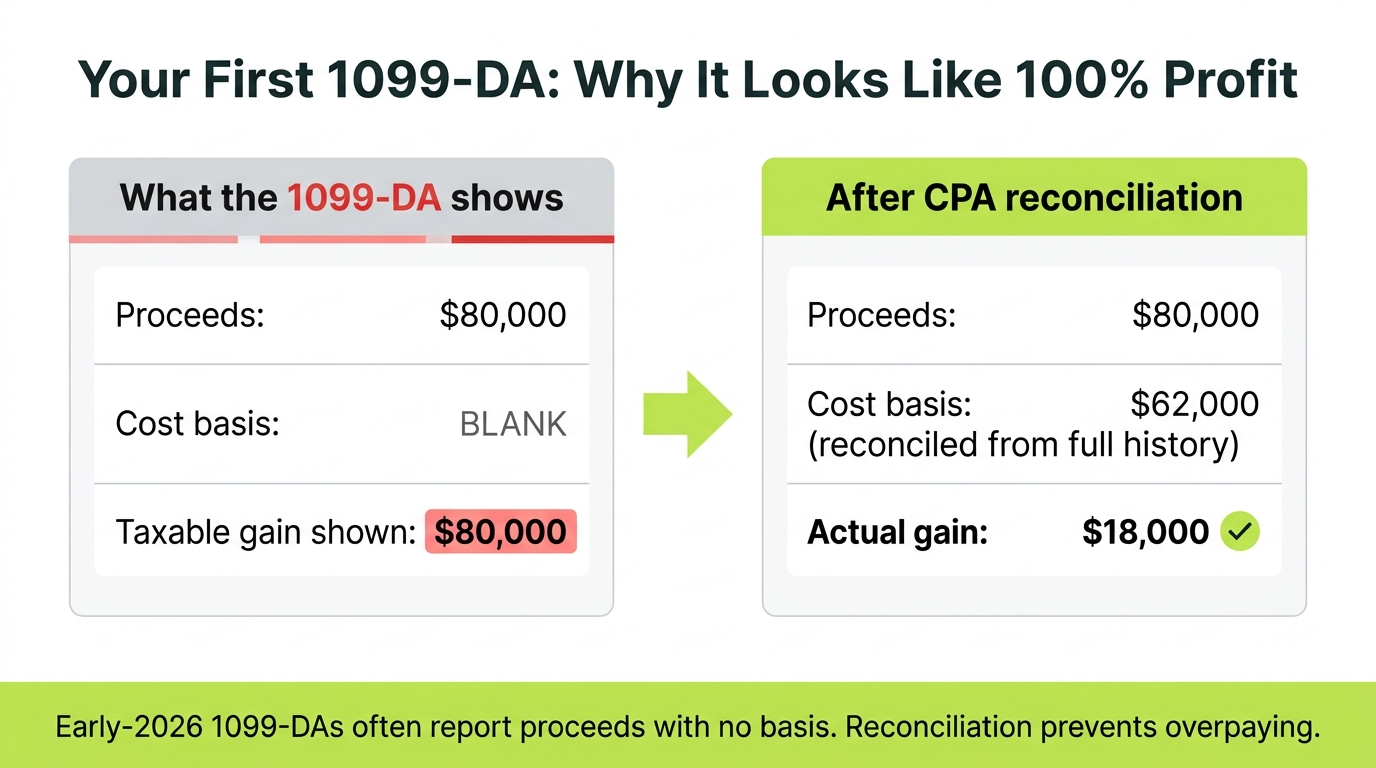
- A 1099-DA that does not match. Exchange-reported proceeds that conflict with your Koinly numbers and need reconciling and documenting.
 6. An IRS notice. A letter about crypto changes the stakes entirely. Get a professional involved before you respond.
The Per-Wallet Rule Alone Is Worth a Specialist
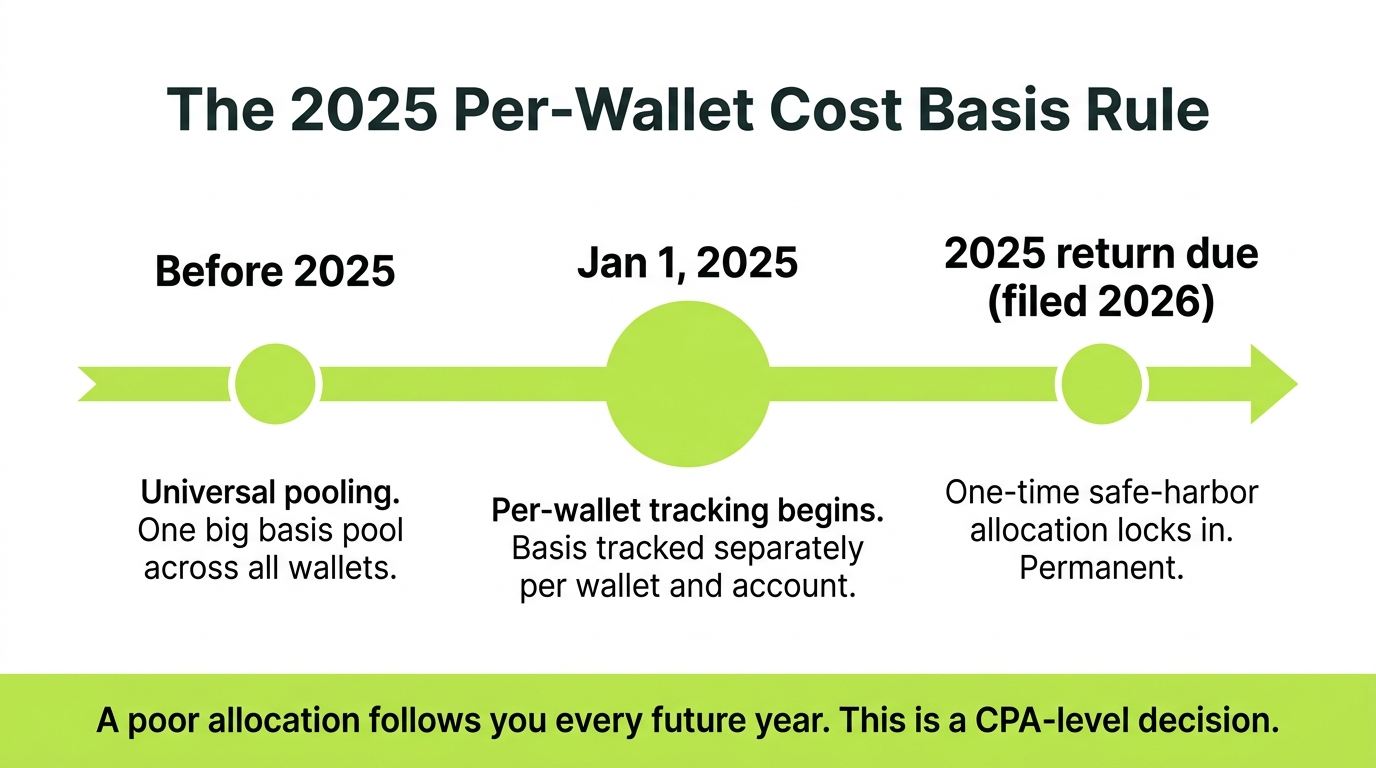
There is one 2025 change significant enough to justify professional help on its own: the per-wallet cost basis rule (Rev. Proc. 2024-28). Starting January 1, 2025, the IRS requires per-wallet basis tracking and ends universal pooling. The one-time safe harbor, allocating your unused basis held as of January 1, 2025 across your wallets, must be locked in by the due date of your 2025 return (filed in 2026), and it is permanent.
Koinly will apply settings. It will not decide the most defensible allocation across your wallets, and a poor choice follows you into every future year.
What a Crypto Tax Specialist Actually Does With Your Koinly Account
A Koinly expert does the mechanical cleanup, connecting missing wallets, matching transfers, resolving $0 cost basis, but the real work is judgment:
- Treating ambiguous DeFi events consistently and defensibly
- Choosing the cost basis method that is both optimal and supportable for you
- Reconciling and documenting 1099-DA mismatches
- Applying the 2025 per-wallet rules correctly
- Producing a report that holds up if the IRS asks questions
A client had spent two weekends fighting his Koinly account and was still staring at gains he knew were wrong. We worked directly in his Koinly, connected a closed exchange he had forgotten, matched 40-some transfers, and re-labeled his liquidity pool activity consistently. His reported gain dropped by roughly $50,000 to the accurate figure, and we documented every position. He kept Koinly. We made it defensible.
You Keep Koinly. We Make It Right.
Bringing in a crypto tax specialist does not mean abandoning your software. We work in your Koinly account or from a complete export, fix the data, make the judgment calls, and hand you a finished report you can file with confidence. You stay in control of your tool, and you stop guessing on the parts that carry real risk.
If any of the six signs sound like your account, let’s take a look before you file. Prefer to hand off the whole job? Here is how our done-for-you Koinly tax filing service works.
Key Takeaways
- Bottom line: Koinly is enough for a clean portfolio. The real question is whether your account has tipped into judgment calls software cannot make
- Let the six signs decide for you. High volume, DeFi, multi-chain, unreconciled history, a 1099-DA mismatch, or an IRS notice each justify bringing in help
- You keep your work. A crypto tax specialist plugs into your existing Koinly account rather than making you start over
- Frame the cost correctly: the fee is usually small next to the tax you overpay from an uncorrected basis, and far smaller than the cost of an unanswered IRS notice
- Next step: if even one of those signs fits your account, line up a specialist now instead of waiting for the deadline to force a rushed return
Frequently Asked Questions
Can a crypto tax specialist help with my Koinly account?
Yes. A crypto tax specialist who uses Koinly can connect missing wallets, match transfers, correct DeFi labeling, resolve $0 cost basis, choose the right cost basis method, and produce a finished, defensible tax report from your Koinly data. Many teams work directly inside your Koinly account or take your export and reconcile it. You keep the software, the specialist fixes and signs off on the numbers.
How much does it cost to have a crypto tax specialist do my Koinly taxes?
Pricing depends on your transaction volume and complexity. A clean account with a few thousand transactions costs far less than a multi-chain DeFi portfolio with years of unreconciled history. Most crypto tax specialists scope the work after a quick review of your account. The cost is usually small next to the overpaid tax that wrong cost basis can cause.
When should I hire a Koinly expert instead of doing it myself?
Hire help when you have high transaction volume, meaningful DeFi or multi-chain activity, years of stacked unreconciled history, a 1099-DA that conflicts with your Koinly numbers, or an IRS notice. Also hire help when the numbers simply will not reconcile after you have connected sources and matched transfers. Those are signs the issue is judgment, not clicks.
Will a crypto tax specialist work inside my existing Koinly account?
Often yes. Many crypto tax specialists work directly in your Koinly account with appropriate access, or reconcile from a complete export. You do not need to abandon Koinly or start over. The software stays your system of record while the professional fixes the data and finalizes the report.
What can a crypto tax specialist fix in Koinly that I can't?
Beyond the mechanical fixes, a specialist makes the judgment calls: how to treat ambiguous DeFi events consistently, which cost basis method is optimal and defensible for you, how to reconcile a 1099-DA mismatch, and how to document positions so they hold up if the IRS asks. That defensibility is the real value, not just clicking buttons faster.