

If you would rather not spend a weekend wrestling with cost basis warnings and DeFi labels, a done-for-you Koinly tax filing service hands the whole thing to a crypto tax specialist. You provide access, a professional reconciles it, and you get a finished, reviewed report instead of a half-fixed account and a headache.
Here is exactly how it works, what it costs, and when paying for it makes sense.
Disclaimer: This guide is for informational purposes only. Always consult a qualified CPA regarding your specific situation.
Quick answer (TL;DR): A done-for-you Koinly tax filing service is a crypto tax specialist who connects your accounts, reconciles your transactions in Koinly, corrects cost basis and DeFi labeling, makes the judgment calls, generates your tax forms, and can file your return. You grant read-only access and keep control of your funds. Worth it for DeFi, high volume, multi-chain activity, 1099-DA mismatches, or simply to save your time.
One clarifier up front: Koinly itself does not file your taxes. It generates the forms; a person files them. A done-for-you service is a crypto tax service that uses Koinly as its reconciliation engine and then actually files and stands behind the return.
What “Done-For-You” Actually Means
A Koinly tax filing service is not a button. It is a crypto tax specialist doing the work you would otherwise do yourself, plus the judgment calls you cannot make from a help article.
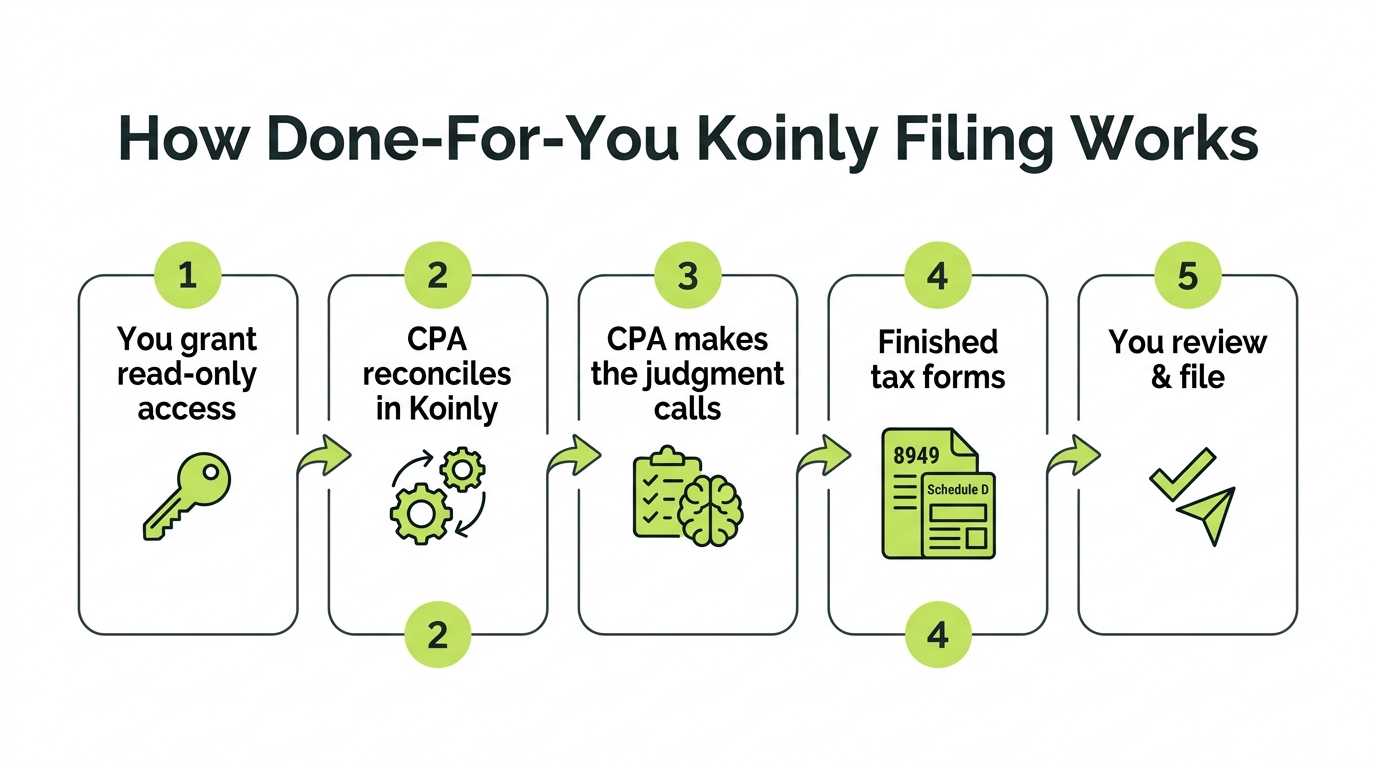
The typical flow:
- You grant read-only access to your exchanges and wallets, or share a complete export.
- The specialist reconciles everything in Koinly: connects missing sources, matches transfers, resolves $0 cost basis, corrects DeFi labels.
- The specialist makes the judgment calls on ambiguous transactions and cost basis method.
- You get finished tax forms (Form 8949, Schedule D, and the rest), reviewed and documented.
- You review and approve, and many firms file the return for you.
What’s Included
A proper done-for-you engagement covers more than a report export:
- Connecting every wallet and exchange, including closed ones
- Matching transfers between your own accounts so they are not taxed as sales
- Resolving $0 and missing cost basis
- Correcting DeFi, staking, lending, and liquidity-pool labels consistently
- Applying the 2025 per-wallet rule and making the safe-harbor allocation
- Reconciling any 1099-DA against your real history and documenting the difference
- Producing finished Form 8949, Schedule D, and supporting reports
- Filing the return, with audit-ready documentation retained
The Per-Wallet Rule and 1099-DA, Handled
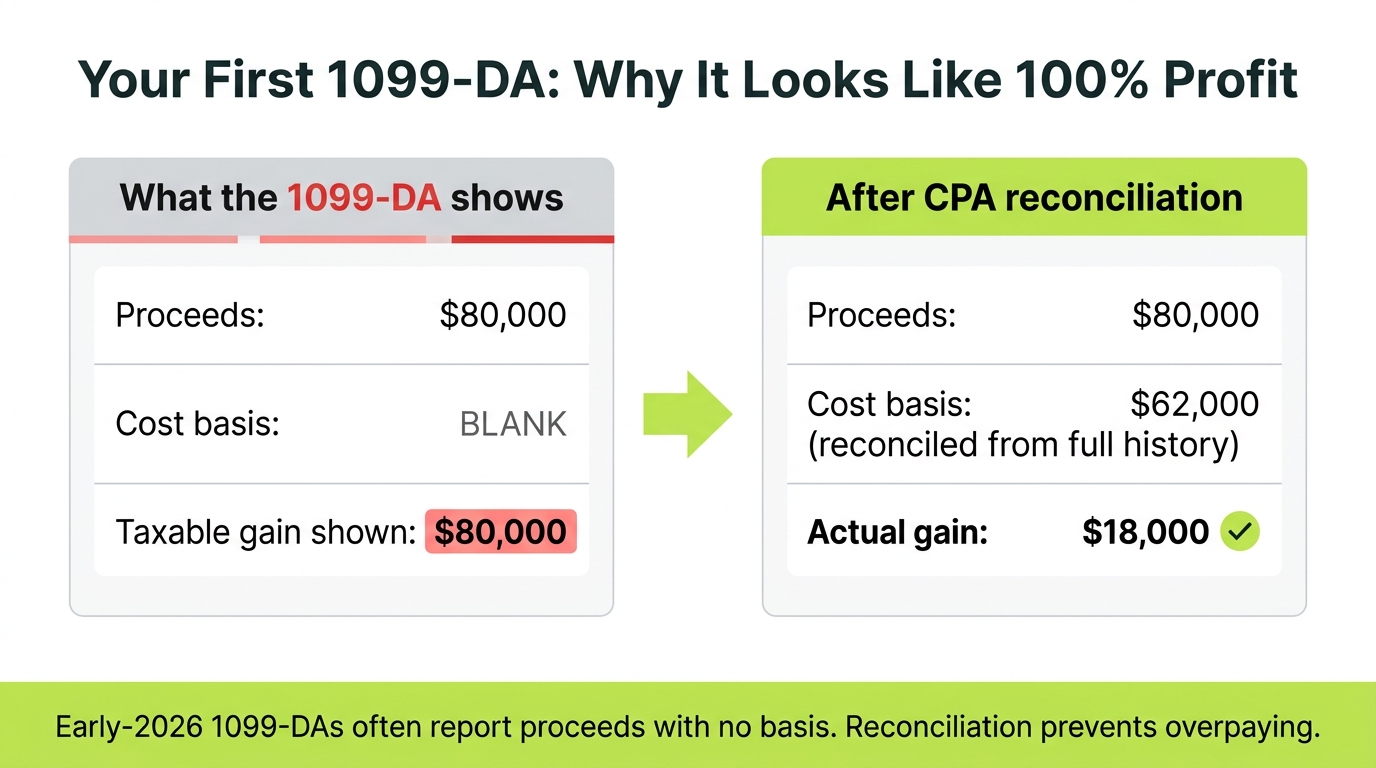
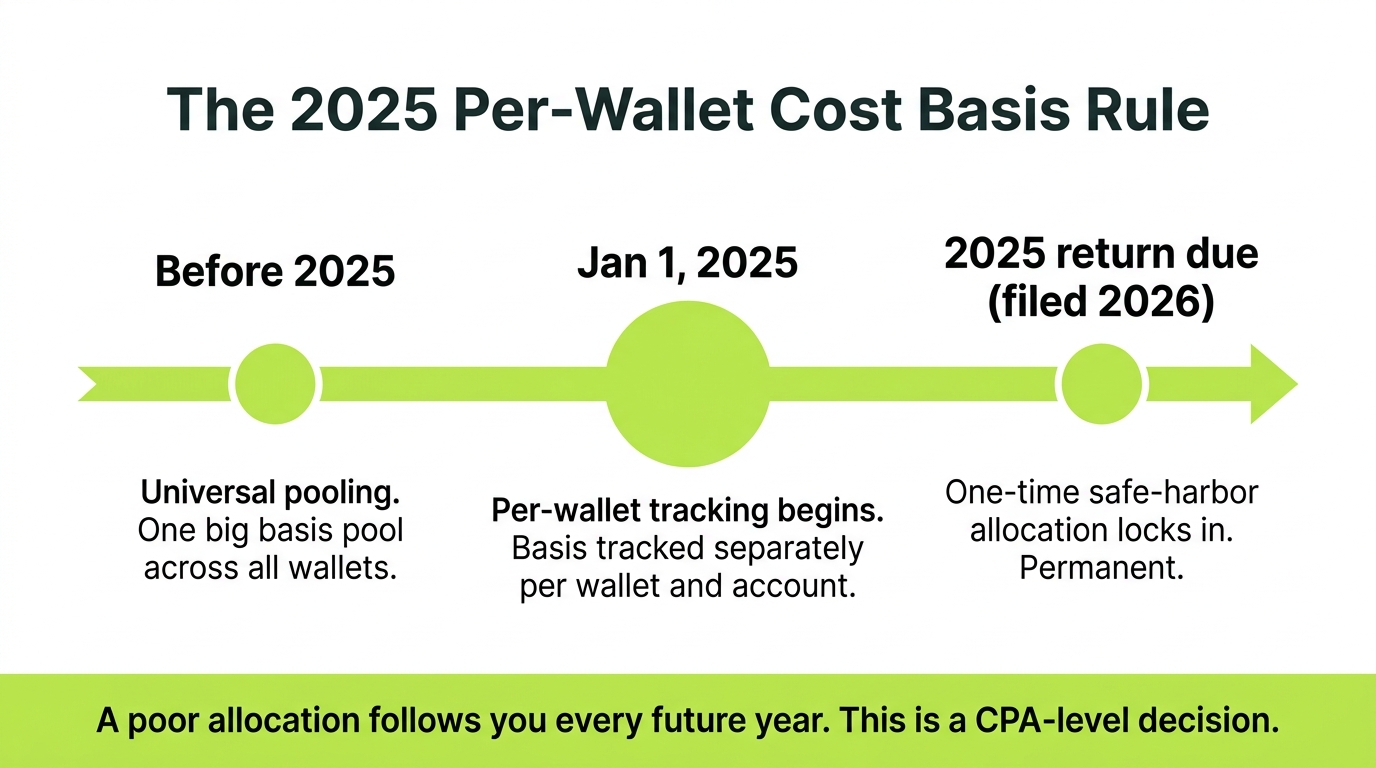
Two 2025/2026 items are easy to get wrong and are part of the job. The per-wallet cost basis rule (Rev. Proc. 2024-28) requires per-wallet tracking from January 1, 2025, with a one-time safe-harbor allocation that locks in permanently on your 2025 return. And your first Form 1099-DA, arriving in early 2026, will often show proceeds with no cost basis, which looks like pure profit until it is reconciled against your full history. Both are handled for you, with documentation.
Is It Safe?
What It Costs and When It’s Worth It
Pricing scales with your transaction volume and how tangled your history is. A clean account is inexpensive to finish. A multi-chain DeFi portfolio with years of gaps takes more work and costs more. Most firms quote after a quick look at your account.
Not sure you need the full service yet? Here are the signs you need a Koinly expert versus doing it yourself.
It is worth it when:
- Your time is better spent elsewhere than on transaction cleanup
- You have DeFi, high volume, or multi-chain activity that is easy to get wrong
- A 1099-DA mismatch or IRS notice raises the stakes
- You want a professional to stand behind the numbers if the IRS asks
A client with about 6,000 transactions across four exchanges and two chains simply did not have the weekend to spare. We took read-only access, reconciled his Koinly in a few days, corrected a stack of mislabeled staking rewards, and delivered finished forms with documentation. He reviewed, approved, and filed, total time on his end about 30 minutes.
Hand Us Your Koinly. Get Back a Finished Return.
You keep Koinly. We do the reconciliation, make the calls, and deliver a report you can file with confidence. If you want your crypto taxes done for you instead of by you, that is exactly the service.
Key Takeaways
- Bottom line: a done-for-you service is the right call when buying back your time is worth more than spending a weekend in the warnings panel
- The handoff carries little risk. Read-only access lets the specialist clean and file while your funds stay firmly in your control
- Run the time math honestly. If reconciling DeFi, high volume, multi-chain history, or 1099-DA mismatches would eat days, the fee is the cheaper trade
- You keep your setup. Koinly stays your system of record, and you walk away with a finished, defensible, professionally reviewed return
- Next step: the unreconciled history you keep putting off is itself the signal. That avoidance is the cue to hand it over now
Frequently Asked Questions
Can someone do my crypto taxes for me in Koinly?
Yes. A done-for-you Koinly tax filing service connects your accounts, reconciles your transactions, corrects cost basis and DeFi labeling, generates the tax forms, and can file your return. You provide access to your exchanges and wallets, and a crypto tax specialist handles the rest. You get a finished, reviewed report instead of doing the cleanup yourself.
How does a done-for-you Koinly service work?
Typically you grant read-only access to your exchanges and wallets or share a complete export, the specialist reconciles everything in Koinly, resolves warnings and missing cost basis, makes the classification judgment calls, and delivers finished tax forms. Many teams also file the return for you. You review and approve before anything is filed.
How much does a Koinly tax filing service cost?
Cost scales with transaction volume and complexity. A clean account is far cheaper than a high-volume DeFi portfolio with years of unreconciled history. Most firms quote after a short review of your account. Weigh it against the overpaid tax that wrong cost basis can cause and the time you would spend doing it yourself.
Is it safe to give a tax service access to my crypto accounts?
Reputable services use read-only access, which lets them see your transaction history but never move or trade your funds. Never grant withdrawal permissions to anyone. With read-only access, a done-for-you service is safe, and you retain full control of your accounts and assets.
Do I still need Koinly if I use a filing service?
Usually the service works within Koinly, so it remains your system of record. You are paying for the reconciliation, the judgment calls, and the finished, defensible report, not for replacing the software. You keep Koinly and gain a professional who stands behind the numbers.