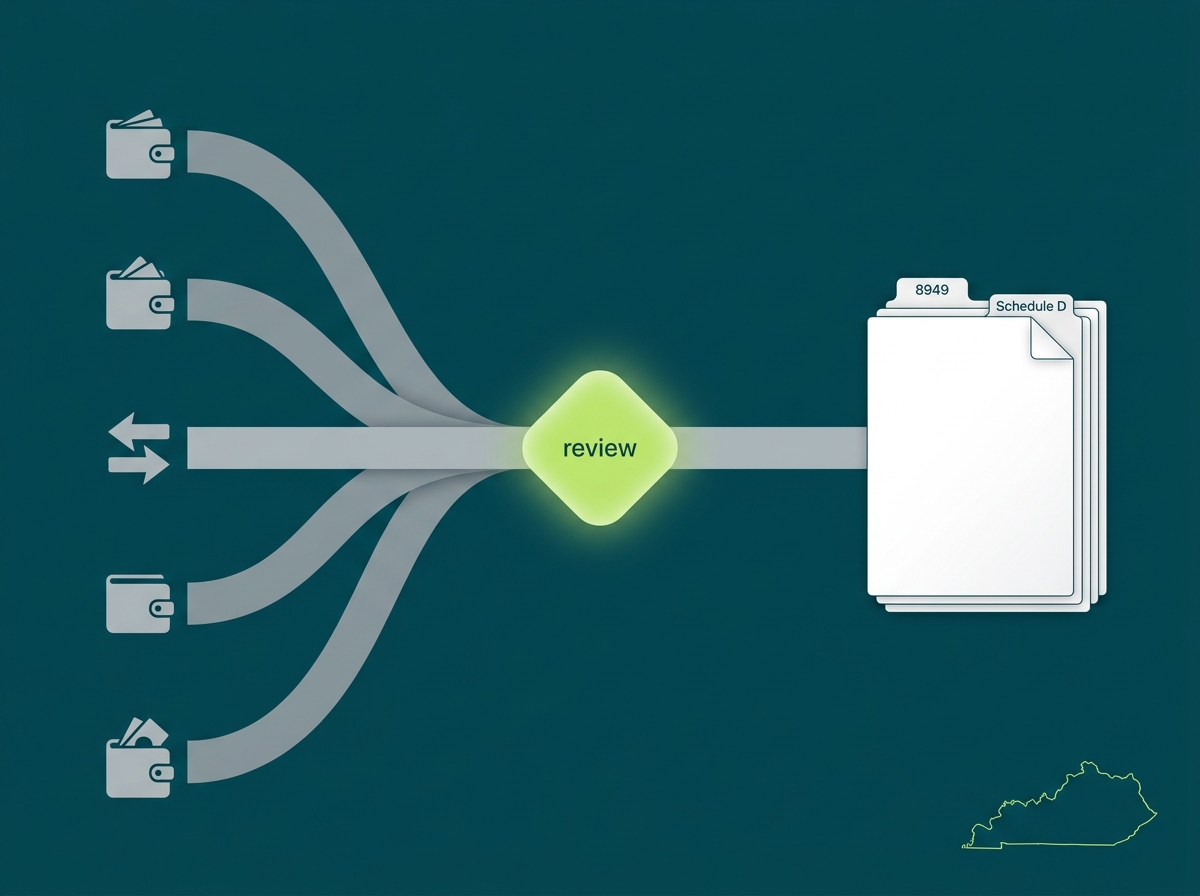
Big 4 trained, crypto native. We bridge DeFi and TradFi for your 8949.
Kentucky investors from Louisville to Lexington need the federal 8949 right before the state layer works. We deliver CPA-ready 8949, Schedule D, and Schedule 1 inputs from every wallet and protocol.
01Kentucky taxes crypto gains at a flat 4% rate (stepping down per recent legislation).
02Kentucky uses rolling IRC conformity.
03Equine-industry and family pass-throughs sometimes hold digital assets at the entity layer.
04Cross-border residency questions are common for Kentucky residents near OH, IN, and TN borders.
05As your crypto tax service specialist, Count On Sheep delivers CPA-ready 8949 and Schedule D inputs, your CPA files.
The Problem. How We Solve It.
Crypto tax software gives you data. We make it filing-ready.
Before you file yourself or hand anything to a CPA, the crypto activity has to be reconciled. That is how Kentucky investors avoid duplicate disposals, unsupported basis, overstated gains, and preventable tax. Clean records improve accuracy, preserve legitimate deductions and losses, and let you reconcile each 1099-DA against the complete transaction history.
The problem
Raw exports are not a tax return.
Exchange exports leave transfers, fees, and missing cost basis unresolved.
DeFi, staking, NFTs, bridges, and wallet-to-wallet moves rarely arrive filing-ready.
1099-DA reports can show proceeds without the complete basis history needed to calculate the right gain or loss.
What you receive
The inputs required to finish your crypto taxes.
A reconciled transaction ledger across every wallet, exchange, chain, and protocol.
Completed Form 8949 inputs and Schedule D totals for capital gains and losses.
Schedule 1 inputs for applicable crypto income, plus payment-income workpapers your tax preparer can classify correctly.
Real Stories, Real Results
What Our Clients Say
Reputation is everything! See what our clients are saying about our service and team.
★★★★★
"This team is a life saver. They are professional, communicate very fast and are pleasant to deal with."
Chris ChambersGoogle Review
★★★★★
"Matt was professional, thorough, timely and had a great understanding of my situation."
Jo JustusGoogle Review
★★★★★
"Reconciled all my previous years and set me up for a clean slate moving forward. Very thorough and transparent."
Jon AbramsGoogle Review
Book a Meeting
Talk with a crypto tax service specialist.
Choose a free scoping call or a paid consultation with a former Big Four auditor. We will review your Kentucky crypto tax situation and map the cleanest path to filing-ready records.
Free scoping call or paid consult with a former Big Four auditor
Written quote first scope reviewed before any work begins
Video meetings secure document sharing and read-only access
Serving Kentucky
From Louisville to every metro in Kentucky
Kentucky crypto investors in Louisville, Lexington, Bowling Green, Covington and surrounding metros throughout the state.
Kentucky crypto investors in Louisville, Lexington, and Bowling Green face a flat state rate but the same federal crypto tax work challenge as anywhere else. Equine-industry pass-throughs sometimes hold digital assets at the entity level, which adds entity-level basis work. We rebuild the on-chain ledger and hand off CPA-ready 8949, Schedule D, and Schedule 1 inputs. Count On Sheep is your crypto tax service specialist for Kentucky. Your CPA stays your CPA. We deliver the crypto inputs, they handle the return.
Statewide · secure video meetings
Why Count On Sheep
Keep your CPA. We do the crypto.
Your CPA handles your business return, your W-2, your K-1s, your real estate. We are the crypto tax service specialists who handle the wallet, exchange, and DeFi side, for Kentucky residents and beyond.
01
Former Big 4 + CPA leadership
Our team came up inside Big 4 firms and CPA leadership roles, then went deep into crypto. Same audit-grade discipline that ran public-company engagements, applied to your wallet history.
02
USA-based, hands-on team
A senior crypto tax service specialist reviews every engagement. No offshore data-entry pipeline, no automated black box. Every edge case, basis split, and DeFi classification is handled by humans here.
03
We stay in our lane
We don't file your taxes. We don't replace your CPA. We do the part most CPAs and most software can't, the crypto. Then your CPA files, or you file with TurboTax.
Kentucky Tax Facts
How Kentucky treats crypto for tax
State Income Tax
Up to 4%
Flat 4.0% rate (reduced from 4.5% in 2024 under HB 8 reform)
Applies to every Kentucky resident, on top of the state layer above.
Event
Federal treatment
Selling crypto for USD
Capital gain (short or long-term)
Crypto-to-crypto swapCommonly missed
Capital gain on both legs
Mining income
Ordinary income at FMV on receipt; basis for later sale
Staking rewards
Ordinary income at FMV on receipt
Airdrop received
Ordinary income at FMV on receipt
NFT sale
Capital gain (collectible rules may apply for some)
DeFi yield / LP rewards
Ordinary income at FMV on receipt
Reportable on Form 8949, Schedule D, Schedule 1 (or Schedule C for mining as a trade or business). Count On Sheep produces these inputs from your complete on-chain history.
Kentucky Crypto Tax Reconciliation
Crypto Tax Service for Kentucky's Investors and Businesses
Count On Sheep provides Kentucky residents with a detailed, accurate accounting of their digital asset transactions. From Louisville to Lexington, we help investors, professionals, and pass-through businesses create a complete historical record for tax purposes. Our Digital Asset Reconciliation (DAR) process delivers the CPA-ready inputs for Form 8949, Schedule D, and other supporting workpapers your tax professional needs to support your federal and Kentucky returns.
01
Reconstructing staking, mining, and reward income
For Kentuckians earning crypto through staking, mining, or other reward programs, proper income recognition is important. Each reward constitutes ordinary income equal to its fair market value on the date of receipt. Our service reconstructs these income streams, creating a complete and auditable ledger of every reward you have earned.
This process is foundational for accurate tax reporting. The income we document provides the basis for your Schedule 1 (or Schedule C) filings. Equally important, the value at receipt becomes the cost basis of the rewarded crypto. Tracking this basis is essential to correctly calculate capital gains or losses when you later sell or trade the assets.
02
Digital assets in pass-through entities
In Kentucky, it is increasingly common for pass-through businesses, such as those in the equine industry or family partnerships, to hold digital assets. The accounting for these entity-level assets must be handled with care. We specialize in isolating and reconciling the crypto activity that belongs to the business, separate from the owners' personal portfolios.
We provide a dedicated ledger for the entity's transactions. This clear record of the business's crypto income, gains, and losses allows your CPA to accurately prepare the entity's tax return and the corresponding K-1s for its partners or members. We focus on the crypto accounting, while your CPA handles equipment depreciation and other business deductions.
03
Review Kentucky's tax rules
The practical Kentucky task is to document pool, node, and validator reward streams without inferring a state conclusion from wallet activity. DAR supplies the transaction chronology and supporting workpapers. The taxpayer's CPA applies current authority guidance to the full return.
Our service is designed to provide the factual, evidence-based record your CPA needs to apply the current Kentucky tax instructions. We do not provide tax or legal advice. Instead, we deliver a transaction history for your crypto portfolio, helping ensure your filing is built on verifiable data.
04
An illustration of reward reconciliation
Here is a typical example. A resident of Lexington runs several validator nodes, which pay out rewards daily to an operating wallet. Once a month, these rewards are transferred to a secure, long-term storage wallet. The work involves more than just downloading a CSV file. It is a transaction reconstruction process.
Our reconciliation would first establish the U.S. dollar value of the rewards each day they were received, creating an income record. Then, we would track the non-taxable transfers to the storage wallet, proving the chain of custody. When the assets are eventually sold, this detailed history provides the documented cost basis needed to accurately calculate the capital gain, preventing the entire sale from being taxed as pure profit.
05
Addressing cross-border residency questions
For those living near Kentucky's borders with Ohio, Indiana, or Tennessee, questions about residency can often arise. While your CPA is the authority on determining your tax home, our work provides an important piece of information. We establish a clear timeline of your crypto activity, independent of where you lived or worked.
This factual chronology of your transactions allows your tax professional to apply the relevant residency and sourcing rules with accuracy. By handling the complex task of tracing your crypto history, we free up your CPA to focus on the work of legal interpretation and tax strategy for your specific situation.
06
Importance of a complete transaction history
A common mistake is to only look at the current year's transactions. However, the cost basis of the assets you sell today may have been established by a purchase or reward years ago. That is why our Digital Asset Reconciliation (DAR) process always aims to build a complete history from the moment you first acquired crypto.
This approach ensures that every transaction is accounted for and that your cost basis calculations are accurate and defensible. It solves the problem of incomplete Form 1099-DA reports from brokers, which often lack the basis for assets transferred in from other platforms. A complete history supports correct tax reporting.
07
Your CPA-ready package from Count On Sheep
Our process culminates in the delivery of a full set of workpapers for your CPA. This includes the detailed data for Form 8949, a summary of ordinary income from rewards, and a complete transaction ledger. We ensure your tax professional has everything they need to proceed.
Count On Sheep is not a CPA firm. We do not prepare or file tax returns. Our specialized role is to perform the detailed transaction reconstruction required for digital assets. The workflow serves taxpayers across Kentucky via video conference, providing the foundational data that supports accurate tax filing.
08
Anchor Kentucky calculations to the 2025 rate
Kentucky’s individual income tax rate is 4% for 2025, while the enacted 2026 rate is 3.5%. A reconciliation that covers both years should never roll disposals into one undated gain total. The same asset may have lots sold on opposite sides of January 1, and reward or compensation receipts may establish basis in one year before a later disposal. Year-specific schedules preserve which events belong to each return period.
Kentucky tax due is not part of Count On Sheep’s output. DAR instead creates annual ledgers with supported proceeds, basis, acquisition dates, holding periods, income records, and closing units. Capital-disposition details are formatted for Form 8949 and Schedule D, while separately identified income is prepared for Schedule 1 review. The taxpayer’s CPA, or the chosen self-filing method, selects the correct Kentucky instructions and determines how modifications, deductions, and the 2025 rate affect the complete return.
09
Separate Louisville business activity from personal investing
Louisville Metro imposes occupational license obligations on compensation and business net profits earned within Louisville and Jefferson County. That local system is not a reason to label every crypto transaction as business activity. A personal purchase and sale, tokens received for services, and coins held by an LLC need separate owners, purposes, source documents, and accounting paths before a CPA can evaluate the local rules.
For a Louisville file, DAR can identify which wallet received service compensation and which accounts held personal investments. It also connects later disposals to the correct receipt or purchase basis. Count On Sheep does not prepare Form OL-3, apportion local income, or decide whether an activity is a trade or business. The completed crypto ledger and CPA-ready federal inputs let the taxpayer’s preparer make those Kentucky and Louisville determinations using records that do not blur entity, compensation, and investment activity.
10
Record crypto compensation before tracing what happened next
A Kentucky independent contractor paid in tokens creates a different record path from an investor buying the same token. The receipt file needs the payer, service date, payment date, quantity, wallet, contract or invoice, and supported dollar value. If the tokens are later swapped or sold, that second event needs its own proceeds and lot calculation. Keeping the two moments separate prevents later trading activity from replacing the original compensation evidence.
Count On Sheep reconciles the token trail and produces Schedule 1 inputs when appropriate for CPA review, plus Form 8949 and Schedule D inputs for later capital dispositions. It does not determine worker status, deductible expenses, local occupational treatment, or the final return classification. Those questions stay with the CPA or self-filing workflow. The DAR package makes that review practical by pairing every value with its source and showing which tokens remained on hand at year end.
Preparing for Your Kentucky Crypto Reconciliation
Gather a list of all crypto exchanges, wallets, and DeFi platforms used.
Separate records for any crypto held by a business or partnership.
Collect statements from mining pools or staking platforms.
Document your residency for the tax years in question.
Provide contact information for your CPA or tax advisor.
Identify any assets received as a gift or inheritance.
Common Issues
What we untangle for Kentucky crypto investors
Pattern 01
Missing or incomplete cost basis
Exchanges lose data, wallets get abandoned, chain history fragments. Reconstructing accurate cost basis across years of trading is the largest source of error on a crypto return.
Pattern 02
DeFi and cross-chain complexity
Liquidity pool entries, yield farming, cross-chain bridges, wrapped tokens, restaking. Each creates taxable moments most consumer software misses or misclassifies.
Pattern 03
Unreported prior-year activity
Many crypto investors discover years of unreported trades after receiving an IRS letter. Back-year reconstruction and voluntary disclosure planning is part of what we deliver.
Kentucky pattern 01
Equine-industry pass-through entities with side digital-asset activity
Kentucky pattern 02
Cross-border OH / IN / TN residency questions for residents near the river
Primary Sources
Authorities used for this Kentucky crypto tax guide
Reviewed September 2026. These first-party resources support the general federal and state information on this page. Your CPA applies the current instructions to your return; Count On Sheep supplies the reconciled crypto records and form-ready inputs.
Review the Form 8949, Schedule D, income, cost-basis, and supporting workpapers delivered after reconciliation.
How it Works
Four steps, start to finish
From anywhere in Kentucky.
01
Connect
You connect read-only access to your exchanges and share wallet addresses. CSV exports work too.
02
Reconcile
We pull and reconcile every wallet, exchange, and DeFi interaction into one ledger with cost basis, holding period, and proceeds per lot.
03
Specialist Review
A senior crypto tax service specialist reviews edge cases. Manual basis splits, DeFi classifications, bridge events, restaking, NFTs.
04
CPA-Ready Reports
You get CPA-ready Form 8949, Schedule D, Schedule 1 inputs (and Schedule C for mining), plus full workpapers. Hand to your CPA, or load into TurboTax.
FAQ
Common questions, Kentucky edition
What does a crypto tax service do for a Kentucky investor?
For Kentucky, Count On Sheep performs Digital Asset Reconciliation. We rebuild exchange, wallet, broker, and DeFi activity into CPA-ready Form 8949, Schedule D, and Schedule 1 inputs. The Kentucky CPA or the taxpayer's self-filing workflow handles the return itself.
Does Count On Sheep file the Kentucky tax return?
No. Count On Sheep is not a CPA firm and does not prepare or file the Kentucky return. We deliver the reconciled crypto schedules and supporting workpapers. The Kentucky return preparer combines those records with wages, businesses, deductions, elections, residence facts, and every other part of the filing.
Why does pool, node, and validator reward streams matter in Kentucky?
Pool, node, and validator reward streams can change which source records a Kentucky CPA needs. Count On Sheep traces the relevant Kentucky transactions, preserves dates and ownership, and documents unsupported items rather than assigning a state tax conclusion without evidence.
Which records support equipment or entity records that remain outside DAR scope for Kentucky?
A Kentucky review of equipment or entity records that remain outside DAR scope can require exchange exports, public wallet addresses, transaction identifiers, prior Form 8949 files, broker statements, and documents that explain ownership or purpose. Count On Sheep organizes the Kentucky crypto evidence and flags anything the CPA must resolve.
How should a Form 1099-DA with missing basis be handled in Kentucky?
The Kentucky broker proceeds still need to be reconciled to the full ownership history. Count On Sheep traces assets through prior exchanges and self-custody, supports available basis and acquisition dates, and prepares a Kentucky workpaper that connects the broker form to Form 8949 inputs.
What does the Kentucky CPA-ready package contain?
The Kentucky package contains transaction-level disposition detail, Schedule D summaries, digital-asset income inputs, transfer matching, closing lots, broker-form reconciliation, and documented exceptions. Each material Kentucky number is tied to a source record or a clearly stated assumption.
How do Kentucky clients meet with Count On Sheep?
Kentucky meetings are held by video conference, which keeps scheduling fast for both sides. Documents move through a secure portal and are reviewed together on screen, so the full engagement happens without a trip to an office.
Can my CPA use your reports?
Yes. That is exactly the point. Our deliverable drops directly into the workflow your CPA already uses. Schedule D totals, 8949 detail, Schedule 1 inputs for staking and airdrops, and reconciliation workpapers behind every number.
Does this work with TurboTax?
Yes. If you self-file, the Count On Sheep deliverable plugs into TurboTax. You enter the 8949 totals (or import where supported), and our workpapers back up every line if you ever need to defend it.
What do I need to start?
Exchange account access or CSV exports, wallet addresses for every chain you have transacted on, any prior-year tax returns that touched crypto, and a brief on your DeFi activity. We scope Kentucky engagements from there.
How is the engagement priced?
Book a meeting to walk us through your account. We will review the scope and provide a written quote before any work begins.
About the team
About the Count On Sheep team
Former Big 4CPA leadershipCrypto native
Count On Sheep is a USA-based team of crypto tax service specialists. Former Big 4 accountants and CPA leadership, now crypto-native blockchain tax experts. We do hands-on crypto tax work for high-volume investors, funds, founders, and active traders, including Kentucky residents from Louisville, Lexington, Bowling Green and beyond.
We don't file taxes. We don't replace your CPA. Most CPAs don't do crypto, that's the gap we fill. We bridge DeFi and TradFi to produce the 8949, Schedule D, and Schedule 1 inputs your CPA can drop into your return.