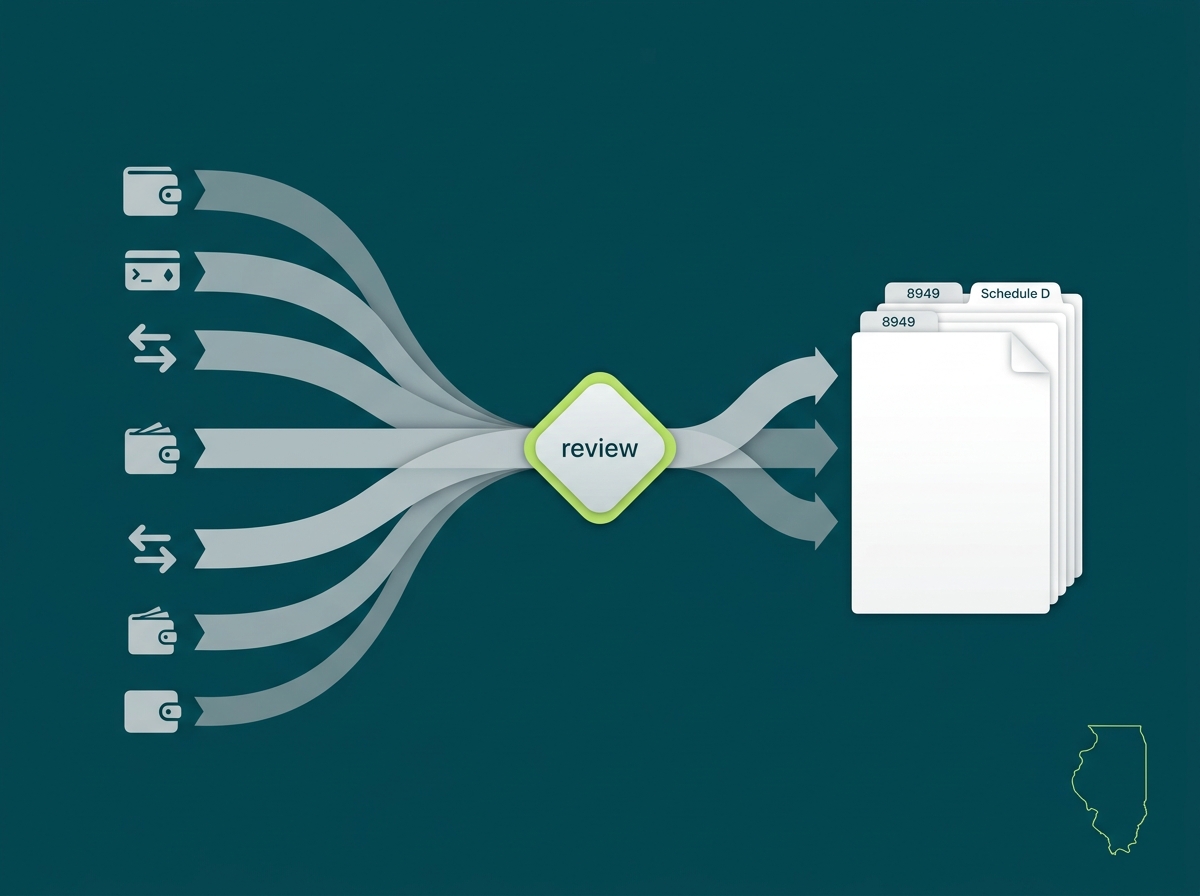
Big 4 trained, crypto native. We bridge DeFi and TradFi for your 8949.
Chicago's financial depth produces complex crypto portfolios. We deliver CPA-ready 8949, Schedule D, and Schedule 1 inputs for Illinois investors so your CPA can complete the return confidently.
Former Big 4 + CPA leadershipCrypto native, blockchain expertsServing Illinois
Keep your CPA. We do the crypto. · By the Count On Sheep team · Reviewed August 2026
Serving all of Illinois
What you getForm 8949Schedule DSchedule 1
Featured In
IL
Key Facts
Key Facts About Crypto Tax Service in Illinois
Illinois taxes crypto gains at a flat 4.95%. Chicago's derivatives and trading culture pushes a lot of high-volume on-chain activity through residents here, exactly the kind of trade ledger that needs per-lot crypto tax work, not aggregate summaries.
01Illinois taxes crypto gains at a flat 4.95% rate.
02Illinois uses rolling IRC conformity.
03Chicago derivatives and prop-trading culture drives high-volume on-chain activity among residents.
04Per-lot crypto tax work, not aggregate summaries, is required for accurate Form 8949 detail.
05As your crypto tax service specialist, Count On Sheep delivers CPA-ready 8949 and Schedule D inputs, your CPA files.
The Problem. How We Solve It.
Crypto tax software gives you data. We make it filing-ready.
Before you file yourself or hand anything to a CPA, the crypto activity has to be reconciled. That is how Illinois investors avoid duplicate disposals, unsupported basis, overstated gains, and preventable tax. Clean records improve accuracy, preserve legitimate deductions and losses, and let you reconcile each 1099-DA against the complete transaction history.
The problem
Raw exports are not a tax return.
Exchange exports leave transfers, fees, and missing cost basis unresolved.
DeFi, staking, NFTs, bridges, and wallet-to-wallet moves rarely arrive filing-ready.
1099-DA reports can show proceeds without the complete basis history needed to calculate the right gain or loss.
What you receive
The inputs required to finish your crypto taxes.
A reconciled transaction ledger across every wallet, exchange, chain, and protocol.
Completed Form 8949 inputs and Schedule D totals for capital gains and losses.
Schedule 1 inputs for applicable crypto income, plus payment-income workpapers your tax preparer can classify correctly.
Real Stories, Real Results
What Our Clients Say
Reputation is everything! See what our clients are saying about our service and team.
★★★★★
"This team is a life saver. They are professional, communicate very fast and are pleasant to deal with."
Chris ChambersGoogle Review
★★★★★
"Matt was professional, thorough, timely and had a great understanding of my situation."
Jo JustusGoogle Review
★★★★★
"Reconciled all my previous years and set me up for a clean slate moving forward. Very thorough and transparent."
Jon AbramsGoogle Review
Book a Meeting
Talk with a crypto tax service specialist.
Choose a free scoping call or a paid consultation with a former Big Four auditor. We will review your Illinois crypto tax situation and map the cleanest path to filing-ready records.
Free scoping call or paid consult with a former Big Four auditor
Written quote first scope reviewed before any work begins
Video meetings secure document sharing and read-only access
New Crypto Tax Update 2026
Illinois Digital Asset Tax Act: 0.2% Crypto Transfer Tax
On June 16, 2026, Governor JB Pritzker signed the Digital Asset Tax Act (DATA) into law as part of the state budget. It makes Illinois the first state in the country to impose a direct, transaction-based tax on crypto. A 0.2% privilege tax applies to the value of digital assets that are exchanged, transferred, or stored, and it takes effect January 1, 2027.
The tax is transactional, not a tax on gains. It can apply every time crypto moves, regardless of whether you made a profit, and brokers are expected to collect it and remit it to the Illinois Department of Revenue. That makes clean, per-lot transaction records more important than ever for Illinois residents.
0.2% privilege tax on the value of digital assets exchanged, transferred, or stored.
Effective January 1, 2027 (signed into law June 16, 2026).
Applies to brokers and businesses physically in Illinois, or serving Illinois residents, with at least $100,000 in annual gross receipts from digital asset services.
Transaction-based: it can apply even with no realized gain, including some transfers between your own accounts or wallets.
Collected by digital asset brokers and remitted to the Illinois Department of Revenue.
This is a high-level summary of new Illinois legislation, not tax or legal advice. Count On Sheep produces CPA-ready 8949, Schedule D, and Schedule 1 inputs; your CPA files the return. Confirm how DATA applies to your situation with your tax advisor.
Serving Illinois
From Chicago to every metro in Illinois
Illinois crypto investors in Chicago, Aurora, Naperville, Springfield and surrounding metros throughout the state.
Illinois crypto investors in Chicago, Aurora, and Naperville often run high-volume strategies that produce trade ledgers consumer software can't handle. Per-lot Rebuilding cost basis across centralized exchanges, DEXs, and wallets is the only way to get accurate Form 8949 detail. We rebuild the ledger and hand off CPA-ready 8949, Schedule D, and Schedule 1 inputs. Count On Sheep is your crypto tax service specialist in Illinois. Your CPA stays your CPA. We deliver the crypto piece, they handle the return.
Applies to every Illinois resident, on top of the state layer above.
Event
Federal treatment
Selling crypto for USD
Capital gain (short or long-term)
Crypto-to-crypto swapCommonly missed
Capital gain on both legs
Mining income
Ordinary income at FMV on receipt; basis for later sale
Staking rewards
Ordinary income at FMV on receipt
Airdrop received
Ordinary income at FMV on receipt
NFT sale
Capital gain (collectible rules may apply for some)
DeFi yield / LP rewards
Ordinary income at FMV on receipt
Reportable on Form 8949, Schedule D, Schedule 1 (or Schedule C for mining as a trade or business). Count On Sheep produces these inputs from your complete on-chain history.
Illinois Deep Dive
Lot-level crypto records for Illinois income tax and the 2027 transaction-tax change
Illinois residents currently need accurate federal gains, losses, and digital-asset income for the state income-tax starting point. A separate enacted Digital Asset Tax Act is scheduled to apply to covered broker activity beginning January 1, 2027, making dated, source-backed updates especially important.
01
Illinois income-tax inputs begin with the federal ledger
Crypto sales and exchanges need proceeds, basis, dates, holding periods, and adjustments for Form 8949 and Schedule D. Staking, mining, airdrops, compensation, and business receipts need separate income records. Illinois return preparation begins after those categories are reconciled.
Count On Sheep produces the crypto schedules and workpapers. Your CPA applies Illinois modifications, combines the results with all other income and deductions, and prepares the state and federal returns.
02
Chicago trading volume magnifies small classification errors
A portfolio with thousands of fills, partial disposals, transfers, and decentralized transactions can create millions of tax lots. One unmatched deposit can assign zero basis to many later sales, while one duplicated API import can count the same transaction twice.
We reconcile balances and movements across sources before relying on gain totals. The work is organized around explainable lots, not a target number. Exceptions remain visible for review rather than disappearing into a bulk software adjustment.
03
Illinois worked example: transfer mistaken for a sale
Assume an investor sends 20 Ether from an exchange to an owned hardware wallet, then later deposits the same units at another venue. If imports fail to match the withdrawal and deposit, software can create a disposal at the first step and a zero-basis acquisition at the second.
Matching the addresses, amounts, timing, and transaction identifiers restores one continuous lot history. The actual later sale can then use the supported basis and holding period instead of two invented taxable events.
04
The Digital Asset Tax Act has a different tax base
Illinois Public Act 104-0468 enacted a 0.2% tax on the value connected with covered digital-asset business activity received by a customer in the state, beginning January 1, 2027. The statutory framework addresses broker-collected activity and is not simply another capital-gains rate.
Implementation details, rules, challenges, and possible legislative changes can evolve before the effective date. The page links directly to the enacted text and should be reviewed whenever Illinois issues regulations or the pending repeal proposal advances. A CPA or attorney determines application to a specific taxpayer.
05
Multi-state workers need timestamps, not county assumptions
A distributed worker may live in Illinois while receiving tokens from an employer or project elsewhere. Wallet geography does not establish residency or sourcing. The ledger can establish when compensation was received and its supported value, but employment and allocation facts come from separate records.
We document the on-chain and exchange evidence. Your CPA evaluates residency, work location, entity, and sourcing rules. This prevents local marketing language from becoming an unsupported tax conclusion.
06
What an Illinois CPA-ready package includes
The package includes disposal detail for Form 8949, Schedule D summaries, digital-asset income inputs, transfer matching, closing lots, broker-statement reconciliation, and a list of material open questions. High-volume engagements also include balance checks and source-by-source exception notes.
Your CPA uses those records for current federal and Illinois returns and separately evaluates the 2027 Act when relevant. The page’s dated source section provides the official law rather than relying on a headline or social-media interpretation.
07
Enacted law and a repeal proposal are different statuses
The Digital Asset Tax Act became Public Act 104-0468 after approval on June 16, 2026. A later House bill proposes repeal, but filing a proposal does not itself remove the enacted law. The page should state both facts with dates and direct legislative links rather than treating political activity as a completed change.
We will update the page when the General Assembly, governor, Department of Revenue, or a court changes the operative status. That dated change log is more useful to search engines and readers than repeating an undated claim that Illinois has or does not have a crypto transaction tax.
08
Broker-collected transaction tax and income tax need separate records
A charge connected with covered broker activity is not the same calculation as gain or loss on Form 8949. Investors may need broker statements showing the value and tax collected alongside the usual acquisition, basis, proceeds, and holding-period records used for income-tax reporting.
The 2027 implementation will determine the exact operational records taxpayers receive. Count On Sheep will preserve supplied broker charges and transaction details for CPA review without netting them into capital gain or inventing a deduction before official guidance supports it.
Illinois records for high-volume and multi-source portfolios
Complete exchange exports with transaction IDs and account identifiers
Wallet addresses across Ethereum, L2 networks and other chains used
Prior Form 8949 files and opening tax-lot inventory
Broker Forms 1099-DA and records supporting missing basis
Compensation, staking, mining and business-payment details
Broker activity records relevant to Illinois changes beginning in 2027
Common Issues
What we untangle for Illinois crypto investors
Illinois pattern 01
High-volume traders adjacent to Chicago derivatives and prop-trading culture
Illinois pattern 02
Cook County / collar-county residency questions for distributed workers crossing state lines
Primary Sources
Authorities used for this Illinois crypto tax guide
Reviewed August 2026. These first-party resources support the general federal and state information on this page. Your CPA applies the current instructions to your return; Count On Sheep supplies the reconciled crypto records and form-ready inputs.
Review the Form 8949, Schedule D, income, cost-basis, and supporting workpapers delivered after reconciliation.
FAQ
Common questions, Illinois edition
How does Illinois currently tax crypto gains?
Federal gain, loss, and income categories provide the starting information for the Illinois individual return, subject to the state rules and modifications your CPA applies. Count On Sheep reconciles the underlying crypto records.
What is Illinois’s Digital Asset Tax Act?
Public Act 104-0468 enacted a 0.2% tax on value connected with covered digital-asset business activity received by a customer in Illinois beginning January 1, 2027. It is structured around covered broker activity, not simply capital gains.
Is the 2027 Illinois rule final for every wallet transfer?
The enacted law is real, but application depends on statutory definitions, exclusions, future rules, possible litigation, and any later legislation. A pending bill proposes repeal. Use current Illinois guidance and professional advice for a specific transaction.
Why is lot-level reconciliation important for Chicago traders?
High transaction volume magnifies unmatched transfers, duplicated imports, missing basis, and holding-period errors. Lot-level work lets a reviewer trace each reported result to the source rather than accepting an unexplained aggregate.
Does Count On Sheep file Illinois returns?
No. We prepare Form 8949, Schedule D, digital-asset income inputs, and reconciliation workpapers. Your CPA applies Illinois rules and files the complete returns.
What should an Illinois investor provide?
Provide all exchange exports, public wallet addresses, prior Form 8949 files, opening lots, broker statements, income records, and any broker activity relevant to the 2027 change.
Ready to get your crypto tax handled and CPA-ready?
Book a free scoping call or call us directly. We serve Illinois residents.