
After 11 years, BitMEX is closing its doors. On July 22, 2026, HDR Global Trading, the owner and operator of BitMEX, announced that the exchange will shut down permanently on September 23, 2026 at 04:00 UTC. New account registrations have already stopped, trading restrictions begin August 26, and every open position will be closed, voluntarily or by force, before the lights go out. The dates and wind-down rules come directly from the official BitMEX closure announcement.
If you have money or history on BitMEX, the shutdown comes with a tax deadline.
Getting your crypto off BitMEX is not a taxable event. Closing positions, forced liquidations, stablecoin conversions, and sales can be. Once the exchange goes dark, the records you need to prove your cost basis may also get harder to retrieve.
This guide covers the shutdown, which moves trigger taxes, what to download before the deadline, and how to report the activity on your 2026 return. Use our 2026 crypto tax guide for the broader filing checklist.
What Is Happening to BitMEX?
BitMEX is closing permanently on September 23, 2026 at 04:00 UTC. The board of HDR Global Trading made the decision after a strategic review, ending an 11-year run for the exchange that invented the 100x perpetual swap.
The wind-down happens in stages, and each stage matters for your taxes:
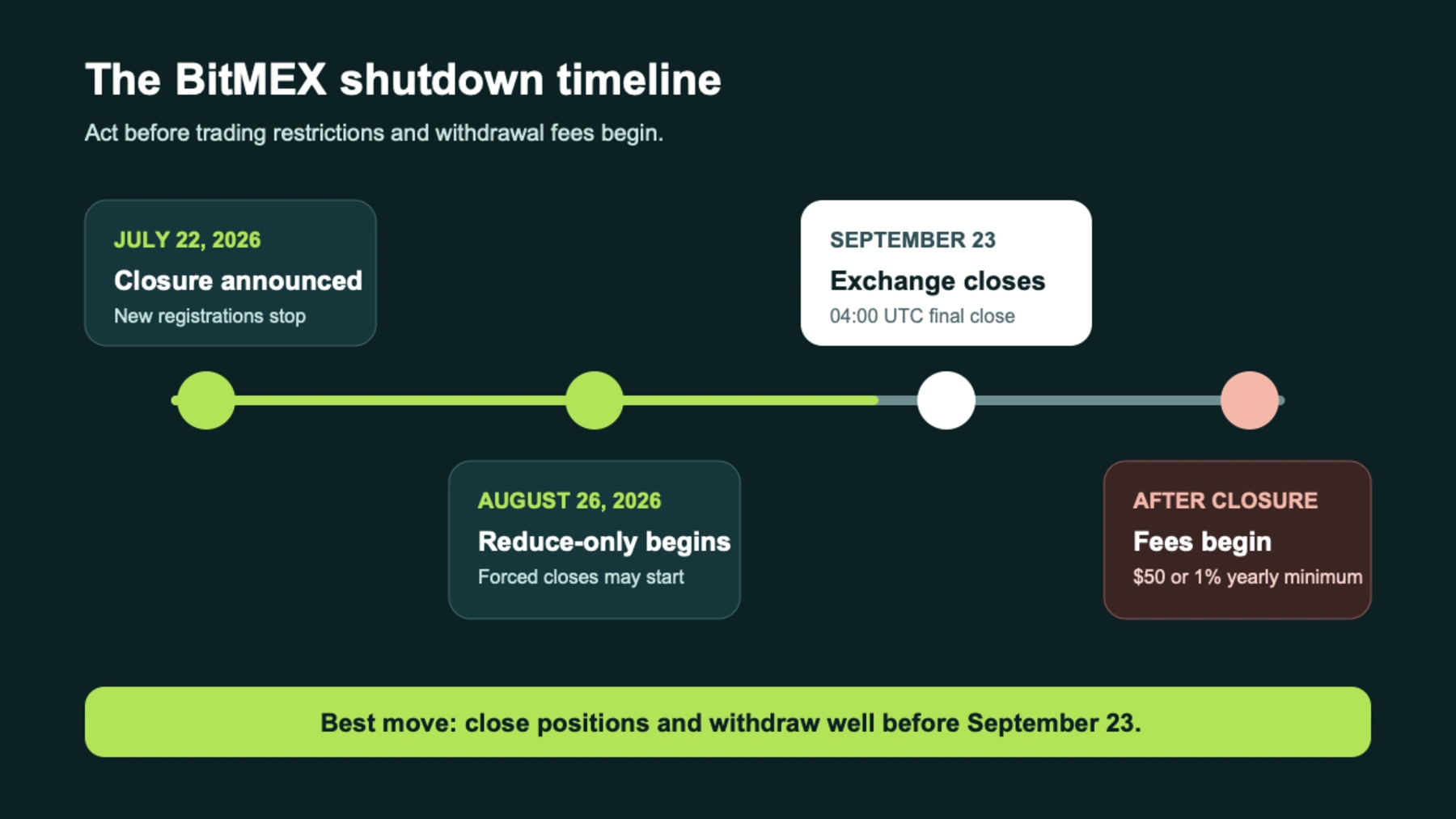
- Now: New registrations are closed. The exchange operates normally otherwise. BitMEX has also delisted dozens of low-liquidity trading pairs and unstaked all staked BMEX tokens, which are now sitting in holder accounts.
- August 26, 2026 at 04:00 UTC: Risk limits kick in. You can only reduce positions, not open new ones.
- August 26 through September 23: BitMEX will progressively force close open positions at its sole discretion to wind the market down. Illiquid contracts may be settled early.
- September 23, 2026 at 04:00 UTC (the Closure Time): All remaining positions are immediately force closed. Exchange services end.
- After closure: You can still log in to view balances and history and to withdraw funds. But KYC verified users who leave assets on the platform get charged a monthly account fee equal to the greater of 50 dollars or 1 percent per year of the remaining balance, and BitMEX has said the fee can increase over time.
BitMEX states that all customer assets remain fully backed per its proof of reserves, and this is an orderly wind-down rather than an FTX-style collapse. That distinction matters for taxes too: because you can recover your funds, there is no abandonment loss or worthlessness argument here. This is a migration, and every step of it needs to be tracked.
One more warning, straight from BitMEX itself: expect phishing. Scammers love exchange shutdowns. There is no priority withdrawal service. Anyone offering one is stealing from you.
Is Withdrawing From BitMEX a Taxable Event?
No. Withdrawing your crypto from BitMEX to a wallet or exchange account you control is a transfer, not a disposal. You are moving your own property between your own pockets. No sale, no gain, no tax.
This is the single most important thing to understand about the shutdown, because it means the exit itself does not have to cost you anything in taxes if you handle it right.
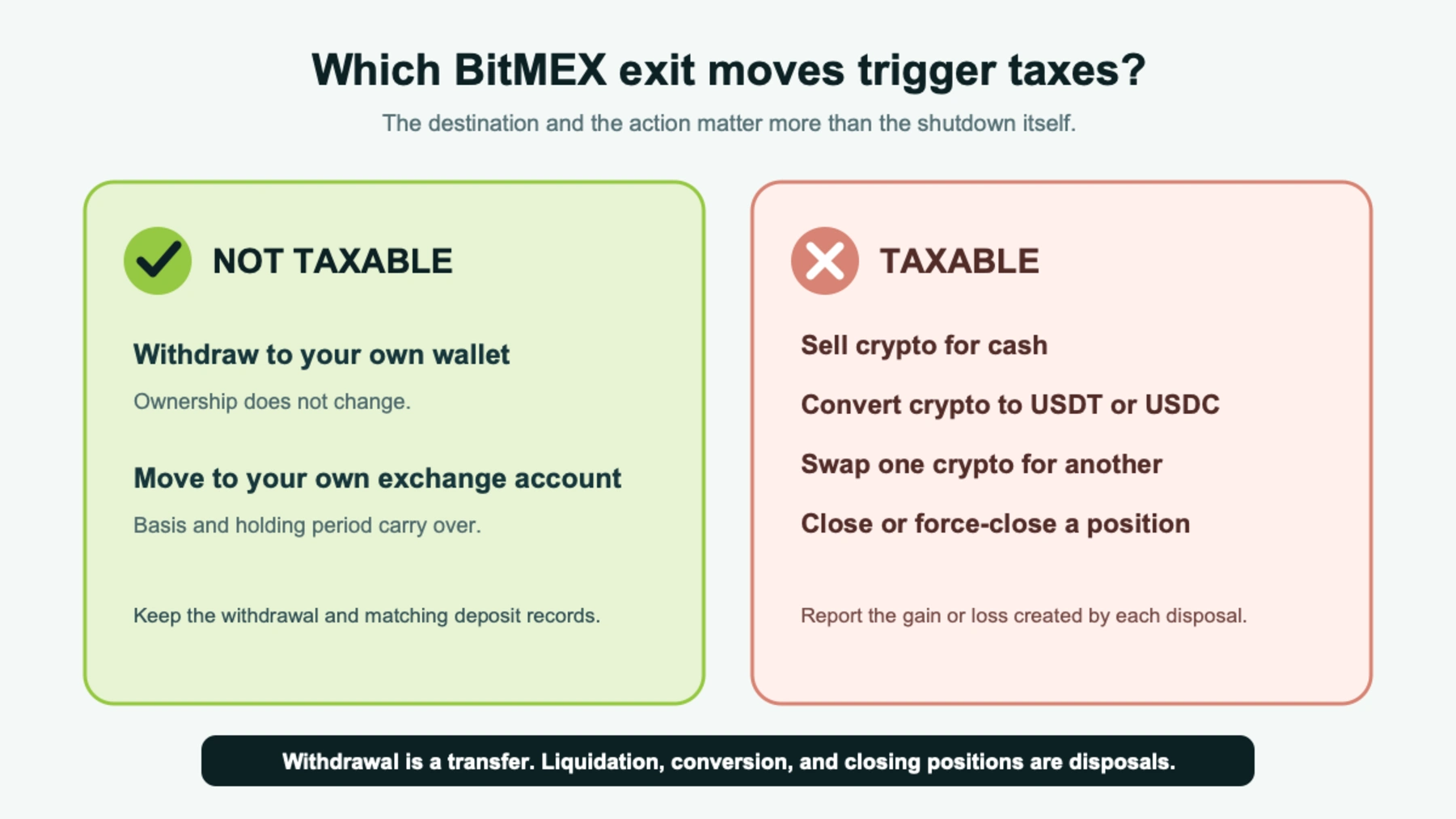
When you withdraw, two things travel with your coins:
- Your cost basis: what you originally paid for the crypto, including fees.
- Your holding period: the clock that determines short-term versus long-term treatment keeps running through the transfer.
Example: Withdrawing 2 BTC to a hardware wallet
You bought 2 BTC years ago for 30,000 dollars each (60,000 dollars total basis). In August 2026 you withdraw both to your hardware wallet while BTC trades at 110,000 dollars. Tax owed on the withdrawal: zero. Your basis is still 60,000 dollars, your holding period is intact, and nothing is reportable until you eventually sell, trade, or spend those coins.
Two small caveats. First, if you pay the withdrawal network fee in crypto, that fee is technically a disposal of the crypto used to pay it. It is usually tiny, but complete records capture it. Second, the transfer is only tax free if the destination is yours. Sending crypto to someone else is a different conversation entirely.
For a broader map of which crypto moves are taxable and which are not, see our guide to taxable vs non-taxable crypto events.
Is Liquidating on BitMEX a Taxable Event?
Yes. And this is where the shutdown gets expensive for people who are not paying attention.
“Liquidating” during the wind-down usually means one of three things, and all three are taxable:
1. Selling crypto for fiat or converting to a stablecoin. Converting BTC to USDT before withdrawing feels like parking, not selling. The IRS disagrees. Stablecoins are property, so the conversion is a disposal of your BTC with a capital gain or loss measured against your basis.
2. Trading one crypto for another. Same rule. Swapping anything into BTC to simplify your withdrawal is a taxable disposal of the coin you gave up, even though no dollars changed hands.
3. Closing derivative positions. Every perpetual or futures position you close between now and September 23 realizes profit or loss. That includes positions you close voluntarily, positions you reduce after the August 26 risk limits, and positions BitMEX force closes for you.
Example: Same 2 BTC, sold instead of withdrawn
Take the same 2 BTC with a 60,000 dollar basis. Instead of withdrawing them, you sell both on the way out at 110,000 dollars each. Now you have 220,000 dollars of proceeds against a 60,000 dollar basis: a 160,000 dollar capital gain, reportable on your 2026 return. Long-term rates apply if you held over a year, but it is a very real tax bill that the withdrawal route would have deferred entirely.
The practical takeaway: if you want to keep your crypto exposure, withdraw the coins themselves. Do not convert first for convenience. Every unnecessary conversion during the exit is a taxable event you chose voluntarily.
The shutdown forces you off the exchange. It does not force you to sell. Withdrawing coins is tax free; converting them is not.
One silver lining: if the wind-down forces you to realize capital losses, those losses may offset capital gains, subject to the normal capital-loss limitations. Current wash-sale reporting rules apply to digital assets that are also stock or securities for tax purposes, not every crypto asset. Our crypto wash sale guide covers the details.
What About Positions BitMEX Force Closes?
A forced close is still a taxable close. The tax law cares that a realization event happened, not whether you wanted it to happen.
Between August 26 and September 23, BitMEX will progressively force close open positions, and anything still open at the Closure Time gets closed immediately. Each of those closures realizes your profit or loss on the position at whatever price the market gives you. BitMEX has explicitly said it takes no responsibility for trading losses from users who fail to close positions themselves.
That creates two tax realities:
- Forced gains are taxable. If your position is force closed at a profit, that profit is reportable income for 2026 even though the timing was not your choice.
- Forced losses may be deductible. If the close realizes a loss, capture it. The character of the contract and the normal loss limitations determine how you can use it.
There is also a timing angle worth thinking about now, while you still have control: closing positions yourself before August 26 lets you choose your exit prices and manage which lots and positions realize gains versus losses this year. Waiting for the force-close queue hands that decision to the wind-down process.
How Are BitMEX Perpetuals and Futures Taxed?
Realized profit and loss on your BitMEX derivatives is taxable, and the mechanics deserve care because BitMEX positions settle in crypto, not dollars.
BitMEX built its reputation on the perpetual swap, and most contracts realize P&L in BTC (or USDT on newer contracts). That means closing a position does two things at once: it realizes a gain or loss, and it hands you crypto that needs its own cost basis going forward.
Example: Long XBTUSD perpetual closed at a profit
You close a long BTC perpetual with 0.15 BTC of realized profit while BTC trades at 100,000 dollars. You have roughly 15,000 dollars of realized gain to report, and the 0.15 BTC you received takes a 15,000 dollar cost basis with a new holding period starting at receipt. If you later withdraw that BTC and sell it at 120,000 dollars per BTC, that later sale is a second, separate taxable event measured against the 15,000 dollar basis.
Three more pieces belong in your derivative math:
- Funding payments. Perpetuals pay or charge funding at regular intervals. Funding you received increases your net result and funding you paid reduces it. These flows are easy to miss and many CSV imports do not surface them cleanly.
- Fees. Entry, exit, and liquidation fees all adjust your realized result.
- Liquidations. A margin liquidation realizes a loss, charges a fee, and can dispose of collateral. All three effects belong in your records.
On character: do not assume every BitMEX contract automatically gets, or automatically misses, the 60/40 Section 1256 treatment reported on Form 6781. Section 1256 status depends on whether a contract meets the statutory definition. Offshore crypto derivatives require contract-level analysis, and different conclusions can change the form, character, and timing of the result. A derivative-heavy account deserves professional review. Our Bybit tax guide walks through the same classification problem in more depth.
What Records Do You Need Before BitMEX Goes Dark?
Download everything, now. This is the most urgent action item in this entire guide.
BitMEX says accounts will remain accessible after the Closure Time to view balances and history and to withdraw. Take that as a courtesy, not a guarantee. Exchanges that wind down have a way of becoming less accessible over time, support queues get long, and a record you cannot retrieve later is a cost basis you cannot prove. FTX users learned this the hard way.
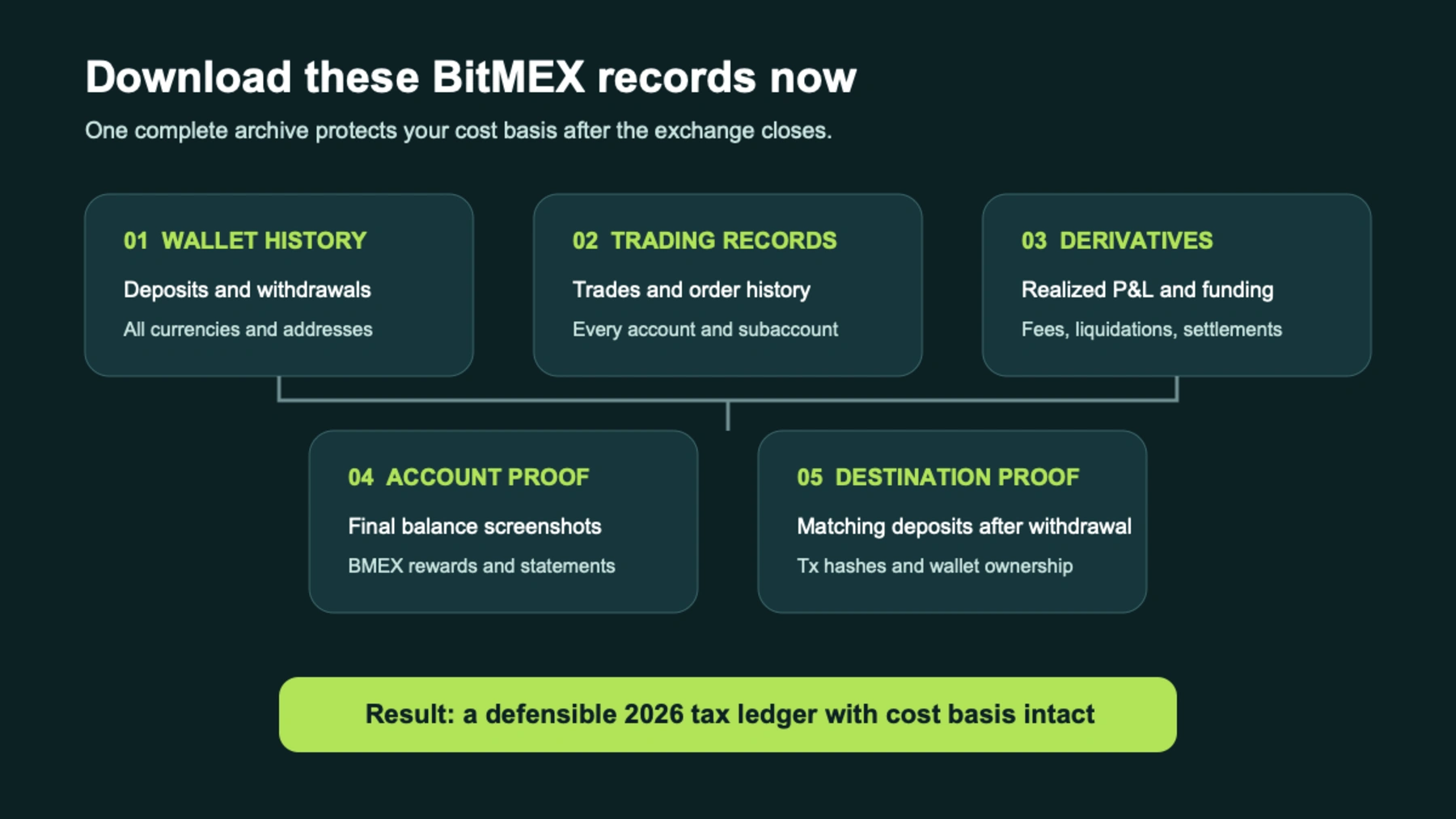
Pull these records from your account:
Why does this matter so much? Cost basis. When your coins land on a new exchange or in a self-custody wallet, the new platform has no idea what you paid for them. If you later sell on Coinbase or Kraken, they may issue a Form 1099-DA showing your proceeds with no acquisition history behind them. Without your BitMEX records, you (or the IRS) could end up treating those coins as zero basis, which overstates your gain dramatically. Your BitMEX exports are the proof that fixes that.
Also remember that the IRS now applies wallet-by-wallet and account-by-account identification rules to digital assets. Rev. Proc. 2024-28 provided the transition safe harbor, and the current IRS digital asset FAQs explain the post-2025 identification rules. Document the basis of every lot leaving BitMEX and match each withdrawal to the corresponding deposit at its destination.
Does BitMEX Report to the IRS?
Do not expect a Form 1099-DA from BitMEX. BitMEX has not announced that it will issue this US broker form, and its closure notice does not promise tax forms. Build your return from the records you download rather than waiting for a form that may never arrive.
Do not confuse that with invisibility. Three things still connect offshore activity to your return:
- On-chain trails. The moment your BitMEX withdrawal lands at a US exchange with your name on the account, the transfer history is visible, and blockchain analytics firms map these flows for the IRS.
- Broker reporting on the other side. A US platform may report proceeds on Form 1099-DA when you eventually sell, even if it does not have your BitMEX acquisition history.
- The digital asset question. Form 1040 asks whether you received, sold, exchanged, or otherwise disposed of a digital asset during the year. Answer it accurately.
A quick word for US taxpayers with older BitMEX history: BitMEX barred US users years ago, but a platform restricting access does not erase taxes on activity that already happened. If prior-year BitMEX trading never made it onto a return, the shutdown is the natural moment to pull the records while you still can and get it corrected. The same logic (and the same fix, an amended return) applies here as with any offshore exchange.
Do You Need to File an FBAR or Form 8938 for BitMEX?
It depends, and the rule is more nuanced than most headlines suggest. FinCEN’s current guidance says a foreign account holding only virtual currency is not presently reportable on the FBAR, though FinCEN has signaled its intent to change that. Form 8938 is a separate regime with its own thresholds, and whether an offshore exchange account triggers it depends on your specific facts.
The shutdown adds one wrinkle worth flagging: 2026 is BitMEX’s final year as an active exchange. Preserve your maximum-balance records while the account history is easy to reach. Our full guide to FBAR and Form 8938 for crypto covers the thresholds and the current state of play. This is worth checking with a qualified tax professional because FBAR and Form 8938 are separate regimes.
Your BitMEX Exit Plan, Step by Step
Use this order to get off BitMEX:
How Do You Report BitMEX Activity on Your 2026 Taxes?
Everything you realize on BitMEX during 2026 belongs on the return you file in early 2027:
- Spot sales and crypto-to-crypto trades: each disposal goes on Form 8949 and Schedule D with acquisition date, disposal date, proceeds, basis, and gain or loss, split short-term versus long-term.
- Derivative P&L, including force-closed positions: compute the realized result with funding and fees, then determine the correct character and form for each contract. Use Form 6781 only if the contract qualifies for Section 1256 treatment.
- BMEX staking rewards: ordinary income at fair market value when you gained control, with that value becoming basis.
- Withdrawals: not reportable events, but they must reconcile so basis carries to the next platform.
- The digital asset question on Form 1040: answer honestly.
Since you should not rely on receiving a BitMEX tax form, all of these numbers need to come from your own reconciled records. That is why the download checklist above matters.
For the bigger picture on rates, brackets, and how crypto gains stack with your other income, start with our complete crypto tax guide for 2026.
Primary Sources
- BitMEX closure announcement
- IRS digital asset transaction FAQs
- IRS digital asset reporting overview
- IRS Revenue Procedure 2024-28
The Bottom Line
BitMEX shutting down is a logistics problem with a tax problem inside it. The rules themselves are friendly if you move deliberately: withdraw your coins and owe nothing today, or convert and sell and owe taxes on the gains. The real danger is not the tax bill. It is losing the records that prove your basis, letting the force-close queue pick your exit prices, or leaving funds behind to bleed monthly fees.
Get your data, close your positions on your own terms, withdraw everything, and reconcile the trail.
If your BitMEX history is years deep, derivative-heavy, spread across wallets, or was never fully reported, Count On Sheep can reconcile it. Our done-for-you Digital Asset Reconciliation rebuilds exchange history, traces basis across transfers, handles perpetuals, funding, and liquidations, and produces a Form 8949 and income report for your tax preparer. The best time to preserve the records is before the exchange closes. Book a call and we will map out your BitMEX exit.
Frequently Asked Questions
Is BitMEX really shutting down?
Yes. HDR Global Trading, the owner and operator of BitMEX, announced the exchange will close permanently on September 23, 2026 at 04:00 UTC. New registrations have already stopped, risk limits begin August 26, 2026, and any positions still open at closure will be force closed. Users are urged to close positions and withdraw funds before the deadline.
Is withdrawing my crypto from BitMEX taxable?
No. Moving your own crypto from BitMEX to a wallet or exchange account you control is a transfer, not a disposal, so it does not trigger US taxes by itself. Your original cost basis and holding period travel with the coins. One small exception: a network fee paid in crypto during the withdrawal is technically a tiny disposal of that crypto.
Do I pay taxes if BitMEX force closes my position?
Generally yes. A forced close is still a realization event. The realized profit or loss on the position is reportable even though you did not choose the timing, and the same applies to positions BitMEX force closes between August 26 and September 23, 2026. An involuntary close does not make the gain tax free, and it does not erase a loss you are entitled to report.
Does BitMEX report to the IRS or send a Form 1099-DA?
Do not expect a Form 1099-DA from BitMEX. BitMEX has not announced that it will issue this US broker form, and its closure notice does not promise tax forms. That does not make the activity invisible or tax free. You are still responsible for reporting taxable gains, losses, and income from your own records.
What records do I need from BitMEX before it closes?
Download everything while you still can: full wallet history CSVs for all currencies and transaction types, trade and order history, realized P&L records, funding payment history, deposit and withdrawal records with addresses, and screenshots of final balances. BitMEX says accounts stay accessible after closure for withdrawals and history, but treat September 23, 2026 as your practical deadline for data.
What happens if I do not withdraw from BitMEX by September 23, 2026?
You can still log in to see your balance and withdraw afterward, but KYC verified users who leave funds on the platform are charged a monthly account fee equal to the greater of 50 dollars or 1 percent per year of the remaining balance, and BitMEX has said that fee can increase over time. Leaving funds behind costs real money and adds custody risk. Withdraw before the deadline.