
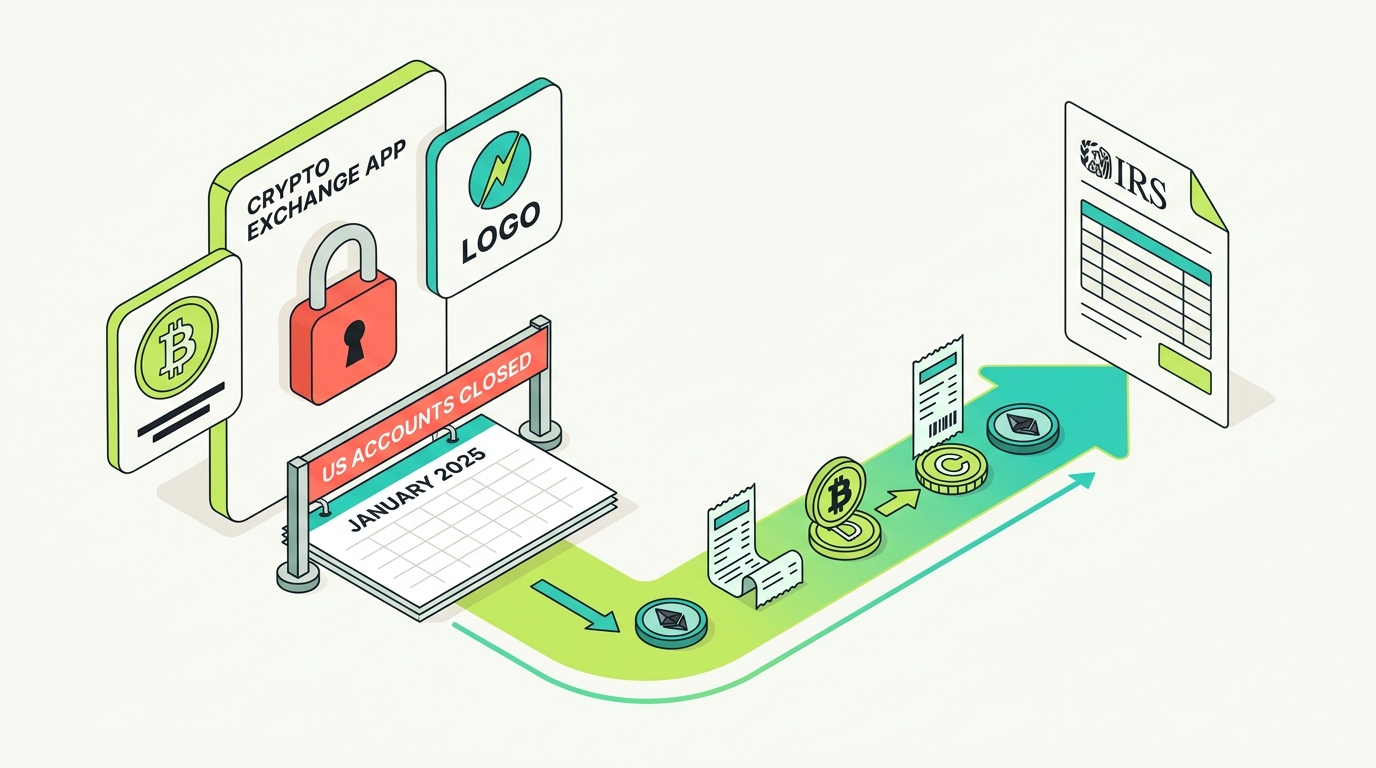
KuCoin may be closed to US users, but your historical KuCoin tax trail is still open. That single sentence reframes everything. For years, KuCoin was a popular offshore exchange for US traders who wanted deep altcoin markets, futures, trading bots, and Earn products that domestic platforms did not offer. Then, in January 2025, the picture changed completely: KuCoin moved to close US user accounts, and its operator pleaded guilty to operating an unlicensed money-transmitting business and agreed to exit the US market. Trading access went away. The tax obligations did not.
This is the definitive KuCoin tax guide for 2026, written for the audience that actually exists now: former US users reconstructing historical activity, taxpayers retrieving records from closed or restricted accounts, traders reconciling KuCoin with the US exchanges and self-custody wallets they moved assets to, and anyone amending prior-year returns or responding to an IRS inquiry. Most existing KuCoin guides still read as if you can sign up today and connect an API, treating KuCoin as a live US option. That framing is outdated, and it leaves the hardest questions unanswered.
If one idea sticks from this guide, let it be this:
An exchange leaving the US does not erase the taxes on what already happened there. A KuCoin account can be closed while every trade, reward, and disposal inside it remains fully reportable.
On a KuCoin account, the real work is rarely the math. It is rebuilding a complete, accurate history out of exports that cap by date, API imports that quietly miss bots and subaccounts, internal transfers that look like sales, and assets that arrived with no cost basis attached.
This guide covers the full landscape of KuCoin taxes:
- The current US status, the account closure, and why historical activity is still reportable
- How the IRS treats your activity, what KuCoin does and does not report, and the Form 1099-DA reality
- How to retrieve and reconstruct records from a closed account, and why API imports are not complete
- KuCoin’s account architecture, KCS, trading bots, futures, margin, staking, Earn, lending, and structured products
- Missing cost basis, wallet- and account-specific basis rules, FBAR and Form 8938, and audit readiness
Important Update for US KuCoin Users
Before a single number, the US status has to be clear, because it changes who this guide is for and what you actually need to do.
Can US Residents Currently Use KuCoin?
In practical terms, no. KuCoin’s terms now identify the United States and US territories as restricted locations, and ordinary US access to spot, futures, and Earn products is no longer available the way it once was. If you are a US taxpayer reading this, you are almost certainly here to deal with activity that already happened, not to open a new account.
What Happened to US KuCoin Accounts?
KuCoin announced that US user accounts would be closed effective January 23, 2025, at 9:00 p.m. Eastern Time. Separately, KuCoin’s operator pleaded guilty in January 2025 to operating an unlicensed money-transmitting business, agreed to pay nearly 300 million dollars, and agreed to exit the US market for at least two years. Many US users were prompted to withdraw their assets, which scattered their holdings across other exchanges and wallets and made record-keeping harder, not easier.
Does KuCoin’s US Exit Eliminate Previous Tax Obligations?
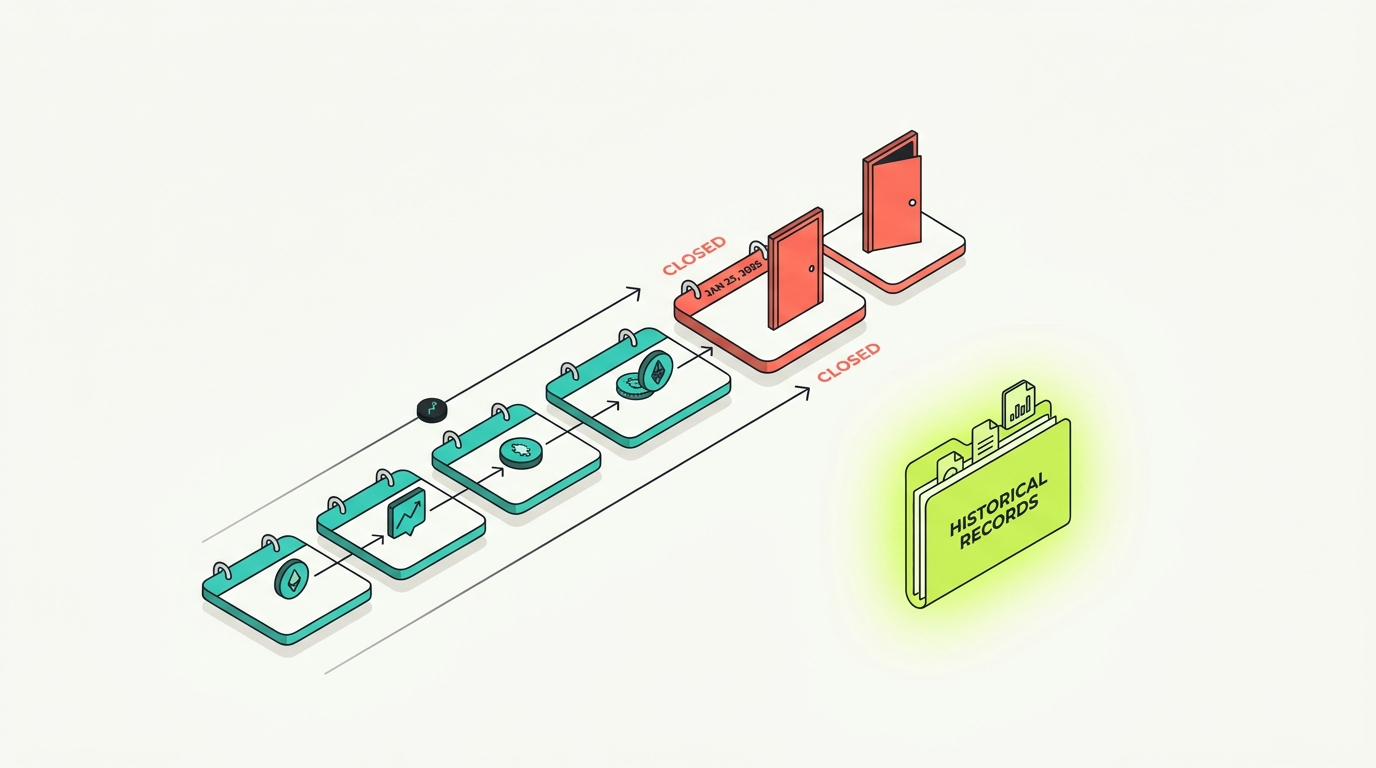
No. This is the point that trips up the most people. An exchange leaving the US market does not retroactively cancel taxes on activity that already occurred. Every taxable event you triggered while you were active (each sale, trade, futures close, fee paid in an appreciated token, and reward received) remains reportable. If anything, the closure raises the stakes, because it makes the records harder to retrieve while leaving the obligation fully intact.
Who This Guide Is Designed For Now
The KuCoin audience has shifted. This guide is built for:
- Former US customers reporting historical transactions.
- Users retrieving historical data from a closed or restricted account.
- Taxpayers who transferred assets off KuCoin and need to trace basis to where they sold.
- Users amending previous returns that left KuCoin activity off.
- Taxpayers responding to an IRS notice or preparing audit support.
What to Do If Your KuCoin Account Is Restricted or Inaccessible
If you can no longer log in normally, you are not out of options. Work through these steps:
- Locate previous exports you already downloaded to your computer or cloud storage.
- Search your email for trade and withdrawal confirmations, which often contain dates and amounts.
- Recover the wallet addresses you used to deposit to and withdraw from KuCoin.
- Contact official KuCoin support to request access to historical data.
- Download records before access changes further, capturing everything you still can.
- Reconstruct missing history from the destination platforms you moved assets to and from public blockchain records.
KuCoin may be closed to US users, but your historical tax trail remains open.
What Is KuCoin?
To reconstruct KuCoin activity accurately, you first need to understand how broad the platform was. KuCoin was never a single buy-and-sell app. It was a sprawling ecosystem of products, each generating its own records and its own tax questions.
KuCoin Spot Trading
The core of KuCoin was its spot market: buying and selling a vast range of cryptocurrencies, including many small-cap altcoins that US exchanges never listed. Spot trades are the most familiar taxable events, but the sheer number of pairs and trades makes completeness a challenge.
KuCoin Convert
KuCoin Convert let users swap one asset for another in a single step. Convenient as it was, each conversion is a disposal of the asset you gave up, so the convert feature does not change the tax treatment.
KuCoin Margin Trading
Margin trading let users borrow assets to amplify positions. Borrowing itself is generally not a sale, but the trades made with borrowed funds, the interest paid, and any liquidation all carry tax consequences that must be tracked separately from spot.
KuCoin Futures and Perpetual Contracts
KuCoin offered USDT-margined and coin-margined futures and perpetual contracts. Realized profit and loss, funding payments, fees, and liquidations all matter, and the characterization of these offshore derivatives is fact-specific rather than automatic.
KuCoin Trading Bots and Copy Trading
KuCoin was particularly associated with automated trading: grid bots, DCA bots, futures bots, and copy trading. A single bot strategy can execute thousands of trades, each a separate taxable event, which makes bots one of the most data-heavy and most commonly missed parts of a KuCoin return.
For current alternatives, see our tested comparison of the best AI crypto trading bots in 2026, including pricing, risk controls, paper testing, and tax-record requirements.
KuCoin Earn, Staking, Savings, and Lending
KuCoin Earn bundled staking, savings, promotional yields, and lending. Rewards from these products are generally ordinary income when received, and they often pay frequently, creating many small income events that are easy to overlook.
KCS and the KuCoin Ecosystem
KCS is KuCoin’s native token. It powers fee discounts, bonuses, and rewards, and it sits at the center of the ecosystem. Because paying fees with appreciated KCS can itself be a disposal, KCS deserves its own dedicated tracking.
KuCoin Subaccounts
KuCoin let users create subaccounts to separate strategies or bots. Subaccounts are a frequent blind spot, because activity siloed in a subaccount may never get imported if you only connect the main account.
KuCoin Structured and Leveraged Products
KuCoin offered structured products such as Dual Investment, Shark Fin, and Snowball products, along with leveraged tokens. These can settle in a different asset than you contributed, which can be a disposal, so each one needs its own analysis.
Do You Owe Taxes on KuCoin?
Owning crypto is not a taxable event. What creates a tax bill is an action, and KuCoin offered many of them. Knowing which actions count is the groundwork for everything that follows.
IRS Treatment of Cryptocurrency
Under IRS Notice 2014-21, cryptocurrency is property for tax purposes, not currency. Almost everything about KuCoin taxes flows from that one classification. When you dispose of property you have a capital gain or loss; when you receive property as a reward you have ordinary income. Every KuCoin scenario, from a spot sale to a futures close to a KCS fee payment, resolves to one of those two.
Capital Gains
Dispose of crypto for more than you paid and the difference is a capital gain. The rate depends on how long you held it. A holding period of a year or less makes the gain short-term, taxed at your ordinary income rate of 10 to 37 percent. More than a year makes it long-term, taxed at the preferential 0, 15, or 20 percent brackets. Because the clock runs per lot, holding period can dramatically change the bill on a large KuCoin position.
Ordinary Income
Some KuCoin activity is taxed as ordinary income at the moment you receive it, valued at fair market value:
- Staking rewards on supported assets.
- Earn, savings, and lending income.
- KCS bonuses and rewards.
- Airdrops, referral, and promotional rewards.
This income is taxed at your marginal rate. The timing rule is what matters: a reward becomes income the instant you gain dominion and control over it, valued in dollars at that moment. The capital gains system only re-enters later, when you sell those reward coins and account for the price change since receipt.
Taxable Events
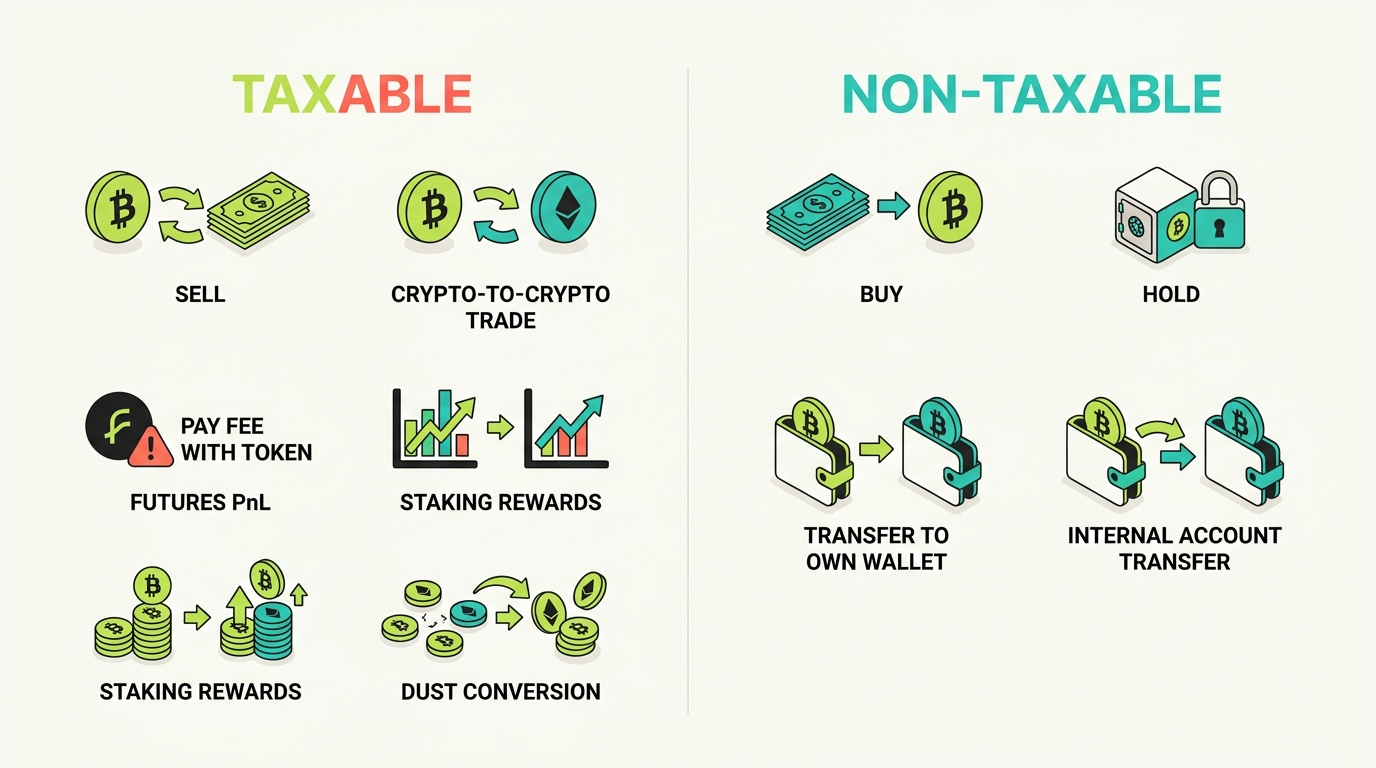
On KuCoin the events that most often trigger tax are selling crypto, trading one crypto for another, converting to a stablecoin, paying fees with an appreciated token, closing a futures position, converting dust, and receiving rewards. At each point the IRS expects a number from you: a gain, a loss, or income.
Non-Taxable Events
Not everything is taxable. Buying crypto with fiat, holding it, transferring between your own wallets, and moving funds between your own KuCoin accounts are generally not taxable. These actions still affect your records, because basis has to follow the asset, but they do not by themselves create a tax bill.
Does KuCoin Report to the IRS?
This is where KuCoin differs sharply from a US broker, and where the most dangerous assumptions live.
What Information KuCoin Retains
As a centralized exchange, KuCoin holds records of your trades, deposits, withdrawals, and rewards while your account is active. It collected identity information through KYC. But holding records is not the same as filing US tax forms, and KuCoin’s offshore status means it generally does not send US information returns the way a domestic broker does.
Does KuCoin Issue US Tax Forms?
Generally no. KuCoin does not issue Form 1099-MISC or Form 1099-DA to most US users. There is typically no form to download and no matching copy flowing to the IRS tied to your Social Security number. That absence is exactly what creates the trap.
Does KuCoin Issue Form 1099-DA?
There is no current official KuCoin publication confirming that KuCoin issues US customers a Form 1099-DA, and given the US account closure and restricted-market status, you should not assume one is coming. Form 1099-DA is a US broker form for reportable digital asset dispositions beginning with 2025 transactions. The realistic 1099-DA scenario for a former KuCoin user is receiving one from another exchange after transferring assets there and selling.
Why You May Receive No KuCoin Tax Form
If you are a US user, the most likely outcome is that you receive nothing from KuCoin at all, especially now that US accounts are closed. No form does not mean no obligation. It means the entire record-keeping and reporting burden sits with you.
Public Blockchain Records and Transfers to Regulated Exchanges
No form is not the same as no visibility. The IRS can still surface offshore activity through several channels:
- On-chain analytics. Transfers between KuCoin and US exchanges or known wallets are traceable on public blockchains.
- US exchange reporting. When you move funds to a US broker and sell, that broker reports proceeds on a 1099-DA, creating a thread the IRS can pull.
- International information sharing. Cross-border data exchange between tax authorities continues to expand.
How to Reconcile KuCoin History With a 1099-DA Received Elsewhere
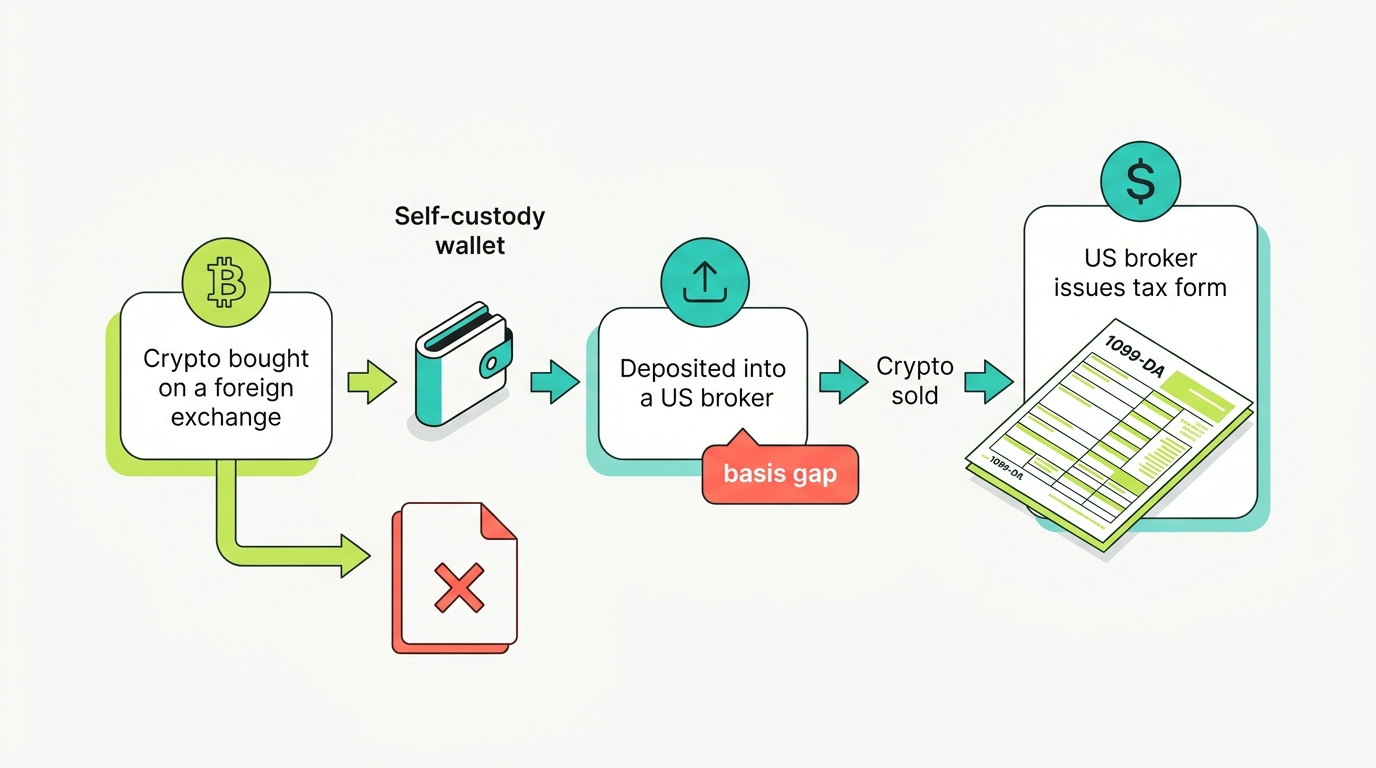
Here is the journey that catches people: you bought an asset on KuCoin, transferred it to a self-custody wallet, deposited it into Coinbase or Kraken, and sold it there. The US broker issues a 1099-DA reporting the proceeds, but without your KuCoin acquisition history, so the basis may show as missing. Reconciling means supplying that original KuCoin basis so your Form 8949 shows the real gain, not the full proceeds.
How to Retrieve Your KuCoin Transaction History
For most former US users, this is the make-or-break step. You cannot file an accurate return on data you do not have, so retrieving and reconstructing records comes before any calculation.
KuCoin’s Data and Report Service
KuCoin’s Data and Report Service is the primary export tool. It supports main-account and subaccount reporting and includes reports for balances, profit and loss, trades, deposits and withdrawals, VIP loans, ledgers, positions, and options. This current workflow should replace any old screenshots or instructions copied from outdated tax-software pages.
Available Historical Date Ranges
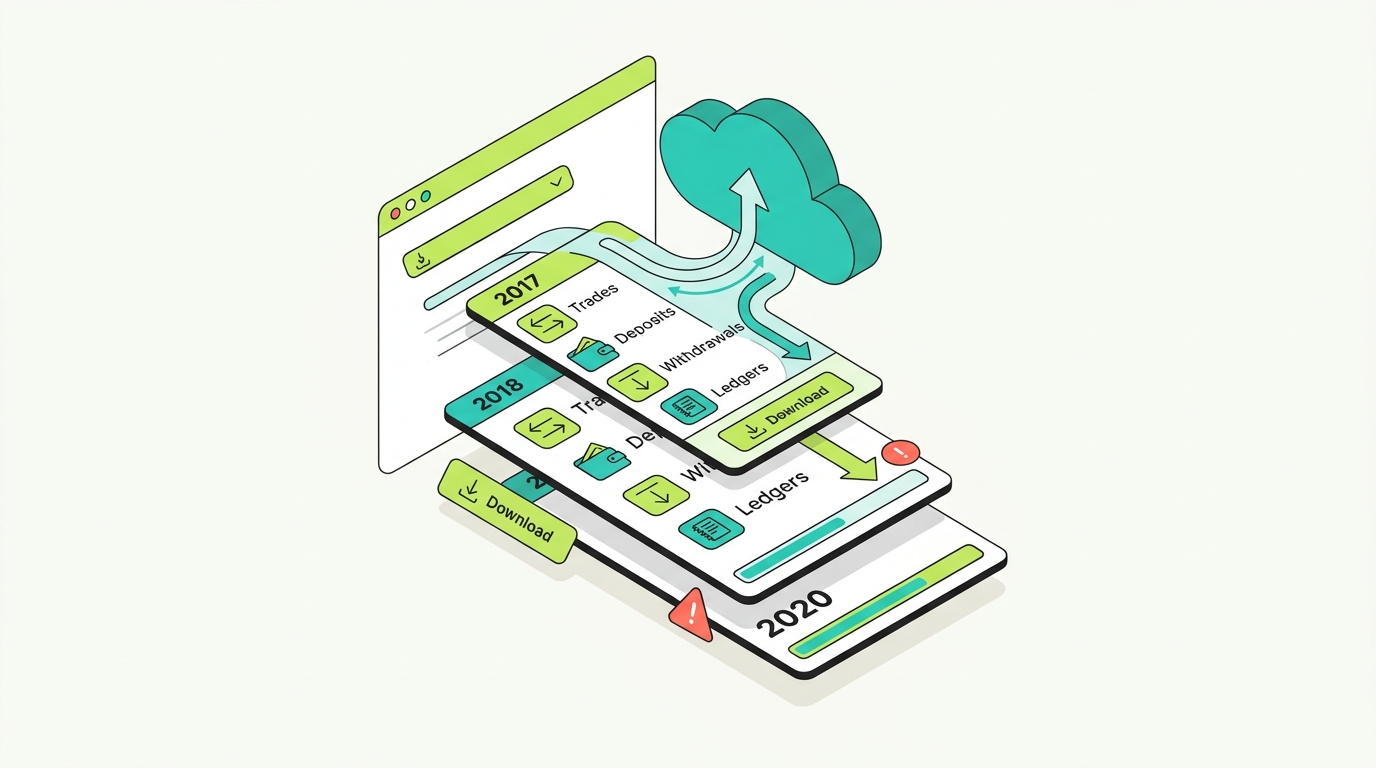
The service states that downloadable data is available from September 16, 2017, with a maximum one-year period in each report request. In practice, that means you generate a separate report for each year you were active, rather than pulling your entire history in one file.
What to Download
Pull each of these as separate reports, for the main account and every subaccount:
- Trade reports for spot, margin, and futures.
- Deposit and withdrawal history for transfer tracing.
- Ledger reports for a complete account-level record.
- Futures reports for realized PnL, funding, and fees.
- Margin and loan reports for borrowing, interest, and liquidations.
- Earn, staking, and lending records for income.
- Trading-bot records for bot executions.
Export Limits and Date Segmentation
Separate deposit and withdrawal export tools may impose shorter date-range limits than the one-year report cap, so segment carefully and verify that each segment connects to the next with no gaps. Name your files clearly by account, report type, and date range, and keep every one.
What to Do When Historical Records Are Unavailable
If exports are incomplete or access is gone, reconstruct from the edges inward. Use the destination platforms you transferred assets to, your email confirmations, your bank records for fiat on-ramps, and public blockchain explorers for the wallet addresses you used. A reconstructed history built from multiple corroborating sources is both possible and defensible.
What Former US Users Should Preserve Now
If you still have any access, preserve everything immediately: full exports, the wallet addresses you used, trade confirmations, and screenshots of balances. Access for restricted accounts can change without warning, and a record you cannot retrieve later is a basis you cannot prove.
KuCoin API vs CSV Imports
Once you have data, the next trap is assuming an import is complete. On KuCoin, it frequently is not.
Why a Successful API Connection Is Not a Complete History
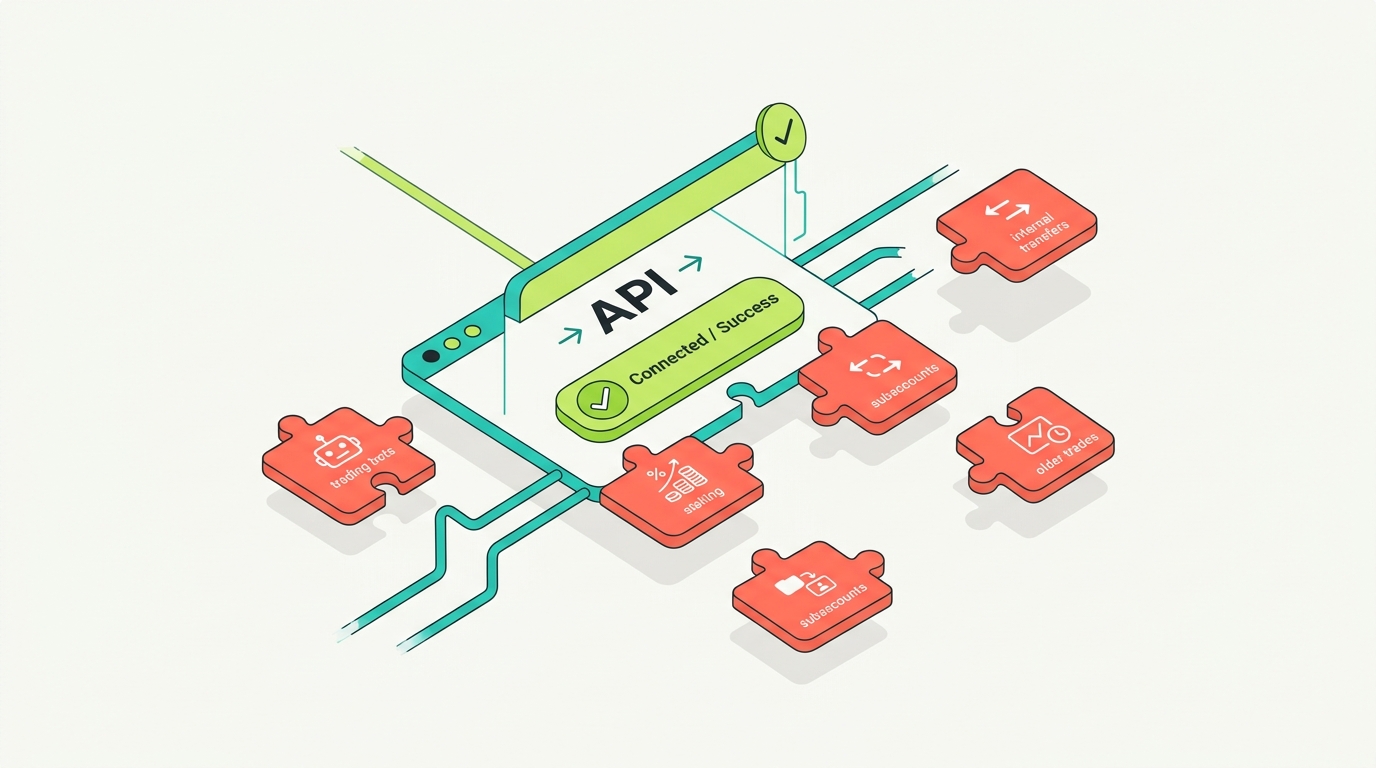
Ranking pages routinely treat “API connected successfully” as equivalent to “tax history complete.” It is not. Depending on the integration, API data may omit or complicate:
- Trading-bot transactions.
- Some savings interest.
- Staked balances.
- Internal transfers.
- Older activity.
- Subaccount activity.
- Certain lending information.
Subaccounts in particular may require separate connections or additional work, and different tools describe different API history limits, which is exactly why you should compare API results against official CSV and account reports rather than relying on a single method.
Advantages and Limitations of an API
A read-only API key can pull a deeper, more automated history than a manual CSV, and it updates as new activity occurs. Its limitation is completeness: it can silently miss the categories above, leaving gaps you only notice if you reconcile against the official reports.
Advantages and Limitations of CSV Exports
Official CSV and report exports are authoritative for the periods they cover and can capture categories an API misses. Their limitation is the date caps and the manual effort of stitching segments together. The right approach uses both and reconciles them against each other.
Read-Only API Security
If you do connect an API, use a read-only key, and never enable withdrawal permissions. Tax software needs to read your history, not move your funds. A read-only key protects you while still allowing a full import.
KuCoin Account Architecture and Internal Transfers
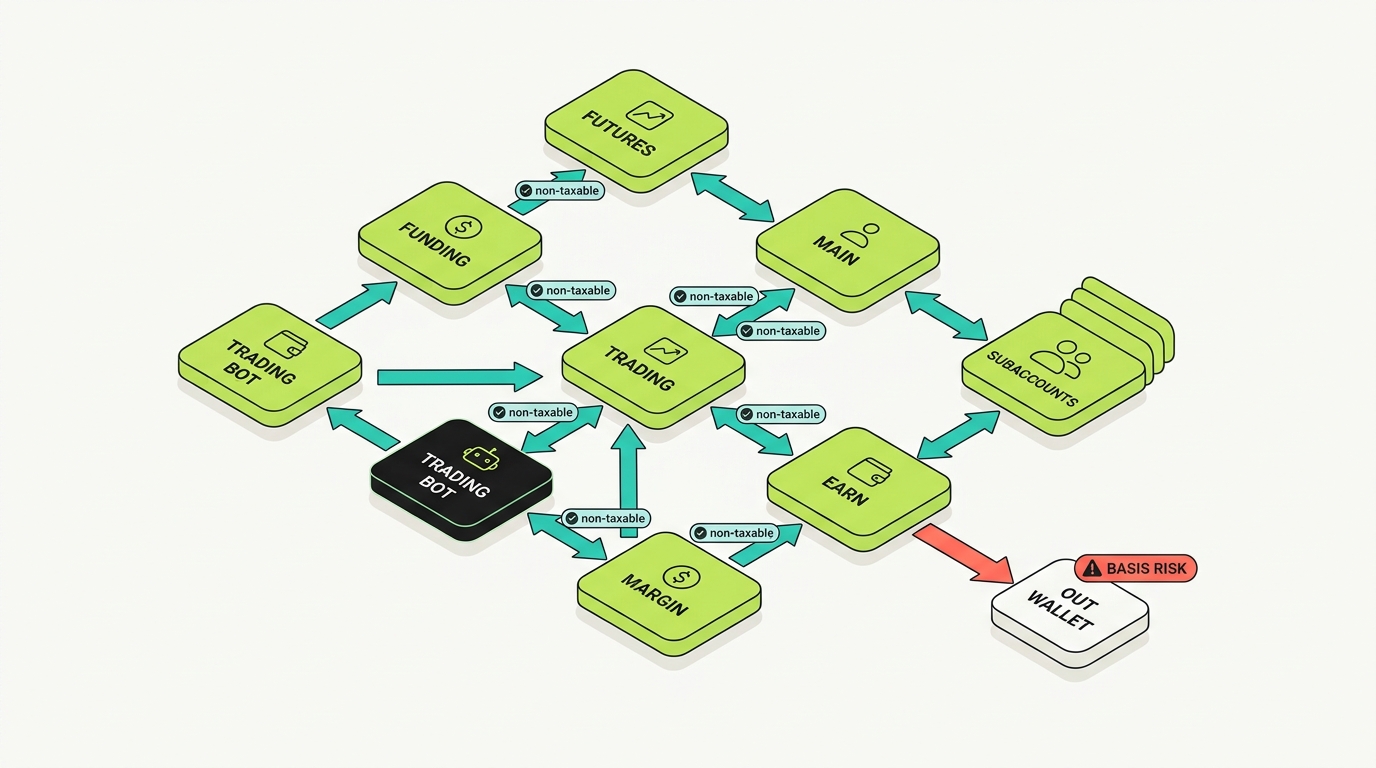
KuCoin’s many internal accounts are a hidden source of errors, because moving money between them is not taxable but often looks taxable to software.
The Many KuCoin Accounts
KuCoin activity can be distributed across the main account, trading account, funding account, margin account, futures account, financial or Earn account, trading bot accounts, subaccounts, lending records, and fiat or P2P records. Each holds a slice of your history.
Why Internal Transfers Get Misclassified
When you move funds between your own KuCoin accounts, tax software can misread the movement as a taxable withdrawal, a zero-basis deposit, income, a duplicate transfer, or a disposal. None of those is correct: an internal transfer is not a sale. Left unmatched, these phantom events inflate or distort your gains.
Reconciling Every Ledger Into One History
The fix is to import every account and subaccount, then match internal transfers so they net out. No leading article walks users through reconciling all of these ledgers into one complete tax history, which is precisely why so many KuCoin returns come out wrong. Treat the account architecture as a map, and make sure every node is captured and every internal movement is paired.
KuCoin Spot Trading Taxes
Spot trades are the foundation, and the rules are the same property rules that govern all crypto.
How Spot Trades Are Taxed
Selling crypto for fiat or a stablecoin is a disposal, and trading one crypto for another is a disposal of the coin you gave up. In each case you report proceeds minus basis as a capital gain or loss, with the holding period setting the rate.
Crypto-to-Crypto Trades
Swapping one coin for another (say BTC into an altcoin) feels different from selling for cash only because nothing landed in your bank account. It is still a taxable disposal of the BTC, measured at the fair market value received.
Stablecoin Trades
A huge share of KuCoin trading happens in stablecoin pairs. Converting crypto into USDT or USDC is a disposal of the crypto you converted, so each of these trades realizes a gain or loss. They add up fast.
Trading Fees and Partial Fills
Trading fees affect your basis or proceeds, and partial fills, canceled orders, and failed orders complicate the record. Capture fees correctly rather than ignoring them, because over many trades they meaningfully change the totals.
Trading SOL for USDT on KuCoin
You acquired 20 SOL with a cost basis of 2,000 dollars. Later you trade all 20 SOL for USDT when the SOL is worth 3,400 dollars, paying a small fee. That trade is a taxable disposal of the SOL: proceeds of 3,400 dollars minus 2,000 dollars basis is a 1,400 dollar capital gain, short-term if you held the SOL a year or less. Your new USDT carries a 3,400 dollar basis going forward.
KCS Taxes
KCS sits at the center of the KuCoin ecosystem, and it deserves its own section because of one overlooked rule: paying fees with appreciated KCS can be a disposal.
Buying, Holding, and Selling KCS
Buying KCS sets your basis and is not taxable. Holding it is not taxable. Selling KCS, or trading it for another asset, is a taxable disposal measured against your basis.
Using KCS to Pay Trading Fees
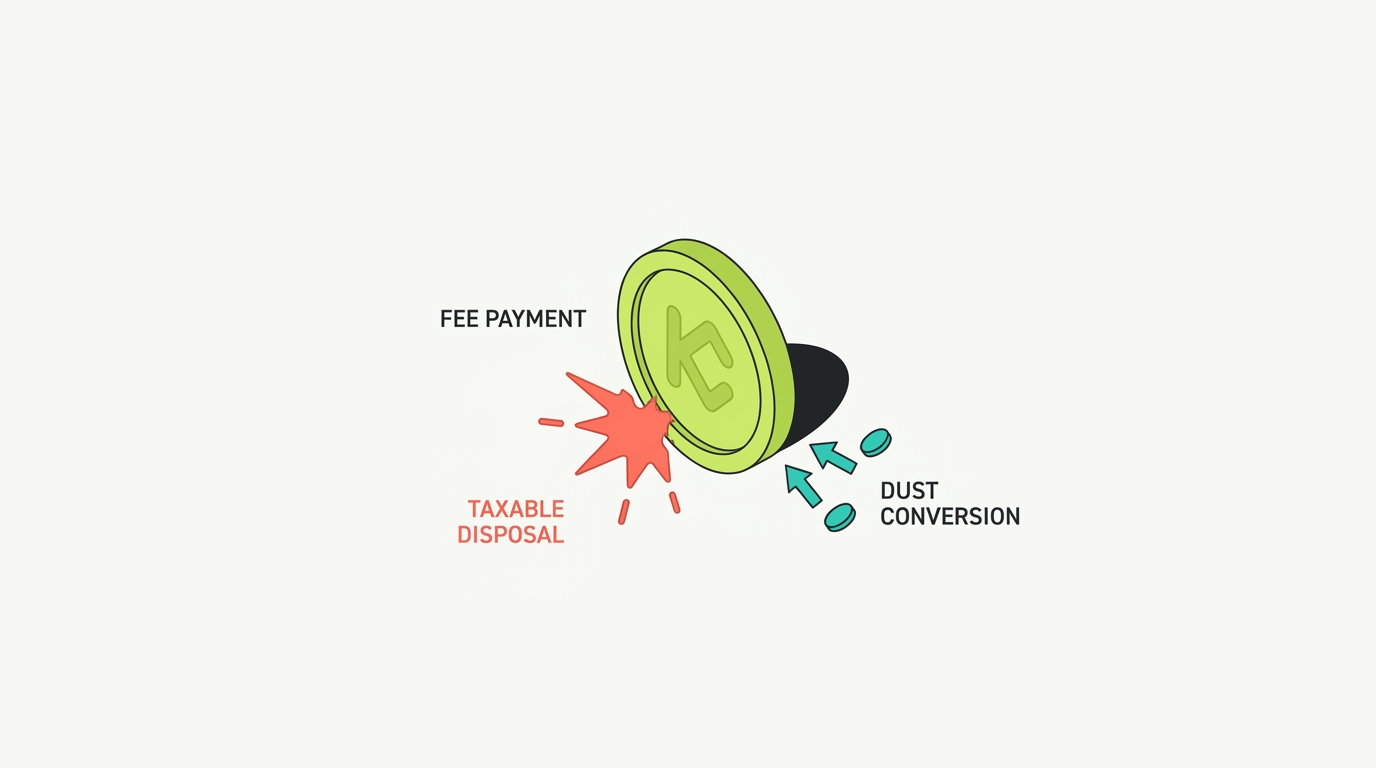
This is the subtle one. KuCoin encourages paying trading fees in KCS for a discount. If the KCS you spend on a fee has appreciated since you acquired it, paying that fee is itself a disposal of KCS, which can create a small capital gain or loss. Across many trades, these tiny disposals accumulate into a real reporting item.
KCS Bonuses, Rewards, and Staking
KCS bonuses, rewards, and staking income are ordinary income at fair market value when received, and that value becomes your basis in the KCS. When you later sell that KCS, you report a separate capital gain or loss.
Dust Conversions Into KCS
Converting small leftover balances into KCS is a disposal of those dust assets. The amounts are tiny, which is why people forget them, but each conversion is still a taxable event.
Paying a trading fee with appreciated KCS
You bought KCS at an average cost of 5 dollars each. Months later you pay a trading fee using 4 KCS when KCS is worth 12 dollars each. Using that KCS is a disposal: 48 dollars of value used minus 20 dollars of basis is a 28 dollar capital gain on the fee payment alone. Multiply by hundreds of fee-paid trades and the reporting matters.
KuCoin Trading Bot Taxes
KuCoin’s bots are powerful and notorious for generating enormous transaction volume. The tax character does not change just because a bot did the trading.
Why a Bot Strategy Creates Thousands of Tax Lots
A grid bot places many small buy and sell orders inside a price range, and each execution is a separate taxable disposal. A single bot strategy running for months can produce thousands of taxable lots, each needing a date, proceeds, basis, and gain or loss.
Grid Bots, DCA Bots, and Futures Bots
Grid bots create many small disposals. DCA bots create recurring buys (not taxable by themselves) and later sells (taxable). Futures bots generate realized PnL on each closed position. Each type needs its own handling.
Copy Trading
Copy trading does not change the underlying tax character. The trades executed on your behalf are still your taxable events, reported the same way as if you had placed them yourself.
Transfers Into a Bot and Avoiding Double-Counting
Moving funds into a bot is not itself taxable, and bot-to-account transfers should not be double-counted. The risk is both directions: missing the bot’s trades entirely (because API imports often omit them) or double-counting transfers that are not dispositions.

KuCoin Staking Taxes
Staking rewards follow a two-layer rule that catches people who only think about the eventual sale.
When Staking Rewards Become Taxable
For US federal tax purposes, staking rewards generally become income when you obtain dominion and control, including rewards received through a centralized exchange. The fair market value at that moment is ordinary income.
Basis in Rewarded Tokens and the Later Sale
That value also becomes your cost basis in the rewarded tokens. When you later sell them, you report a separate capital gain or loss measured from that basis. Two events, two calculations: income at receipt, then capital gain or loss at sale.
Frequent Rewards and Inaccessible Rewards
Staking often pays frequently, producing many small income events across the year, each needing a value at receipt. Rewards you cannot yet access or control raise timing questions about when dominion and control actually occurred, which is a fact-specific point worth confirming.
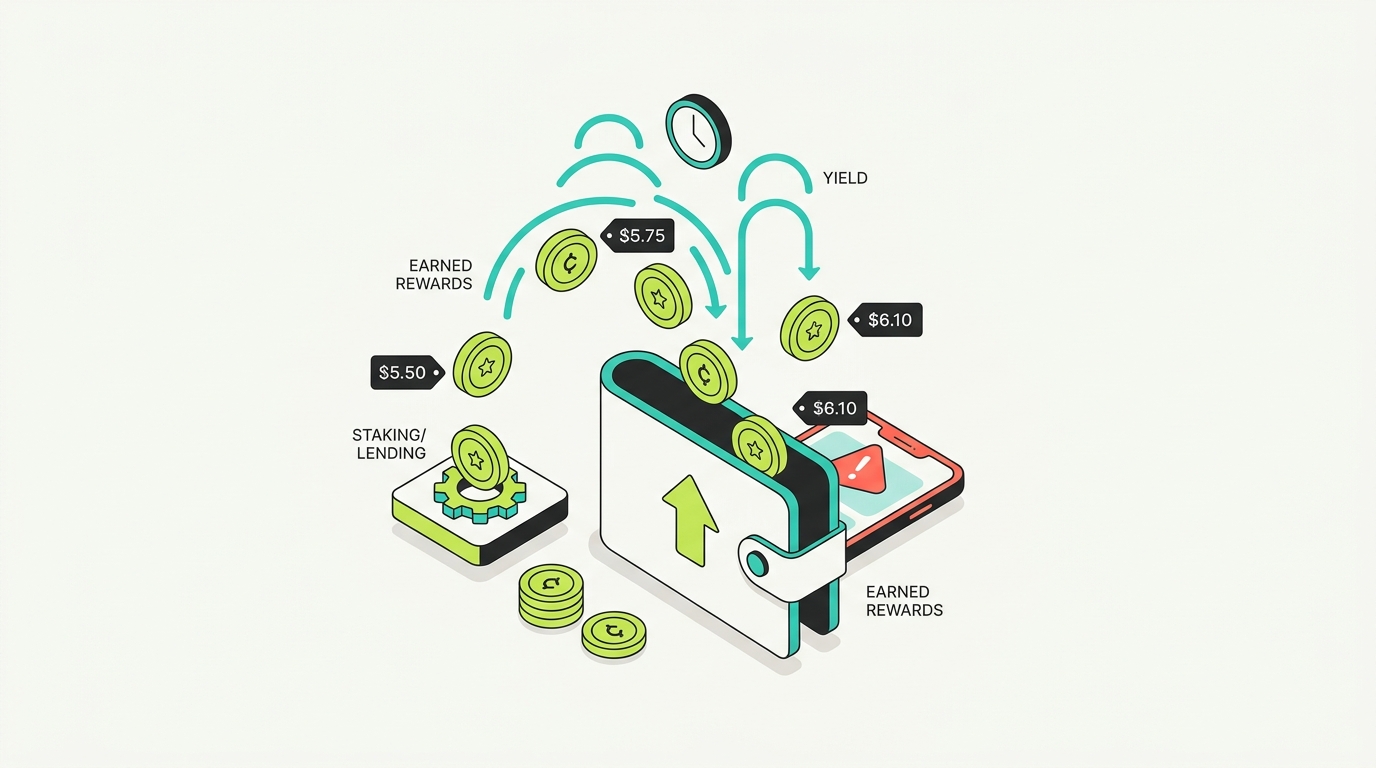
KuCoin Earn, Savings, and Lending Taxes
KuCoin Earn bundled several reward products, and ranking pages usually compress all of them into one vague paragraph. They deserve separation.
Earn and Savings Income
Flexible and locked Earn products, savings interest, and promotional yields are ordinary income at fair market value when you gain control of them, and that value becomes basis for a later sale. Compounding rewards create a stream of small income events.
Lending Income for Lenders
Interest received from lending crypto is ordinary income at fair market value when received, and the received asset takes that value as its basis. This is a straightforward income item that nonetheless gets missed when it is not on any form.
Borrowing and Crypto Loans
For borrowers, loan proceeds are generally not income. Interest and fees paid, collateral transfers, collateral liquidation, and any bad-debt situation can have tax consequences. The lender and borrower sides are treated differently, so be clear about which role you were in.
Why Earn Activity Is Missing From Imports
Earn, savings, and lending transactions are among the categories API imports frequently omit. Pull the dedicated Earn and lending reports and reconcile them, because unreported reward income is one of the most common KuCoin errors.
Monthly Earn rewards with changing value
You hold an asset in a KuCoin Earn product that pays a reward every month. Each monthly payout is ordinary income at its fair market value on the day you receive it, so twelve payouts mean twelve income entries at twelve different prices. Each payout also gets that value as basis, so when you later sell the accumulated rewards, you compute gain or loss from those individual basis points.
KuCoin Margin Trading Taxes
Margin adds borrowed money to the mix, which separates the act of borrowing from the taxable trades and liquidations that follow.
How Margin Events Are Taxed
Borrowing an asset is generally not the same event as selling it. But selling borrowed crypto, buying replacement crypto, and repaying the loan are trades with tax consequences, and margin interest and fees factor into the picture.
Liquidations and Collateral
A liquidation is a forced disposal of collateral, which can create a sizable and unexpected gain or loss. Collateral disposals, and any unrecovered collateral or bad debt, need careful treatment. Liquidations surprise users precisely because they were not voluntary.
Transfers Between Spot and Margin
Moving funds between your spot and margin accounts is an internal transfer, not a sale. As with the rest of KuCoin’s architecture, the risk is software misreading these movements, so match them so they net out.
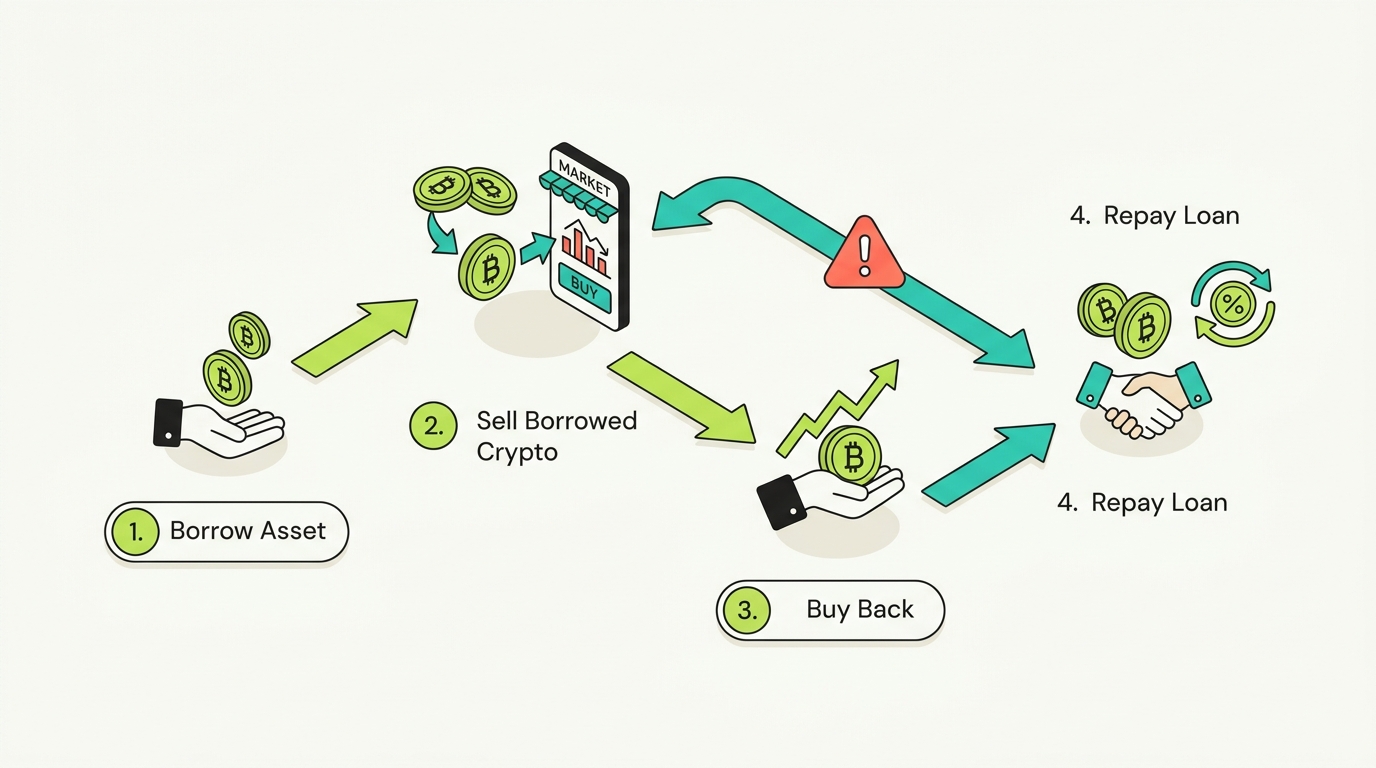
Shorting BTC through a margin account
You borrow BTC, sell it for 30,000 dollars, and later buy BTC back for 26,000 dollars to repay the loan. The trades net to a 4,000 dollar gain before fees and interest, which reduce it. The borrowing itself was not the taxable moment; the sell and buy-back trades and the loan repayment are what carry the tax consequences, and margin interest paid is tracked separately.
KuCoin Futures and Perpetual Contract Taxes
Futures are where KuCoin returns get heavy, and where a common shortcut can be wrong.
USDT-Margined and Coin-Margined Contracts
KuCoin offered both USDT-margined and coin-margined futures and perpetual contracts. Each produces realized profit and loss on closed positions, plus funding payments, fees, and settlement entries.
Realized vs Unrealized PnL
Only realized PnL on closed positions is reportable. Unrealized PnL on open positions is not a taxable event until you close. Reporting unrealized profit, or forgetting realized profit, are both common errors.
Funding, Fees, Liquidations, and Settlement
Funding payments, trading fees, liquidations, auto-deleveraging, and settlement all factor into the result. Many small closes and funding entries pile up quickly, which makes futures one of the most data-heavy parts of a KuCoin return and a frequent source of errors when reconstructed from memory.
Why Futures Characterization Is Fact-Specific
Avoid automatically telling yourself that all crypto futures qualify for the favorable 60/40 treatment under Section 1256. That treatment generally applies to contracts traded on a regulated US board of trade, and the US characterization of offshore crypto derivatives is highly fact-specific, depending on the instrument, venue, taxpayer, and applicable rules. The conservative, common-practice approach is to report realized PnL as ordinary short-term gain or loss, and to confirm the treatment with a professional.

Perpetual contract profit, fees, and funding
Over a quarter you close several USDT-margined perpetual positions for a net realized profit of 6,200 dollars, pay 380 dollars in trading fees, and net negative 140 dollars in funding payments. The reportable figure is the realized PnL adjusted for fees and funding, treated conservatively as ordinary short-term gain, and kept separate from your spot trades on your return.
KuCoin Leveraged Tokens and Structured Products
KuCoin’s structured product set adds complexity that no single rule can cover.
Leveraged Tokens
Buying and selling KuCoin leveraged tokens are taxable disposals measured against basis. Internal rebalancing, fees, and decay change the token’s value over time, but your reportable events are the purchases and sales you make. Leveraged tokens are treated differently from directly holding a futures position.
Dual Investment, Shark Fin, and Snowball Products
These structured products can involve a premium or yield received, settlement in a different asset than you contributed, early redemption, or expiration. Because settlement in a different token can be a disposal, the tax treatment depends on the specific product terms.
A Decision Framework, Not One Rule
Rather than applying a universal claim, analyze each structured product on its own terms: what asset you contributed, the contract terms, the settlement asset, whether one token was exchanged for another, the premium or yield received, and whether it was redeemed early or expired. Retain the exact product confirmation and settlement record for each one.
Dual Investment that settles in a different asset
You commit USDT to a Dual Investment product, and at settlement it pays out in a different cryptocurrency plus yield. The conversion into a different token can be a disposal, and the yield can be income, so this single product can generate both a capital event and an income event. Keep the product confirmation and settlement record so each piece can be analyzed and reported correctly.
KuCoin Airdrops, Referral Bonuses, and Promotions
Reward distributions follow the income-then-capital pattern, with a few nuances.
Airdrops and Token Distributions
Airdrops and token distributions are generally ordinary income at fair market value when you gain dominion and control, and that value becomes basis for a later sale. Unsolicited spam tokens with no market value are a more nuanced case.
Referral and Promotional Rewards
Referral and promotional rewards are generally ordinary income at fair market value when received, with the received asset taking that value as basis. Small and frequent, they are easy to overlook but still reportable.
The Later Sale
For any reward that had value at receipt, selling it later is a separate taxable event, with gain or loss measured from the value you already recognized as income. Two events, two calculations.
KuCoin Transfers and Missing Cost Basis
This is the single most expensive KuCoin tax problem, and the most fixable.
Why a Transfer Is Often Misclassified
Moving crypto between platforms you control is not a disposal, but the basis must travel with the asset. When it does not, a later sale can appear to have no cost basis and overstate your gain. Common journeys include Coinbase to KuCoin, Kraken to KuCoin, Binance to KuCoin, MetaMask to KuCoin, a hardware wallet to KuCoin, and KuCoin back out to any of them.
How a Destination Platform Shows Zero Basis
When you transfer an asset into KuCoin (or out to a US exchange) and later sell, the selling platform sees only the deposit, not your original purchase. Left alone, the system can treat your entire sale price as gain. This is the classic cost-basis-gap trap.
How to Reconstruct Basis
Reconstruct the original acquisition from the platform where you first bought the asset, your own purchase records, and on-chain history, then apply that basis to the disposal. Supplying that original record is the difference between a fair tax bill and a wildly inflated one.
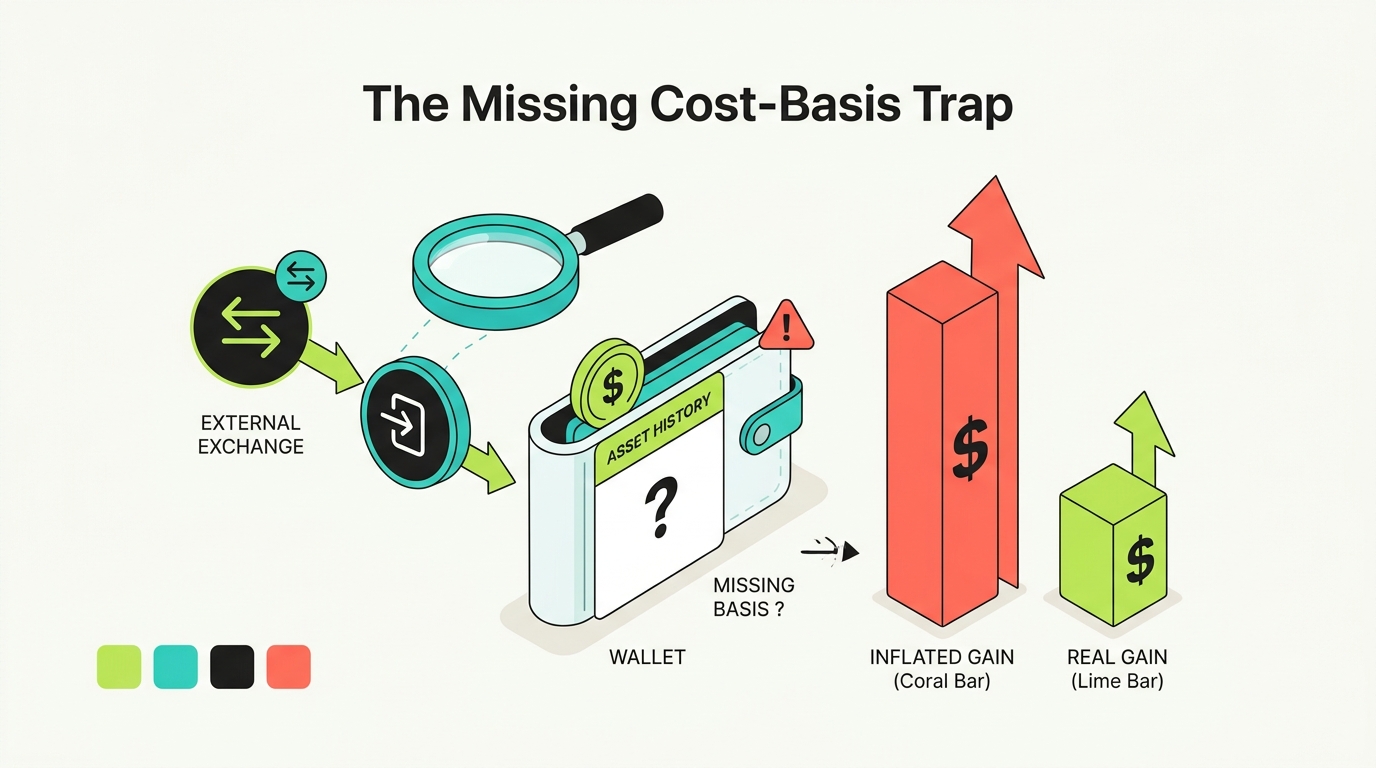
BTC bought elsewhere, transferred through KuCoin, later sold
You bought 0.5 BTC on Coinbase for 15,000 dollars, moved it to a hardware wallet, then deposited it to KuCoin and later sold it for 22,000 dollars. The sale is a taxable disposal, but only the 7,000 dollar gain is taxable, not the full 22,000 dollars. Without the Coinbase purchase record following the asset, software could treat the entire 22,000 dollars as gain. Reconstructing that basis is the whole job.
Wallet- and Account-Specific Cost Basis
The shift to wallet- and account-specific basis tracking makes accurate KuCoin records more important than ever.
Why Wallet and Account Location Matters
Under updated IRS guidance, basis is tracked per wallet or account rather than universally across everything you own. The per-wallet cost basis rules mean lots held on KuCoin are tracked separately from lots held elsewhere, and you cannot freely pool them.
FIFO, Specific Identification, and Default Ordering
You can use specific identification when you keep adequate records identifying which units you sold, otherwise a default ordering applies. The IRS’s updated guidance addresses identification of units held in particular wallets or accounts and the default ordering when adequate identification is not made.
Documenting a Transfer of Basis
When you moved assets between accounts or off KuCoin entirely, document how basis traveled so you can support specific identification later. Records that tie each lot to its acquisition are what make a specific-identification position defensible.
KuCoin Reconciliation Checklist
Reconciliation is the heart of an accurate KuCoin return. Work this list before you file.
How to Calculate KuCoin Gains and Losses
With reconciled data, the calculation itself is mechanical.
The Core Steps
For each disposal: determine the asset disposed, the disposal date, the US dollar proceeds, the correct acquisition lot, the adjusted basis (including applicable transaction costs), and the holding period, then compute gain or loss. Separate capital transactions from income items, which follow their own rules.
Short-Term vs Long-Term
Hold one year or less and the gain is short-term, taxed at your ordinary rate. Hold more than a year and it is long-term, taxed at 0, 15, or 20 percent. High earners may also owe the extra 3.8 percent Net Investment Income Tax, and most states tax crypto gains as ordinary income.
How to Report KuCoin on Your Tax Return
Once reconciled, KuCoin activity lands on a familiar set of forms, with the key difference that none of it was pre-filled by a 1099.
The Forms
- Form 8949 lists every disposal (each sale, trade, futures close, fee paid in crypto, and dust conversion) with dates, proceeds, basis, and gain or loss.
- Schedule D totals those gains and losses, split into short-term and long-term.
- Schedule 1 carries your staking, Earn, lending, and other reward income as other income.
- Schedule C may apply if your activity rises to a qualifying business.
- The Form 1040 digital asset question must be answered yes if you sold, exchanged, or received crypto.
Reconciling With a 1099-DA From Another Broker
If you received a 1099-DA from a US exchange after selling assets that originated on KuCoin, reconcile it: pair the reported proceeds with the true KuCoin basis so your Form 8949 shows the real gain rather than the raw proceeds. You correct your basis without changing the broker’s reported proceeds figure.
KuCoin, FBAR, and Form 8938
Foreign-account reporting is an important and frequently mishandled topic, so it must be presented carefully rather than with a blanket rule.
Current FBAR Treatment
FinCEN’s current notice states that a foreign account holding solely virtual currency is not presently reportable on the FBAR, unless the account contains otherwise reportable assets. FinCEN has also indicated its intention to amend the regulations, so this could change.
Form 8938 Is a Separate Analysis
Form 8938 is a separate regime that may apply to certain specified foreign financial assets or foreign financial accounts when the applicable thresholds and legal requirements are met. It is not the same as the FBAR, and one can apply without the other.
Why This Needs Professional Advice
A responsible approach does not say either “every KuCoin account requires FBAR reporting” or “KuCoin never has foreign-account reporting implications.” The present rule, the separate Form 8938 analysis, and your specific facts all matter, so this is an area to confirm with a qualified professional.
Correcting Prior-Year KuCoin Tax Returns
Many former US users have prior returns that left KuCoin activity off. Fixing them is both possible and often advisable.
Signs an Older Return Is Incomplete
Watch for missing trades, missing staking or reward income, incorrect zero basis, unreported futures, duplicate disposals, and mishandled transfers. Any of these suggests an amendment may be appropriate.
How to Amend
Build the corrected transaction ledger first, then file an amended return to reflect it. Preserve both the original and corrected workpapers, and be mindful of the statutes of limitation that govern how far back amendments and assessments can reach.
Preparing for a KuCoin Tax Audit or IRS Notice
Most guides end when Form 8949 is generated. For KuCoin, the work should continue through audit readiness, because offshore activity draws scrutiny.
What to Retain
Keep your KuCoin transaction exports, deposit and withdrawal history, wallet addresses, blockchain explorer records, bank records, trade confirmations, bot reports, futures and margin statements, reward and staking records, cost-basis support, specific-identification evidence, the transfer trail, your reconciliation summary, Form 8949 support, prior-year returns, and any notice-response records.
Why This Matters More for KuCoin
Because KuCoin sends no form, your records are your entire defense. A well-organized archive that reconstructs a complete history from multiple corroborating sources is what turns an anxious audit into a manageable one.

Best KuCoin Tax Software
Software helps, but on KuCoin it is a starting point, not a finish line.
The Main Options
Koinly, CoinLedger, CoinTracker, Coinpanda, TokenTax, and ZenLedger all support KuCoin to varying degrees. They differ in historical depth, and in their handling of futures, margin, bots, subaccounts, and Earn. The best choice depends on the shape of your transaction history, not on brand alone.
Why an Import Can Look Complete and Not Be
The recurring trap is that an import can show a green checkmark while quietly missing bot activity, subaccounts, Earn income, internal transfers, and older history. Always reconcile the software’s output against your official KuCoin reports rather than trusting the import on faith.
When Software Alone Is Not Enough
When you have a closed account, missing exports, large transferred-in positions, futures or margin, bots, many subaccounts, KCS fee payments, structured products, or prior-year errors, software often produces a draft full of gaps and zero-basis lines. Closing those gaps is reconciliation work, and in complex cases it is what separates a guessed return from a defensible one.
Digital Asset Reconciliation for KuCoin Users
This is where Count On Sheep fits, and why it matters more for KuCoin than for almost any other exchange.
What Digital Asset Reconciliation Is
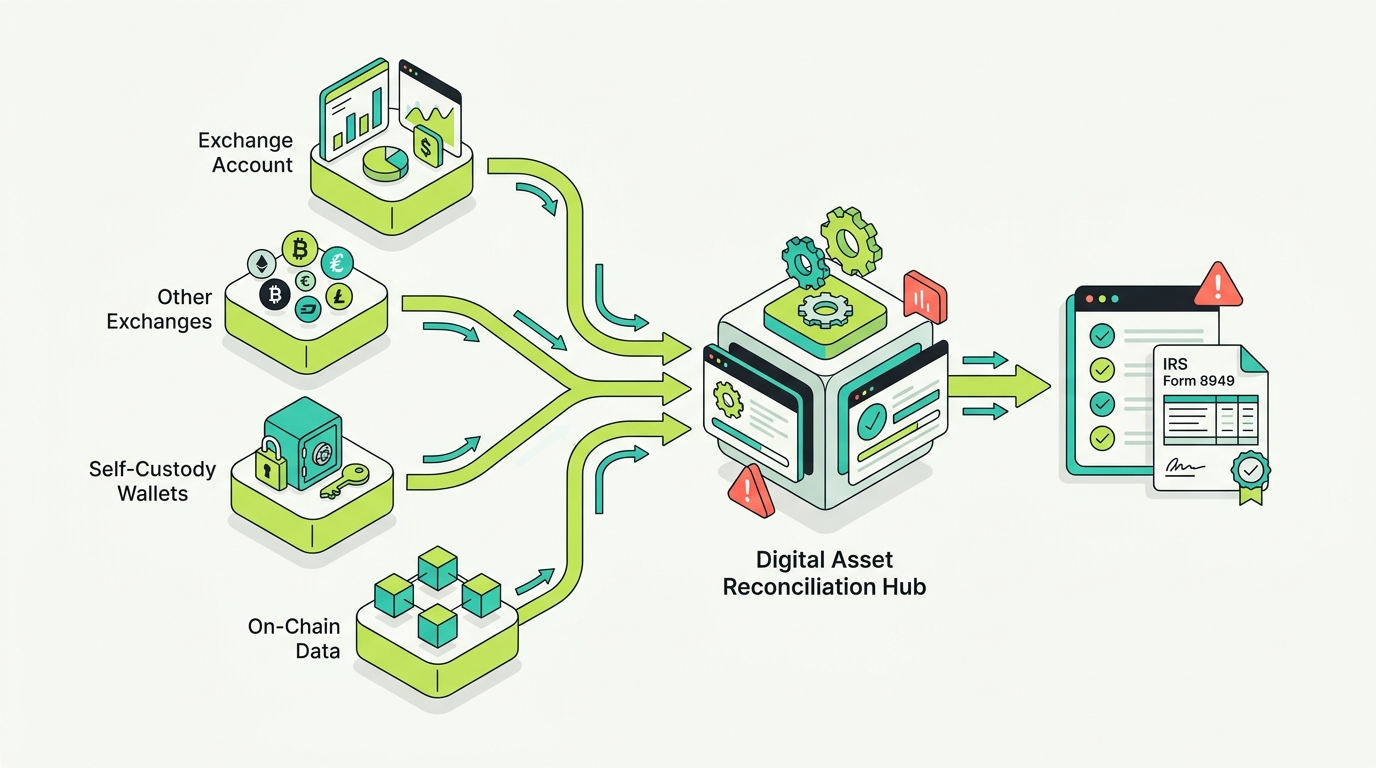
Digital Asset Reconciliation is the process of identifying every data source, connecting transfers, reconstructing missing basis, classifying complex products, reconciling balances, and producing an audit trail. It is fundamentally different from uploading a CSV and trusting the output.
Why KuCoin Needs It
A closed or restricted account, missing exports, large transferred positions, futures and margin, trading bots, numerous subaccounts, KCS fee payments, structured products, prior-year errors, and IRS notices are exactly the conditions where reconciliation earns its keep. KuCoin tends to combine several of them at once.
How Count On Sheep Helps
Count On Sheep retrieves and reconstructs historical KuCoin records after the US closure, connects every account and subaccount to your other exchanges and wallets, matches transfers so basis follows each asset, handles KCS, futures, margin, bots, staking, Earn, and structured products, reconciles against any 1099-DA you received elsewhere, and produces a defensible Form 8949 and income report. We work alongside your tax preparer as the reconciliation layer.
Common KuCoin Tax Mistakes
These are the errors that quietly cost former US KuCoin users money or invite trouble later.
- Assuming no 1099 means no tax. This is the headline mistake. Offshore activity is fully reportable, and skipping it is what creates back taxes and penalties.
- Using outdated guidance about US access. Treating KuCoin as a live US option ignores the January 2025 closure and the records you now need to retrieve.
- Relying on API data alone. A successful connection can silently miss bots, subaccounts, Earn, internal transfers, and older activity.
- Forgetting subaccounts. Activity siloed in a subaccount that never gets imported is invisible on your return.
- Treating internal transfers as sales. Moving funds between your own KuCoin accounts is not taxable, but software can misread it.
- Giving transferred-in crypto zero basis. Coins funded by transfers arrive with no basis, which overstates gains if not reconstructed.
- Ignoring KCS fee disposals and dust conversions. Small and frequent, but still taxable dispositions.
- Omitting staking, Earn, and lending income. Frequent small rewards are taxable even though no form lists them.
- Reporting unrealized futures profit, or omitting realized PnL. Both are common and both are wrong.
- Assuming every offshore derivative is a Section 1256 contract. The characterization is fact-specific, not automatic.
Legal Ways to Reduce KuCoin Tax Errors and Liability
Accuracy is its own tax strategy, and a few habits prevent the most expensive mistakes.
- Preserve long-term holding periods where you can, for the lower rate.
- Use valid specific identification when you have adequate records.
- Include allowable transaction costs in basis and proceeds.
- Capture every capital loss, including from delisted, hacked, stolen, or worthless assets, carefully.
- Avoid artificial zero-basis entries by reconstructing real basis.
- Reconcile before year-end rather than at the deadline.
- Maintain account-specific records under the per-wallet rules.
- Amend material prior-year errors when appropriate.
- Avoid unsupported aggressive positions, especially on offshore derivatives.
A KuCoin tax report is only as accurate as the complete transaction history behind it. The reconstruction is the work; the filing is the easy part.
Conclusion
KuCoin’s US closure did not erase your tax obligations. It made the records harder to retrieve while leaving every gain, loss, and income item fully reportable. The platform’s breadth (spot, KCS, trading bots, futures, margin, Earn, lending, and structured products) means a KuCoin return touches more transaction types than almost any other exchange, and the offshore status means none of it arrives pre-filled on a form.
The throughline is reconciliation. Retrieve your history year by year before access changes, reconcile API imports against official reports, match internal and external transfers so basis follows every asset, reconstruct missing basis rather than accepting zero, and keep an audit-ready archive. Do that, and a return that once looked impossible becomes a defensible, accurate filing.
If your KuCoin history is large, your account is closed, or your records are scattered across exchanges and wallets, that is exactly the situation Digital Asset Reconciliation is built for. KuCoin may be closed to US users, but your historical tax trail remains open, and we can help you close it cleanly.
Frequently Asked Questions
Do I have to pay taxes on KuCoin?
Yes. Tax obligations are based on the underlying transaction, not on whether you received a tax form. If you sold crypto, traded one coin for another, closed a futures position, paid fees with an appreciated token, or earned staking and Earn rewards on KuCoin, those events are taxable in the US even though KuCoin does not send most US users a tax form. Receiving no form does not eliminate the obligation to report.
Can US residents still use KuCoin?
No, not in the normal sense. KuCoin announced that US user accounts would be closed effective January 23, 2025, at 9:00 p.m. Eastern Time, and its terms now identify the United States and US territories as restricted locations. The platform's operator pleaded guilty in January 2025 to operating an unlicensed money-transmitting business, agreed to pay nearly 300 million dollars, and agreed to exit the US market for at least two years. For US taxpayers, the relevant question now is how to report historical KuCoin activity, not how to keep trading there.
What happened to US KuCoin accounts?
KuCoin moved to close US user accounts effective January 23, 2025, following its operator's January 2025 guilty plea and agreement to exit the US market. Many US users were asked to withdraw their assets and lost ordinary trading access. Importantly, closing your account does not erase the tax history behind it. Every trade, reward, and disposal that happened while you were active remains reportable, which is why retrieving and reconstructing your records is now the central task.
Does KuCoin's US exit eliminate my previous tax obligations?
No. An exchange leaving the US market does not cancel taxes on activity that already happened. If you traded, earned rewards, or closed positions on KuCoin in prior years, those events are still reportable, and amended returns may be appropriate if you previously left them off. The account closure makes your records harder to retrieve, but it does not make the underlying gains, losses, and income disappear.
Does KuCoin report to the IRS?
KuCoin is an offshore exchange and does not issue US tax forms like Form 1099-MISC or Form 1099-DA to most US users, so it generally does not report your activity to the IRS the way a US broker does. That does not make your trades invisible or tax free. On-chain transfers to and from US exchanges, blockchain analytics, and international information sharing can still surface offshore activity, and you are legally required to self-report all gains, losses, and income regardless of whether a form was issued.
Does KuCoin issue a 1099?
Generally no. KuCoin does not issue Form 1099-MISC or Form 1099-DA to most US users. The absence of a form is not the absence of a tax obligation. You build your own records from KuCoin's data exports and self-report everything on your US return. If you later moved assets to a US exchange and sold them there, that US broker may issue you a 1099-DA, which is a separate form covering only the part of your journey that happened on its platform.
Does KuCoin issue Form 1099-DA?
There is no current official KuCoin publication confirming that KuCoin issues US customers a Form 1099-DA, and given its US account closure and restricted-market status, you should not assume one is coming. Form 1099-DA is a US broker form. The more realistic 1099-DA scenario for a former KuCoin user is receiving one from another exchange, such as Coinbase or Kraken, after transferring assets there and selling. That form will report proceeds without the KuCoin acquisition history behind it.
Why did I not receive a KuCoin tax form?
Because KuCoin is an offshore exchange that does not issue US tax forms to most US users, and because US accounts were closed in January 2025. There is generally no 1099 to download. This is the single most misunderstood point about KuCoin taxes: no form does not mean no tax. You must reconstruct your transaction history from exports, wallet records, and destination-platform records and report it yourself.
How do I download KuCoin transaction history?
Use KuCoin's Data and Report Service to download historical reports, including trades, deposits and withdrawals, ledgers, profit and loss, positions, and balances. Reports are generally available from September 16, 2017, with a maximum one-year period per report request, so you download year by year. You should also use the separate deposit and withdrawal export tools, capture main-account and subaccount data, and connect a read-only API key to tax software for a deeper history. Export everything while you still have access.
How do I get KuCoin records from a closed account?
Start by locating any exports you already downloaded, then search your email for trade and withdrawal confirmations, recover the wallet addresses you used, and contact official KuCoin support to request access to historical data. You can also reconstruct large parts of your history from the destination platforms you transferred assets to and from public blockchain records. The goal is to rebuild a complete picture even when live account access is limited or gone.
How far back can I download KuCoin records?
KuCoin's Data and Report Service states that downloadable data is available from September 16, 2017, with a maximum one-year period in each report request, so you generate separate reports for each year. Some deposit and withdrawal export tools impose shorter date-range limits. Because of these caps, you should export in segments and keep every file, rather than assuming you can pull your entire history in one download later.
Why is my KuCoin API missing transactions?
API imports are frequently incomplete. Depending on the integration, API data may omit or complicate trading-bot transactions, some savings interest, staked balances, internal transfers, older activity, and subaccount activity, and subaccounts often require separate connections. Treat a successful API connection as a starting point, not proof that your history is complete, and reconcile the API results against official CSV exports and account reports.
How do I import KuCoin subaccounts?
Subaccounts are easy to miss because they often need separate handling. KuCoin's reporting supports main-account and subaccount reports, so you should generate reports for each subaccount and, in tax software, connect or import each subaccount individually rather than assuming the main account covers everything. Activity siloed in a subaccount that never gets imported is one of the most common reasons a KuCoin return comes out wrong.
Are KuCoin trades taxable?
Yes. Selling crypto for fiat or a stablecoin is a taxable disposal, and trading one cryptocurrency for another is also a taxable disposal of the coin you gave up, even though no US dollars are involved. You calculate a capital gain or loss equal to the value received minus the cost basis of the coin you traded away. Crypto-to-crypto trades are among the most commonly overlooked taxable events on KuCoin.
Are KuCoin stablecoin trades taxable?
Yes. Converting crypto into a stablecoin like USDT or USDC is a disposal of the crypto you converted, so it is a taxable event with a gain or loss measured against your basis. Stablecoins are still property to the IRS, and a great deal of KuCoin trading happens in stablecoin pairs, so these dispositions add up quickly and must all be reported.
Are KuCoin transfers taxable?
Moving your own crypto between wallets and platforms you control is generally not a taxable event. Depositing crypto into KuCoin, withdrawing it, or sending it to your own hardware wallet is a transfer, not a disposal. The catch is cost basis: your purchase history must travel with the asset, and a network fee paid in crypto during the transfer is itself a small disposal.
Are transfers between KuCoin accounts taxable?
No. Moving funds between your own KuCoin accounts, such as from your main account to your trading, funding, margin, futures, or a subaccount, is an internal transfer, not a sale. The danger is that tax software can misread these internal movements as taxable withdrawals, zero-basis deposits, or duplicate transfers. Matching internal transfers correctly is a core part of reconciling a KuCoin return.
Are KuCoin trading bots taxable?
Yes, at the level of the underlying trades. A trading bot does not change the tax character of what it does. Every buy and sell a grid bot, DCA bot, or futures bot executes is a separate taxable event, so a single bot strategy can generate thousands of taxable lots in a year. Transfers of funds into a bot are not themselves taxable, but the resulting trades are, and bot activity is frequently absent from API imports.
Are KuCoin futures taxable?
Yes. KuCoin futures and perpetual contracts are crypto derivatives, and realized profit and loss on closed positions is taxable. The common, conservative treatment is to report realized PnL as ordinary short-term gain or loss rather than assuming the favorable 60/40 treatment of Section 1256 contracts, because the US characterization of offshore crypto derivatives is fact-specific. Funding payments, fees, liquidations, and settlement all factor in, which makes futures one of the most data-heavy parts of a KuCoin return.
Are KuCoin margin trades taxable?
Borrowing crypto on margin is generally not the same taxable event as selling, but the trades you make with borrowed funds, and a liquidation of collateral, can create reportable gains and losses. Selling borrowed crypto, buying it back, repaying the loan, and paying margin interest all have tax consequences that need to be tracked separately from your spot trades. Liquidations in particular often surprise users because they are forced disposals.
Are KuCoin staking rewards taxable?
Yes. Staking rewards are ordinary income at their fair market value when you gain dominion and control over them, including rewards received through a centralized exchange. That value then becomes your cost basis, so when you later sell the rewarded asset you report a separate capital gain or loss based on the change in value since you received it. Rewards that pay frequently create many small income events across the year.
Is KuCoin Earn taxable?
Yes. Rewards from KuCoin Earn, savings, and similar products are ordinary income at fair market value when you gain control of them, and that value becomes your cost basis for a later sale. Flexible and locked products, promotional yields, and compounding rewards all count. Earn activity is often missing from API imports, so it is a frequent source of unreported income on KuCoin returns.
Is KuCoin lending interest taxable?
Yes. Interest received from lending crypto on KuCoin is ordinary income at fair market value when received, and the received asset takes that value as its cost basis. For borrowers, loan proceeds are generally not income, but interest and fees paid, collateral disposals, and any liquidation can have tax consequences. Lender and borrower sides are treated differently, so it matters which one you were.
Are KCS rewards taxable?
Yes. KCS bonuses and rewards are ordinary income at fair market value when you receive them, and that value becomes your basis in the KCS. When you later sell or trade that KCS, you report a separate capital gain or loss. KCS sits at the center of the KuCoin ecosystem, so it deserves its own careful tracking rather than being lumped in with everything else.
Is paying fees with KCS taxable?
It can be. Paying a trading fee with KCS that has appreciated since you acquired it is itself a disposal of that KCS, which can create a small capital gain or loss. Because KuCoin encourages paying fees in KCS for a discount, these tiny disposals can occur on a large number of trades. Transaction fees can also affect the basis or proceeds of the underlying transaction, so they are not purely cosmetic.
Are KuCoin dust conversions taxable?
Yes. Converting small leftover balances (dust) into KCS or another asset is a disposal of the dust assets, so each conversion is a taxable event with a gain or loss measured against the basis of those small balances. Dust conversions are easy to forget because the amounts are tiny, but they are still dispositions and they should be captured in your records.
Are KuCoin airdrops taxable?
Generally yes. Airdrops and similar token distributions are ordinary income at fair market value when you gain dominion and control over them, and that value becomes your cost basis for a later sale. Worthless or unsolicited spam tokens with no market value are a more nuanced case. When you eventually sell an airdropped token that had value at receipt, you also report a capital gain or loss.
Are KuCoin referral rewards taxable?
Yes. Referral and promotional rewards are generally ordinary income at fair market value when received, and the received asset takes that value as its basis. Like other small, frequent rewards, they are easy to overlook, but they are reportable income, and the eventual sale of those reward tokens is a separate taxable event.
How do I calculate KuCoin cost basis?
For each disposal, take the US dollar proceeds and subtract your adjusted cost basis, which is what you paid for that specific lot including acquisition fees. The result is your capital gain or loss, and the holding period determines whether it is short-term or long-term. The hard part on KuCoin is establishing accurate basis when assets were transferred in from other platforms or when records were lost after the account closure, not the subtraction itself.
What do I do if KuCoin shows zero cost basis?
A zero or missing basis usually means the asset was transferred into KuCoin and the purchase history did not follow it. Do not accept a zero basis, because it overstates your gain. Reconstruct the original acquisition from the platform where you first bought the asset, your own purchase records, and on-chain history, then apply that basis to the disposal. This single fix is often the difference between a fair tax bill and a wildly inflated one.
How do I reconcile KuCoin with Coinbase?
Import both your KuCoin history and your Coinbase history into one tax tool, then match the transfers between them so basis follows each asset across the move. A common pattern is buying on Coinbase, sending to KuCoin, trading, and later sending back to Coinbase to sell. Each leg must be traced so the eventual sale reflects true basis rather than a zero-basis, overstated gain on either side.
What if I transferred crypto out of KuCoin?
Transferring crypto out of KuCoin to your own wallet or another exchange is not itself a taxable event, but it is a critical basis-tracking moment. The basis must travel with the asset so that when you eventually sell it elsewhere, you can report the real gain. If the basis is lost in transit, the destination platform may treat the asset as zero-basis and overstate your gain when you sell.
Does KuCoin require an FBAR?
It depends, and the rule is nuanced. FinCEN's current guidance states that a foreign account holding solely virtual currency is not presently reportable on the FBAR, though FinCEN has signaled an intention to amend the regulations. If the account also held otherwise reportable assets, the analysis can change. Because this is fact-specific and evolving, confirm your FBAR position with a qualified professional rather than assuming either extreme.
Does KuCoin require Form 8938?
Possibly. Form 8938 is a separate regime from the FBAR and may apply to certain specified foreign financial assets or foreign financial accounts when the applicable thresholds and legal requirements are met. Whether a KuCoin account triggers Form 8938 depends on your specific facts, balances, and circumstances, so this is another area where individualized professional advice is appropriate.
What happens if I did not report previous KuCoin activity?
Unreported KuCoin activity can lead to back taxes, penalties, and interest, especially if the activity surfaces through transfers to US exchanges or blockchain analysis. The safest path is to reconstruct your complete history and file accurately, amending prior-year returns where appropriate, rather than leaving the activity off. Coming into compliance proactively is generally far better than waiting for a notice.
Can I amend a return with missing KuCoin transactions?
Yes. If a prior-year return left off KuCoin trades, rewards, futures, or other activity, you can file an amended return to correct it. Signs that an older return may be incomplete include missing trades, missing staking or reward income, incorrect zero basis, unreported futures, duplicate disposals, and mishandled transfers. Build a corrected transaction ledger first, then amend, and keep both the original and corrected workpapers.
What records should I retain for KuCoin?
Keep your full KuCoin transaction exports, deposit and withdrawal history, the wallet addresses you used, blockchain explorer records, trade confirmations, bot reports, futures and margin statements, reward and staking records, cost-basis support, evidence supporting specific identification, the transfer trail to and from other platforms, your reconciliation summary, and prior-year returns. For a closed US account, preserving these now is essential because access can disappear.
What is the best KuCoin tax software?
The best tool depends on your transaction history. Koinly, CoinLedger, CoinTracker, Coinpanda, TokenTax, and ZenLedger all support KuCoin to varying degrees, with differences in historical depth, futures, margin, bot, subaccount, and Earn support. No matter which you choose, an apparently successful import may still be incomplete, so the real differentiator is whether your history is fully reconciled, not which logo is on the software.
When should I hire a crypto tax professional for KuCoin?
Consider professional help when you have a closed or restricted account, missing exports, large transferred-in positions, futures or margin activity, trading bots, numerous subaccounts, KCS fee payments, structured products, prior-year errors, an IRS notice, or high transaction volume. At that point, software alone often cannot produce a clean, defensible return, and a reconciliation specialist who connects every source and traces basis across transfers becomes worth far more than the fee.
Are KuCoin leveraged tokens taxable?
Yes. Buying and selling KuCoin leveraged tokens are taxable disposals, and gain or loss is measured against your basis just like any other asset. Internal rebalancing within the product, fees, and decay affect value over time, but your reportable events are the purchases and sales you make. Leveraged tokens are treated differently from directly holding a futures position, so do not assume the two are interchangeable.
Are KuCoin structured products like Dual Investment taxable?
They can be, and the treatment depends on the specific product. Dual Investment, Shark Fin, Snowball products, and options can involve a premium or yield received, settlement in a different asset than you contributed, early redemption, or expiration, each with different consequences. Because settlement in a different token can be a disposal, the right approach is to retain the exact product confirmation and settlement record and analyze each one rather than applying a single universal rule.
How do I report KuCoin on Form 8949?
Each disposal (every sale, crypto-to-crypto trade, futures close, fee-paid-in-crypto, and dust conversion) goes on Form 8949 with the acquisition date, disposal date, proceeds, cost basis, and resulting gain or loss, split between short-term and long-term. Those totals carry to Schedule D. Reward and income items go on Schedule 1 or the appropriate income form. Because KuCoin sends no form, these entries only appear if you build them from your reconciled records.
What is the biggest KuCoin tax mistake?
Assuming that no 1099 means no tax. That single assumption is what leads to unreported offshore activity, back taxes, and penalties. Close behind it are relying on a single API import as if it were complete, ignoring subaccounts and bot activity, treating internal transfers as sales, and giving transferred-in assets a zero basis. The fix for all of them is the same: reconcile your complete history across every account and source before you file.
Can Count On Sheep help with KuCoin taxes?
Yes. Count On Sheep provides CPA-ready Digital Asset Reconciliation for current and former KuCoin users: retrieving and reconstructing historical records after the US closure, connecting every KuCoin account and subaccount to your other exchanges and wallets, matching transfers so basis follows each asset, handling KCS, futures, margin, bots, staking, Earn, and structured products, reconciling against any 1099-DA you received elsewhere, and producing a defensible Form 8949 and income report. We are a reconciliation service that works alongside your tax preparer.