Big 4 trained, crypto native. We bridge DeFi and TradFi for your 8949.
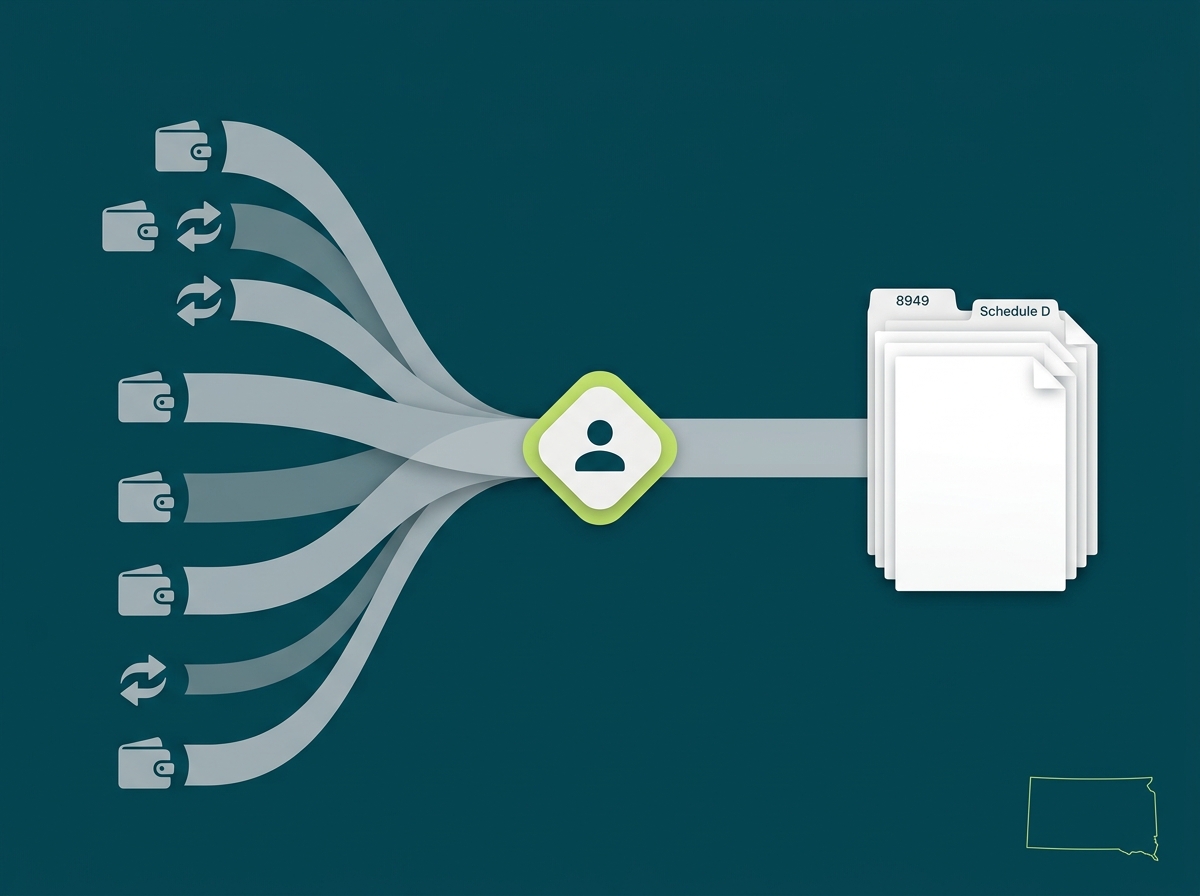
No state income tax in South Dakota means federal accuracy is everything. We produce CPA-ready 8949, Schedule D, and Schedule 1 inputs for Sioux Falls and Rapid City investors.
Former Big 4 + CPA leadershipCrypto native, blockchain expertsServing South Dakota
Keep your CPA. We do the crypto. · By the Count On Sheep team · Reviewed September 2026
Serving all of South Dakota
What you getForm 8949Schedule DSchedule 1
Featured In
SD
Key Facts
Key Facts About Crypto Tax Service in South Dakota
South Dakota has no state income tax, federal is the whole game. The state's trust-friendly law also makes it a hub for digital-asset trust structures, which adds entity-level crypto tax work.
01South Dakota has no state income tax, crypto gains are taxed only at the federal level.
02Federal reporting still requires Form 8949, Schedule D, and the digital-asset question on Form 1040.
03SD's trust-friendly law makes the state a hub for digital-asset trust structures.
04Trust-level crypto tax work requires per-trust wallet attribution and clean separation from personal activity.
05Count On Sheep produces CPA-ready 8949 and Schedule D inputs, your CPA files.
The Problem. How We Solve It.
Crypto tax software gives you data. We make it filing-ready.
Before you file yourself or hand anything to a CPA, the crypto activity has to be reconciled. That is how South Dakota investors avoid duplicate disposals, unsupported basis, overstated gains, and preventable tax. Clean records improve accuracy, preserve legitimate deductions and losses, and let you reconcile each 1099-DA against the complete transaction history.
The problem
Raw exports are not a tax return.
Exchange exports leave transfers, fees, and missing cost basis unresolved.
DeFi, staking, NFTs, bridges, and wallet-to-wallet moves rarely arrive filing-ready.
1099-DA reports can show proceeds without the complete basis history needed to calculate the right gain or loss.
What you receive
The inputs required to finish your crypto taxes.
A reconciled transaction ledger across every wallet, exchange, chain, and protocol.
Completed Form 8949 inputs and Schedule D totals for capital gains and losses.
Schedule 1 inputs for applicable crypto income, plus payment-income workpapers your tax preparer can classify correctly.
Real Stories, Real Results
What Our Clients Say
Reputation is everything! See what our clients are saying about our service and team.
★★★★★
"This team is a life saver. They are professional, communicate very fast and are pleasant to deal with."
Chris ChambersGoogle Review
★★★★★
"Matt was professional, thorough, timely and had a great understanding of my situation."
Jo JustusGoogle Review
★★★★★
"Reconciled all my previous years and set me up for a clean slate moving forward. Very thorough and transparent."
Jon AbramsGoogle Review
Book a Meeting
Talk with a crypto tax service specialist.
Choose a free scoping call or a paid consultation with a former Big Four auditor. We will review your South Dakota crypto tax situation and map the cleanest path to filing-ready records.
Free scoping call or paid consult with a former Big Four auditor
Written quote first scope reviewed before any work begins
Video meetings secure document sharing and read-only access
Serving South Dakota
From Sioux Falls to every metro in South Dakota
South Dakota crypto investors in Sioux Falls, Rapid City, Aberdeen and surrounding metros throughout the state.
South Dakota residents in Sioux Falls, Rapid City, and Aberdeen pay no state income tax, but the state's trust-friendly law makes it a hub for digital-asset trusts that need entity-level crypto tax work. We separate trust wallets from personal activity, rebuild the per-lot ledger, and hand off CPA-ready 8949, Schedule D, and Schedule 1 inputs at both layers. Count On Sheep is your crypto tax service specialist for South Dakota. Your CPA stays your CPA. We handle the crypto, they file the federal return.
Statewide · secure video meetings
Why Count On Sheep
Keep your CPA. We do the crypto.
Your CPA handles your business return, your W-2, your K-1s, your real estate. We are the crypto tax service specialists who handle the wallet, exchange, and DeFi side, for South Dakota residents and beyond.
01
Former Big 4 + CPA leadership
Our team came up inside Big 4 firms and CPA leadership roles, then went deep into crypto. Same audit-grade discipline that ran public-company engagements, applied to your wallet history.
02
USA-based, hands-on team
A senior crypto tax service specialist reviews every engagement. No offshore data-entry pipeline, no automated black box. Every edge case, basis split, and DeFi classification is handled by humans here.
03
We stay in our lane
We don't file your taxes. We don't replace your CPA. We do the part most CPAs and most software can't, the crypto. Then your CPA files, or you file with TurboTax.
Applies to every South Dakota resident, on top of the state layer above.
Event
Federal treatment
Selling crypto for USD
Capital gain (short or long-term)
Crypto-to-crypto swapCommonly missed
Capital gain on both legs
Mining income
Ordinary income at FMV on receipt; basis for later sale
Staking rewards
Ordinary income at FMV on receipt
Airdrop received
Ordinary income at FMV on receipt
NFT sale
Capital gain (collectible rules may apply for some)
DeFi yield / LP rewards
Ordinary income at FMV on receipt
Reportable on Form 8949, Schedule D, Schedule 1 (or Schedule C for mining as a trade or business). Count On Sheep produces these inputs from your complete on-chain history.
Federal Crypto Tax & Trusts
South Dakota Crypto Tax Service: Federal-Only Reporting
South Dakota's lack of a state income tax means digital asset accounting focuses on federal reporting. For residents across the state, every crypto transaction requires correct documentation for the IRS. The state's trust laws also make it a hub for digital asset trust structures, adding entity-level accounting complexities. The core task remains building a complete and defensible federal record from transactions across exchanges, wallets, and legal entities.
01
Federal is the entire picture for South Dakota crypto taxes
For South Dakota, the record question is federal Form 8949 and income records. Count On Sheep documents transaction dates, quantities, basis support, income inputs, and unresolved records. South Dakota Department of Revenue: Individuals instructions and the taxpayer's CPA control the state treatment and complete return.
This federal-only environment means accurate transaction history is important. The IRS receives reports from major exchanges, but these reports often have incomplete cost basis information, especially for assets moved from self-custody or other platforms. Our service focuses on this challenge. We perform a full Digital Asset Reconciliation, abbreviated as DAR after its first use, to build a complete ledger that substantiates the numbers you report on your federal return. This process creates the workpapers your CPA needs to support your Form 1040 filing.
02
Digital asset trusts and entity-level reconciliation
South Dakota is a leading jurisdiction for trust formation, including trusts designed to hold digital assets. When crypto is held within a trust, its transaction history must be carefully separated from the personal holdings of the grantor or beneficiaries. This requires dedicated, entity-level DAR. Each wallet and account must be attributed to the correct owner, the trust or the individual, before any tax calculations are performed. Commingling assets can create accounting challenges.
Our process documents the trust's activity, rebuilding its standalone transaction ledger. We trace every contribution, trade, and distribution to ensure the trust's Form 8949 and Schedule D inputs are based solely on its own history. This clear separation helps your CPA or trust administrator prepare the trust's tax filings and K-1s, respecting the legal and financial boundaries of the entity structure.
03
From raw data to CPA-ready workpapers
The practical South Dakota task is to document federal Form 8949 and income records without inferring a state conclusion from wallet activity. DAR supplies the transaction chronology and supporting workpapers. The taxpayer's CPA applies current authority guidance to the full return.
The final output is not a filed tax return, but the critical inputs your CPA requires. We deliver CPA-ready Form 8949, Schedule D, and Schedule 1 (for income like staking or mining rewards) inputs and the supporting workpapers that detail every step of our analysis. Count On Sheep is not a CPA firm and does not prepare or file returns. We specialize in digital asset accounting, providing your tax professional with the evidence for your federal return.
04
An illustration of an asset path reconciliation
To understand how this works, consider a purely illustrative example. An individual in South Dakota establishes a trust and funds it by sending 5 BTC from a personal hardware wallet to a new wallet controlled by the trust's administrator. Later, the trust sells 1 BTC on an exchange. Our reconciliation process documents these steps. First, we record the non-taxable transfer from the personal wallet to the trust wallet, preserving the original cost basis of the 5 BTC. Second, when the 1 BTC is sold, we use the correct basis from the original acquisition to calculate the capital gain for the trust.
This detailed tracking prevents common errors, such as treating the transfer as a sale or using an incorrect cost basis. The CPA receives a clear report showing the asset's journey and the evidence supporting the trust's ownership at the time of the sale. The final tax determination and legal treatment are decided by your CPA or attorney, based on the complete and accurate transaction history we provide.
05
The role of official guidance in federal reporting
The primary authority for crypto tax rules is the IRS. The IRS has issued specific guidance treating virtual currency as property, which is the foundation for how it is taxed. All our reconciliation work adheres to these federal standards, ensuring the records we produce are built for IRS scrutiny. We track long-term versus short-term gains, account for different lot-closing methodologies, and document income from staking and other rewards according to federal guidelines.
The final authority on your tax return is always your CPA, who interprets your specific financial situation in the context of current federal tax law. Our role is to provide an accurate transaction record so those interpretations can be made from a clear position. We focus on the evidence, so your tax professional can focus on the filing.
06
Solving for incomplete exchange and 1099-DA reports
One common challenge is the Form 1099-DA. While helpful, these forms from brokers often show an incomplete picture, particularly with missing cost basis for assets transferred in. Relying solely on these forms can lead to incorrect tax calculations if basis is missing. Our DAR process goes beyond any single 1099, incorporating data from every source to establish the most accurate basis possible for every asset.
We piece together the history from self-custody wallets, defunct exchanges, and multiple active platforms to fill in the gaps. This complete approach ensures that the Form 8949 we produce for your CPA is a true and complete record, not just a reflection of one broker's limited view. By reconciling your entire history, we help ensure accurate tax reporting.
07
Common scenarios for South Dakota residents
We frequently work with two primary types of clients in South Dakota. The first is individuals reporting crypto for the first time, often with a multi-year backlog of transactions that need to be untangled. The second is individuals or families utilizing South Dakota's trust laws, who need to establish clean, separate accounting for digital assets held within those trusts. In both cases, the core need is the same: a thorough reconstruction of the transaction history to support accurate federal tax reporting.
Whether you are catching up on past years or setting up a new trust correctly from the start, the foundational work is Digital Asset Reconciliation. It creates the foundational record for all subsequent tax work, providing a clear and defensible record of every transaction. All meetings are conducted by video conference, providing convenient access to our reconciliation service from anywhere in the state.
08
A South Dakota address does not close the residency file
South Dakota does not levy an individual income tax, but a move to the state does not erase the period when another state may have treated you as a resident. For a sale near the move date, assemble closing statements, leases, travel records, driver license dates, voter registration, and the date each household member relocated. Those facts belong beside the crypto disposal timestamp, because the blockchain can prove when units moved but cannot establish where the owner was domiciled.
Count On Sheep builds the transaction side of that chronology through Digital Asset Reconciliation. We identify the acquired lot, follow it through owned wallets, and document the exact disposal time and proceeds. Your CPA or attorney combines that ledger with independent residency evidence and decides which jurisdiction, if any, can tax the event. We do not decide domicile, prepare the return, or provide tax advice. The handoff includes CPA-ready Form 8949, Schedule D, and Schedule 1 inputs where applicable.
09
Trust accounting starts with authority, not wallet labels
A wallet named after a South Dakota trust is not proof that every asset inside it belongs to the trust. The stronger record begins with the trust instrument, custody agreement, contribution documents, distribution notices, and any direction issued by an investment adviser or distribution adviser. Add the dates when keys changed hands and the people authorized to approve multisignature transactions. That packet lets the accounting follow legal control and documented intent instead of relying on an exchange nickname or a spreadsheet tag.
During reconciliation, Count On Sheep maps each supported contribution, purchase, transfer, sale, and distribution to the appropriate ledger. Items with incomplete authority records remain flagged rather than being forced into a personal or trust account. The trustee, attorney, and CPA make the ownership and return decisions from the governing documents. Our role is narrower: create traceable digital asset workpapers and form-ready transaction inputs without preparing trust returns, K-1s, or an individual's federal filing.
10
Work performed outside South Dakota needs a second calendar
A South Dakota resident may spend part of the year consulting, speaking, or completing project work in a state that taxes nonresident income. If payment arrives in tokens, the wallet timestamp shows receipt but not where the services were performed. Preserve contracts, invoices, work calendars, travel records, and payer statements alongside the on-chain transaction. Another state may ask about source income even though South Dakota itself has no individual income tax, so location evidence should not be reconstructed months after filing season begins.
The reconciliation file should separate three facts: when the service was completed, when the recipient gained control of the tokens, and when those tokens were later sold or exchanged. Count On Sheep documents the digital asset events and unresolved gaps. A CPA determines sourcing, character, and any nonresident return requirement. This division prevents a zero-tax home state from becoming a shortcut that hides work performed elsewhere, while still keeping the federal Form 8949, Schedule D, and Schedule 1 inputs tied to the same verified history.
Your South Dakota crypto tax checklist
Gather all transaction reports (CSVs) from every crypto exchange you have used.
List all public addresses for your personal and self-custody wallets.
Provide any operating agreements for trusts or entities holding digital assets.
Identify all wallets and accounts belonging to the trust, separate from personal ones.
Collect records of any crypto income from staking, mining, or airdrops.
Note any assets with a known but unsupported cost basis for manual reconstruction.
Common Issues
What we untangle for South Dakota crypto investors
Pattern 01
Missing or incomplete cost basis
Exchanges lose data, wallets get abandoned, chain history fragments. Reconstructing accurate cost basis across years of trading is the largest source of error on a crypto return.
Pattern 02
DeFi and cross-chain complexity
Liquidity pool entries, yield farming, cross-chain bridges, wrapped tokens, restaking. Each creates taxable moments most consumer software misses or misclassifies.
Pattern 03
Unreported prior-year activity
Many crypto investors discover years of unreported trades after receiving an IRS letter. Back-year reconstruction and voluntary disclosure planning is part of what we deliver.
South Dakota pattern 01
South Dakota dynasty trusts holding digital assets, entity-level basis tracking required
South Dakota pattern 02
First-time multi-year crypto tax work for residents with no prior crypto reporting
Primary Sources
Authorities used for this South Dakota crypto tax guide
Reviewed September 2026. These first-party resources support the general federal and state information on this page. Your CPA applies the current instructions to your return; Count On Sheep supplies the reconciled crypto records and form-ready inputs.
Review the Form 8949, Schedule D, income, cost-basis, and supporting workpapers delivered after reconciliation.
How it Works
Four steps, start to finish
From anywhere in South Dakota.
01
Connect
You connect read-only access to your exchanges and share wallet addresses. CSV exports work too.
02
Reconcile
We pull and reconcile every wallet, exchange, and DeFi interaction into one ledger with cost basis, holding period, and proceeds per lot.
03
Specialist Review
A senior crypto tax service specialist reviews edge cases. Manual basis splits, DeFi classifications, bridge events, restaking, NFTs.
04
CPA-Ready Reports
You get CPA-ready Form 8949, Schedule D, Schedule 1 inputs (and Schedule C for mining), plus full workpapers. Hand to your CPA, or load into TurboTax.
FAQ
Common questions, South Dakota edition
What does a crypto tax service do for a South Dakota investor?
For South Dakota, Count On Sheep performs Digital Asset Reconciliation. We rebuild exchange, wallet, broker, and DeFi activity into CPA-ready Form 8949, Schedule D, and Schedule 1 inputs. The South Dakota CPA or the taxpayer's self-filing workflow handles the return itself.
Does Count On Sheep file the South Dakota tax return?
No. Count On Sheep is not a CPA firm and does not prepare or file the South Dakota return. We deliver the reconciled crypto schedules and supporting workpapers. The South Dakota return preparer combines those records with wages, businesses, deductions, elections, residence facts, and every other part of the filing.
Why does federal Form 8949 and income records matter in South Dakota?
Federal Form 8949 and income records can change which source records a South Dakota CPA needs. Count On Sheep traces the relevant South Dakota transactions, preserves dates and ownership, and documents unsupported items rather than assigning a state tax conclusion without evidence.
Which records support entity or trust custody separated from personal activity for South Dakota?
A South Dakota review of entity or trust custody separated from personal activity can require exchange exports, public wallet addresses, transaction identifiers, prior Form 8949 files, broker statements, and documents that explain ownership or purpose. Count On Sheep organizes the South Dakota crypto evidence and flags anything the CPA must resolve.
How should a Form 1099-DA with missing basis be handled in South Dakota?
The South Dakota broker proceeds still need to be reconciled to the full ownership history. Count On Sheep traces assets through prior exchanges and self-custody, supports available basis and acquisition dates, and prepares a South Dakota workpaper that connects the broker form to Form 8949 inputs.
What does the South Dakota CPA-ready package contain?
The South Dakota package contains transaction-level disposition detail, Schedule D summaries, digital-asset income inputs, transfer matching, closing lots, broker-form reconciliation, and documented exceptions. Each material South Dakota number is tied to a source record or a clearly stated assumption.
How do South Dakota clients meet with Count On Sheep?
South Dakota meetings are held by video conference, which keeps scheduling fast for both sides. Documents move through a secure portal and are reviewed together on screen, so the full engagement happens without a trip to an office.
Can my CPA use your reports?
Yes. That is exactly the point. Our deliverable drops directly into the workflow your CPA already uses. Schedule D totals, 8949 detail, Schedule 1 inputs for staking and airdrops, and reconciliation workpapers behind every number.
Does this work with TurboTax?
Yes. If you self-file, the Count On Sheep deliverable plugs into TurboTax. You enter the 8949 totals (or import where supported), and our workpapers back up every line if you ever need to defend it.
What do I need to start?
Exchange account access or CSV exports, wallet addresses for every chain you have transacted on, any prior-year tax returns that touched crypto, and a brief on your DeFi activity. We scope South Dakota engagements from there.
How is the engagement priced?
Book a meeting to walk us through your account. We will review the scope and provide a written quote before any work begins.
About the team
About the Count On Sheep team
Former Big 4CPA leadershipCrypto native
Count On Sheep is a USA-based team of crypto tax service specialists. Former Big 4 accountants and CPA leadership, now crypto-native blockchain tax experts. We do hands-on crypto tax work for high-volume investors, funds, founders, and active traders, including South Dakota residents from Sioux Falls, Rapid City, Aberdeen and beyond.
We don't file taxes. We don't replace your CPA. Most CPAs don't do crypto, that's the gap we fill. We bridge DeFi and TradFi to produce the 8949, Schedule D, and Schedule 1 inputs your CPA can drop into your return.