
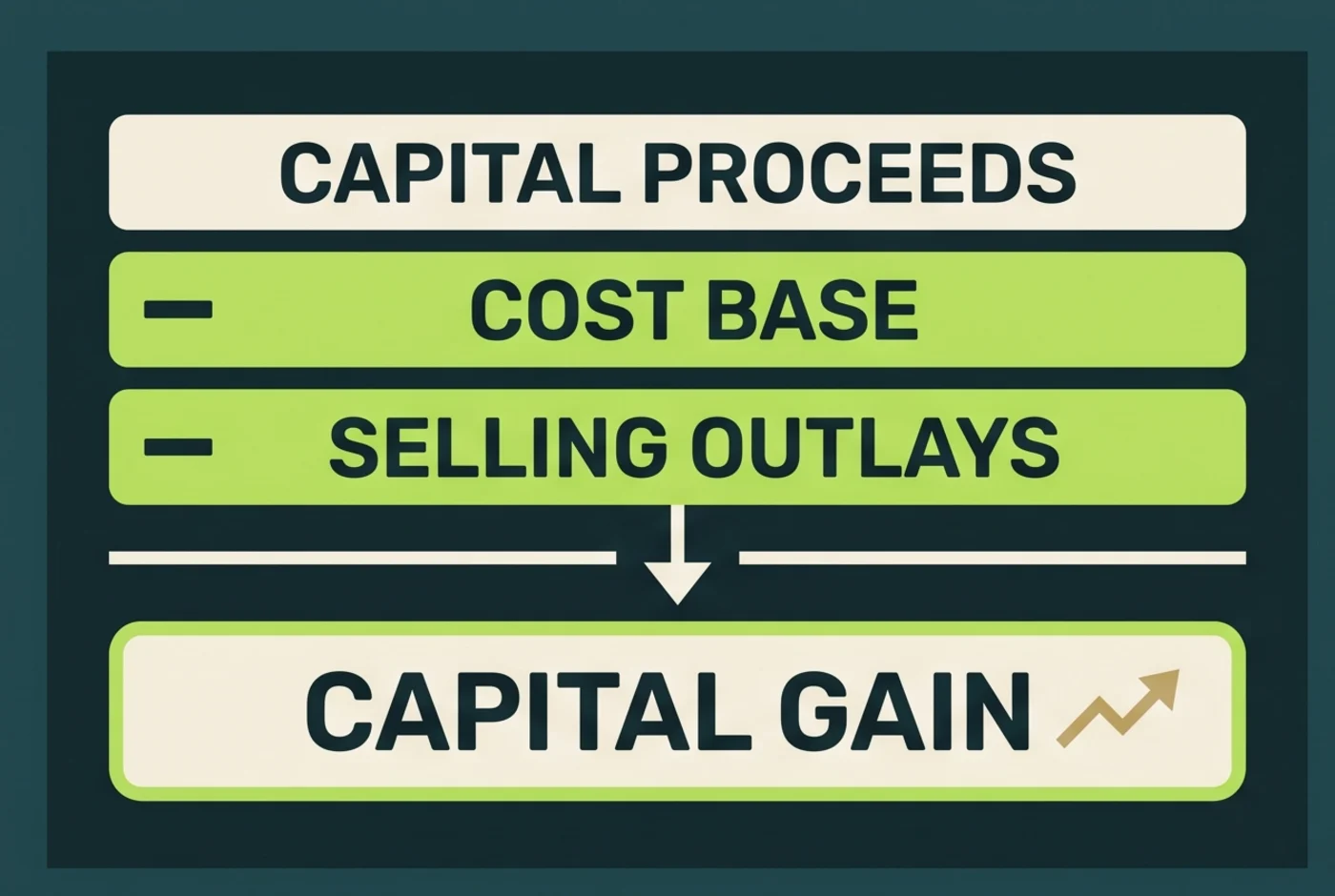
Capital gain = capital proceeds - cost base - eligible selling outlays.
The calculation starts by deciding whether the asset was an investment or trading stock. Each event must be valued in AUD. Capital losses are applied before any 50% CGT discount. A page-level estimate cannot determine final tax payable without the rest of the return.
Last reviewed 27 July 2026. Critical rules checked against current ATO, Treasury and legislation.gov.au sources.
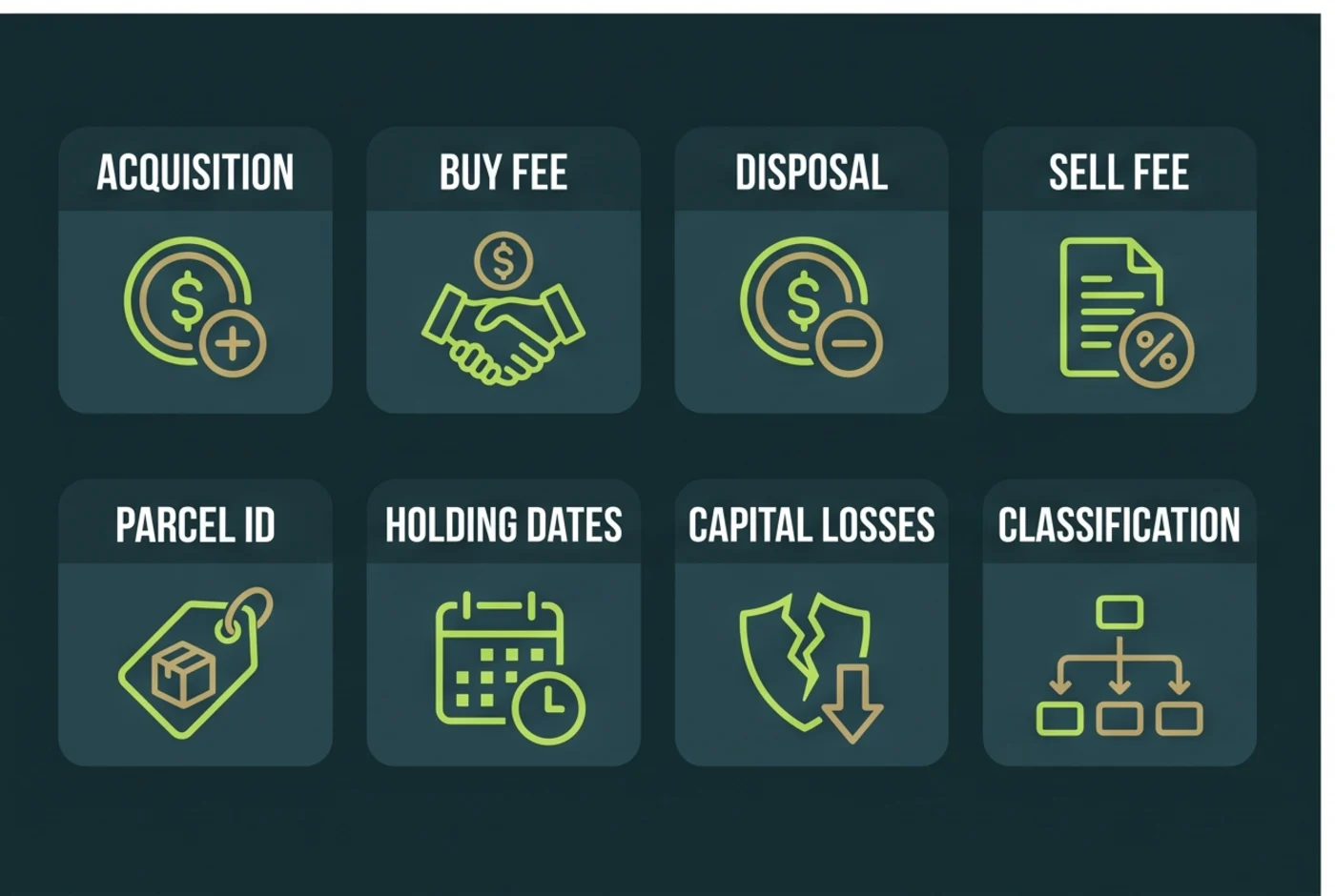
Inputs for an Australian crypto tax calculation
| Input | Source | AUD timing | Common error |
|---|---|---|---|
| Acquisition amount | Trade confirmation or on-chain swap | Time acquired | Using token quantity without AUD value |
| Acquisition fee | Exchange fee or transaction record | Time paid | Adding a fee already included |
| Disposal value | Sale, swap or market-value evidence | Time disposed | Using bank withdrawal amount |
| Selling fee | Exchange or protocol record | Time paid | Counting the fee twice |
| Parcel ID | Lot, wallet and transaction history | Specific units disposed | Choosing a method after seeing the result |
| Holding dates | Acquisition and disposal timestamps | Exact ownership period | Assuming one year means at least 12 months |
| Capital losses | Current and prior-year schedules | Apply before discount | Offsetting salary or income rewards |
| Classification | Full activity and ATO business indicia | Before the calculation | Treating every active user as an investor |
Capital-gain worksheet
This worksheet illustrates an investment CGT calculation. It does not classify the activity, identify the disposed parcel, test every discount condition, apply the rest of the tax return, include the Medicare levy, or calculate final tax payable.
How to calculate crypto tax in Australia
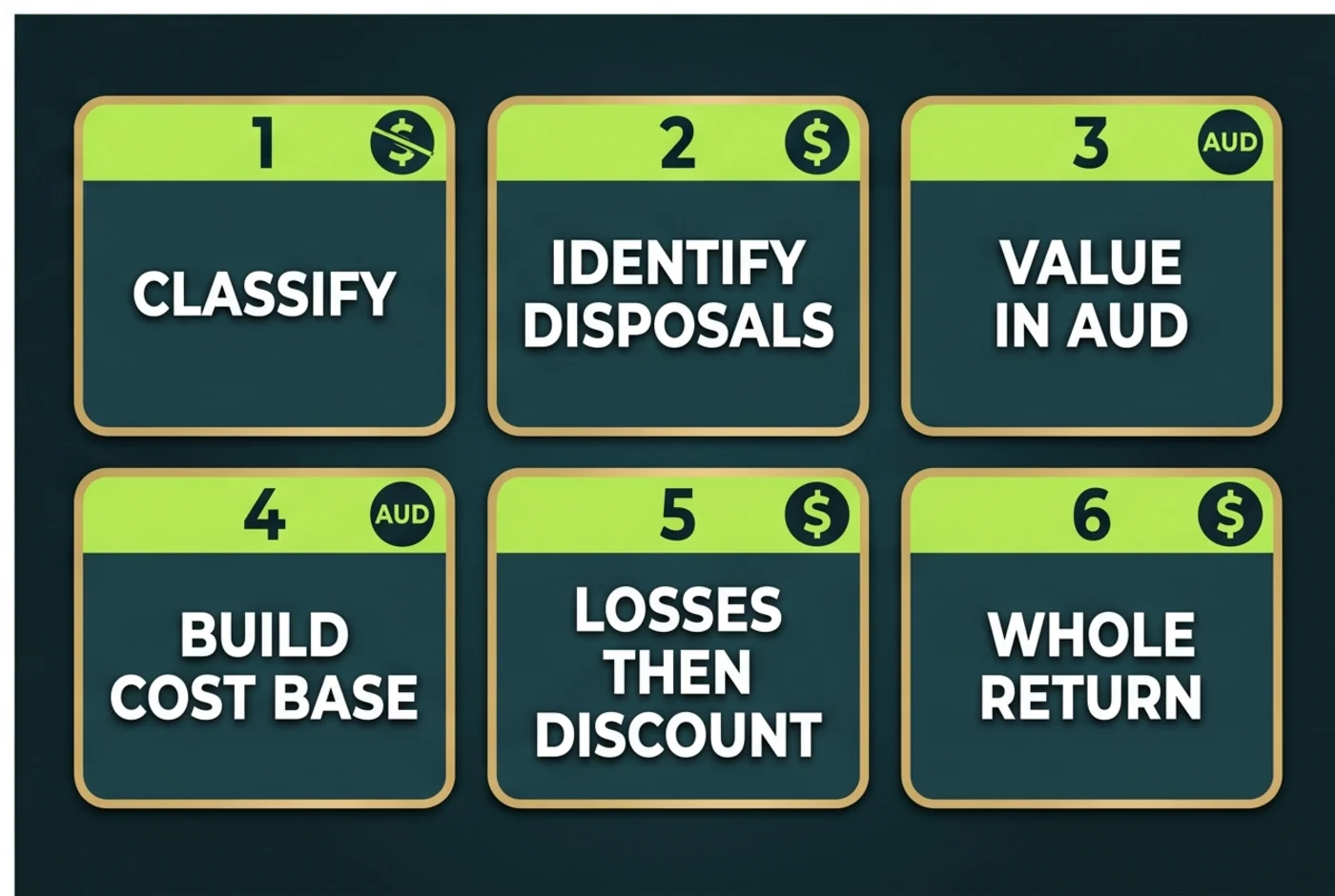
Step 1: classify investment or trading business
Decide whether the activity is on capital account or forms part of a business before treating the output as a capital gain. An investor generally holds crypto as a CGT asset. A person carrying on a crypto-trading business generally accounts for trading stock and ordinary business income. No trade count settles the answer. Review the ATO investor versus trader tests and preserve the evidence.
Step 2: identify each disposal
List sales for AUD, token swaps, purchases made with crypto, gifts and other changes of ownership. Do not count a same-owner wallet transfer as a disposal simply because an import shows a withdrawal. Separately identify fees paid in crypto, because disposal of the fee token can have its own consequence.
Step 3: translate values to AUD
Express the capital proceeds, cost-base elements and relevant fees in Australian dollars at the time of the event. Preserve the price source, market, timestamp and timezone. For a crypto-to-crypto swap, the AUD market value of the property received or disposed of is needed even when no cash is present.
Step 4: establish the cost base and parcel
Identify the actual units disposed of and build their cost base from the acquisition amount plus eligible elements. Link the lot to exchange or wallet evidence. Where the parcel cannot be supported, flag the issue for the registered tax agent rather than silently applying whichever inventory method produces the lowest gain.
Step 5: apply losses and any discount
Apply current-year capital losses and then carried-forward capital losses. Only after those reductions do you consider the 50% CGT discount for an eligible resident individual who owned the asset for at least 12 months and meets the other conditions. Trading-stock profit does not receive the discount.
Step 6: add the result to the whole-return calculation
The remaining net capital gain enters assessable income. It is not the final tax payable. Salary, other income, deductions, offsets, residency, marginal rates and the Medicare levy can change the result. The worksheet on this page isolates the CGT arithmetic so you can see that boundary.
Australian crypto CGT formula
Capital proceeds
Capital proceeds are generally the money and market value of property received for the disposal. A sale for AUD starts with the sale amount. A swap or gift may need market-value rules. Proceeds are not the amount later transferred to a bank account, and they are not automatically reduced by acquisition costs.
Five cost-base elements
The statutory cost base can contain five elements. These broadly cover acquisition money or property, eligible incidental costs, certain ownership costs, eligible capital expenditure to increase or preserve value, and certain expenditure to establish or defend title. Not every expense belongs in a crypto cost base. The first element and eligible transaction fees do most of the work in a simple exchange purchase.
Eligible acquisition and selling fees
A buy fee can form part of acquisition cost where the law allows. A selling fee can reduce the gain as an eligible incidental cost or outlay. Gas and fees paid using another token can also dispose of that token. Preserve gross trade values and fees separately so the same amount is not embedded in a net figure and then deducted again.
Why net capital gain is not tax payable
The formula calculates a gain on an event and contributes to the annual net capital gain. It does not apply the person’s marginal rate or the rest of the return. The resident AUD 18,200 tax-free threshold applies to total taxable income, not specifically to this gain. See Australian crypto tax-free rules and myths.
Worked example: one ETH purchase and sale
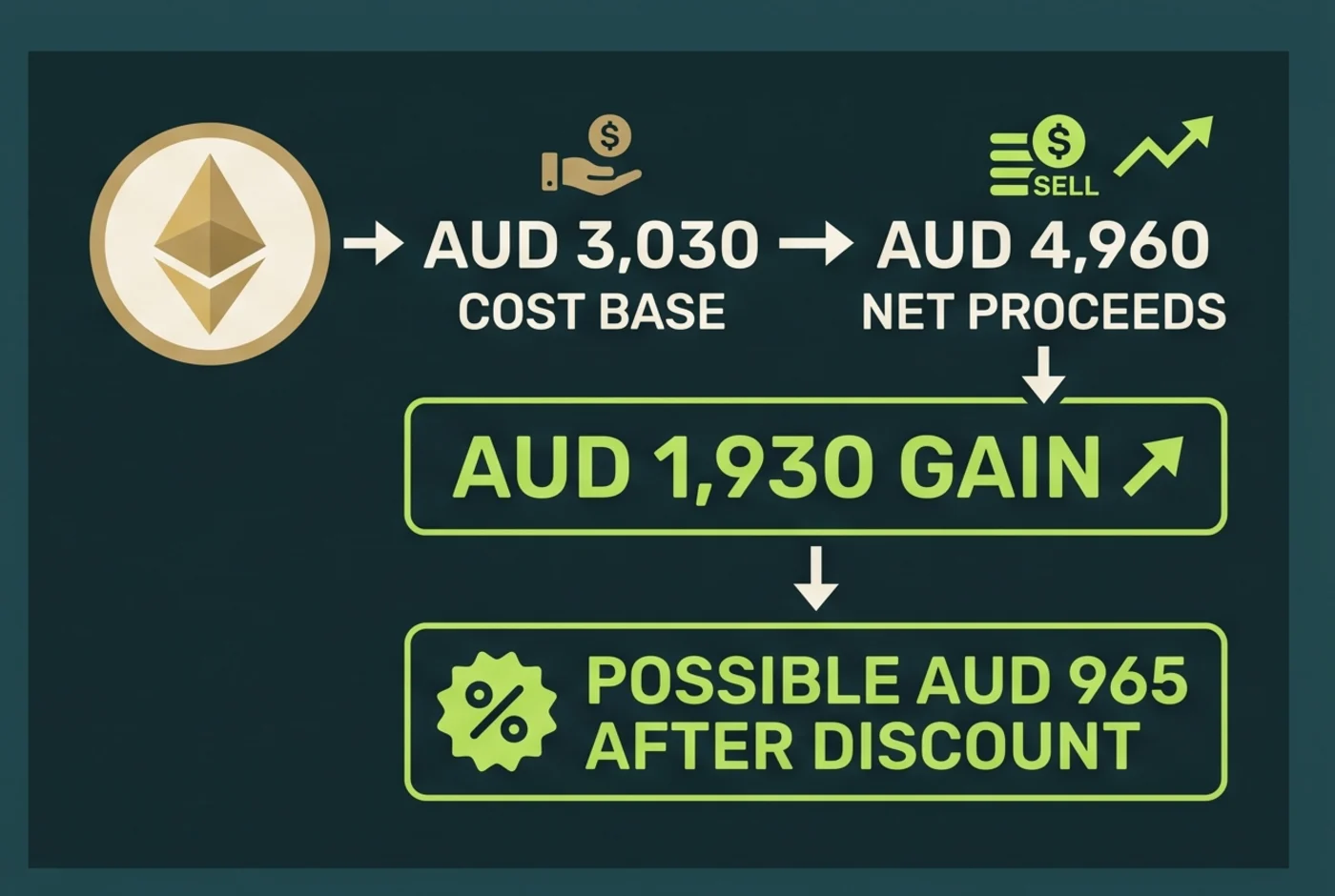
AUD 3,000 purchase plus AUD 30 fee
An investor buys one ETH for AUD 3,000 and pays a AUD 30 exchange fee. Assuming the fee is an eligible acquisition cost and is not already included in the quoted trade value, the supported cost base is AUD 3,030. Keep the confirmation showing the gross purchase, fee, timestamp and asset quantity.
AUD 5,000 sale less AUD 40 fee
The investor later sells that ETH for AUD 5,000 and pays a AUD 40 eligible selling fee. The sale proceeds and fee should remain separately visible. For the simple formula, the AUD 40 selling outlay reduces the gain.
AUD 1,930 capital gain
AUD 5,000 minus the AUD 3,030 cost base minus the AUD 40 selling outlay equals a AUD 1,930 capital gain. This assumes the actual ETH parcel is identified and there are no other cost-base adjustments. A calculator should show each input rather than presenting only the final number.
Possible AUD 965 discounted amount
If the investor is an eligible resident individual, owned the ETH for at least 12 months, has no capital losses and satisfies every other discount condition, a 50% discount could reduce the eligible amount to AUD 965. The amount enters the annual net capital gain calculation. It is not the final tax bill.
Worked example: crypto-to-crypto swap
Disposal of the asset sent
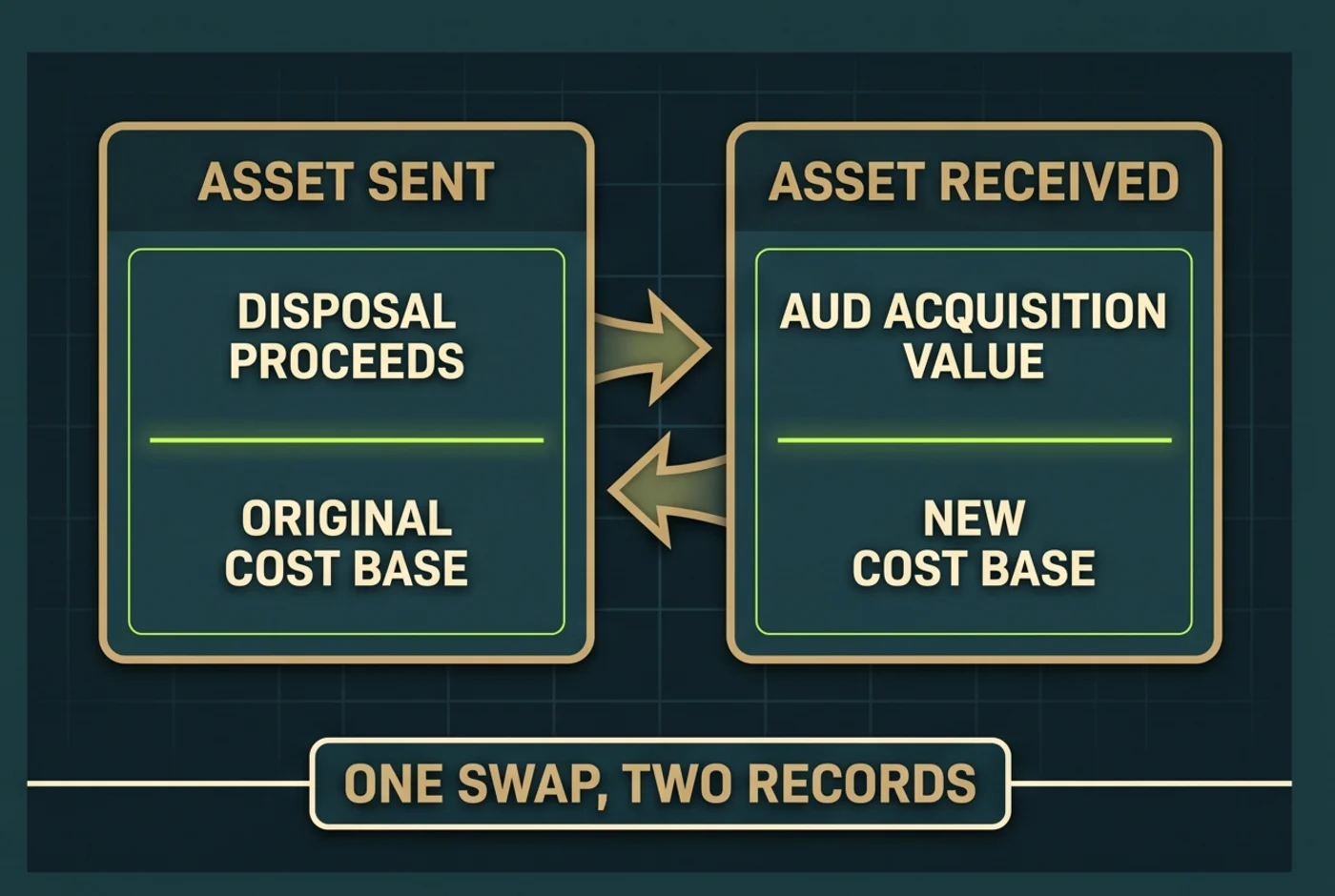
Suppose an investor sends token A and receives token B. Token A is disposed of. Calculate its gain or loss using its supported cost base and the AUD capital proceeds at the swap timestamp. The exchange may show only quantities, so an external price or market-value record may be needed.
AUD market value of the asset received
The market value of token B received can evidence proceeds for token A where appropriate. Check the actual pool or market and account for slippage rather than assuming the user-interface quote equals execution. Record the block time and the AUD conversion source.
New cost base for the asset received
The same swap also establishes an acquisition record for token B. Its acquisition amount will generally start from the AUD market value used in the exchange, subject to fees and the detailed cost-base rules. A later sale of token B needs that record, so one swap creates two linked asset schedules.
Two asset records from one swap
A robust ledger records a disposal row for token A, an acquisition row for token B and each fee token separately. It keeps a link between the rows and the source transaction. Treating the swap as a single neutral conversion loses the gain and the new basis.
Worked example: partial disposal from several parcels
Identify the actual units disposed of
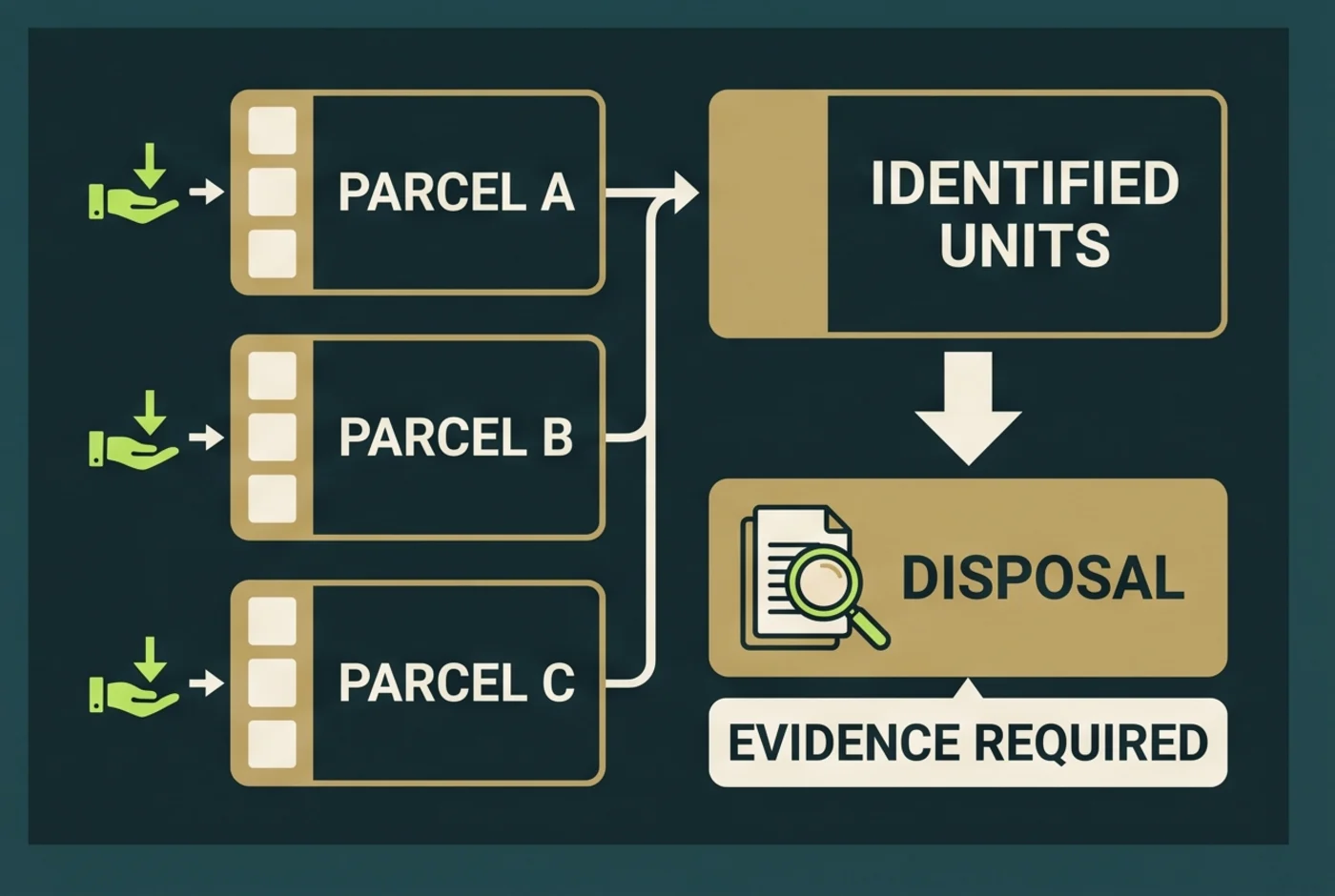
Assume an investor acquired three 0.5 BTC parcels at different times and costs, then sold 0.6 BTC. The task is not to choose the most attractive cost after the sale. It is to identify which units were disposed of using contemporaneous exchange lots, wallet movement and transaction records.
Evidence from exchange lot, wallet and transaction records
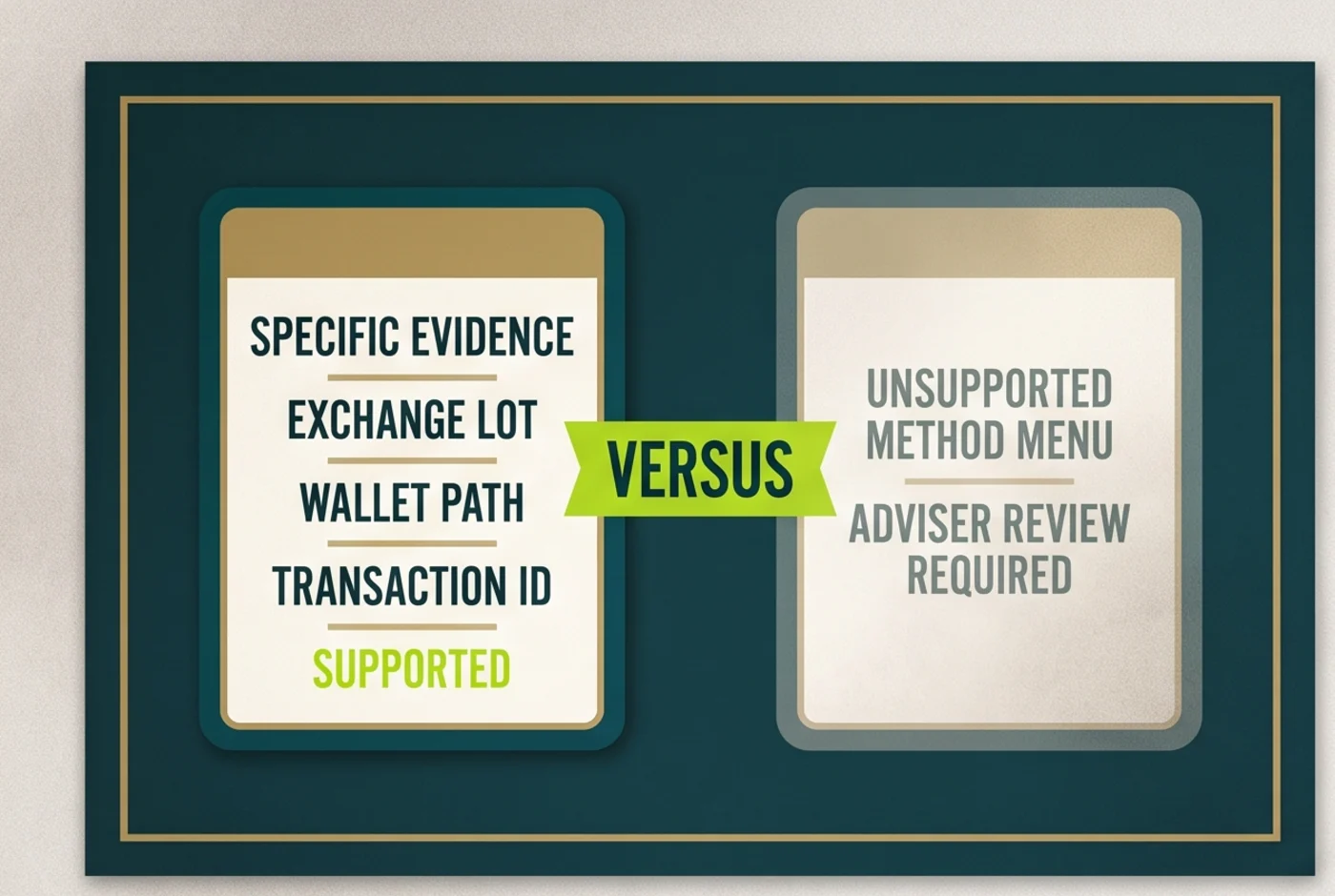
An exchange-specific lot selection, segregated wallet, transaction path or documented instruction can support parcel identity. A spreadsheet label created after the gain is known is weaker. Retain the evidence that connects the acquisition units to the disposal and explain any transfers between controlled wallets.
Why arbitrary HIFO or average-cost promises are unsafe
The ATO sources reviewed do not provide a blanket crypto ruling that makes HIFO, LIFO or average cost universally acceptable. Share guidance can discuss specific identification and FIFO where parcels cannot be identified, but it should not be converted into an unrestricted crypto method menu. Australian calculations need a defensible factual basis.
When parcel identity cannot be supported
If the source records do not identify the units, show the unresolved parcel question and calculate the material alternatives if useful. The client’s registered tax agent should determine the method that can be defended under the facts and law. Do not conceal the uncertainty in a final software total.
How capital losses and the 50% discount are ordered
Current-year losses
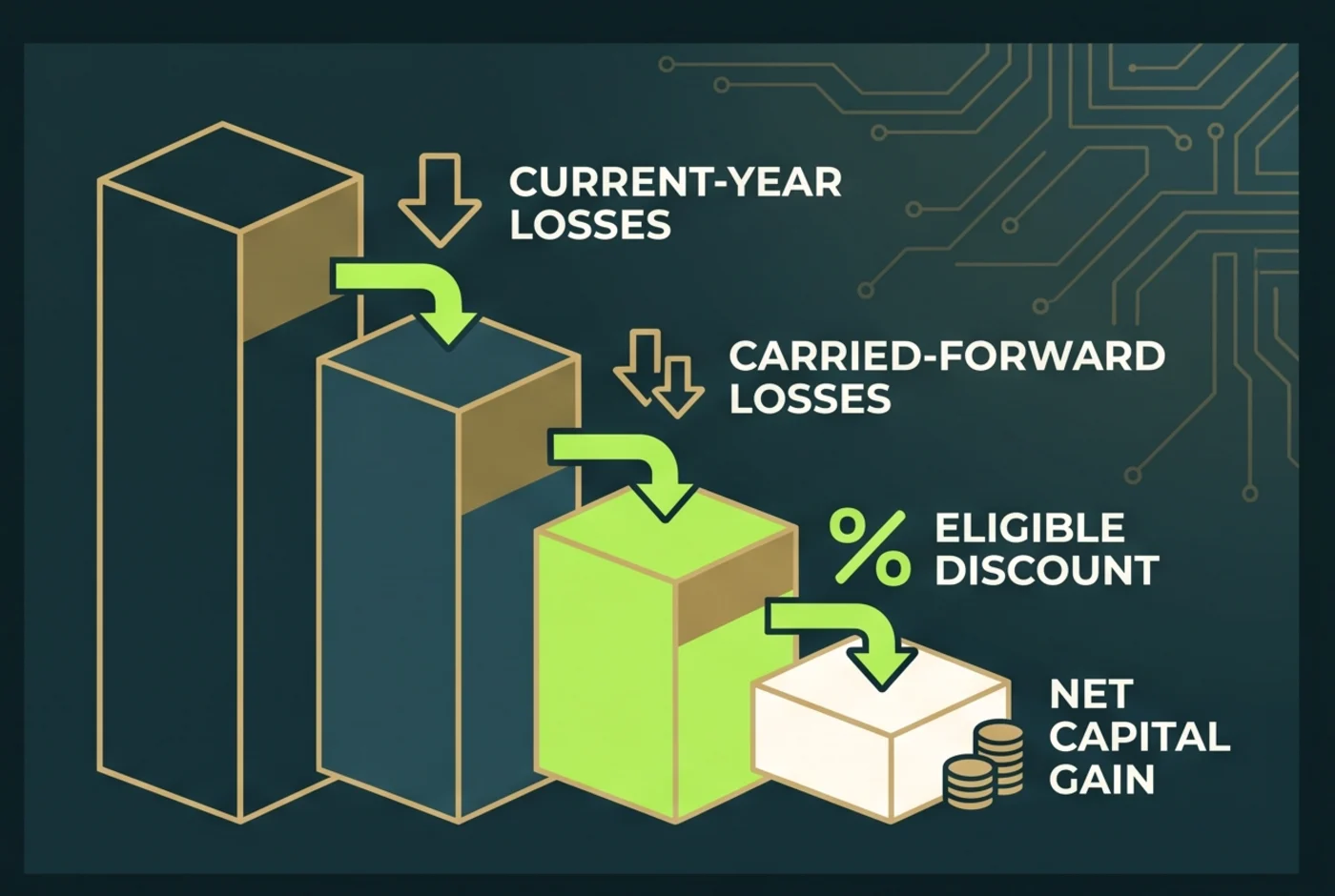
Apply current-year capital losses against current-year capital gains before the discount. Where more than one gain exists, the choice of which gains absorb losses can affect the available discount. The annual schedule should show gross gains, loss application and the remaining eligible gains.
Carried-forward losses
Next apply available net capital losses from earlier income years. Reconcile the opening balance to prior returns and show the amount used. Capital losses cannot ordinarily reduce salary or staking income, and personal-use losses are disregarded.
Discount only after eligible losses
After losses, apply the 50% discount only to gains and taxpayers that satisfy the conditions. Companies do not receive the individual discount. Trading-stock profit is outside this CGT discount sequence.
Remaining net capital gain
The remaining net capital gain enters assessable income. A calculator can show the sequence, but final tax still needs the full return. Avoid multiplying every event-level gain by 50% before applying losses, because that can reverse the statutory ordering.
How staking, airdrops and DeFi affect the calculation
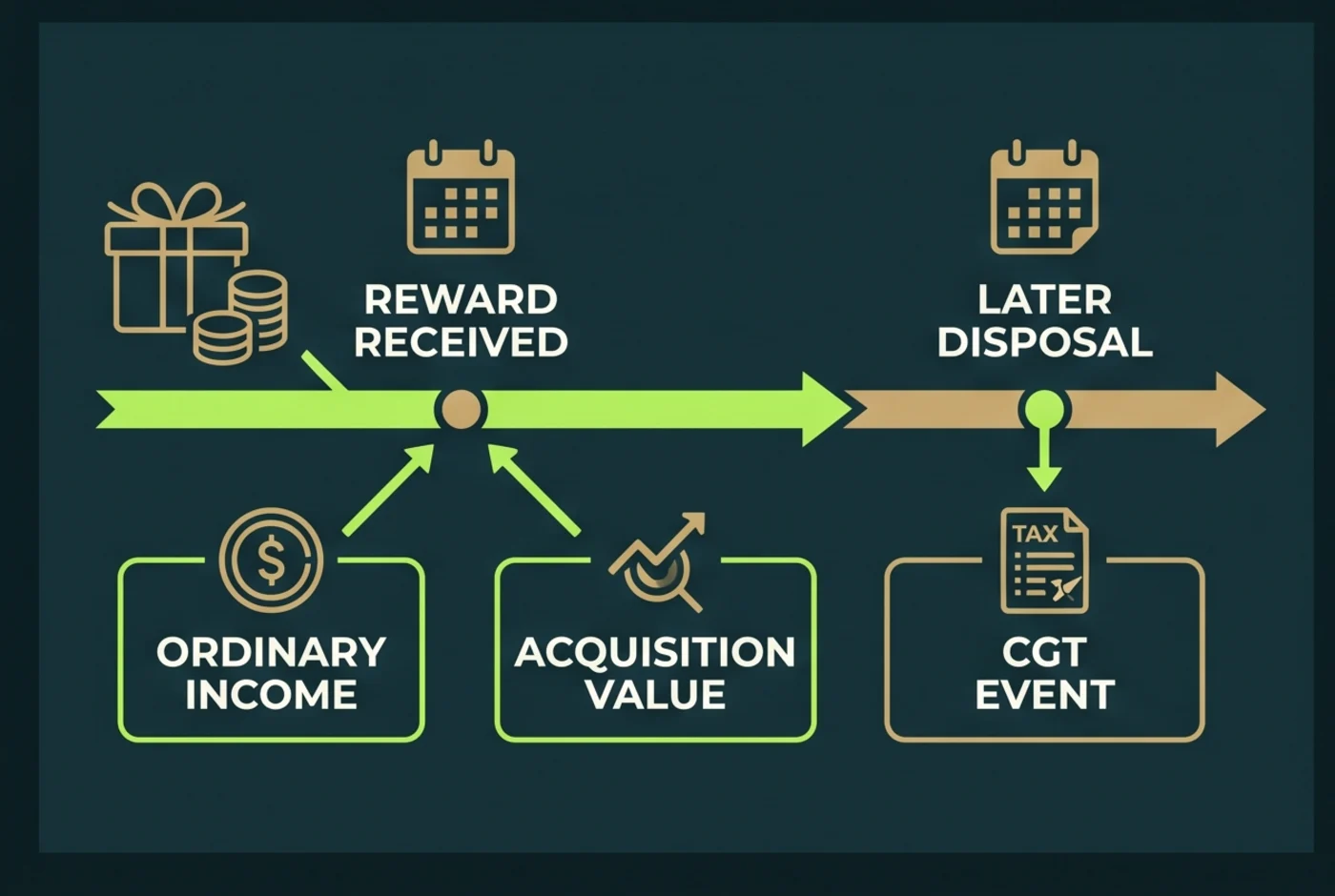
Ordinary income creates an acquisition value for later CGT
Under the ATO guidance reviewed, staking rewards and established-token airdrops outside a business are ordinary income at money value when received. That receipt also creates an asset record for a later disposal. Preserve the receipt value so the same amount is not taxed again as a capital gain.
Reward receipt and later disposal are separate calculations
A token worth AUD 400 when received can create AUD 400 of ordinary income. If it is later sold for AUD 550 and the supported cost base is AUD 400, the later CGT calculation may produce a AUD 150 gain before fees, losses or discounts. The two events belong in linked but separate schedules.
LP tokens and rights can create multiple events
The ATO says depositing into a liquidity pool can trigger CGT where an LP token or other right is received. Withdrawal can dispose of that right, and periodic rewards may be income. A calculator must model each token leg instead of netting the deposit and withdrawal as one investment return. The Australia DeFi tax guide explains the ATO positions and protocol-specific caveats.
Missing-price and locked-reward exception flags
Thin markets, spam tokens, locked rewards and rebasing assets can make receipt timing or value uncertain. Do not force a zero value or invent liquidity. Record the protocol terms, accessibility, market evidence and proposed treatment for the registered tax agent.
What a crypto calculator often gets wrong
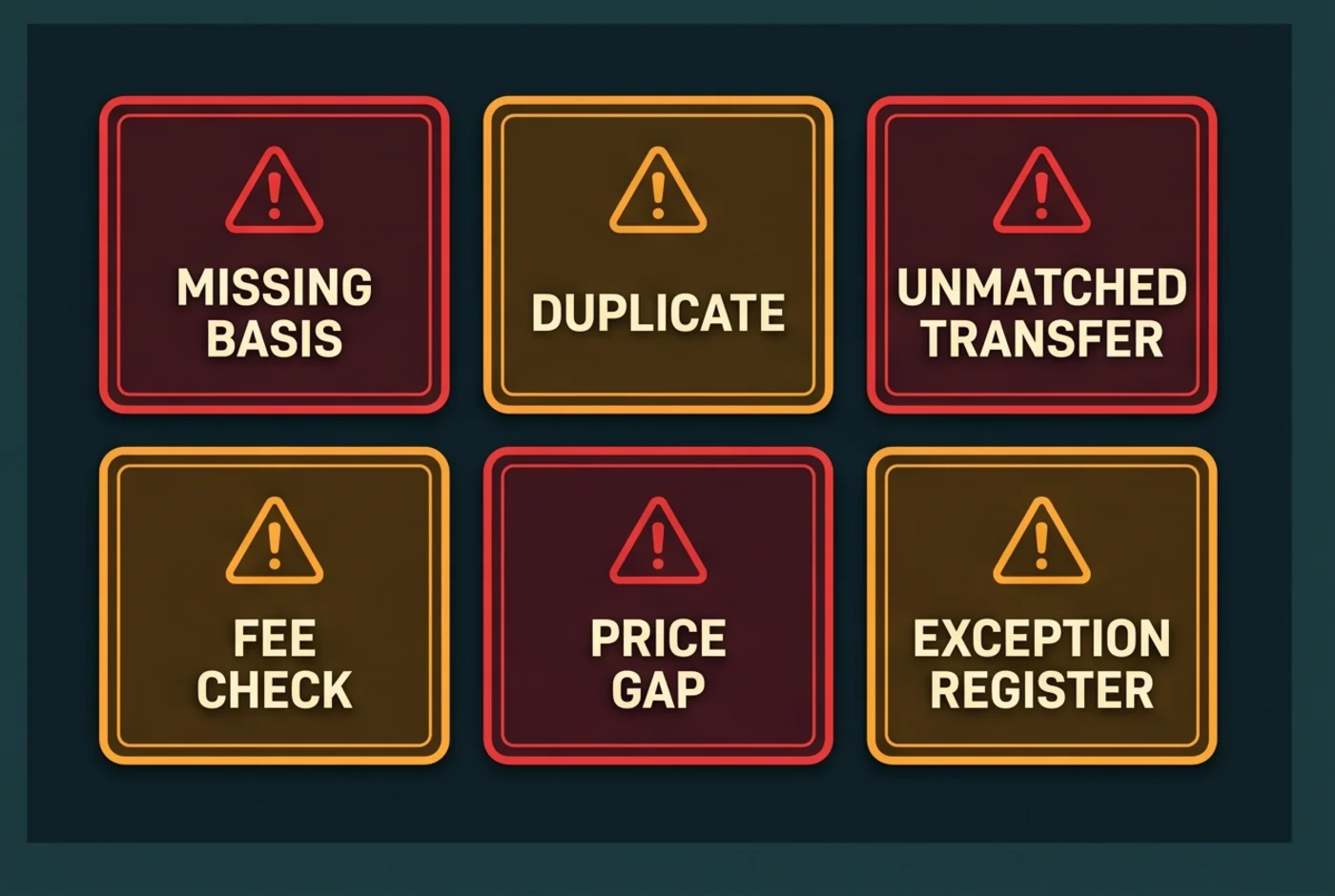
Unmatched same-owner transfers
A withdrawal and deposit across owned wallets can become a false sale and acquisition when sources are not matched. Link transaction IDs, times, quantities and addresses. Account for the network fee separately. The ATO may receive platform data, so internal consistency matters. See ATO crypto data matching.
Duplicate exchange and wallet records
One on-chain transaction can appear in an exchange export, wallet export and protocol report. Deduplicate by source identifiers and retain the relationship. Deleting duplicates without trace can make later balance reconciliation impossible.
Missing historical cost base
An imported deposit often arrives without acquisition history. A calculator may assign zero cost, which can overstate the gain, or ignore the disposal, which can understate it. Trace earlier exchanges and wallets. If basis remains missing, show the exposure explicitly.
Spam tokens and zero-value rows
Unsolicited tokens can create thousands of irrelevant rows. Filter them with an auditable rule, but do not assume every unfamiliar token is worthless. Retain contract addresses and evidence supporting exclusion or value.
Wrong timestamps or AUD prices
UTC, exchange-local time and Australian local time can place a transaction in different days or income years. A volatile token can also move sharply within a day. Use event timestamps and preserve the conversion source rather than applying one annual or daily estimate indiscriminately.
Fees counted twice
Some exports show net proceeds while also listing a fee. Others show gross proceeds and a separate fee. Normalise the source convention before calculating. A fee paid in a different crypto asset needs its own disposal record as well as possible treatment in the main transaction.
From a tax-software export to defensible figures
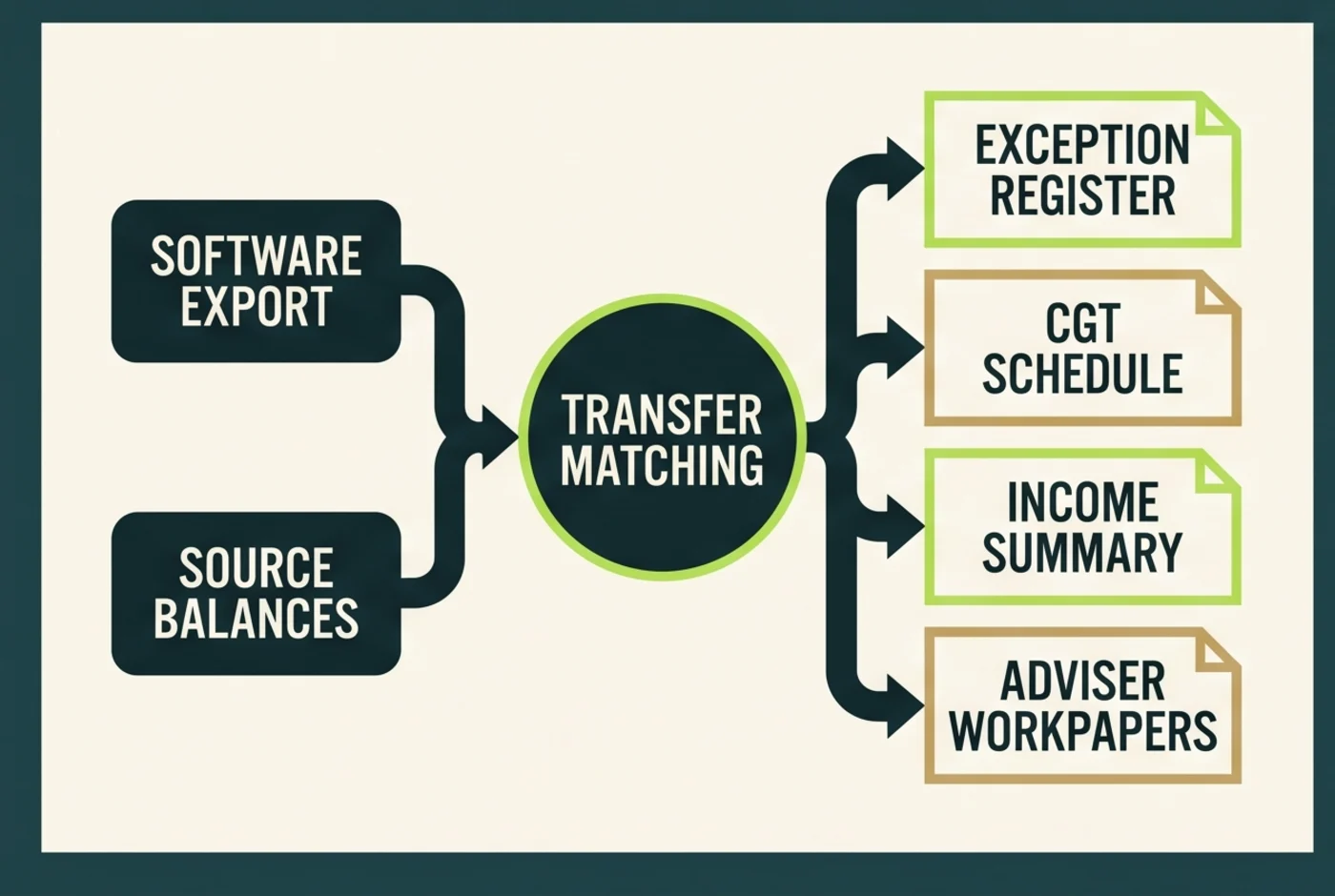
Reconcile source balances
Compare imported transactions with exchange and wallet opening and closing balances. A clean-looking report can still omit an account, token or date range. A source register documents what was obtained, its coverage and the remaining gaps.
Resolve transfer pairs
Match movements between owned addresses and platforms, including bridge and wrapped-token steps. Separate network fees and identify any change in beneficial ownership. Unmatched transfers go to an exception register with the evidence needed from the client.
Review parcel evidence and classification
Support the disposed units and their holding dates. Separately assess whether the activity may be a trading business. A polished CGT schedule is not reliable if the underlying activity belongs on ordinary-income and trading-stock schedules.
Create an exception register
List missing basis, uncertain prices, locked rewards, protocol rights, classification questions and unsupported parcel assumptions. Quantify material alternatives where possible. This gives the registered tax agent a focused decision list instead of an unexplained total.
Produce CGT and income summaries for the adviser
Count On Sheep reconciles digital-asset records into ATO-ready figures and workpapers for your own accountant or registered tax agent. We are not a registered tax agent and do not lodge Australian tax returns. The output supports the adviser’s final classifications, labels and lodgment. For the wider rules behind the calculations, read the Australia Crypto Tax Guide 2026.
Get ATO-ready figures for your own accountant or registered tax agent
Count On Sheep reconciles complex digital-asset activity into ATO-ready figures and workpapers for your own accountant or registered tax agent. Count On Sheep is not a registered tax agent and does not lodge Australian tax returns.
Reconcile my Australian crypto recordsAustralian crypto calculator FAQs
How do I calculate crypto capital gains in Australia?
Identify the disposal, value it in AUD, subtract the supported cost base of the units disposed of and eligible selling outlays, then apply capital losses and any eligible CGT discount in the correct order. The net capital gain enters the whole income-tax calculation.
Do transaction fees reduce a crypto capital gain?
Eligible acquisition and selling fees can affect cost base or the gain, depending on their character. Preserve gross trade values and fees separately so they are not counted twice. A fee paid in crypto can also create a separate disposal of the fee units.
Can I use FIFO or HIFO for Australian crypto?
The ATO sources reviewed do not provide a blanket crypto rule making FIFO, HIFO, LIFO or average cost universally acceptable. Specific parcel identification should be supported by contemporaneous exchange, wallet and transaction records. If units cannot be identified, ask the registered tax agent to choose a defensible method.
How do I calculate a crypto-to-crypto swap?
Record a disposal of the asset sent using its AUD proceeds and cost base, and a separate acquisition of the asset received using its AUD market value and relevant fees. Preserve both token legs, the timestamp, transaction ID and valuation source.
Do capital losses apply before the 50% discount?
Yes. Current-year and carried-forward capital losses are applied before an eligible CGT discount. The discount is then applied only to gains and taxpayers that satisfy the conditions. The remaining net capital gain enters assessable income.
Why is my crypto calculator missing cost base?
An exchange deposit or wallet receipt often arrives without its earlier acquisition history. Trace the asset through prior exchanges and wallets, match same-owner transfers and retrieve old exports. If the basis cannot be supported, show it as an exception rather than silently using zero or an invented figure.