
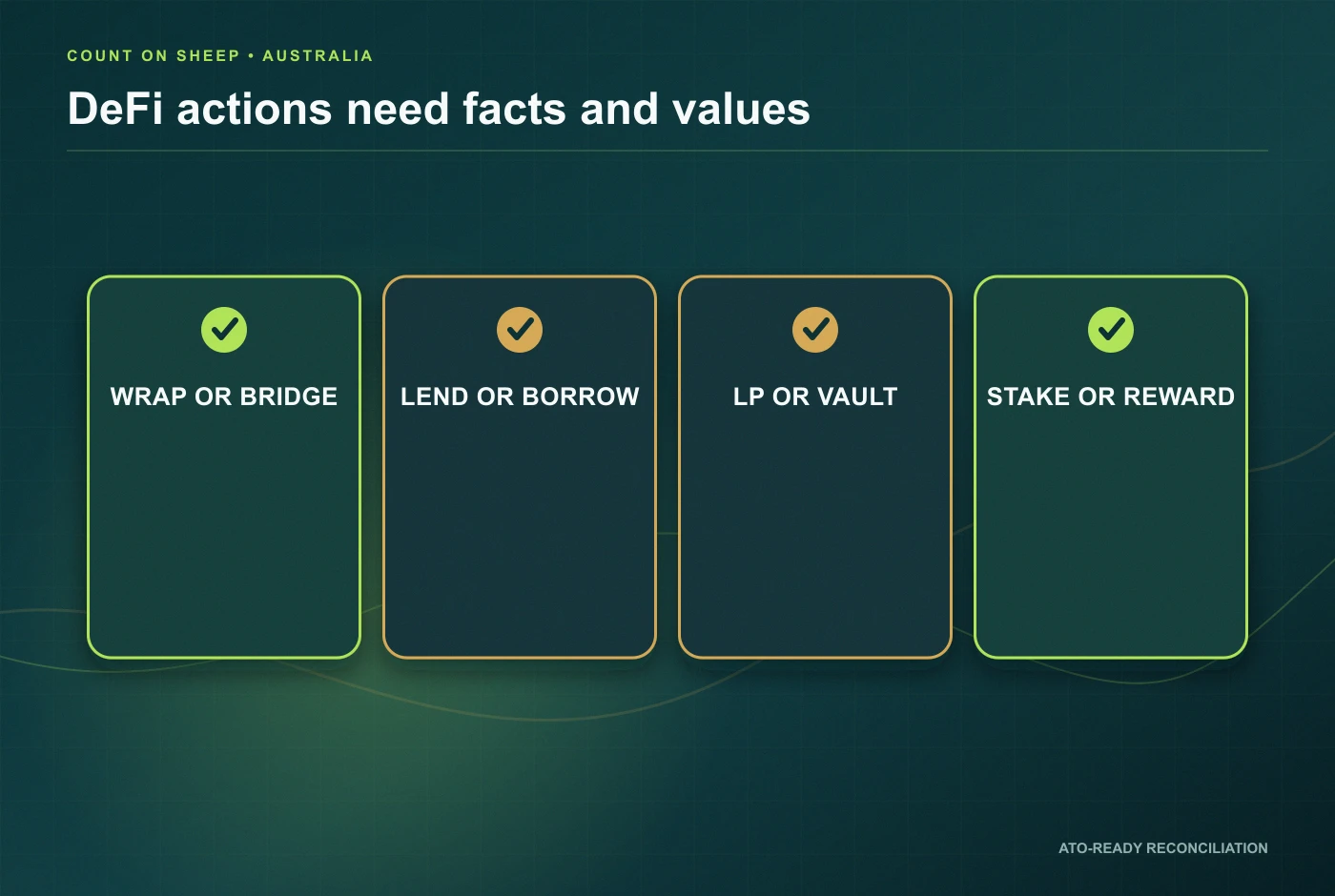
DeFi can create both CGT events and ordinary income. The ATO says wrapping and unwrapping exchange one crypto asset for another and trigger CGT. Lending and liquidity-pool deposits can also trigger CGT where beneficial ownership ends or the user receives a different token or contractual right. Rewards may be ordinary income when received. The precise event depends on the protocol’s legal terms and the rights created.
Last reviewed 27 July 2026. Critical rules checked against current ATO, Treasury and legislation.gov.au sources.
DeFi actions at a glance
| DeFi action | ATO position or main issue | Value needed | Fact to confirm |
|---|---|---|---|
| Wrap | ATO says exchange and CGT event | AUD value of wrapped token or asset disposed | Protocol asset and rights received |
| Unwrap | ATO says another exchange and CGT event | AUD value at unwrapping | Asset returned and beneficial ownership |
| Lend | CGT may arise if ownership ends or a different right is received | AUD value of asset and right | Legal terms and receipt token |
| Borrow | Borrowing itself may not be income | Collateral and liquidation values | Ownership, repayment and liquidation terms |
| LP deposit | CGT may arise when assets are exchanged for an LP token or right | AUD values of assets and LP interest | What the depositor receives |
| LP withdrawal | Disposal of LP token or right may trigger CGT | Market value of assets received | Pool redemption mechanics |
| Staking reward | Ordinary income at money value when received | AUD value at receipt | When reward is actually received |
| Bridge | Cannot be labelled uniformly | AUD values if an exchange occurs | Same asset, wrapper or new right |
| Vault | Receipt token or share can indicate an exchange | Deposit and share values | Legal and beneficial interests |
| Liquid staking | Reward income and token exchange questions can coexist | Receipt and disposal values | Claimability and token rights |
How does the ATO approach DeFi?
Start with the asset, entity and rights
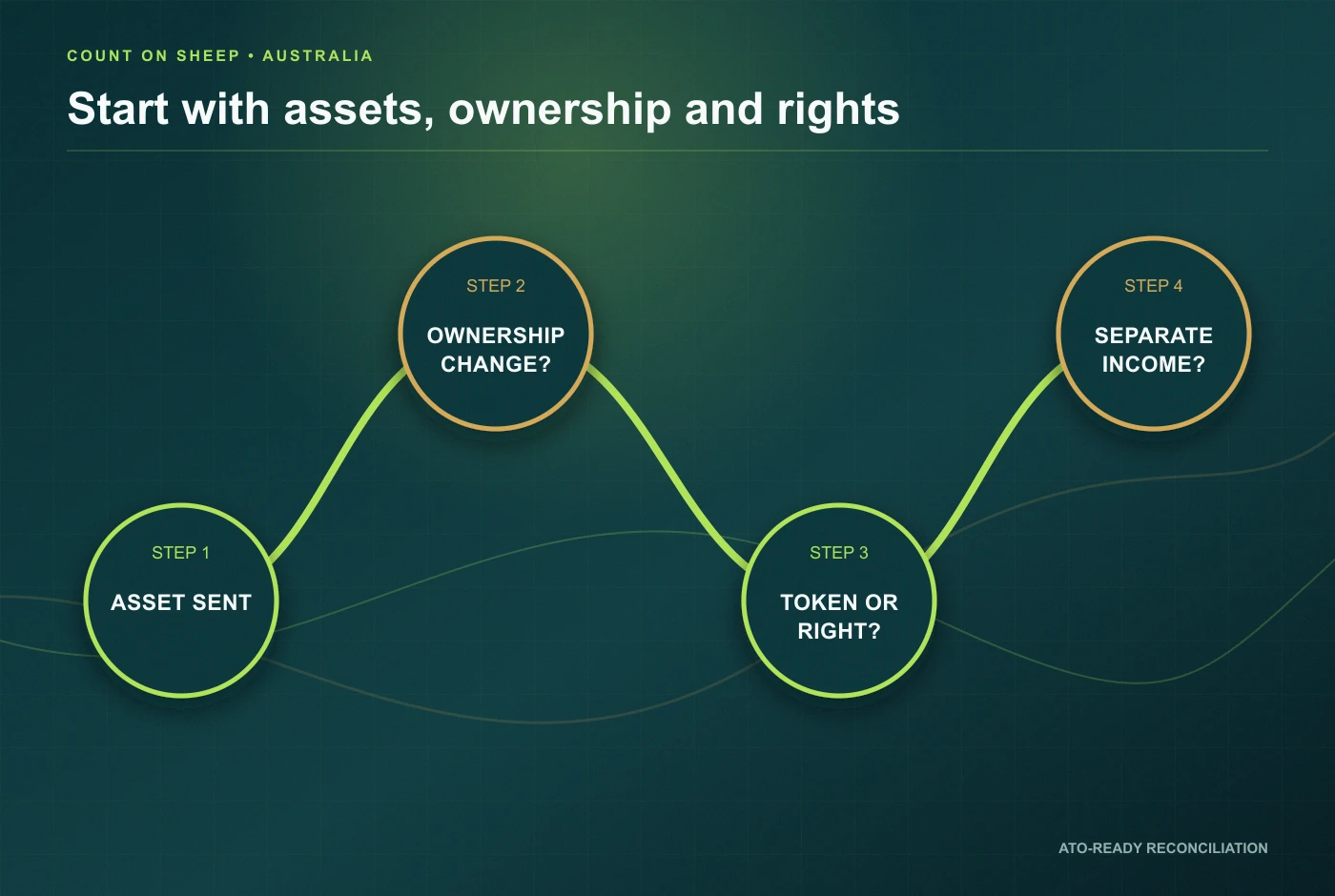
A DeFi interface may call an action deposit, stake, supply, vault or migrate. Those labels do not settle the tax result. Identify the original asset, the smart-contract or legal counterparty, any token or contractual right received, and what the user can claim afterwards. The protocol documentation and transaction data should be preserved together.
Did beneficial ownership change?
Beneficial ownership is central to the ATO’s published DeFi guidance. A transaction can have CGT consequences if the user gives up ownership of the original asset, even where an economically similar exposure remains. A true custodial movement can point differently from a transfer that leaves the protocol free to use or dispose of the asset.
Was a token or contractual right received?
Receipt tokens, LP tokens, vault shares and contractual claims can be separate CGT assets. If the user exchanges the original token for one of those assets or rights, the transaction may involve a disposal and a new cost base. Reconciliation should record both legs, not merely rename the receipt token as the original asset.
Several CGT events may be relevant
The ATO says DeFi arrangements can involve CGT events A1, E2, C2 or H2 depending on the interests and rights created. These can concern a disposal, trust transfer, ending of an intangible right or another event relating to a CGT asset. The registered tax agent determines the correct legal event.
Ordinary income can arise separately
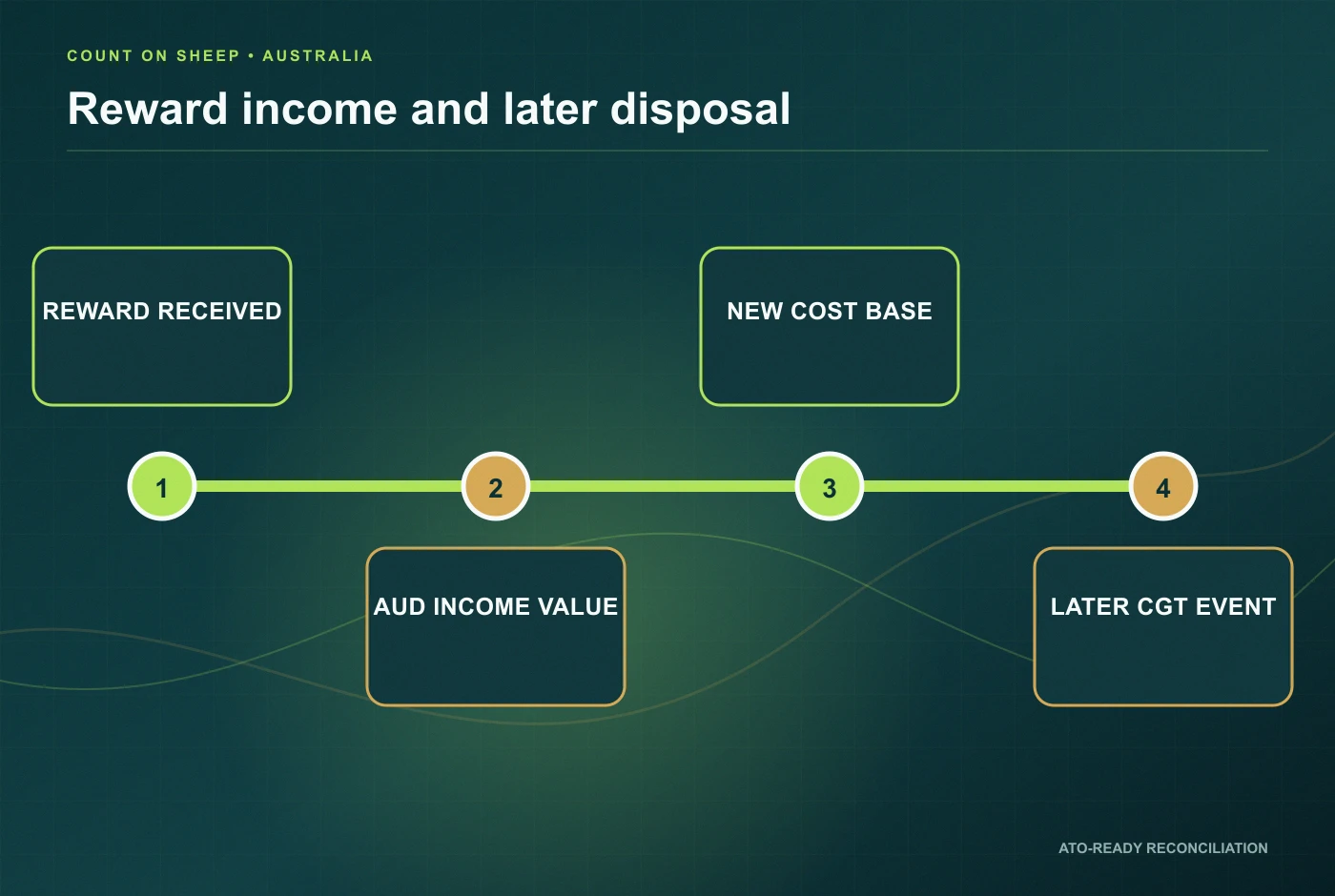
Periodic rewards, staking receipts and established-token airdrops may be ordinary income at their money value when received. A later disposal can create a separate CGT result. An income record needs receipt time, units and AUD value, then a linked acquisition record for the later cost-base calculation.
Is wrapping crypto taxable in Australia?
The ATO says wrapping is an exchange
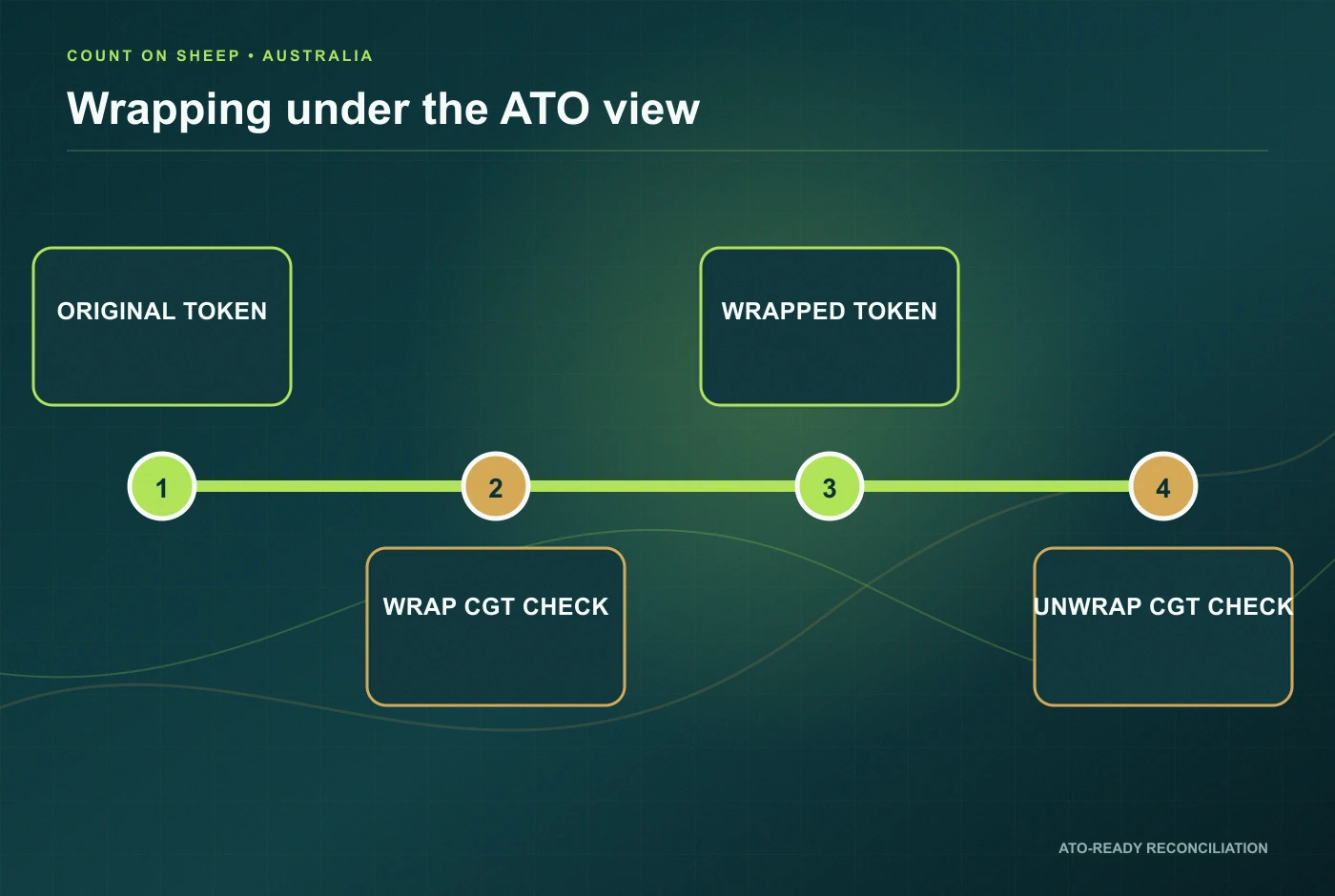
The ATO’s published position is that wrapping or unwrapping exchanges one crypto asset for another and triggers a CGT event. If BTC is exchanged for a wrapped representation, the original BTC disposal and the acquisition of the wrapped asset need AUD values and source records.
Record the disposed and received assets
Preserve the original asset units, parcel cost base, wrapping timestamp, transaction hash, wrapped token contract and units received. Record fees separately. A one-for-one token quantity does not mean the Australian-dollar gain is zero because the cost base of the original parcel may differ from market value at wrapping.
Create the new cost base in AUD
The AUD market value of the property received or given at the exchange helps establish capital proceeds and the new asset’s cost base under the applicable rules. Use a documented price source at the relevant time. Illiquid or chain-specific assets may require an exception rather than an unsupported spot price.
Unwrapping can be another checkpoint
Under the ATO view, unwrapping exchanges the wrapped asset for another asset and can trigger another CGT event. Track the wrapped token’s cost base from acquisition through disposal. Returning to the original token does not erase the earlier history.
Protocol-specific arguments go to the adviser
The ATO page is administrative guidance, and legal character can depend on protocol terms. Count On Sheep records the facts, values and rights, then flags the treatment question for the client’s accountant or registered tax agent. The page describes the ATO position without claiming every legal argument is settled.
How can crypto lending be taxed?
A true loan and a transfer can differ
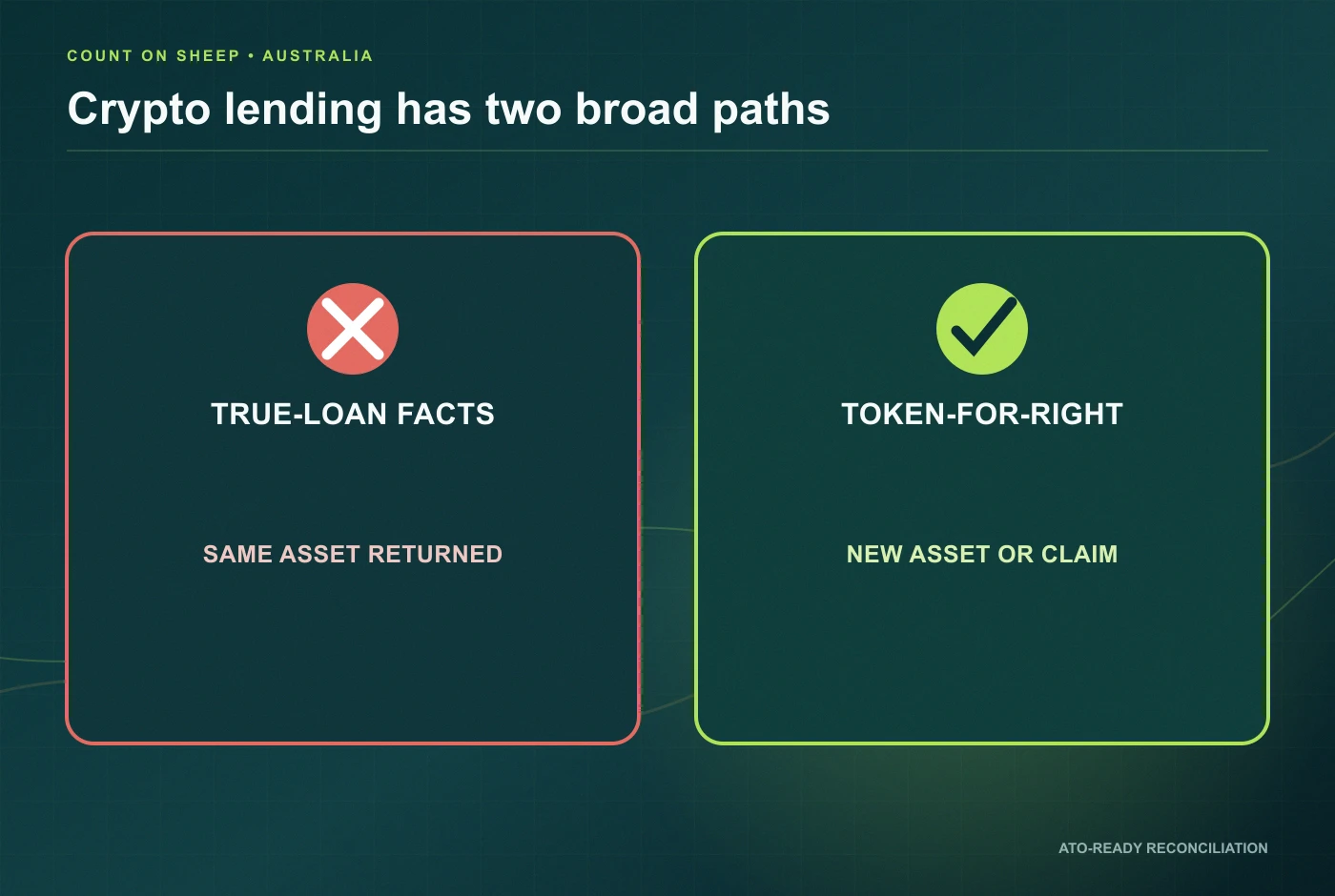
The word loan covers arrangements with different legal effects. In one structure the lender may retain beneficial ownership and have the same asset returned. In another, the protocol or borrower can deal with the asset while the user receives only a contractual claim. The second structure can involve a disposal or creation of a different CGT asset.
Receipt tokens and contractual rights
If depositing ETH produces a receipt token or account right, record that asset’s contract, units, market value and redemption terms. The transaction may exchange the original crypto for the new right. Treating the receipt token as a harmless label can lose both a disposal and the cost base of the asset later redeemed.
Interest and reward receipts
Interest-like tokens and incentive rewards can be ordinary income under the applicable category. Record when each amount became controlled or claimable, its AUD value and whether it was added to principal.
Repayment and disposal of the right
At repayment, the contractual right or receipt token may be disposed of, cancelled or redeemed. Match the closing transaction to the opening right and value the assets returned.
Collateral and liquidation
Collateral does not have one universal treatment. If liquidation occurs, identify the asset disposed of, when control ended, the debt satisfied and any balance returned.
How are liquidity pools taxed?
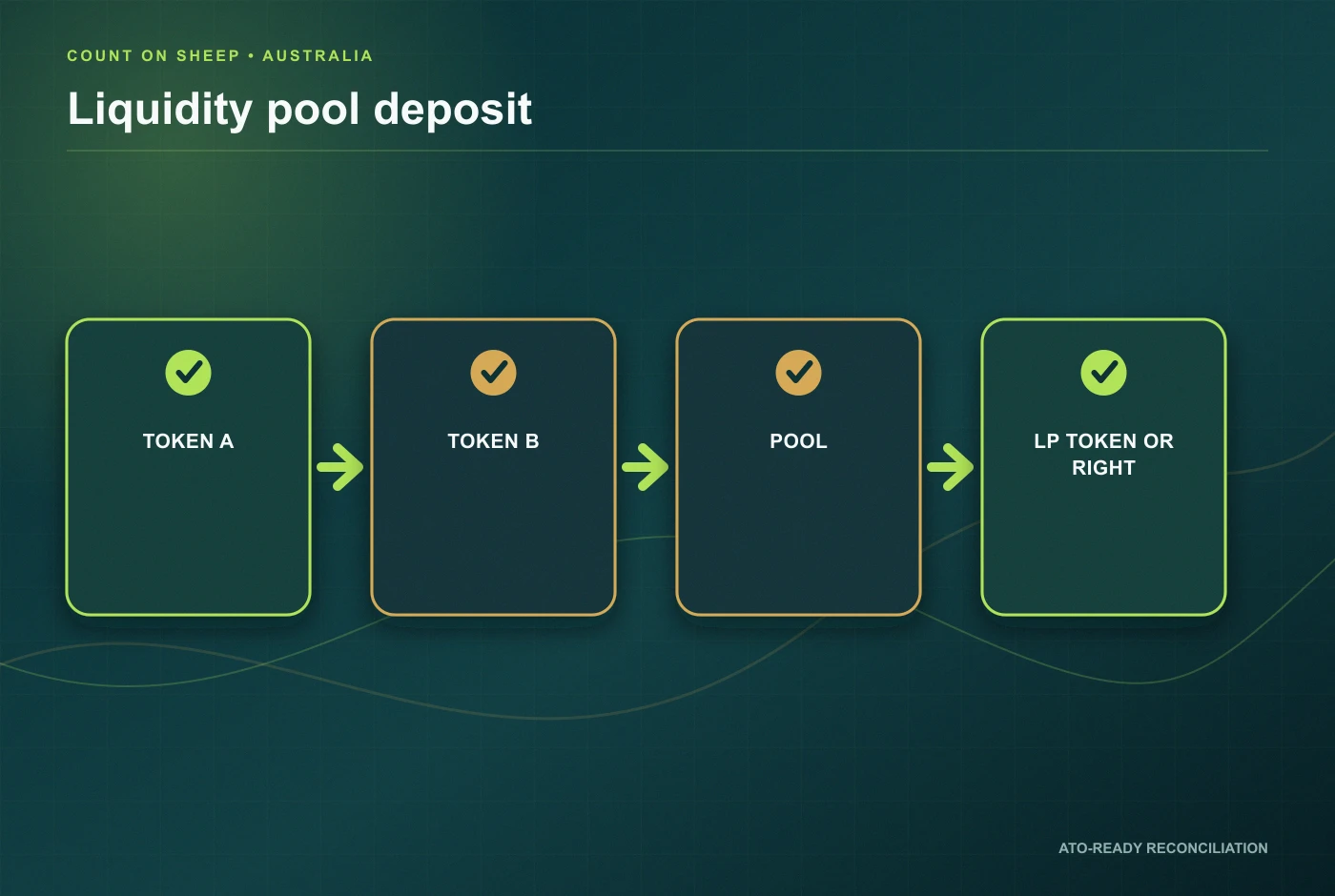
Depositing assets into a pool
A liquidity provision can send two assets to a smart contract in one economic action. Record each token leg, units, AUD value, timestamp, fees and pool. Internal contract calls and router transactions should be grouped without deleting source detail.
LP token or right received
The ATO says a deposit can trigger CGT if the depositor receives an LP token or other right in exchange. The original assets may be disposed of and the LP interest may receive a new cost base. A protocol that records a balance without a transferable LP token still requires analysis of the contractual right.
Deposit-stage calculation
For each original asset, identify the disposed parcel, cost base and AUD capital proceeds under the applicable market-value rules. Then record the LP token or right acquired. If the pool position cannot be valued directly, preserve the underlying values and method and place the uncertainty in the exception register.
Fees and rewards while the position is open
A pool may distribute tokens or auto-compound rewards. Identify amounts received, when they became controlled and whether value instead accrued inside an existing right.
Withdrawal and redemption
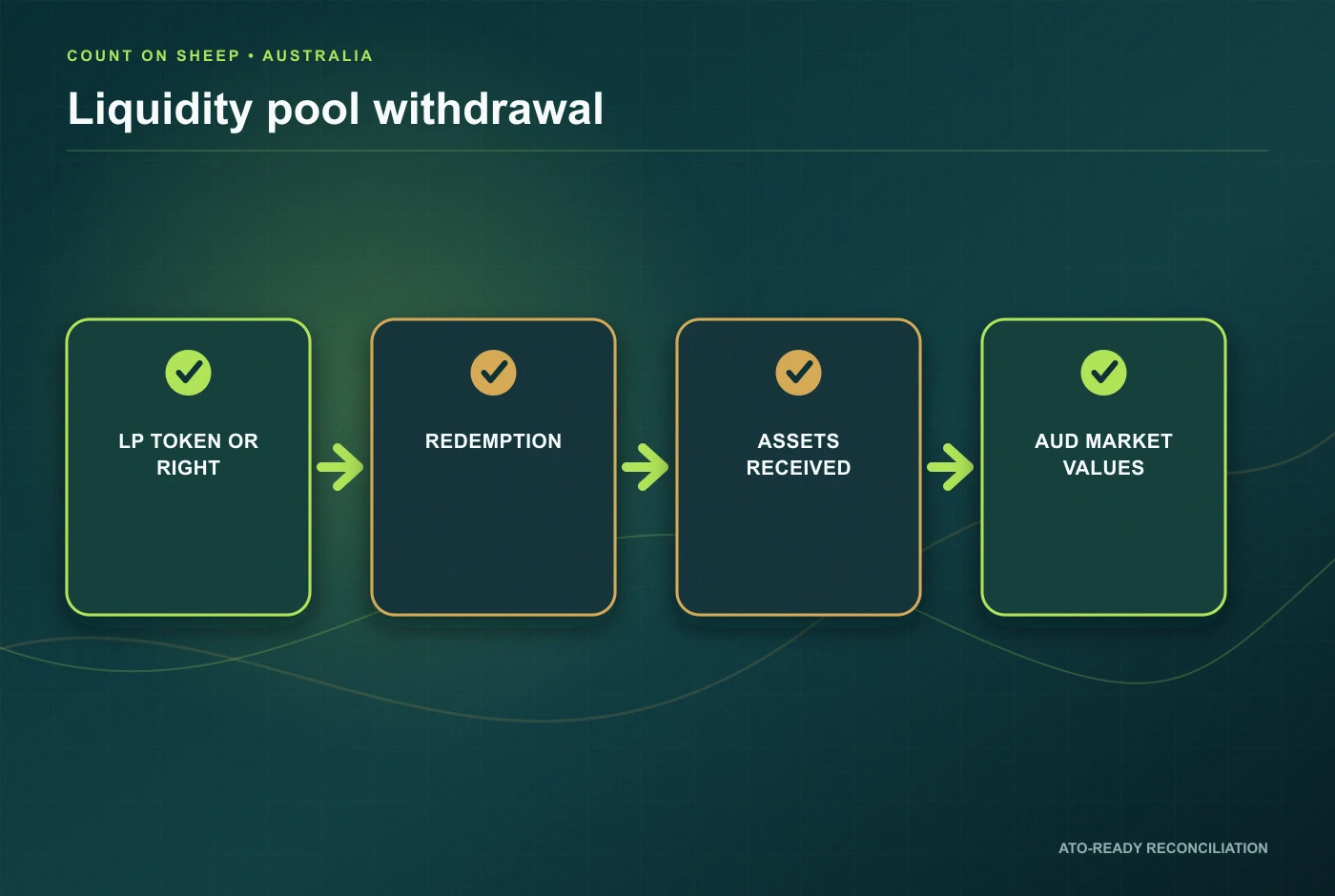
Withdrawing can dispose of the LP token or end the contractual right. The market value of assets received may form capital proceeds. Record each asset returned and establish its acquisition value for later disposal. Do not simply restore the original deposit cost to a different mix of tokens.
Impermanent loss is not automatically a tax loss
Impermanent loss compares a pool with a hypothetical hold. It is not automatically a recognised capital loss. Tax follows actual disposals, rights, cost bases and proceeds. See the Australian crypto tax calculator guide.
How are staking rewards and airdrops taxed?
Staking rewards as ordinary income
The ATO says staking rewards are ordinary income at their money value when received. Outside a relevant business, the amount is reported as other income under the current ATO materials reviewed. Capture receipt date, units, token, wallet and AUD value.
Established-token airdrops
For an established token airdrop, the money value at receipt is ordinary income. Unsolicited tokens, hard forks and distributions without an established market can require a different analysis. Use the exact category rather than treating every free token as the same event.
Later disposal and CGT
A reward’s receipt value generally supports its acquisition record. When that token is later sold, swapped, spent or gifted, calculate the capital gain or loss using the supported cost base and proceeds. Keep the income and disposal entries linked to prevent duplicate income or zero basis.
Locked or unclaimable rewards
Receipt timing can be fact-specific where rewards are locked, unclaimable or subject to protocol conditions. Record when the amount was displayed, when it became claimable, when it entered a controlled wallet and what restrictions applied. The registered tax agent decides the correct receipt point.
Liquid-staking tokens
Liquid staking can combine reward accrual with the issue of a receipt token. The ATO wrapping and DeFi positions can raise an exchange question at deposit or redemption, while rewards may create separate income. Decode the token mechanics instead of labelling the whole position staking.
What about bridges, vaults, restaking and protocol migrations?
A bridge label is not enough
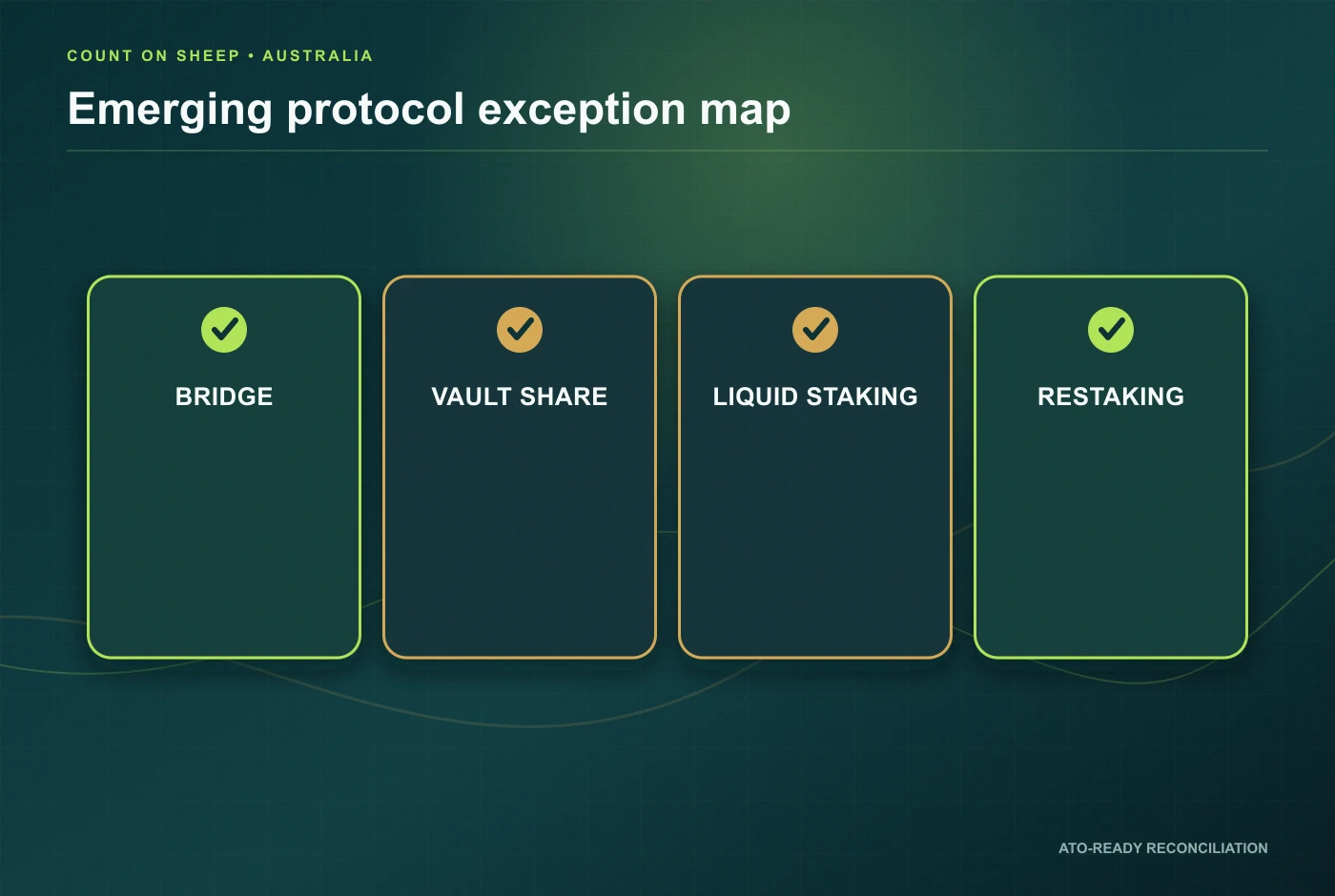
Bridges can lock and mint, burn and mint, use liquidity providers or transfer control through a custodian. Determine whether the same beneficial interest continued or a different asset or right was received. An unchanged ticker does not settle the result.
Vault shares and receipt tokens
A vault can issue a share in pooled assets. Record the deposited token, share contract, conversion rate, values and redemption terms. Auto-compounding value can differ from a distributed reward.
Rebasing and liquid-staking records
A rebasing token can change units while a value-accruing token changes its redemption ratio. Store balance snapshots and protocol formulas so the record distinguishes new units, a changed right and a claimable distribution.
Restaking and layered rights
Restaking can create a second receipt token or points balance. Trace the rights from original asset through liquid-staking token, restaking receipt and reward so later redemptions do not look like unexplained deposits.
Migrations and redenominations
A migration may replace a contract, redenominate units or create a different token. Preserve terms, dates, hashes and conversion ratios, then flag legal character instead of forcing a software label.
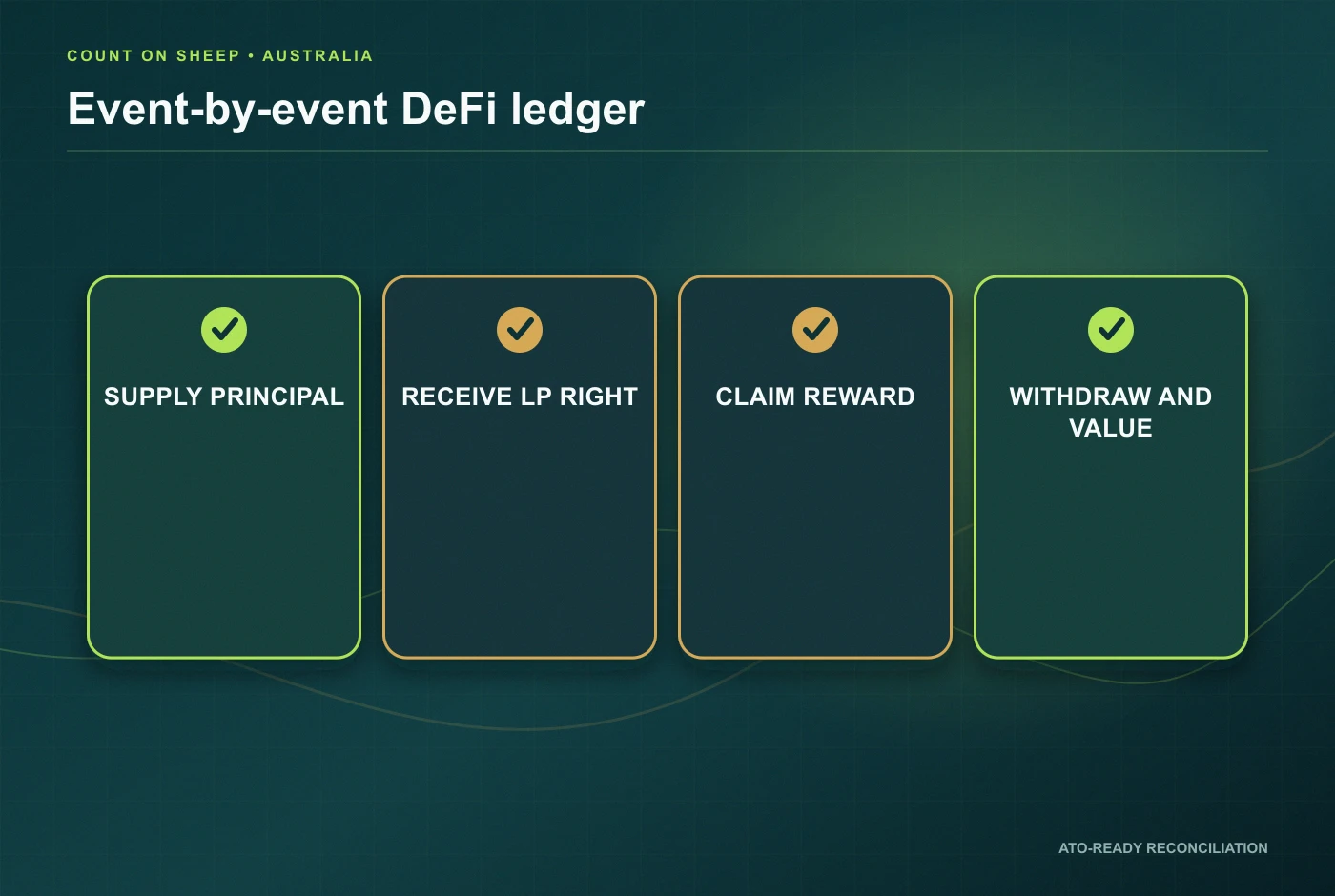
DeFi worked example: an event-by-event ledger
Assume an investor supplies assets to a protocol, receives an LP token, claims a reward and later withdraws. The figures are illustrative. Final tax treatment depends on the protocol terms, beneficial ownership and the client’s circumstances.
1. Send tokens to the protocol
The wallet sends Token A worth AUD 4,000 and Token B worth AUD 4,000. The reconciliation keeps the specific disposed parcels, cost bases and transaction hash. It does not use the AUD 8,000 market value as a substitute for cost base.
2. Receive an LP token
The protocol issues one LP token representing an AUD 8,000 pool interest. Under the ATO position, the original asset exchanges may trigger CGT and the LP token or right needs an acquisition record. Fees paid in crypto are recorded as separate legs.
3. Claim a reward
The wallet receives 100 Reward tokens worth AUD 250 when controlled. If the amount is ordinary income under the applicable ATO category, record AUD 250 at receipt and create the linked acquisition record for those tokens.
4. Withdraw underlying assets
The LP token is redeemed when the returned assets are worth AUD 8,600. Record disposal or ending of the LP interest under the treatment chosen by the registered tax agent, then record the units and values of each returned asset.
5. Pay network fees
The wallet spends AUD 35 worth of another token on gas across the lifecycle. Each fee requires purpose and treatment review and can involve disposal of the fee token. The ledger links it to the relevant action without hiding the separate asset history.
| Event | Principal or right | Reward | Fee | AUD evidence |
|---|---|---|---|---|
| Supply | Token A + Token B sent | None | Gas token | AUD 8,000 supplied |
| LP receipt | LP token acquired | None | Included above | AUD 8,000 right |
| Claim | LP remains open | 100 Reward tokens | Gas token | AUD 250 income value |
| Withdraw | LP token ends; assets received | None | Gas token | AUD 8,600 assets |
| Fee summary | Linked to each action | None | AUD 35 total | Source and timestamp per fee |
Why DeFi tax software reports break
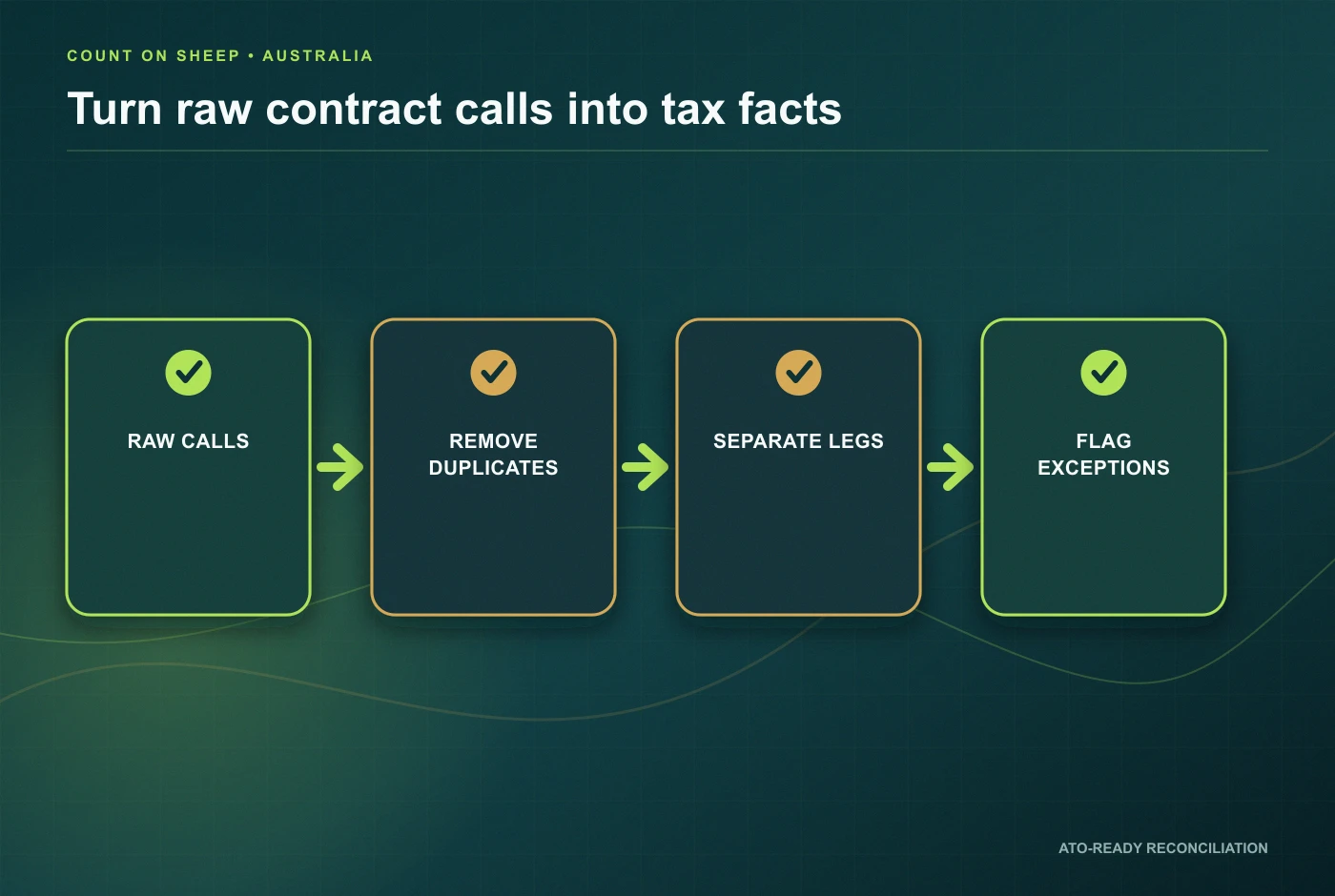
Internal calls and duplicate legs
Routers create several transfers for one economic action, and duplicate feeds can count the same transfer twice. Group the action only after matching the raw legs.
Missing token prices
New or thinly traded tokens may have no reliable price. A zero can distort income, cost base or gains. Keep market evidence and put unresolved values in the exception register.
Spam and scam tokens
Public addresses receive spam tokens and malicious NFTs. Do not import every balance as income. Quarantine suspicious assets and record whether they were accepted, controlled or marketable.
Bridges marked as disposals
Software may mark every bridge as a sale or every bridge as a transfer. Match both chains, identify any wrapper or right and document the mechanics.
Rewards mixed with principal
Auto-compounding, rebasing and LP positions blur principal and rewards. Distinguish an amount received from appreciation in an existing right. Yield percentage is not transaction evidence.
LP balances without cost base
If software ignores the LP token at entry, redemption can look like free assets. Rebuild the deposit and right before calculating the exit.
From on-chain records to adviser-ready workpapers
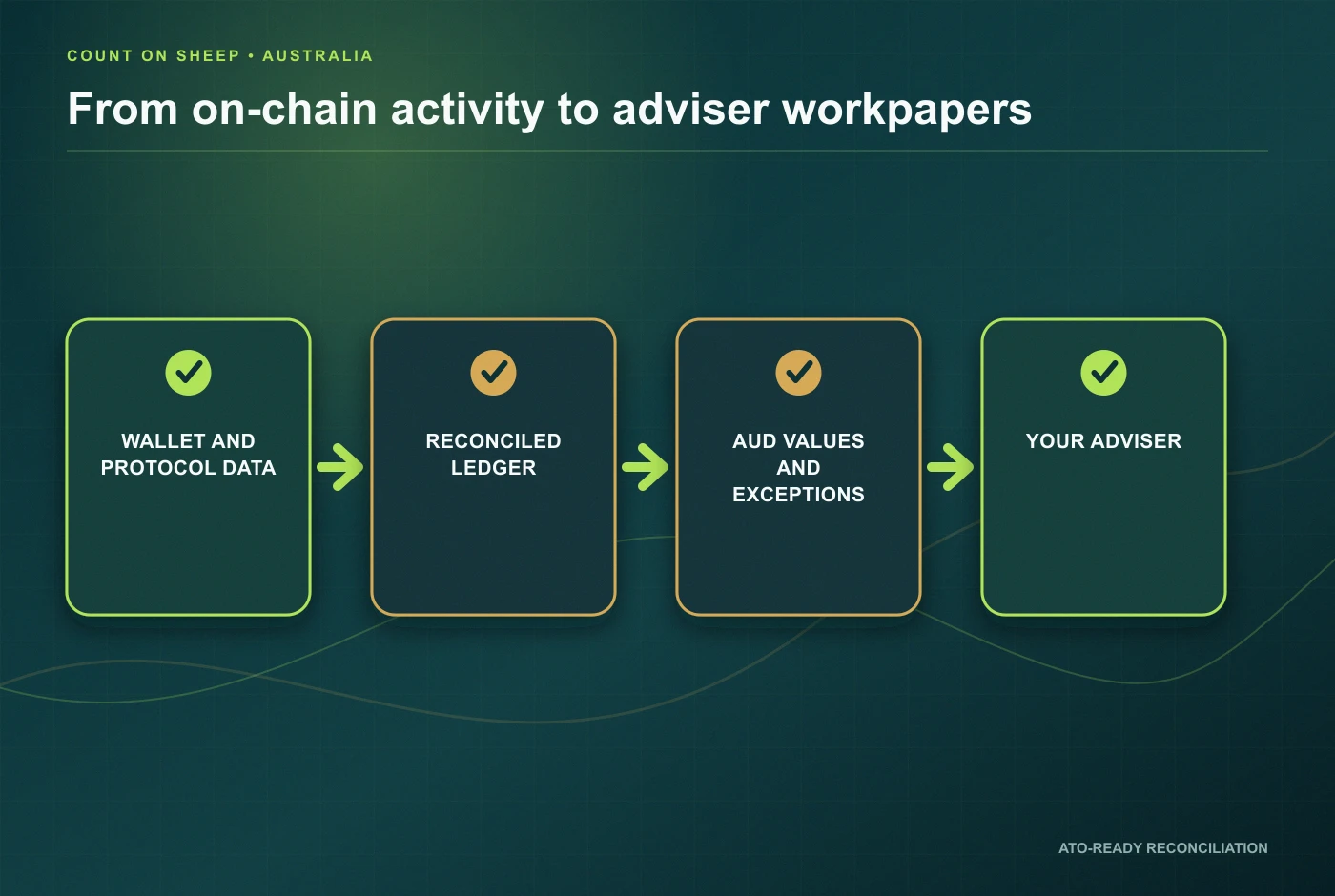
Preserve addresses, hashes and protocol terms
Keep every public wallet address, material transaction hash, protocol name, version and relevant terms. Add screenshots or statements for locked positions and manual notes about ownership and purpose. Never provide a seed phrase or private key.
Decode and normalise each transaction leg
Map raw contract calls to the economic action while retaining source references. Match same-owner transfers and bridges, standardise asset identifiers and timestamps, and separate principal, rights, rewards and fees.
Build an exception register
Unclear beneficial ownership, unsupported values, ambiguous receipt tokens, locked rewards and protocol migrations should remain visible. State the facts and evidence available without forcing a tax conclusion. The registered tax agent can decide the legal character.
Deliver ATO-ready figures to the client’s adviser
Count On Sheep provides universal digital-asset reconciliation for complex DeFi activity. We prepare ATO-ready figures and workpapers for your own accountant or registered tax agent. Count On Sheep is not a registered tax agent and does not lodge Australian tax returns.
Connect DeFi to the broader return
DeFi connects to the Australia Crypto Tax Guide 2026. Reward income affects total income, while the ATO visibility guide covers self-hosted and exchange data.
Get ATO-ready figures for your own accountant or registered tax agent
Count On Sheep reconciles complex digital-asset activity into ATO-ready figures and workpapers for your own accountant or registered tax agent. Count On Sheep is not a registered tax agent and does not lodge Australian tax returns.
Reconcile my Australian DeFi activityAustralian DeFi tax FAQs
Is wrapping crypto a CGT event in Australia?
The ATO says wrapping and unwrapping exchange one crypto asset for another and trigger CGT. Record the disposed parcel, AUD market value, wrapped asset received, new cost base and fees. Protocol-specific legal arguments should go to a registered tax agent.
Is depositing crypto into a liquidity pool taxable?
It can be. The ATO says a deposit can trigger CGT where assets are exchanged for an LP token or other right. The result depends on beneficial ownership, the rights received and the protocol terms. Do not label every pool deposit the same way.
Are DeFi rewards taxed when received?
Periodic DeFi rewards may be ordinary income at market value when received. Staking rewards and established-token airdrops have specific ATO guidance. Locked, unclaimable or unusual distributions can require facts-based review.
Is lending crypto always a disposal?
No. Lending structures differ. CGT may arise where beneficial ownership ends or the original asset is exchanged for a different asset or contractual right. Review the agreement, receipt token, control and repayment terms.
How is bridging crypto taxed in Australia?
There is no universal bridge label. Determine whether beneficial ownership continued and whether the user received the same asset, a wrapped token or a new right. Preserve both chain transactions and protocol terms for review.
What records does my registered tax agent need for DeFi?
Provide wallet addresses, transaction hashes, protocol names and versions, token contracts, rights received, AUD values, reward receipt evidence, locked-position records, fee details, ownership notes and an exception register.