
Yes. The ATO can receive identity and transaction data from Australian crypto designated service providers and match it with tax records. The published program covers 2014-15 through 2025-26. Data can include names, bank accounts, wallet addresses, transaction dates, deposits, withdrawals, quantities and coin types. This does not mean the ATO automatically understands every self-hosted wallet transaction, but avoiding a cash withdrawal does not make crypto activity invisible.
Last reviewed 27 July 2026. Critical rules checked against current ATO, Treasury and legislation.gov.au sources.
ATO crypto visibility at a glance
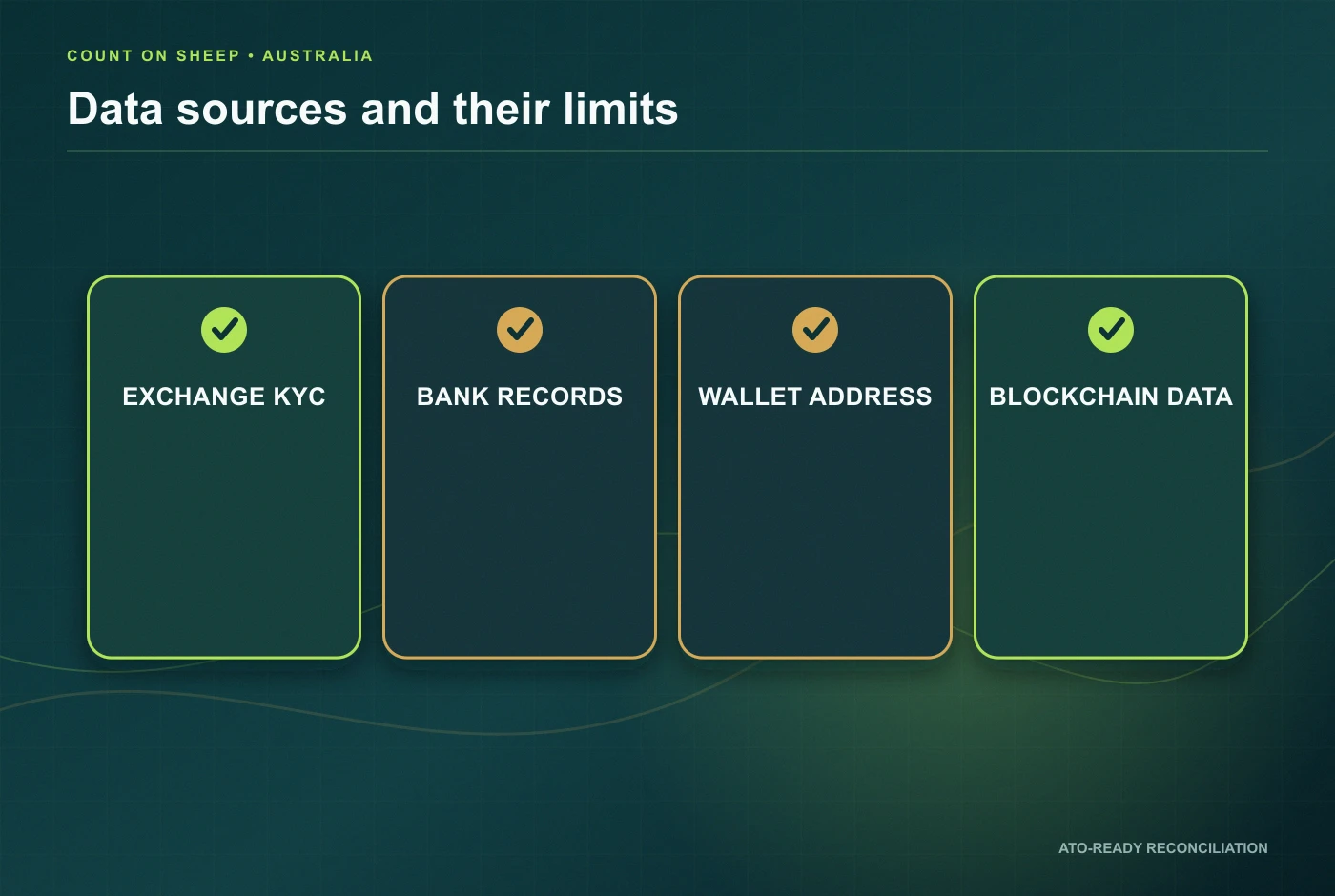
| Data source | Fields it may contain | What it can help show | Important limitation |
|---|---|---|---|
| Exchange KYC | Name, address, date of birth, email and phone | Who controls a platform account | An account record does not classify every tax event |
| Exchange transactions | Dates, types, quantities, deposits and withdrawals | Platform activity and counterpart transfers | Exports can omit wallet context or protocol activity |
| Bank records | Account details and fiat transfers | Money entering or leaving a provider | A transfer is not necessarily the taxable event |
| Wallet addresses | Public addresses and transaction hashes | On-chain paths linked to known accounts | An address is not always a verified identity |
| Blockchain data | Transfers, token contracts and timestamps | Public movement across addresses and protocols | Legal rights, purpose and ownership may be unclear |
| Tax returns | Previously reported gains, income and losses | Differences between records and lodged positions | The return contains conclusions, not all source evidence |
| CARF in future | Provider and cross-border reportable information | Broader domestic and international reporting | Australian legislation and final mechanics need rechecking |
How does the ATO know about crypto?
Australian crypto designated service providers
The ATO’s published crypto-assets data-matching program obtains data from Australian crypto designated service providers. The provider category is more reliable than an internet list of exchange brands because participation, products and corporate arrangements can change. If an Australian platform verifies identity and holds transaction records, a taxpayer should not assume the activity sits outside the program.
Identity and bank-account matching
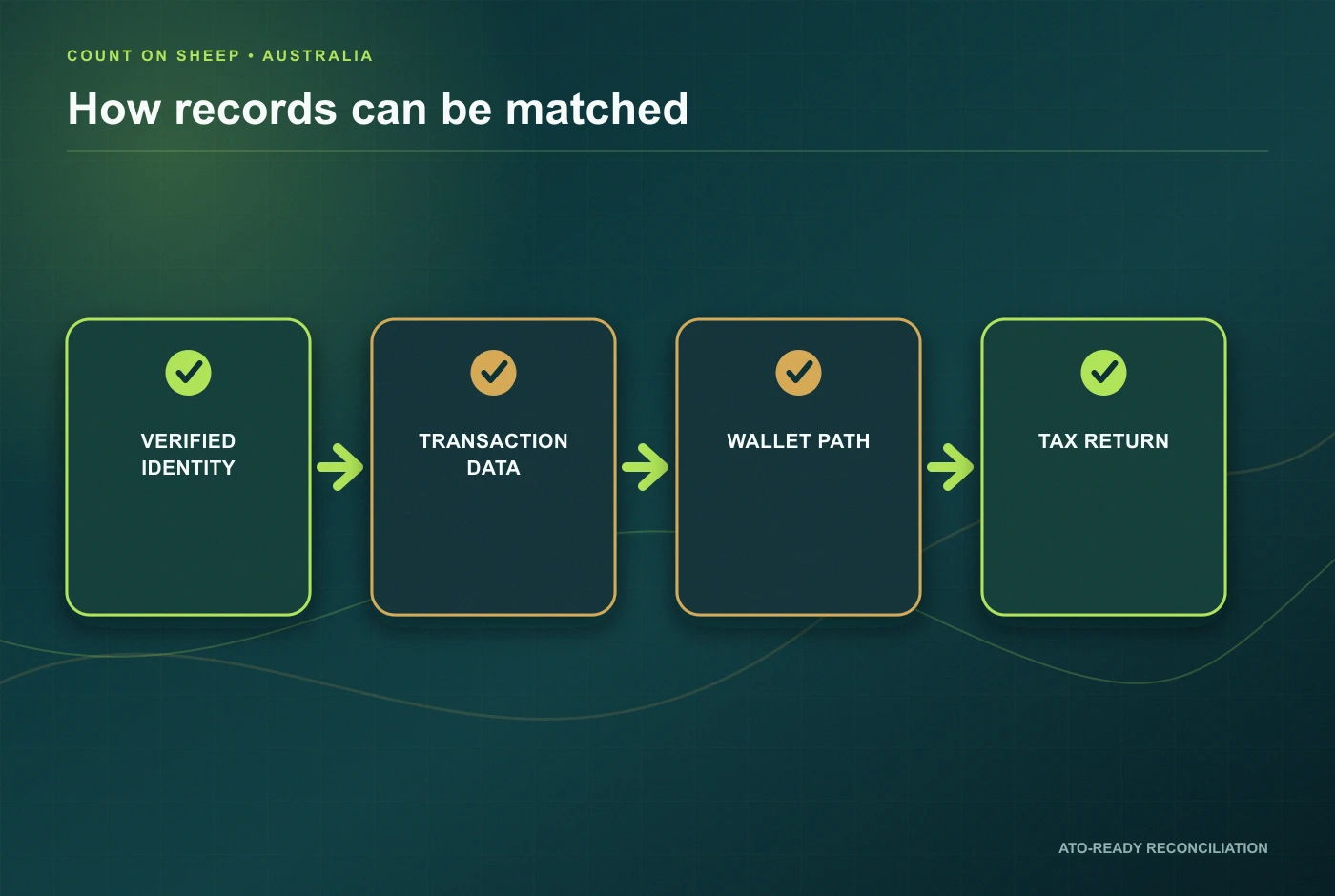
Identity fields can be compared with tax registrations and lodged returns. Bank-account information and fiat transfers can connect a verified person to a platform account. The matching does not need every transaction to touch a bank. It can establish a starting point from which exchange and wallet records are examined.
Wallet addresses and transaction histories
The April 2024 notice lists wallet addresses, transaction dates and times, types, deposits, withdrawals, quantities and coin types among data fields. A withdrawal from a KYC exchange to a public address can link the account holder with an on-chain destination. Later movements may be traceable even when they pass through self-hosted wallets.
Public blockchain analysis
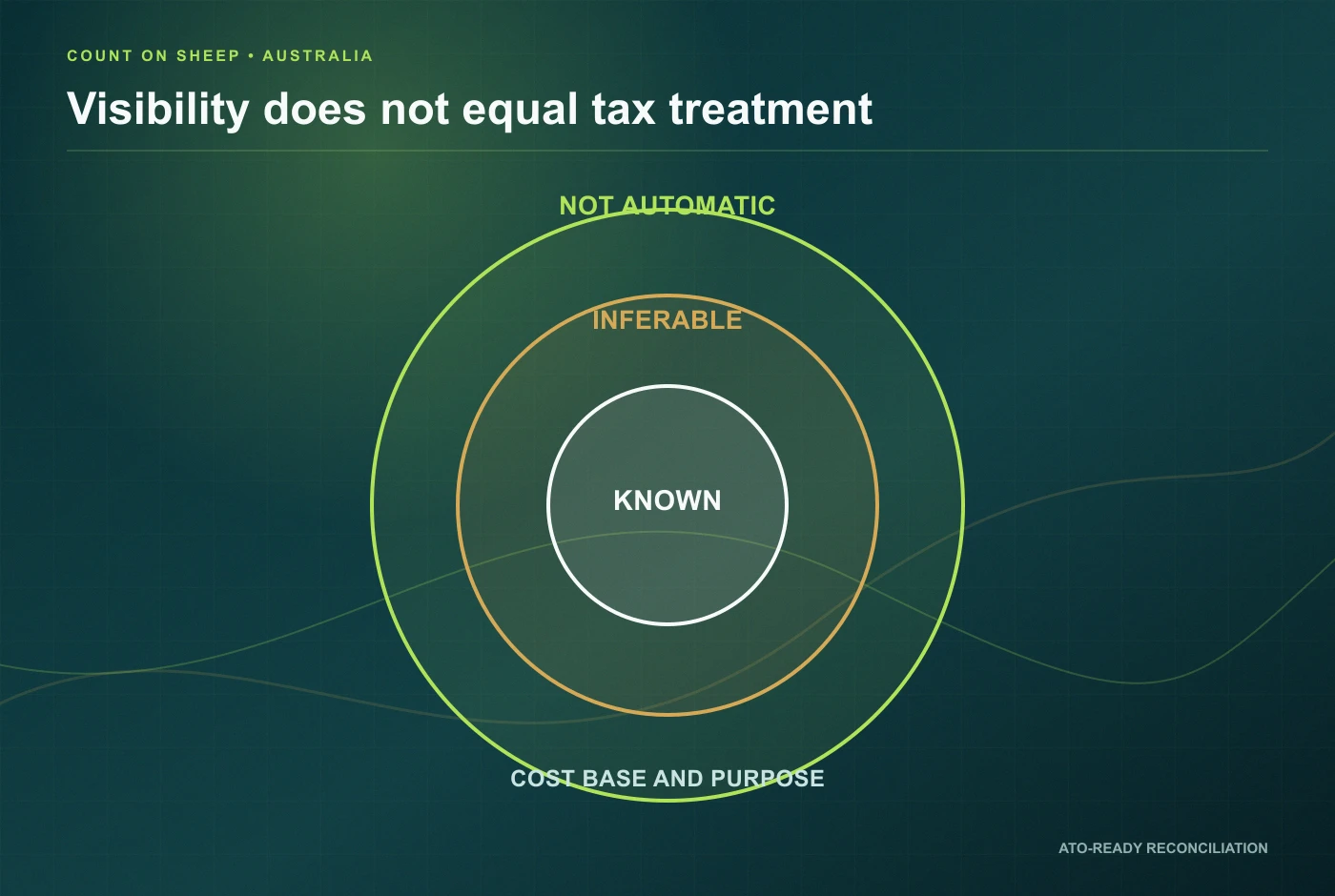
Public blockchains preserve transaction paths, token contracts and timestamps. That evidence can show that assets moved, but it may not show why they moved, who beneficially owned every address, whether a transfer was a gift, or what legal right a DeFi token represents. Blockchain visibility and correct tax character are separate problems.
Information on prior returns
Previously lodged gains, losses, business amounts and other income can be compared with third-party information. A difference can prompt review, but the third-party record may itself need reconciliation. The taxpayer’s source-backed ledger remains necessary to explain transfers, cost base, income events and exceptions.
What data does the ATO crypto program receive?
Identity fields in the gazette notice
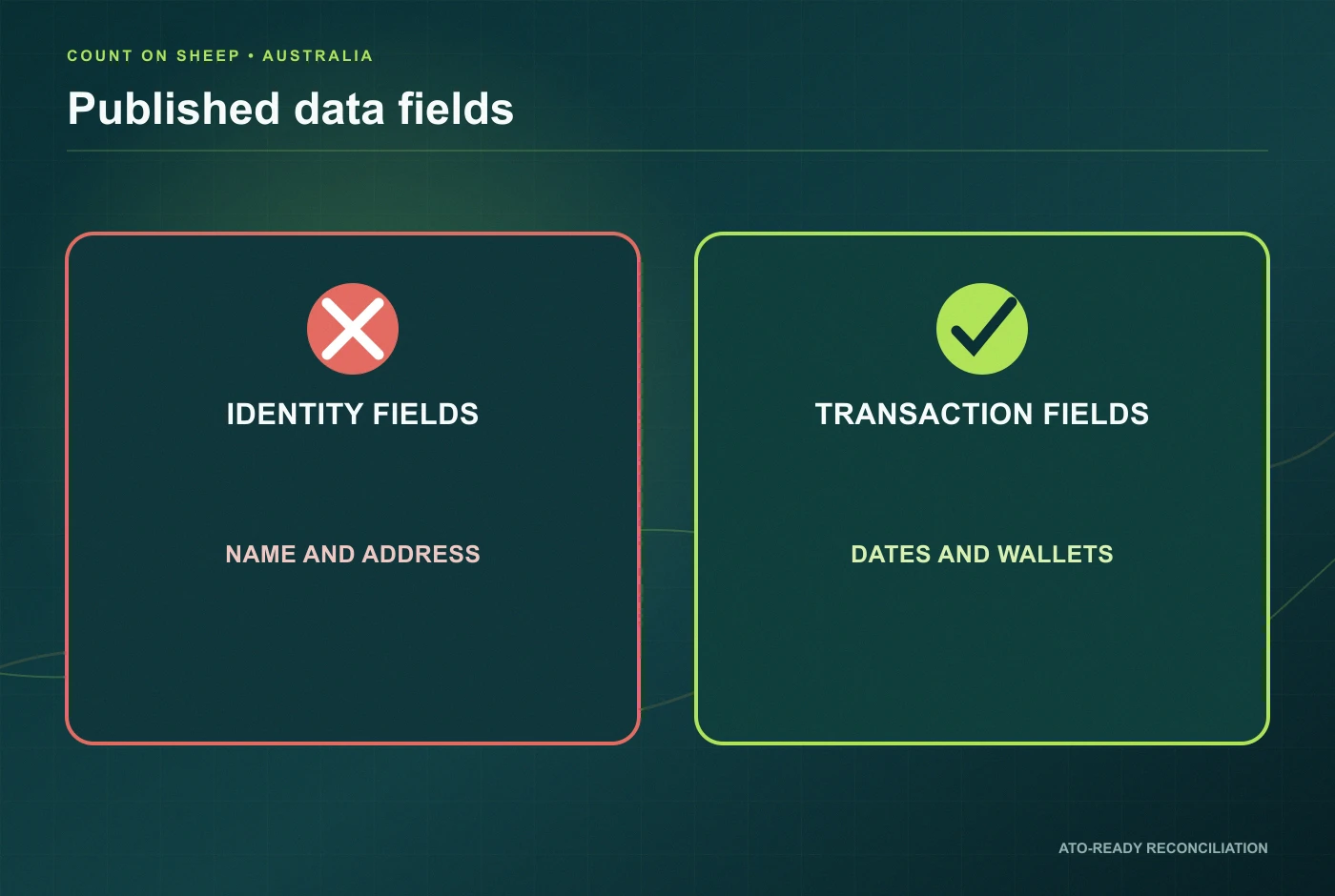
The April 2024 legislation.gov.au gazette notice describes identity data including names, residential and postal addresses, dates of birth, phone numbers, email addresses and social-media identifiers. These fields help distinguish account holders and join provider data to the right taxpayer record.
Transaction fields in the gazette notice
Transaction data can include bank-account details, wallet addresses, transaction dates and times, transaction types, deposits, withdrawals, quantities and coin types. Those fields can reveal activity that a simple year-end balance or bank summary misses.
Estimated annual scale
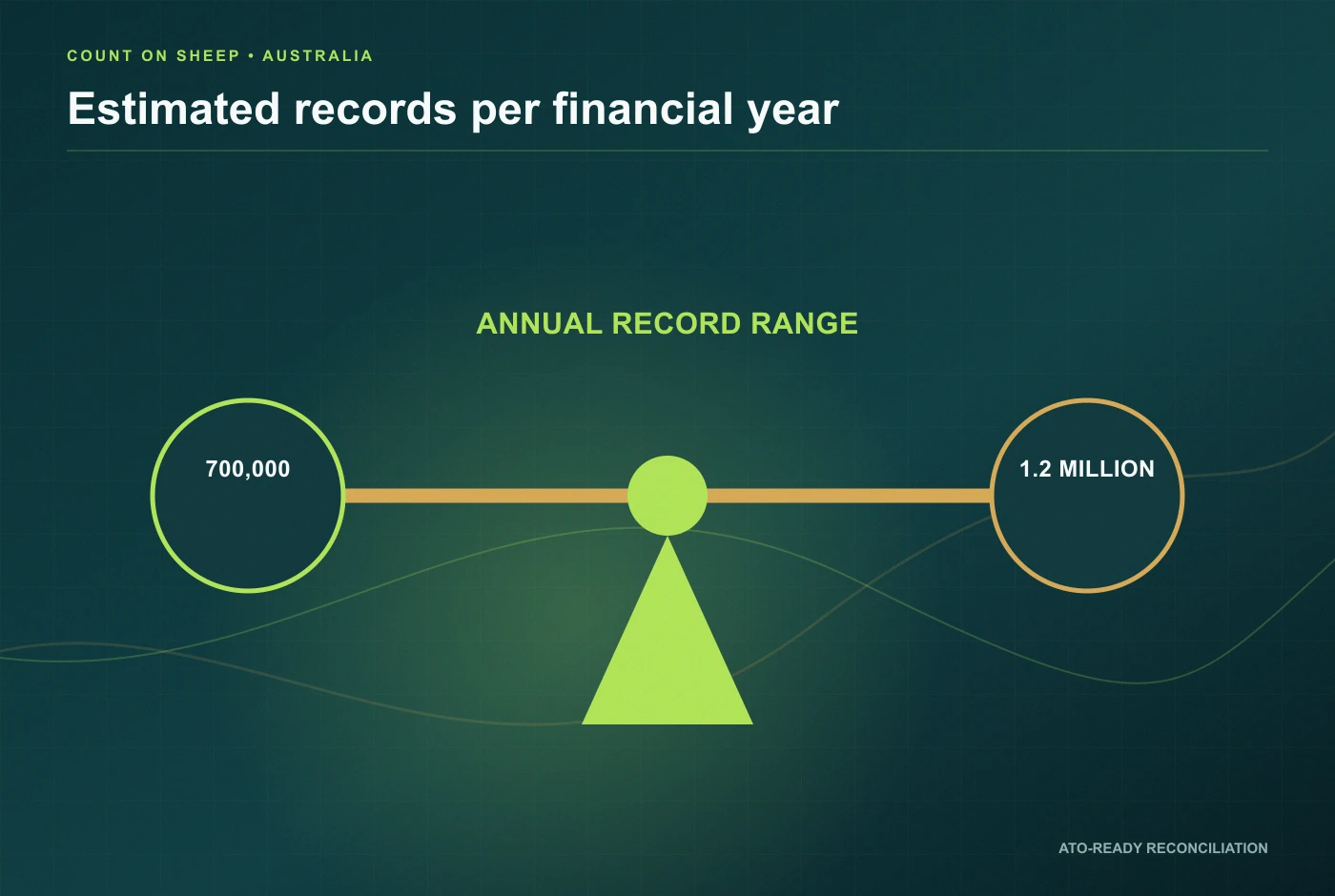
The 2024 notice estimated records for 700,000 to 1.2 million individuals and entities in each financial year. That is a program estimate, not a claim that every record contains a taxable error. Matching is used to identify potential non-reporting and support compliance activity.
What matching can flag
A platform disposal with no corresponding capital-gain information, large deposits inconsistent with a return, or reward activity absent from other income may warrant review. The match is a lead rather than a completed tax calculation. Cost base, same-owner transfers, losses and classification can materially change the correct figure.
How far back does ATO crypto data matching go?
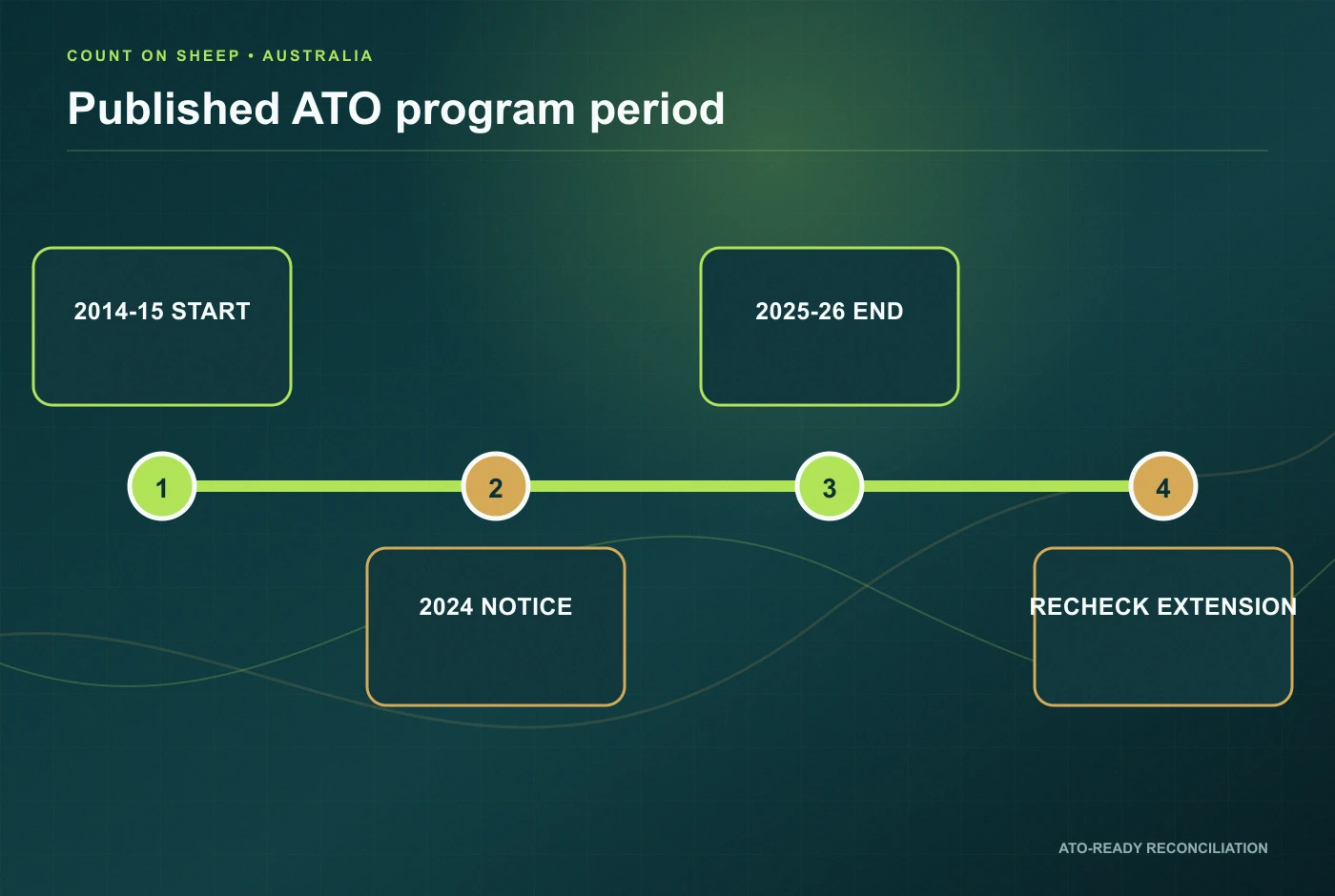
Published period from 2014-15 through 2025-26
The ATO’s published crypto-assets data-matching protocol covers the 2014-15 to 2025-26 financial years. The OAIC register describes the same program span. That long period means an old exchange account should not be dismissed merely because it closed years ago.
The 2024 notice covers three recent years
The April 2024 gazette notice concerns provider data for 2023-24 through 2025-26. It sits within the longer published program. A current notice should not be read as if earlier years disappeared from the protocol.
What to say after 2025-26
The last published protocol located for this research ends at 2025-26. That does not prove the ATO stopped collecting data afterwards. The correct statement is that the published extension should be rechecked. Avoid turning the end date of one protocol into a promise about future visibility.
Data range and amendment periods are different
The years covered by data matching do not answer whether a return can or should be amended, what review period applies, or how penalties and interest might be handled. Those questions depend on facts and law outside the data protocol. A registered tax agent should advise on the appropriate response.
Do CoinSpot and other exchanges report to the ATO?
Use the verified provider category
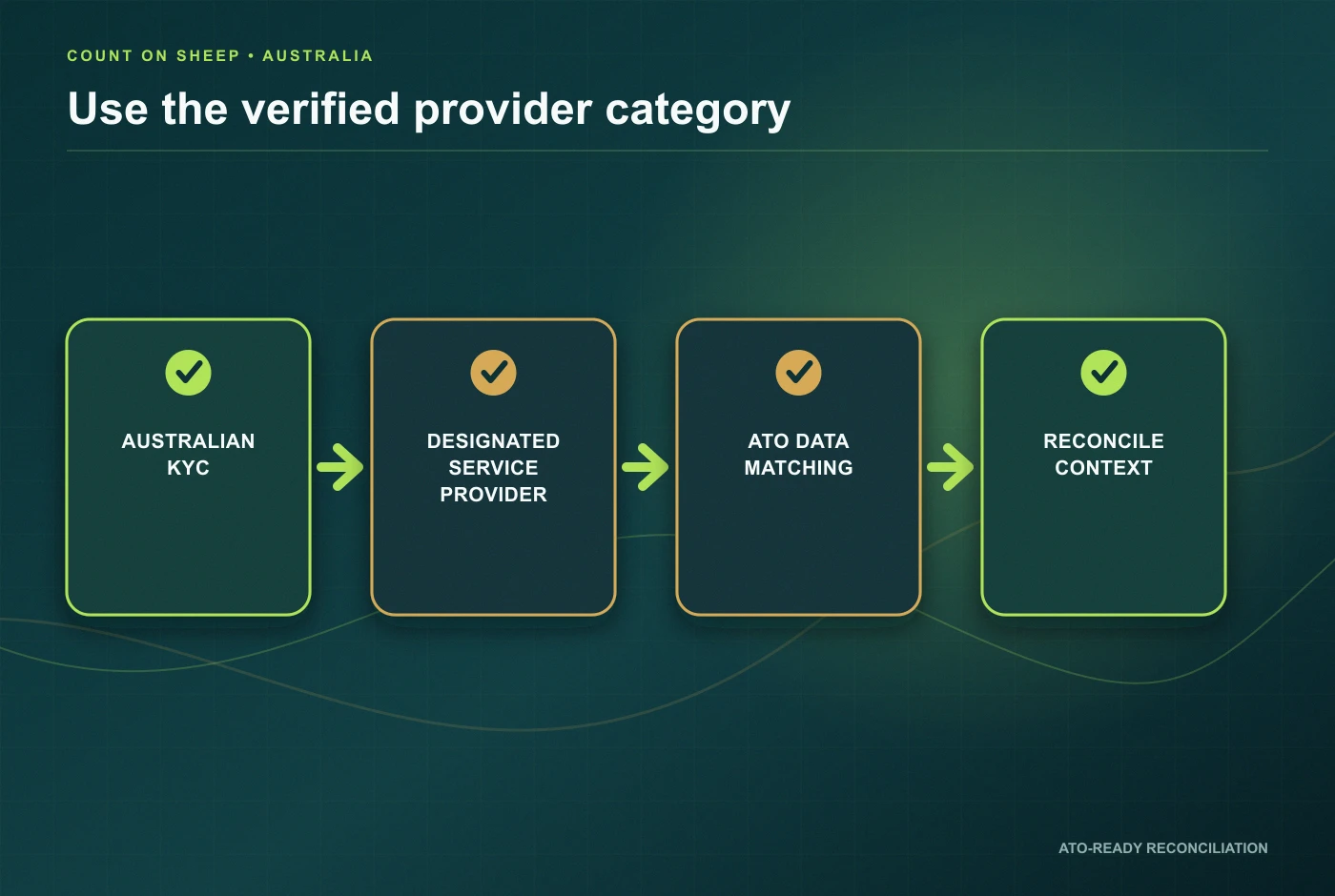
The ATO describes data obtained from Australian crypto designated service providers. It is safer to explain that category than publish a static list claiming exactly which brands report every product and field. Corporate entities, reporting arrangements and platform scope can change.
Australian KYC exchanges
A platform that identifies Australian customers and records transactions can provide strong identity and activity evidence. If you use CoinSpot or another Australian KYC exchange, plan on retaining complete exports and reporting correctly. Do not rely on an unverified claim that a particular platform sits outside ATO visibility.
Offshore platforms are not a safe harbour
An offshore platform may be connected through Australian bank transfers, withdrawals from a domestic exchange, wallet paths or future international reporting. Australian tax obligations do not depend on whether the venue has an Australian brand. Provider access can also disappear, so export the records while they remain available.
Matching does not calculate cost base
An exchange record may show a disposal without the original acquisition, especially after a transfer from another venue. Treating every unmatched deposit as zero cost can overstate gains. Reconcile across accounts before comparing the final figures with the return.
Can the ATO see MetaMask or a self-hosted wallet?
A wallet address is not always a verified identity
A public address generally shows transactions, not a legal name. Someone looking only at the chain may not know who controls it. That limitation should not be confused with anonymity once the address has interacted with a verified account.
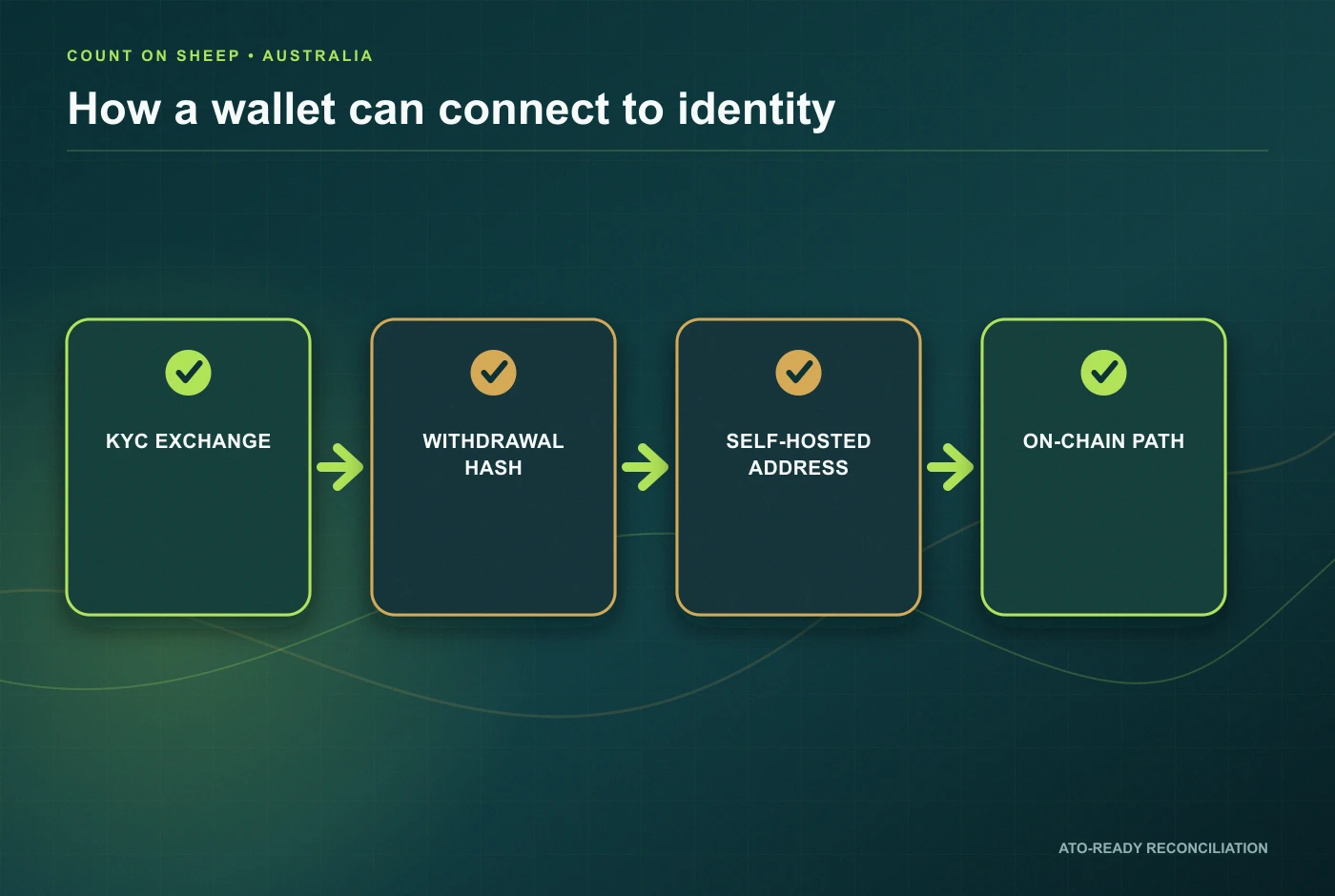
Exchange withdrawals can connect identity to an address
A withdrawal from a KYC exchange to a MetaMask or other self-hosted address can create a link between known account data and the destination. Repeated deposits and withdrawals can strengthen the connection. Transaction hashes provide a direct bridge between exchange records and the chain.
DEXs and bridges add complexity
A decentralised exchange, bridge or protocol can create many smart-contract calls and token legs. The complexity can make automated classification unreliable, but it does not remove the public transaction history. The Australia DeFi tax guide explains why beneficial ownership, receipt tokens and protocol rights require event-level review.
What raw blockchain data cannot settle alone
The chain may not reveal whether two addresses had the same owner, whether a transfer was a gift, what private agreement governed a lending arrangement, or whether a receipt token represented a different legal right. It also may not provide the correct AUD market value. Taxpayers need contextual evidence, not merely a block explorer screenshot.
Is CARF already operating in Australia?
Existing data matching is not CARF
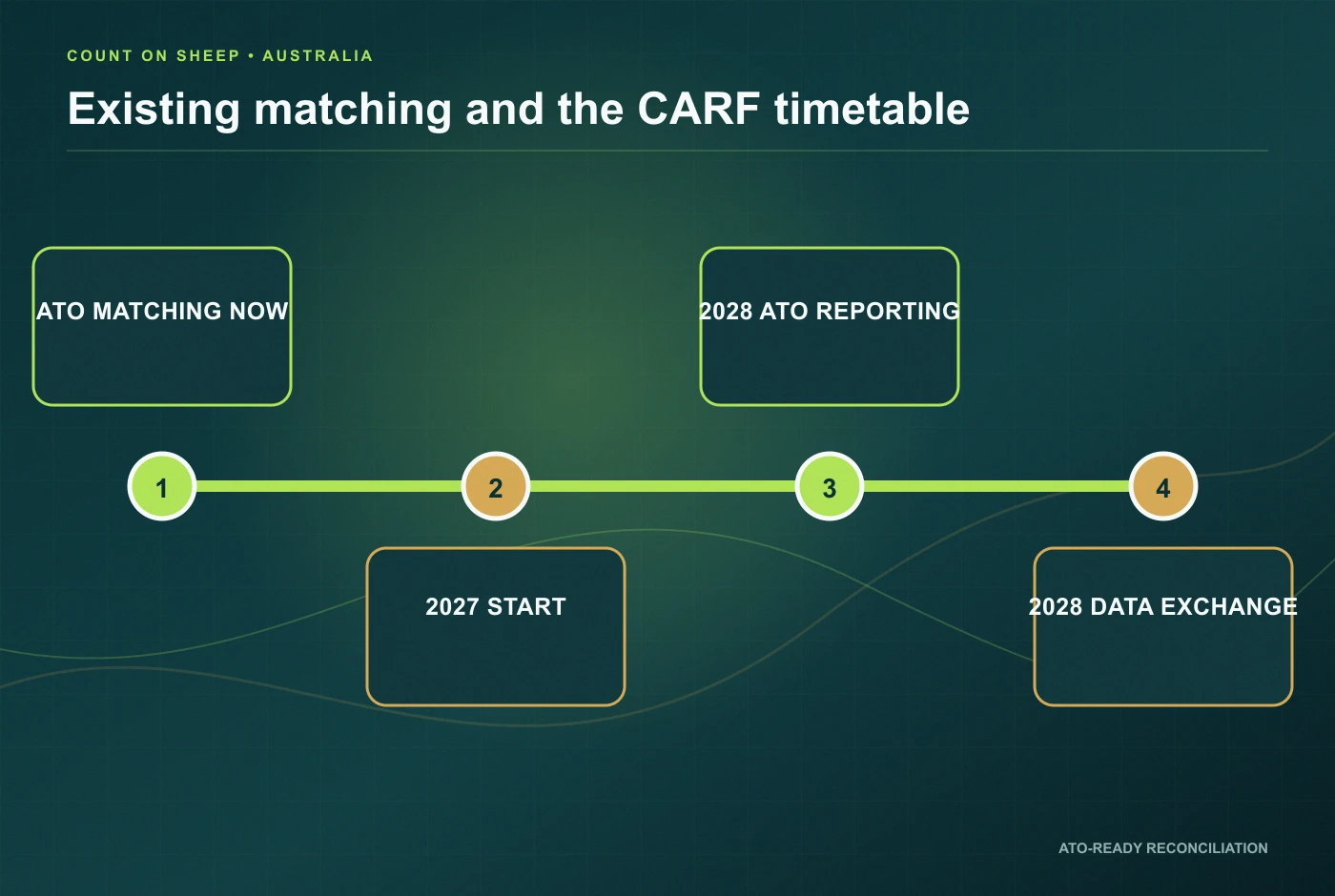
Australia already has a domestic crypto data-matching program. The OECD Crypto-Asset Reporting Framework is a separate reporting system intended to support standardised domestic reporting and exchange of information between tax authorities. Calling existing exchange reporting CARF in 2026 would blur two different programs.
Current government timetable
The 2025-26 MYEFO measure says Australian implementation will commence in 2027. It also says domestic crypto tax reporting will commence in 2027, with reporting to the ATO in 2028, and the first exchange of information with foreign tax authorities in 2028.
Implementation details need rechecking
Treasury consulted on implementation in 2024, but this research did not locate enacted Australian CARF tax legislation as at 27 July 2026. Provider scope, due dates, transitional rules and legislative mechanics should be checked before relying on them. State the government timetable with that qualification.
What CARF changes in practice
The direction is toward more standardised and cross-border reporting. It does not remove the need for reconciliation. Provider data can still be fragmented across years, venues, wallets and DeFi protocols, and a report may identify a disposal without its cost base or context.
What if your crypto was omitted or calculated incorrectly?
Do not guess from wallet balances
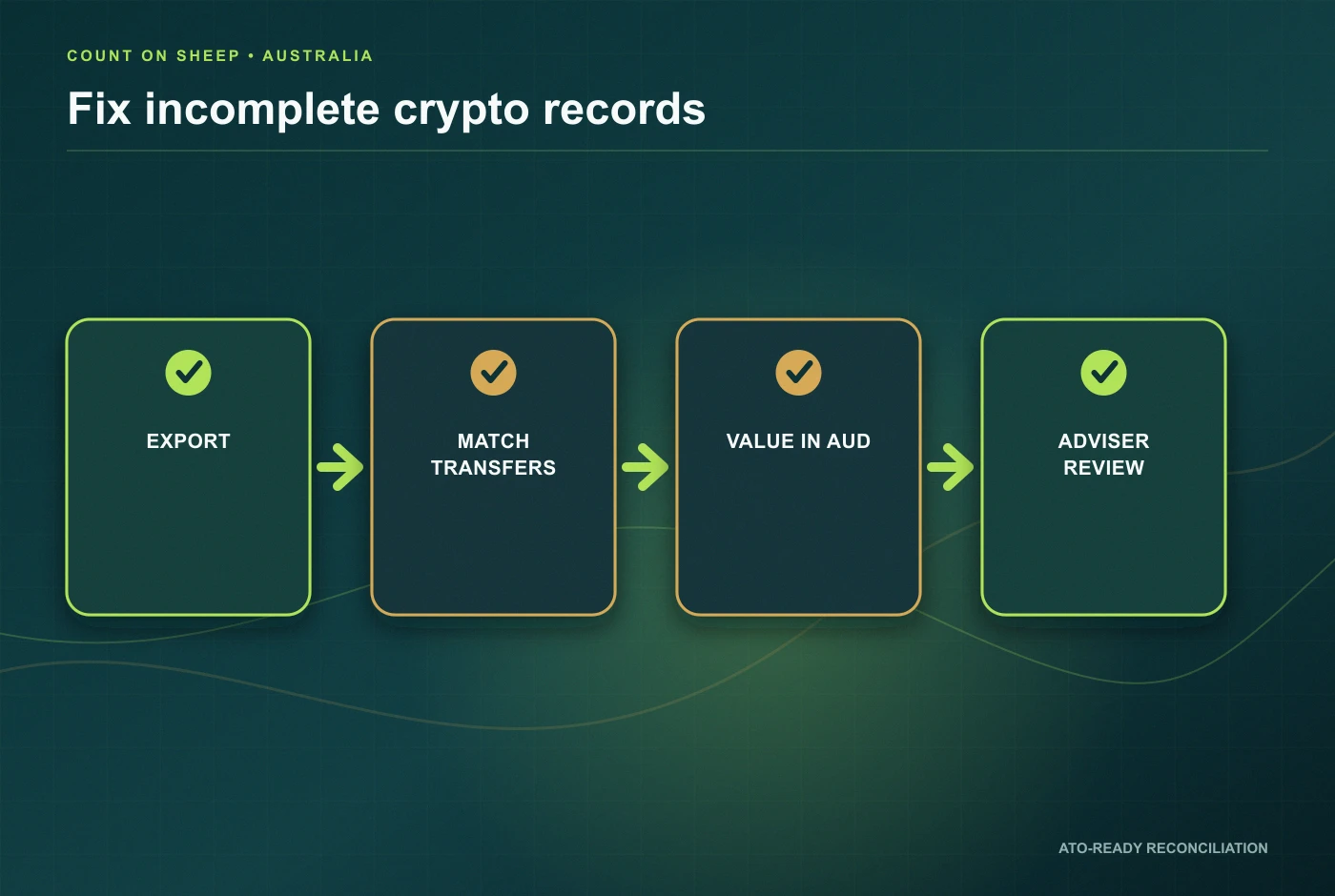
A current wallet balance cannot reconstruct disposals, rewards, fees or AUD values in an earlier year. A bank summary has the same problem. Start with raw exchange exports, public addresses, transaction hashes and prior reports.
Reconstruct transfers and cost base
Match withdrawals with deposits across accounts, identify same-owner transfers and recover original acquisitions. A correct transfer match can prevent both a false disposal and a false zero-cost acquisition. Use the Australian crypto tax calculator guide to understand the required gain inputs.
Separate income and disposal events
Staking rewards, established-token airdrops and some DeFi receipts can create ordinary income before a later disposal. Keep receipt values and later cost-base records connected so the same token history does not disappear or get counted twice.
Take reconciled figures to a registered tax agent
The registered tax agent decides whether an amendment, disclosure or other process is appropriate and advises on timing, penalties and interest. Count On Sheep prepares the evidence-backed digital-asset figures and workpapers. It does not provide Australian tax-agent services or lodge the return.
What records should you preserve now?
Raw exports and statements
Download complete CSV histories and statements from every exchange. Preserve the original file without editing it and keep a note of the account, export date and period. The ATO recommends regular exports because access can disappear.
Wallet addresses and transaction hashes
Maintain a wallet inventory showing chain, address, owner, purpose and active dates. Store transaction hashes for material transfers and protocol actions. Never share seed phrases or private keys with a reconciler.
AUD price evidence
Record AUD market values at the relevant times, with source, timestamp and method. Thinly traded assets and missing token prices should be placed in an exception register rather than filled with unexplained estimates.
Ownership and transfer notes
Document same-owner transfers, shared accounts, gifts, changes in control and addresses belonging to businesses or other entities. These notes explain facts that the blockchain cannot.
Prior reports and workpapers
Keep prior tax-software reports, accountant schedules, capital-loss balances and return workpapers. Do not assume a PDF total is reproducible. The source files and assumptions behind it may be needed to rebuild cost base in a later year.
Reconcile first, then get tax advice
Build one source-linked ledger
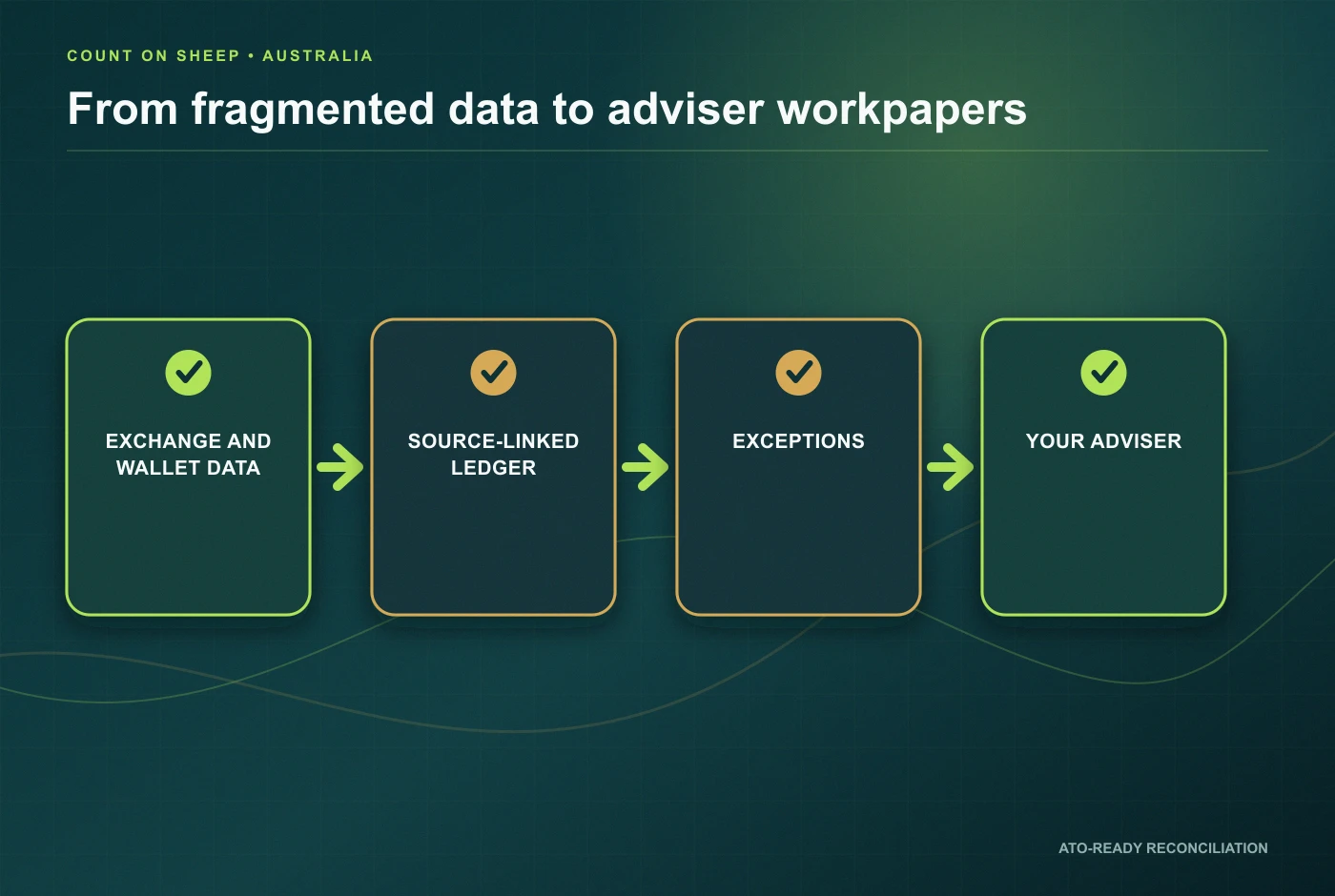
Combine exchange, wallet and protocol records without losing their origin. Standardise timestamps and asset identifiers, then remove duplicate imports with an audit trail. Every material row should link back to a source file or transaction hash.
Resolve transfers and exceptions
Match same-owner movements and separate principal, rewards, fees and protocol rights. Missing acquisitions, uncertain owners, unsupported prices and ambiguous DeFi events belong in a visible exception register.
Compare the reconciled result with reported amounts
Only after the ledger is coherent should gains, income and loss schedules be compared with prior reports or third-party data. A difference needs explanation. It is not automatically unpaid tax, and it should not be hidden by changing software labels.
Give your adviser a complete handoff
Count On Sheep reconciles exchange, wallet and protocol records into ATO-ready figures and workpapers for your own accountant or registered tax agent. Count On Sheep is not a registered tax agent and does not lodge Australian tax returns. Your adviser decides the tax treatment and response.
Get ATO-ready figures for your own accountant or registered tax agent
Count On Sheep reconciles complex digital-asset activity into ATO-ready figures and workpapers for your own accountant or registered tax agent. Count On Sheep is not a registered tax agent and does not lodge Australian tax returns.
Reconcile my reported crypto activityATO crypto data matching FAQs
Does CoinSpot report crypto transactions to the ATO?
The ATO obtains data from Australian crypto designated service providers. Rather than rely on a static brand list, assume an Australian KYC exchange can be within data matching and retain complete records for every account.
Can the ATO see my MetaMask wallet?
A self-hosted address does not always identify its owner by itself. A withdrawal from a verified exchange, bank records and public transaction paths can connect an identity to an address. Raw chain data still may not settle purpose, ownership or tax treatment.
How far back does ATO crypto data matching go?
The published ATO protocol covers the 2014-15 through 2025-26 financial years. The April 2024 gazette notice covers provider data for 2023-24 through 2025-26. Any extension after that should be rechecked.
What happens if I did not report crypto?
Reconstruct the records and obtain advice from a registered tax agent. The tax agent decides whether an amendment, disclosure or other step is appropriate. Do not estimate the answer from withdrawals or a current wallet balance.
Is CARF already active in Australia?
Not under the current Australian timetable. Existing ATO data matching is separate. The government measure says implementation and domestic reporting commence in 2027, with reporting to the ATO and international exchange in 2028. Legislation and final details need rechecking.
What records should I gather before speaking to a registered tax agent?
Gather raw exchange exports, public wallet addresses, transaction hashes, AUD value support, ownership and transfer notes, prior reports, capital-loss schedules and records of DeFi, staking, NFT and reward activity.
More Australia crypto tax guides
Primary sources
- ATO: Crypto assets data-matching program protocol
- Legislation.gov.au: Gazette notice C2024G00249
- OAIC: Crypto assets 2014-15 to 2025-26 data-matching program
- Australian Treasury: Implementing the Crypto-Asset Reporting Framework
- Australian Government: MYEFO 2025-26 CARF measure
- ATO: Keeping crypto records