
Australia does not have a general tax-free amount of crypto that you can sell, swap or cash out. Buying and holding is not a disposal. A resident taxpayer’s AUD 18,200 threshold applies to total taxable income, not crypto by itself. A narrow personal-use rule can disregard a gain where a qualifying personal-use asset was acquired for AUD 10,000 or less. An eligible individual may also receive a 50% CGT discount after at least 12 months, but that discount is not tax-free treatment.
Last reviewed 27 July 2026. Critical rules checked against current ATO, Treasury and legislation.gov.au sources.
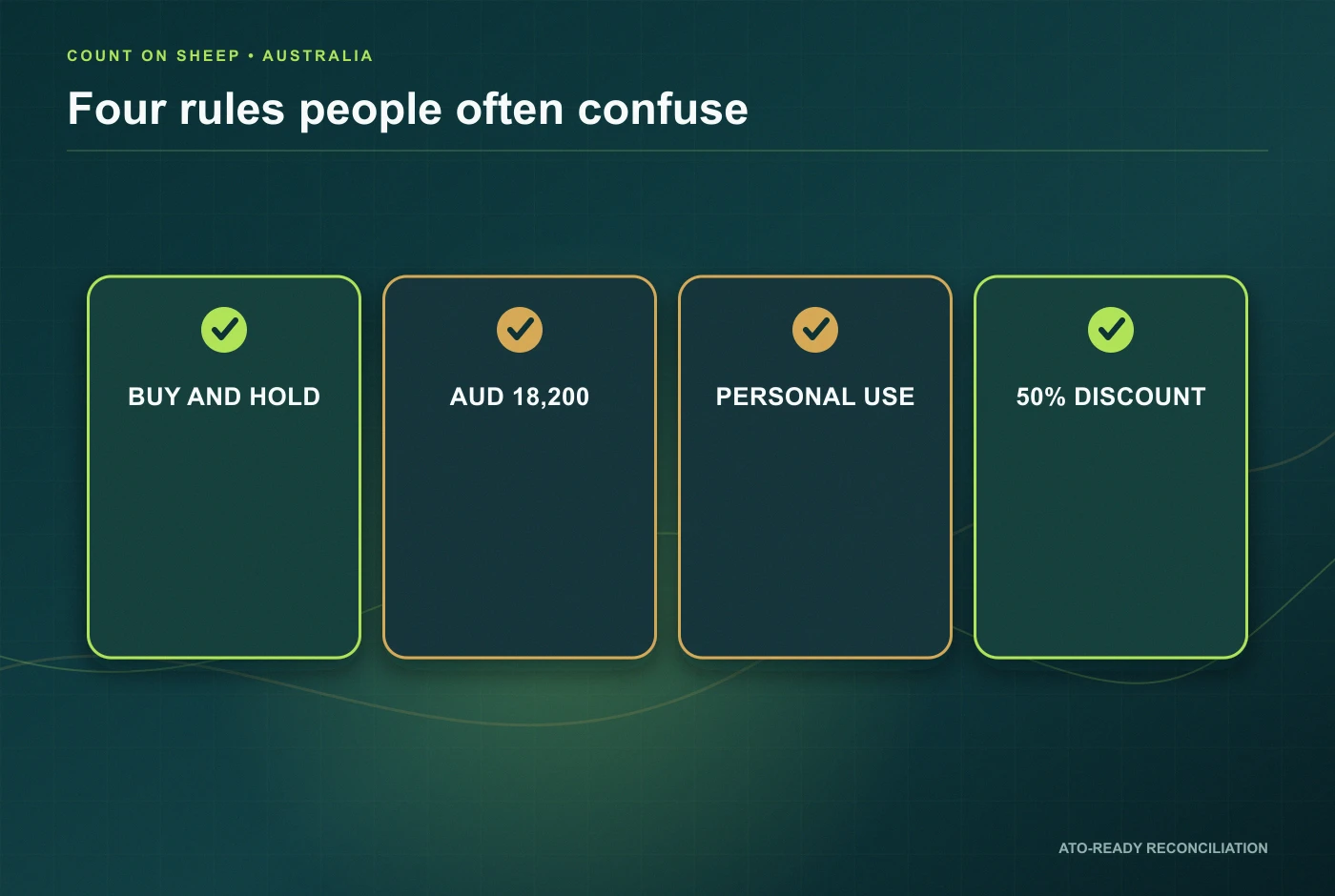
Four rules people often confuse
| Rule | What it actually does | Main condition | Common myth |
|---|---|---|---|
| Buy and hold | No current disposal merely because value rises | You still own the asset | Every price increase is immediately taxed |
| AUD 18,200 threshold | Applies to a resident’s total taxable income | Whole-return calculation | It is a separate crypto allowance |
| Personal-use asset | May disregard a qualifying capital gain | Mainly personal consumption and acquired for AUD 10,000 or less | The first AUD 10,000 of any crypto is exempt |
| 50% CGT discount | May reduce an eligible gain after losses | Eligible taxpayer, at least 12 months and other conditions | Twelve months makes crypto tax-free |
Is there a crypto tax-free threshold in Australia?
There is no separate crypto allowance
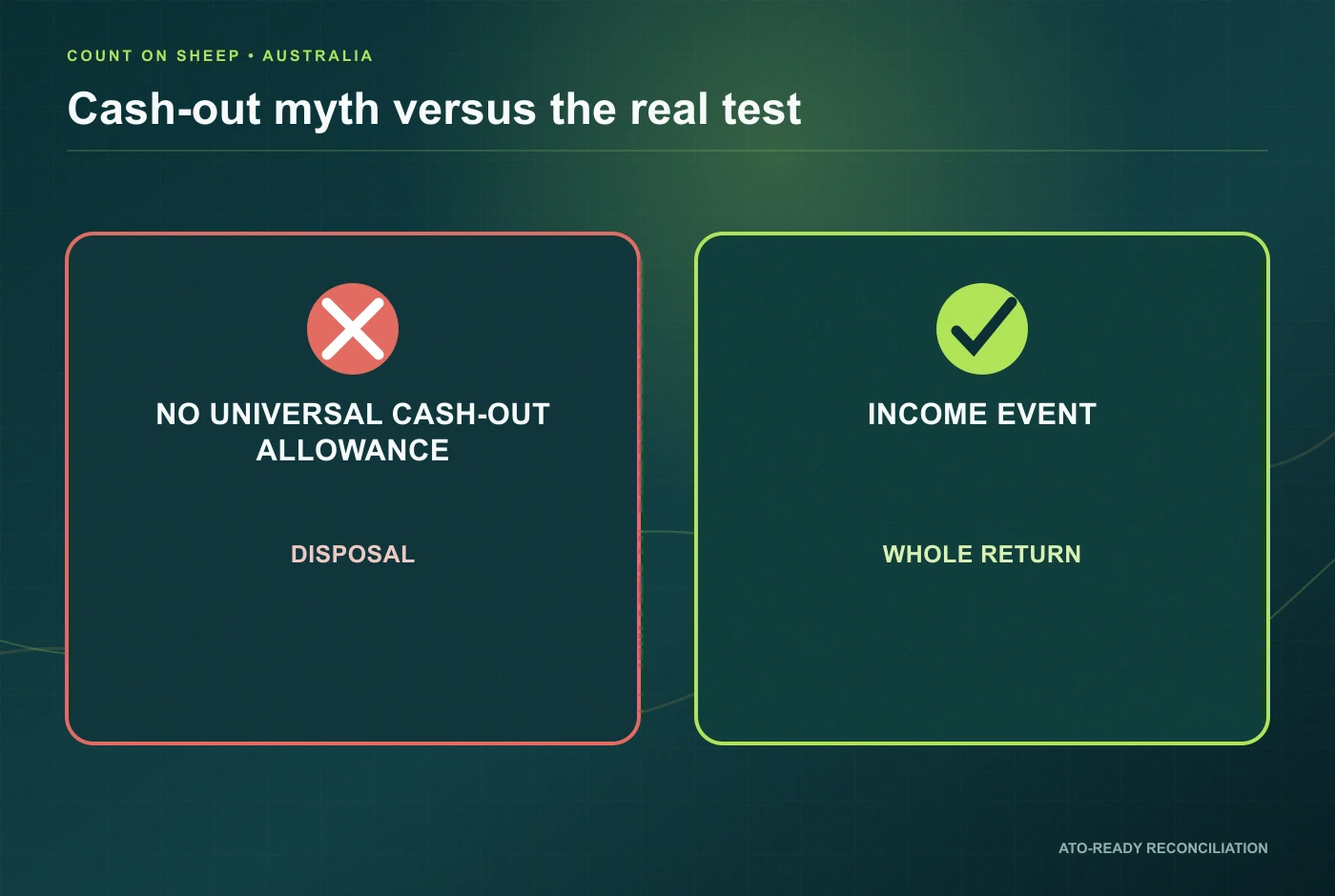
Australian tax law does not give each person a fixed annual amount of crypto sales, withdrawals or gains that sits outside tax. The relevant result depends on what happened to the asset, whether the amount is on capital or revenue account, the taxpayer’s losses and discounts, and the rest of the tax return. A transaction can be reportable even when little or no final tax is payable.
The first question is therefore not how much reached a bank account. It is whether a disposal or income event occurred. Selling for AUD, swapping one token for another, spending crypto and gifting it can create CGT consequences for an investor. Staking rewards and some airdrops can be ordinary income. A genuine trading business follows different rules again.
A bank withdrawal is not the tax trigger
Moving AUD from an exchange to a bank generally reflects an earlier transaction. The sale on the exchange may be the disposal. Keeping sale proceeds on the platform does not erase that sale, and withdrawing a smaller amount does not cap the gain. Reconcile the underlying trades and transfers instead of estimating tax from cash movement.
Classification and total income still matter
An investor generally calculates capital gains and losses. A person carrying on a crypto-trading business generally deals with trading stock and ordinary business income. The distinction is based on the whole activity, not a label chosen in software. See the Australian investor versus trader guide before assuming one set of rules.
When buying and holding creates no current CGT event
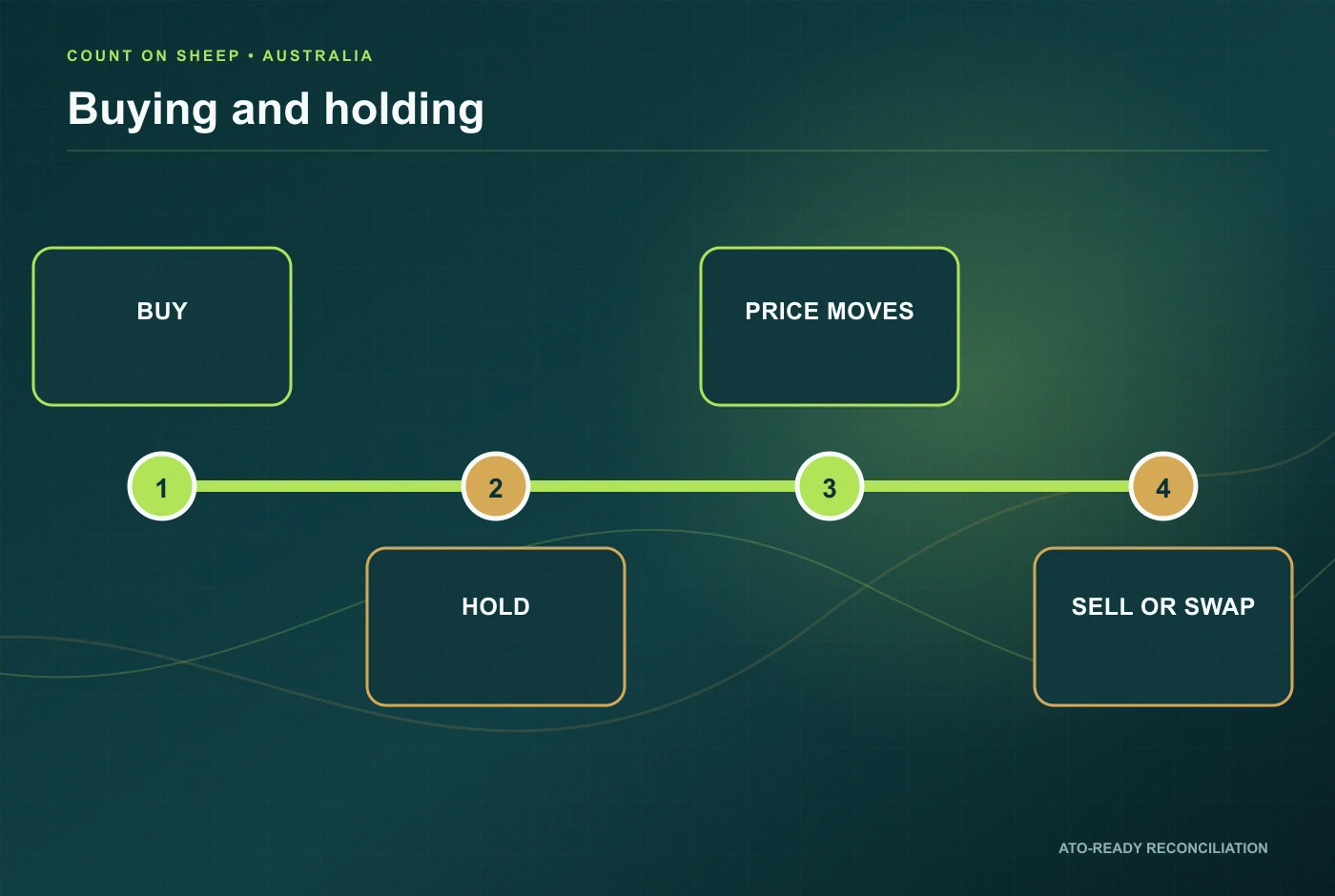
Buying crypto
Buying a crypto asset with AUD normally establishes an acquisition and cost-base record rather than a capital gain. Record the date, units, AUD amount, fees, account and source document. Those facts become important when the asset is later sold, swapped, spent or gifted.
Holding through a price increase
An unrealised increase in the market price of an investment asset does not by itself create a disposal. A wallet balance can rise for years without a current capital gain merely because the asset is still held. Income can arise during the holding period, though. Staking rewards are a common example, and the later sale of the reward can create a separate CGT calculation.
Same-owner wallet transfers
A transfer between wallets under the same beneficial ownership is not itself a disposal simply because the address changed. Preserve the sending and receiving records, transaction hash and ownership evidence. Software can mistake an unmatched withdrawal for a sale or an unmatched deposit for zero-cost crypto.
Fees paid in crypto can still matter
A network fee paid with crypto can involve a small disposal of the fee token. The main transfer may be non-taxable while the fee leg needs its own AUD value and cost base. This is why wallet activity should be read event by event rather than labelled with one rule.
How the AUD 18,200 tax-free threshold interacts with crypto
It applies to total resident taxable income
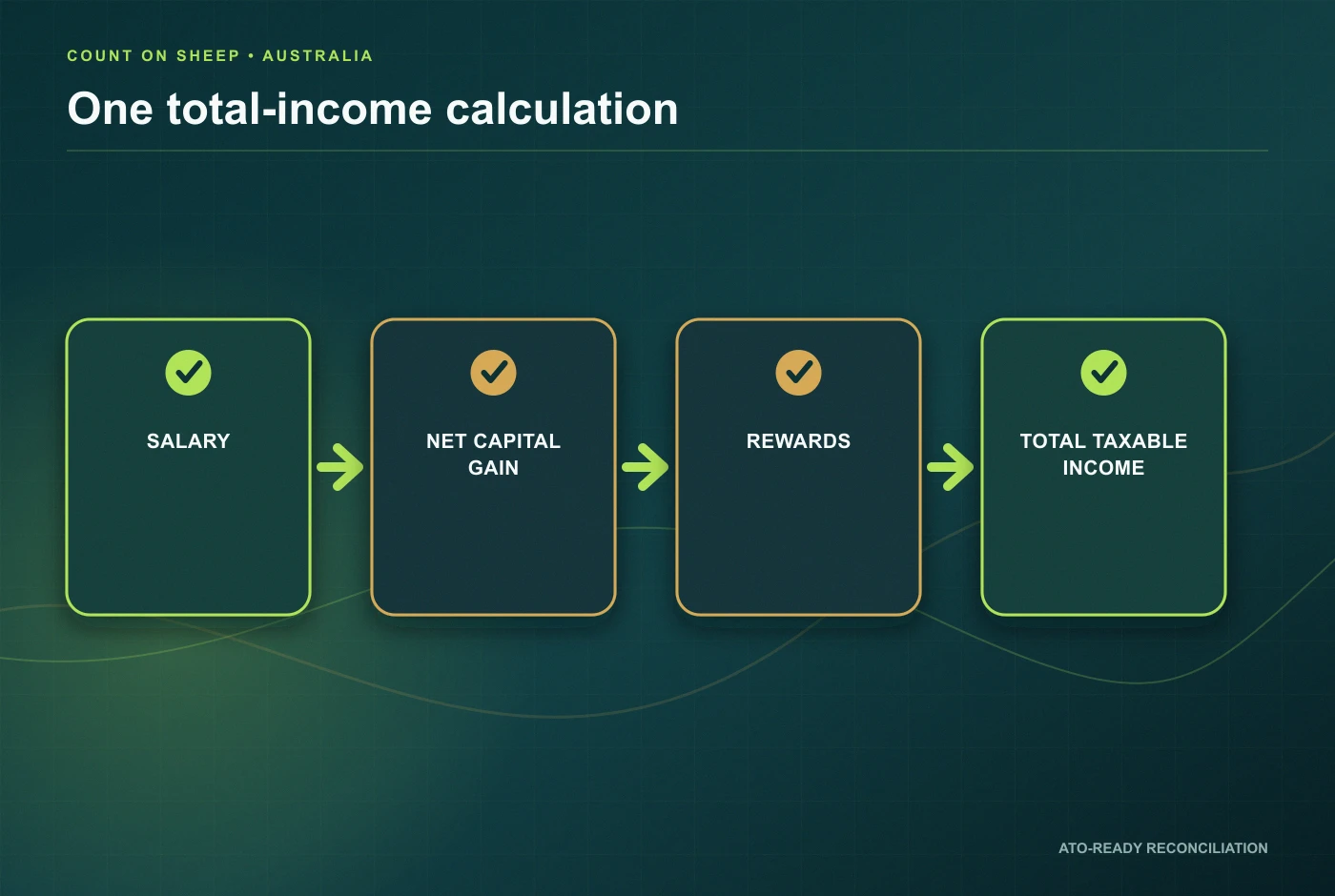
The resident tax-free threshold is AUD 18,200. It is not reserved for crypto and does not reset for each asset or exchange. Salary, net capital gains, taxable staking rewards, established-token airdrops, business profit and other assessable amounts feed into the taxpayer’s overall position under their applicable rules.
For 2026-27, the legislated resident rates begin at 0% to AUD 18,200, then 15% from AUD 18,201 to AUD 45,000. Higher bands apply above that. Those rates exclude the Medicare levy. Annual rates, residency and personal circumstances should be checked for the actual return being prepared.
Net capital gain is an input, not the final bill
For an investor, capital gains and eligible capital losses are worked through the CGT calculation. Any available discount is applied in the correct order. The resulting net capital gain enters assessable income. Calling the net capital gain the tax payable confuses an income amount with the eventual whole-return calculation.
Ordinary crypto income also uses the same return
Staking rewards are ordinary income at their money value when received under the ATO’s published position. That amount does not receive the CGT discount. If the reward is later sold, the later disposal can produce a capital gain or loss using its supported acquisition value and disposal proceeds.
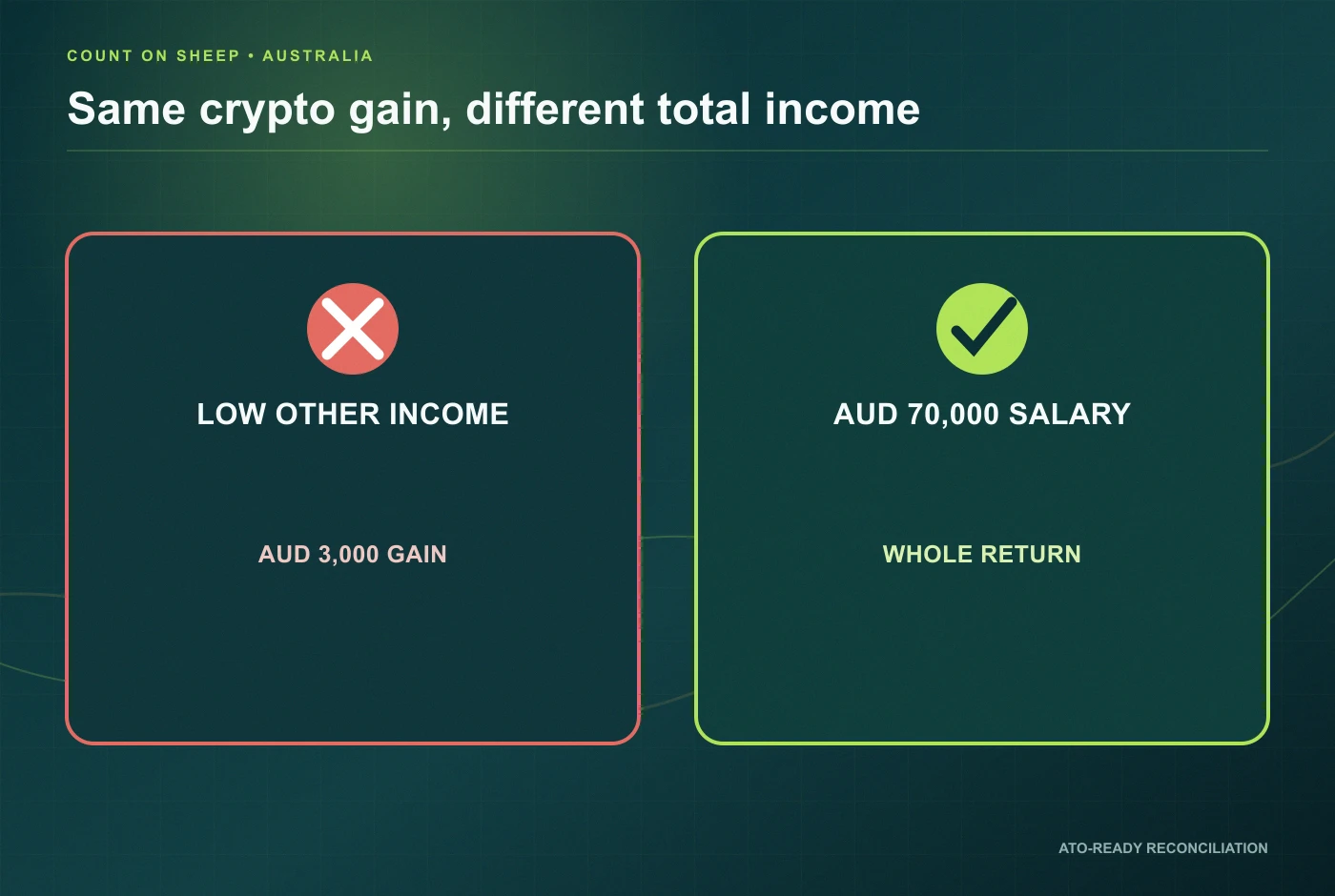
Two taxpayers can have the same crypto gain and different outcomes
Example with little or no other taxable income
Assume a resident individual has no salary and has a AUD 3,000 net capital gain after applying the correct loss and discount rules. That amount enters the whole return. It may still leave taxable income below AUD 18,200, but offsets, Medicare levy rules, residency and other amounts must be considered before saying no tax is payable.
Example with AUD 70,000 salary
Now assume another resident individual has the same AUD 3,000 net capital gain and AUD 70,000 of salary. There is no additional AUD 18,200 crypto allowance. The crypto amount is added to the taxpayer’s existing taxable-income calculation and is generally exposed to the applicable marginal rate.
Why a whole-return calculation matters
The examples start with an already calculated net capital gain. Real files also need capital-loss history, residency, income categories, eligible deductions and other return data. Count On Sheep prepares the digital-asset figures and workpapers. The client’s accountant or registered tax agent completes the tax calculation and lodges the return.
What the AUD 10,000 personal-use rule actually says
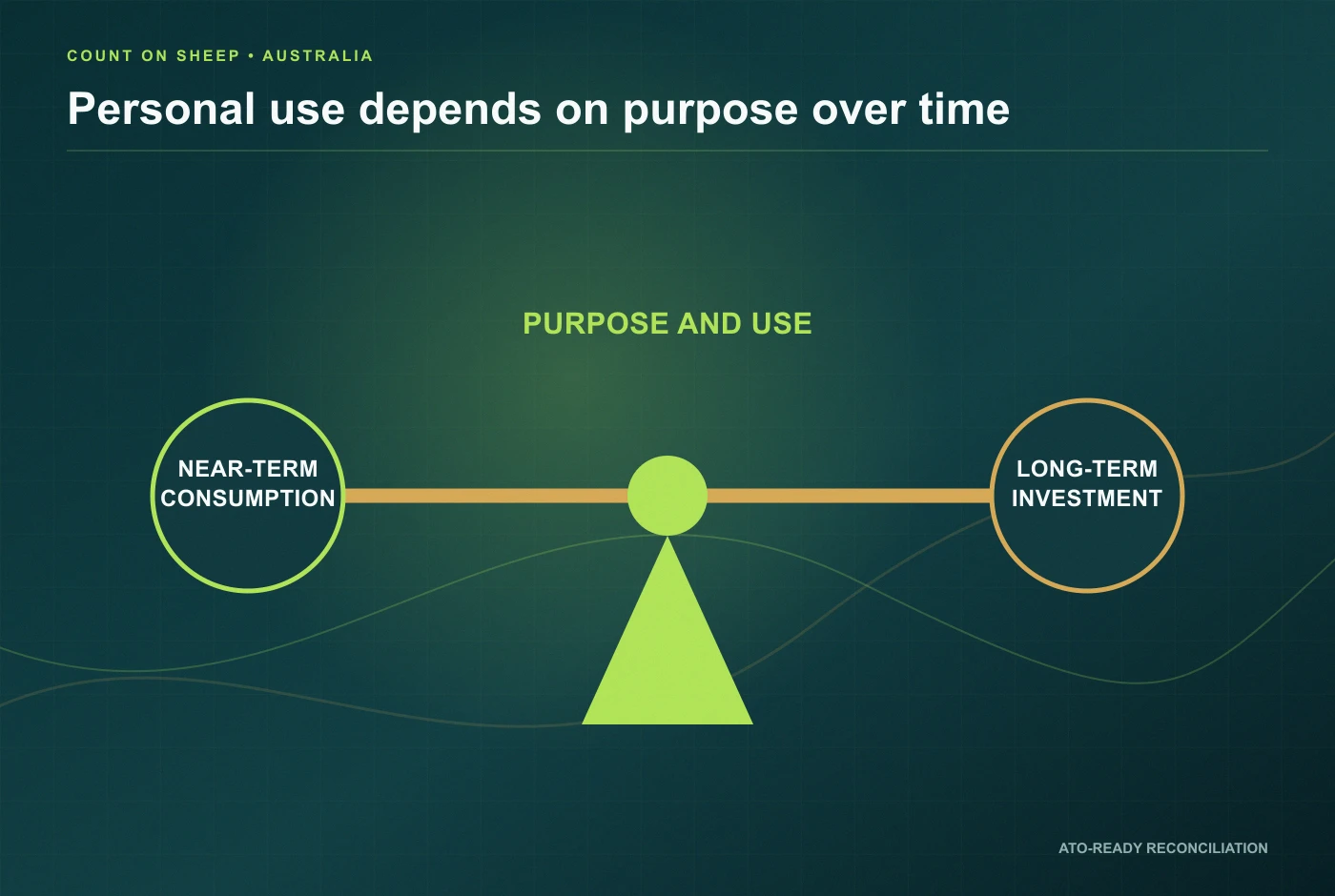
The asset must be mainly for personal use or consumption
Crypto can be a personal-use asset when it is kept or used mainly to buy items for personal use or consumption. The test looks at the main use over the ownership period. Buying crypto shortly before spending it on a personal item can support the conclusion more readily than holding it as an investment while waiting for price growth.
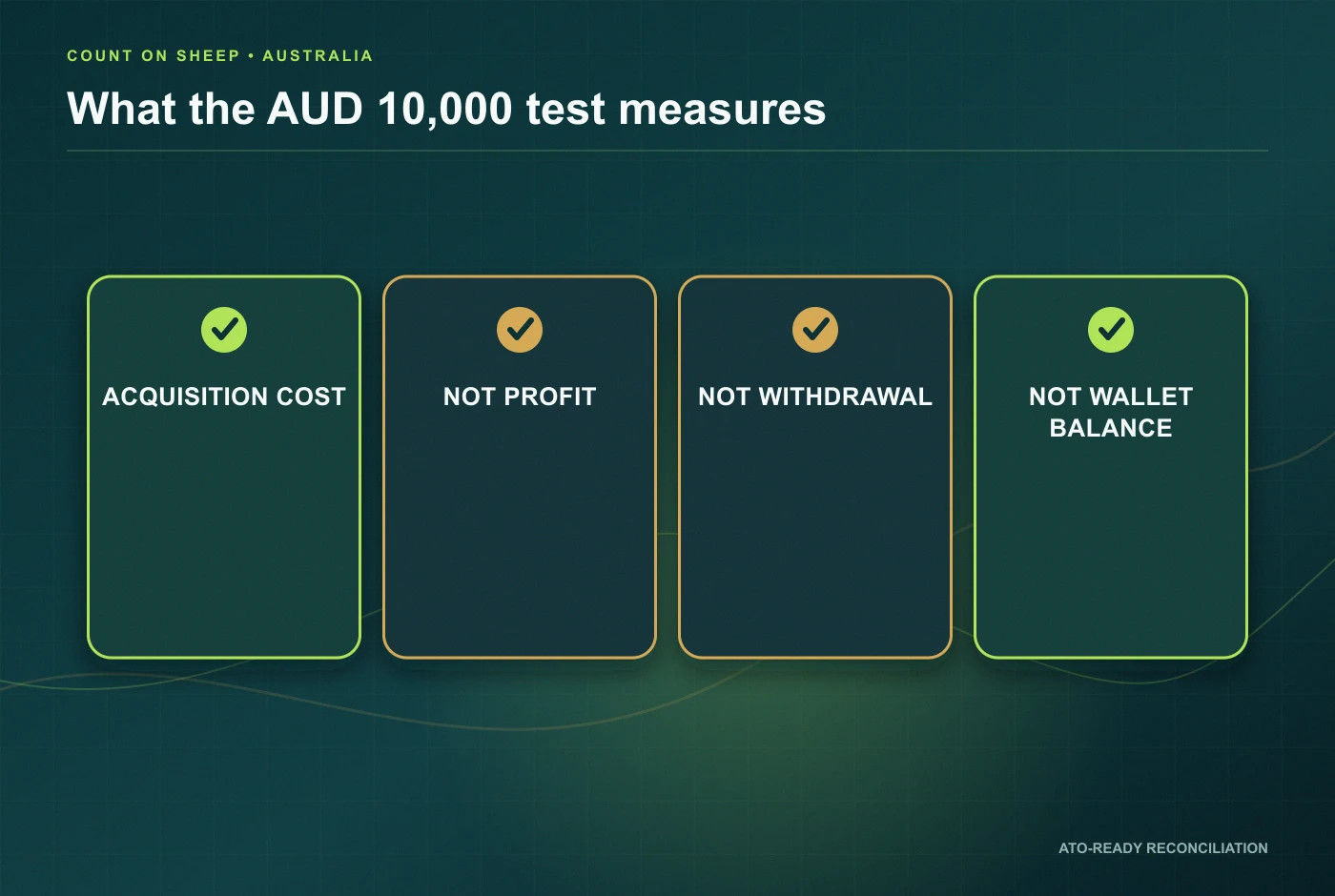
AUD 10,000 refers to acquisition cost
A capital gain from a qualifying personal-use asset is disregarded if that asset was acquired for AUD 10,000 or less. The figure is not the amount of gain, sale proceeds, cash withdrawn or wallet balance. Splitting an investment disposal into smaller withdrawals does not turn it into personal use.
Personal-use losses are disregarded
A capital loss from a personal-use asset is disregarded. A taxpayer cannot usually claim the favourable gain rule while preserving losses for investment use. Purpose, timing and actual consumption should be documented consistently.
Do not confuse two separate AUD 10,000 rules
The ATO’s annual CGT instructions can require a CGT schedule when total current-year capital gains or losses exceed AUD 10,000. That reporting threshold is not the personal-use acquisition-cost test. The same number appears in two rules that answer different questions.
Does holding crypto for 12 months make it tax-free?
An eligible individual may receive a 50% discount
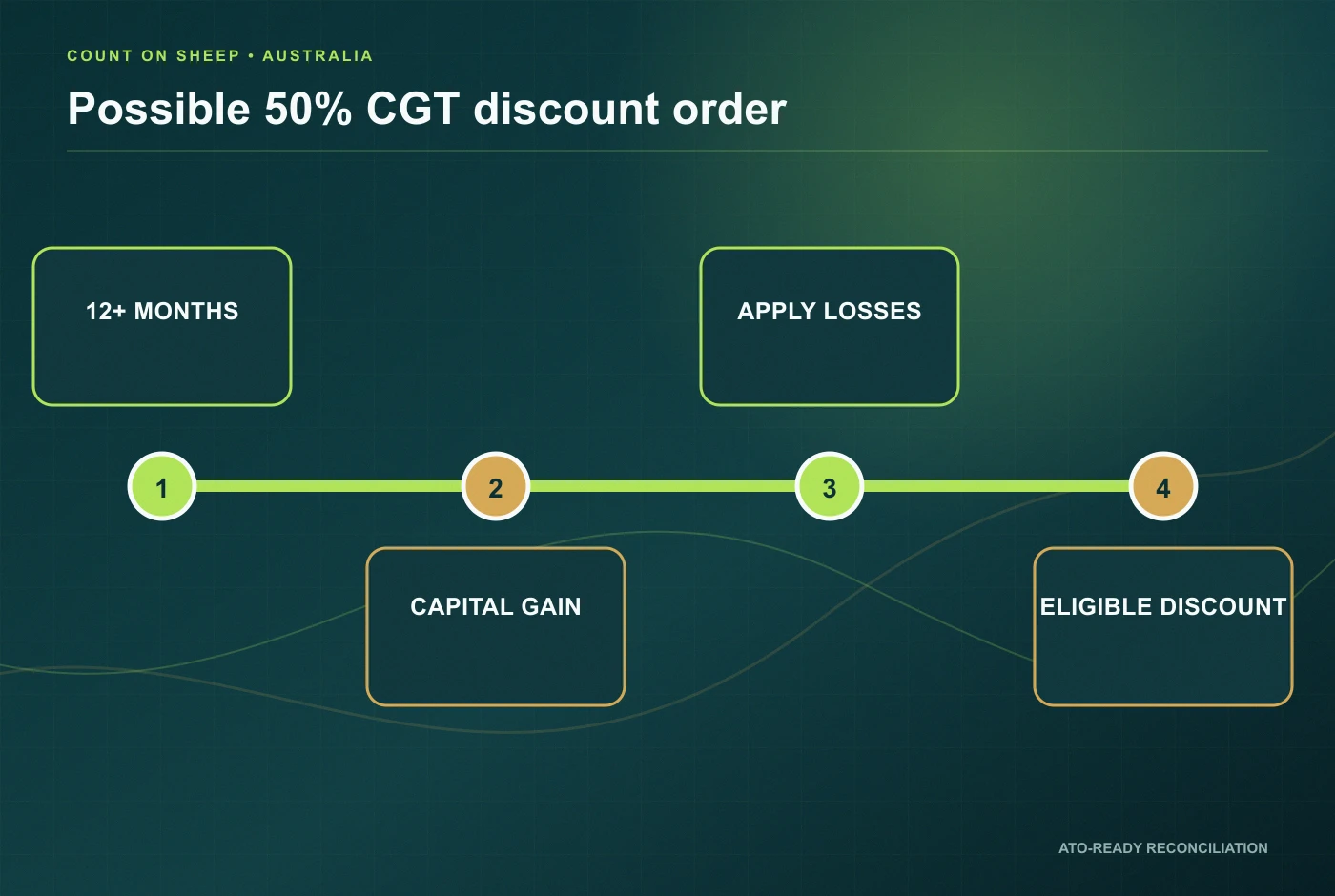
An Australian resident individual may be eligible to reduce a capital gain by 50% after owning the CGT asset for at least 12 months and meeting the other Division 115 conditions. The wording matters. The discount may apply to an eligible gain, not to every token held for a year.
Capital losses are applied first
Current-year and carried-forward capital losses reduce capital gains before the CGT discount. A taxpayer cannot discount a gain and then use the full loss against other income. Keep parcel dates and loss schedules so the ordering can be reproduced.
AUD 6,000 gain illustration
Assume an eligible resident individual sells an investment parcel for AUD 16,000 with a supported AUD 10,000 cost base. There are no capital losses, the parcel was held for at least 12 months and all discount conditions are satisfied. The AUD 6,000 capital gain may be reduced to AUD 3,000. The AUD 3,000 enters taxable income. It is not the final tax payable.
Companies do not receive the 50% discount
Companies are not entitled to the 50% CGT discount. Trading-stock profit in a crypto-trading business also does not receive it. Entity type, classification, parcel identity and dates need to be settled before applying a percentage. The Australian crypto tax calculator guide walks through cost base, losses and discount ordering.
Other situations where no tax may be payable
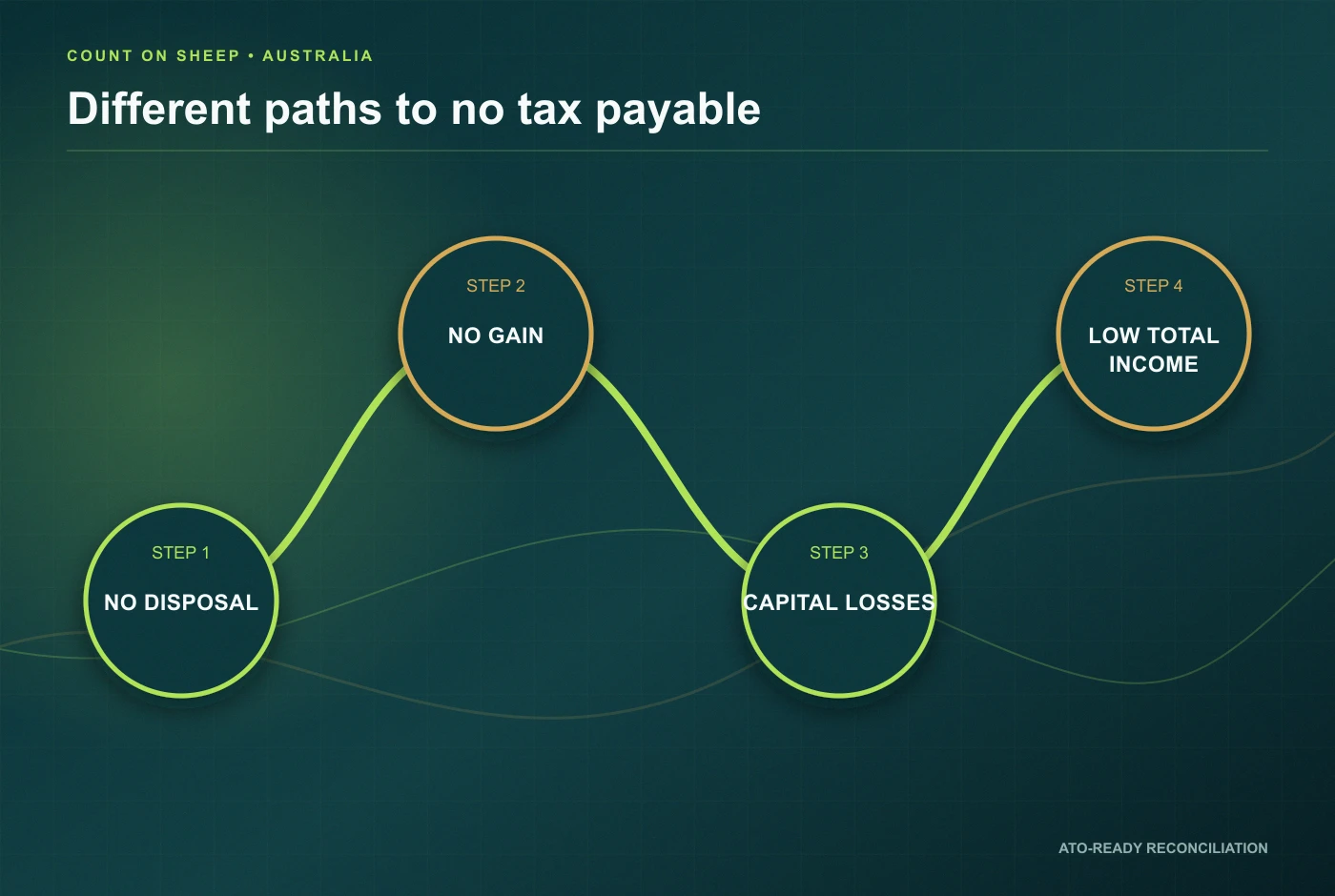
No disposal occurred
Buying and continuing to hold an investment asset may leave an unrealised gain outside the current CGT calculation. A supported same-owner wallet transfer also may not be a disposal. Check fee legs and income events separately.
There was no capital gain
A disposal can be reportable without producing a gain. Capital proceeds may equal the cost base, or the transaction may produce a capital loss. The absence of profit should come from a documented calculation rather than a wallet-balance estimate.
Capital losses reduced capital gains
Current-year or carried-forward capital losses can reduce capital gains. Excess capital losses move to later years and cannot ordinarily reduce salary or staking income. A personal-use asset loss is disregarded.
Low overall taxable income
After correct calculations, a taxpayer’s total taxable income may sit within the applicable tax-free threshold. This is a whole-return conclusion. It should not be marketed as a crypto loophole or predicted before the other income and tax circumstances are known.
Tax-reduction claims to treat cautiously
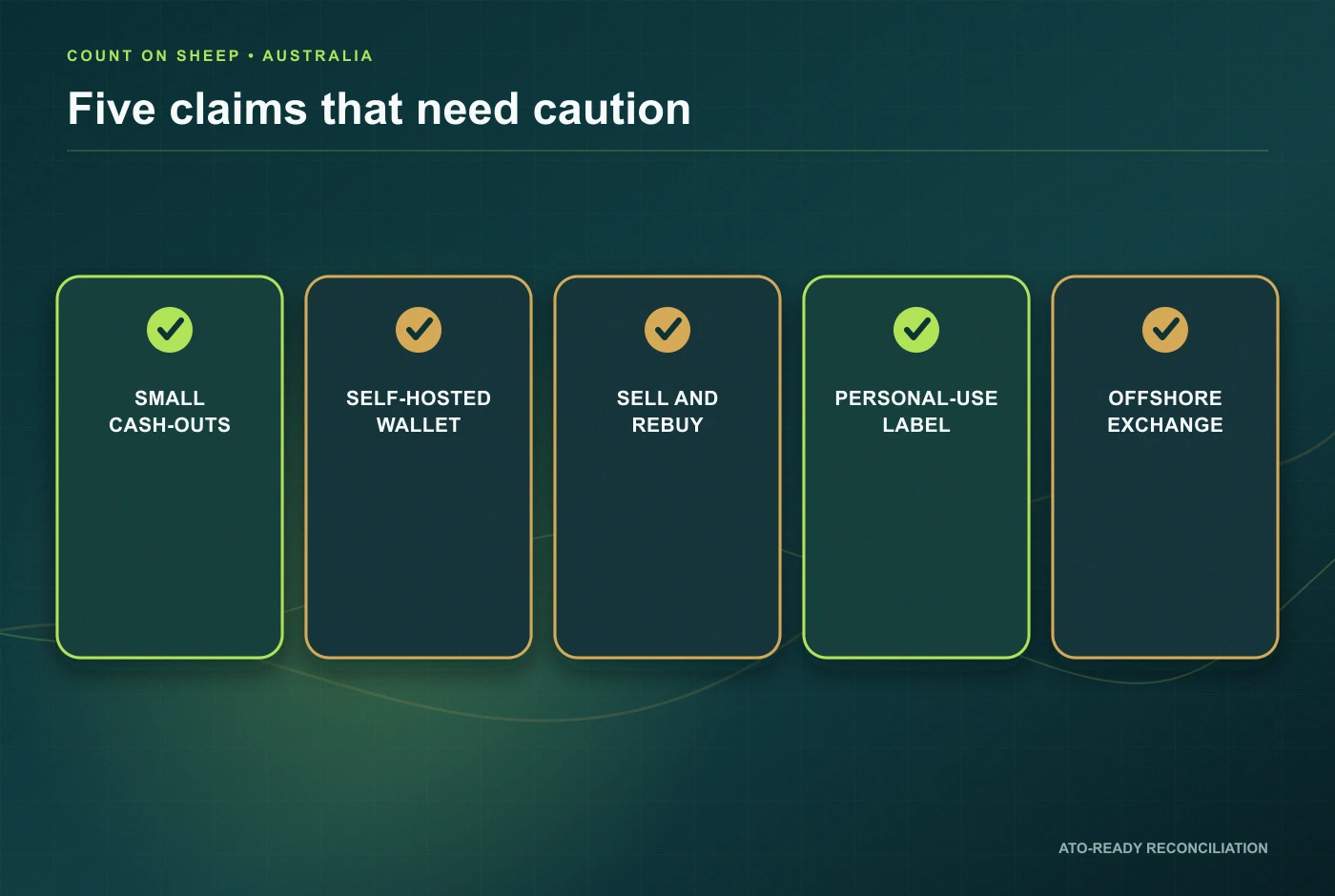
Cash out in small amounts
Small withdrawals do not create an exemption. The taxable event can be the earlier sale, swap, spend or reward receipt. Break a report into real events rather than bank transfers.
Move crypto to a self-hosted wallet
A same-owner transfer can be non-disposal, but it does not remove the asset’s history. Exchange KYC, bank information, wallet addresses and public blockchain records can be combined. Read how ATO crypto data matching works before relying on visibility myths.
Sell and buy back immediately
Australia does not provide a mechanical 30-day crypto wash-sale safe harbour. TR 2008/1 and Part IVA can apply to arrangements that dispose of and reacquire the same or substantially the same asset while preserving economic exposure and pursuing a tax benefit. Timing, purpose, ownership and exposure all matter.
Call investment crypto personal use
A label added after a profitable sale does not change how the asset was mainly kept or used. Retain evidence of the intended purchase, timing and actual personal consumption. Long holding and an investment purpose weigh against the personal-use rule.
Use an overseas exchange
An offshore venue does not alter an Australian resident’s tax obligations by itself. Bank transfers, exchange records and blockchain activity can connect accounts. Future CARF exchanges may add cross-border reporting from 2028 under the current government timetable, subject to legislation and final implementation details.
Records that support the correct rule
Acquisition and parcel evidence
Keep acquisition dates, quantities, AUD values, fees, exchange records and transaction hashes. Match the units sold to a supported parcel. Parcel identity affects cost base, holding period and possible discount eligibility.
Purpose and personal use
For a possible personal-use asset, preserve why the crypto was acquired, what personal item was intended, how long the asset was held and how it was actually spent. A bank withdrawal does not prove personal consumption.
Income and capital-loss history
Keep reward receipt dates and values, prior CGT schedules and carried-forward capital-loss workpapers. A capital loss can matter years later, so preserve the source records while it remains relevant.
AUD values and fees
Record the AUD market value at each relevant event and identify the price source and timestamp. Fees can affect cost base, proceeds or form a separate crypto disposal depending on the facts. Unsupported conversions make an otherwise simple threshold analysis difficult to defend.
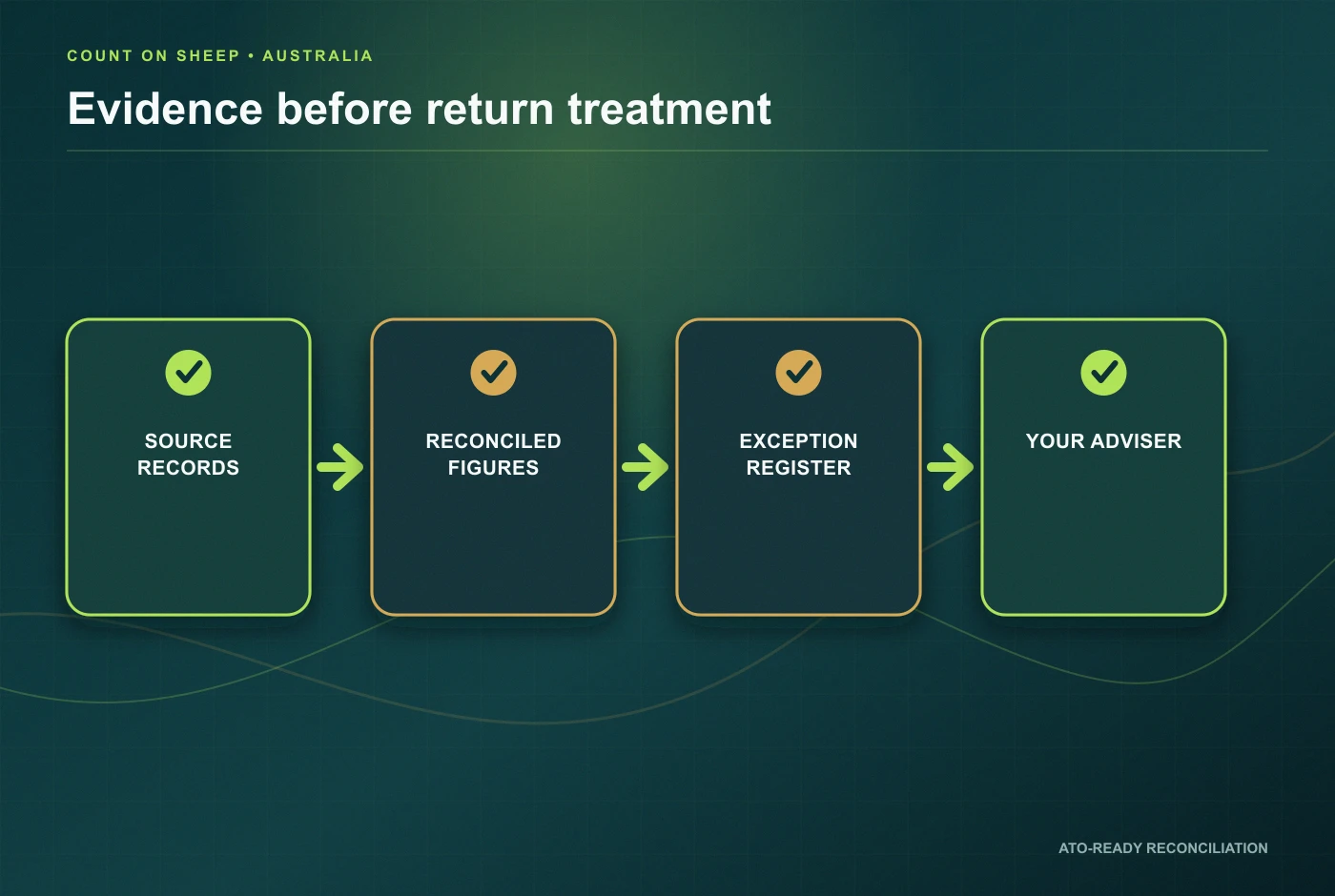
Get the figures right before your adviser applies the return rules
Reconcile all disposals and same-owner transfers
Combine exchange and wallet histories, remove duplicate imports and match internal transfers. Separate purchases, disposals, reward receipts and fee legs. A complete ledger prevents a withdrawal-based estimate from replacing transaction evidence.
Calculate cost base and eligible gains
Translate values to AUD at the relevant time, identify parcels and calculate gains and losses in the correct order. Flag missing basis and unsupported assumptions instead of silently using zero. The registered tax agent can then review which gains qualify for a discount.
Identify personal-use and discount evidence
Build a schedule showing acquisition cost, purpose, holding period, disposal and source links for each amount that may depend on a special rule. Keep questions visible. The service boundary is evidence and reconciliation, not making an unsupported tax decision.
Hand the workpaper to your adviser
Count On Sheep prepares ATO-ready digital-asset figures and workpapers for your own accountant or registered tax agent. Count On Sheep is not a registered tax agent and does not lodge Australian tax returns. Your adviser decides the final treatment and completes the return.
Get ATO-ready figures for your own accountant or registered tax agent
Count On Sheep reconciles complex digital-asset activity into ATO-ready figures and workpapers for your own accountant or registered tax agent. Count On Sheep is not a registered tax agent and does not lodge Australian tax returns.
Reconcile my Australian crypto figuresAustralian crypto tax-free threshold FAQs
How much crypto can I sell tax-free in Australia?
Australia has no general amount of crypto that every person can sell tax-free. Tax depends on the disposal, cost base, capital losses, possible discount, classification and the taxpayer’s total income. A small cash withdrawal is not an exemption.
Is the first AUD 10,000 of crypto tax-free?
No. The AUD 10,000 personal-use rule tests the acquisition cost of an asset kept or used mainly for personal consumption. It is not the first AUD 10,000 of profit, proceeds, withdrawals or holdings.
Does the AUD 18,200 threshold apply separately to crypto?
No. The resident tax-free threshold applies to total taxable income. Net capital gains, taxable crypto rewards, salary and other assessable amounts feed into the same whole-return calculation.
Is buying and holding crypto taxable?
Buying and continuing to hold an investment crypto asset does not generally create a capital gain merely because its market price rises. Income received while holding and fees paid in crypto can have separate consequences.
Does holding crypto for 12 months make it tax-free?
No. An eligible Australian resident individual may receive a 50% CGT discount on an eligible capital gain after at least 12 months and other conditions. Losses are applied first, and the remaining net capital gain enters taxable income.
Can crypto capital losses reduce my salary income?
Capital losses can reduce capital gains in the current or later income years. They cannot ordinarily be deducted from salary or other ordinary income. Personal-use asset losses are disregarded.