
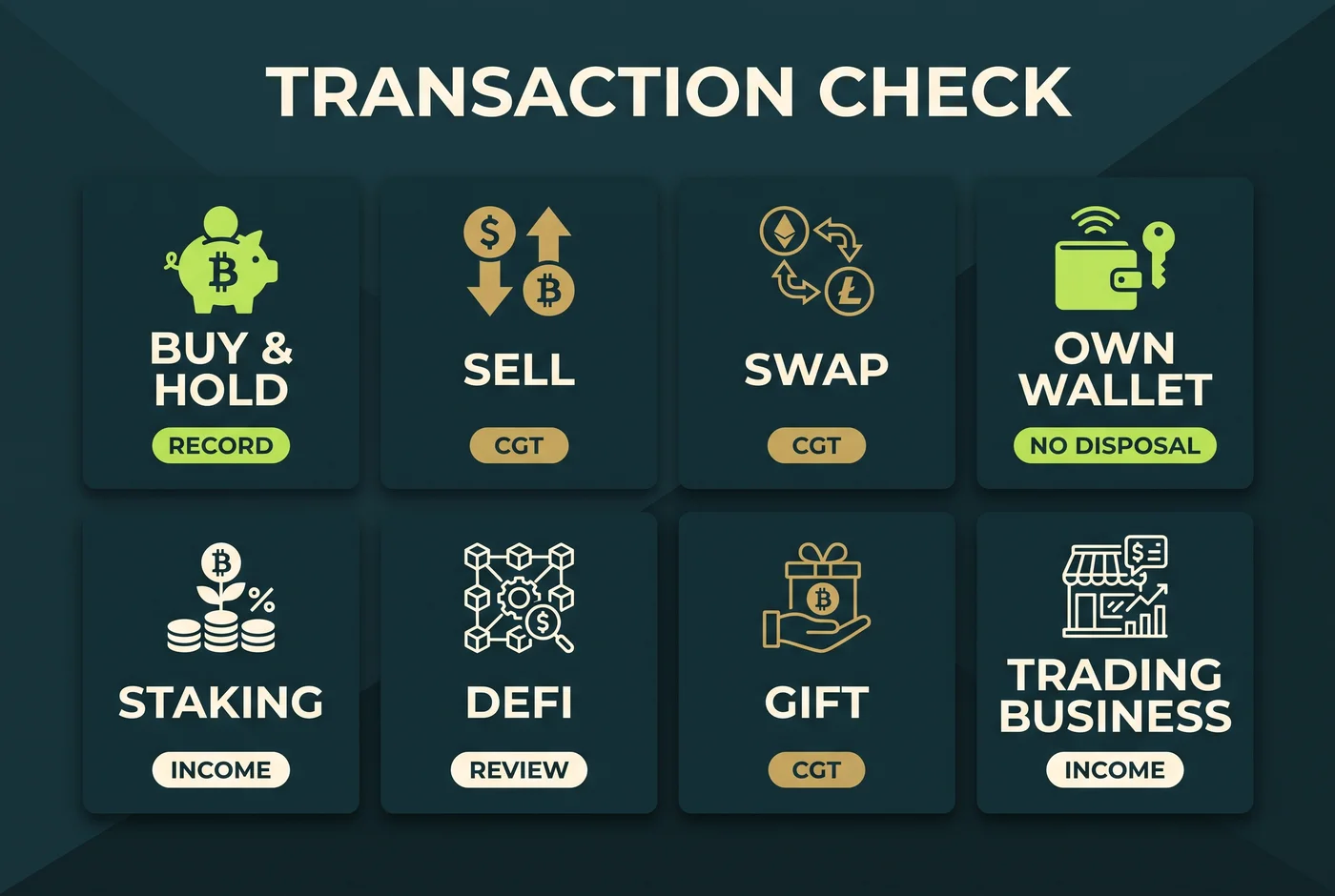
Crypto is generally treated as a CGT asset when held as an investment. Selling, swapping, spending or giving it away can trigger a CGT event. Staking rewards, established airdrops and business activity can instead produce ordinary income. Eligible individuals may receive a 50% CGT discount after holding an asset for at least 12 months. The answer depends on classification, complete AUD records and the facts of each transaction.
Last reviewed 27 July 2026. Critical rules checked against current ATO, Treasury and legislation.gov.au sources.
Australia crypto tax at a glance
| Activity | Likely tax account | AUD value needed | Key record | Detailed guide |
|---|---|---|---|---|
| Buy and hold | Usually no disposal at purchase | Acquisition cost | Trade confirmation and fee | This guide |
| Sell for AUD | CGT for an investor | Proceeds at disposal | Sale and parcel record | Calculator |
| Crypto swap | CGT disposal plus new acquisition | Market value at swap | Both token legs and fees | Calculator |
| Own-wallet transfer | No disposal if ownership is unchanged | Fee value may still matter | Addresses and transaction ID | ATO visibility |
| Staking reward | Ordinary income when received under ATO guidance | Money value at receipt | Reward and access record | DeFi tax |
| DeFi deposit | Fact-specific CGT and income analysis | Assets or rights exchanged | Protocol terms and transaction IDs | DeFi tax |
| Gift | Usually a CGT disposal by the giver | Market value at gift | Recipient, date and value source | This guide |
| Business trading | Trading stock and ordinary income | Sales, purchases and year-end stock | Business books and strategy | Investor vs trader |
How does the ATO tax crypto in Australia in 2026?
Short answer for an investor
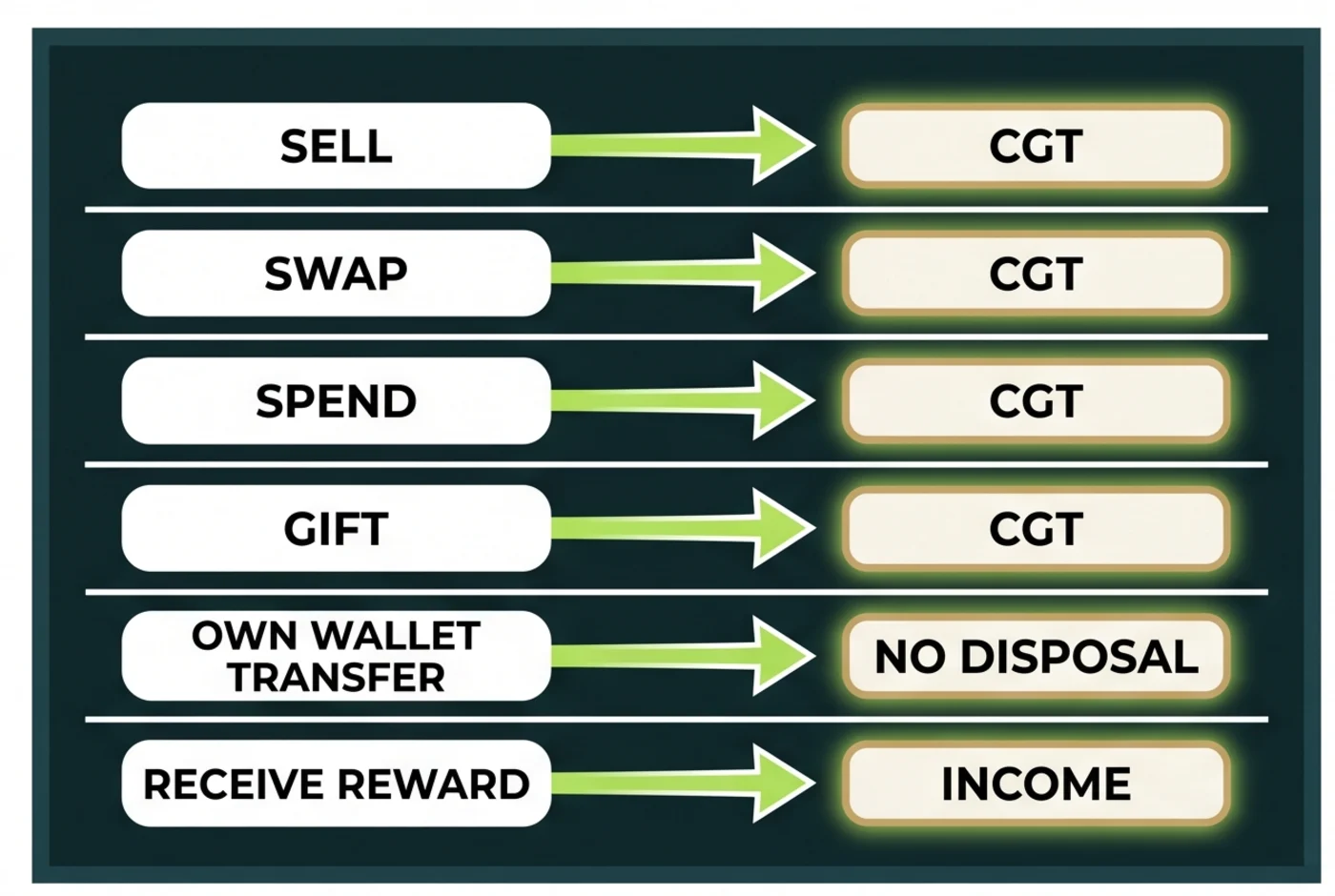
An Australian crypto investor generally holds each token as a CGT asset. Buying a token establishes an acquisition record. A later sale, swap, purchase made with crypto, gift or other disposal can trigger a CGT event. The basic calculation compares capital proceeds with the asset’s cost base and eligible outlays. Capital losses are applied under the CGT rules, and a qualifying resident individual may then be eligible for the 50% CGT discount after at least 12 months.
The gain is not taxed at a separate crypto rate. The net capital gain becomes part of assessable income. Final tax depends on the person’s total taxable income, deductions, offsets, residency and other circumstances. A profitable disposal can therefore increase tax even if no Australian dollars reached a bank account.
Short answer for a crypto trading business
A person who is actually carrying on a business of trading crypto generally accounts for crypto as trading stock. Sales are ordinary income, and acquisition costs and qualifying business expenses are dealt with under the business and trading-stock rules. Profit on trading stock does not receive the CGT discount. Revenue losses may be deductible, but the non-commercial loss rules and general deduction rules can restrict how a loss is used.
Calling an activity a business does not make it one. The ATO looks at commercial purpose, profit intention, repetition, organisation, scale, records and resemblance to an ordinary business. The conclusion should be made from the evidence before figures are optimised.
CGT is part of income tax, not a separate crypto tax
Capital gains tax is a component of income tax. It is not a stand-alone invoice applied to the amount withdrawn. An investor calculates current-year capital gains and losses, applies eligible losses and discounts in the required order, and includes the resulting net capital gain in assessable income. That amount then sits alongside salary, interest, business income and other taxable amounts.
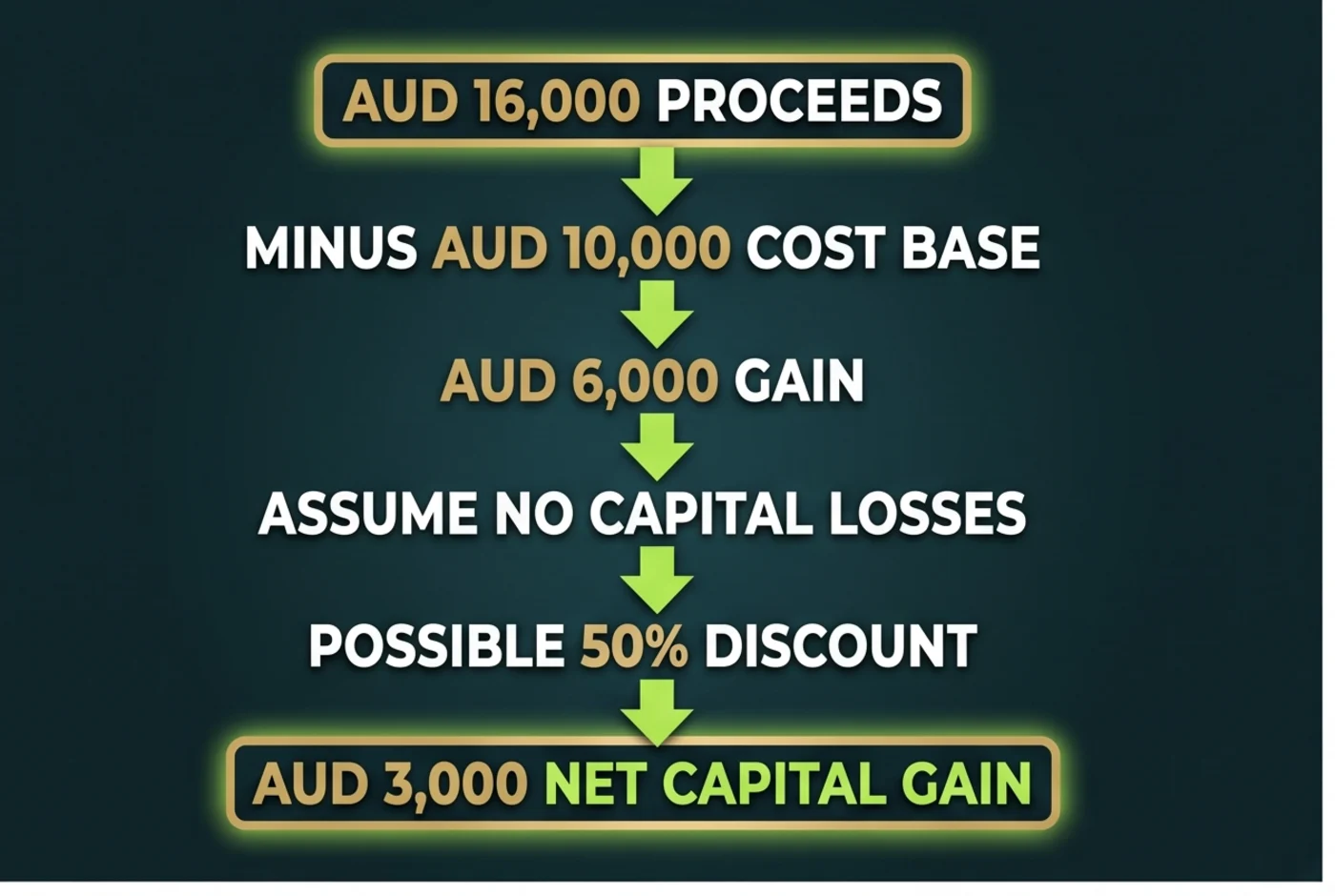
This distinction prevents a common mistake. A AUD 6,000 capital gain is not automatically a AUD 6,000 tax bill. It is an input into the whole return. The tax effect depends on the marginal rates and other return items that apply to the taxpayer.
Which crypto transactions can be taxable?
Selling crypto for Australian dollars
Selling an investment token for Australian dollars is a disposal. Capital proceeds are usually the AUD amount received, adjusted for relevant selling outlays. Compare that amount with the supported cost base of the units disposed of. The bank withdrawal after the sale is merely movement of cash. The disposal happened when the crypto was sold.
Swapping one crypto asset for another
A token swap normally contains a disposal of the asset sent and an acquisition of the asset received. Record the AUD market value at the time of the exchange, even if the platform displays only token quantities. The value used for the received asset commonly becomes a starting point for its new cost-base record, subject to the detailed cost-base rules.
Spending crypto on goods or services
Using crypto to buy something can dispose of the crypto. Capital proceeds are generally based on the market value of what is received. Personal-use asset rules may apply in a narrow set of circumstances, but they are not a general exemption for purchases under AUD 10,000. The token’s main use during ownership and its acquisition cost both matter.
Gifting crypto
Giving crypto to another person can trigger a CGT event for the giver. Where the parties are not dealing at arm’s length or no money changes hands, market-value rules can affect the proceeds used in the calculation. Keep the recipient, date, units, transaction ID and contemporaneous AUD value.
Staking, airdrops and mining
The ATO says staking rewards and established-token airdrops are ordinary income at their money value when received. A later disposal can create a separate CGT calculation using the acquisition information established at receipt. Mining carried on as a business is treated through ordinary-income and trading-stock rules. Non-business mining is more fact-specific, so avoid applying one universal receipt rule without advice.
Moving assets between your own wallets
A transfer between wallets owned beneficially by the same person is not itself a disposal merely because an exchange export labels it as a withdrawal and a wallet export labels it as a deposit. Match the transaction IDs, timestamps, quantities and addresses. A network fee paid in crypto can still involve a separate disposal of the fee units.
Are you a crypto investor or trader?
Why frequency alone does not decide
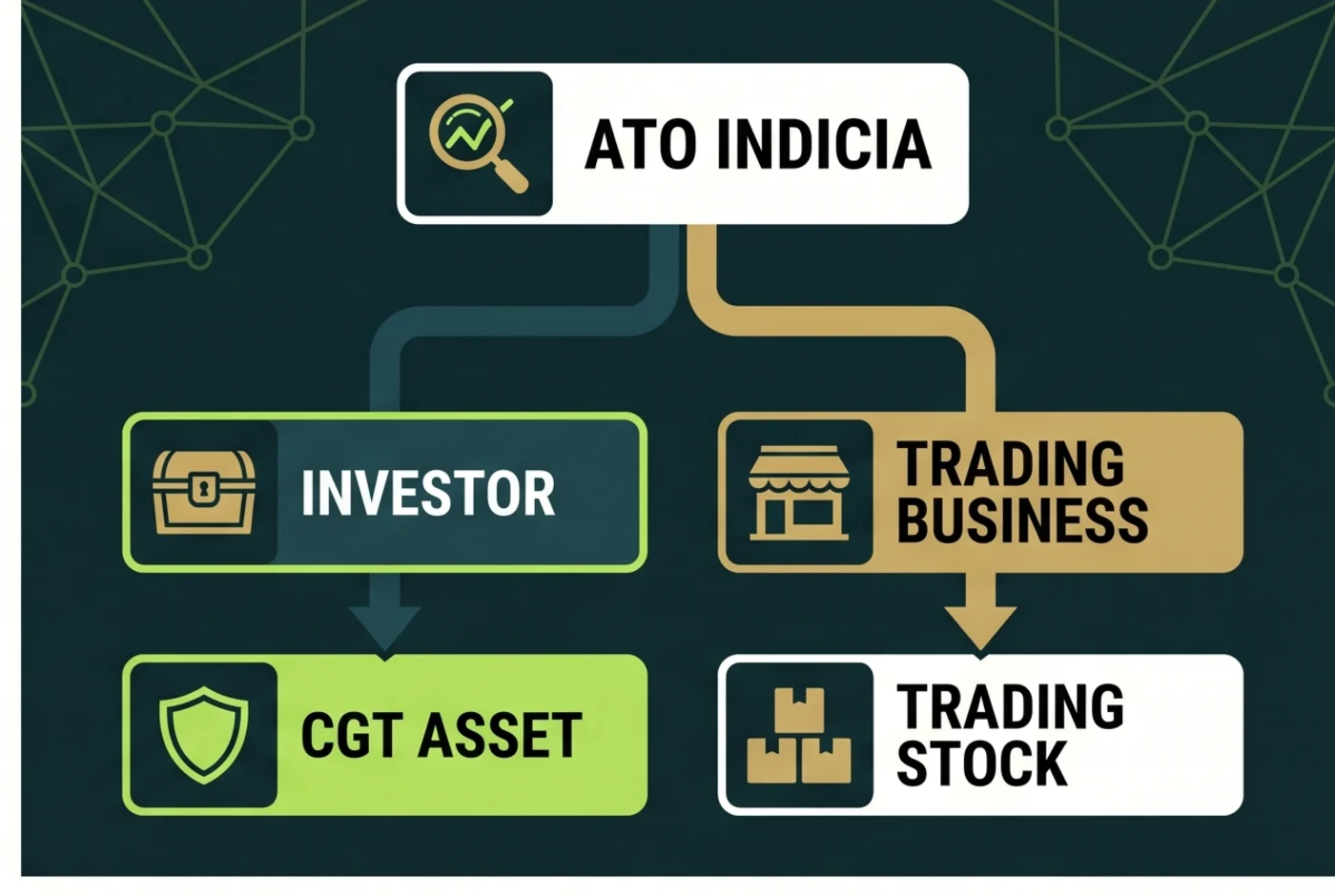
There is no official Australian transaction count, holding period or dollar threshold that automatically turns an investor into a trader. Frequent trades can support a business conclusion, but the activity must be assessed as a whole. One person can place many portfolio rebalancing trades without carrying on a business, while another can operate a smaller but organised commercial trading activity.
ATO business indicia
Relevant indicia include commercial purpose, an intention to profit, repetition and regularity, the scale and capital committed, a planned and organised method, business records, a strategy or business plan, and similarity to an ordinary business of that kind. No single factor is decisive. Evidence that points both ways should be shown rather than hidden.
Investor consequences: CGT assets and capital losses
An investor tracks parcels, acquisition costs, incidental costs, proceeds and ownership periods. Capital losses can reduce capital gains but cannot generally be deducted against salary or staking income. Eligible individuals may receive the CGT discount after applying losses, provided the asset was owned for at least 12 months and all other conditions are met.
Trading-business consequences: ordinary income and trading stock
A genuine trading business records sales as ordinary income and deals with crypto holdings under trading-stock rules. Business expenses must still satisfy the normal deduction requirements. Revenue losses may be affected by non-commercial loss rules. Because the treatment changes stock, income, expenses and loss use, classification cannot safely be treated as a single checkbox at the end.
Evidence your registered tax agent will need
Preserve the strategy, contemporaneous intention, frequency and holding-period reports, turnover, capital used, time spent, tools, bots, research, financing, separate accounts and consistency across prior years. Read the detailed guide to crypto investor versus trader in Australia before assuming high volume settles the result.
How to calculate an Australian crypto capital gain
Capital proceeds less cost base and eligible selling costs
Start with the capital proceeds for the disposal. Subtract the supported cost base of the particular units and any eligible selling outlays not already included. The cost base can include money paid, the market value of property given and eligible incidental costs under the statutory rules. Do not add the same fee twice.
AUD value at the time of each event
Every relevant amount must be expressed in Australian dollars. Use a consistent, supportable price source for the timestamp and market involved. A daily closing price can materially misstate a volatile intraday swap. Preserve the source, timezone, timestamp and conversion so an adviser can reproduce the figure.
Fees and specific-parcel evidence
Acquisition fees can affect cost base and selling fees can affect the gain, depending on their character. Gas paid in another token may require a separate disposal. Parcel identification should be supported by exchange lot data, wallet records and transaction history. Avoid promises that FIFO, HIFO, LIFO or average cost is always accepted for Australian crypto.
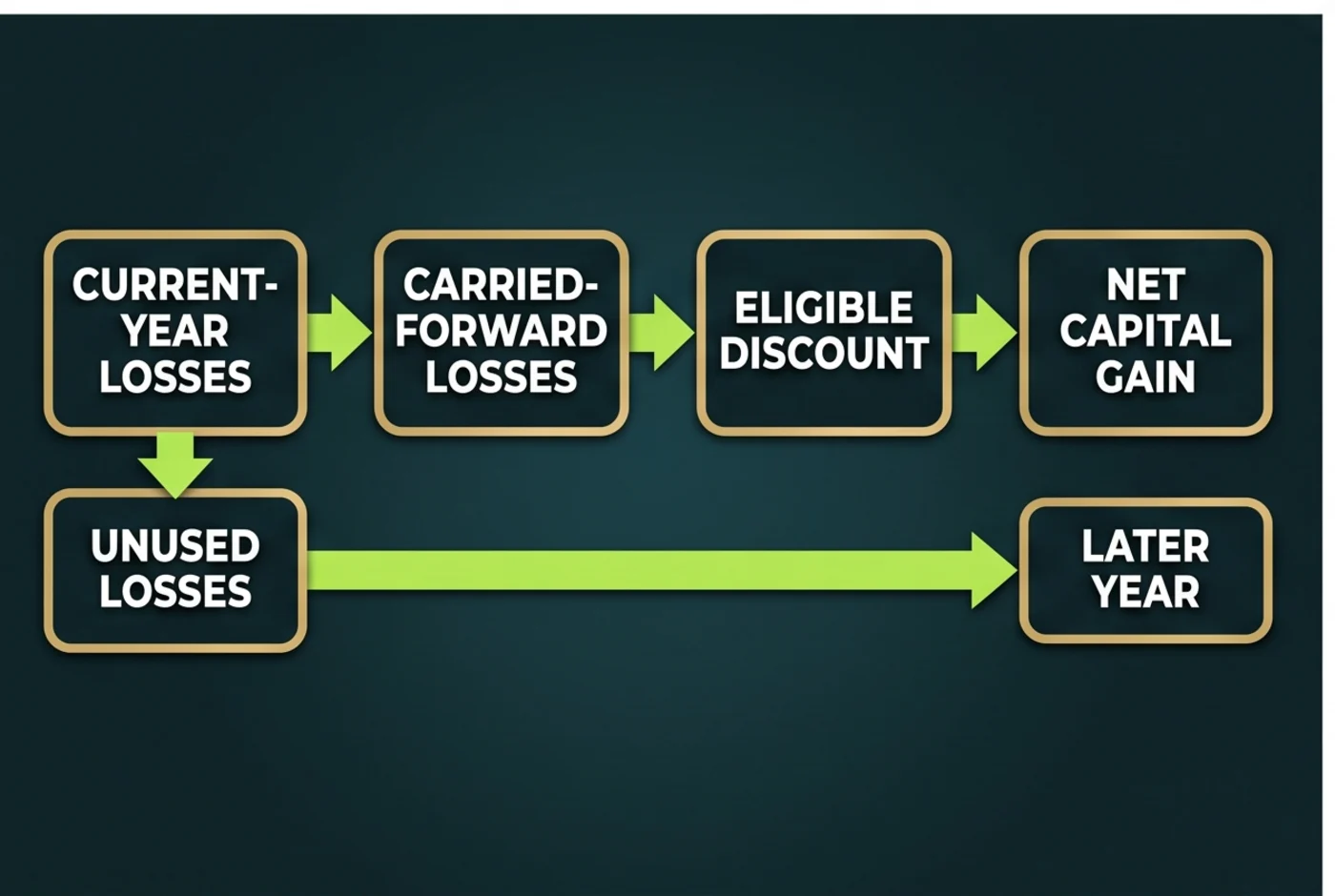
Capital losses before the 50% discount
Apply current-year and carried-forward capital losses before calculating the discount. The discount does not rescue a capital loss, apply to trading-stock profit or reduce the sale proceeds. It reduces an eligible gain within the net capital gain calculation.
Taxable income is not the same as tax payable
The resulting net capital gain enters taxable income. It is then considered with the rest of the return. The Australian crypto tax calculator guide shows the steps, parcel evidence, swaps, fees and loss ordering in more detail.
How much crypto is tax-free?
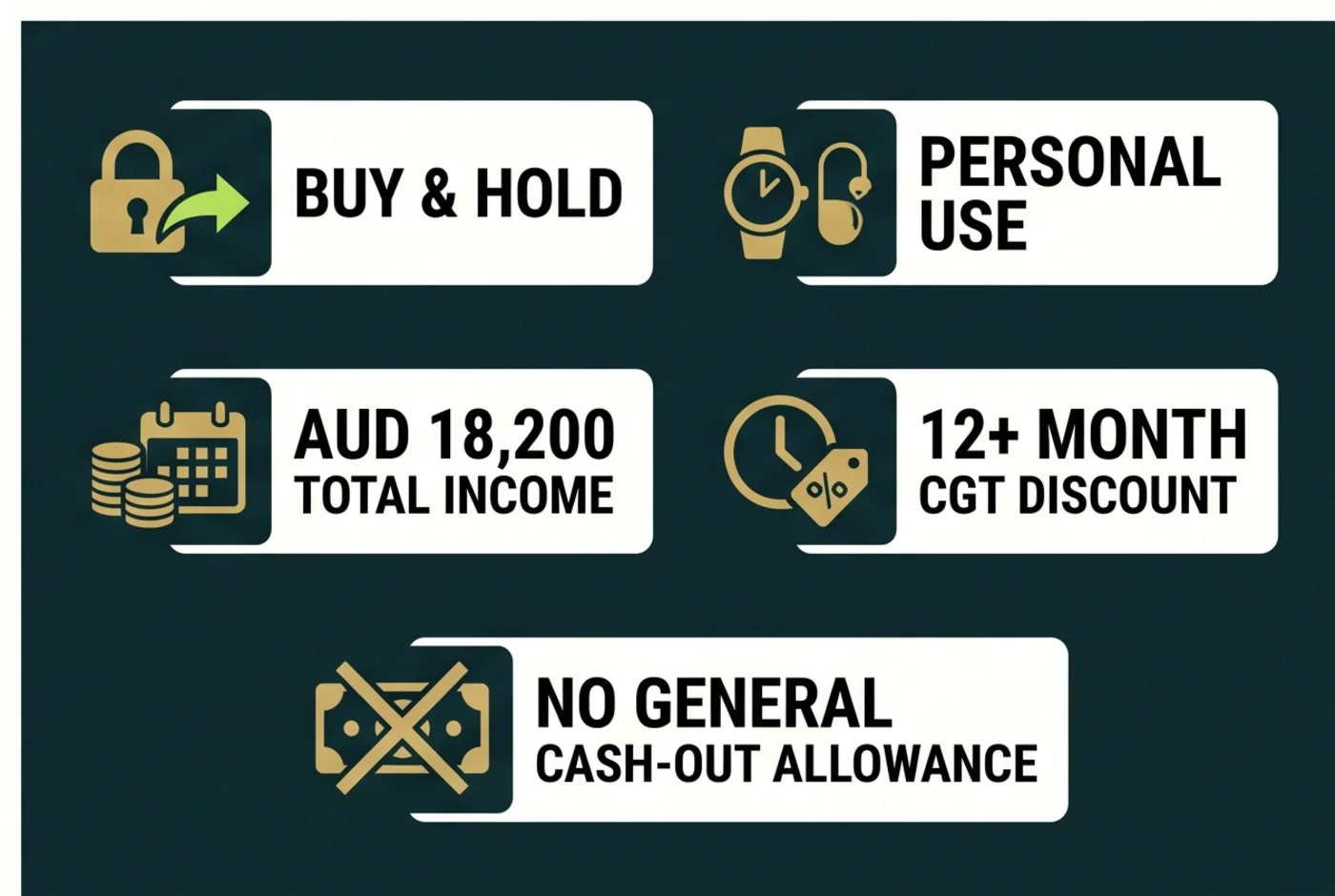
Buying and holding
Buying crypto and continuing to hold it generally does not create a capital gain at that point. The purchase still creates an important cost-base record. Income can arise while an asset is held, such as a staking reward, so no-disposal does not always mean no crypto-related income.
The AUD 18,200 threshold applies to total taxable income
The resident tax-free threshold applies to aggregate taxable income, not to crypto alone. Salary, interest, staking income, business profit and net capital gains can all contribute. A person with other income may already be above the threshold before adding crypto amounts.
Personal-use assets acquired for AUD 10,000 or less
A capital gain from a personal-use asset can be disregarded where the asset was acquired for AUD 10,000 or less. Crypto must have been kept or used mainly to buy items for personal use or consumption. Long holding, investment intent and profit-seeking conduct weigh against the treatment. Personal-use capital losses are disregarded.
The 12-month CGT discount is not a tax exemption
An eligible individual may reduce an eligible gain by 50% after at least 12 months, but the remaining amount still enters the tax calculation. Companies do not receive this discount. Residency, dates, entity type and other Division 115 conditions can change the result.
Why there is no general AUD 10,000 cash-out allowance
The AUD 10,000 personal-use test looks at acquisition cost and main use. It is not the first AUD 10,000 of profit, proceeds, withdrawals or wallet balance. See how much crypto may result in no tax payable for a careful separation of these rules.
How are staking, airdrops, mining and DeFi taxed?
Staking rewards and established airdrops
The ATO says staking rewards and established-token airdrops are ordinary income at money value when received. Keep the quantity, time, accessibility, AUD value and price source. If a reward is locked, unclaimable or subject to protocol conditions, the receipt point can be fact-specific and should be flagged.
Mining as a business and the non-business position
A crypto-mining business treats mined crypto as trading stock, with sales as ordinary income and qualifying expenses considered under the normal business rules. The reviewed ATO material does not establish one universal treatment for every hobby-mining arrangement. Record the scale, equipment, purpose, organisation and actual receipts for adviser review.
The ATO’s wrapping position
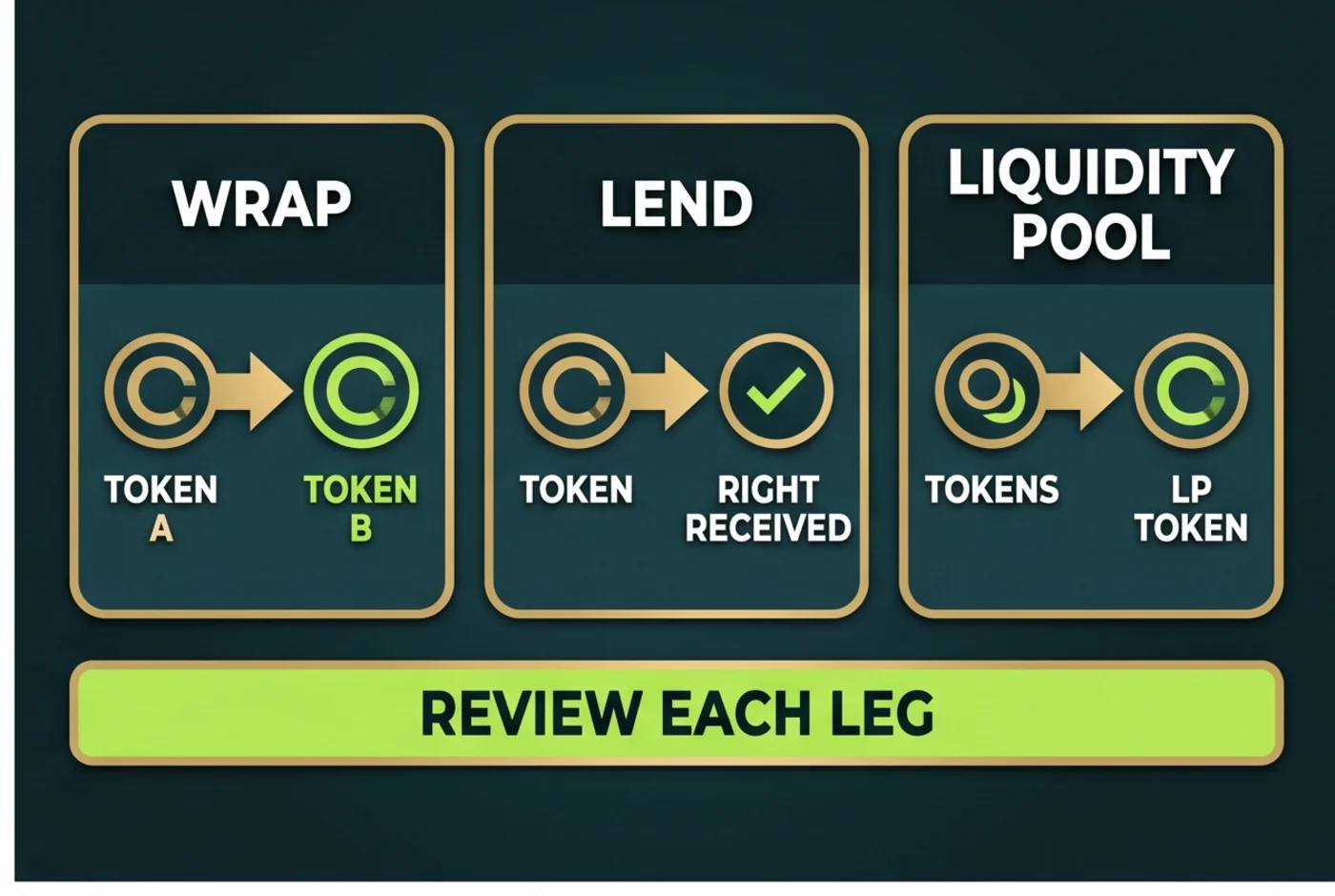
The ATO says wrapping or unwrapping exchanges one crypto asset for another and triggers a CGT event. That published position should be reflected in an Australian workpaper. Protocol-specific facts and legal arguments may still need advice, so describe the token legs and rights rather than reducing the transaction to a software label.
Lending, liquidity pools and rights received
A lending deposit can trigger CGT where beneficial ownership ends or the depositor receives a different asset or contractual right. Depositing into a liquidity pool can trigger CGT where an LP token or other right is received. Withdrawal can create another event on disposal of that right. Rewards may also be ordinary income.
Protocol-specific arrangements that need advice
Bridges, liquid-staking tokens, vault shares, rebasing assets, restaking, collateralised loans and migrations should not all receive one label. Reconcile the on-chain steps and identify what was sent, received and retained. The Australia DeFi tax guide separates verified ATO positions from arrangements that need legal and tax judgement.
How do crypto losses work?
Capital losses offset capital gains, not salary
An investor’s capital loss can generally reduce capital gains. It cannot ordinarily be deducted from salary, staking income or business income. The classification therefore matters before a loss is entered into a return. A trading-business loss follows revenue rules and may be affected by non-commercial loss provisions.
Carrying losses forward
Unused net capital losses can generally be carried forward for use against later capital gains. Preserve the year, source transactions and prior return support. A loss balance without the parcel and disposal evidence behind it can be difficult to defend years later.
Personal-use losses are disregarded
A capital loss from a personal-use asset is disregarded. This is the other side of the limited gain exemption. A taxpayer cannot claim personal-use status for an exemption when an asset rises and investment status for a deductible capital loss when it falls.
Wash sales and Part IVA
Australia does not use a mechanical 30-day crypto rule like some overseas regimes. That does not make engineered loss arrangements automatically safe. The ATO warns that wash sales designed to create a tax benefit can attract Part IVA. Commercial context, continued exposure, reacquisition steps and purpose matter.
No mechanical Australian 30-day crypto rule
Do not import a foreign superficial-loss or wash-sale calculator into an Australian file. Record the sale and any reacquisition, but ask the registered tax agent to assess the Australian law and anti-avoidance position. The absence of a fixed window is not approval of a pre-arranged loss.
Does the ATO know about crypto?
Exchange data matching since 2014-15
The ATO’s published crypto-assets data-matching program reviewed for this guide covers 2014-15 through 2025-26. The April 2024 gazette notice covers provider data for 2023-24 through 2025-26 and estimated 700,000 to 1.2 million individuals and entities per financial year. The published period should be rechecked for an extension rather than treated as an end date.
Identity, bank, wallet and transaction data
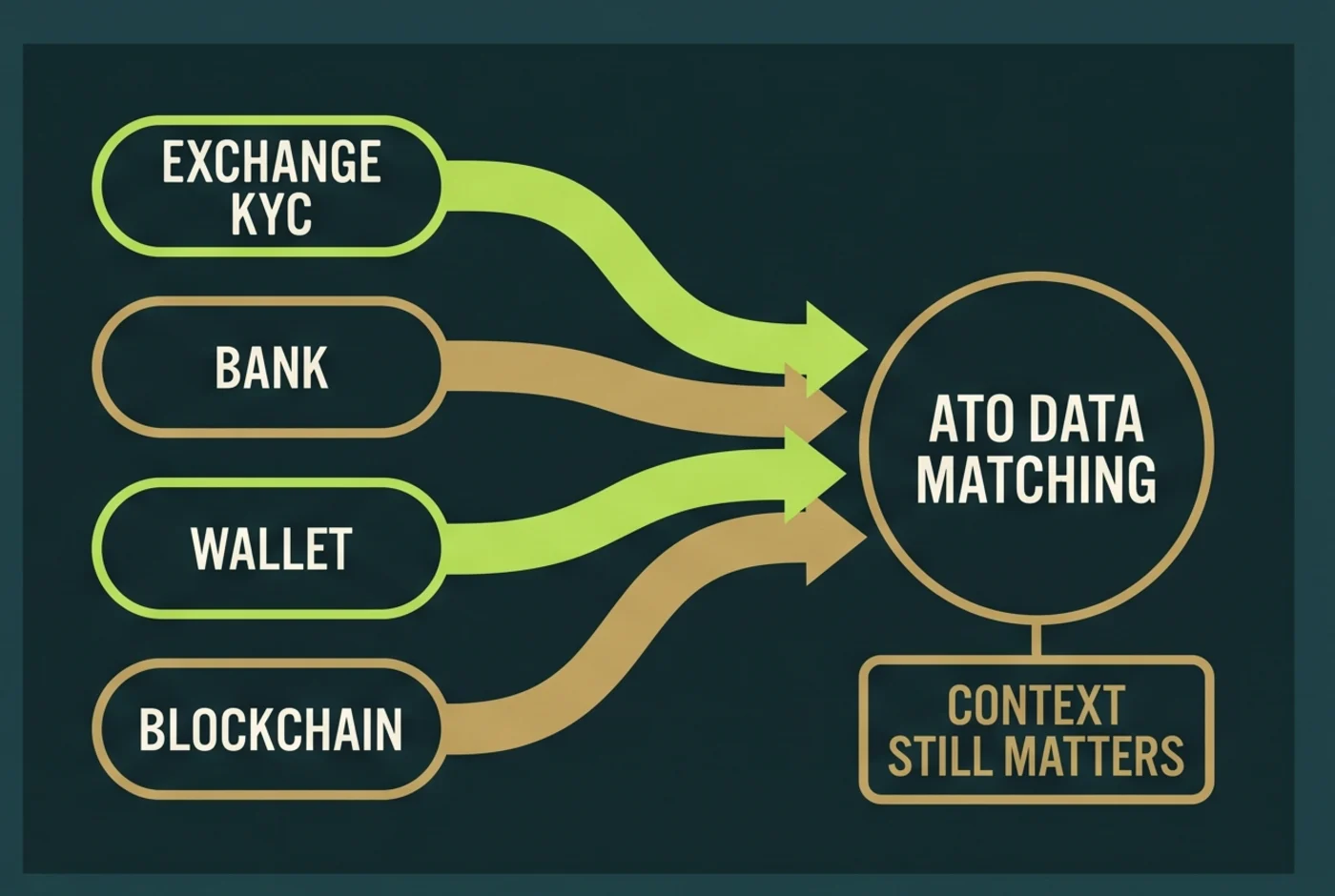
Matched identity information can include names, addresses, dates of birth, phone numbers, emails and social-media identifiers. Transaction information can include bank accounts, wallet addresses, transaction dates and times, deposits, withdrawals, types, quantities and coin types. The ATO uses these records to identify possible reporting gaps.
What public blockchain analysis can add
A public chain exposes transaction paths, wallet interactions and contract calls. Exchange KYC, bank transfers and known service addresses can help connect parts of that activity. A complete reconciliation can follow funds beyond one platform and explain why apparent withdrawals are transfers rather than undisclosed disposals.
What the ATO cannot automatically infer
Raw data does not automatically prove beneficial ownership, cost base, purpose, investor or trader status, or the legal rights created by a DeFi protocol. The ATO cannot be assumed to identify every self-hosted wallet from one exchange record. Good workpapers explain the missing context instead of assuming invisibility.
CARF timing from 2027
Australia has committed to implement the OECD Crypto-Asset Reporting Framework. The 2025-26 MYEFO measure says implementation and domestic reporting commence in 2027, with reporting to the ATO and first international information exchange in 2028. Final provider scope, due dates and transitional rules require a legislation recheck. Read how the ATO can obtain crypto data for the detailed evidence chain.
What crypto records should you keep?
Exchange exports, wallet addresses and transaction IDs
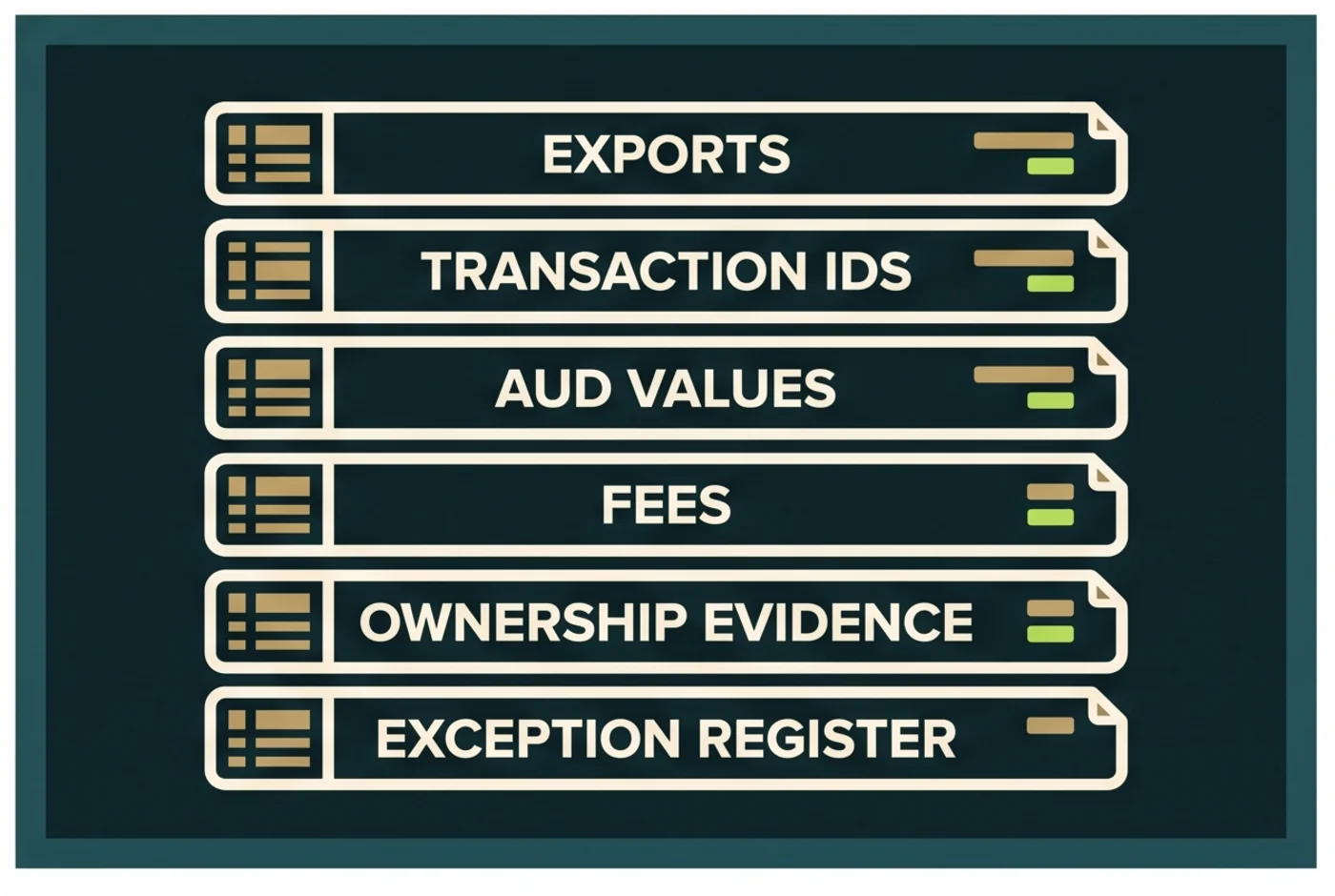
Keep complete exports from every exchange, broker, wallet and protocol. Preserve wallet addresses, transaction hashes, token contract addresses and platform account identifiers. Screenshots can support a fact but should not replace machine-readable history. Export before an exchange closes an account or shortens its download window.
AUD values and price-source evidence
For each tax-relevant event, preserve the AUD value, timestamp, timezone, market and price source. Where a token has thin liquidity or no reliable price, flag the exception and document the method used. Consistency helps, but it should not override a clearly inappropriate market.
Same-owner transfer evidence
A transfer match should connect the outbound and inbound records with transaction ID, time, quantity after fee and controlled addresses. Keep evidence that beneficial ownership did not change. Without this link, software can duplicate disposals or leave an acquisition with missing cost base.
Fees, missing basis and duplicate records
Record the token and AUD value of each fee, what it related to and whether it was already netted by the platform. Missing basis should remain an explicit exception until resolved. Duplicate exchange and wallet rows should be linked and suppressed, not quietly deleted without an audit trail.
Five-year rule and longer-lived records
The ATO generally says crypto records should be kept for five years. The start of that period depends on the record and event. Acquisition records for assets still held may need to survive much longer because they support a disposal years later. The practical rule is to retain the purchase evidence until the relevant retention period after the final disposal and reporting.
Build the record before the return deadline
Late reconstruction is harder when exchange names, token symbols and wallet labels have changed. A yearly archive of raw exports and a reconciled closing inventory reduces the work needed later. If records are incomplete, an ATO-ready crypto reconciliation can produce an exception register for the client’s adviser.
Where does crypto appear in myTax?
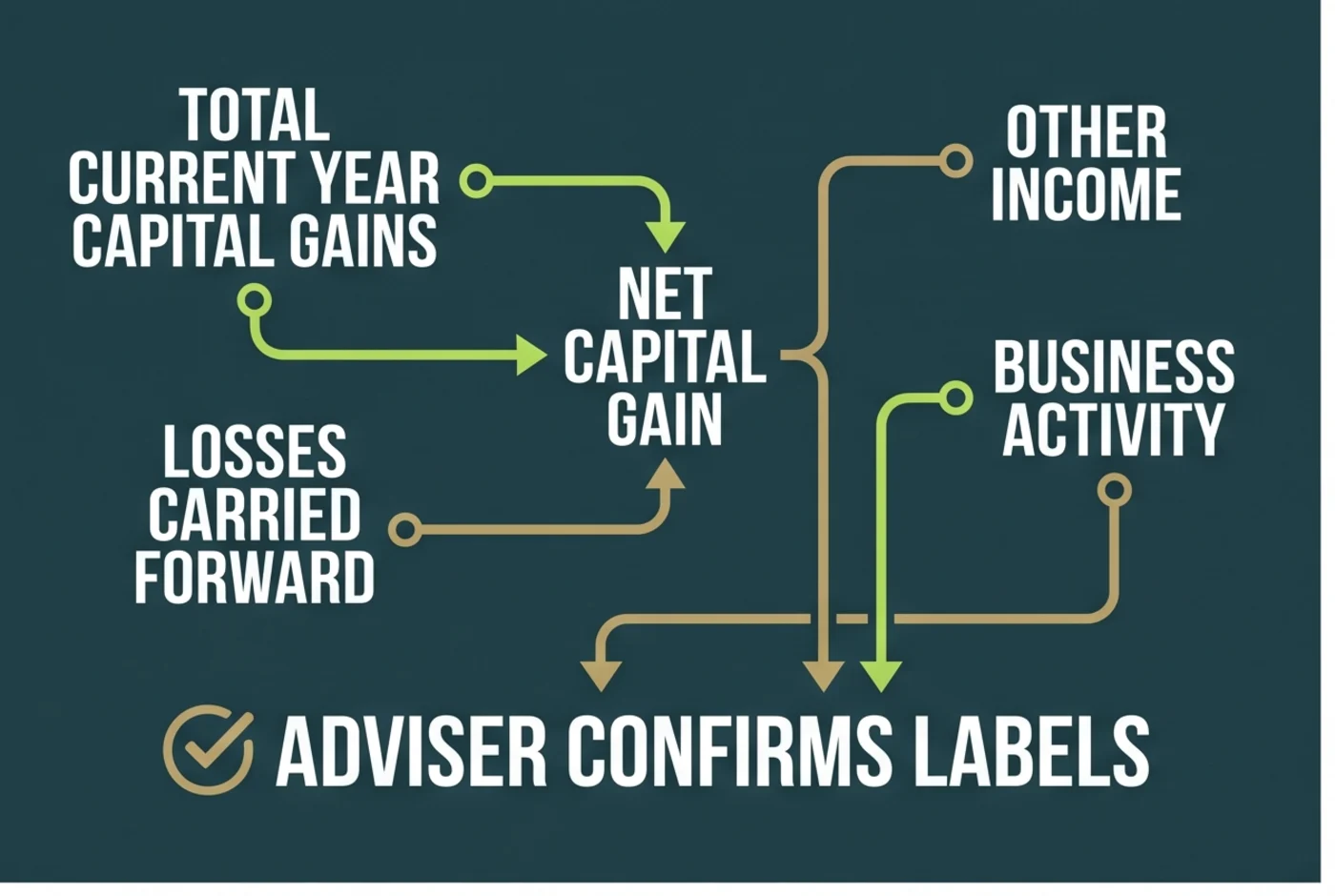
Total current year capital gains
For the current ATO material reviewed, an investor’s capital activity feeds the Total current year capital gains field before losses and discounts. That figure is not the same as net capital gain. Keep a summary that reconciles the gross gain amount to transaction-level schedules.
Net capital gain
The Net capital gain field reflects the CGT calculation after relevant losses, discounts and concessions. It enters assessable income. A summary should show each stage so the adviser can trace why gross gains differ from the amount included.
Net capital losses carried forward
Unused net capital losses are reported for later income years. Reconcile the closing balance to prior returns, current-year utilisation and the supporting disposal records. Do not treat a tax-software loss total as self-proving.
Other income for staking and established airdrops
Outside a business, the reviewed ATO guidance directs established airdrops and staking rewards to Other income. The reward schedule should show receipt date, quantity, AUD value, price source and later-disposal reference. Locked or disputed receipt timing should be flagged for advice.
Business or sole-trader section
A person carrying on a crypto trading business generally reports the activity through the business or sole-trader income and loss section rather than investor capital-gain labels for trading stock. Business schedules should reconcile revenue, purchases, expenses and opening and closing stock.
Annual label recheck
myTax screens and instructions change. The exact fields and any CGT schedule threshold should be checked for the return being prepared. The ATO material reviewed indicates a CGT schedule where total current-year gains or losses exceed AUD 10,000, but that is separate from the personal-use asset rule. An ATO-ready crypto reconciliation supplies the figures and workpapers, while the client’s registered tax agent chooses the final labels and handles lodgment.
From raw crypto data to ATO-ready workpapers
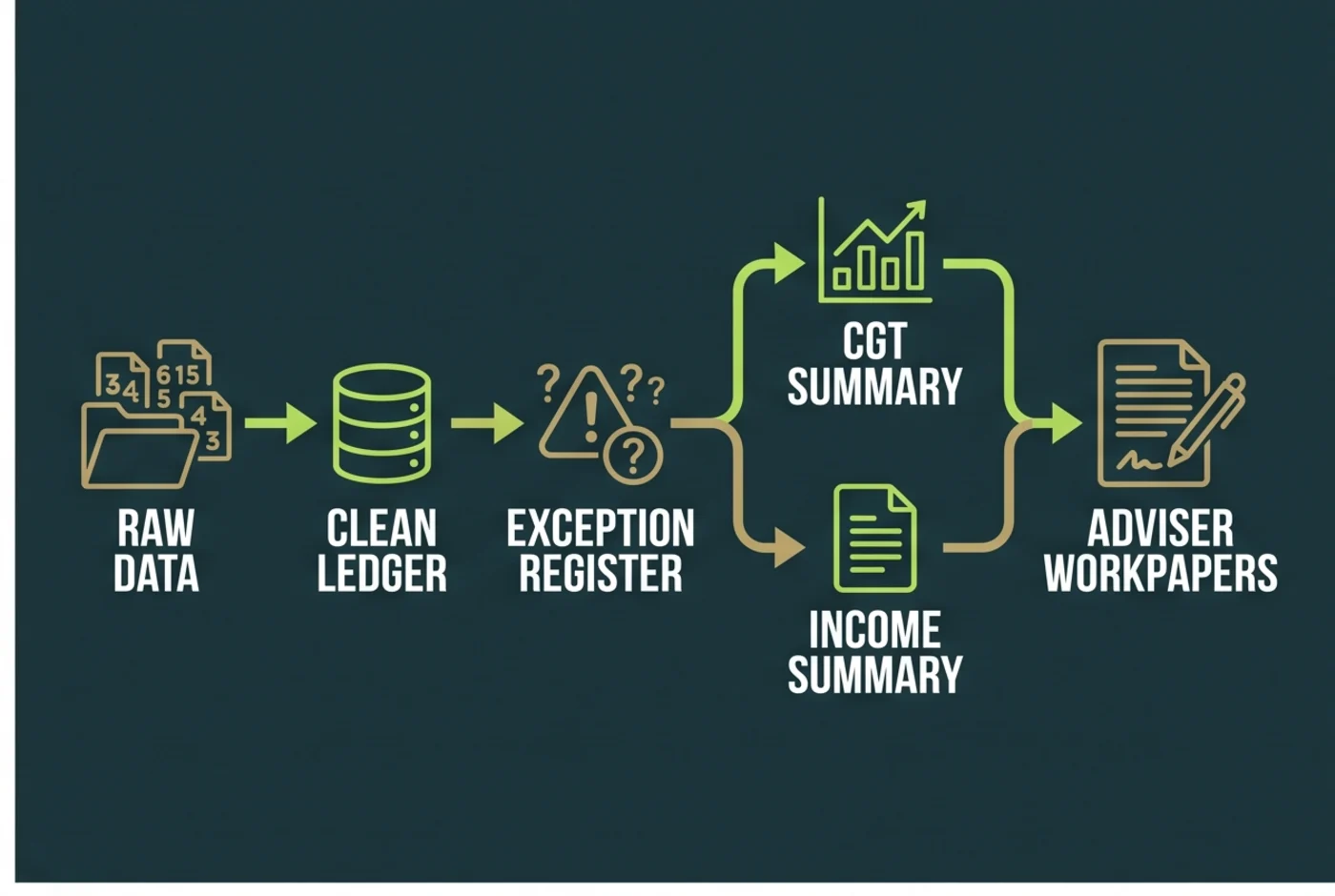
Gather exchange, wallet and protocol histories
Start with source data rather than a single software summary. Gather every exchange export, wallet history, transaction ID, API record and protocol event. Create a source register that lists coverage dates and known gaps. Opening and closing balances help identify missing periods.
Normalise and deduplicate
Platforms use different timestamps, symbols, fee formats and transaction labels. Normalisation converts them into a consistent ledger while retaining the original references. Duplicate records are linked across sources and suppressed with an audit trail. Spam and unsupported assets remain identifiable rather than disappearing silently.
Match same-owner transfers
Connect outbound and inbound legs across exchanges, wallets and chains. Account for network fees and timing differences. This prevents a transfer from becoming a false sale or a fresh acquisition with no cost base. Unmatched movements go to an exception register for client evidence.
Value tax-relevant events in AUD
Apply supportable AUD values at the time of each event and preserve the source. Separate income receipts from later disposals. Build parcel and holding-period evidence for investment assets, and business summaries where trading-stock treatment may apply.
Produce figures, summaries and an exception register
The output should include transaction schedules, gains and losses, income summaries, closing holdings, price evidence, assumptions and unresolved items. An exception register makes uncertainty visible. It gives the adviser a practical list of missing basis, ownership, classification or protocol questions.
Hand off to the client’s own adviser
Count On Sheep reconciles complex digital-asset activity into ATO-ready figures and workpapers for your own accountant or registered tax agent. Count On Sheep is not a registered tax agent and does not lodge Australian tax returns. The adviser decides final tax positions, return labels and lodgment based on the reconciled facts.
Get ATO-ready figures for your own accountant or registered tax agent
Count On Sheep reconciles complex digital-asset activity into ATO-ready figures and workpapers for your own accountant or registered tax agent. Count On Sheep is not a registered tax agent and does not lodge Australian tax returns.
Get ATO-ready crypto workpapersAustralia crypto tax guide FAQs
How much tax do you pay on crypto in Australia?
There is no separate Australian crypto tax rate. An investor includes the net capital gain in assessable income, while a crypto trading business generally includes net business profit as ordinary income. Final tax depends on total taxable income, losses, deductions, offsets, residency and the Medicare levy.
Do I pay tax if I swap crypto but never cash out?
A crypto-to-crypto swap can dispose of the asset sent even when no Australian dollars are withdrawn. Record the AUD market value at the time of the swap, the cost base of the units disposed of, fees and the new acquisition record for the asset received.
Does the 50% CGT discount apply to crypto?
An Australian resident individual may be eligible for the 50% CGT discount when a crypto asset was owned for at least 12 months and all other conditions are met. Capital losses are applied before the discount. Companies do not receive it, and it does not apply to trading-stock profit.
How does the ATO know about my crypto?
The ATO uses a crypto-assets data-matching program that can include exchange identity data, bank accounts, wallet addresses and transaction details. Public blockchain analysis can add transaction paths. Raw data does not automatically determine beneficial ownership, cost base or tax classification.
What happens if I have incomplete crypto records?
Create a source register, preserve available exports, match transfers and list missing basis, prices and ownership questions in an exception register. Do not silently enter zero cost or invent a parcel method. A reconciliation can give your accountant or registered tax agent the evidence and unresolved items needed for judgement.
Where do I report crypto in myTax?
Under the current ATO material reviewed, investor gains feed Total current year capital gains and Net capital gain, unused losses feed Net capital losses carried forward, and staking and established airdrops outside a business are reported as Other income. A trading business generally uses business or sole-trader sections. Recheck the annual instructions.