
Is the Flare airdrop taxable? Yes. Every FLR token you received, from the January 2023 initial distribution through the final monthly FlareDrop in January 2026, is ordinary income at its fair market value on the day you gained control of it. The same rule covers the Songbird (SGB) tokens that landed in September 2021. The December 2020 snapshot of your XRP balance was not the taxable moment. The taxable moments came later, one for every batch of tokens that actually reached you.
That distinction between the snapshot and the receipt is where almost every Flare tax question lives. It decides which tax year your income belongs to, what your basis is, what happens if your exchange credited tokens two years late, and whether someone who never claimed owes anything at all. This guide walks through the whole Flare saga for XRP holders: Spark, Songbird, the token distribution event, 36 monthly FlareDrops, wrapped FLR, and what to do if you sold, never claimed, or never reported.
This is one piece of our complete XRP tax guide, which covers the full picture for XRP holders: sales, the ETFs, escrow myths, and more. If your main question is what happens when you sell the XRP itself, start with our guide to selling XRP and taxes.
Disclaimer: This guide is for informational purposes only and is not tax or legal advice. Cryptocurrency rules change quickly. Always consult a qualified CPA about your specific situation.
The Flare Airdrop, Start to Finish: Why the Timeline Is the Tax Answer
You cannot get Flare taxes right without the timeline, because the distribution stretched across more than five years and four separate tax filing seasons. Here is the whole arc.
December 12, 2020: the snapshot. Flare Networks recorded every XRP balance at 00:00 UTC. Holding XRP at that moment made you eligible for Spark tokens at roughly a 1:1 ratio, minus certain excluded addresses. Nothing was distributed. Nothing was taxable. A snapshot is a promise of future tokens, not a receipt of property.
September 2021: Songbird (SGB) arrives. Before launching its main network, Flare released Songbird, a live canary network used to test everything under real conditions. Eligible XRP holders received 0.1511 SGB per XRP, based on the same December 2020 snapshot. Exchanges that supported the drop, including Kraken, credited SGB to customer accounts. This was the first actual receipt of property in the Flare story, and the first taxable event.
January 9, 2023: the Token Distribution Event (TDE). After a rename from Spark to Flare and a long delay, the Flare mainnet distributed the first 15 percent of each holder’s FLR allocation. Exchanges credited it to accounts; self-custody claimers received it in their Flare addresses. Taxable event number two, and for most holders the largest single one.
March 2023 through January 2026: 36 monthly FlareDrops. The remaining 85 percent of the public allocation, roughly 24.2 billion FLR, was distributed through monthly FlareDrops. Eligibility was not automatic: you had to hold wrapped FLR (WFLR) or participate in staking to receive each month’s drop. Every single monthly drop you received is its own income event. The final FlareDrop landed on January 30, 2026, which makes the 2026 tax year the last one with FlareDrop income on it.
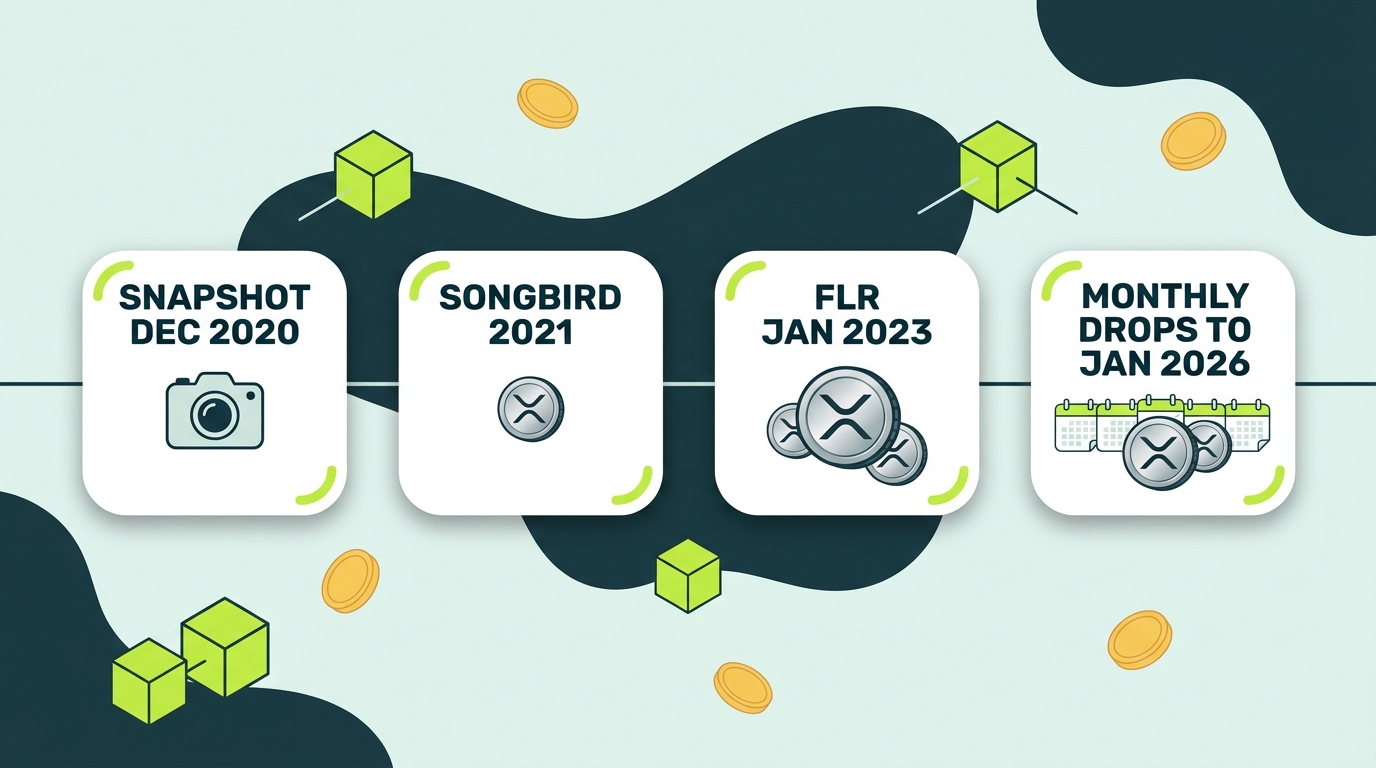
Add it up and a fully participating XRP holder has income events in 2021, 2023, 2024, 2025, and 2026. That is five tax returns touched by one airdrop. Most holders reported none of them, which is the problem this guide helps you fix.
The Governing Rule: Income at Dominion and Control
The IRS addressed airdropped tokens directly in Rev. Rul. 2019-24: new tokens received via airdrop are ordinary income at fair market value when the taxpayer gains dominion and control, meaning the ability to sell, exchange, or transfer them. Rev. Rul. 2023-14 applied the same dominion and control timing to staking rewards, confirming that this is the IRS’s general framework for crypto you receive without paying for it. If you can dispose of it, you have income. If you genuinely cannot, you do not yet.
For Flare, that framework answers the questions in order:
- The snapshot was not income. In December 2020, Spark tokens did not exist on any live network. You could not sell, transfer, or control anything. Eligibility is not receipt.
- SGB was income in September 2021 for anyone whose exchange credited it or who could claim it to a wallet they controlled, at its market value on that date.
- The FLR initial distribution was income in January 2023 on the same logic.
- Each FlareDrop was income in the month it arrived, valued at that month’s receipt-date price. Thirty-six drops means up to thirty-six income entries.
- Tokens you never received are not income. No credit, no claim, no control, no income.
The snapshot made you eligible. The credit made you taxable. Every Flare tax question comes down to which of those two moments you are looking at.
One important nuance on valuation: SGB and FLR both traded at very different prices across their distribution windows. SGB briefly spiked after launch before falling hard. FLR opened trading in January 2023 around a few cents and moved meaningfully month to month through the FlareDrop period. Because each receipt is valued at its own date, two holders with identical XRP stacks can have very different income totals depending on when their exchange credited tokens. That is not a bug in your software. That is the rule working as designed.
Exchange-Credited vs Self-Custody Claims: Same Rule, Different Dates
How you held your XRP in December 2020 determines how, and when, your Flare tokens reached you. The income rule never changes, but the receipt dates and the record-keeping do.
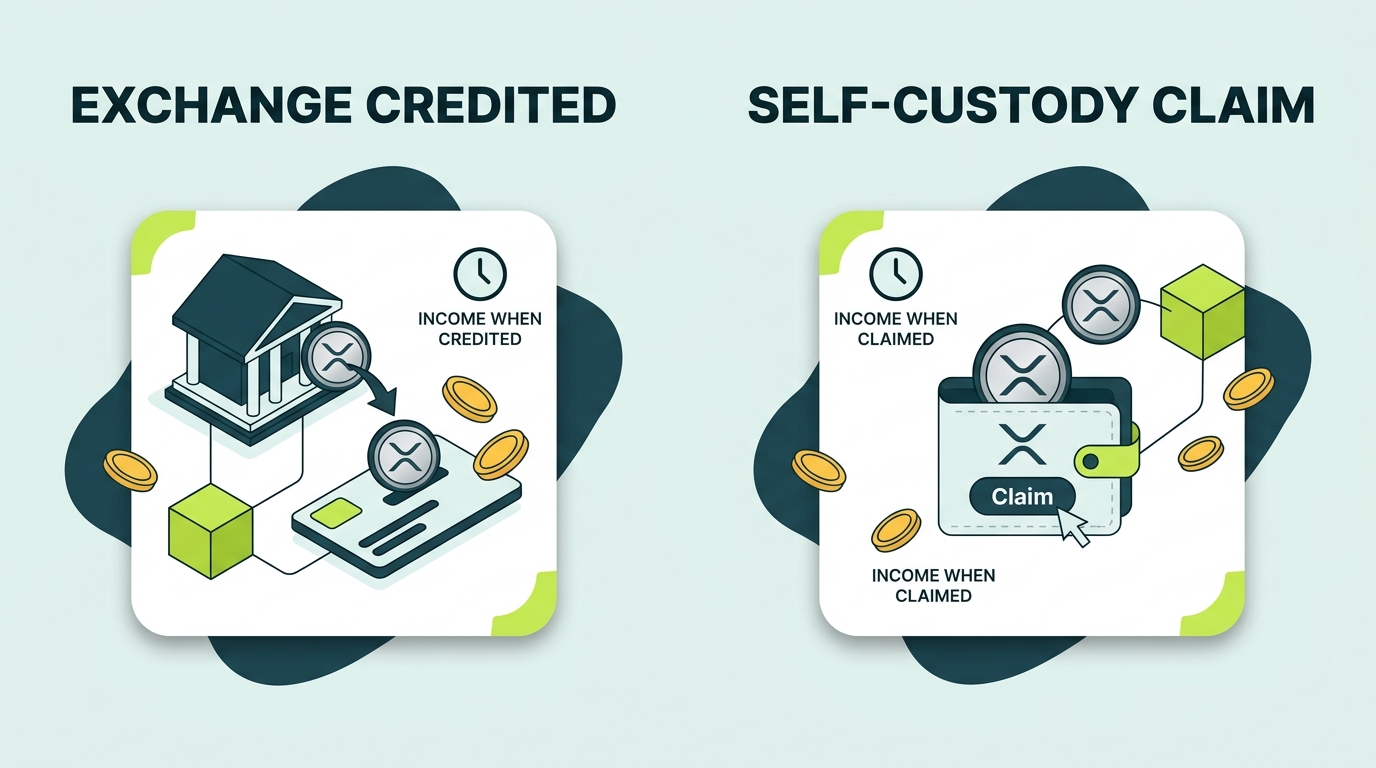
Exchange Holders: Income When the Credit Lands
If your XRP sat on an exchange at the snapshot, the exchange handled everything. Your income date for each distribution is the date the exchange actually credited the tokens to your account, and your income amount is the token price on that date.
This sounds simple until you remember how unevenly exchanges handled it:
- Kraken supported SGB and credited it relatively promptly, then supported the FLR distribution in January 2023.
- Coinbase committed to the FLR airdrop but did not support SGB initially, and its FLR handling drew a class action over delays. Coinbase users generally received FLR at the January 2023 distribution, but received SGB late or not at all depending on timing.
- Uphold was among the most consistent supporters, crediting SGB, the FLR TDE, and passing through monthly FlareDrops.
- Some exchanges never participated. If your platform never distributed tokens, you never received them, and you have no income from that platform’s allocation.
Two consequences follow. First, a late credit is income at the late date. If an exchange credited your SGB in 2022 instead of 2021, your income belongs on the 2022 return at 2022 prices. You do not reach back to the launch date. Second, an exchange credit is receipt even if you never touched the tokens. FLR sitting untouched in your Coinbase account since January 2023 was still income in January 2023. Dominion and control means the ability to sell, not the act of selling.
Self-Custody Holders: The Claim Was the Receipt
If you held XRP in your own wallet at the snapshot, you had to act. The original Spark claim required setting a message key on your XRP Ledger address pointing to a Flare address, during a claim window that ran from the snapshot to mid-June 2021. Holders who completed that step received the 15 percent initial distribution at the January 2023 TDE directly in their Flare address.
The monthly FlareDrops added another layer: receiving them required holding wrapped FLR (WFLR) or staking, so passive holders who claimed the TDE but never wrapped simply did not receive the monthly drops. No wrap, no drop, no income from the missed months.
For self-custody claimers, the income dates are on-chain and unambiguous: the TDE credit in January 2023, then each monthly FlareDrop transaction afterward. Your Flare wallet history is your income record, and every entry needs a fair market value stamped on it.
The Wrapping Question: Is FLR to WFLR Taxable?
To collect FlareDrops, self-custody holders wrapped FLR into WFLR, a 1:1 wrapped version used for delegation and drop eligibility. Is the wrap itself a disposal?
Most practitioners say no. The wrap is instant, free, 1:1, and reversible at will, and you retain the same economic exposure to the same asset on the same network. Treating it as non-taxable mirrors the dominant (though not officially blessed) position on wrapped tokens generally. A conservative minority view treats any token-for-token exchange as a taxable disposal under the plain reading of the property rules. The IRS has never ruled on wrapping specifically.
Our take for most Flare holders: the non-taxable position is reasonable and widely used, and the dollar stakes on a same-price 1:1 wrap are usually zero anyway, since proceeds equal basis at the moment of the wrap. Pick a position, apply it to every wrap and unwrap, and note it in your records. Consistency is what survives an audit. For a deeper look at how this same question plays out with wrapped XRP on other chains, see our XRP Ledger DeFi tax guide.
What If You Never Claimed?
This is the question we hear most from long-time XRP holders, and the answer is cleaner than people fear.
If you never claimed and never received tokens, you have no income. Rev. Rul. 2019-24 is explicit that a taxpayer does not have income from an airdrop until they have dominion and control. An unclaimed allocation you cannot access fails that test completely. Holders who missed the six-month Spark claim window in 2021, or whose exchange never supported the distribution, received nothing and owe nothing on the missed tokens. There is no phantom income for value you never controlled.
The edge cases are worth spelling out:
- Eligible but never claimed (self-custody): no receipt, no income, ever. The allocation lapsed.
- Claimed the TDE but never wrapped: income on the January 2023 distribution you received, no income on the monthly FlareDrops you did not receive. Missing the wrap requirement means the drops never existed for you.
- Exchange credited tokens you ignored: income at the credit date regardless. You controlled them the moment they hit your account.
- Exchange credited tokens years late: income at the actual credit date and that date’s price, in that tax year.
- Tokens claimable right now that you have not claimed: this is the gray zone. Where a claim is a pure formality, a click with no conditions, the IRS can argue you have constructive receipt of income already. Where claiming requires real action, gas, and setup, the better reading is that income waits for the claim. For Flare specifically, the original claim window has long closed, so this mostly matters for people with unclaimed balances sitting in claim contracts.
Basis and Selling: The Second Tax Event
Reporting airdrop income buys you something valuable: cost basis. The fair market value you report for each batch of SGB or FLR becomes that batch’s basis, and the holding period starts on the receipt date. When you eventually sell, swap, or spend the tokens, you compare proceeds against that basis:
- Held one year or less: short-term capital gain or loss, taxed at ordinary income rates.
- Held more than one year: long-term capital gain or loss, taxed at 0, 15, or 20 percent. For 2026, the 0 percent rate covers taxable income up to $49,450 single and $98,900 married filing jointly, with the 20 percent rate starting above $545,500 single and $613,700 joint.
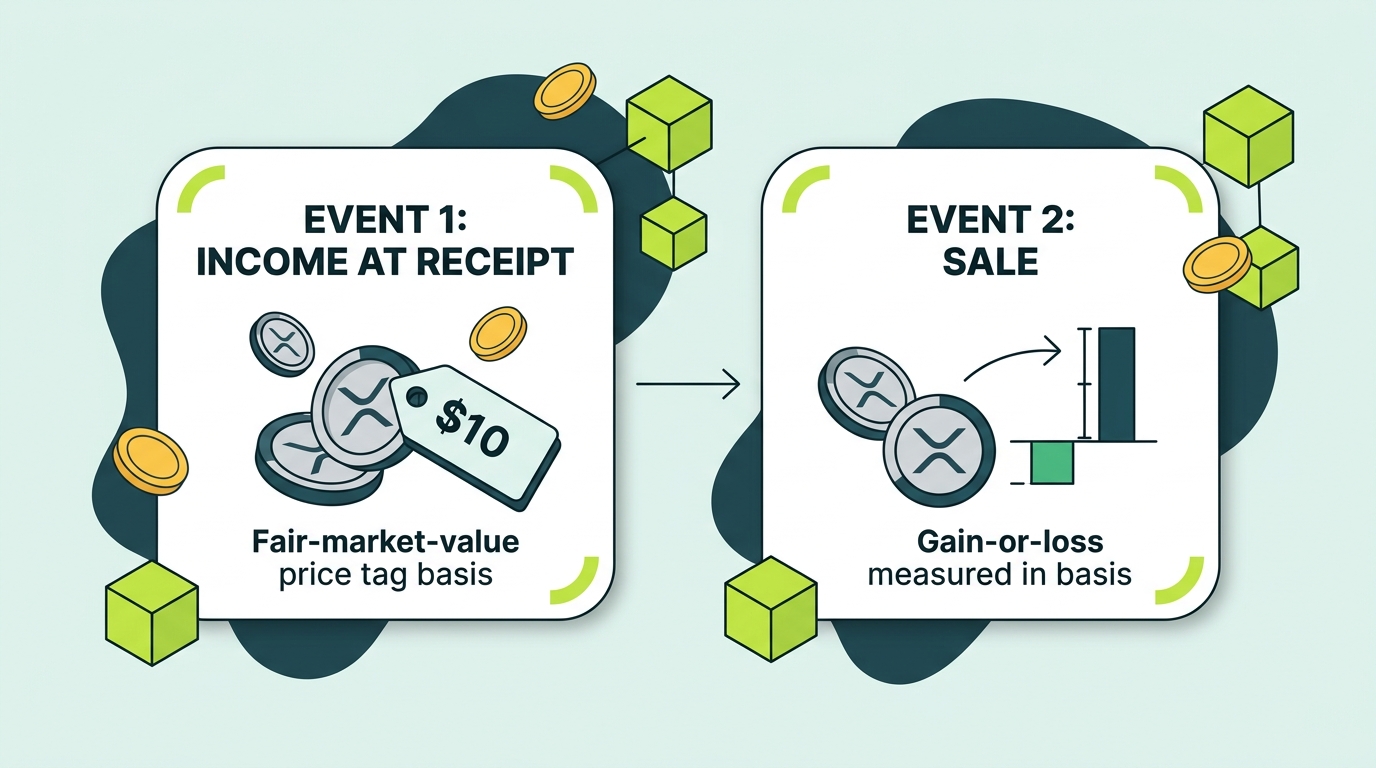
One FlareDrop, Two Tax Moments
In June 2024, a monthly FlareDrop credits you 6,000 FLR when FLR trades at $0.03. You report $180 of ordinary income, and those 6,000 FLR take a $180 basis. In August 2025, you sell them at $0.0417 for $250. That is a $70 long-term capital gain, taxed at 0, 15, or 20 percent depending on your bracket. The $180 was taxed once as income and then protects itself as basis at sale. Nothing is taxed twice.
Now run the failure mode. Same facts, but you never reported the $180 of income. Your tax software sees 6,000 FLR appear from nowhere, assigns them zero basis, and reports the entire $250 sale as gain. You overpay on the sale while remaining non-compliant on the income. Multiply that across an initial distribution plus 36 monthly drops and the zero-basis error becomes the single most expensive mistake in Flare tax reporting.
Two more selling notes. First, because FLR prices during much of the FlareDrop period were higher than today’s, many holders are sitting on losses relative to their income-based basis. Those losses are real and deductible against other capital gains once you harvest them, but only if the basis was established by reporting the income. Second, disposal mechanics for airdropped tokens are identical to any other crypto sale, so the same Form 8949 and Schedule D process applies, and if you are also unloading the underlying XRP, our selling XRP tax guide covers that side.
Beyond the Airdrop: FTSO Delegation and Staking Rewards
Many holders did not stop at receiving tokens. Flare and Songbird both encourage wrapping and delegating to FTSO data providers, which pays ongoing rewards, and FLR staking pays rewards as well. Tax treatment is the familiar one: delegation and staking rewards are ordinary income at fair market value when claimed or credited, on the same dominion and control logic as everything else in this guide. Each claim is an income event, the income value becomes basis, and later sales are capital events.
Practically, FTSO rewards are the piece most likely to be missing from your records, because they accrue at the protocol level and only hit your wallet when you claim. If you delegated for years and claimed sporadically, your claim transactions are your income dates. The broader framework for reward-type income is covered in our guide to crypto income from staking, mining, and airdrops.
Reporting Forms and the 1099 Reality
No exchange issued a clean, comprehensive tax form for the Flare distributions. Here is what actually exists:
- Form 1099-MISC. Some exchanges report airdrop and reward income on 1099-MISC once your total miscellaneous income crosses $600 for the year. Coverage of the Flare drops specifically was inconsistent across platforms and years. A missing form does not make the income unreportable.
- Form 1099-DA. Starting with the 2025 tax year, exchanges report gross proceeds from your sales on Form 1099-DA. This is the form that makes old unreported airdrops surface: when you sell FLR on an exchange, the IRS sees the proceeds, and if no return ever showed the airdrop income that created your basis, the mismatch is easy to flag.
- Schedule 1. Airdrop, FlareDrop, and delegation income lands on Schedule 1 of Form 1040 as other income for nearly all individual holders.
- Form 8949 and Schedule D. Every disposal of SGB or FLR goes here, batch by batch, with basis from the income you reported.
Also remember the digital asset question on the front of Form 1040. Receiving an airdrop means the answer is yes.
How to Report Flare Airdrop Income: Step by Step
- Reconstruct your receipt history. Pull exchange statements for every platform that held your XRP in December 2020, and export your Flare address history if you self-claimed. You are looking for every SGB credit, the January 2023 FLR distribution, every monthly FlareDrop, and every FTSO reward claim.
- Stamp each receipt with fair market value. Use the token’s price on each receipt date. Crypto tax software (Koinly, CoinTracker, CoinLedger) can price most of these automatically once the transactions are imported, though Flare network support varies and spot-checking is essential.
- Assign each receipt to the right tax year. SGB is mostly 2021 income. The TDE is 2023. FlareDrops span 2023 through January 2026. Late exchange credits belong to the year they actually landed.
- Report income on Schedule 1 for each affected year. If a past year is missing, that year needs an amended return, not a catch-up entry in the current year.
- Verify basis carried through. Every income entry should create a lot with matching basis. Spot-check that your software did not double-count wraps or treat WFLR as a new zero-basis asset.
- Report disposals on Form 8949 and Schedule D, using receipt-date basis and holding periods.
- Apply per-wallet basis tracking. Under Rev. Proc. 2024-28, basis is tracked per wallet and account from January 1, 2025. Flare holders often have lots split across an exchange, an XRPL wallet, and a Flare wallet, and our per-wallet cost basis guide explains how to keep them straight.
- Archive everything: snapshots of exchange statements, claim transactions, price sources, and the position you took on wrapping.
Common Flare Airdrop Tax Mistakes
The errors we see most often in XRP-holder reconciliations, in rough order of cost:
Treating the Sale as the First Taxable Event
Holders who received FLR in 2023 and sold in 2025 often report only the sale, at zero basis, in the sale year. That overstates the 2025 gain and leaves 2023 income unreported. Both years are wrong, in opposite directions.
Reporting Everything in One Year
Bundling SGB, the TDE, and three years of FlareDrops into a single tax year because that is when you noticed them. Income belongs to the year of receipt. A 36-drop history spans four filing years, and the IRS matches by year.
Valuing Income at the Snapshot or Announcement Date
The December 2020 snapshot has no tax significance, and neither does any announcement. Only receipt dates and receipt-date prices count.
Forgetting the Monthly Drops Entirely
Many holders remember the big January 2023 credit and forget that 85 percent of the allocation arrived in monthly pieces afterward. If you held WFLR, those drops were flowing every month through January 2026, and each one is income.
Missing FTSO Delegation Rewards
Delegation rewards claimed along the way are income separate from the airdrop. Sporadic claim habits make them easy to lose; the chain remembers them anyway.
Assuming No Form Means No Income
Most of this history generated no 1099 at all. The reporting duty is yours, from your own records, regardless of paperwork.
Your Flare Airdrop Tax Checklist
- List every venue that held your XRP at the December 2020 snapshot: exchanges, wallets, all of them.
- Pull SGB receipt records from September 2021 onward, including late exchange credits.
- Pull the January 2023 FLR distribution records from each exchange or your Flare address.
- Export every monthly FlareDrop from March 2023 through January 2026 if you held WFLR.
- Capture FTSO delegation and staking reward claims as separate income events.
- Price every receipt at its own date and assign it to the correct tax year.
- File amended returns for any past year with missing airdrop income.
- Confirm every income entry created basis in your tax software, with no zero-basis FLR lots.
- Report disposals on Form 8949 and Schedule D with receipt-date basis and holding periods.
- Document your wrap treatment and apply it consistently.
Bottom Line
The Flare airdrop looks complicated because it was slow, not because the tax rule is hard. One principle covers everything: tokens are ordinary income at fair market value when you gain dominion and control, and that income becomes your basis for the eventual sale. Apply it to SGB in 2021, the FLR distribution in January 2023, each monthly FlareDrop through January 2026, and every FTSO reward in between, and the whole five-year saga resolves into a list of dated income events and dated disposals. The work is reconstruction, not interpretation.
That reconstruction is exactly what we do. Count On Sheep rebuilds airdrop histories across exchanges and self-custody wallets, prices every receipt, fixes zero-basis lots, prepares amended returns where years were missed, and hands you CPA-ready numbers. A 15-minute call with a crypto tax specialist is the fastest way to find out how much cleanup your Flare history actually needs, or reach out to our team for a full review. And for everything else in your XRP life, from ETF shares to on-ledger DeFi, start with our complete XRP tax guide.
Related Reading
- XRP Tax Guide: The Complete Picture
- Selling XRP and Taxes: What You Owe in 2026
- XRP ETF Taxes: Spot ETFs and What They Change
- XRP Ledger DeFi Taxes: AMM, DEX, and NFTs
- Crypto Income Taxes: Staking, Mining, and Airdrops
- Form 1099-DA Explained
- Per-Wallet Cost Basis Under Rev. Proc. 2024-28
Frequently Asked Questions
Is the Flare (FLR) airdrop taxable for XRP holders?
Yes. FLR tokens received through the airdrop are ordinary income at their fair market value on the date you gained dominion and control over them. For most holders that means the January 2023 initial distribution and each monthly FlareDrop afterward, through the final drop in January 2026. The XRP snapshot itself in December 2020 was not a taxable event because no tokens existed to receive yet.
When did the Flare airdrop become taxable income?
When you could actually sell, swap, or transfer the tokens. For exchange users, that is the date your exchange credited FLR to your account. For self-custody claimers, it is the date the tokens arrived in your Flare wallet. The initial 15 percent landed in January 2023, and the remaining 85 percent arrived through 36 monthly FlareDrops from March 2023 through January 2026, each one a separate income event.
What if I never claimed my Flare tokens?
If you never claimed and never received FLR, you have no income to report. Income requires dominion and control, and tokens you cannot sell or transfer do not meet that test. The nuance is exchange users: if your exchange credited FLR to your account, you received it whether you ever touched it or not, and it is income even if it just sat there.
Is the Songbird (SGB) airdrop taxable?
Yes, under the same rule. SGB distributed in September 2021 was ordinary income at fair market value when it was credited to you or claimable by you. Many XRP holders received SGB on exchanges automatically. SGB traded thinly at first, which makes the valuation date matter, but a defensible fair market value at receipt is still required.
What is my cost basis in airdropped FLR or SGB?
The fair market value you reported as income when you received each batch. That income value becomes the basis, and the holding period starts the day of receipt. If you report zero income, your basis is zero, and every later sale is 100 percent gain.
How do I report FlareDrop income on my tax return?
Total the fair market value of every FLR distribution received during the year and report it as other income on Schedule 1 of Form 1040. When you later sell the tokens, report the disposal on Form 8949 and Schedule D using the income value as basis. This is the same framework the IRS applies to staking rewards and other airdrops.
Do the monthly FlareDrops count as separate income events?
Yes. Each of the 36 monthly FlareDrops is its own income event with its own date and its own fair market value. A holder who wrapped FLR and collected every drop has 36 income entries plus the initial distribution, each valued at the price on its receipt date.
Was wrapping FLR into WFLR a taxable event?
Most practitioners treat a 1:1 wrap of FLR into WFLR as non-taxable because you retain the same economic ownership and the wrap is freely reversible. A conservative minority view treats any token-for-token exchange as a disposal. Whichever position you take, apply it consistently and document it.
What if my exchange never supported the Flare airdrop?
If your exchange never distributed FLR to you and you had no self-custody claim, you received nothing and have no income. Some exchanges credited tokens years late. In that case the income date is the late credit date, at that day's price, not the announcement date and not the snapshot date.
What happens when I sell my airdropped FLR?
Selling is a second, separate taxable event. You compare sale proceeds to the basis established at receipt. Held one year or less, the gain is short-term and taxed at ordinary rates. Held more than a year, it is long-term and taxed at 0, 15, or 20 percent depending on your income. Losses are deductible against other gains.
I never reported my 2021 SGB or 2023 FLR income. What now?
File amended returns for the affected years before the IRS asks. Airdrop credits on KYC exchanges are visible to the IRS, and 1099-DA proceeds reporting makes an eventual sale of unreported tokens easy to flag. Voluntary amendment is dramatically cheaper than responding to a notice. Our team handles this reconstruction regularly.
Are FTSO delegation rewards on Flare taxable too?
Yes. Rewards earned by delegating WFLR or WSGB to FTSO data providers are ordinary income at fair market value when claimed or credited, under the same dominion and control logic. They are separate from the airdrop itself and need their own income entries.