
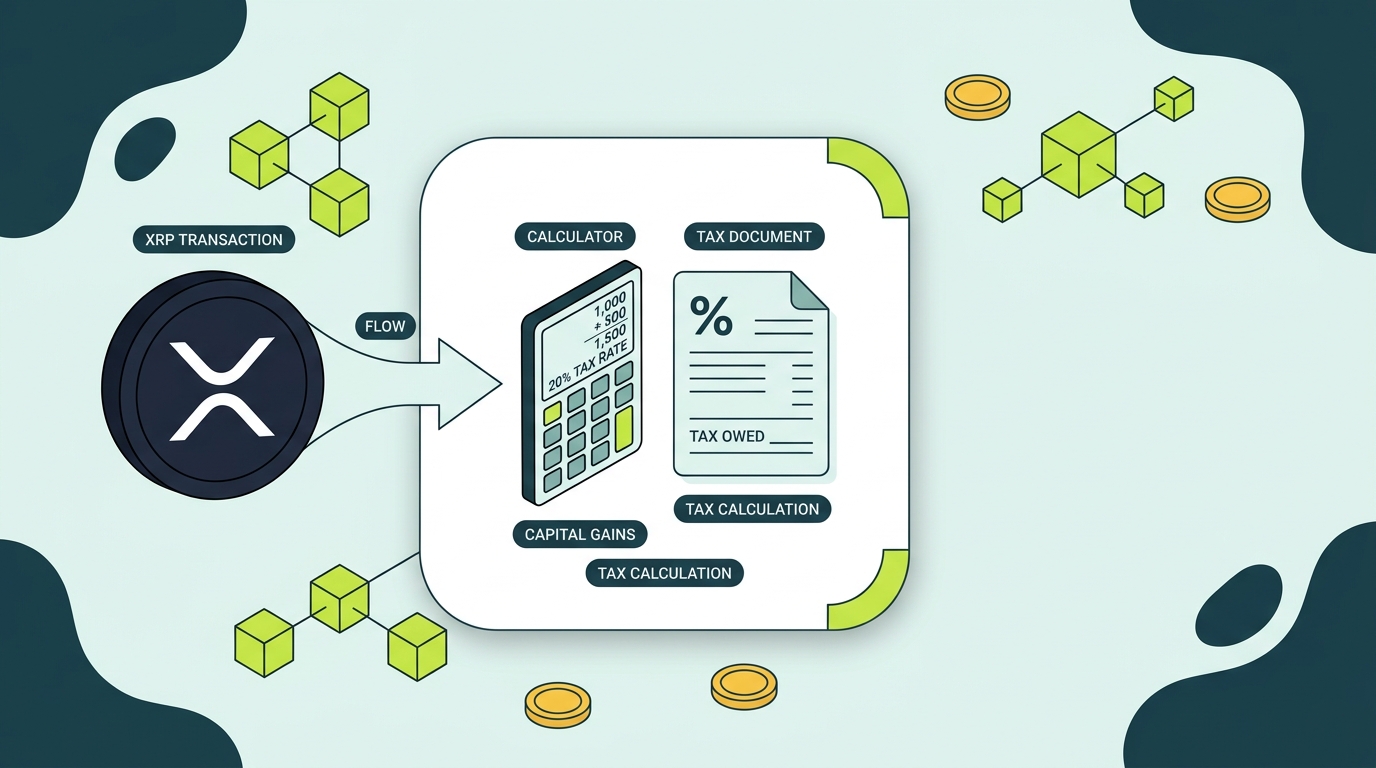
How is selling XRP taxed? Every sale, swap, or spend of XRP is a disposal of property that produces a capital gain or loss: proceeds minus cost basis. Hold more than one year and the gain gets long-term rates of 0%, 15%, or 20%. Hold a year or less and it is taxed like wages, at rates up to 37%. High earners add 3.8% NIIT on top. The SEC lawsuit, the Torres ruling, the appeals, the settlement: none of it changed a single word of this.
That last point matters more for XRP than for any other coin, because no asset in crypto has accumulated more tax folklore. Holders spent four years watching a securities case and concluded, in surprising numbers, that the outcome had tax consequences. It did not. Meanwhile the things that actually do have tax consequences went ignored: the exchange delistings that shredded basis records, the wallet migrations that broke transfer trails, the wallet-by-wallet basis rules that took effect January 1, 2025, and a new IRS form that now reports your gross proceeds whether or not you can prove what you paid.
This guide covers selling XRP taxes end to end for 2026: exactly which events are taxable, the current rate brackets with worked examples, FIFO versus specific identification and why the choice is worth five figures for long-time holders, the Rev. Proc. 2024-28 wallet rules, the 1099-DA zero-basis trap that hits XRP holders harder than almost anyone, the SEC-case myths that refuse to die, and loss harvesting while the wash sale window stays open. It is one piece of our complete XRP tax guide, alongside our guides to XRP ETF taxes, Flare airdrop taxes, and XRP staking and lending taxes.
Disclaimer: This guide is for informational purposes only and is not tax or legal advice. Cryptocurrency rules change quickly. Always consult a qualified CPA about your specific situation.
What Counts as Selling: The Full List of XRP Taxable Events
The IRS treats XRP as property, the same as it treats Bitcoin, Ethereum, and every other digital asset. Property has one core tax rule: disposing of it is a realization event. The word “selling” in this guide covers more than cashing out to dollars, and the gap between what holders think is taxable and what actually is taxable is where most XRP tax problems start.
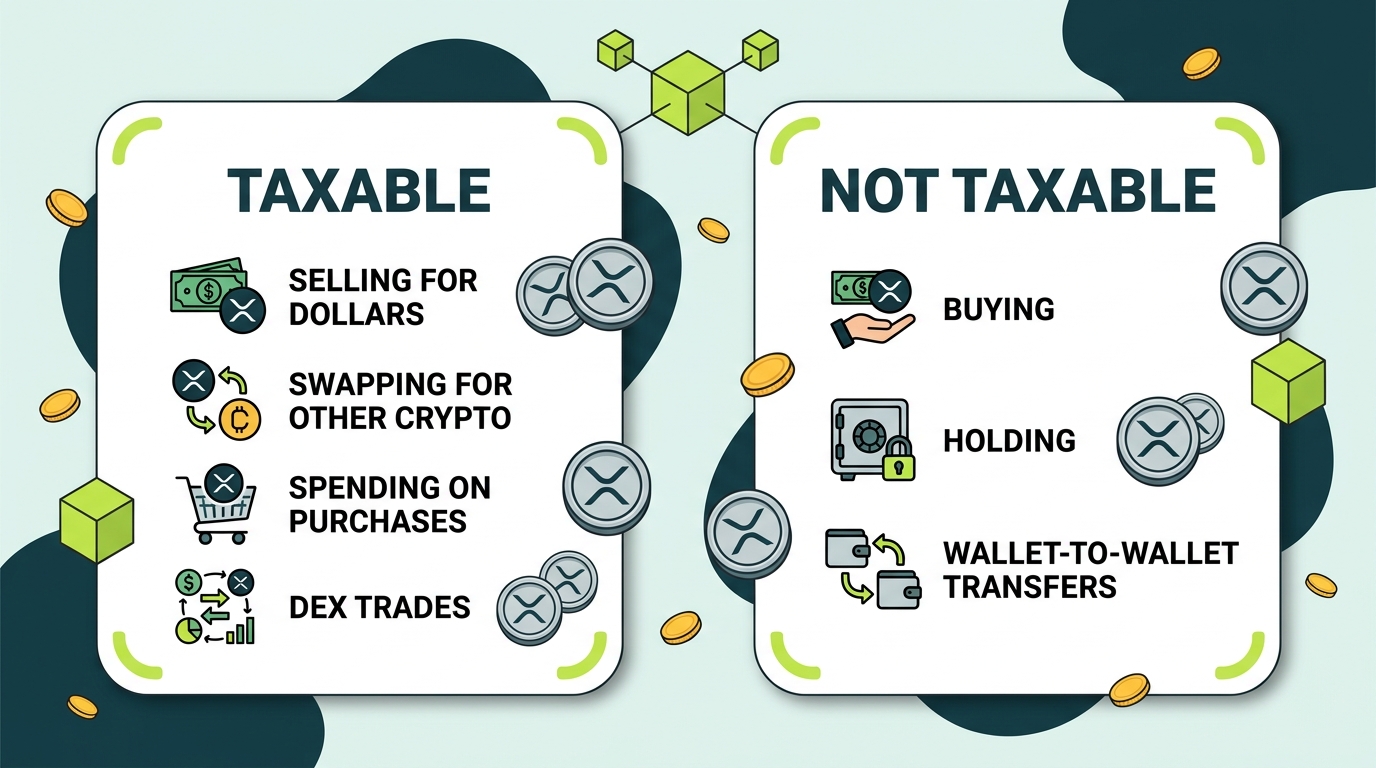
Taxable disposals of XRP:
- Selling XRP for dollars or any fiat currency, on an exchange or peer to peer.
- Swapping XRP for another cryptocurrency. XRP to BTC, XRP to ETH, XRP to a stablecoin like USDC or RLUSD. Every one of these is a sale of the XRP at its fair market value at the moment of the trade, even though no dollars appear anywhere.
- Spending XRP on goods or services. A laptop, a plane ticket, a coffee. Each purchase disposes of the XRP at the price of the thing you bought.
- Trading on the XRP Ledger’s built-in DEX. The XRPL has had a native decentralized exchange since 2012. Swapping XRP for a token issued on the ledger, or providing XRP to an AMM pool in a way that changes what you own, is a disposal like any other. Our XRPL DeFi tax guide covers the ledger-native mechanics in depth.
Not taxable:
- Buying XRP with dollars. You acquired property. Nothing was disposed of.
- Holding XRP through any amount of price movement. Unrealized gains are not taxed, and unrealized losses are not deductible.
- Moving XRP between your own wallets and accounts. Ledger to exchange, exchange to Xumm wallet, one of your addresses to another. No disposal occurs because ownership never changed. But every one of these transfers must be documented, because a transfer your records cannot explain looks exactly like a purchase with no basis or a sale with no report.
- The XRPL network fee burned on each transaction. Every XRP Ledger transaction destroys a tiny amount of XRP, typically a fraction of a cent. Technically each burn is a disposal of a minuscule lot, and in practice tax software treats these amounts as negligible fees. They are not where your tax risk lives.
One more distinction worth pinning down early: receiving XRP as income is a different tax event entirely. Airdrops like the Flare distribution, payment for services, and lending yield are ordinary income at receipt, covered in our Flare airdrop guide and staking and lending guide. This guide is about the disposal side: what happens when XRP leaves your hands. For the full map of every XRP tax event in one place, start with our XRP tax guide.
The 2026 Rates: Short-Term vs Long-Term
Your rate depends on one question: did you hold the XRP for more than one year before disposing of it? The clock starts the day after acquisition and the boundary is exact. Three hundred sixty-five days is short-term. Three hundred sixty-six is long-term, and the rate difference can be enormous.
Short-Term: Ordinary Income Rates
XRP held one year or less is taxed at the same rates as your salary. For 2026, the brackets are:
| Rate | Single (taxable income) | Married Filing Jointly |
|---|---|---|
| 10% | Up to $12,400 | Up to $24,800 |
| 12% | $12,401 to $50,400 | $24,801 to $100,800 |
| 22% | $50,401 to $105,700 | $100,801 to $211,400 |
| 24% | $105,701 to $201,775 | $211,401 to $403,550 |
| 32% | $201,776 to $256,225 | $403,551 to $512,450 |
| 35% | $256,226 to $640,600 | $512,451 to $768,700 |
| 37% | Over $640,600 | Over $768,700 |
Short-term XRP gains stack on top of your wages and other ordinary income, so a trader with a $110,000 salary and $30,000 of short-term XRP gains pays 24% on most of those gains.
Long-Term: The 0/15/20 Brackets
XRP held more than one year gets the preferential long-term capital gains rates. For 2026:
| Rate | Single (taxable income) | Married Filing Jointly | Head of Household |
|---|---|---|---|
| 0% | Up to $49,450 | Up to $98,900 | Up to $66,200 |
| 15% | $49,451 to $545,500 | $98,901 to $613,700 | $66,201 to $579,600 |
| 20% | Over $545,500 | Over $613,700 | Over $579,600 |
The long-term brackets are measured against your total taxable income, with the gain stacking on top of ordinary income. A married couple with $70,000 of wage income and a $25,000 long-term XRP gain sits entirely in the 0% bracket and pays no federal tax on the gain at all. That is not a loophole. It is the design, and it is one of the most underused planning levers for households in modest income years.
The 3.8% NIIT Layer
The Net Investment Income Tax adds 3.8% on net investment income, including XRP capital gains, once modified adjusted gross income exceeds $200,000 (single) or $250,000 (married filing jointly). A large XRP sale can push you over the threshold by itself, which means the sale that triggers the gain also triggers the surtax on it. High earners selling long-term XRP should think in terms of 18.8% or 23.8% total federal rates, not 15% or 20%.
Worked Examples: Three Disposals, Three Outcomes
Numbers make the rules concrete. Here are the three most common XRP disposal patterns we reconcile.
The Long-Term Holder Cashing Out
Maya bought 10,000 XRP in 2020 at $0.50, for a $5,000 cost basis. In 2026 she sells all of it at $3.00, for $30,000 of proceeds. Her gain is $25,000, all long-term. Her taxable income including the gain lands in the 15% long-term bracket, so she owes $3,750. If she had sold the same position within a year of buying it at her 24% ordinary rate, the bill would have been $6,000.
The Swap Nobody Reported
Dev bought 5,000 XRP at $2.20 in January, spending $11,000. Six months later, with XRP at $2.80, he swaps the entire position for Bitcoin. No dollars hit his bank account, so he assumes nothing happened. Wrong. The swap is a disposal of 5,000 XRP at $14,000 of proceeds against $11,000 of basis: a $3,000 short-term gain, taxed at his 24% ordinary rate. His Bitcoin takes a $14,000 basis, and the clock on its holding period starts from zero.
Spending XRP on a Laptop
Sam pays for a $2,500 laptop with XRP he bought years ago for $600. The purchase is a disposal of the XRP at $2,500 of proceeds against $600 of basis: a $1,900 long-term capital gain, reportable on Form 8949 like any sale. There is no de minimis exemption in current law. The tax code does not care that he bought a laptop instead of dollars.
The pattern across all three: the taxable moment is the disposal, not the cash-out. XRP holders who only track exchange withdrawals to their bank accounts are missing most of their taxable events.
FIFO vs Specific Identification: The Choice Worth Five Figures
When you sell part of a position, which coins did you sell? For a holder with one purchase, the question is trivial. For an XRP holder with lots from 2017, 2020, and 2025 at wildly different prices, the answer determines the size of the gain.
FIFO: The Default, and Often the Most Expensive
First in, first out is the IRS default. Your oldest lot is deemed sold first. For long-time XRP holders, the oldest lots are usually the cheapest lots, which means FIFO front-loads the largest gains. It is simple, it requires no election, and it is frequently the worst-performing choice available.
Specific Identification: Choosing Your Lots
Specific identification (spec ID) lets you designate exactly which units you are selling, including strategies like highest cost first (HIFO), which minimizes the current gain. The catch is procedural: you must identify the units no later than the time of the sale, and you need records showing the date, time, basis, and fair market value of the identified units. Under the post-2025 broker rules, identifying lots to your exchange at or before the trade is the clean path; a spreadsheet built in April does not qualify.
Same Sale, $12,000 Difference in Gain
Lena holds three XRP lots: 5,000 bought in 2017 at $0.20, 5,000 bought in 2021 at $1.40, and 5,000 bought in 2025 at $2.60. In 2026 she sells 5,000 XRP at $3.00 for $15,000. Under FIFO, she sells the 2017 lot: $15,000 minus $1,000 basis is a $14,000 long-term gain. Under spec ID choosing the 2025 lot, the gain is $15,000 minus $13,000, just $2,000, and it is long-term if the lot has crossed a year. Same sale, same proceeds, $12,000 less gain, purely from lot selection made at the moment of the trade.
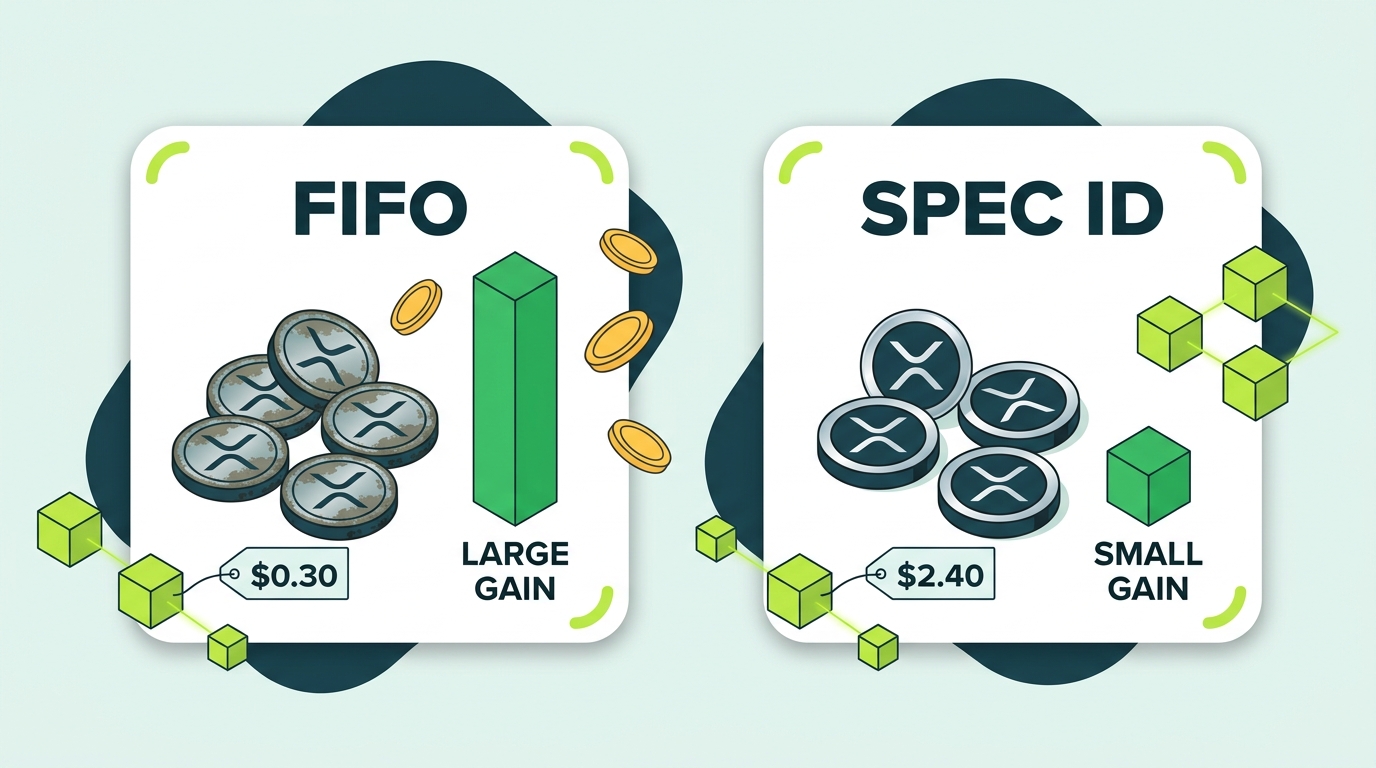
Which method wins depends on your goals. HIFO minimizes this year’s tax but leaves the cheap lots, and their embedded gains, for later. FIFO burns the cheap lots now, which can be smart in a 0% bracket year or ahead of an expected rate increase. The point is that this is a decision, not a default you drift into, and the decision must be made at sale time, not at filing time. For the full framework, see our guide to FIFO vs HIFO vs spec ID.
Wallet-by-Wallet Basis: Rev. Proc. 2024-28 and the XRP Migration Mess
Until 2025, most crypto software tracked basis in a single universal pool: every XRP you owned, across every wallet and exchange, treated as one big bucket. Rev. Proc. 2024-28 ended that. Effective January 1, 2025, cost basis must be tracked per wallet and per account. Each exchange account and each self-custody wallet holds its own lots with their own basis, and a sale from one account uses only that account’s lots.
The revenue procedure included a one-time safe harbor: taxpayers could allocate their existing universal basis across their wallets as of January 1, 2025, using a reasonable method, and lock that allocation in. Holders who did the allocation have clean, defensible per-wallet records. Holders who never heard of it are now running software that silently guesses.
XRP holders got hit by this transition harder than almost any other community, for a reason specific to XRP’s history: the delisting era scattered everyone’s coins. When the SEC sued Ripple in December 2020, Coinbase, Kraken, and most major US platforms suspended or delisted XRP trading. Holders scrambled: coins moved to overseas exchanges, to self-custody XRPL wallets, to platforms that later collapsed, and then back again when relistings began in mid-2023. Every hop was non-taxable, and every hop was another chance for the basis trail to break. A 2017 purchase that traveled through four platforms and two wallets before landing on Coinbase in 2024 is exactly the kind of lot the per-wallet rules expose.
If your XRP took that journey and you never did the safe harbor allocation, fix the records before your next large sale, not after. Our per-wallet cost basis guide walks through the full framework, including what a reasonable allocation looks like after the deadline has passed.
The 1099-DA Zero-Basis Trap
Starting with the 2025 tax year, US exchanges file Form 1099-DA with the IRS, reporting your gross proceeds every time you sell or swap digital assets on their platform. The first wave of these forms landed in early 2026, covering 2025 sales. Basis reporting phases in next: for XRP acquired on the same platform on or after January 1, 2026, brokers will also report cost basis, starting with the forms that arrive in early 2027.
Notice the gap, because it is where XRP holders live. Basis reporting only covers coins bought and sold on the same platform. XRP that arrives by transfer, from your Xumm wallet, from an overseas exchange, from anywhere, shows up at the broker with no basis attached. When you sell it, the 1099-DA reports the full proceeds and says nothing about what you paid.
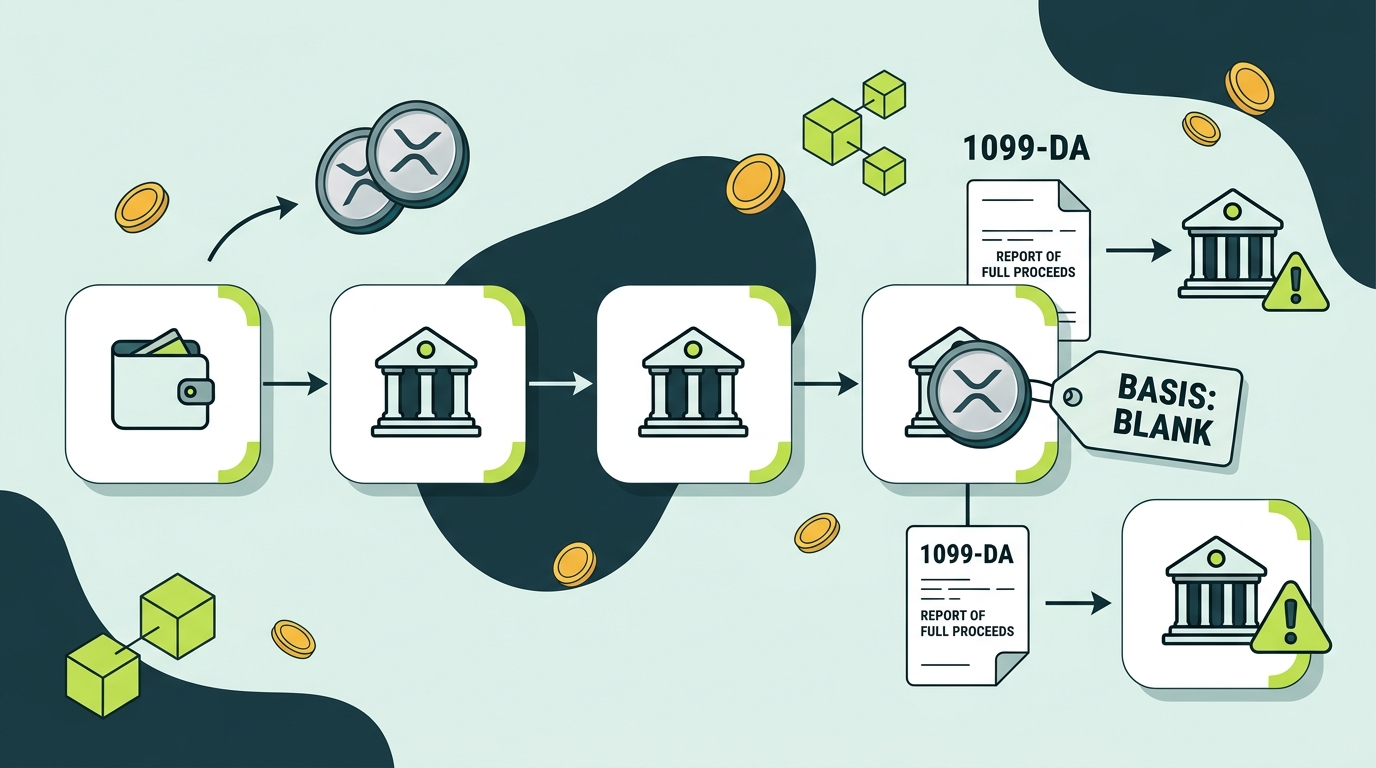
Now play out the typical XRP story. Bought on an exchange in 2017. Moved to self-custody. Moved to an offshore platform during the 2021 delistings. Moved back to Coinbase after relisting in 2023. Sold in 2026 for $40,000. Coinbase files a 1099-DA showing $40,000 of proceeds and no basis. The IRS matching system sees $40,000 with no story. If your return reports the true $4,000 basis, you need the records to back it. If you report nothing, the notice that eventually arrives assumes the basis was zero and calculates tax on the entire $40,000.
The defense is straightforward and unglamorous:
- Reconstruct basis now, while old exchange records, bank statements, and email confirmations are still retrievable. Several platforms XRP holders used are gone; their data gets harder to recover every year.
- Match every transfer in your tax software so deposits are linked to the withdrawals that funded them, carrying basis and holding period across each hop.
- Reconcile any 1099-DA you receive against your own records before filing, and never let software default a transferred lot to zero basis without a fight.
The 1099-DA tells the IRS what you received. Only your records can tell it what you paid. For a coin whose holders spent four years moving it between platforms, that difference is the whole ballgame.
The SEC Lawsuit and Your Taxes: Separating Law from Folklore
The SEC sued Ripple in December 2020, alleging that XRP sales were unregistered securities offerings. In July 2023, Judge Analisa Torres ruled that Ripple’s programmatic sales of XRP on exchanges were not securities transactions, while its direct institutional sales were. In August 2024 the court ordered Ripple to pay a $125 million civil penalty. Both sides appealed, then both sides walked away: the appeals were dismissed in August 2025, and the case is over.
That saga was consequential for exchange listings, for ETF approval, and for Ripple’s business. For your taxes, it was consequential for exactly nothing, and the myths it spawned are worth killing one at a time.
Myth 1: “XRP is not a security, so the tax rules are different”
Securities law and tax law are separate bodies of law with separate definitions. The IRS taxes digital assets as property under Notice 2014-21 and years of subsequent guidance, and that classification never depended on the securities question. XRP was taxable property in 2019, taxable property while the case was pending, and taxable property the day the appeals died. No ruling in SEC v. Ripple changed a single tax obligation for a single holder.
Myth 2: “The delisting losses were deductible”
When exchanges delisted XRP in early 2021, the price fell hard and holders felt real losses. Felt is the operative word. A capital loss exists only when you dispose of the asset below your basis. Holders who kept their XRP through the drawdown, and then rode it back up, never realized anything. There is no deduction for watching a price chart, and there was no special casualty treatment for delistings.
Myth 3: “The court ruling reset my basis” (or holding period, or anything)
Nothing about the litigation touched your lots. Your basis is what you paid. Your holding period runs from when you acquired each lot. XRP that relisted on Coinbase in 2023 came back with the same basis and holding period it always had. Holders who treated the relisting as a fresh start, or assumed pre-lawsuit history stopped mattering, built their records on sand.
Myth 4: “The case is settled, so old unreported sales are water under the bridge”
The opposite is closer to true. The end of the lawsuit brought relistings, ETFs, institutional attention, and vastly more reporting infrastructure pointed at XRP than existed in 2021. Exchanges now file 1099-DAs. The XRP Ledger’s history is public and permanent. Unreported disposals from the delisting-era shuffle did not expire; they became easier to find. If you have unreported XRP sales from prior years, an amended return filed proactively is dramatically cheaper than an IRS letter, and we cover the notice process in our guide to IRS crypto letters.
Loss Harvesting XRP: The Wash Sale Window Is Still Open
XRP’s volatility cuts both ways, and the down years are worth money if you use them. Selling XRP below your basis realizes a capital loss that offsets your capital gains dollar for dollar, then up to $3,000 of ordinary income per year, with the remainder carried forward indefinitely.
Here is the part that surprises people coming from stocks: the wash sale rule does not apply to directly held XRP under current law. Section 1091 disallows losses on securities repurchased within 30 days. XRP held directly is property, not a security, so the statute does not reach it. You can sell XRP at a loss on Tuesday, buy it back Tuesday afternoon, keep your position, and keep the loss.
Harvesting a Loss Without Losing the Position
Priya bought 5,000 XRP at $3.40 near the 2025 highs. In 2026 it trades at $2.20. She sells all 5,000, realizing a $6,000 loss, and rebuys 5,000 XRP an hour later at essentially the same price. Her position is unchanged. The $6,000 loss offsets gains elsewhere in her portfolio, and her new lot has a $11,000 basis with a fresh holding period. With stocks, the 30-day rule would disallow this. With XRP, under current law, it works.
Three caveats before you build a strategy on this:
- The window may close. Congress has proposed extending wash sale rules to digital assets in multiple budget cycles. Any change would almost certainly be prospective, but harvests should be documented carefully in case the ground shifts.
- XRP ETF shares are different. The spot XRP ETFs that launched in late 2025 trade as securities, and the wash sale rule applies to them. Selling ETF shares at a loss and rebuying within 30 days is a disallowed loss, full stop. If you hold both direct XRP and ETF shares, the two sides of your position live under different rules, and our XRP ETF tax guide covers the interaction.
- Economic substance still matters. A harvest should be a real sale at market prices on a real venue. Wash trading with yourself on thin XRPL DEX pairs to manufacture losses is a different activity with a different name.
The broader playbook, including timing harvests against your gain profile, lives in our tax loss harvesting guide.
How to Report XRP Sales: Step by Step
- Gather every account. Exchange accounts (current, delisting-era, and defunct), XRPL wallets, and any platform that ever held your XRP go into your crypto tax software. XRPL address history is public and importable.
- Match your transfers. Confirm every wallet-to-exchange and exchange-to-exchange movement is linked as a self-transfer carrying basis and holding period. This is the step XRP holders most often fail, and the one that prevents zero-basis disasters.
- Verify your lots. Spot-check acquisition dates and prices against old confirmations and bank records, especially for pre-2021 lots that traveled during the delistings.
- Confirm your lot method. FIFO by default; specific identification only if you made the identification at or before each sale.
- Report each disposal on Form 8949, with acquisition date, sale date, proceeds, and basis, flowing to Schedule D. Short-term and long-term lots net separately.
- Reconcile any 1099-DA against your own numbers before filing. The form’s proceeds should match your reported proceeds; its missing basis is yours to supply.
- Check NIIT. Over $200,000 single or $250,000 MFJ modified AGI means Form 8960 and 3.8% on the gains.
- Answer the digital asset question on Form 1040. Selling, swapping, or spending XRP is a yes.
- Set quarterly estimates if a large gain landed early in the year. Nobody withholds tax from an XRP sale, and underpayment penalties are pure waste.
Common XRP Selling Mistakes
The errors we find most often in XRP reconciliations, roughly in order of expense:
Treating Crypto-to-Crypto Swaps as Non-Events
XRP to BTC, XRP to RLUSD, XRP to anything is a taxable disposal at fair market value. Swaps are the most common unreported taxable event in every XRP file we clean up.
Selling Transferred Coins with No Basis Records
The delisting-era migration broke more basis trails than any event in XRP’s history. Selling those coins through a 1099-DA-reporting exchange without reconstructed records invites tax on 100% of the proceeds.
Using FIFO by Inertia
Long-time holders sitting on $0.20 lots who sell under default FIFO realize the maximum possible gain. Lot selection is a decision worth real money, and it must be made at sale time.
Believing the Lawsuit Changed Something
It changed nothing about taxes. Sales during the case were taxable. Losses during the delistings were not deductible without a sale. The settlement reset nothing.
Ignoring Spending
Buying anything with XRP is a disposal. Holders who used XRP for payments, one of the network’s core use cases, often have dozens of small unreported gains.
Skipping the Safe Harbor Allocation
Holders with XRP spread across wallets who never allocated basis under Rev. Proc. 2024-28 are filing on top of software guesses. The gap surfaces at the worst time: a large sale, or an audit.
Your Selling XRP Tax Checklist
- List every venue that ever held your XRP: current exchanges, delisting-era platforms, defunct ones, and all XRPL wallets.
- Import everything into crypto tax software and let it read XRPL history directly.
- Match all self-transfers so basis and holding periods survive every hop.
- Reconstruct basis for old lots from exchange records, bank statements, and confirmations before selling, not after.
- Choose a lot method deliberately and set it up with your exchange before the sale.
- Apply per-wallet tracking under Rev. Proc. 2024-28, with a documented allocation for pre-2025 holdings.
- Report every disposal on Form 8949 and Schedule D, including swaps and spending.
- Reconcile 1099-DAs against your records and supply the basis the form lacks.
- Harvest losses deliberately while the wash sale window for direct XRP stays open, with clean documentation.
- Check NIIT exposure and quarterly estimates in any year with a large gain.
Bottom Line
Selling XRP is taxed like selling any property: proceeds minus basis, short-term or long-term by holding period, 0/15/20 brackets on the long side, ordinary rates up to 37% on the short side, NIIT on top for high earners. None of that is exotic. What makes XRP hard is history: a four-year lawsuit that generated tax myths instead of tax changes, a delisting era that scattered coins and shredded basis records, and a new reporting regime that broadcasts proceeds while leaving basis entirely on you. The holders who do well from here are the ones who rebuild their records before the next big sale, pick their lots on purpose, and treat the SEC saga as what it was: securities news, not tax news.
If your XRP history spans the delisting years, multiple platforms, or lots you can no longer price, this is exactly the reconstruction work we do. Count On Sheep rebuilds the trail, fixes the basis, and hands you and your preparer CPA-ready numbers. A 15-minute call with a crypto tax specialist is the fastest way to find out where you stand, or reach out to our team for a full XRP review.
Related Reading
- XRP Tax Guide: The Complete Picture
- XRP ETF Taxes: Grantor Trusts, Wash Sales, and IRAs
- XRP Flare Airdrop Taxes
- XRP Ledger DeFi Taxes
- XRP Staking and Lending Taxes
- FIFO vs HIFO vs Spec ID for Crypto Taxes
- Per-Wallet Cost Basis Under Rev. Proc. 2024-28
- Form 1099-DA Explained
- Crypto Tax Loss Harvesting and the Wash Sale Rule
Frequently Asked Questions
How much tax do I pay when I sell XRP?
It depends on your holding period and income. XRP held more than one year gets long-term capital gains rates of 0%, 15%, or 20% based on your taxable income. XRP held one year or less is taxed as ordinary income at rates up to 37%. High earners may also owe the 3.8% net investment income tax on top of either rate.
What are the 2026 long-term capital gains brackets?
For 2026, single filers pay 0% on taxable income up to $49,450, 15% from $49,451 to $545,500, and 20% above that. Married filing jointly pays 0% up to $98,900, 15% from $98,901 to $613,700, and 20% above. Your XRP gain stacks on top of your other income to determine which bracket applies.
Is swapping XRP for another cryptocurrency taxable?
Yes. Trading XRP for Bitcoin, a stablecoin, or any other token is a disposal of the XRP at its fair market value at the moment of the trade. You realize a capital gain or loss even though no dollars touched your bank account. Crypto-to-crypto trades are the most commonly missed taxable events we see in XRP reconciliations.
Is spending XRP a taxable event?
Yes. Using XRP to buy anything is a disposal of property. You realize a gain or loss equal to the difference between the item's price and your cost basis in the XRP you spent. There is no de minimis exemption under current law, so even small purchases technically count.
Did the SEC lawsuit change how XRP is taxed?
No. The Ripple case was about securities law, not tax law. The IRS taxes XRP as property regardless of whether it is a security, and that was true before Judge Torres ruled in 2023, while the appeals were pending, and after both sides dropped them in August 2025. Every sale, swap, and spend of XRP was taxable the entire time.
What cost basis method should I use for XRP?
FIFO (first in, first out) is the default. You can use specific identification instead, which lets you choose which lots to sell, including highest cost first (HIFO), but you must identify the units no later than the time of sale and keep records supporting the identification. Spec ID usually produces dramatically lower gains for holders with lots from 2017 or 2020.
What did Rev. Proc. 2024-28 change for XRP holders?
It ended universal basis tracking. Starting January 1, 2025, cost basis must be tracked wallet by wallet and account by account. The revenue procedure offered a one-time safe harbor to allocate old basis across wallets as of that date. XRP holders who migrated coins across exchanges during the delisting era have the messiest allocations, and they need attention before any big sale.
Will the IRS know I sold my XRP?
If you sold on a US exchange, yes. Brokers began reporting gross proceeds on Form 1099-DA for 2025 transactions, and basis reporting for XRP bought and sold on the same platform starts with 2026 acquisitions. Self-custody sales generate no form, but XRP Ledger activity is public and permanent, and deposits to KYC exchanges link addresses to identities.
What is the 1099-DA zero-basis trap?
When you transfer XRP into an exchange and sell, the exchange reports your gross proceeds but has no idea what you originally paid. If you cannot document your basis, tax software and IRS matching default to treating the entire proceeds as gain. Long-time XRP holders who bounced between exchanges during the SEC delistings are the single most exposed group.
Does the wash sale rule apply to XRP?
Not under current law. The wash sale rule in Section 1091 covers securities, and XRP held directly is treated as property. You can sell at a loss and rebuy immediately while keeping the loss. Note that XRP ETF shares are securities, so the wash sale rule does apply to them. Congress has proposed extending wash sale treatment to digital assets several times, so the direct-XRP window may not stay open.
How do I report an XRP sale on my tax return?
Each disposal goes on Form 8949 with the acquisition date, sale date, proceeds, and cost basis. Totals flow to Schedule D, which nets short-term and long-term results. You also answer yes to the digital asset question on Form 1040. If you received a 1099-DA, reconcile it against your own records before filing.
What if I do not know my XRP cost basis?
Reconstruct it. Old exchange records, bank statements showing fiat transfers, XRP Ledger history, and email confirmations can usually rebuild acquisition dates and prices, even for accounts on exchanges that delisted XRP or shut down entirely. Reporting zero basis means paying tax on your full proceeds, which massively overstates the real gain for most long-time holders.