
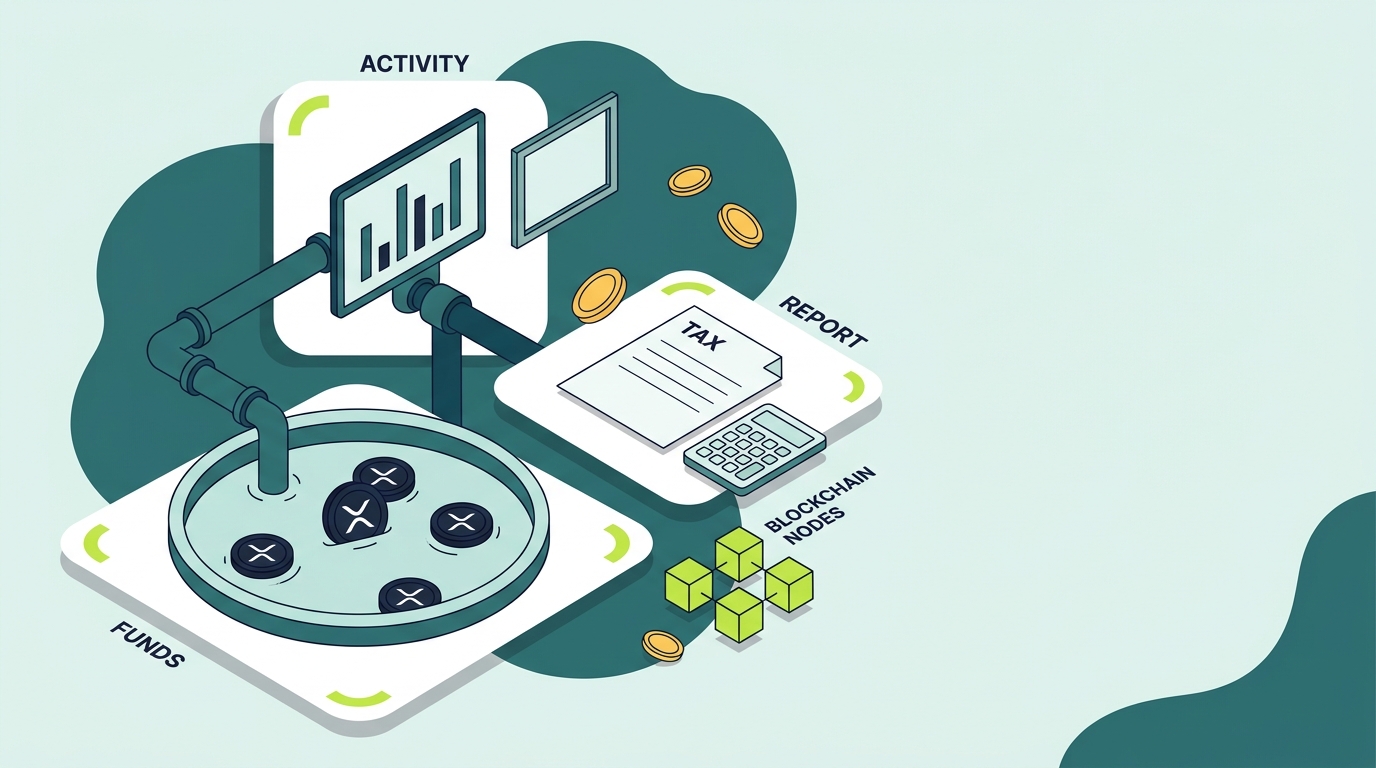
Is DeFi on the XRP Ledger taxable? Yes, and more often than most XRPL users expect. Every DEX swap is a disposal, AMM deposits and withdrawals are most safely treated as swaps, NFT purchases spend appreciated XRP, and royalties are ordinary income. The XRP Ledger got a native automated market maker in March 2024 when the XLS-30 amendment went live, and XLS-20 NFTs have been trading since 2022. The tax rules caught up instantly, because they never needed to change: the same property rules that govern Ethereum DeFi govern XRPL DeFi.
What did not catch up is the software. Most crypto tax platforms handle XRPL activity poorly, misreading AMM deposits, ignoring LP tokens, and mangling issued currencies. That gap makes XRPL DeFi one of the highest-effort reconciliation jobs in crypto right now, and it is the reason this guide spends as much time on records as on rules.
This guide covers the whole XRPL DeFi surface: the native AMM, the on-ledger DEX, wrapped XRP on other chains, trust lines, XLS-20 NFTs, and the record-keeping playbook that holds it together. It is part of our complete XRP tax guide, and if your XRP earns yield on exchanges rather than on-ledger, our XRP staking and lending tax guide covers that side.
Disclaimer: This guide is for informational purposes only and is not tax or legal advice. Cryptocurrency rules change quickly. Always consult a qualified CPA about your specific situation.
The One Rule Behind Everything: Disposals and Receipts
Before touching anything XRPL-specific, anchor on the framework, because every section below is just this framework applied to different plumbing.
Crypto is property. That produces exactly two kinds of taxable moments:
- Disposals. Whenever you sell, swap, or spend a crypto asset, you dispose of property. Gain or loss equals the fair market value of what you receive minus your basis in what you gave up. Trading XRP for an issued token is a disposal of XRP. Trading that token back is a disposal of the token. Spending XRP on an NFT is a disposal of the XRP.
- Receipts. Whenever you receive crypto as compensation, reward, or payment, you have ordinary income at fair market value on receipt, and that value becomes your basis. Royalties, airdrops, and payment for services all land here.
Holding, transferring between your own wallets, and setting up account plumbing are not taxable. Everything else on the XRP Ledger sorts into one of those two buckets, and the rest of this guide does the sorting. For the full taxonomy across all of crypto, our guide to taxable vs non-taxable crypto events is the reference.
The XRPL DEX: Every Fill Is a Disposal
The XRP Ledger has had a native decentralized exchange since 2012, long before anyone said DeFi. It runs on a central limit order book: you place offers to trade XRP against issued currencies, or issued currencies against each other, and the ledger matches them. Since March 2024, the payment engine also routes through AMM pools when they offer a better price, blending both liquidity sources into a single fill.
The tax analysis does not care about the routing. Every executed trade is a taxable disposal of the asset you gave up, measured at the fair market value of what you received:
- XRP for an issued token: disposal of XRP, gain or loss against your XRP basis.
- Issued token for XRP: disposal of the token.
- Token for token: disposal of the token you sold, even though no XRP and no dollars touched the trade.
- Partial fills: each fill is its own disposal at its own execution price. One offer that fills in five pieces over two days is five taxable events.
Holding period rules are standard. Assets held one year or less produce short-term gains at ordinary rates; more than a year, long-term gains at 0, 15, or 20 percent depending on income. Issued currencies on XRPL are often thin and volatile, which means realized gains and losses accumulate quickly for active DEX traders, and losses are just as reportable as gains. If you are harvesting those losses deliberately, read our crypto tax loss harvesting guide first, because the repurchase landscape is shifting.
One XRPL-specific wrinkle: offer creation and cancellation are not taxable. An unfilled offer moves nothing. Only executed fills matter, which is exactly the detail bad CSV imports get wrong when they count offer transactions as trades.
XLS-30 AMM: Deposits, LP Tokens, and Withdrawals
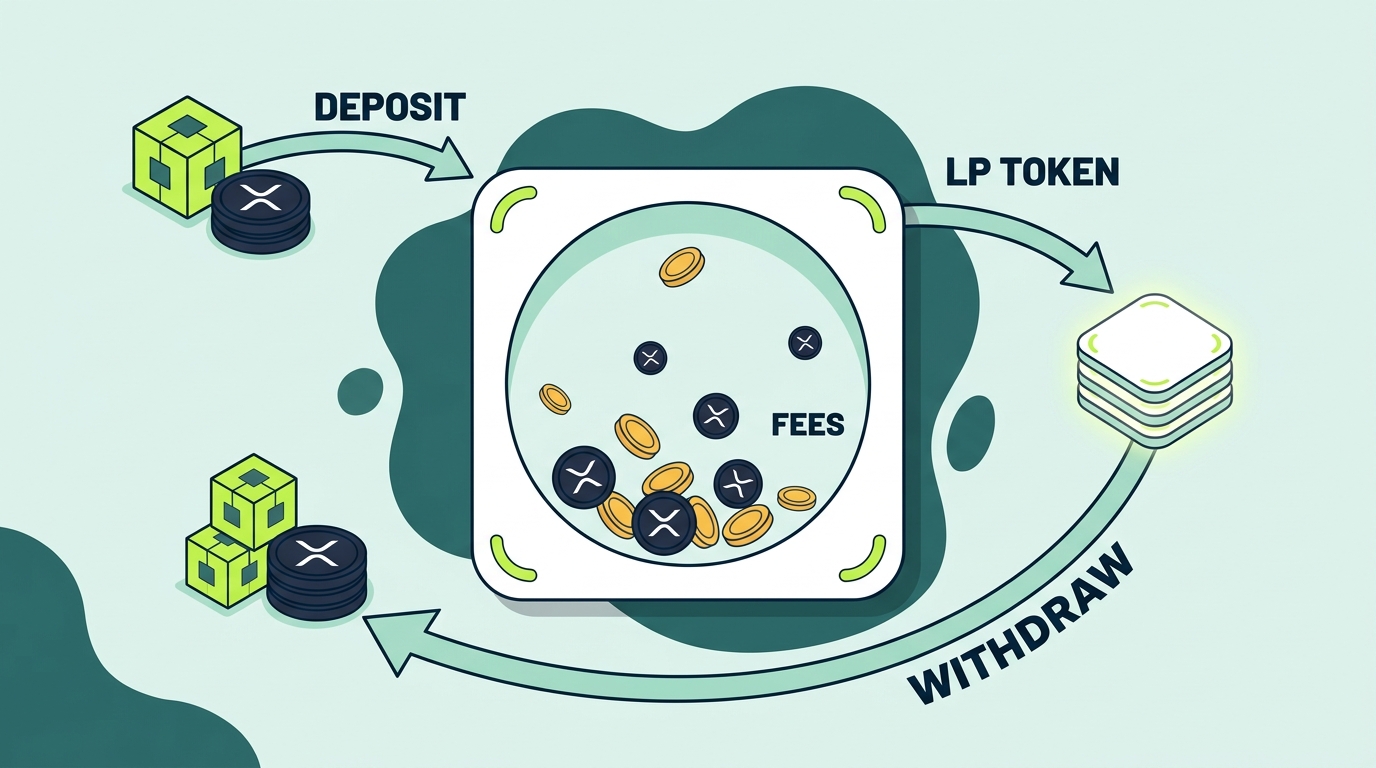
The XLS-30 amendment went live on the XRPL mainnet on March 22, 2024, giving the ledger a native automated market maker. Anyone can create or join a pool holding two assets, deposit liquidity, and receive LP tokens representing a proportional claim on the pool. Trading fees accrue inside the pool, and LP tokens are surrendered through a withdrawal transaction to redeem the underlying assets. Withdrawals are instant with no lockups.
The IRS has never issued guidance on AMM liquidity provision, on XRPL or anywhere else. What follows is the prevailing practitioner analysis, the same one applied to Uniswap-style pools, and it maps onto XLS-30 cleanly because the mechanics are nearly identical.
Depositing: Probably a Taxable Swap
When you deposit XRP and a token into a pool, you give up direct ownership of those assets and receive a different asset, the LP token, in return. Property changed hands in both directions. The conservative and most widely applied treatment is a taxable disposal of the deposited assets at fair market value on the deposit date, with the LP tokens taking a basis equal to that value.
The minority view treats the deposit as a non-taxable contribution because you retain economic exposure to the pooled assets. It has intuitive appeal and no authority behind it. If your deposited assets have large unrealized gains, the difference between the two positions is real money, and it is worth a conversation with a professional before you take the aggressive one. Whichever you choose, consistency across every pool entry and exit is non-negotiable.
XLS-30 also allows single-asset deposits, where you deposit only XRP or only the token and the pool internally rebalances. The swap analysis applies the same way: you disposed of the asset you deposited and received LP tokens.
While You Are In: Fees Accrue Silently
XLS-30 pools charge a trading fee, adjustable by LP vote up to 1 percent, and the fees stay in the pool. No claims, no distributions, no reward transactions. Your LP tokens simply redeem for slightly more over time.
This is genuinely convenient for taxes. There is no stream of small ordinary income events to track while your position is open, unlike staking rewards or farm emissions. The fee earnings surface later, embedded in your withdrawal value, and get taxed as capital gain on the LP token disposal rather than ordinary income. The auction slot mechanism, where an arbitrageur bids LP tokens for a discounted-fee slot, burns those LP tokens and marginally increases everyone else’s share value; you do not need to account for it separately.
Withdrawing: A Second Swap, and Where Impermanent Loss Gets Real
Withdrawal reverses the deposit: you surrender LP tokens and receive your proportional share of the pool. Under the swap treatment, that is a disposal of the LP tokens, with gain or loss equal to the value of assets received minus your LP token basis.
Because pool ratios drift with every trade, you will not get back the same mix you deposited. Fees push your redemption value up; adverse price movement between the paired assets (impermanent loss) pushes it down. Both effects settle into a single number at withdrawal, and that number is your realized gain or loss on the position.
An XRP/Token Pool, Entry to Exit
You deposit 1,000 XRP (basis $1,600) and $2,000 of an issued token (basis $2,000) into an XLS-30 pool when XRP trades at $2.00. Deposit value is $4,000, so under the swap treatment you recognize a $400 gain on the XRP leg (value $2,000 minus basis $1,600) and nothing on the token leg. Your LP tokens take a $4,000 basis. Eight months later you withdraw, and after fees and pool drift your share redeems for $4,150 of assets. You recognize a $150 short-term gain on the LP token disposal, and the withdrawn assets take a combined $4,150 basis going forward.
The assets you withdraw start fresh: new basis equal to their value at withdrawal, new holding periods beginning that day. Every later sale of those assets measures against those numbers. This resetting behavior is the hidden cost of the swap treatment, because it converts what could have been long-term holding periods into short-term ones, and it is worth factoring into how long you keep pool positions open. The general framework here mirrors what we cover for Ethereum in our Ethereum DeFi tax guide; the chains differ, the analysis does not.
Wrapped XRP and Bridging: When Moving Chains Is a Disposal
XRP itself lives on the XRP Ledger, but wrapped versions circulate on Ethereum, BNB Chain, and elsewhere, and holders bridge out to reach lending markets and DeFi that XRPL lacks. Whether the bridge crossing is taxable depends entirely on what the mechanism actually does.
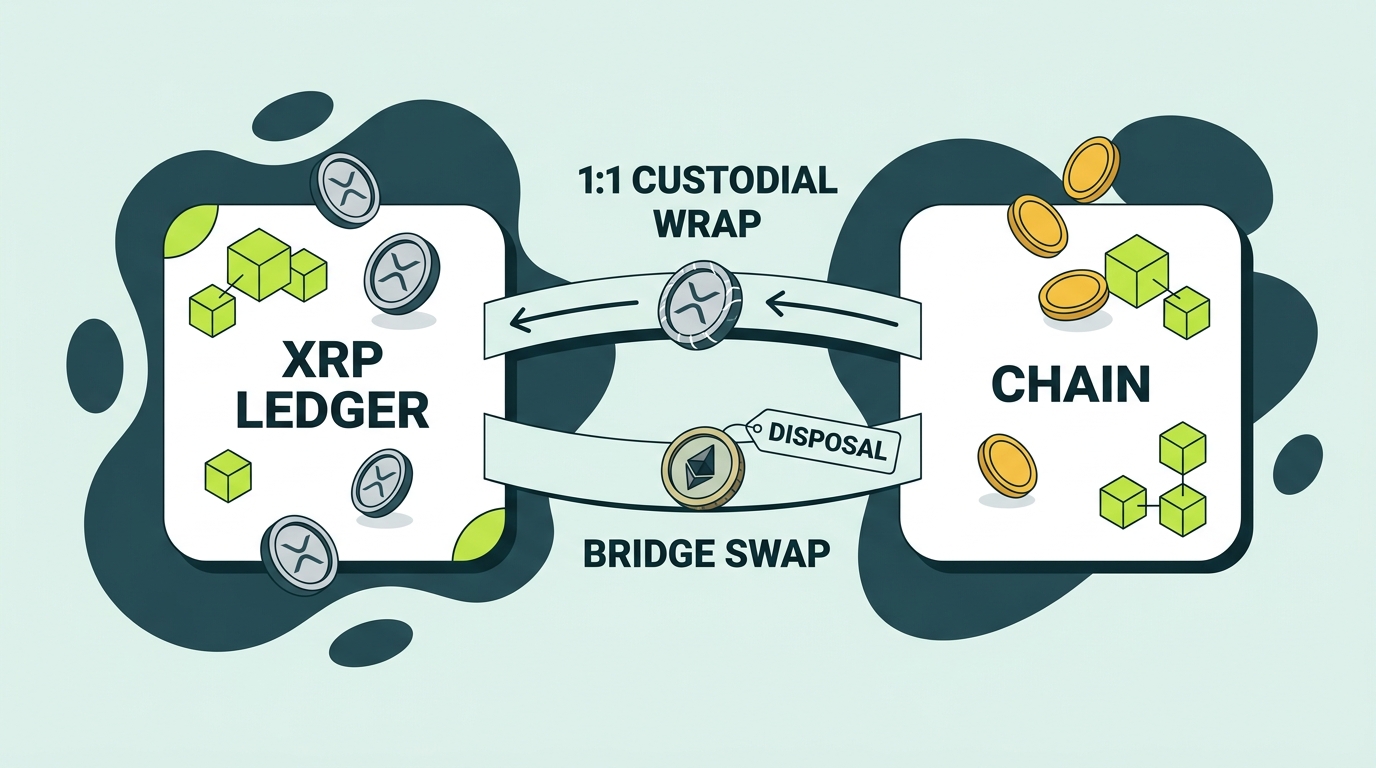
- True 1:1 wraps with redemption rights. A custodian or contract locks your XRP and issues wXRP redeemable 1:1 at will. You keep the same economic position in the same underlying asset. Most practitioners treat this as non-taxable, the same position taken for WBTC and WETH. Your basis and holding period carry into the wrapped token.
- Bridge swaps into a different asset. Some bridges do not wrap at all; they swap your XRP for a destination-chain asset from a liquidity pool, and you hold no claim on your original XRP afterward. That is a taxable disposal of the XRP under any reading. The destination asset takes a fresh basis and holding period.
- The conservative view. A minority of practitioners treat every wrap as a taxable token-for-token exchange. The IRS has not ruled. If you wrap at a moment when price equals your basis, the stakes are near zero either way; if you wrap XRP carrying years of gains, the positions diverge sharply.
Practical rules: read what the bridge actually does before you use it, screenshot the mechanism, pick a treatment, and apply it to every crossing in both directions. And remember that whatever you do with the wrapped XRP on the other chain is fully taxable under that chain’s ordinary analysis: lending it, pooling it, swapping it. Wrapping is a doorway, not a shield. The same debate, with the same lack of guidance, appears in our wrapped Bitcoin DeFi guide, and the reasoning carries over one for one.
Trust Lines: Plumbing, Not Taxes
Every issued token on the XRP Ledger requires a trust line, an explicit authorization that your account will hold that issuer’s token, backed by a small XRP reserve that unlocks when the line closes.
The tax answer is simple: trust lines are not taxable events. Opening one moves no value. Closing one moves no value. The reserve XRP never leaves your ownership. Taxes begin when tokens actually flow across the line: a swap that acquires the token (disposal of what you paid), income paid to you in the token (ordinary income at receipt), or a later disposal of the token itself.
The one thing trust lines do for your taxes is create a paper trail. Your trust line history is a map of every issued currency your account ever touched, which makes it a useful completeness check when you reconcile: any token with a trust line and no transactions in your records is a token your import missed.
XLS-20 NFTs: Mints, Buys, Sells, Royalties, and the Collectibles Question
Native NFTs arrived on the XRP Ledger with the XLS-20 amendment in late 2022, complete with on-ledger minting, an on-ledger marketplace mechanism, and enforced creator royalties called transfer fees. Each action has a distinct treatment.
Buying an NFT with XRP is a disposal of the XRP. If you spend 500 XRP you bought at $0.60 to buy an NFT when XRP trades at $2.20, you realize an $800 capital gain on the XRP at the moment of purchase. The NFT takes a $1,100 basis. Buyers consistently miss this because nothing feels like a sale, and it is the single most common unreported event in NFT reconciliations.
Selling an NFT is a capital event for investors. Proceeds minus basis, short-term or long-term by holding period. Selling for XRP means your proceeds are the XRP’s fair market value at the sale, and that XRP starts a fresh basis.
Minting your own NFTs and selling them is creator income. A creator selling their own mints has ordinary income, and a regular operation belongs on Schedule C with self-employment tax and deductible expenses. A one-off casual mint by a hobbyist is still ordinary income, just without the business treatment.
Royalties are ordinary income at receipt. XLS-20 transfer fees pay the creator automatically on every secondary sale, up to 50 percent of the sale amount. Each royalty payment is ordinary income at its fair market value when it lands, and for an active creator these arrive constantly in small amounts, every one of them an income event. For the buyer and seller, the royalty is simply part of the transaction price, not a separate deduction.
The collectibles risk is real for art NFTs. In Notice 2023-27, the IRS proposed a look-through analysis: an NFT is a collectible if the asset it represents is one, and art is the canonical collectible. Long-term gains on collectibles are taxed at up to 28 percent instead of the standard 20 percent cap. Most XRPL NFTs are digital art or profile pictures, which sit squarely in look-through range. Until final guidance says otherwise, price that risk into any large long-term NFT gain, and read our Bitcoin Ordinals guide for the deeper collectibles discussion, because the same analysis applies across chains.
Record-Keeping: The Real XRPL Problem
Here is the honest state of things in 2026: most crypto tax software handles the XRP Ledger badly. Basic XRP transfers usually import fine. Beyond that, expect problems: AMM deposits imported as unexplained outflows, LP tokens missing entirely or valued at zero, DEX partial fills collapsed or duplicated, issued currencies with no price data, offer transactions miscounted as trades, and XLS-20 NFT activity invisible to the importer. XRPL support is an afterthought for platforms built around EVM chains, and it shows.
That does not excuse anyone from reporting. It changes the workflow:
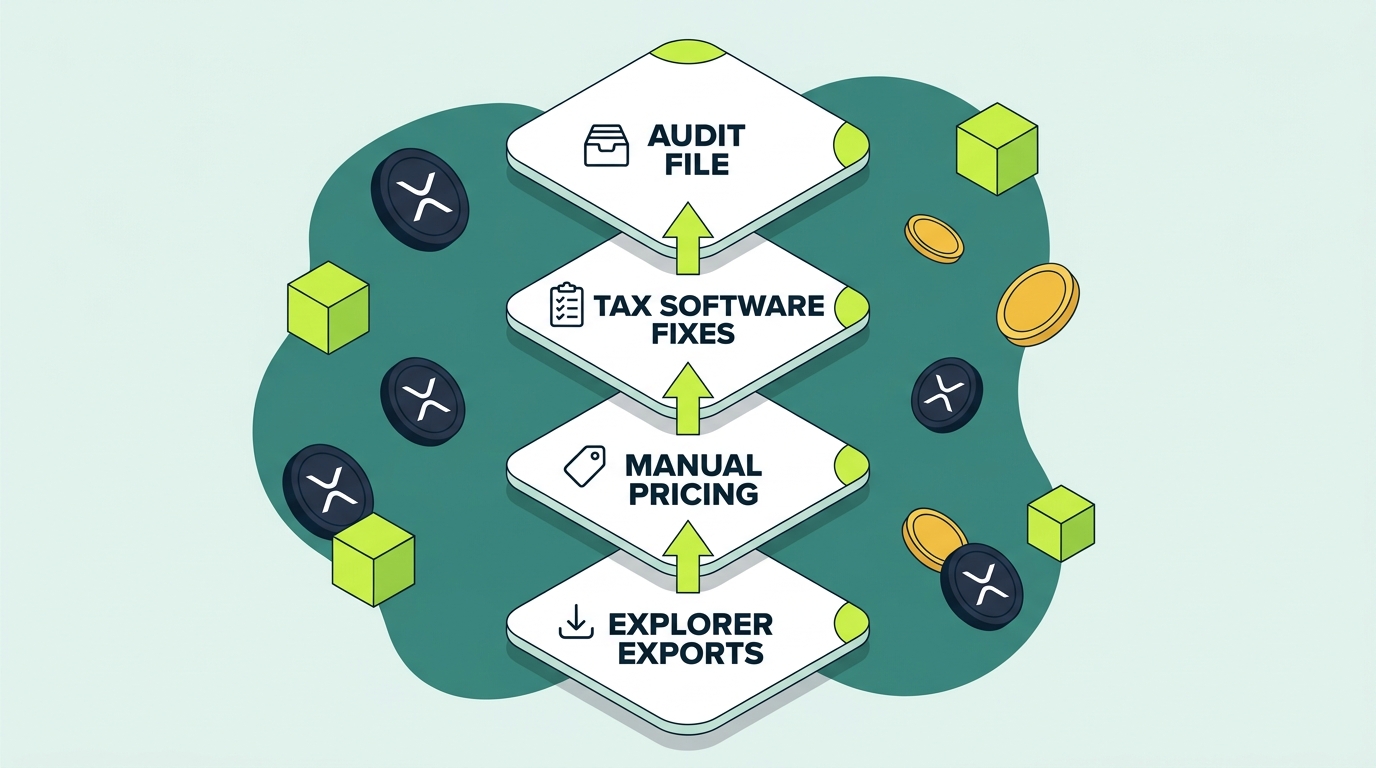
- Export everything from the source. XRPL explorers (XRPScan, Bithomp, xrplcluster tools) hold your complete transaction history: payments, offers, fills, AMM transactions, NFT mints and trades, trust line changes. Pull the full history per account, not just what your tax software managed to sync.
- Classify by transaction type. XRPL transaction types map cleanly to tax categories once you know them: OfferCreate fills and Payments with currency conversion are swaps, AMMDeposit and AMMWithdraw are your pool entries and exits, NFTokenMint / NFTokenAcceptOffer cover NFT activity, TrustSet is non-taxable plumbing.
- Price the thin stuff yourself. Issued currencies and LP tokens often have no feed in tax software. Contemporary DEX prices, pool ratios at your deposit and withdrawal, and explorer data are your valuation sources. Capture them now; thin-market price history has a way of disappearing.
- Fix classifications in software, then verify totals. Import what you can, correct what imported wrong, and manually add what never imported. Then reconcile ending balances per asset against the ledger. If balances match, your event history is probably complete.
- Archive the audit file. Transaction hashes, exports, price sources, and the positions you took on AMM deposits and wrapping. Under Rev. Proc. 2024-28, basis tracking is per wallet and per account, so keep XRPL accounts, exchange accounts, and other-chain wallets as distinct ledgers, matched by transfer. Our per-wallet cost basis guide covers the mechanics.
And one reporting-net note: none of this on-ledger activity generates a 1099. But the moment you move XRP or proceeds to a US exchange and sell, Form 1099-DA reports the gross proceeds, and the IRS sees a number your return needs to explain. Self-custody DeFi is not invisible DeFi; it is self-reported DeFi.
Common XRPL DeFi Tax Mistakes
The recurring errors from XRPL reconciliations, in rough order of expense:
Treating Crypto-to-Crypto Swaps as Non-Events
Token-for-token DEX trades with no dollars involved are still disposals. Active traders can rack up hundreds of unreported events in a year.
Ignoring the XRP Spent on NFTs
Buying an NFT with appreciated XRP realizes the XRP gain. The purchase feels like an acquisition, and the disposal hides inside it.
AMM Positions With No Tax Story
Deposits booked as transfers-out and withdrawals as mystery deposits, with LP tokens nowhere. The position needs an entry treatment, an exit treatment, and basis math connecting them.
Assuming Wrapping Is Always Free
Some bridges are swaps in disguise. The treatment follows the mechanism, not the marketing.
Trusting the Software Import
XRPL imports fail quietly. A clean-looking report built on a half-imported history is wrong with confidence. Verify balances against the ledger before you trust totals.
Forgetting Royalty Income
Creators with transfer fees flowing in have ordinary income arriving weekly. Small individual amounts, material annual totals.
Your XRPL DeFi Tax Checklist
- Export complete history for every XRPL account from an explorer, including offers, AMM, and NFT transactions.
- Book every DEX fill as a disposal at execution-date value, partial fills included.
- Pick and document your AMM treatment, then book deposits, LP token basis, and withdrawals consistently.
- Classify each bridge crossing as wrap or swap based on the actual mechanism, and keep evidence.
- Capture NFT activity end to end: XRP disposals at purchase, basis, sales, mint income, and royalty receipts.
- Price issued tokens and LP tokens from contemporary market data and archive the sources.
- Reconcile per-asset balances against the ledger after import corrections.
- Track basis per wallet and account under Rev. Proc. 2024-28.
- Report disposals on Form 8949 and Schedule D, income on Schedule 1 or Schedule C.
- Archive the full audit file with hashes, exports, prices, and position memos.
Bottom Line
XRPL DeFi taxes are ordinary crypto taxes applied to an extraordinary record-keeping situation. The rules are the familiar two: disposals trigger gains and losses, receipts trigger income. DEX fills, AMM entries and exits, bridge swaps, NFT purchases with appreciated XRP, and royalty streams all resolve under that framework without any special XRPL doctrine. What makes the ledger hard is that the tooling ecosystem has not caught up, so the burden of building an accurate event history falls on you, from explorer exports and manual pricing to corrected classifications.
That is precisely the work we do. Count On Sheep reconciles XRPL activity that mainstream software cannot: AMM positions, DEX histories, NFT and royalty flows, and cross-chain bridges, priced and classified into CPA-ready numbers. Book a 15-minute call with a crypto tax specialist to scope your situation, or reach out to our team for a full XRPL review. For the rest of your XRP picture, from simple sales to the ETFs, start with our complete XRP tax guide.
Related Reading
- XRP Tax Guide: The Complete Picture
- XRP Staking and Lending Taxes
- Selling XRP and Taxes: What You Owe in 2026
- XRP Flare Airdrop Taxes
- Ethereum DeFi Taxes
- Wrapped Bitcoin and DeFi Taxes
- Taxable vs Non-Taxable Crypto Events
- Per-Wallet Cost Basis Under Rev. Proc. 2024-28
Frequently Asked Questions
Are trades on the XRP Ledger DEX taxable?
Yes. Every swap of one asset for another on the XRPL DEX is a taxable disposal of the asset you give up, whether that is XRP for a token, a token for XRP, or token for token. You recognize gain or loss equal to the fair market value received minus your basis in what you sold. This applies to order book trades and AMM-routed trades alike.
Is depositing into an XRPL AMM pool taxable?
Most likely yes under the prevailing analysis. When you deposit assets into an XLS-30 AMM pool, you receive LP tokens in exchange, which looks like a swap of your deposited assets for a new asset. The conservative and most common treatment is a taxable disposal of the deposited assets at fair market value. A minority position treats it as a non-taxable contribution, but there is no IRS guidance blessing that for AMMs.
Are XRPL AMM LP tokens taxed when I withdraw?
Under the swap treatment, yes. Withdrawing means surrendering LP tokens for a share of the pool, which is a disposal of the LP tokens. Your gain or loss is the value of assets received minus your basis in the LP tokens. Because pool ratios shift with trading and impermanent loss, you rarely get back exactly what you put in, and the difference is real gain or loss.
How are XRPL AMM fees taxed?
XLS-30 pools do not pay out fees as separate claims. Trading fees accrue inside the pool, increasing the value each LP token can redeem. That means fee income is captured as extra capital gain when you withdraw or sell LP tokens, rather than as ordinary income along the way. Auction slot discounts and vote mechanics do not change this basic picture.
Is wrapping XRP to another chain taxable?
It depends on the mechanism and your position. A 1:1 custodial wrap where you retain redemption rights is treated as non-taxable by most practitioners, similar to WBTC or WETH. A bridge that swaps your XRP for a different asset on another chain, or where you give up your claim on the original XRP, looks like a taxable disposal. The IRS has not ruled, so document your position and apply it consistently.
Are XRPL NFT purchases taxable?
Buying an XLS-20 NFT with XRP is a taxable disposal of the XRP you spend. If your XRP appreciated since you acquired it, you owe capital gains on that appreciation, even though you are buying rather than selling. The NFT takes a basis equal to the XRP's value at purchase.
How are XRPL NFT sales and royalties taxed?
Selling an NFT is a capital gain or loss against its basis for investors. Creators who mint and sell as a business have ordinary income, often on Schedule C. On-ledger transfer fees (royalties) paid automatically to creators are ordinary income at fair market value when received. Buyers cannot deduct the royalty separately; it is part of their purchase cost.
Do NFTs on XRPL face the 28 percent collectibles rate?
Possibly. The IRS look-through analysis in Notice 2023-27 treats an NFT as a collectible if its underlying asset is one, such as art. Many XRPL NFTs are digital art, so long-term gains on them could be taxed at up to 28 percent instead of the standard 20 percent cap. Until final guidance lands, art NFTs carry genuine collectibles risk.
Is setting a trust line taxable?
No. A trust line is just an authorization that lets your XRPL account hold a specific issued token. Creating or removing one moves no value and is not a taxable event. The reserve XRP it temporarily locks is still your XRP. Taxes start when tokens actually move: swaps, receipts, and disposals.
Does tax software support the XRP Ledger?
Support is thin and uneven. Major platforms can usually import basic XRP transactions from an address, but AMM deposits, LP tokens, DEX offers, issued currencies, and NFT activity frequently import wrong or not at all. Plan on exporting full transaction history from an XRPL explorer and manually reviewing classifications, or having a professional reconcile it.
What records should I keep for XRPL DeFi activity?
Every transaction hash, date, asset amounts on both sides, and fair market values at execution, for swaps, AMM deposits and withdrawals, NFT mints, buys, sells, royalty receipts, and bridge transfers. XRPL explorers hold full history, but pricing thin issued tokens is on you. Build the record now, while the market data still exists.
Do I report XRPL DeFi if I never cashed out to dollars?
Yes. Crypto-to-crypto swaps, AMM entries and exits under the swap treatment, NFT purchases with appreciated XRP, and royalty receipts are all taxable without any dollars moving. Cashing out is not the trigger. Disposing of property or receiving income is.