

Let’s clear this up first: XRP has no staking. None. The XRP Ledger runs on a consensus protocol where validators agree on transactions without staking anything and without earning rewards. There is no proof of stake, no delegation, no protocol yield. So every product marketed as “XRP staking,” on every exchange and every app, is actually a lending or earn program: you hand your XRP to a platform, the platform puts it to work, and it pays you a yield for the privilege.
That distinction is not pedantic. It drives the tax treatment, and it drives the risk. Tax-wise, earn rewards are ordinary income when credited, which is the easy part. Risk-wise, lending programs mean counterparty exposure, and Celsius and BlockFi taught a generation of yield-chasers what that costs. This guide covers both: how every flavor of XRP yield is taxed, what happens when platforms fail, and how to report it all correctly.
This guide is part of our complete XRP tax guide. If your XRP yield comes from on-ledger activity like AMM pools rather than platforms, our XRP Ledger DeFi tax guide is the right companion.
Disclaimer: This guide is for informational purposes only and is not tax or legal advice. Cryptocurrency rules change quickly. Always consult a qualified CPA about your specific situation.
Why XRP Has No Staking, and Why the Label Matters
The XRP Ledger validates transactions through the XRP Ledger Consensus Protocol. Validators, run by universities, exchanges, businesses, and individuals, compare proposed transaction sets and converge on agreement every few seconds. No validator posts a stake. No validator earns block rewards. All 100 billion XRP were created at launch in 2012, so there is no new issuance to distribute, and transaction fees are burned rather than paid to anyone.
Compare that to Ethereum or Solana, where proof of stake means the protocol itself pays you to lock tokens and secure the network. That protocol-level yield is what “staking” actually means, and it is what our Ethereum staking tax guide covers. XRP simply has no equivalent. Nothing to lock, nothing to earn, no protocol paying anyone.
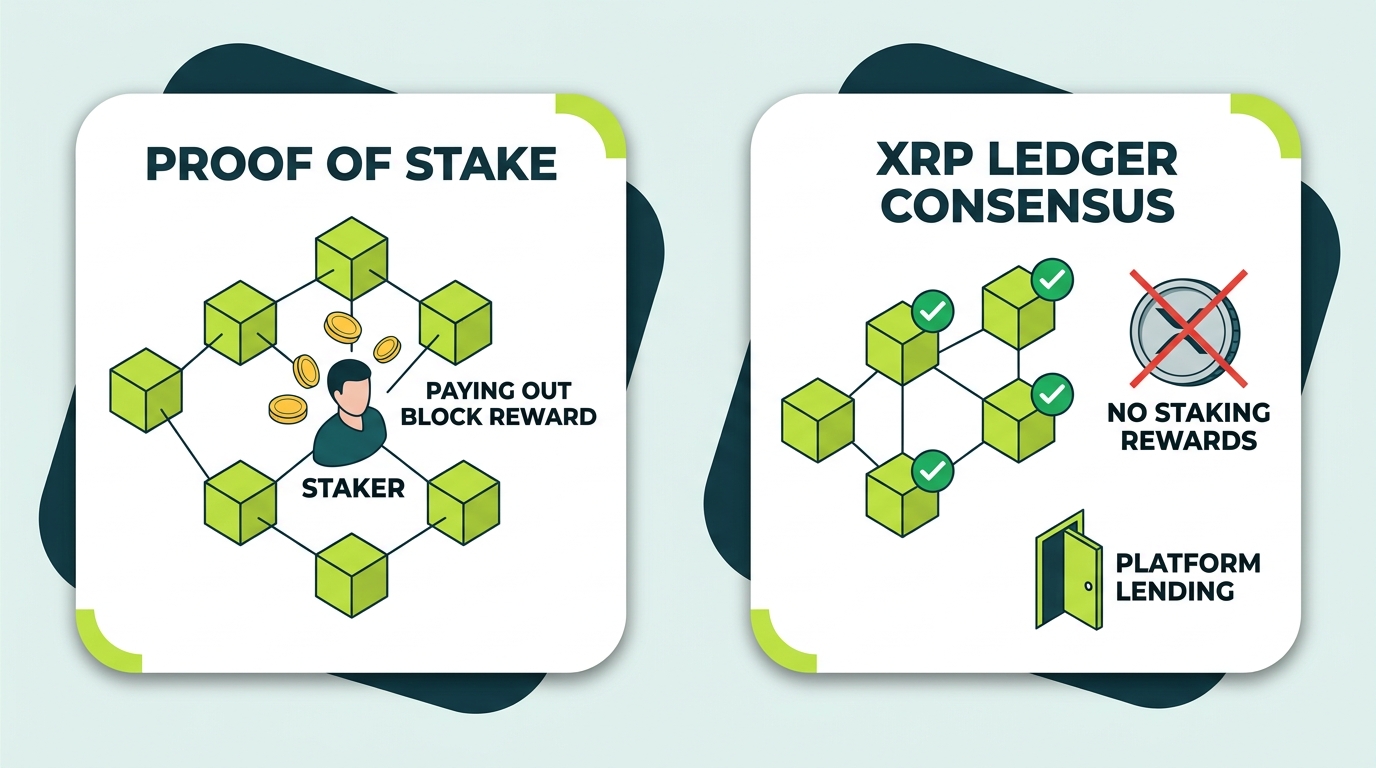
So where does “XRP staking” yield come from? From a business. When an exchange offers 3 percent on your XRP, that yield is generated by the platform lending your XRP to institutional borrowers and market makers, deploying it in its own trading operations, or paying promotional rates from its marketing budget. Your XRP leaves your control and becomes an asset the platform uses. You hold a claim against the company, not a position in a protocol.
Staking yield comes from a protocol that cannot go bankrupt. Earn yield comes from a company that can. XRP only ever offers the second kind.
Three practical consequences before we touch taxes:
- Counterparty risk is the price of the yield. Your recovery in a platform failure depends on the company’s balance sheet and its terms of service, not on any blockchain.
- Terms of service decide what you own. Most earn programs transfer title or control of your coins to the platform. Celsius depositors learned in bankruptcy court that “your” coins in an earn account were the estate’s coins.
- The tax treatment is the earn treatment, not the staking treatment. Conveniently, the two are nearly identical on the income side, which is where we go next.
How Earn Program Rewards Are Taxed: Income at Credit
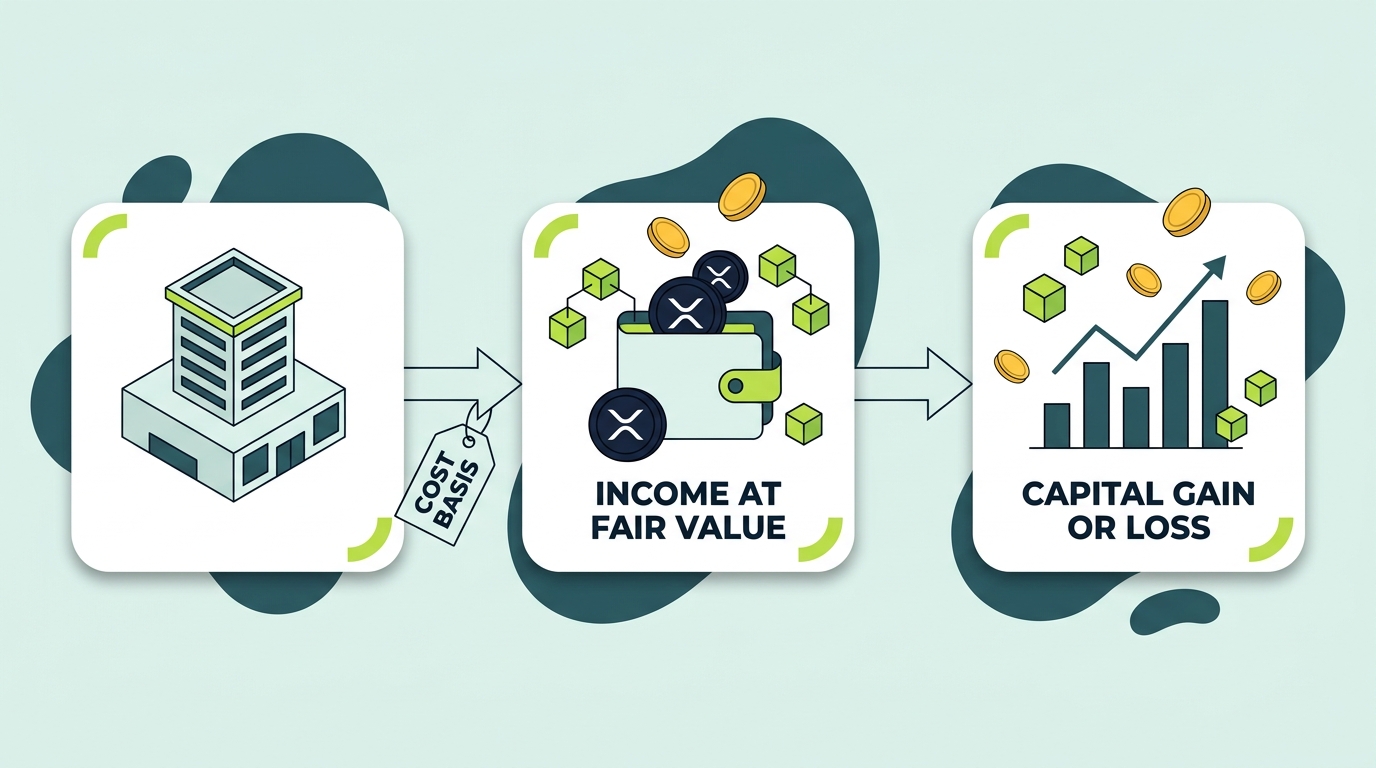
The rule is short: every reward credited to your account is ordinary income at its fair market value on the credit date. This follows the dominion and control standard the IRS applies across reward-type crypto income (Rev. Rul. 2023-14 for staking rewards, and the same logic in Rev. Rul. 2019-24 for airdrops). If you can sell, swap, or withdraw the reward, you control it, and controlling it is the taxable moment.
The details that trip people up:
- Credit, not withdrawal, is the trigger. Rewards sitting in your exchange account are just as taxed as rewards moved to cold storage. Leaving them on the platform defers nothing.
- Each credit is its own event. A program paying weekly has 52 income events a year, each valued at that week’s XRP price. Your annual income is the sum, and a volatile XRP price means two identical reward amounts can carry very different dollar values.
- Compounding does not merge events. Rewards that auto-roll into your earning balance were still income when credited, and they start earning their own rewards with their own basis.
- The income value becomes basis. Every reward lot takes a cost basis equal to the income you recognized and a holding period starting at credit. This is what prevents double taxation later.
A Year in an XRP Earn Program
You hold 10,000 XRP in an exchange earn program paying 3 percent, credited monthly. Over the year you receive 300 XRP across 12 credits, at prices ranging from $1.85 to $2.40, totaling $624 of ordinary income at credit-date values. In December you sell 100 of those reward XRP at $2.50. Their basis, from the months they were credited, totals $155, so you also report a $95 short-term capital gain. Income and gain are two separate lines on two separate forms, and both came from the same 300 XRP.
Skip the income step and the math turns against you. Software that never saw the income assigns reward lots zero basis, so every later sale reports the full proceeds as gain. You end up out of compliance on the income and overpaying on the sale, the same failure mode we see across all reward income, covered more broadly in our crypto income tax guide.
One more timing nuance: some programs advertise accrual daily but credit weekly or monthly, and some impose lockups where rewards are not claimable until a term ends. The defensible income date is when the reward becomes claimable or credited, whichever your program’s mechanics actually support. A genuine lockup with no access supports deferral until it lifts. A preference for not clicking withdraw supports nothing.
The 1099-MISC Question: What the IRS Already Knows
US platforms generally issue Form 1099-MISC when your miscellaneous income, including earn rewards, reaches $600 for the year, and a copy goes to the IRS. Three things follow:
- At or above $600, the IRS is expecting the number. Your Schedule 1 should show at least the 1099-MISC amount. An exact mismatch between a filed form and a silent return is the easiest automated notice in the system.
- Below $600, nothing is filed, but everything is taxable. The threshold controls the platform’s paperwork, not your obligation. A $480 reward year is $480 of reportable income from your own records.
- Offshore and DeFi yield reports nothing at any amount. No form, same taxability, and possibly FBAR and Form 8938 obligations if foreign platform balances are large enough.
And the reporting net keeps tightening: when you eventually sell reward XRP on a US exchange, Form 1099-DA reports your gross proceeds. If those proceeds trace to reward lots that never appeared as income on any return, the paper trail tells that story to anyone who pulls it.
Platform Risk: What Celsius and BlockFi Taught Every Lender
Earn programs looked free until 2022. Celsius froze withdrawals in June 2022 and filed for bankruptcy a month later. BlockFi followed that November in the FTX contagion. Voyager, too. Hundreds of thousands of customers, including plenty of XRP holders chasing single-digit yields, discovered that their earn balances were unsecured claims in a bankruptcy, worth a fraction of face value, repaid years later, partly in kind.
The tax lessons are specific and worth writing down before you touch any earn product again:
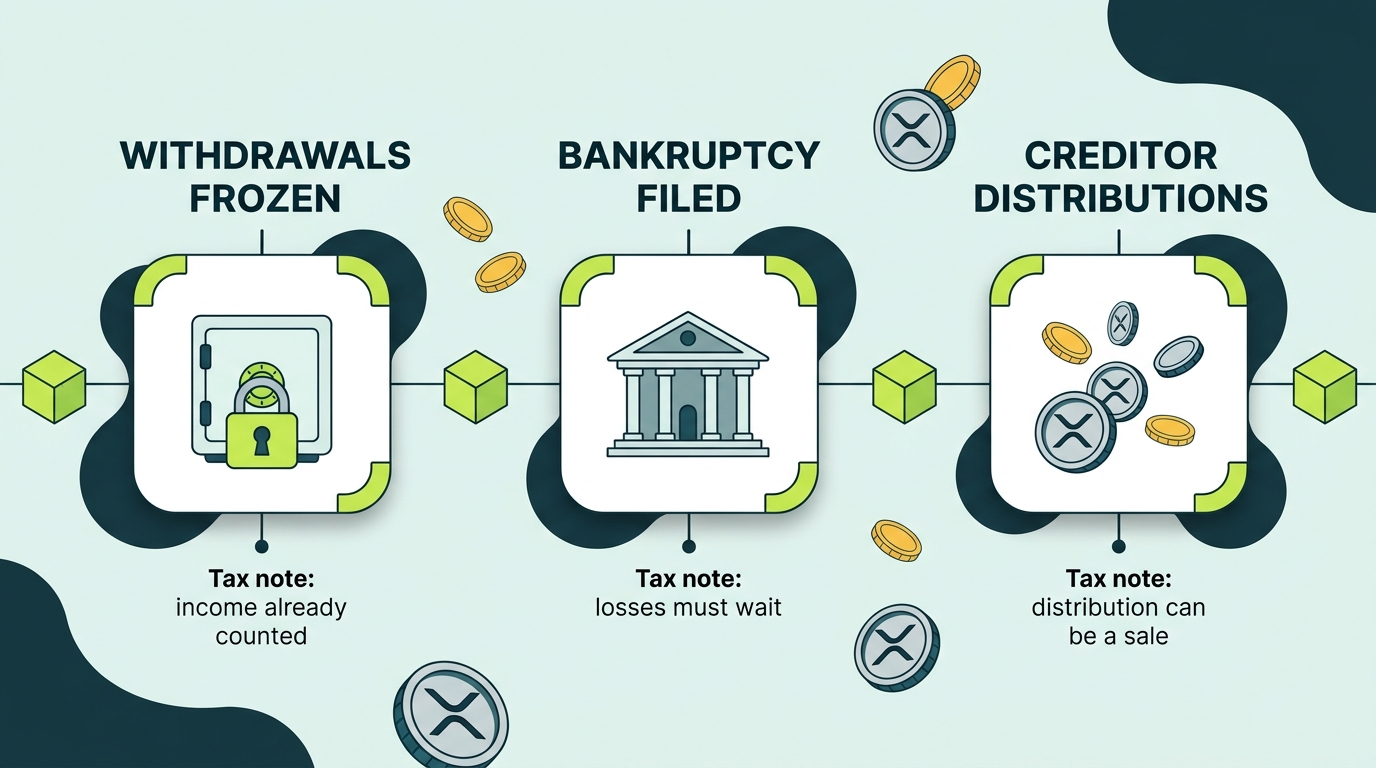
- Income already credited stays taxable. Rewards credited before a freeze were income when credited, and the platform’s later collapse does not claw the income off your return. Celsius users paid tax on yield they never withdrew and then lost the principal that earned it.
- A freeze is not a deductible loss. Losses generally cannot be claimed while recovery is still possible. Through years of Celsius and BlockFi proceedings, customers had claims of uncertain value, not closed losses. Deduction timing waits for finality: a plan distribution, a claim sale, or a worthless-claim determination.
- The loss, when final, is messy. Depending on facts, outcomes range from capital loss treatment on the difference between basis and recovery, to arguments over theft loss availability under post-2017 rules. Distributions paid partly in different assets than you deposited add another layer of disposals. Our guide to lost and stolen crypto deductions covers the framework.
- Selling your claim is a taxable disposal. A market developed for bankruptcy claims, and selling yours closes the loss (or gain) at the sale price against your basis in the claim. For many creditors this was the cleanest tax exit available.
None of this means earn programs are always a mistake. It means an earn deposit is a credit decision. Read the terms, understand whether title transfers, and treat the platform like the borrower it is.
DeFi Lending of Wrapped XRP
XRP itself cannot be lent on Aave or similar protocols because it does not live on those chains. Lending XRP in DeFi means lending wrapped XRP, which stacks the lending analysis on top of the wrapping analysis:
- Getting there may be taxable. Bridging XRP off the XRP Ledger is non-taxable if it is a true 1:1 redeemable wrap, and taxable if the bridge swaps you into a different asset. The mechanism controls, and we cover the full framework in our XRPL DeFi guide.
- The deposit may be a second layer. Protocols that hand you an interest-bearing receipt token for your deposit raise the same swap-in, swap-out question as any token exchange. Conservative treatment reads deposit and withdrawal as disposals; a common alternative treats them as non-taxable when redemption is 1:1 and at will. Pick one, document it, keep it consistent.
- The yield is ordinary income either way. Interest paid in tokens is income at fair market value when claimable or received. Rebasing or accruing receipt tokens push value growth into the eventual disposal instead, depending on design.
- Liquidations are disposals. If you borrowed against wrapped XRP collateral and got liquidated, the collateral seized was sold, and the gain or loss against your basis is yours to report, usually in a year when you least feel like reporting it.
The honest summary: DeFi lending of wrapped XRP is taxable at more layers than exchange earn, with less guidance and worse software support. It is the corner of XRP yield where professional help pays for itself fastest.
Schedule 1 vs Schedule C: Where the Income Goes
All earn and lending income is ordinary income. The remaining question is which schedule.
Schedule 1, for almost everyone. Passive earn rewards are investor income: report the year’s total as other income on Schedule 1 of Form 1040. No self-employment tax. No business deductions. Clicking a toggle on an exchange, however large the balance, does not make you a business.
Schedule C, for genuine lending operations. A trade or business requires regularity, continuity, profit motive, and real activity: think an operation actively managing loans across platforms and counterparties with business records, not a household with an earn account. Schedule C brings 15.3 percent self-employment tax on net profit and, in exchange, deductible expenses. Very few individual XRP holders belong here, and drifting into the middle ground with big activity and no business structure invites the worst outcome, hobby treatment: income fully taxable, expenses non-deductible.
Two add-ons complete the picture for high earners. The 3.8 percent Net Investment Income Tax reaches passive earn income and reward-sale gains once modified adjusted gross income passes $200,000 single or $250,000 married filing jointly. And because nobody withholds tax from earn credits, meaningful reward income belongs in your quarterly estimated payments: set aside a slice of each credit at your marginal rate and true up quarterly against the safe harbors (90 percent of this year’s tax or 100 to 110 percent of last year’s).
How to Report XRP Earn and Lending Income: Step by Step
- Export reward history from every platform: each credit with date, amount, and value. Add wallet data for any DeFi positions.
- Verify your software booked credits as income, not deposits. Spot-check a handful against platform statements and prices.
- Total the year’s income and report it on Schedule 1 (or Schedule C if you genuinely run a lending business).
- Confirm every reward lot carries income-value basis with a holding period from its credit date.
- Report disposals of reward XRP on Form 8949 and Schedule D, matching proceeds to basis lot by lot.
- Reconcile any 1099-MISC against your records; report at least the form’s amount while you resolve differences.
- Check NIIT exposure and set quarterly estimates if reward income is material.
- Answer yes to the digital asset question on Form 1040, and archive statements, terms of service, and price sources, especially from any platform showing signs of stress.
Common XRP Earn Tax Mistakes
Believing the Staking Label
There is no XRP staking, and no special staking treatment to claim. It is earn income, taxable at credit, full stop.
Waiting for Withdrawal to Report
Rewards are income when credited to your account, not when moved to your wallet. Years of “I never withdrew it” is years of unreported income.
Ignoring Sub-$600 Years
No 1099-MISC does not mean no income. Small reward years are still reportable from your records.
Zero-Basis Reward Sales
Unreported income means unpriced lots, and unpriced lots mean every sale reports as pure gain. The most expensive version of already being wrong.
Deducting Frozen Funds Too Early
A platform freeze is a claim, not a closed loss. Deducting before finality invites disallowance. Document now, deduct when the outcome is real.
Letting the Platform Keep Your Only Records
Celsius customers who relied on the app for their history spent the bankruptcy reconstructing it from emails. Export everything, every year.
Your XRP Earn and Lending Tax Checklist
- List every platform and protocol that ever paid yield on your XRP or wrapped XRP.
- Export complete reward histories with dates, amounts, and credit-date values.
- Book every credit as ordinary income in the year received, withdrawn or not.
- Verify income-value basis on every reward lot in your software.
- Reconcile 1099-MISC forms and keep records for income below the threshold.
- Document bridge and deposit treatments for any DeFi lending of wrapped XRP.
- Report sales on Form 8949 and Schedule D against reward-lot basis.
- Choose Schedule 1 or Schedule C honestly and check NIIT and estimates.
- Preserve statements and terms of service from every platform, healthy or not.
- File amended returns for past years of uncredited earn income before the IRS asks.
Bottom Line
XRP yield is simple once the label is fixed. There is no staking, so there is no staking mystery: every XRP earn program is lending, every reward is ordinary income at credit-date value, that income becomes basis, and later sales are capital events. The paperwork is Schedule 1 for nearly everyone, a 1099-MISC at $600 from US platforms, and Form 8949 when you sell. The real complexity lives in the failure cases, frozen platforms and half-taxable recoveries, and in wrapped-XRP DeFi where wrapping, depositing, and earning each carry their own analysis.
If your earn history spans multiple platforms, includes a Celsius or BlockFi claim, or wanders into DeFi, this is exactly the reconciliation we do daily. Count On Sheep rebuilds reward histories, prices every credit, fixes zero-basis lots, and handles the bankruptcy-claim tax math most preparers have never seen. Book a 15-minute call with a crypto tax specialist to find out where you stand, or reach out to our team for a full review. And for everything else XRP, from simple sales to the ETFs, start with our complete XRP tax guide.
Related Reading
- XRP Tax Guide: The Complete Picture
- XRP Ledger DeFi Taxes: AMM, DEX, and NFTs
- Selling XRP and Taxes: What You Owe in 2026
- XRP ETF Taxes: Spot ETFs and What They Change
- Ethereum Staking Taxes
- Crypto Income Taxes: Staking, Mining, and Airdrops
- Lost and Stolen Crypto Tax Deductions
- Form 1099-DA Explained
Frequently Asked Questions
Can you actually stake XRP?
No. The XRP Ledger runs on a consensus protocol with trusted validators, not proof of stake. There are no staking rewards at the protocol level, no validator payouts, and no delegation. Anything marketed as XRP staking is a lending or earn program where a platform pays you yield for handing over your XRP.
Are XRP earn program rewards taxable?
Yes. Rewards from exchange earn, savings, or so-called staking programs are ordinary income at their fair market value on the date each reward is credited to your account. The label the platform uses does not matter. Credit date and credit-date price control.
How do I report XRP earn income on my tax return?
Total the fair market value of all rewards credited during the year and report it as other income on Schedule 1 of Form 1040. Each reward's income value becomes its cost basis, and selling the reward XRP later is a separate capital gain or loss on Form 8949 and Schedule D.
Will I get a 1099 for XRP earn rewards?
Only sometimes. US exchanges generally issue Form 1099-MISC when your miscellaneous income reaches 600 dollars for the year, with a copy to the IRS. Below 600 dollars, most platforms send nothing, but the income is still fully reportable from your own records. Offshore platforms may send nothing at any amount.
Is lending XRP itself a taxable event?
Depositing XRP into an earn program is generally treated as non-taxable by most practitioners, since you expect the same asset back. But it is not free of risk: unlike a bank deposit, you usually transfer legal control to the platform. The taxable events are the reward credits along the way and any later disposal of your XRP.
What happens to my taxes if the platform freezes or goes bankrupt?
Celsius and BlockFi made this real. Rewards credited before a freeze remain taxable income even if you never withdrew them. Losses on frozen or lost principal are generally not deductible until the loss is final, usually when the bankruptcy resolves, and then the character of the loss depends on the facts. Keep every statement from a failing platform.
Do I owe tax on rewards I never withdrew from the exchange?
Yes. Dominion and control means the ability to sell or transfer, and rewards credited to your exchange account meet that test the moment they land. Withdrawal to a private wallet is not the trigger. The credit is.
Is DeFi lending of wrapped XRP taxed differently?
The income side is the same: interest or rewards are ordinary income when claimable or received. The complication is the wrapper. Getting wrapped XRP onto a lending chain may itself be taxable depending on the bridge mechanism, and protocols that swap your deposit for a receipt token add another layer of potential disposals.
Schedule 1 or Schedule C for XRP earn income?
Schedule 1 for almost everyone. Passive earn program rewards are investor income with no self-employment tax. Schedule C only enters the picture if you run a genuine lending business with regularity, profit motive, and business operations, which very few individuals do.
Do XRP earn rewards affect estimated taxes?
They can. Nobody withholds tax from earn rewards. If your rewards are large relative to your withholding, quarterly estimated payments protect you from underpayment penalties. Set aside a percentage of each credit at your marginal rate and true up quarterly.
Is XRP earn income subject to NIIT?
Often, yes, for high earners. If your modified adjusted gross income exceeds 200,000 dollars single or 250,000 dollars married filing jointly, the 3.8 percent Net Investment Income Tax generally reaches passive earn income and any capital gains from selling the rewards.
What records should I keep for earn programs?
Every reward credit with date, amount, and fair market value, plus deposit and withdrawal history, platform statements, and the terms of service showing what the program actually was. If a platform fails, those records are also your evidence for the eventual loss claim.