

Are Ethereum staking rewards taxable? Yes. Every reward you receive is ordinary income at its fair market value on the day you gain control of it, under Rev. Rul. 2023-14. Since the Shanghai upgrade turned on withdrawals in April 2023, there is no serious argument that validator rewards sit outside your control. They sweep to your withdrawal address automatically, they are spendable the moment they arrive, and the IRS expects them on your return in the year they land.
That one rule ripples through everything: how solo stakers with 32 ETH validators track hundreds of small reward events, how pooled stakers handle protocol-level payouts, why Coinbase sends some stakers a 1099-MISC, whether your validator is a hobby or a Schedule C business, and what happens when you finally sell the rewards. This guide covers Ethereum staking taxes end to end for 2026, and it is one piece of our complete Ethereum tax guide, which maps the whole chain: gas, DeFi, NFTs, and more.
If you hold stETH, rETH, or cbETH instead of running or delegating to a validator, the analysis changes substantially. We cover that in our companion guide to Ethereum liquid staking and restaking taxes.
Disclaimer: This guide is for informational purposes only and is not tax or legal advice. Cryptocurrency rules change quickly. Always consult a qualified CPA about your specific situation.
How Ethereum Staking Pays You: The Mechanics That Drive the Tax Timing
Tax timing follows the plumbing, so start with how rewards actually move.
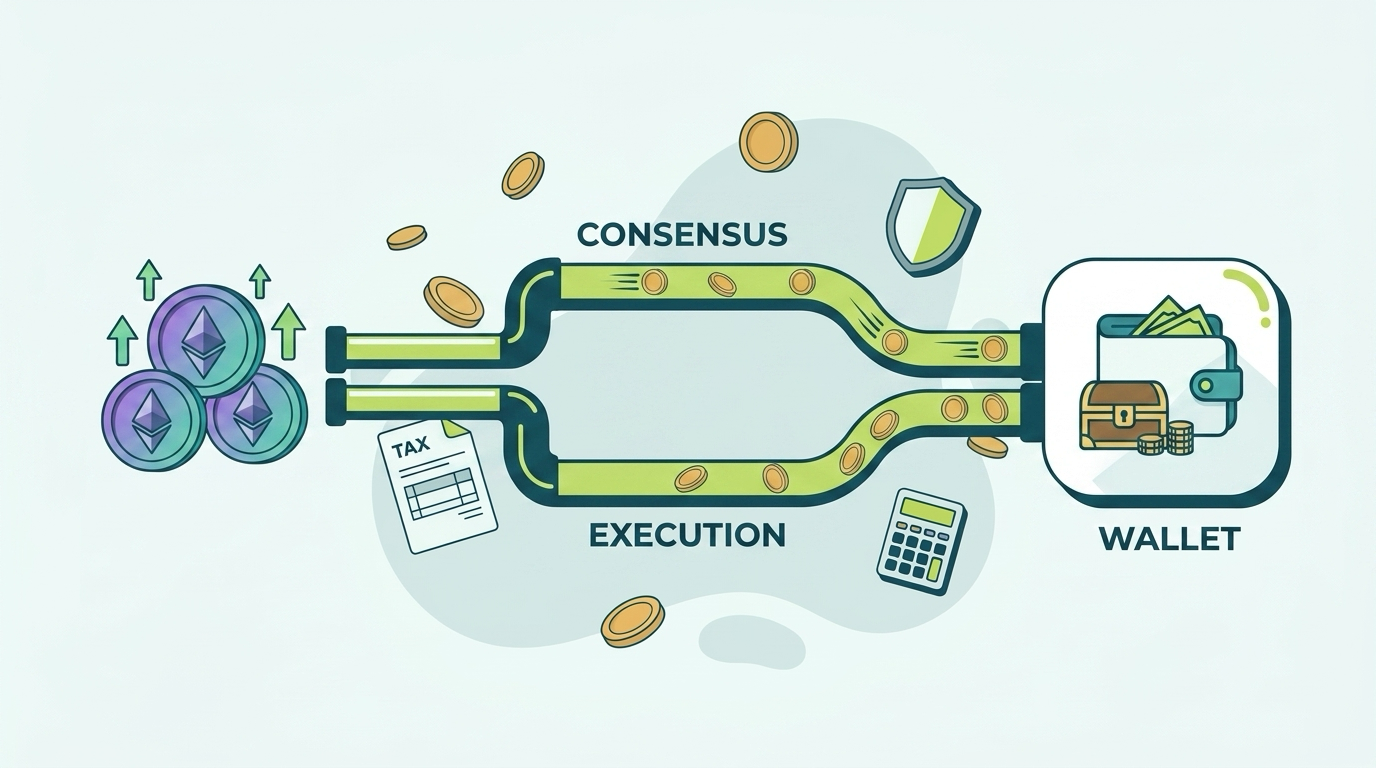
Ethereum is a proof of stake network. Validators lock ETH (the classic requirement is 32 ETH per validator, and since the Pectra upgrade a single validator can hold a much larger effective balance) and earn rewards for attesting to and proposing blocks. Those rewards arrive through two separate pipes, and the pipes matter for taxes:
- Consensus layer rewards. Attestation and proposal rewards accrue to your validator’s balance on the beacon chain. Since Shanghai, any balance above the effective maximum is automatically swept to your withdrawal address on a rolling cycle, typically every few days depending on how many validators are in the queue. You do not claim anything. The ETH just shows up.
- Execution layer rewards. When your validator proposes a block, the priority fees (tips) and any MEV payments go straight to your fee recipient address at that moment. These arrive irregularly, in lumps, whenever you win a proposal.
Pooled protocols and exchanges sit on top of this machinery and pass rewards through on their own schedules. But whether you run the hardware yourself, delegate through a pool, or click a button on Coinbase, the same ETH rewards are flowing, and the same income rule applies to all of it.
The Governing Rule: Income at Dominion and Control
Rev. Rul. 2023-14 is the controlling guidance. Staking rewards are includible in gross income at their fair market value when the taxpayer gains dominion and control over them, meaning the ability to sell, exchange, or otherwise dispose of them.
For Ethereum, the Shanghai upgrade (also called Shapella, April 2023) is the dividing line that settled the hard question.
Post-Shanghai: Control Is Not in Doubt
Before Shanghai, staked ETH and its rewards were locked on the beacon chain with no withdrawal mechanism at all. Stakers had a genuine argument that they lacked dominion and control, because no action they could take would convert rewards into spendable ETH.
That argument died in April 2023. Today, consensus rewards sweep automatically to your withdrawal address every few days, and execution rewards land in your fee recipient address the instant a block is proposed. Both are ordinary ETH in ordinary addresses you control with your own keys. The standard position, and the one every major crypto tax platform applies by default, is:
- Execution layer rewards are income on arrival, at ETH’s fair market value the day the proposal pays out.
- Consensus layer rewards are income no later than each sweep, valued at the sweep date. Some preparers book income as the beacon chain balance accrues, which is a slightly earlier and more conservative timing. Either way, the income lands in the same tax year in almost every case, and consistency matters more than which of the two defensible dates you pick.
Locked and Illiquid Rewards: The Exceptions That Still Exist
Dominion and control still does real work in a few corners of the Ethereum staking world:
- Pre-Shanghai reward history. If you staked from the beacon chain launch in December 2020 through April 2023, your rewards were genuinely locked for part of that period. Some taxpayers took the position that those rewards became income only when withdrawals were enabled, which stacked multiple years of accrued rewards into 2023. Others reported as accrued anyway. If your old returns are inconsistent or silent on this period, that history is worth cleaning up before it surfaces in an audit.
- Exit and withdrawal queues. When you fully exit a validator, your principal and remaining balance pass through an exit queue that can stretch from hours to weeks during congestion. The queue delays your access to the principal, but the rewards you already received along the way were income when they arrived. A queue on the way out does not retroactively defer income that already landed.
- Pooled protocols with claim mechanics. Some pools accrue rewards at the protocol level and require you to claim. Under the standard reading, rewards claimable at will are already within your control, so income hits when they become claimable, not when you press the button. A protocol that genuinely locks rewards for a fixed period, with no ability to claim, transfer, or sell, supports deferral until the lock releases.
Jarrett v. United States: The Case Everyone Cites and What It Actually Holds
No discussion of staking taxes is complete without the Jarrett saga, mostly because it is so often misread as authority that staking rewards are not taxable. It holds no such thing.
Joshua Jarrett staked Tezos, reported his rewards as income, then sued for a refund arguing that staking rewards are newly created property, like a baker’s bread or a farmer’s crop, taxable only when sold. Rather than litigate, the government refunded his money, and the case was dismissed as moot in 2022, a result affirmed on appeal in 2024. No court ever reached the merits. Jarrett filed a second suit in October 2024, this time squarely challenging Rev. Rul. 2023-14, and that litigation continues.
What this means for you in 2026: the creation argument is alive as a litigating position, and if a court eventually adopts it, the staking tax landscape changes. But today, Rev. Rul. 2023-14 is the rule the IRS enforces and the rule your software applies. Filing as if Jarrett already won is a bet on unsettled litigation, made without disclosure, against explicit published guidance. That is a bad trade for almost everyone.
The government refunding one taxpayer to avoid a ruling is not the same as the rule changing. Until a court says otherwise, rewards are income when you control them.
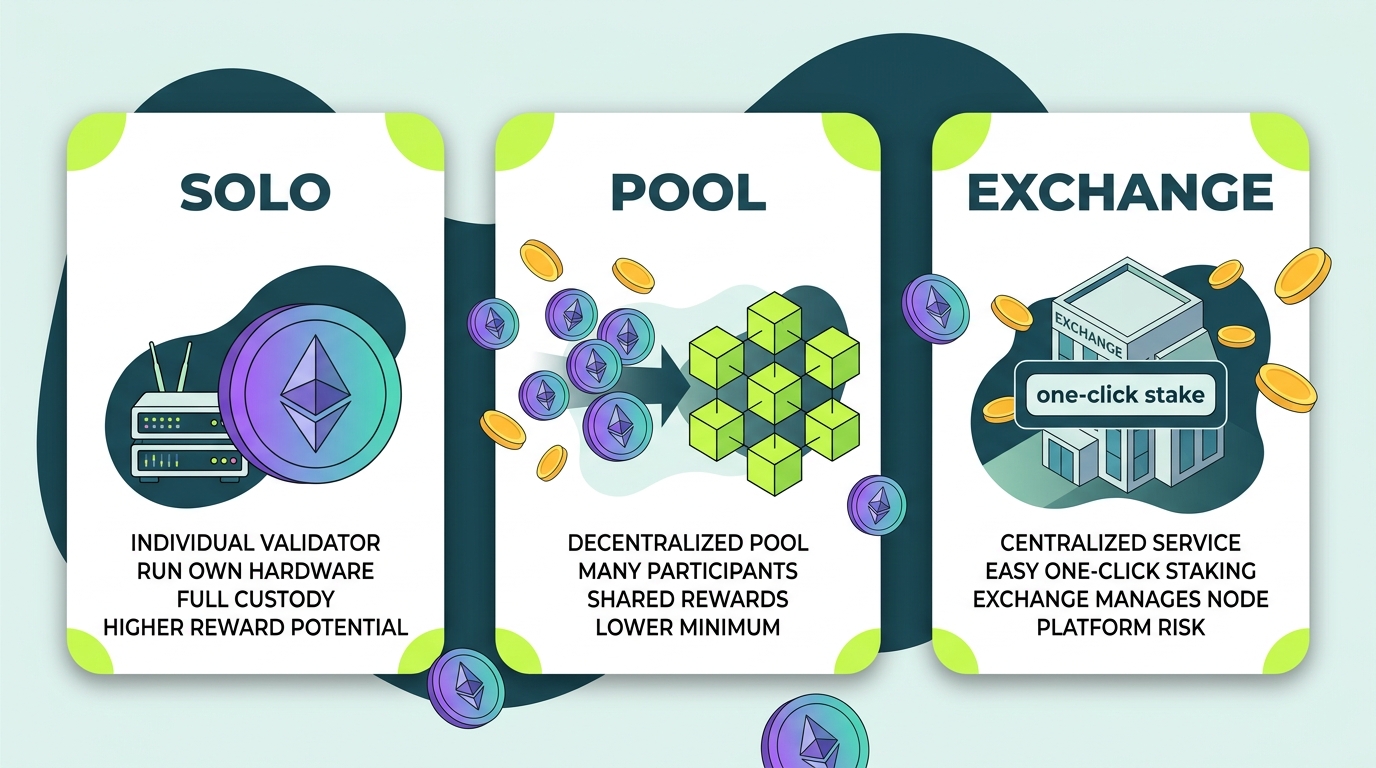
Solo Staking, Pooled Staking, Exchange Staking: Same Income Rule, Different Everything Else
How you stake does not change whether rewards are income. It changes who keeps the records, what forms exist, and how many separate income events you have to capture.
Solo Staking: 32 ETH, Your Hardware, Your Records
Running your own validator is the purest form: you deposit 32 ETH, run consensus and execution clients, and collect both reward streams directly. Nobody stands between you and the protocol, which also means nobody keeps records for you and nobody sends you a form.
Your tax data lives in two places: the sweep history of your withdrawal address and the payment history of your fee recipient address. A year of solo staking typically produces dozens of consensus sweeps plus a handful of block proposal payouts, each an income event at its own date and price. If you run MEV-Boost, the MEV payments route through your fee recipient the same way and are income the same way. Crypto tax software can read both addresses directly from the chain; your job is making sure every address is imported and every credit is tagged as staking income rather than a mystery deposit.
Pooled Staking: Fractional Stakes, Protocol-Level Payouts
Decentralized pools let you stake less than 32 ETH by combining deposits across many users. Some pools pay rewards as periodic ETH distributions, which are straightforward income at each credit. Others issue a liquid staking token whose value or balance grows instead, and at that point you have left native staking territory entirely: the tax model shifts to the token, and the questions become whether acquiring it was a swap and how its growth is taxed. That full analysis lives in our liquid staking and restaking guide.
The dividing line to watch: if ETH rewards land in an address you control, it is income at each credit. If your position is a token that appreciates or rebases, read the LST guide.
Exchange Staking: Convenience, a Commission, and a 1099-MISC
Coinbase, Kraken, and other platforms run the validators and credit rewards to your account, minus their cut. The income rule is identical: rewards are ordinary income at fair market value when credited to you. The practical differences:
- The exchange controls the credit schedule, which may be daily, every few days, or on its own batch cycle. Its statements are your primary record.
- Coinbase issues Form 1099-MISC reporting your staking income once it reaches $600 for the year, with a copy to the IRS. Kraken and others do the same. The IRS is expecting that number, or more, on your Schedule 1.
- Below $600, no form is filed, but the income is still taxable. The threshold controls paperwork, not taxability. A $450 reward year with no 1099 is still $450 of reportable income.
Hobby, Investment, or Business: Where Validator Income Belongs
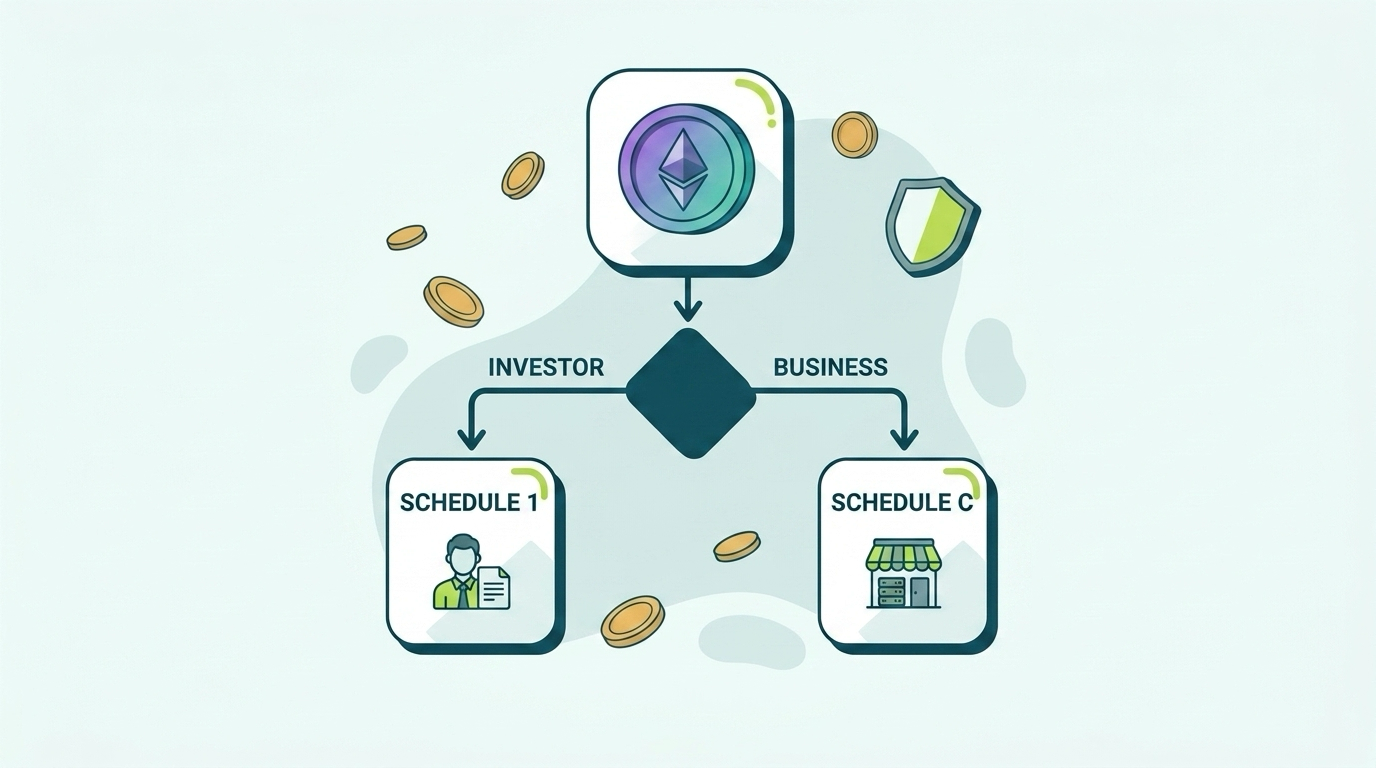
All staking rewards are ordinary income. The question is which kind, and it determines your forms, your extra taxes, and your deductions.
Schedule 1: The Default for Almost Everyone
If you stake through an exchange, a pool, or even run a single home validator as a passive holding, you are an investor earning reward income. Report the year’s total reward value as other income on Schedule 1 of Form 1040. No self-employment tax applies. No business deductions are available, which stings a little if you bought hardware, but a single validator’s costs rarely justify the alternative.
Schedule C: When Validating Becomes a Business
Run enough validators with enough regularity, effort, and profit motive, and staking crosses into a trade or business. Think multi-validator operations, professional node services, staking-as-a-service providers, or operators with meaningful infrastructure spend and business-like records. Consequences:
- Self-employment tax of 15.3% on net profit, on top of income tax.
- Deductions become available: servers, hosting, bandwidth, monitoring, client infrastructure, home office if you qualify, depreciation on hardware.
- Cleaner treatment of MEV and commission income from operating validators for others, which is plainly service revenue.
There is no bright-line validator count. The factors are the classic trade or business ones: continuity, regularity, expertise, books and records, and whether you are genuinely pursuing profit from the activity rather than passively holding an appreciating asset. One home validator almost never qualifies. Forty validators with a monitoring stack and an LLC probably do. In between, the classification is worth a conversation with a crypto tax specialist, because it swings both your rate and your deductions.
The Hobby Trap
An operation run without a genuine profit motive can be classified as a hobby: income fully reportable, expenses not deductible. This is the worst outcome, and it is where sloppy mid-size operations land when they cannot demonstrate business intent. If you are spending real money on staking infrastructure, keep business-grade records or accept investor treatment; do not drift in the middle.
Selling Reward ETH: The Second Tax Event
Reporting reward income is half the job. The other half happens when you sell, swap, or spend the reward ETH, and this is where taxpayers who skipped the income step pay for it twice.
Each reward’s income value becomes its cost basis, and its holding period starts the day you received it. When you dispose of it:
- Sell within a year of receipt: short-term capital gain or loss, taxed at ordinary rates.
- Sell after a year: long-term capital gain or loss, taxed at the 0%, 15%, or 20% brackets depending on your income.
One Reward, Two Tax Moments
A consensus sweep credits you 1 ETH when ETH trades at $3,000. You report $3,000 of ordinary income, and that ETH takes a $3,000 basis. Fourteen months later you sell it for $3,700. You report a $700 long-term capital gain, taxed at 0%, 15%, or 20% depending on your bracket. The $3,000 is taxed once as income and then shields itself as basis forever after. There is no double tax, despite the myth.
The failure mode is skipping the income step. Software that never saw reward income assigns the ETH zero basis, so that $3,700 sale reports as $3,700 of gain instead of $700. Across hundreds of small reward lots, unreported income quietly converts into overstated gains, and you pay more tax than the law requires while simultaneously being out of compliance. It is the worst of both worlds, and it is the single most common error we find in staking reconciliations.
One more planning note: if you sell reward ETH at a loss, the crypto wash sale rules are worth reading before you harvest, because the landscape around repurchases is shifting.
NIIT: The 3.8% Layer High Earners Forget
The Net Investment Income Tax adds 3.8% on net investment income once modified adjusted gross income passes $200,000 (single) or $250,000 (married filing jointly). Two ways it reaches stakers:
- Reward income reported as an investor. Staking rewards on Schedule 1, earned passively from holding an asset, generally fall within net investment income for NIIT purposes. A big reward year for a high earner picks up the extra 3.8% on top of ordinary rates.
- Capital gains on selling reward ETH. Gains are classic investment income and count toward NIIT whenever your income is over the threshold.
Schedule C validators are in a different lane: their staking profit is self-employment income subject to the 15.3% SE tax rather than NIIT. Either way, there is an extra layer above the headline income tax rates, and it belongs in your planning math, especially in years when a strong ETH price inflates both your reward income and your gains simultaneously.
Quarterly Estimates: Nobody Withholds for You
Every dollar of staking income arrives with zero tax withheld. If your rewards are meaningful relative to your salary withholding, the IRS expects you to pay as you go through quarterly estimated payments, due roughly in April, June, September, and January.
The safe harbor rules are your planning anchor: avoid underpayment penalties by paying in at least 90% of the current year’s tax or 100% of last year’s tax (110% if your prior-year AGI exceeded $150,000), whichever is smaller. A practical approach for stakers:
- Estimate your annual reward income from your current stake and the network’s reward rate.
- Set aside a fixed percentage of each sweep or credit, in dollars, at receipt. Your marginal rate plus NIIT is the right ballpark for high earners.
- True up each quarter against actual rewards received, because ETH’s price moves your income even when your validator count does not.
Underpayment penalties are calculated like interest and are pure waste. Thirty minutes of setup in January beats an unpleasant surprise the following April.
1099-DA and the Reporting Net Around Your Rewards
Starting with the 2025 tax year, centralized exchanges file Form 1099-DA with the IRS, reporting gross proceeds when you sell or swap digital assets on their platforms. For stakers, the form creates a specific and predictable trap.
The common flow: you stake for two years in your own validator or wallet, accumulate a few ETH of rewards across dozens of sweeps, then transfer a stack to Coinbase and sell. Coinbase files a 1099-DA reporting your gross proceeds. It has no idea what your basis is, because your ETH arrived by transfer, and it certainly does not know that part of the stack was reward income you already recognized. Broker basis reporting is phasing in, but it will never reach back into your withdrawal address history.
The IRS now sees proceeds on one side and your return on the other. If your prior returns show no staking income and your current return shows a sale with vague basis, that is exactly the mismatch automated matching flags. The defense is unglamorous:
- Report reward income every year it is earned, so the basis is real and documented.
- Match every wallet-to-exchange transfer in your records so deposits are not treated as zero-basis mystery coins.
- Reconcile any 1099-DA you receive against your own records before filing, and correct missing basis from your documentation rather than accepting blanks.
Record-Keeping: Per-Wallet Basis, Sweep by Sweep
Under Rev. Proc. 2024-28, effective January 1, 2025, cost basis must be tracked per wallet and per account rather than in one universal pool. For Ethereum stakers this is not abstract, because staking naturally scatters ETH across addresses: a withdrawal address collecting sweeps, a fee recipient address collecting tips and MEV, a main wallet, and often an exchange account or two. Each holds its own lots with its own basis. Our per-wallet cost basis guide covers the full framework, including the safe harbor allocation for lots held when the rules switched.
What complete Ethereum staking records look like:
- Every address in the system: withdrawal addresses, fee recipient addresses, main wallets, exchange accounts, including retired ones.
- Every reward event with date, amount, and fair market value: each consensus sweep and each execution layer payment. The chain has the full history; your software’s job is reading it correctly, and your job is spot-checking that it did.
- Transfer matching between your own addresses and exchanges, so consolidations never read as sales or zero-basis deposits.
- A consistent basis method per account (FIFO or specific identification), applied without switching opportunistically.
- Validator lifecycle documentation: deposit dates, exit dates, and the distinction between returned principal (not income) and final reward balances (income if not already recognized).
How to Report Ethereum Staking Rewards: Step by Step
- Import every address. Withdrawal address, fee recipient address, wallets, and exchange accounts go into your crypto tax software. Koinly, CoinTracker, and CoinLedger all read Ethereum reward history from the chain.
- Verify rewards are booked as income. Spot-check several sweeps and block proposals against a block explorer. Confirm they are tagged as staking income at sensible prices, not as deposits.
- Match your transfers. Confirm movements between your own addresses and exchange deposits are linked as self-transfers carrying basis.
- Total the income. The year’s staking income is the sum of every reward’s credit-date value. It goes on Schedule 1 as other income for investors, or Schedule C for validator businesses.
- Report disposals. Any ETH sold or swapped during the year, including reward ETH, goes on Form 8949 and Schedule D with proceeds, basis, and gain or loss. Reward lots use their income value as basis, with holding periods from the credit date.
- Check NIIT and estimates. If your income clears the NIIT thresholds, Form 8960 comes into play, and next year’s quarterly estimates should reflect this year’s run rate.
- Answer the digital asset question. Receiving staking rewards means you check “yes” on Form 1040.
- Reconcile forms received. Cross-check 1099-MISC income and 1099-DA proceeds against your records before filing, and archive everything.
For the broader income picture, see our crypto income tax guide, and for the full map of what is and is not taxable, our taxable events guide.
Common Ethereum Staking Tax Mistakes
The errors we see most in Ethereum reconciliations, roughly in order of expense:
Reporting Rewards Only When Sold
Rewards are income at receipt, not at sale. Waiting until you sell understates income in earning years and usually pairs with the zero-basis error below. Jarrett is a pending lawsuit, not permission.
Zero-Basis Reward Sales
If rewards were never booked as income, software assigns them zero basis, and every reward sale reports 100% gain. You voluntarily overpay on the back end while remaining non-compliant on the front end.
Forgetting the Fee Recipient Address
Solo stakers reliably import their withdrawal address and forget the fee recipient collecting tips and MEV. Block proposal income is lumpy and easy to miss, and MEV payments can dwarf consensus rewards in a good year.
Treating Principal Withdrawal as Income
Exiting a validator returns your 32 ETH principal plus any residual balance. The principal is your own property coming home, not income. Mislabeling exits inflates income dramatically; review how your software categorized them.
Missing Pre-Shanghai History
Stakers active from 2020 to 2023 sometimes have reward history that was never reported under any theory. Inconsistent old returns do not age well. Fix them proactively with an amended return rather than waiting for a notice.
Ignoring Sub-$600 Exchange Rewards
No 1099-MISC does not mean no income. Sub-threshold rewards are fully reportable from your own records.
Your Ethereum Staking Tax Checklist
- List every address: withdrawal, fee recipient, wallets, exchange accounts, old and current.
- Import them into crypto tax software and let it read reward history from the chain.
- Confirm every sweep and proposal payout is booked as income at credit-date fair market value.
- Verify reward lots carry their income value as basis for later sales.
- Match all self-transfers between addresses and exchanges.
- Choose your lane: Schedule 1 for investors, Schedule C for validator businesses, professional advice in between.
- Report disposals on Form 8949 and Schedule D, including reward ETH sales.
- Check NIIT exposure and set quarterly estimates for the current year.
- Apply per-wallet basis tracking under Rev. Proc. 2024-28.
- Reconcile any 1099-MISC or 1099-DA against your records and archive the audit file.
Bottom Line
Ethereum staking taxes are settled at the core and messy at the edges. The core: rewards are ordinary income at fair market value when you control them, that income becomes basis, later sales are capital gains, and Schedule 1 versus Schedule C turns on whether you are an investor or an operator. The edges: two reward pipes to track, pre-Shanghai history, exit queues, NIIT, estimates, and a 1099-DA reporting net that sees your proceeds but not your story. Every expensive problem on that list is solved by the same thing: complete, per-address records built while the history is fresh.
If your staking spans years, multiple validators, MEV income, or liquid staking layered on top, this is exactly the reconciliation work we do. Count On Sheep rebuilds the reward history, fixes the basis, and hands you and your preparer CPA-ready numbers. A 15-minute call with a crypto tax specialist is the fastest way to find out where you stand, or reach out to our team for a full Ethereum staking review.
Related Reading
- Ethereum Tax Guide: The Complete Picture
- Ethereum Liquid Staking & Restaking Taxes: stETH, rETH, EigenLayer
- Ethereum Gas Fees and Taxes
- Ethereum DeFi Taxes
- Ethereum NFT Taxes
- Per-Wallet Cost Basis Under Rev. Proc. 2024-28
- Form 1099-DA Explained
Frequently Asked Questions
Are Ethereum staking rewards taxable?
Yes. Under Rev. Rul. 2023-14, staking rewards are ordinary income at fair market value when you gain dominion and control over them. Since the Shanghai upgrade enabled withdrawals in April 2023, Ethereum validator rewards are spendable ETH, and standard practice treats each reward as income when it is credited or swept to an address you control.
When exactly do I owe tax on Ethereum staking rewards?
For solo validators, execution layer rewards like priority fees and MEV are income the moment they land in your fee recipient address. Consensus layer rewards are income no later than each automatic sweep to your withdrawal address, which happens roughly every few days. For exchange and pooled staking, income lands when rewards are credited to your account or claimable by you.
How do I report Ethereum staking rewards on my tax return?
Most stakers total the fair market value of all rewards received during the year and report it as other income on Schedule 1 of Form 1040. When you later sell or swap the reward ETH, you report that disposal on Form 8949 and Schedule D using the income value as your cost basis. Validators operating as a business report on Schedule C instead.
Does Coinbase send a tax form for ETH staking rewards?
Yes, if your rewards reach 600 dollars. Coinbase issues Form 1099-MISC reporting your staking income, and a copy goes to the IRS. Below 600 dollars no form is filed, but the income is still fully taxable and reportable from your own records.
What is the cost basis of my Ethereum staking rewards?
The fair market value you reported as income when each reward was received. That figure becomes the basis of the reward ETH. If you never report the income, tax software assigns the rewards zero basis, which overstates your gain when you eventually sell.
Is unstaking ETH a taxable event?
No. Exiting a validator and withdrawing your 32 ETH principal is not a disposal, because you still own the same ETH. The taxable moments are the reward credits along the way, which are income, and any later sale or swap, which is a capital gain or loss.
Do Ethereum validators pay self-employment tax?
It depends on whether the operation is a trade or business. A solo staker running one validator from home as a passive investment usually reports on Schedule 1 with no self-employment tax. Someone running many validators with regularity, profit motive, and real operating expenses may be a business, which means Schedule C, 15.3 percent self-employment tax, and deductible expenses.
What was Jarrett v. United States about?
Joshua Jarrett, a Tezos staker, sued the IRS arguing staking rewards are newly created property that should not be taxed until sold. The first case was dismissed after the IRS refunded his money without conceding the issue. He filed a second suit in October 2024 challenging Rev. Rul. 2023-14 directly. Until a court rules otherwise, income at receipt remains the governing rule.
Do I owe the 3.8 percent Net Investment Income Tax on staking rewards?
Possibly. If your modified adjusted gross income exceeds 200,000 dollars single or 250,000 dollars married filing jointly, NIIT applies to net investment income, and staking rewards reported as investor income generally count. Capital gains from selling reward ETH count as well. Validators reporting on Schedule C pay self-employment tax instead.
Do I need to make quarterly estimated tax payments on staking income?
If your staking income is large enough that your total withholding will not cover at least 90 percent of this year's tax or 100 percent of last year's (110 percent at higher incomes), yes. No one withholds tax from staking rewards, so a strong reward year with no estimates can mean an underpayment penalty on top of the bill.
How does Form 1099-DA affect Ethereum stakers?
Form 1099-DA reports gross proceeds when you sell or swap crypto on a centralized exchange. If you stake in your own wallet and later sell reward ETH on Coinbase or Kraken, the exchange reports your proceeds without knowing your basis. If you never reported the reward income that created that basis, the IRS sees proceeds with no story behind them.
Are liquid staking tokens like stETH taxed the same as native staking?
No. Liquid staking tokens raise their own questions, including whether swapping ETH for the token is taxable and how rebasing balances are treated. See our Ethereum liquid staking and restaking tax guide for the full analysis.